This is not true. The construction industry has crashed in Florida. No workers so nothing being built. Half crews means nothing built. The work is far to hard for most people. Hugs
In his first year back in office, Mr. Trump has unabashedly adopted the trappings of royalty just as he has asserted virtually unbridled power to transform American government and society to his liking. In both pageantry and policy, Mr. Trump has established a new, more audacious version of the imperial presidency that goes far beyond even the one associated with Richard M. Nixon, for whom the term was popularized half a century ago.
Trump is expected to announce plans to build a new, large warship that Trump is calling a “battleship” and is part of his larger vision to create a “Golden Fleet” that includes as many as 50 support ships, according to people familiar with the matter who were not authorized comment publicly.
Bigotry / Hate / Racism / DEI Misinformation / White Supremacy
Ten Bears made a post that points out something I think we all should be aware of. I know a lot of the people who come here also go to his site also. But incase anyone missed it this short video is a powerful reminder of what we are fighting in the second tRump dictatorship. Hugs
Commissioners in Randolph County, North Carolina dissolved the county library system’s entire board of trustees last week, after the trustees voted to keep a picture book about a transgender boy on library shelves.
In October, the Randolph County Public Library’s Board of Trustees voted to keep the picture book Call Me Max on shelves despite some objections from members of the public. The book, written by Kyle Lukoff and illustrated by Luciano Lozano, tells the story of a young trans boy who asks to be called Max at school, eventually leading him to come out to his parents. The Randolph County trustees voted 5-2 to keep the book available, with some trustees reportedly commenting that removing or relocating the book would be a “slippery slope” toward censorship.
In response, the Randolph County Board of Commissioners voted 3-2 on December 8 to dissolve the library board and its governing bylaws entirely, Blue Ridge Public Radio (BPR) reported. Commissioner Hope Haywood, who cast one of the two dissenting votes, told BPR that the other commissioners’ likely intended to appoint new members, but that she had wanted to establish plans to facilitate that process first.
“Three commissioners didn’t see it that way. Three commissioners felt like, just abolish the board and then figure it out,” Haywood told BPR.
Minutes and video of the December 8 meeting were not yet available at time of writing. According to coverage of the meeting by local news website Randolph Hub, commission chairman Darrell Frye made bizarre comments about a member of his family he said had killed themself after being “brainwashed” on social media, apparently in reference to being trans. “It’s about, to me, exposing a child before it’s able to make a decision. It’s personal to me,” Frye reportedly said. Commissioner Kenny Kidd opined that dissolving the board of trustees was “a black-and-white issue,” and that “the soul of our children” was at stake.
“We adhere to the rules for the disposition of materials. We have the responsibility to serve all sides of issues,” trustee Betty Armfield reportedly told the board, adding that it was “parents’ responsibility to choose what they believe are appropriate books for their children.”
Call Me Max will still be available to check out from Randolph libraries in the wake of the commissioners’ vote, the county public information officer told CBS affiliate station WFMY. Still, Lukoff — who won a 2020 Stonewall Book Award for another picture book about a trans boy, When Aidan Became a Brother — lamented the vote and what it represents on Instagram last week.
“A library’s entire board of trustees was fired and replaced because they refused to ban one of my books. It’s so terrible,” Lukoff wrote. “I just feel so bad for the people who live in that community and love their library,” he added in a later reply.
Anti-LGBTQ+ activists have increasingly targeted local and school libraries over the past several years, particularly amid the rise in popularity of “Drag Queen Story Hour” events, some of which have been the subject of bomb threats and harassment from far-right militia groups. Tennessee officials have ordered libraries across the state to remove books with LGBTQ+ themes or characters this year, while in South Carolina, the York County Library board voted last week to move all books dealing with gender identity to sections for patrons aged 13 and older. One conservative activist claimed that move was necessary for “protecting childhood innocence.”
Issues of access to LGBTQ+ materials are increasingly landing in courts. Earlier this year, former Wyoming librarian Terri Lesley settled a wrongful dismissal lawsuit with county officials for $700,000, after she was fired in 2023 for refusing to remove LGBQ+ books from children’s and young adult sections of her library. (Neither party admitted wrongdoing as a result of the settlement.)
“People that want to keep pushing an agenda to go against these library materials and the First Amendment, I hope they see this, and I hope it’s a deterrent,” Lesley told CBC Radio in October.
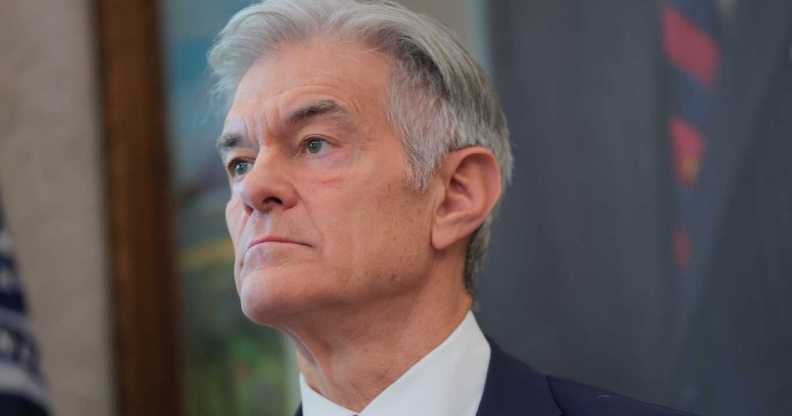
Dr Mehmet Oz, administrator for the Centers for Medicare and Medicaid Services. (Anna Moneymaker/Getty Images)
Mehmet Oz, better-known as Dr Oz, has raged about “$150k penis surgery” for trans youth, but he failed to cite any facts.
Dr Oz, who leads Medicaid and Medicare, announced on Thursday (18 December), alongside health secretary Robert F Kennedy Jr, measures that will ban gender-affirming care for trans youth.
The ban, part of Dr Oz’s bid to end “taxpayer funding of sex rejecting procedures for children in Medicaid and CHIP [children’s health insurance program], full stop”, takes the form of two new proposed rules from Medicaid and Medicare.
The first prevents doctors and hospitals from receiving federal Medicaid reimbursement for gender-affirming care provided to trans youth under the age of 18, while the second blocks all Medicaid and Medicare funding for any services at hospitals that provide pediatric gender-affirming care.
Medicaid, which is the health care program that covers low-income Americans, alongside older and disabled citizens, is taken at most hospitals, meaning the proposals could have a wide-ranging effect, as per New Hampshire Public Radio.
During announcing the proposals, Kennedy referred to gender-affirming care as “malpractice”, while Dr Oz went completely off topic.
The 65-year-old began ranting about the prices of bottom surgery, which is very rarely performed on individuals under 18.
“A vaginoplasty – a procedure a child does not need – costs $60,000,” he claimed, adding: “Shockingly, a phalloplasty, the creation of a penis, costs, on average, in America, $150,000 per child.
“I do believe, with doing some work, that these prices have continued to increase due to increased manufactured demand,” he continued. “A scrotalplasty, where you add testicles? That’s extra.”
Dr Oz didn’t clarify where he pulled his quoted figures from, but according to the Gender Confirmation Center, the price of a vaginoplasty is between $23,000 and $24,500, while phalloplasty ranges between $35,000 and $50,000.
According to 2025 data from the Williams Institute, about one per cent of people aged 13 and older identify as trans in the US, and despite the proposals attacking gender-affirming care for trans youth, multiple studies show that surgeries are rarely performed on minors.
A 2024 study by researchers at Harvard TH Chan School of Public Health found that no gender-affirming surgeries were performed on trans or gender diverse youth (TGD) aged 12 and younger in 2019, the most recent year for which data is available.
For teens ages 15 to 17 and adults ages 18 and older, the rate of undergoing gender-affirming surgery was 2.1 per 100,000 and 5.3 per 100,000, respectively. The majority of surgeries were chest surgeries.
Co-author Elizabeth Boskey, instructor in the Department of Social and Behavioral Sciences, said: “We found that gender-affirming surgeries are rarely performed for transgender minors, suggesting that US surgeons are appropriately following international guidelines around assessment and care.”
Lead author Dannie Dai, research data analyst in the Department of Health Policy and Management, added: “Our findings suggest that legislation blocking gender-affirming care among TGD youth is not about protecting children, but is rooted in bias and stigma against TGD identities and seeks to address a perceived problem that does not actually exist.”
Share your thoughts! Let us know in the comments below, and remember to keep the conversation respectful.
This is just hate and bigotry. It is a group of people who hate trans people for some unknown reason and have made their life / career the harassment of trans minors who play sports. I can not see how this harms this reporter and his group in any way. To make your life about harming others is a real petty way to exist. Many conservatives use their religion to justify such hate but the Jesus of the bible never said a word against the entire LGBTQ+ community. So their hate is internally driven and they must be such miserable people. So Sad. The drive to regress the world’s most progressive countries back to an uneducated straight cis white male controlled society is really causing a lot of damage to people and freedom to express your life as you wish. It seems driven by two groups, the older people who are uncomfortable with the progression of society and younger religious people driven by wealthy religious hate groups. Hugs
Since Sept. 5, right-wing sports publication OutKick has published 19 articles about a 12th grade girls’ volleyball player at Skyline High School in Ann Arbor, Michigan. The player caught the attention of reporter Dan Zaksheske after he obtained public documents that appear to show her requesting a legal name change from a traditionally masculine first name to a traditionally feminine one.
Over the next three months, Zaksheske would write 18 of the 19 articles OutKick would publish about this student. He and other OutKick reporters attended multiple high school girls’ volleyball games where they recorded and reported on Skyline High’s volleyball season. At the heart of each article was a focus on the girl, who Zaksheske refers to as a “trans-identifying biological male.”
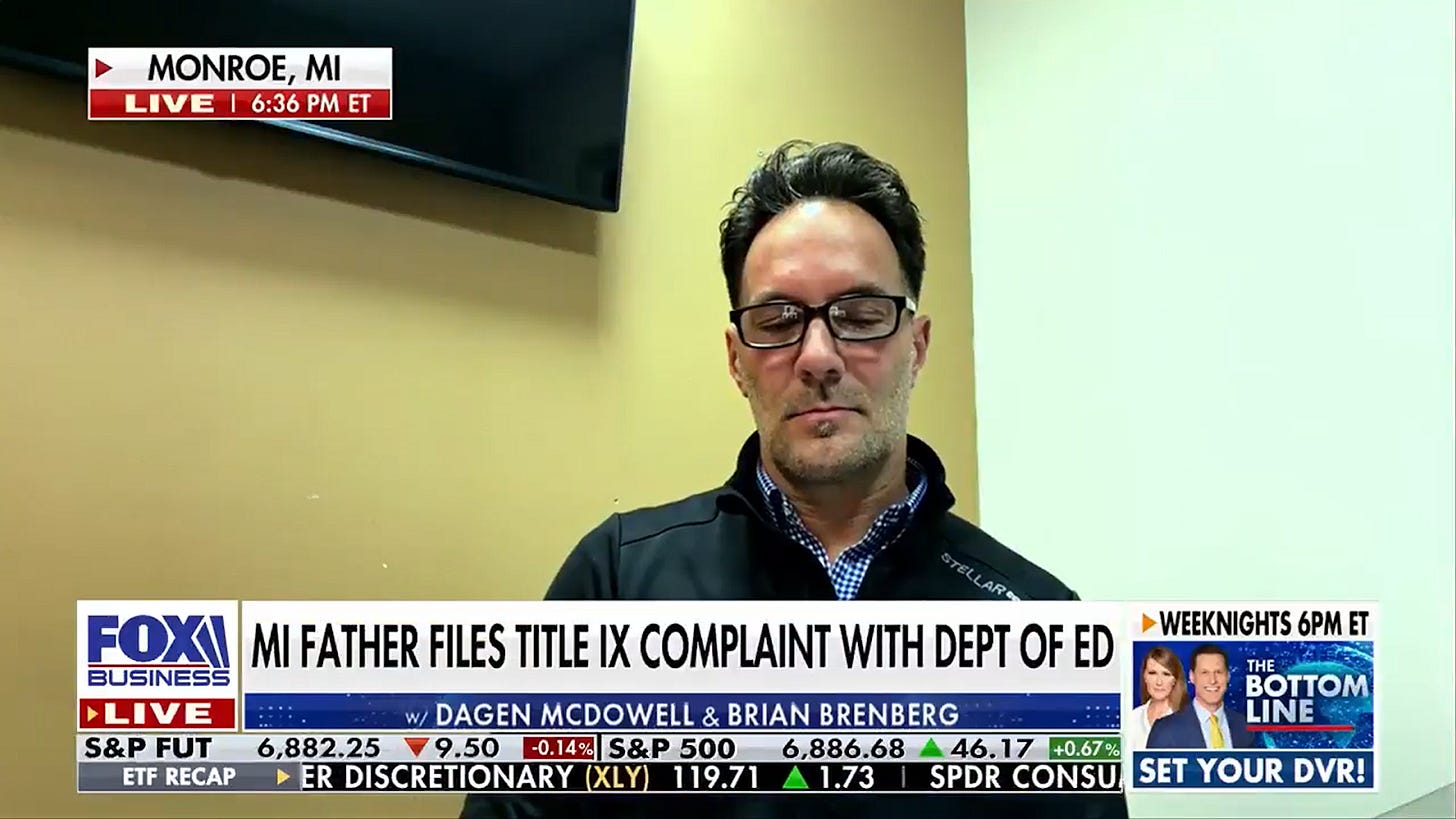
Zaksheske’s reporting stoked a controversy that drew the attention of multiple right-wing publications, politicians and influencers. This coverage led Sean Lechner, whose cisgender daughter played against Skyline and allegedly shared a locker room with their team, to file a Title IX complaint.
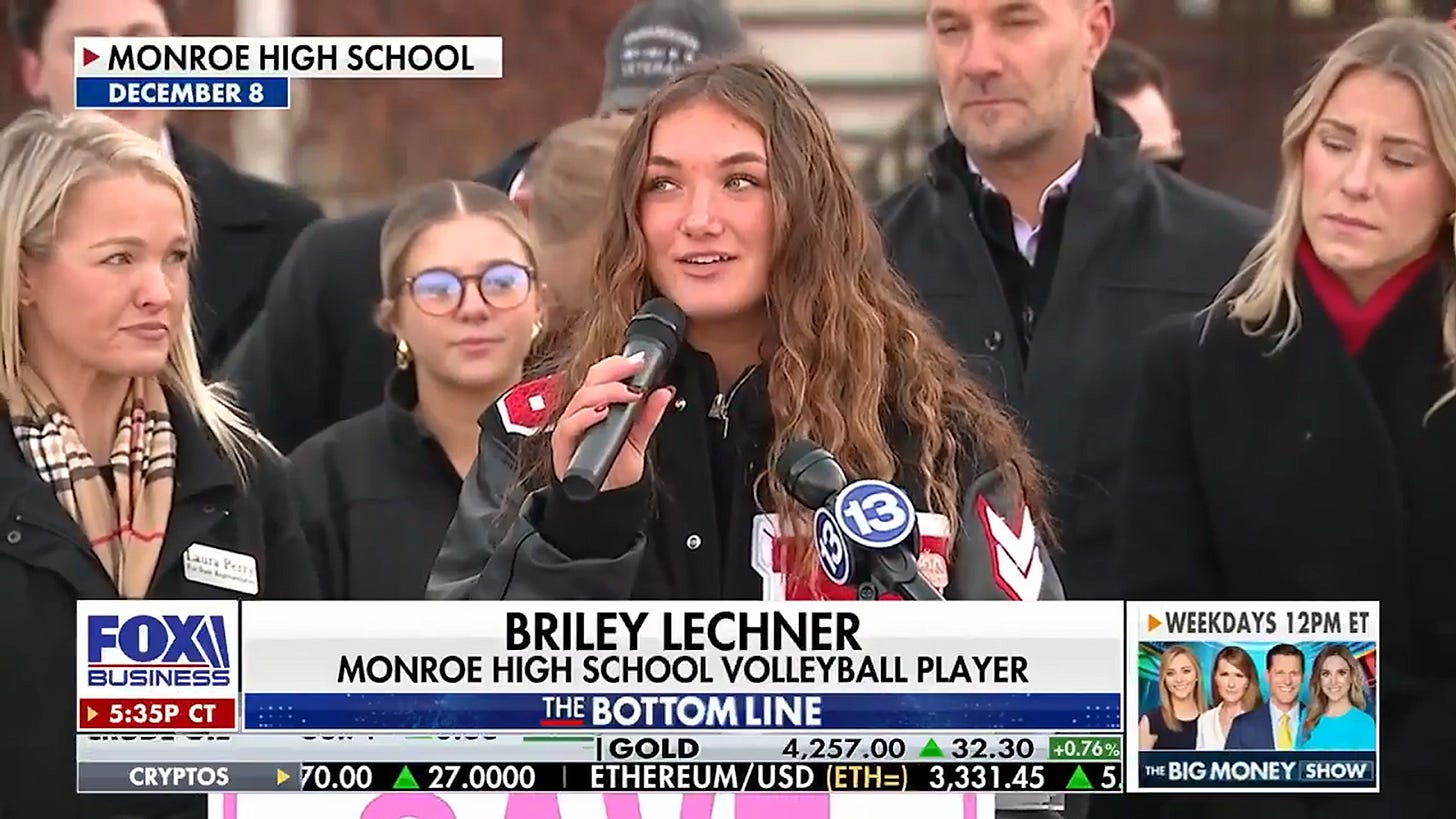
Lechner’s daughter at a press conference about the complaint. Screenshot via Fox Business.
While the Michigan High School Athletic Association (MHSAA) does require trans athletes to get a waiver approved to compete in official state tournaments, the Democrat-majority state Senate outright rejected the idea of a trans athlete sports ban earlier this year. In addition, LGBTQ Michiganders have strong anti-discrimination protections under the state’s Elliott-Larsen Civil Rights Act.
In the complaint, Lechner calls for a ban on “biological males from competing in female sports” and for a “full investigation into actions and communications of Ann Arbor Public Schools/Monroe High/Chet Hesson,” citing a Trump executive order that declares that trans-inclusive policies are in violation of Title IX.
Shortly after the complaint was filed, Uncloseted Media published an interview clip with Hesson, the athletic director of Monroe Public Schools, in which he simply said his “heart goes out” to the player for being under such scrutiny. Less than 24 hours later, he was put on administrative leave.
As this story spreads like wildfire, experts in journalistic ethics are raising concerns about Zaksheske’s reporting.
“OutKick’s inflammatory reporting on a Michigan high school volleyball player who may or may not be trans disregards several core principles of the Society of Professional Journalists’ [SPJ] Code of Ethics,” Dan Axelrod, chairman of the SPJ’s ethics committee, told Uncloseted Media. SPJ’s Code of Ethics, originally drafted in 1973, has been embraced and used by thousands of journalists from numerous newsrooms and schools.
“The Code cautions reporters to ‘show compassion for those who may be affected by news coverage,’ and to ‘use heightened sensitivity when dealing with juveniles,’ while ‘weigh[ing] the consequences of publishing or broadcasting personal information,’” Axelrod says. “[OutKick] has essentially ignored all those ethical principles, given [Zaksheske’s] relentless coverage of the player, which has led the public to easily infer who she is, and its negative framing of her story.”
The player, whose mother did not respond to an interview request, does not appear to have publicly come out as trans prior to the publication of Zaksheske’s first article.
Chad Painter, associate professor and chair of the communications department at the University of Dayton, says this “brings up a whole host of issues.” While Zaksheske wrote that he did not name the girl “because the student athlete is under 18,” Painter says that doesn’t do enough to conceal her identity.
In his reporting, Zaksheske references the existence of publicly accessible name change documents, the girl’s county of residence and the name of a local volleyball club she’d been a part of. “Someone who is reasonably well-versed in being able to Google someone can figure this out pretty easily,” Painter, who has co-authored multiple media ethics textbooks, told Uncloseted Media.
“There’s longstanding norms in newsrooms that we don’t out people, that that is a very personal decision that an individual gets to make, and unless there is a massively compelling reason to do that, it’s not our role,” he says. “The idea that he is in the clear because he didn’t specifically write this person’s name in a story, it wouldn’t hold up to journalistic scrutiny.”
And Zaksheske’s reporting appears to have outed the girl. The same day that he published his first article on the matter, an X account whose mission is “to call out these male athletes and expose the damage that they have each caused to women and girls in sports” published the girl’s full name and deadname along with multiple photos and videos of her. (Uncloseted Media has chosen not to link to these posts directly in the interest of her privacy.)
In addition to the 18 articles Zaksheske wrote, he also tweeted about the situation at least 41 times and attendedatleastfourhigh school girls’ volleyball games. While watching, he recorded videos of the girls playing and then posted them to X and OutKick’s website.
“Having 19 stories about one athlete … to me, that seems like this coverage is out of line with how we’d normally talk about, especially high school sports, which, frankly, no one outside of this little area in Michigan are going to really care about,” says Painter.
“Outside of the culture war stuff, I don’t see where this is a story.”
When Zaksheske was confronted by multiple people at the school about attending and recording one of the games, he published another article accusing them of harassment. “I was shadowed by the school principal and harassed and stalked by Skyline supporters,” he wrote.
Painter notes that while Zaksheske was within his rights as a journalist and citizen to be attending and recording such events, he understands why the school would approach him with skepticism.
“I have a feeling that if I just started showing up randomly to high school volleyball games and taking photos and videos, there would probably be questions,” Painter says. “Because, again, we are talking about minors.”
“The reporter has a right to pursue news … and that right especially exists at a public school,” says Axelrod. “However, one has to wonder at what point is the coverage just pandering to curiosity as opposed to serving a valid societal purpose in informing and facilitating larger discussions about real and valid questions regarding the participation of trans athletes in sports.”
Misinformation and Animus
Zaksheske has pushed back against similar criticism on X, accusing those who question the ethics of his reporting of being “in favor of sterilizing, mutilating and castrating children” and characterizing his reporting as “exposing their heinous acts.”
“I don’t see that as an ethical problem because it doesn’t even enter into the world of ethics,” Painter says of Zaksheske’s rhetoric. “It is wrong factually and it doesn’t really have a place in what we do in terms of the journalism field.”
Misleading rhetoric about trans health care is common throughout OutKick’s reporting. Zaksheske has written several articles about gender-affirming care, where he has claimed that puberty blockers “take healthy children and sterilize them for life.”
Puberty blockers have been FDA-approved for treating precocious puberty in cisgender children since 1993. Multiplestudies have found no evidence of them causing permanent infertility, and gynecologists and endocrinologists have said that they do not cause sterilization.
Much of Zaksheske’s coverage of trans people has been negative. Of adult trans women, he wrote that “that person might see himself as a woman, but we are under no obligation to ‘affirm’ that.” He also wrote that doctors who provide gender-affirming care “have to answer to their consciences.”
OutKick also generally misgenders trans women and girls, referring to them as “males,” “biological males” or “trans-identifying males,” additionally using masculine pronouns to refer to them.
Painter notes that this goes against the “Associated Press Stylebook,” which he says “any newsroom worth its salt is going to follow.”
“The journalist and the news outlet squander their credibility covering these types of societal questions when they use language … that fails to recognize and respect the underlying humanity of an entire group of people,” he says.
In an email, Brian Karpas, OutKick’s director of media relations, told Uncloseted Media that the publication “stands by the thorough and responsible reporting of Dan Zaksheske and will continue to protect women from competing against biological males.”
Beyond Michigan
OutKick’s extensive reporting of the Michigan volleyball player is reflective of the publication’s increasingly conservative bent since it launched in 2011. In 2021, it was acquired by Fox Corporation. Since then, it has partnered with Fox News and has become home to numerous right-wing personalities known for anti-trans rhetoric. These include founder Clay Travis, who has said World Aquatics is “encouraging …super young kids to be transitioned”; Tomi Lahren, who said that liberals “don’t know what a woman is”; and Riley Gaines, who referred to an eighth-grade trans girl as a “mediocre man.”
This story in Michigan is not the first time OutKick and Zaksheske have hyperfocused on one trans girl. They were one of the first national publications to report on California-based track and field athlete AB Hernandez, who later became the center of a feud between the Trump administration and Gov. Gavin Newsom. Since March, OutKick has published at least 24 articles about Hernandez, 10 of which were written by Zaksheske. They sent reporters to at least twogames to photograph Hernandez and other teenage players. Additionally, OutKick published 15 articles and attended at least four games covering the story of a trans softball player in Minnesota, whose presence on the team became a key point of a lawsuit by the Southern Poverty Law Center-designated anti-LGBTQ hate group, Alliance Defending Freedom.
This massive amount of coverage is common for U.S. conservative media: A report published this year from Media Matters for America found that Fox News ran over 400 weekday segments mentioning trans athletes from Feb. 5 to June 6.
All of this has had an impact. While the Title IX investigation is still pending, Hesson, who was named in the complaint, told Uncloseted Media that he had been targeted with harassment and vitriol online.
Uncloseted Media on Instagram: “Last Friday, Uncloseted Media p…
In the comments of the Instagram post, Hesson was attacked by numerous users: squaredbeach9 wrote, “Stop normalizing these freaks. You don’t give a bulimic chick a bucket and some gum.”
And others chimed in, saying:
“Guaranteed he has child pron on an electronic device.”
“Fuck off, poor tranny hates attention, give me a fn break.”
“So a male playing in women’s sports. And this cuck is defending it.”
All of this has come even though Hesson is not directly affiliated with Skyline High School, which is part of a different district. As such, he was not involved in the decision to allow the girl to play, and he was also not privy to whether she had a waiver.
In addition, numerous right-wing lawmakers and candidates have endorsed Lechner’s complaint. Republican state Rep. James DeSana posted a statement to Facebook “calling for Chet Hesson to be removed immediately.”
“The public cannot have good discourse, debate, or dialogue without good information,” Painter says. “Supplying that information is the fundamental duty of the news media. When journalists are distracted by inconsequential stories, then we’re not spending the time to cover interesting and important news that our readers really need.”
Both Painter and Axelrod took note of the small number of known trans athletes in the U.S. Last year, the NCAA’s president told a Senate panel that fewer than 10 of the 510,000 college athletes affiliated with the organization were transgender.
“This controversy is part of a much larger national narrative about transgender athletes and the LGBTQ+ community as a whole,” Painter says. “The entire national conversation is based on virtually nothing, so this particular set of stories are based on an inconsequential premise.”
Going Forward
If the Department of Education does find that Title IX was violated, the school district could risk losing federal funding if it continues to allow trans athletes to compete.
Zaksheske has been pressuring the MHSAA to confirm whether a waiver was approved for the volleyball player to compete, citing a statement from early September in which the association said it had not yet approved any waivers for the semester. On Dec. 9, MHSAA confirmed that one waiver was granted in the fall season, though no details were given in the interest of the student’s privacy.
While research into the relative athletic capabilities of trans and cis women is ongoing, numerous experts and athletes say that politicized vitriol, misleading information and outsized media attention about trans athletes makes girls’ sports less safe for all athletes.
“There are real, valid, and necessary societal discussions to be had about trans athletes participating against competitors who don’t match their birth gender, and ethical journalism can have a place in informing those discussions,” Axelrod says. “At the end of the day, this woman is still a human, and a child at that, not a canvas for OutKick to paint a distorted picture of one individual who’s a tiny part of a much bigger societal dialogue about trans athletes.”
If objective, nonpartisan, rigorous, LGBTQ-focused journalism is important to you, please consider making a tax-deductible donation through our fiscal sponsor, Resource Impact, by clicking this button:
I can’t understand living just to hate and harm others who are not doing anything that harms you. To carry that bitterness and to work so hard to deny to others what you demand for yourself seems like poisoning one’s self. With so much to enjoy in diversity and inclusion why work so hard to create a homogeny of everyone being the same. Hugs
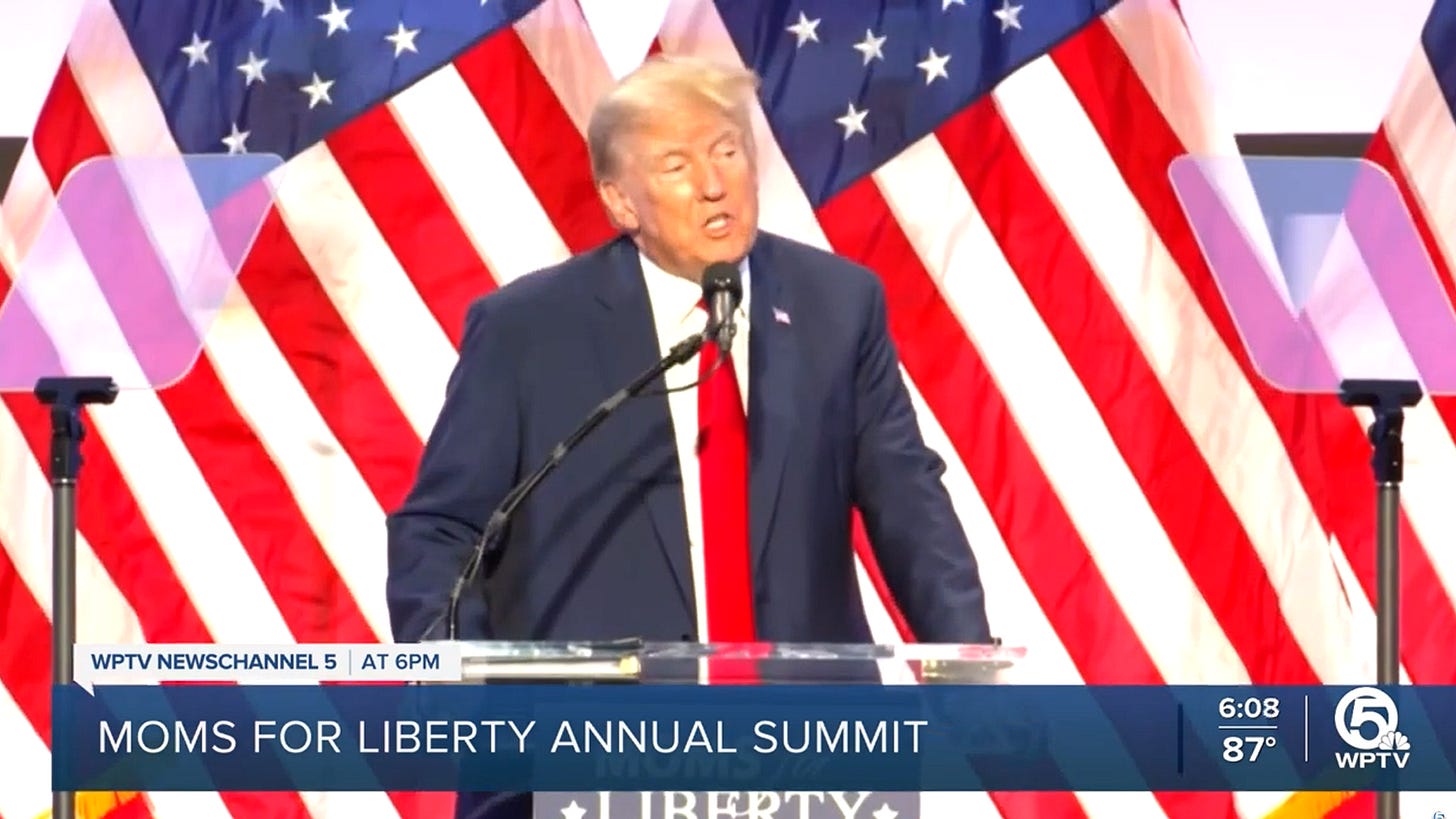
As the M4L annual summit kicks off this weekend, here’s how one of the group’s original chapters is sowing chaos and pushing anti-LGBTQ policies in Indian River County.
Mink Tyner says some people call her a “helicopter parent” because of how protective she is over her kids. Despite this, she wasn’t concerned about bringing her daughter, then 14, to the Indian River County, Florida, school board meeting in August 2023, where they were discussing changes to the state’s curriculum relating to race and slavery.
That’s why she was shocked when she saw community members at the podium reading excerpts of sexual content from books.
“I hate lights out now because my D has a mind of its own,” one woman read. Then a man came up and read, “When Doris had just turned 11, her current stepfather started having sex with her.” And a third person read, “He took a long long time peeling off my jeans and T-shirt, pink bra and panties, and a longer time stroking and kissing me.”
The meeting had turned into more of a stunt led by protestors affiliated with the local chapter of Moms for Liberty (M4L), a Southern Poverty Law Center-designated far-right extremist group.
“I’m not gonna have my kid in here listening to these adults doing this shit,” Tyner remembers thinking.
She took her daughter out of the room and pleaded with security to intervene, but they refused. So she spoke up to disrupt the meeting herself, only for security from the Sheriff’s office—who told Uncloseted Media their deputies responded “appropriately and in accordance with established procedures”—to escort her out.
As she was leaving, conservative pastor John Amanchukwu, who had attended the meeting with M4L, confronted her while recording a video that he would later post to X calling her “demonic” and lashing out about her being pro-LGBTQ: “You’re okay with DEI. … You’re okay with Pride Month. You’re okay with the rainbow flag. You’re okay with all that junk,” he yelled. Tyner responded by calling him a “fucking weirdo” and walked out.
That video opened a floodgate of harassment that tormented Tyner and her family for years: She received insults, accusations of pedophilia, and persistent threats of violence from a Facebook account displaying the name CURTIS COUSINS who called her a “fent-using fat fucking dyke” and told her she deserved to have “a potato peeler peel her clit right off to the bone.”
“I never know if this week or 10 years from now somebody’s gonna show up [to my business] based on some kind of misinformation that Moms for Liberty started about me [or] want to harm me and my family,” Tyner, who owns a tattoo shop, told Uncloseted Media.
Indian River County is home to one of the first of M4L’s 320 chapters nationwide. The group’s annual summit is this weekend and will feature a variety of politicians with anti-LGBTQ track records, including Oklahoma’s former state superintendent Ryan Walters, who made headlines for making anti-trans comments after the death of 16-year-old trans teen Nex Benedict. Last year, conservative heavyweights spoke at the event, including President Trump, Tulsi Gabbard and Sebastian Gorka.
Over the last four years, M4L have built a reputation for chaos and controversy. Members have made the news for quoting Hitler, stripping at a school board meeting and offering bounties to report teachers who teach about “critical race theory.”
At one point in Indian River County, close allies of M4L made up a majority of the school board where they pressured the district to ban scores of books, many of which contain LGBTQ themes, and reverse a racial equity policy—all while harassing, doxing and defaming their adversaries.
Maurice Cunningham, a retired professor of political science from the University of Massachusetts, says what’s playing out in Indian River County is a microcosm for so many other chapters across the country.
“[The media are] falling like suckers for this story that they’re a grassroots moms organization. They are not, they are connected to … the far right establishment,” he says. “And that’s become … more and more apparent. So this whole grassroots thing is hogwash.”
Beginnings
Moms for Liberty was founded in Florida in 2021 by three current and former school board members: Tiffany Justice, Tina Descovich and Bridget Ziegler, the latter of whom has since left the group after being involved in a sex scandal wherein her husband allegedly prowled local bars to solicit women for threesomes.
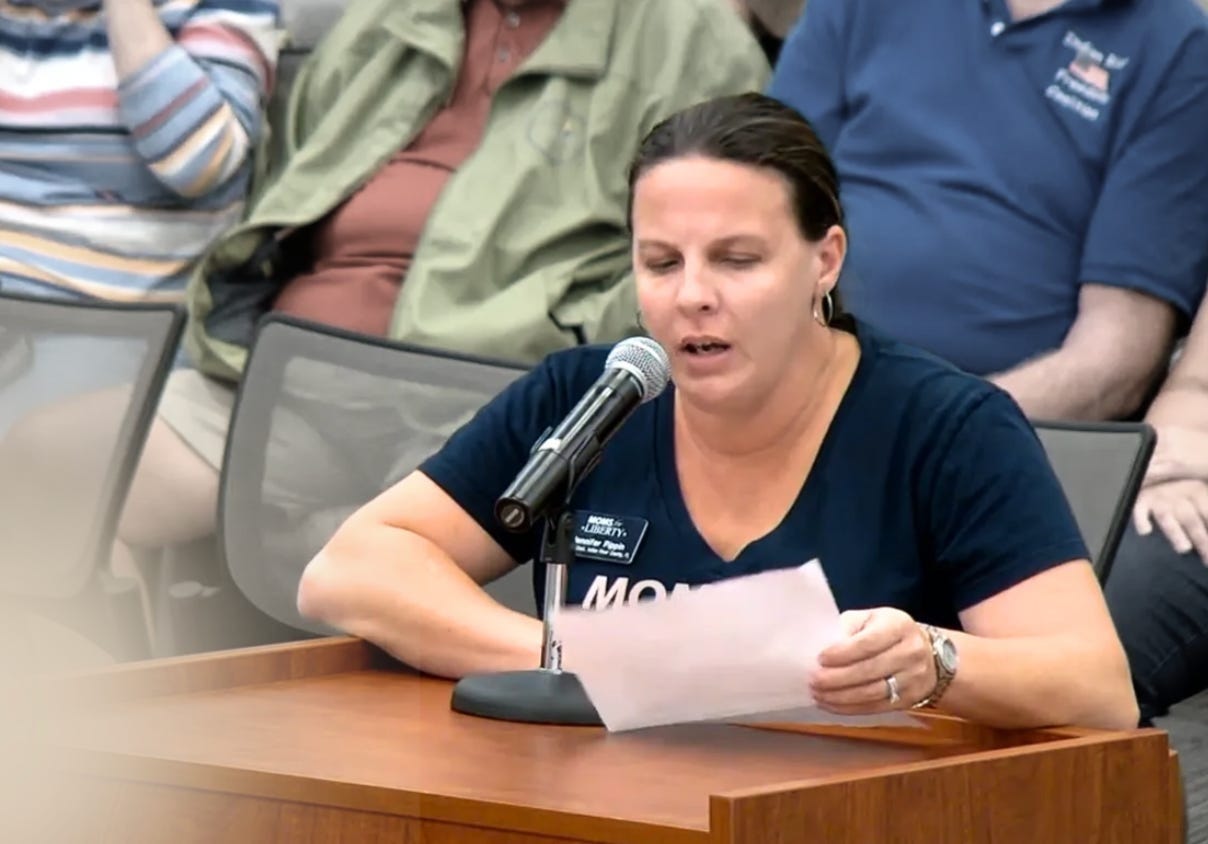
Shortly after M4L launched, Justice tapped Jennifer Pippin, who had made a name for herself for leading activism against COVID-19 restrictions, to lead the chapter for her home county, Indian River.
While the anti-mask circles that would later be folded into M4L always had a conservative lean, multiple county residents told Uncloseted Media that the group’s discriminatory views were not initially apparent.
Tyner, a lesbian who identifies as politically independent, actually felt welcomed by the group when she worked with them on their anti-mask mandate advocacy. However, that changed as M4L’s focus turned towards opposing LGBTQ inclusion measures in schools.
“Once they organized and got the appearance of a grassroots start … and many people in the community that were siding with them, it’s like they took the steering wheel and they just steered another direction,” she says.
When Tyner began speaking up against this rhetoric, she says she was blocked from the group’s Facebook pages. But as she continued to oppose them publicly, Justice offered to meet with her to address her concerns.
Over breakfast at a local cafe, Tyner says Justice gave her a “scripted” response in the hopes of winning back her support. She even invited Tyner to an M4L chapter meeting. However, Tyner declined as the meeting was allegedly to be hosted by a community member who had made an online post suggesting necrophilia and pedophilia are part of the LGBTQ umbrella.
“I was like, ‘Alright, this is not a good or a safe movement,” says Tyner.
Justice did not respond to a request for comment. In an email, Pippin told Uncloseted Media that M4L have “members and members children that are LGB in [their] chapter and across the country.”
Another local parent, who requested anonymity due to concerns about his job security, says while he’d initially been on board with M4L’s parental rights advocacy, he ran into conflict with the group when they started opposing the school district’s racial equity policies and tried to ban books with antiracist themes, including Ibram X. Kendi’s “Antiracist Baby”and “Stamped: Racism, Antiracism, and You.” Like Tyner, he says he was approached by Justice and Pippin to win him over again but was ultimately unconvinced.
After he split from M4L, he began publicly criticizing the group’s book bans. In retaliation, some M4L members accused him of supporting pedophiles.
When he reached out to Pippin to ask for the people making such accusations against him to be held accountable, he says she waved him off—all while blocking him on social media and accusing him of “bullying.” He also says that she doxed him after another dispute—a major factor in his decision to remain anonymous.
“Her response to me basically was ‘free speech,’ ‘we don’t control what our members say.’ And I’m like, ‘But Jennifer, you know me, and you know I’m not a pedophile, and this is unacceptable,’” he told Uncloseted Media.
Building Political Power
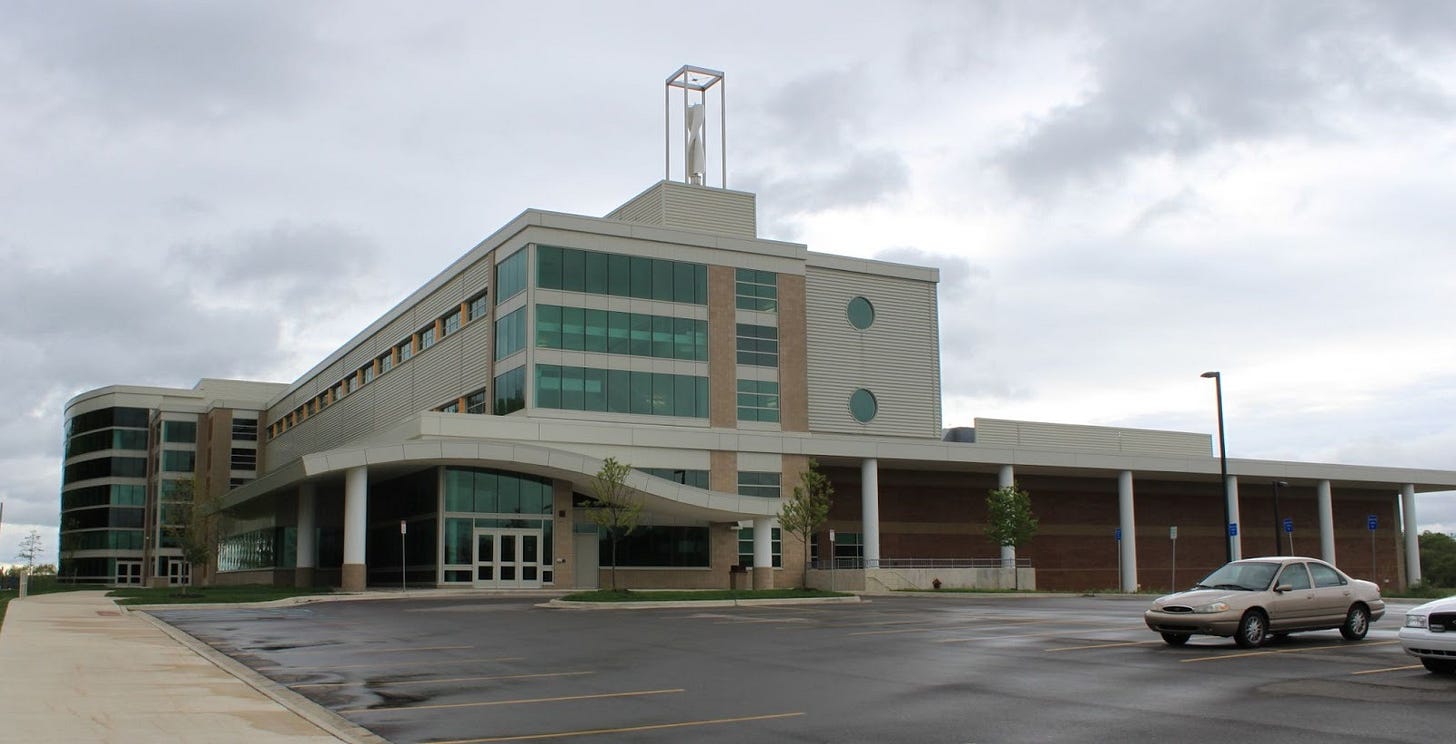
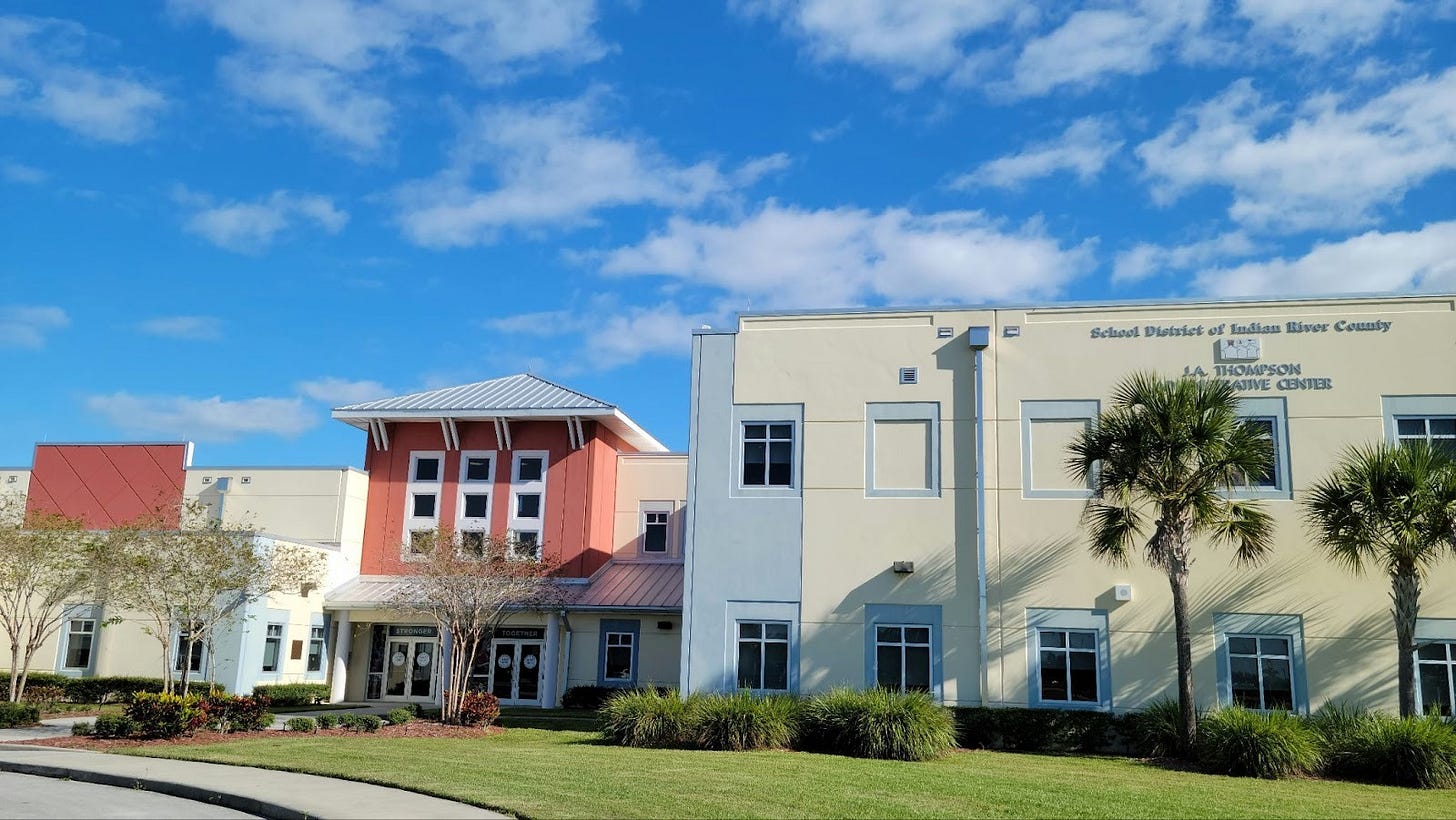
The Indian River County School District’s J.A. Thompson Administrative Center. Photo by Kiran891.
Efforts to ban LGBTQ and racial justice-related books in schools are part of M4L’s national ammo that helped them quickly explode in popularity.
Cunningham says M4L were boosted by high-profile connections on the right. Ziegler and Descovich both served as presidents of the Florida Coalition of School Board Members, a group billed as a conservative alternative to the Florida School Board Association. Ziegler’s husband, Christian, was vice chairman of Florida’s Republican Party at the time and worked as a media surrogate for the Trump campaign in 2016.
Since their launch, M4L have had their conferences and events sponsored by the Heritage Foundation and the Leadership Institute; were directly advised by Leadership Institute founder Morton Blackwell; and were a part of Project 2025’s advisory board. And this summer, Justice was hired as executive vice president of Heritage Action.
In 2022, the Indian River County chapter leveraged this influence to carve out power in local government: They got two close allies, Jacqueline Rosario and Dr. Gene Posca, elected to the school board, and they developed closerelationships with the Ron DeSantis-backed county sheriff Eric Flowers. Pippin was even appointed by Florida’s Department of Education to a statewide workgroup to develop compliance training for Florida’s classroom censorship policies, including the infamous “Don’t Say Gay” law.
As M4L became notorious for pushing exclusionary measures in schools, some officials—including school board member Peggy Jones—criticized the group. In retaliation, Jones reportedly received so many death threats that the district had to increase security detail at all school events where she was present.
In the midst of increasing chaos surrounding M4L, the group mounted a campaign of hundreds of requests to ban books containing “sexual content.”
While some librarians continued to hold the majority of books where bans were unsuccessful, M4L convinced Flowers to investigate one school library, alleging that keeping the books on the shelf could constitute a sex crime. While the investigation found that no crime had been committed, Flowers concluded that “we do not feel that this content is appropriate for young children,” putting even further pressure on local librarians.
Pippin at the school board meeting in August 2023. Photo via YouTube.
This kind of direct action proved very effective. Even the reading protest where Tyner was escorted out won them 34 additional book bans from a unanimous board vote.
“You can’t deny that the kind of tactics that they have have been useful,” Cunningham says. “Some of the places they’ve taken over, [including] Sarasota County, where Bridget Ziegler was on the board, became much more conservative over the past few years.”
Silencing Opposition
In addition to school board meetings, the group has a track record of trolling progressive events. Tyner and the anonymous parent remember an incident where a group of M4L members showed up to a local National Association for the Advancement of Colored People (NAACP) meeting that had been organized to discuss plans for opposition against new state regulations that required classes to portray slavery in a more positive light.Tyner says white M4L members attempted to shout down NAACP speakers, with one member allegedly using the n-word. Thomas Kenny, a M4L member who was at the event, said this “did not happen” and that one of their members using the n-word is “an absolute lie.”
Cunningham says these disruptions are part of M4L’s playbook. He pointed to the example of Jennifer Jenkins, the liberal school board member who unseated Tina Descovich in neighboring Brevard County, who says protestors spurred by M4L have turned up outside her home calling her a pedophile and burning “FU” in her lawn.
“They [use the] same kind of tactics … over and over again,” says Cunningham.
Pippin
Chapter leader Jennifer Pippin has mastered those tactics, becoming widely known as one of the most influential book banners in the country. She’s also made headlines for filing a complaint against the Kilted Mermaid, a Vero Beach wine bar, alleging that they had hosted an all-ages drag event with sexual content, which the bar owner denies. M4L rallied against the bar online, spamming the posts of one of the bar’s drag performers, telling the queen to “stay away from children.” This stunt caught the attention of Florida’s Attorney General James Uthmeier, who launched an investigation and issued subpoenas for video recordings of the bar on the day of the event as well as identifying documents for employees and performers.
Pippin has also claimed to be a nurse, despite no public records showing that she has a license, and appeared on the antisemitic and homophobic far-right news website TruNews, where she claimed, without evidence, that anti-M4L activists have been killing pets and livestock owned by the group’s members.
Fear
Tyner and the other anonymous parent both say that they’ve had to take a step back from the school board and local activism because of the toxic environment M4L have created.
“It’s been turned into such a circus,” Tyner says.
In the meantime, things have gotten worse for the LGBTQ community in Indian River County, and in Florida overall, between the “Don’t Say Gay” law and anti-LGBTQ legislation that requires teachers to deadname trans students unless they have signed parental permission slips. The anonymous parent says he’s watched many of the LGBTQ people in his life, including one of his own children, who is a teacher, leave the state due to the hostile environment.
“It’s not safe for a lot of people,” he says.
Greener Pastures?
Despite all of this, a sea change may be on the horizon. A 2024 Brookings report found that the success rates of M4L-endorsed candidates were on the decline, and in Indian River County’s elections last year, both of M4L’s school board candidates lost. With the continued controversies of the Trump administration and the growing popularity of groups that oppose M4L’s ideology, Cunningham feels the tide may be turning for M4L’s influence in Indian River County and across America.
“In school board races, the Moms for Liberty label is toxic, so try to not get attached to that,” he says. “They’ve had quite an impact … I don’t wanna downplay that. But in terms of popular appeal and growth, I think it’s much more limited than it is portrayed.”
Editor’s Note: In an email, Jennifer Pippin responded to the allegations made about her in this story. You can read them here.
If objective, nonpartisan, rigorous, LGBTQ-focused journalism is important to you, please consider making a tax-deductible donation through our fiscal sponsor, Resource Impact, by clicking this button:
Steve Bannon, former advisor to U.S. President Donald Trump, arrives for a hearing at Manhattan Criminal Court on February 11, 2025 in New York City. Michael M. Santiago/Getty Images
With Republicans and Democrats embroiled in a fight over redistricting around the country, GOP operatives are beginning to openly discuss their plan to leverage institutional power — from statehouses to the Supreme Court — to usher in a near-unbreakable House majority.
In Texas, Republicans are pushing forward a plan to create five new GOP House seats, which alone could be enough to prevent Democrats from retaking the House in the 2026 midterms. The new Texas maps are part of a larger redistricting play, in which Republicans think they can squeeze out a dozen new GOP seats from states such as Texas, Florida, Missouri and Indiana.
The redistricting play from Republicans, however, is only part of a larger campaign to totally change the state of play in the House of Representatives. If successful, that effort could see Republicans pick up more than 40 seats without having to win any more support from voters, according to GOP operatives.
GOP strategist Alex deGrasse, an advisor to Rep. Elise Stefanik, R-N.Y., spoke about the emerging plan on Steve Bannon’s “War Room,” outlining three changes that Republicans are counting on to bail them out of potential democratic accountability: partisan gerrymandering; a Supreme Court ruling that guts the Voting Rights Act; and an unprecedented and unconstitutional mid-decade Census.
“You’ve got these three vectors,” deGrasse said. “Back of the envelope map this morning — when I woke up with a smile — was Democrats could lose 42 seats.”
Potentially the most important part of this plan hangs on the fate of Section Two of the Voting Rights Act of 1965. This section of the landmark civil rights law generally bans race-based discrimination in voting laws, and has been an important part of the legal framework that currently guarantees House districts where the majority of the voters are a minority group. This then allows members of that minority group the ability to elect their chosen representative.
The case before the court directly concerns one of Louisiana’s two majority-Black districts, with the group of voters who brought the case seeking to overturn the current map used in the state. Republicans, however, are hoping the Supreme Court will issue a maximalist ruling that would allow their party to dilute minority voters in the South, effectively eliminating Black representation in Congress in swaths of the country. This would also, in effect, eliminate many Democratic seats across the South.
The Republican dominated Supreme Court has steadily dismantled the Voting Rights Act in recent decades, with Shelby County v. Holder in 2013 allowing some states, mostly concentrated in the South, to change the rules and procedures around voting without a federal review.
The potential gains for Republicans here are huge. In 2024, there were 141 majority-minority House districts;119 of these districts elected Democrats to represent them.
The specific number of seats that Republicans would be able to pick up through a change in the Voting Rights Act would depend on the specifics of the ruling, as well as practical constraints on the GOP’s ability to gerrymander. Still,it’s clear Republicans are hoping to be given a free hand to eliminate majority-minority districts altogether.
“The other third aspect that we’re talking about here, Steve, is that voting rights are up in the Supreme Court; they said, ‘Hold on, do we need race-based seats? Does this go against the 14th and 15th Amendments? And does the Constitution supersede racial seat drawing?” deGrasse said.
The third part of the GOP plan, alongside the current round of redistricting and their hopes at the high court, has to do with President Donald Trump’s ordering of a new mid-decade Census.
Stephen Miller, Trump’s White House deputy chief of staff, signaled at the purpose of Trump’s mid-decade Census plan when he claimed on Fox News that “Democrats rigged the 2020 Census by including illegal aliens.” Miller made these claims despite the fact that Trump was president and in charge of the 2020 Census.
For context, non-citizens have been counted in every Census since 1790, and the framers of the Constitution explicitly included non-citizens in the Census by stating in Article One that it shall count the “whole number of persons in each state.” For the 2020 Census, Trump also pushed to have a question about citizenship included in the Census, acknowledging that the Census was meant to count all persons in the United States, including noncitizens.
Miller went on to reveal the goal of Trump’s mid-decade Census plan, saying that “20 to 30 House Democrat seats wouldn’t exist but for illegal aliens.”
Charlie Kirk, the right-wing activist who maintains a personal line of communication with Trump, indicated in an interview with the Daily Caller that the Census scheme would also help to lock Democrats out of the presidency and “potentially subtract 20 electoral votes from Democrats in the electoral college system, as congressional seat appropriation is directly correlated with Electoral College totals.” Kirk is a co-founder of Turning Point USA, an organization dedicated to indoctrinating high school and college-age students in conservative ideology. The organization was also among the groups Trump’s 2024 campaign delegated get-out-the-vote efforts to.
The GOP’s Census plan will almost certainly be challenged in court. Federal law holds that a mid-decade Census can be conducted, but not used for apportionment. And, since the country’s founding, the U.S. has conducted a Census once a decade for the purposes of apportionment.
Democrats in Texas say that this current push from the Republicans — to totally reconfigure American elections to retain power — should be a wake-up call.
Texas state Rep. Venton Jones, the House minority whip in Texas, told Salon that national Democrats need to realize that “there’s a bigger plan at play and we need to wake up and address that as a nation.”
“We have to continue to overperform to at least get back the majority and be ready for an electoral fight when that happens, because we’ve already seen what happens when this president, or even this Congress, doesn’t get what they want,” Jones said. “They don’t always play by the rules. They just change the rules to make it benefit them.”
The suit alleges the new state law unconstitutionally silences the viewpoints of students and teachers. The law’s supporters say DEI programs use public funds to promote political agendas.
The ACLU and a group of LGBTQ+ and student rights organizations are suing Texas to block the state’s ban on diversity, equity and inclusion initiatives in K-12 public schools. Ilana Panich-Linsman for The Texas Tribune
The American Civil Liberties Union of Texas and a group of LGBTQ+ and student rights organizations are suing to block a new state law that would ban diversity, equity and inclusion initiatives in K-12 public schools.
In a lawsuit filed last month in federal court, attorneys from the ACLU of Texas and Transgender Law Center argued that Senate Bill 12 violates the First and Fourteenth Amendments as well as the Equal Access Act. Gov. Greg Abbott signed the legislation last June, and it will go into effect Sept. 1 alongside an array of other transformative laws for public education in Texas.
“Senate Bill 12 is a blatant attempt to erase students’ identities and silence the stories that make Texas strong,” said Brian Klosterboer, senior staff attorney at the ACLU of Texas. “Every student — no matter their race, gender, or background — deserves to feel seen, safe, and supported in school.”
Supporters of SB 12 say DEI programs use class time and public funds to promote political agendas, while opponents believe banning those initiatives will disproportionately harm marginalized students by removing spaces where they can find support.
Here’s what you need to know about the effort to block the law.
What the ban would do: Authored by Sen. Brandon Creighton, R-Conroe, SB 12 prohibits public school districts from considering race, ethnicity, gender identity or sexual orientation in hiring decisions. The ban also bars schools from offering DEI training and programs, such as policies designed to reduce discrimination based on race or gender identity, except for when required by federal law.
The law requires families to give written permission before their children can join any school club, and prohibits school groups created to support LGBTQIA+ students. Parents will be able to file complaints if they believe their schools are not complying with the DEI ban, and the law requires school districts to discipline employees who knowingly take part in DEI-related activities.
Rep. Jeff Leach, R-Allen, said SB 12 builds on a 2021 state law barring public schools from teaching critical race theory, an academic discipline that explores how race and racism have influenced the country’s legal and institutional systems. While critical race theory is not taught in Texas public schools, the term has become a shorthand used by conservatives who believe the way some schools teach children about race is politically biased.
DEI advocates say initiatives that promote diversity provide support for marginalized communities in workforce development and higher education, while critics say DEI practices give preference to people based on their race and ethnicity rather than on merit.
What the lawsuit says: Attorneys from the ACLU and the Transgender Law Center are suing Texas Education Agency Commissioner Mike Morath and three school districts on behalf of a teacher, a student and her parent. They’re also representing the Genders & Sexualities Alliance Network and Students Engaged in Advancing Texas, two organizations that say they would be harmed by the ban. The ACLU amended the complaint in September, adding as plaintiffs the Texas American Federation of Teachers, another student and his parent.
The suit calls SB 12 an “overzealous” attempt to ban DEI in public schools and argues that it censors constitutionally protected speech and restricts students’ freedom of association. It’s also vague and overly broad, the suit says.
“S.B. 12 seeks to erase students’ identities and make it impossible for teachers, parents, and volunteers to tell the truth about the history and diversity of our state,” said Cameron Samuels, executive director at Students Engaged in Advancing Texas. “The law also guts vital support systems for Black, Brown, Indigenous, Asian, and LGBTQIA+ students and educators.”
As part of the lawsuit, the Genders & Sexualities Alliance Network claims SB 12 singles out the organization by explicitly restricting student clubs based on “sexual orientation or gender identity,” language the group uses to describe the student organizations it sponsors at schools. That restriction harms the freedom of speech of the group and its members, the suit says. The Genders & Sexualities Alliance Network has chapters in Texas at more than a dozen school districts, according to the filing.
Lawsuits against similar laws have had mixed results in the past.
Because of SB 12’s ban on discussions of sexual orientation and gender identity in classrooms, opponents have compared it to Florida’s “don’t say gay” law, which attracted widespread media attention in 2022 due to its far-reaching impacts in public schools. Civil rights lawyers sued to block it, saying the law violated free speech and the Fourteenth Amendment’s equal protection clause. But a federal judge dismissed the case and said the plaintiffs had no legal standing and had failed to prove harm from the law. The attorneys ultimately agreed to a settlement with Florida education officials that clarified the law to allow discussions of sexual orientation and gender identity in classrooms only if it’s not part of instruction.
The Texas Education Agency did not immediately respond to a request for comment.
The broader push against DEI:The DEI ban on K-12 schools comes two years after the Texas Legislature passed a similar ban for the state’s higher education institutions. Senate Bill 17 requires public universities to close their diversity offices, ban DEI training and restrict hiring departments from asking for diversity statements, or essays in which a job candidate expresses their commitment to promoting diversity in the workplace.
Creighton, who also authored that bill, has warned higher education leaders that they could lose millions of dollars in state funding if they fail to comply with the law. Earlier this year, Abbott threatened Texas A&M University President Mark Welsh III’s job after claims spread online that Texas A&M was sending students and staffers to a conference that limited participation to people who are Black, Hispanic or Native American.
At the national level, President Donald Trump has ordered all federal agencies to end “equity-related” practices and asked contractors to certify they do not promote DEI efforts. Trump also told schools and universities they would lose federal money if they do not eliminate diversity practices.
Over the last five years, Texas and other Republican-led states have also taken other steps to abolish and ban DEI efforts in public education and the workforce. Similar to Trump, Abbott issued an executive order in January mandating that Texas agencies end all forms of DEI practices.
“We must always reject race-based favoritism or discrimination and allow people to advance based on talent and merit,” Abbott said.
Disclosure: ACLU Texas and Texas A&M University have been financial supporters of The Texas Tribune, a nonprofit, nonpartisan news organization that is funded in part by donations from members, foundations and corporate sponsors. Financial supporters play no role in the Tribune’s journalism. Find a complete list of them here.
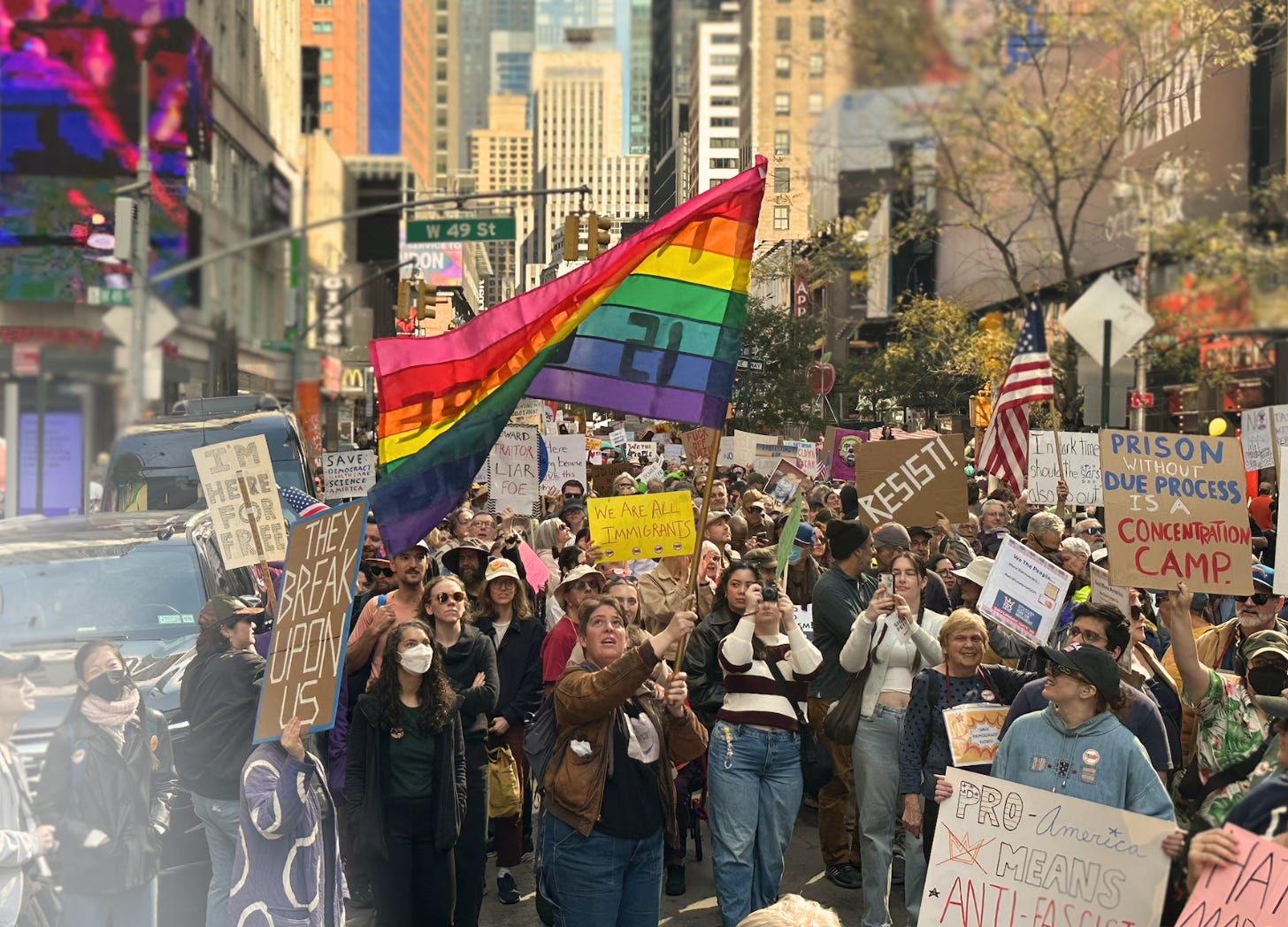
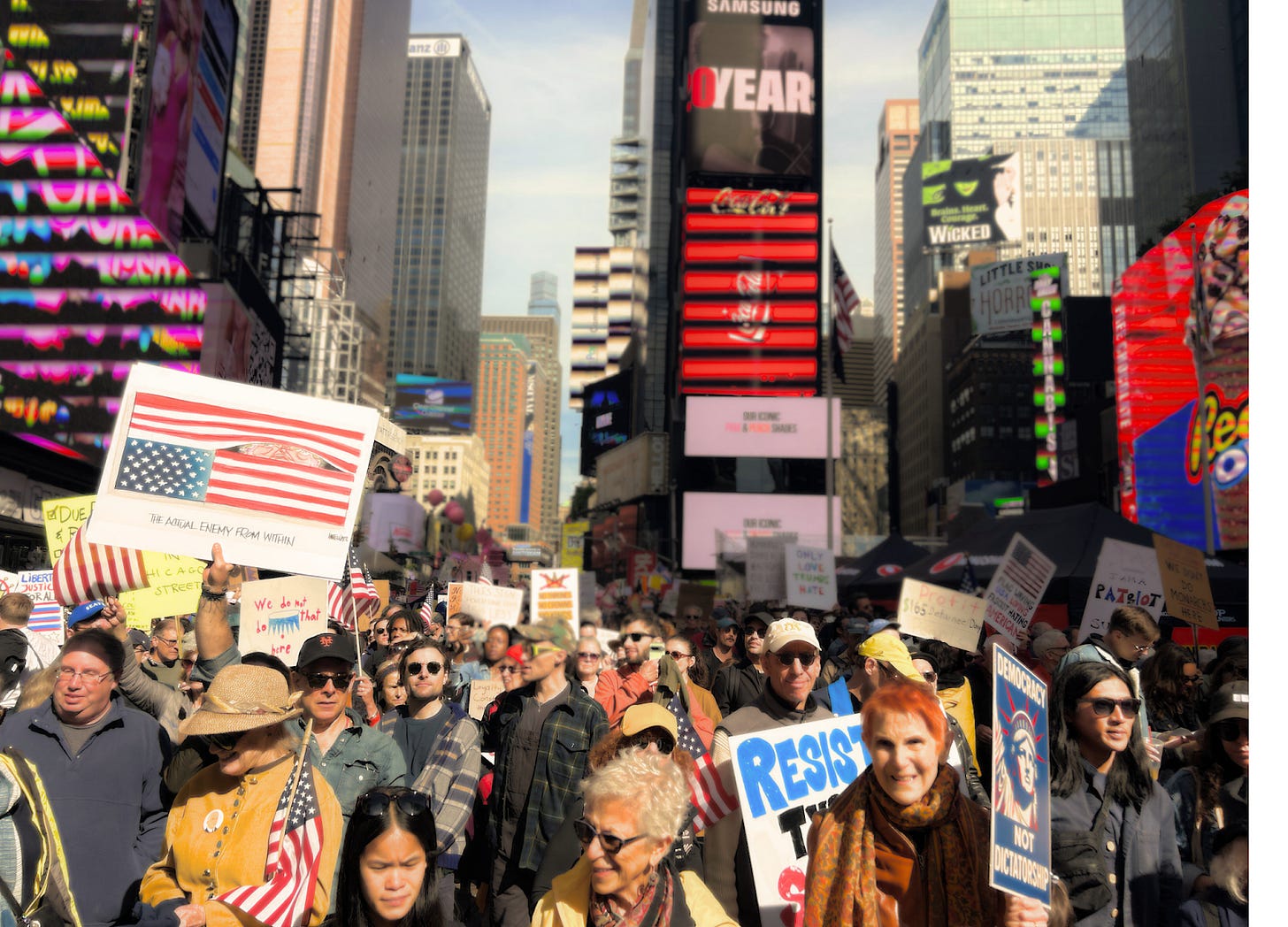
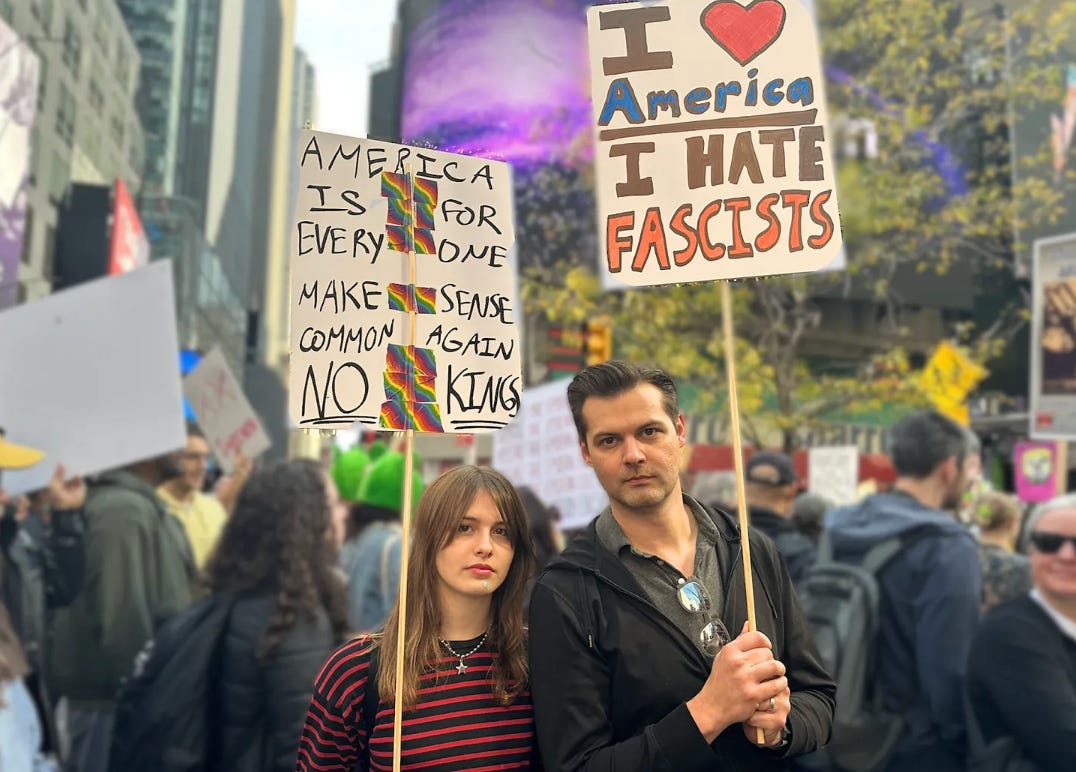
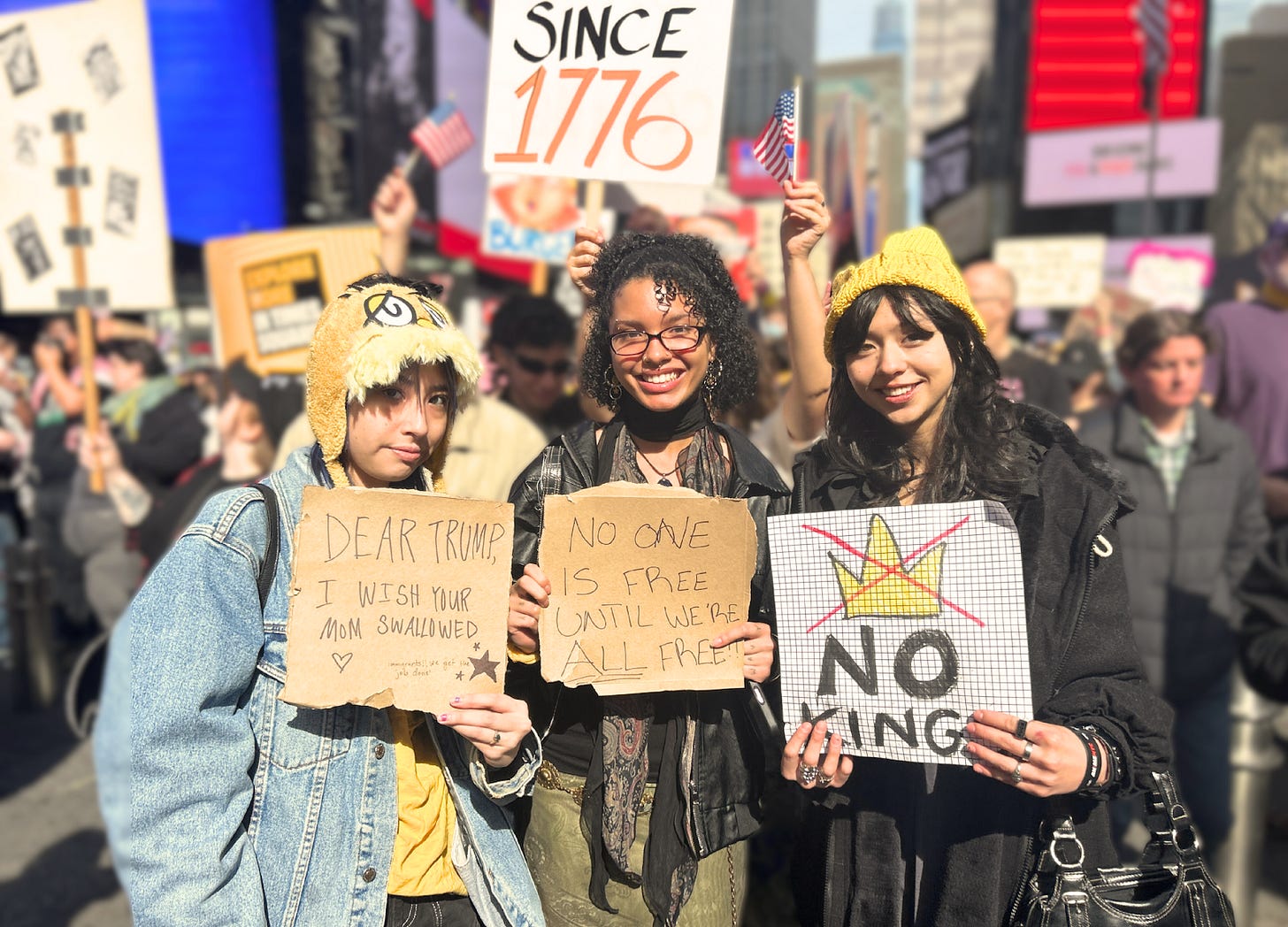
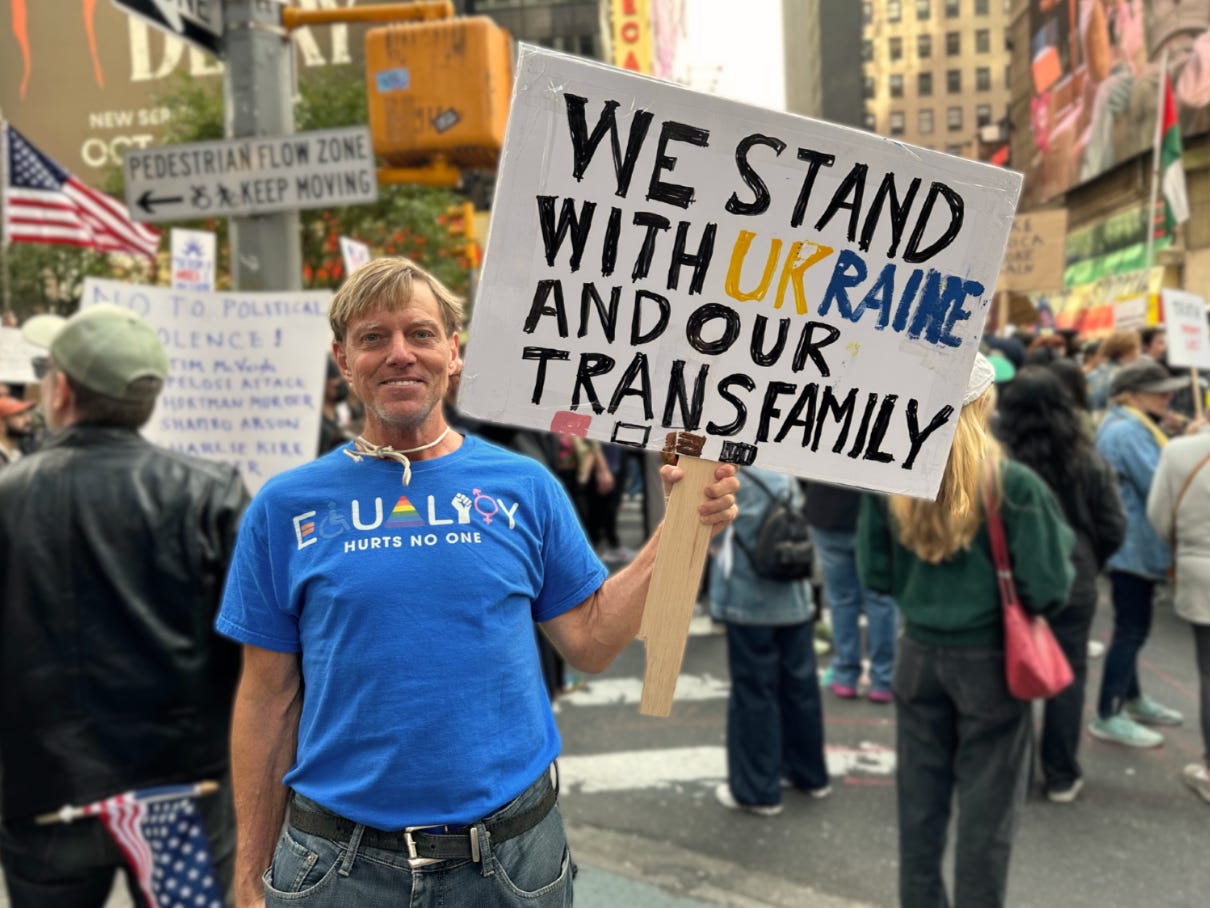
“Hey hey, ho ho, Donald Trump has got to go,” protestors chanted in the middle of Times Square, among a sea of signs that read “love reigns not kings,” “gays against faux-king Trump,” “we stand with … our trans family” and “the future is coming.”
On Saturday, independent analysts estimated that the No Kings March drew between 5 and 8 million people, and organizers say over 7 million people attended 2,700 events across all 50 states. The event, which was organized to push against the rise of authoritarianism in the U.S., was the largest single-day protest in America since 1970.
Over 100,000 New Yorkers marched in all five boroughs in NYC on Saturday. Photo by Jelinda Montes.
Among the crowd were countless LGBTQ people, fighting back against an administration that has introduced a litany of anti-LGBTQ executive orders and used vile rhetoric to denigrate queer people. This backsliding of LGBTQ rights, according to experts, has a deep connection to authoritarianism, with research showing that when governments weaken protections for queer and trans people, they often turn to broader democratic institutions next.
“Threats to democratic institutions and threats to LGBTQ rights are mutually reinforcing, generating a vicious cycle that strengthens authoritarian control,” Ari Shaw, director of International Programs at the Williams Institute, told Uncloseted Media. “Increased persecution of minority groups, including LGBTI people, is itself evidence of democratic backsliding by indicating the erosion of liberal democratic norms [meant to protect] minority rights.”
Legal Abuse of Power
One of the ways the Trump administration’s abuse of power has been most evident is through its legal actions.
He’s also slashed HIV funding at a staggering rate. Uncloseted Media estimates that the National Institutes of Health has terminated more than $1 billion worth of grants to HIV-related research, including 71% of all global HIV grants.
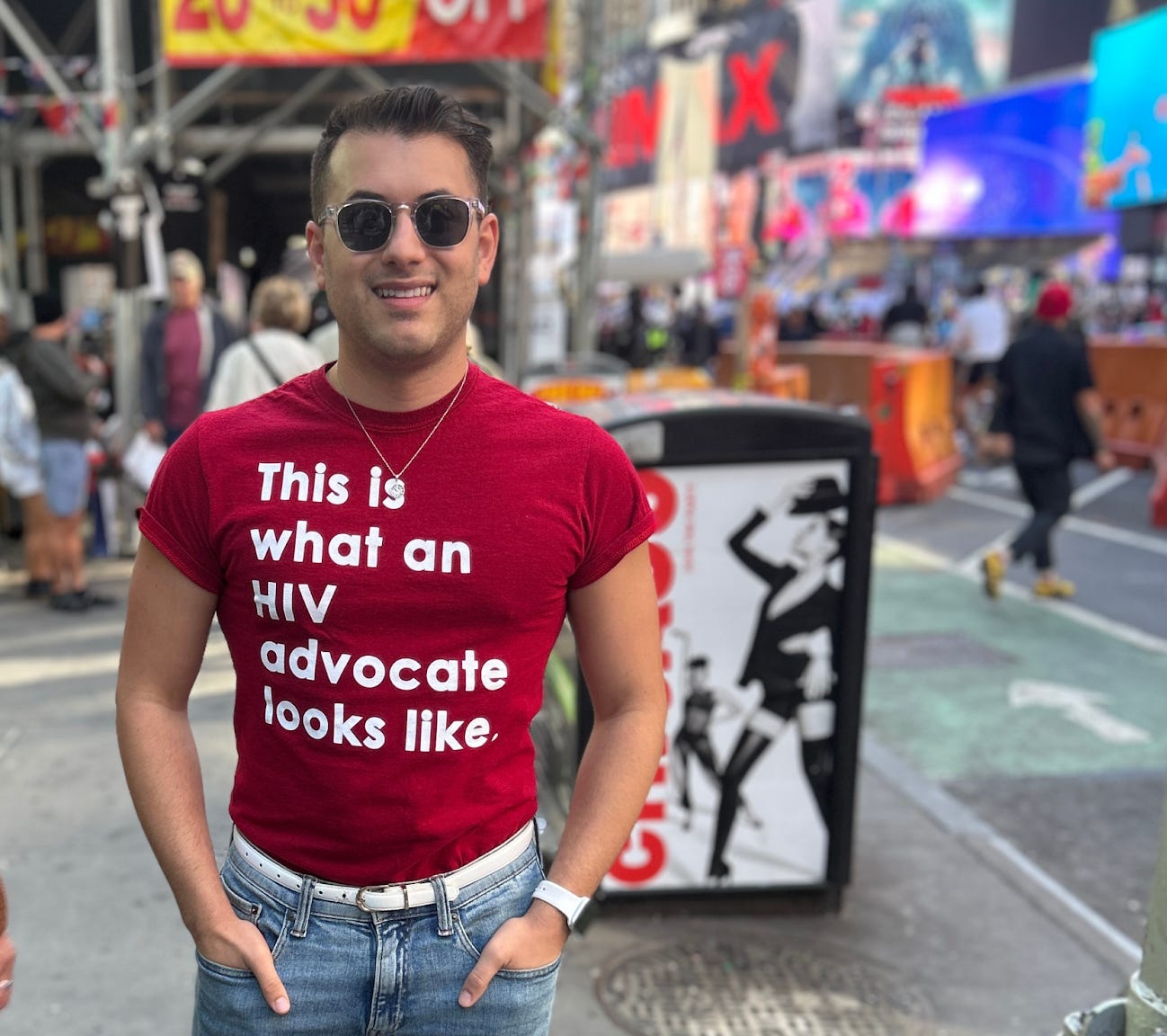
Jeffrey Cipriano at the NYC No Kings protest Saturday. Photo by Jelinda Montes.
It was these cuts that prompted Brooklynite Jeffrey Cipriano to turn out to protest. “The specific reason that I’m protesting is actually on the shirt I’m wearing,” says Cipriano.
“My best friend works for an organization called AIDS United. … His job is to travel the country and help people get AIDS medication, specifically trans and unhoused community members. But his job is at risk,” he says. “The end outcome of his work is that people who have issues in their lives have the issues resolved and that’s going away under the current administration.”
Executive orders are based on powers granted to the president by the U.S. Constitution or by Congressional statutes. The president cannot use an executive order to create new laws or spend money unless Congress has authorized it. They are meant to direct how existing laws are implemented. But Trump has ignored democratic norms, often filling agencies with loyal supporters, using orders to go after political opponents and pushing the limits of what the law allows.
In some cases, he has moved illegally. “The President is directing various executive branch officials to adopt policy that has either not yet been adopted by Congress or is in violation of existing statutory law,” says Jodi Short, professor of law at UC Law San Francisco. “The analogy to a king and what has troubled many about this presidency is the sheer consolidation of executive branch power in one individual.”
Short’s colleague, Dave Owen, agrees. “Illegality has been rampant,” he told Uncloseted Media in an email. “People are often cynical about the government, and they might think what Trump’s doing is nothing new. But most of the time, the executive branch takes the law seriously, and both legal constraints and norms of good governance matter,” he wrote. He says that through history, there’s been “a lot more integrity and a lot less lawlessness than most people realize.”
“This administration has broken with those traditions,” he adds.
Revolt Against Executive Orders
Many Americans have recognized this. A survey from April found that 85% of Americans agreed or strongly agreed that the president should obey federal court rulings even if he doesn’t like them.
In response to Trump’s overreach, more than 460 legal challenges have been filed across the country challenging his executive actions. One of these is a federal lawsuit by Lambda Legal and the Human Rights Campaign Foundation that challenges the constitutionality of the Trump administration’s ban on military service by transgender people. Another lawsuit challenges Trump’s order directing federal agencies to withhold funds from medical providers and institutions that provide gender-affirming medical treatments for people under 19.
Zoe Boik and her father, Derik, protesting on Saturday. Photo by Sean Robinson.
Both of those lawsuits are one reason 17-year-old Zoe Boik came out to protest with her friends and her dad. “Obviously, I’m disappointed and kind of helpless because there’s nothing I can directly do to change or impact anything that’s going on,” says Boik, who identifies as pansexual and gender fluid and is not legally allowed to vote.
Boik—who was seven years old when Trump announced his run for presidency in 2015—says she’s doing a research paper on Trump’s trans military ban and is frustrated because she sees it as inexplicable discrimination. “They’re not letting trans people serve … which doesn’t make any sense.”
Zoe as a child with her dad, Derik. Photo courtesy of Boik.
LGBTQ Rights and Democratic Backsliding
This type of blatant discrimination is often a key sign of a country moving closer to authoritarianism and away from democracy. According to a 2023 research paper by Shaw and his colleagues, anti-LGBTQ stigma may contribute “to the erosion of democratic norms and institutions.”
The paper found that when a country with relatively high acceptance of LGBTQ rights introduces anti-LGBTQ legislation, it clashes with what most people believe and can weaken public trust in democracy, deepen political divides and make it easier for populist or extremist movements to gain power.
“The level of acceptance of LGBTQ people is closely associated with the strength of democracy in a country,” Shaw says. “In some cases, we even saw that rising anti-LGBTQ rhetoric or policies preceded a broader decline in democracy.”
In Brazil, for example, early democratic gains coincided with rising LGBTQ acceptance, including legal recognition of same-sex unions and workplace protections. But as populist President Jair Bolsonaro came into power in 2019, he began questioning—without evidence—the security of Brazil’s voting systems, saying he would only lose his re-election campaign if there were fraud. He was also accused of trying to intervene in operations held by the Federal Police about the alleged criminal conduct of his sons, and he told his ministers that he had the power and he would interfere—without exception—in all cabinet ministries. At the same time, LGBTQ protections were rolled back, and schools and civil society faced censorship, suggesting that falling LGBTQ acceptance may have “preceded Brazil’s democratic erosion,” according to Shaw’s paper. In September of this year, Bolsonaro was sentenced to 27 years in prison for plotting a military coup.
Another example is Poland’s democracy weakening since 2015 under the Law and Justice Party, which consolidated power by undermining the Constitutional Tribunal, installing loyal judges and restricting independent media. Anti-LGBTQ rhetoric became central to the party’s nationalist platform, fueling the creation of nearly 100 “LGBT ideology free zones,” inciting violence against LGBTQ individuals and stymying legal recourse through politicized courts.
When it comes to LGBTQ rights, Trump has mimicked the moves of these leaders even though most of his constituents don’t want it: A 2022 survey from the Public Religion Research Institute found that 80% of Americans favor laws that would protect LGBTQ people against discrimination.
“The definition of an authoritarian system is a system where power is consolidated in one individual whose power is unchecked by any other institution. And I fear that in certain domains, that’s the direction in which this administration is trying to move us,” says Short. “I think it’s incredibly dangerous.”
Attacks on Higher Education
Another common tool in the authoritarian playbook is attacking higher education.
While many universities are rejecting Trump’s demands, others are experiencing a chilling effect, changing their policies before the administration tries to hold up funds.
James Revson, Maddy Everlith and Shay Wingate holding their signs at the No Kings protest. Photo by Jelinda Montes.
“I’m here because I’m angry and I feel that we aren’t angry enough,” Maddy Everlith, a sophomore gender studies major at Pace University, told Uncloseted Media as she marched with her friends. “Being a woman of color in America and having so many intersectional identities is also what affects me. … I want to stand up and advocate for other people.”
Everlith’s university responded to Trump’s threats in September by renaming its DEI office to the “Division of Opportunity and Institutional Excellence.”
“I am beyond horrified how quickly our university was willing to bend the knee on this decision,” Austin Chappelle, a senior at Pace, told the student newspaper. This change comes in the midst of uncertainty under the Trump administration, which has already caused many LGBTQ students to feel uneasy on campus.
“It’s part of an electoral strategy to try to mobilize right-wing voters to distract from other sorts of political or economic scandals,” Shaw says, adding that this tactic is another way to gain power.
Lars Kindem protesting for his trans sister at the No Kings protest. Photo by Sean Robinson.
The pain of this rhetoric has affected millions of trans Americans and allies alike, including Lars Kindem, a 64-year-old retired pilot from Minnesota who was marching to support his transgender sister.
“What Trump has done is he’s taken people that haven’t done anything wrong and has turned them into scapegoats,” he says, adding that Trump’s language is “hateful, petty, mean and hurtful.”
He says his sister and her partner are having issues getting the correct gender markers issued on their passports. Because of the Trump administration’s treatment of the community, they are making plans to move to Denmark, where “there’s a lot more acceptance.”
Christian Nationalism
This scapegoating has played into the hands of Trump’s voter base of white evangelical Protestants, the only major Christian denomination in the U.S. in which a majority believes society has gone too far in accepting transgender people.
Since 2020, Trump has increasingly embraced Christian nationalism in his rhetoric and imagery. He’s sold Bibles, created a federal task force on anti-Christian bias and been intrinsically linked to Project 2025, the 920-page plan calling for the establishment of a government imbued with “biblical principles” and run by a president who holds sweeping executive powers.
Experts say that “a strong authoritarian streak” runs through conservative Christianity. A 2023 study found that supporters of Christian nationalism tend to support obedience to authority and the idea of authoritarian leaders who are willing to break the rules. Nearly half of Christian nationalists support the notion of an authoritarian leader.
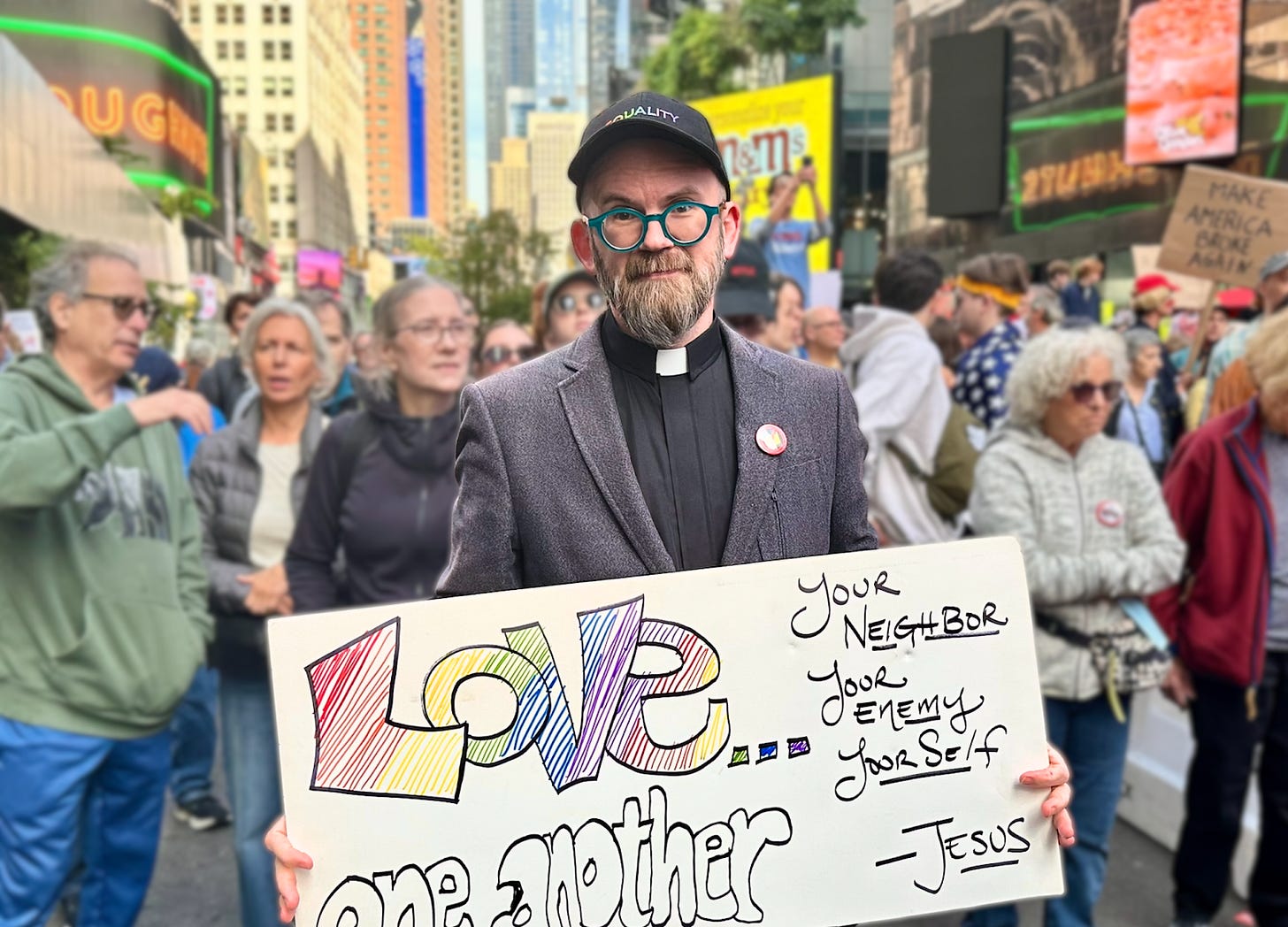
“They are trying to use the language of Christianity, but they are abusing it and misusing it constantly,” Rev. Chris Shelton, a gay pastor at the protest, told Uncloseted Media. “Our faith is all about reaching out to the marginalized, reaching out to the people who are ostracized by society and embracing them and offering love and welcome and a sense of dignity and worth. And to see any human being’s worth being denied is just a mockery of our faith.”
Rev. Chris Shelton marched in Saturday’s NYC protest. Photo by Sean Robinson.
Heidi Beirich, the vice president and co-founder of the Global Project Against Hate and Extremism, says that “the LGBTQ community is the prime target of modern authoritarian regimes.”
“For Christian nationalists, attacking LGBTQ rights is the first pillar in destroying civil rights for all. This has happened in countries like Hungary and Poland as authoritarianism consolidated and now it’s happening here,” Beirich told Uncloseted Media.
Moving Forward
As the country bleeds toward authoritarianism, LGBTQ protestors are encouraging people to use their voice, something the queer community is familiar with doing: One 2012 survey found that queer folks are 20 times more likely to be active in liberal social movements than their straight, cis counterparts.
“It is imperative that people continue to pay attention,” Short says. “There is so much going on, a lot of it is disturbing and intense, and there’s such a strong impulse to look away. But we have to engage in political action and resist inappropriate assertions of authority and continue to show up and vote for our democracy.”
17-year-old Zoe Boik is ready. She remembers being in second grade and crying the day after Trump won his first election in 2016. She couldn’t believe how he could lead the country despite “all the bad things he said.”
Boik can’t wait until the midterm elections, when she will be 18 and finally able to vote. “If we don’t vote, then our voices won’t be heard,” she says.
Despite this, she’s also concerned about her freedom to exercise that right being jeopardized.
“My fears about Trump don’t stem specifically from me being queer, but from his authoritarianism as a whole,” she says. “I am scared about how far he will move into dictatorship, [and] my biggest fear is that our right to vote will be compromised, leaving us no recourse.”
If objective, nonpartisan, rigorous, LGBTQ-focused journalism is important to you, please consider making a tax-deductible donation through our fiscal sponsor, Resource Impact, by clicking this button:







 The ACLU and a group of LGBTQ+ and student rights organizations are suing Texas to block the state’s ban on diversity, equity and inclusion initiatives in K-12 public schools.