Bigotry and racism pure and simple. It was once illegal in the US. But under Stephen Miller and tRump it is flourishing and supported. We must fight for acceptance and tolereance for those who are not white. So many gains since the 1960s are being erased illegally. Imagain being a kid, a preteen and having a bunch of masked men stop you and threaten you. Hey we keep being told that ICE is going after the worst of the worst to protect the public. Tell me what horrific crime could that child have done that would harm the public? According to ICE, he was not white and that is dangerous enough to the white racists who make up ICE and support them. Hugs
“The government’s decision is deeply disturbing and is just the latest example of the Trump administration targeting the LGBTQ+ community.”
John Russell (He/Him)February 18, 2026, 11:07 am EST
After elected officials raised a Pride flag on a temporary flagpole, activists raise the flag on the permanent flagpole at the Stonewall National Monument in New York City Feb. 12, 2026. Thousands gathered at the monument to see the flag raised after President Donald Trump had ordered the flag to be removed earlier in the week. | Seth Harrison/The Journal News / USA TODAY NETWORK
The Trump administration violated federal law when it removed the LGBTQ+ Pride flag from the Stonewall National Monument in New York City, according to a lawsuit filed by several nonprofit groups on Tuesday.
The lawsuit, led by the Gilbert Baker Foundation — which honors the artist who created the original, eight-striped rainbow Pride flag in the 1970s — alleges that the administration’s “arbitrary and capricious” removal of flag earlier this month violates the Administrative Procedures Act and that the administration “misinterpreted” its own policies as a pretext for the flag’s removal.
“The policies the government says require removing the Pride flag expressly permit the [National Parks Service] to fly other flags that provide historical context to national monuments—which is precisely what the NPS official Pride flag did at Stonewall for many years,” the lawsuit states.
As the New York Times notes, an NPS-sanctioned Pride flag that has for years flown in Christopher Park, the site of the Stonewall Monument in New York’s Greenwich Village, was removed sometime during the night of February 8 with no notice or explanation. NPS later cited new guidance issued by the Trump administration in January mandating that “only the U.S. flag and other congressionally or departmentally authorized flags are flown on NPS-managed flagpoles, with limited exceptions.”
But according to the lawsuit, neither the Department of the Interior policy on flag displays nor the administration’s January directive require the removal of the Pride flag.
“The Policy permits officials to ‘authorize the flying of flags and pennants, other than [U.S. and DOI flags], as appropriate, provided flags and flagpole space are available for this purpose” and “the Directive provides an exemption for flags that ‘provide historical context,’” according to the complaint. “Under the policies that they are purporting to be implementing, Defendants had discretion to allow the Pride flag to be displayed at the Stonewall memorial.”
“This was no careless mistake. The government has not removed other historical flags at other national monuments, most notably Confederate flags,” that lawsuit alleges. “Meanwhile, the assault on Stonewall is the latest example in a long line of efforts by the Trump Administration to target the LGBTQ+ community for discrimination and opprobrium.”
“These actions alone support a strong inference of animus against the LGBTQ+ community and that Defendants’ reasons for removing the flag were pretextual,” the lawsuit argues. “Because Defendants’ reasons were pretextual and based on an impermissible reason, i.e., animus toward the LGBTQ+ community, they are arbitrary and capricious.”
The lawsuit notes that while local lawmakers restored a Pride flag in Christopher Park last week, “Defendants have not restored the NPS-sanctioned Pride flag” and “continue to prohibit its display.”
The Gilbert Baker Foundation and other plaintiffs are asking the court to issue an order requiring the administration to restore the officially sanctioned Pride flag to the monument and to permanently enjoin the administration from removing it without, at minimum, taking into account the effect such a change would have, in accordance with the National Historic Preservation Act.
“The government’s decision is deeply disturbing and is just the latest example of the Trump administration targeting the LGBTQ+ community,” Alexander Kristofcak, a lawyer for the plaintiffs, said according to Courthouse News Service. “At best, the government misread its regulations. At worst, the government singled out the LGBTQ+ community. Either way, its actions are unlawful.”
Subscribe to the LGBTQ Nation newsletter and be the first to know about the latest headlines shaping LGBTQ+ communities worldwide.
This is horrific that a young person has had to live with racism all his life and now has to protect his family and others from a racist gang of thugs who only want to hurt brown people like him. He is doing a great thing but he shouldn’t need to do this in the land of the free. Hugs.
Cesar Vasquez, who has supported families of undocumented immigrants since age 14, has become a community lifeline – and a known ICE target
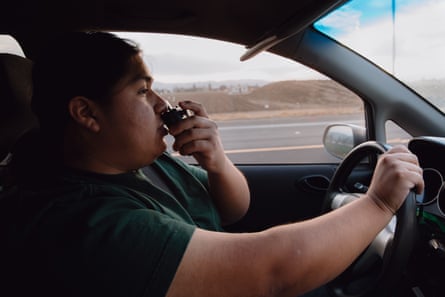
While most 18-year-olds worry about college papers and spring break plans, Cesar Vasquez drives through coastal California farm towns scanning for unmarked SUVs before dawn. He flips down his driver’s seat visor to look at a taped list of license plates he has already identified as Immigration and Customs Enforcement (ICE) vehicles, and jots down a few new ones he suspects could be. His phone buzzes constantly – tips from neighbors, text chains from volunteers alerting to ICE activity – all in an attempt to keep his community safe from being swept up in federal agents’ widening dragnet.
This is what organizing looks like for this son of undocumented immigrants. In his home town of Santa Maria, a small farming town on California’s central coast where over 80% of farm workers are undocumented, Vasquez has become both a crucial community lifeline and a known target of federal immigration enforcement.
Outside the ICE office in Santa Maria, California, Cesar Vasquez and a group of activists gather to decide who will patrol each neighborhood.
Vasquez began volunteering with the 805 Immigrant Rapid Response Network as a high school senior. Last August, he was hired full-time as a rapid response organizer, covering North Santa Barbara and San Luis Obispo counties, overseeing volunteers, supporting families and tracking ICE activity.
Routinely, he visits the families of detained immigrants. “There have been so many occasions where I walked through the door, and a kid was expecting their father or mother,” Vasquez said wistfully. “And it was just me, and I had to explain what happened to their parents.”
Other times, for Vasquez, the reality is personal. He recalled in December, speaking with families waiting for news about their detained relatives outside the immigration enforcement office in Santa Maria, when an ICE vehicle slowed down in front of them. The agent’s voice crackled from the car’s speaker, loud enough to carry through the open window: “How’s your mother, Cesar? We’ll go visit her soon.”
Vasquez drove straight home and found his mother washing clothes.
“I took her car keys and told her to stop everything she’s doing. My hands were shaking,” Vasquez said. “I then moved her to a secret location that I have precisely for this moment.”
As the sun rises in Santa Maria, Vasquez continues monitoring ICE activity in his neighborhood. The 18-year-old says he spends more time in his car than anywhere else these days.
Growing up as a birthright citizen of undocumented parents
Vasquez’s mother is one of the thousands of undocumented farm workers in Santa Maria whom he is trying to protect. She left her home in a tiny town in Mexico to cross the US-Mexico border at age 13 in search of a better life. Vasquez’s biological father was one of the first people she encountered – a Guatemalan American whose family was settled in California and who held US citizenship. He was also abusive and never legally married her, keeping her from accessing US citizenship, Vasquez said. When Vasquez was an infant, his mother ran away with her three children to Santa Maria, a town about 150 miles (240km) north of Los Angeles, where she found work in the strawberry fields. She has been trying to secure documentation for more than a dozen years now.
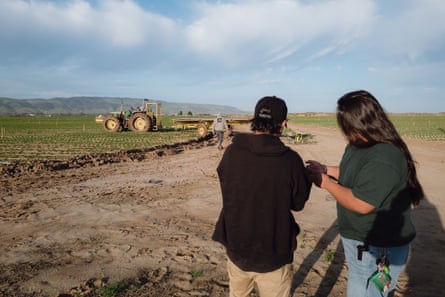
Vasquez distributes flyers on immigration rights to farmworkers in Santa Maria on 6 February.
Strawberry picking is physically demanding work, and the pay is minimal. Pickers spend hours bent over in the fields under the California sun, with no benefits, no sick days and no guaranteed work once the season slows between October and March. Climate change has made the labor even more precarious, disrupting growing cycles and shrinking paychecks. Rising costs of living – rent, food, transportation – have squeezed families further. In Santa Maria, where a two-bedroom apartment can cost $3,000 a month, many families crowd into single rooms or garages.
Built on an economy of strawberries, lettuce and wine grapes, Santa Maria has long depended on undocumented labor while rendering those workers largely invisible. Many arrived during waves of Mexican migration in the 1980s and 90s, settling into a community where immigration enforcement and workplace exploitation became routine. Before Donald Trump’s recent immigration priorities, ICE enforcement in the region tended to be more targeted – focusing on people with criminal convictions or referrals from local jails, rather than broad community sweeps. ICE didn’t even have a holding facility in Santa Maria until 2015.
But since 2025, enforcement has intensified dramatically with rapid‑response trackers documenting more than 620 immigration arrests across Santa Barbara, Ventura and San Luis Obispo counties, with Santa Maria often at the center of daily apprehensions. These high‑profile raids – often carried out with unmarked vehicles and tactical gear, drawing protests and criticism from community leaders – reflect a broader national surge in immigration enforcement under Trump.
Vasquez holds his mother along the river in Santa Maria. He keeps a feather with him, which he says brings spiritual cleansing when he burns sage.
When Trump was first elected, Vasquez was only nine years old. He was already well-acquainted with the repercussions of growing up in a mixed-status household.
“I mean, it’s common for most children of immigrants to be doing things for their parents like filling out their legal forms, right?” Vasquez said. “But in fourth grade, I had to learn what a warrant looked like and what rights I had.”
He was in a Halloween costume shop, age 14, when it clicked that his fears and concerns weren’t just his own. He overheard a woman at the register, saying she had saved all year to buy her son a costume, but it didn’t fit. The store wouldn’t take it back. Her shirt was stained with strawberries, her exhaustion visible. He’d seen his own mother do the same thing countless times, so he offered to buy the woman’s son the costume.
Building a network at 14
At age 14, Vasquez founded La Cultura Del Mundo, an entirely youth-led organization that eliminates what he calls the “red tape” associated with traditional aid. They prioritize direct, unrestricted support to families in need, asking, “How much do you need?” rather than requiring forms. The group then rapidly mobilizes whatever the family requests, whether that’s cash assistance, groceries, rent help or other essential support.
In August, La Cultura Del Mundo drew national attention when Vasquez organized La Marcha De La Puebla, a national protest against ICE raids that involved nearly 30 cities across 17 states, drawing about 10,000 participants.
Seventeen-year-old Claudia Santos is one of the many young people Vasquez has inspired. “My sister and I heard about a school walkout and just decided to go. After that, Cesar told us about a meeting at city hall, and that’s how I got involved,” Santos said. “I did it because I feel like the kids coming here from Mexico deserve a good future too.”
Vasquez packs up flyers to hand out to the immigrant community as they head to work in Santa Maria.
While Vasquez was organizing in high school, he was simultaneously struggling with his own mental health. He commuted by bus an hour each way to a school in a predominantly white neighborhood with good academic prospects.
When he told his counselor that he had anxiety, “she couldn’t understand that I was uncomfortable because I was brown in a white school, where the principal was racist and the students were racist. It led me to become really suicidal.”
Being misunderstood drove him closer to his community. He transferred to his local school and graduated early. Despite being accepted into San Diego State University, he deferred enrollment.
Most kids who grow up in Santa Maria look forward to leaving. One of Vasquez’s older sisters became a teacher in Los Angeles, the other a graduate student in the UK. But Vasquez likes that the impact of his work is immediate.
Tina van den Heever, one of his teachers from Santa Maria high school, said it was clear Vasquez was a leader with great potential: “To be honest, I worry about his safety, because as we’re seeing, the United States tends to silence people who stand up in the way that he does.”
‘I think about the kids being left behind’
During a four-day raid in late December, Vasquez’s uncle was among the 118 people detained.
“I think about the kids being left behind,” Vasquez said. “The children home for winter break whose parents never returned because of the December raids. And there was no way to know what happened to them because school didn’t reopen until days later.”
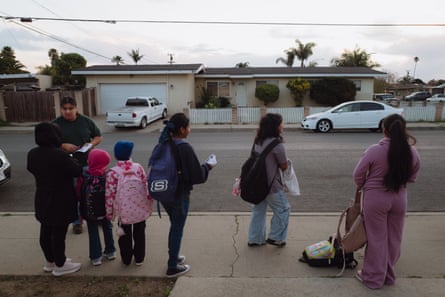
Vasquez distributes flyers on immigration rights to parents.
During the raids, flower vendors disappeared from the streets. When Vasquez later visited the area, the children of a family he had gotten close to told him they had gone inside after hearing his warning. They were safe.
The work – the constant alertness, the phone calls at all hours, the weight of knowing families depend on his network – has taken a toll. But he sees no alternative.
“I’m continuously preparing for the worst,” Vasquez said. He keeps a “to-go bag”, extra clothes and cash in his car.
Every time ICE picks up someone in the Central Coast valley, Vasquez plays the same song in his car: Hasta La Piel (Down to My Skin) by the Mexican American artist Carla Morrison. The lyrics speak to having and losing, wanting and not being able to say, intense love and desperate fear of loss – an homage to those who have been detained.
“They want us to be afraid,” he said. “But fear is what keeps people isolated.”
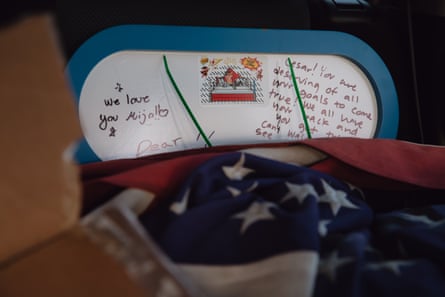
In the back seat of his car, a whiteboard filled with encouraging messages for Vasquez sits alongside an American flag.
Jennifer Chowdhury reported this story while participating in the USC Annenberg Center for Health Journalism’s Kristy Hammam Fund for Health Journalism
I follow Allison Gill’s Daily Beans morning audio podcast which gives the news from the prior day with the sources to verify it. This is one of the stories they cover deeply. They now have a video version called Beans Talk on the YouTube channel MSW. I do recommend them as a valid news source. Hugs
The iconic civil rights leader, who has died at 84, made anti-war and pro-diplomacy politics central to his presidential bids and his lifelong activism.
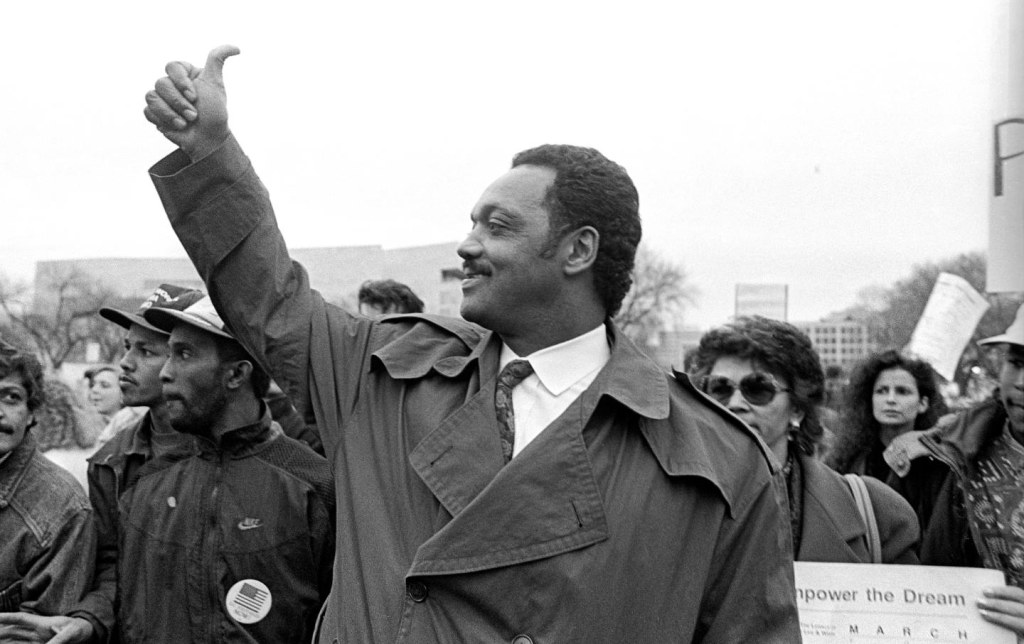
Jesse Jackson at a rally against the Gulf War in Washington, DC, on January 18, 1991. (Ricky Flores / Getty Images)
he Rev. Jesse Jackson Jr., the iconic champion of racial, economic, and social justice whose work as a young aide to the Rev. Martin Luther King Jr. began a public life that would eventually see him mount a pair of transformative presidential bids, died Tuesday morning at age 84.
Jackson’s legacy is so rich, and extends across so many generations and struggles, that it cannot be contained in one reflection. He was, as the Rev. Al Sharpton said Tuesday, “a movement unto himself.”
Over seven decades in the public arena, Jackson emerged as one of the most multifaceted figures in American history: a legendary civil rights leader, a knowing and caring defender of the disenfranchised, a vital advocate for voting rights and voter mobilization, a savvy media critic who recognized the importance of challenging narratives that promoted discrimination and division, an essential ally of labor unions, a reformer of the Democratic Party, a friend to struggling family farmers and urban workers alike, and a counselor to presidents and prime ministers. He was, as well, a man of deep faith, who expressed that faith in his ardent advocacy for peace.
That dedication to peace was central to both his 1984 and 1988 presidential bids, a fact that is too frequently neglected in cursory reflections on those seismic Rainbow Coalition campaigns.
Political historians recognize Minnesota Senator Eugene McCarthy and New York Senator Robert F. Kennedy as the great anti–Vietnam War candidates of the 1968 presidential campaign. George McGovern, the Democratic presidential nominee in 1972, is often recalled as the most ardent foe of a US military intervention to be nominated by a major American political party since Democrats ran William Jennings Bryan in 1900. Former Vermont governor Howard Dean and former Ohio representative Dennis Kucinich are remembered for seeking the Democratic presidential nod in 2004 as sharp critics of the Iraq War. Barack Obama’s prescient opposition to the Bush-Cheney administration’s war of choice, which he voiced as early as 2002, did much to advance his successful bid for the presidency in 2008. And Vermont Senator Bernie Sanders, whose 2020 presidential bid Jackson supported, reframed foreign policy debates by explicitly rejecting the elite consensus about the US role in the Middle East and so many other parts of the world.
Jackson’s two 1980s campaigns deserve a key place in this proud history—both because they were uniquely dynamic and because they had a profound and lasting impact on progressive thinking about foreign policy. That’s one of the many reasons, when veterans of the Jackson campaigns got together, we often reflected on this too-frequently-neglected aspect of his political legacy. His was a powerful and transformative message that resonates to this day.
groundbreaking advocacy on behalf of economic, social, and racial justice at home, but Jackson also outlined what was then a fresh foreign policy vision, rooted in what has come to be known as progressive internationalism. He advanced a comprehensive—and morally coherent—argument for shifting American foreign policy away from military interventionism, nuclear brinksmanship, and Cold War posturing and toward diplomacy, cooperation, and dramatically reduced Pentagon spending.
Jackson understood precisely what was at stake, and he declared in a voice so resonant that it inspired a new generation of activists, “Peace is worth the risk!”
And he was taking a risk. It is important to recall how—as Ronald Reagan was ramping up the Cold War around the world and pouring US resources into heated conflicts in El Salvador and on the border of Nicaragua—Jackson boldly broke not just with the Republican president but also with many Democrats to make opposition to war a focal point of his bid.
After it was revealed that the Central Intelligence Agency had mined three harbors in Central America, as part of an effort to destabilize the country’s left-wing government, Jackson declared in April 1984 that “the undeclared war against the people of Nicaragua…must be stopped.” In addition to criticizing the Reagan administration and the CIA, Jackson took issue with Walter Mondale and Gary Hart, the front-runners for the Democratic nomination that year, for failing to clearly deliver a message that the US must “stop our funding of terror in Nicaragua and El Salvador now and to withdraw all our troops from Central America.”
“It is not enough for Walter Mondale to call mining the harbors a clumsy and ill-conceived act,” argued Jackson. “It is not enough to imply that the main problem was not informing Congress adequately. Our foreign policy in Central America is wrong. We are standing on the wrong side of history. We are engaged in killing people, and starving people who are trying to work out their own destiny.”
Jackson’s 1984 Rainbow Coalition campaign shocked pundits by winning primaries and caucuses in key states, and by collecting roughly 20 percent of the Democratic primary vote. Jackson also made a historic trip to Central America and the Caribbean, where he met with regional leaders—including Cuban President Fidel Castro—and warned, “The signs of war are rising. We see the military buildup throughout the region. We see the United States taking sides instead of helping to reconcile the conflict. We cannot allow another Vietnam.”
The bitter legacy of the Vietnam War, which Jackson had opposed as a young aide to Dr. King, weighed heavily on his mind during the 1984 campaign. At the Democratic National Convention in San Francisco, Jackson delivered a renowned, electrifying speech, in which he recalled,
Twenty years ago, our young people were dying in a war for which they could not even vote. Twenty years later, young America has the power to stop a war in Central America and the responsibility to vote in great numbers. Young America must be politically active in 1984. The choice is war or peace.
Jackson’s focus in 1984 and in 1988 extended beyond concerns about the “dirty wars” in Central America. He campaigned as an outspoken advocate for nuclear disarmament, embracing the “nuclear freeze” movement to halt the testing, production, and deployment of nuclear weapons by the United States and the Soviet Union. He called for a rethinking of US military and economic alliances in order to advance democracy and human rights, argued for an end to US aid to the violent apartheid regime in South Africa, and proposed a new approach to Middle East relations that respected the rights of both Israelis and Palestinians.
As a 42-year-old first-time candidate in the fall of 1983, Jackson met with Arab Americans, urged the US to use diplomacy so that the Middle East would no longer be a ”flashpoint for both hot and cold war,” and said that any path to peace had to include a ”homeland and a state for Palestine.”
”It is a tragedy to see the lack of talk and dialogue in the Middle East, but it is even worse not to see it here,” said Jackson. ”The first step for peace in the Middle East is for black Americans, Arab-Americans and Jewish-Americans to start talking here.”
A young James Zogby, then the director of the Arab-American Antidiscrimination Committee, cheered Jackson’s inclusion of Palestinian rights in his campaign platform. ”He challenged us on 50 issues and not just one,” said Zogby, who would go on to place Jackson’s name in nomination at the 1984 Democratic National Convention. ”He respected us as Arab-Americans and didn’t pander to us. This is the first time ever that a presidential candidate has come before an Arab-American audience, and we don’t feel disenfranchised anymore.”
At the end of 1983, Jackson traveled to the Middle East and visited the Jaramana refugee camp in Syria, where on New Year’s Day in 1984, he told a group of Palestinian children, “Keep your dreams high. Don’t let anyone break your spirit. You’ll be free one day.” It was on that same journey that he secured the release of US Navy airman Lt. Robert Goodman, whose plane had been shot down over Lebanon and who had been captured and held by Syrian forces.
Jackson remained actively engaged with Middle East peace issues through the rest of his life. Among the memorials posted on Tuesday was one from former British Labour Party leader Jeremy Corbyn, who wrote, “It was an honor to march alongside him against the Iraq War in 2003. May his legacy inspire us to strive for a world of dignity and peace for all.” More than two decades later, one of an ailing Jackson’s last great initiatives was an emergency conference—held at the headquarters of the Rainbow-Push Coalition in Chicago in early 2024—to demand a ceasefire in Gaza.
Jackson’s faith in diplomacy and negotiation was part of a broader commitment to creating the circumstances for peace to thrive. Just like his mentor King, the Nobel Peace Prize recipient who linked his nonviolent civil rights activism in the US to the global anti-war movement—and who took his own huge risk for peace by standing against the Vietnam War—Jackson recognized the political courage that was required to advance that commitment.
As a presidential candidate, he showed that courage by talking about cutting as much as 25 percent from the Pentagon budget. In response to critics who claimed his ideas were too radical, Jackson told New Hampshire primary voters in February of 1984, “We are so strong militarily that we can afford to take measures such as these in the pursuit of peace.… We must fight for peace and give peace a chance.”
At the close of his 1988 campaign, in which he was endorsed by The Nation and won more than a dozen statewide primary and caucus contests, securing 6.9 million votes, Jackson pulled all the threads together in an epic address to that year’s Democratic National Convention in Atlanta. He spoke movingly of tackling poverty and inequality within the United States, but he was just as compelling in his discussion of foreign policy, which included a stirring call for disarmament that is as relevant today as it was 35 years ago.
The nuclear war build-up is irrational. Strong leadership cannot desire to look tough and let that stand in the way of the pursuit of peace. Leadership must reverse the arms race. At least we should pledge no first use. Why? Because first use begets first retaliation. And that’s mutual annihilation. That’s not a rational way out.
No use at all. Let’s think it out and not fight it out because it’s an unwinnable fight. Why hold a card that you can never drop? Let’s give peace a chance.
I went out shopping early this morning. Then I came home and after putting the stuff away I did all the dishes. It was not a lot but three days worth and last night I cooked a good meal. I am washing all the bed linens and all the towels in the chairs / places that Tupac lays on. So as I try to do they cartoon / meme post for tomorrow …. My mind is fractured. So these songs are in my mind. Sorry if this hurts anyone. Also remember I am not in danger of self-harm. I won’t do that to all of you who I respect so much. Hugs or best wishes to all as you appreciate the gesture. The songs below are shattering my thoughts. I walk alone, and I wish for the sound of silence. Oh, to have the thoughts in my mind stop! I desperately wish for it. I have not eaten yet today, nor did I after breakfast yesterday and Ron has called me 3 times asking me to eat. Even telling me to order something if it is more pleasing to me. I just can’t. I bought salad stuff today so maybe a salad later. I am so confused. I had four more ready to post and suddenly realized it was useless. Is my life useless? I do good things. My husband loves me. His cat sleeps pressed up against me at night, yet even last night as I struggled to sleep and he moved up onto my pillow I took no comfort from him. I am feeling so numb inside when I let myself feel anything at all because the government is forcing my pain doctors to reduce my medications despite the new MRI showing severe and increased damage to my spine. My doctors say it my be necessary for me to do surgery to get relief because RFK Jr. has determined that all pain clinics lower their clients morphine equviancy to less than 100. Those who do not feel chronic pain or live in long pain because they dont hve to suffer … well illegal drugs all of a sudden get a hollier than though about drugs. Seriously, this former drug adic is restricting needed medication from people like me with seriously damaged spines and no contributions to his campaigns. But drugs from a qualified pain doctor can mean the difference between living a quality life and suffering in even more agony. Hugs
I am sorry. I do not not want to worry anyone or cause fear. But I feel so… out of sync with the world. I just hurt. It is part physical and a lot emotional. The MRI I had just had showed many parts of my lower spine are showing far more damage than my doctors had thought. They thought I had a few more years before surgery. I cannot afford surgery. The MRI moved many of my lower vertebrae from the moderate to severe to extremely severe zone. One the report said was in civilian terms destroyed. The bone matrrial decaded, the inside soft stuff pushed out and the nerves were caught by the edges of the jagged edges of the bones both being forced out and being pinched and being pinced inside as I moved. It is why I cannot sit in my chair very long. Ron is going to get me an air seat when he gets home but I doubt it will help. I am sitting here thinking of why when my spine shows ever more damage the government is requiring that my pain doctors reduce everyone’s pain medications. Just because the former coke addict RFK Jr dosent feel the crippling pain that people like me do doesn’t mean he gets to stop our pain medication or at least shouldn’t. All that does is force us on to illegal drugs to get relief. I wonder if that is the point all along. Think of it, all the friends in pain suddenly not able to vote would change the election in plenty of ways. Hugs
Sorry, but I keep repeating the songs over and over. Hugs
Every body hurts. But today I hurt terribly. Sorry. Now I have to go struggle to make the bed because I washed the bed sheets. More pain. Hugs
By: Start TV Staff Posted: January 14, 2026, 1:17PM
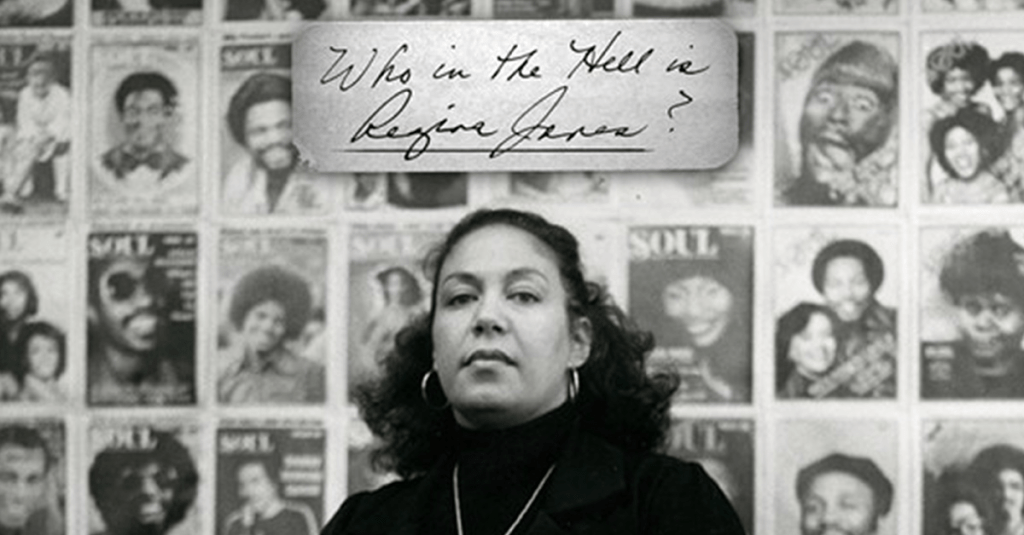
Start TV is set to premiere the award-winning documentary, Who in the Hell is Regina Jones?, on Monday, February 16 at 8P | 7C with a special encore immediately after at 10P | 9C.
The stellar production from Weigel Productions Corp. shines a light on legendary journalist Regina Jones. The documentary, which won the Outstanding Documentary Feature Award at the Greater Cleveland Urban Film Festival, turns a lens on Jones’ historical journey – the invisible labor, turmoil, struggle, and joy of a modern-day Black woman, who emerged as publisher and founder of the groundbreaking SOUL newspaper. On this nationwide platform, Black artists could get coverage long before other publications entered the arena.
Pregnant and married at 15, Regina Jones experienced the Watts Rebellion of 1965, raised five children, stepped into places where she was not wanted, and navigated a world that offered her no favors. SOUL was the first publication devoted specifically to Black musicians and perspectives in music, published from 1966 to 1982. During its run, the publication profiled some of the era’s most prominent Black artists, including Aretha Franklin, James Brown, Diana Ross, Gladys Knight, and Stevie Wonder.
Who in the Hell is Regina Jones? was produced by Weigel Productions Corp and directed by Soraya Sélène and Billy Miossi, edited by Nancy Novack A.C.E., co-edited by Alisa Selman, produced by Alissa Shapiro, and executive produced by Academy Award nominee Sam Pollard.
Frightened little kids who are U.S. citizens are running from agents of their own government because their skin color is brown instead of white. My childhood was full of fear. It is horrifying and in the case of these children it is complete bigotry and racism directed by Nazi wannabe Stephen Miller.
What is wrong in this country where adults think terrorizing little kids because of their skin color is acceptable? I cannot accept this. I cannot accept terrified children running from adults just because of skin color! What are we, apartheid South Africa? This video is horrific! Only racists could like seeing this. Hugs


 After elected officials raised a Pride flag on a temporary flagpole, activists raise the flag on the permanent flagpole at the Stonewall National Monument in New York City Feb. 12, 2026. Thousands gathered at the monument to see the flag raised after President Donald Trump had ordered the flag to be removed earlier in the week. | Seth Harrison/The Journal News / USA TODAY NETWORK
 Cesar Vasquez, who has supported families of undocumented immigrants since age 14, has become a community lifeline – and a known ICE target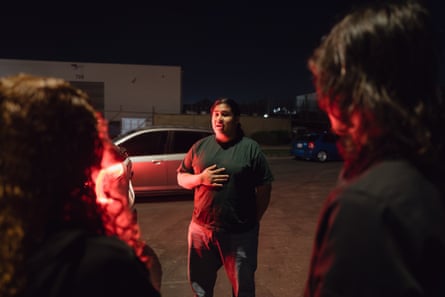



 Scottie's Playtime