So far, it’s not illegal for us to acknowledge that February is Black History Month, so here we are, doing just that. Ha! There is even some Black History for this very date in Peace and Justice History:
February 1, 1960 Greensboro first day: Ezell A. Blair, Jr. (now Jibreel Khazan), Franklin E. McCain, Joseph A. McNeil, and David L. Richmond leave the Woolworth store after the first sit-in on February 1, 1960. Four black college students sat down at the Woolworth’s lunch counter in Greensboro, North Carolina, and were refused service because of their race. To protest the segregation of the eating facilities, they remained and sat-in at the lunch counter until the store closed. Four students returned the next day, and the same thing happened. Similar protests subsequently took place all over the South and in some northern communities. By September 1961, more than 70,000 students, both white and black, had participated, with many arrested, during sit-ins. On the second day of the Greensboro sit-in, Joseph A. McNeil and Franklin E. McCain are joined by William Smith and Clarence Henderson at the Woolworth lunch counter in Greensboro, North Carolina.
February 1, 1961 On the first anniversary of the Greensboro sit-in, there were demonstrations all across the south, including a Nashville movie theater desegregation campaign (which sparked similar tactics in 10 other cities). Nine students were arrested at a lunch counter in Rock Hill, South Carolina, and chose to take 30 days hard labor on a road gang. The next week, four other students repeated the sit-in, also chose jail.
In light of current events, I thought it’d be good to review how Black History Month came to be. Below is a bit on its beginnings.
Black History Month was first observed as Negro History Week in February 1926, but the inspiration for the commemoration began over a decade earlier through a steady stream of electrifying events, discoveries, and other celebrations of Black excellence. In 1915, American historian Dr. Carter G. Woodson attended the national celebration of the fiftieth anniversary of emancipation in Washington D.C. This event was widely attended and proved to be profoundly inspiring for Dr. Woodson who, later that year, joined forces with A. L. Jackson, William B. Hartgrove, George Cleveland Hall, and James E. Stamps to establish the Association for the Study of Negro Life and History, known today as the Association for the Study of African American Life and History (ASALH 2024). ASALH had the ambitious goal of educating the public about the achievements, inventions, and progress made by Black Americans, and though the Association’s intellectual efforts were remarkable – they began to publish The Journal of Negro History in 1916 and founded Negro History and Literature Week in 1924 – Dr. Woodson had a wider vision of his mission. Wishing to continue to discover and celebrate the history of the Black past, Dr. Woodson announced the celebration of Negro History Week through a press release.
Accounts of the contributions of Black Americans were notably absent from history books, credited to white men, or omitted altogether. Progressive communities and schools were ripe for the rich history that Negro History Week offered. Matching the popularity of the week, Woodson and the Association established an annual theme for the celebration to guide and inspire educators. Weary of those simply wishing to capitalize on a popular event, “Woodson warned teachers not to invite speakers who had less knowledge than the students themselves” (ASALH 2024). Additionally, ASALH expanded their offerings to provide study materials: pictures, lessons for teachers, plays for historical performances, and posters of important dates and people. This cemented the celebration of Black history in schools and communities, and Negro History Week grew in popularity throughout the following decades, with mayors across the United States endorsing it as a holiday.
Negro History Week grew into Black History Month in 1970 under the leadership of Black educators and students at Kent State University and would become a federally recognized event six years later. President Gerald Ford recognized Black History Month in 1976 during the celebration of the United States Bicentennial. He urged Americans to “seize the opportunity to honor the too-often neglected accomplishments of Black Americans in every area of endeavor throughout our history” (Franklin 2022). Today, nearly one hundred years after that initial celebration, it is prudent to reflect on the designed purpose of Black History Month and discover that after all this time, these lessons are still relevant, inspiring, and necessary. As Dr. Woodson said, “Real education means to inspire people to live more abundantly, to learn to begin with life as they find it and make it better” (Woodson 1933).
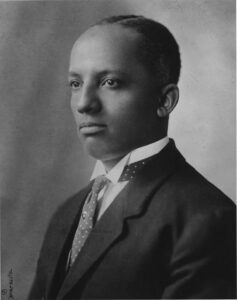
Pictured: Dr. Carter G. Woodson, The “father of Black history”
Photo Credit: Addison Norton Scurlock, Public domain, via Wikimedia Commons
ASALH. 2024. Carter G. Woodson Timeline: ASALH – the Founders of Black History Month. December 19. Accessed January 16, 2025. asalh.org/carter-g-woodson-timeline/.
Woodson, Carter G. 1933. The Mis-Education of the Negro. Trenton: Africa World Press.
==========
All right! So, we see that Black History Week then Month has been around for at least 20 years longer than our current POTUS, who seems to be ignoring the month’s existence. But, there’s no reason any of the rest of we the people have to! Including all history makes the US so much richer in knowledge. Most local historical and cultural organizations are going to have commemorations this month. What fun it will be, and how community-unifying for each of us to find an activity near us, and join in!
A bag of tiny chocolate chip cookies from the company who was here a few weeks ago working in my bathroom. I’m off cookies until my jeans are looser again like they were in November, so these will go into the freezer, but anyway, they still brightened the day!
Next, a cool Substack post from Worriedman. I’ve shared his posts here before. Today’s is extra cool.
February

by Margaret Atwood

Winter. Time to eat fat
and watch hockey. In the pewter mornings, the cat,
a black fur sausage with yellow
Houdini eyes, jumps up on the bed and tries
to get onto my head. It’s his
way of telling whether or not I’m dead.
If I’m not, he wants to be scratched; if I am
He’ll think of something. He settles
on my chest, breathing his breath
of burped-up meat and musty sofas,
purring like a washboard. Some other tomcat,
not yet a capon, has been spraying our front door,
declaring war. It’s all about sex and territory,
which are what will finish us off
in the long run. Some cat owners around here
should snip a few testicles. If we wise
hominids were sensible, we’d do that too,
or eat our young, like sharks.
But it’s love that does us in. Over and over
again, He shoots, he scores! and famine
crouches in the bedsheets, ambushing the pulsing
eiderdown, and the windchill factor hits
thirty below, and pollution pours
out of our chimneys to keep us warm.
February, month of despair,
with a skewered heart in the centre.
I think dire thoughts, and lust for French fries
with a splash of vinegar.
Cat, enough of your greedy whining
and your small pink bumhole.
Off my face! You’re the life principle,
more or less, so get going
on a little optimism around here.
Get rid of death. Celebrate increase. Make it be spring.

Presented complete for educational purposes. And because no page celebrating the work of the great Margret Catwood is complete without the phrase "Cat, enough of your greedy whining and your small pink bumhole."

It's the last Saturday before February. It's wicked cold  - 2 degrees with a breeze.

It's Caturday, though Hello  Barncat!
Sam, in repose
Amos , paying attention!
Cold assed….ass.
One more !
Soon ...
That's all I got room for - Thanks for dropping by !
In the video below we learn that ICE is now disappearing people. Simply taking them and not documenting where they are taken or what happened to them. Families missing loved ones simply can’t find them in the ICE system anywhere. Hugs
I am reading / hearing clips of a lot of pushback, especially in sports media that ICE is not going after the worst of the worst and instead is going after only hardcore murderers, rapists, predators, or other violent criminals. These people reject any mention or idea that ICE is targeting people who came here legally or have asylum, or even that they are detaining children. They simply watch only their right wing media bubble which lies to them or they are paid / make their clicks supporting the right wing talking points. So I post this with the question what crime did this child do against others? Because we can see the crime being committed against him. There is a video at the link below. Hugs
Ramos’ mother addressed his deteriorating health earlier this week: “Liam is getting sick because the food they receive is not of good quality,” she told MPR News on Monday. “He has stomach pain, he’s vomiting, he has a fever and he no longer wants to eat.”
Liam Conejo Ramos, the pre-school student who ICE agents in Minneapolis nabbed last week and shipped off to a Texas detention facility with his dad, is in poor health now, according to his school’s superintendent.
Zena Stenvik, the superintendent for Ramos’ Columbia Heights public school district, told HuffPost that she spoke to the 5-year-old’s mother on Tuesday.
“Unfortunately, Liam’s health is not doing great right now,” said Stenvik. “He’s been ill. I’ve been told he has a fever. So I’m very, very concerned about his well-being in that facility.”
His mother is also “incredibly distraught,” she said.
Ramos’ mother addressed his deteriorating health earlier this week: “Liam is getting sick because the food they receive is not of good quality,” she told MPR News on Monday. “He has stomach pain, he’s vomiting, he has a fever and he no longer wants to eat.”
Marc Prokosch, the family’s attorney, did not immediately respond to a request for comment.
Ramos and his father, Adrian Alexander Conejo Arias, are being held at the South Texas Family Residential Center in Dilley, Texas. This is despite Arias entering the country legally and having no criminal record, according to Prokosch. Late Tuesday, a federal judge temporarily blocked federal immigration officials from deporting Ramos and Arias, for now.
The conditions at the Texas facility where Ramos is being held are “absolutely abysmal,” according to attorney Eric Lee, who represents other families being held there.
“They mix baby formula with water that is putrid. The food has bugs in it. The guards are often verbally abusive,” Lee told Minnesota Public Radio on Monday. “One of my clients had appendicitis, collapsed in the hallway, was vomiting from pain, and the officials told him, ‘Take a Tylenol and come back in three days.’”
Five-year-old Liam Conejo Ramos was detained Jan. 20, 2026 in a suburb of Minneapolis.
Columbia Heights Public Schools
Reps. Joaquin Castro (D-Texas) visited the Texas ICE facility on Wednesday to meet with children and families being held there, including Ramos and his dad.
He posted a photo on social media after meeting with them. It shows Ramos either sleeping or lying weakly in his father’s arms, as Castro stands with them:
Rep. Joaquin Castro (D-Texas) visits Liam Conejo Ramos and his father in a Texas detention center, a week after ICE agents detained them outside their home in Minneapolis.
Congressman Joaquin Castro
“Just visited with Liam and his father at Dilley detention center,” Castro wrote. “I demanded his release and told him how much his family, his school, and our country loves him and is praying for him.”
In a separate video, the Texas Democrat said he spent 30 minutes with Ramos and his dad. He said the 5-year-old “wasn’t in any kind of emergency or anything, physically,” but that he shared the photo of them together so people could see the state he’s in.
“His dad said he hasn’t been himself and he’s been sleeping a lot, because he’s been depressed and sad,” said Castro. “Liam actually was not awake during our visit.”
Well I had hoped to hear from Schumer but at least he is demanding the reforms be in writing. He is getting a lot of pressure to do something this time. But he wanted to end the last shut down with a loss because he was afraid the republicans would destroy the filibuster. He settled for a vote that meant nothing and was totally performative. Will he do the same here? Hugs
Well at least he can articulate the points that need to be made in a strong manner. I liked him better clean shaven. My view on a beard is either grow one big, bushy, and long or don’t grow it. Scruffy is a sad look I think and reminds me of teenagers getting their first facial hairs. I wonder what political job he will run for next. I think Senate, or governor. Hugs
from Florida, too! I’m not sure how liberal he’ll be, but there’s a lot of work to get done before worrying about that, and we know this guy can do the work.













 Scottie's Playtime