An Essential Shot: Vitamin K shots, which help the blood to clot, are one of three key interventions for newborns, along with an antibiotic eye ointment and the hepatitis B vaccine.
Increasing Rejections: The government doesn’t track vitamin K rejections, but hospitals have seen a rise in parents opting out of the shots for their newborns, often driven by unfounded fears.
Troubling Data: Hundreds of children die each year from spontaneous bleeding in the brain, a common result of vitamin K deficiency, suggesting that many related deaths go unreported.
These highlights were written by the reporters and editors who worked on this story.
They entered the world the way babies should, with piercing cries announcing their arrival. They passed their newborn screening tests. Some made it to their 2-week wellness visits without concern.
Then, without warning, their systems began to shut down. A 7-week-old boy in Maryland developed sudden seizures. An 11-pound girl in Alabama stopped breathing for 20 seconds at a time. A baby boy in Kentucky vomited before becoming lethargic. A brown-haired girl in Texas, not yet 2 weeks old, bled around her belly button.
Desperate to save them, records show, doctors inserted tubes into their airways and hooked them up to IVs. They ordered blood transfusions. They spent half an hour trying to resuscitate one boy until his parents told them they could stop. They shaved another boy’s soft locks to embed a needle directly into his skull to reduce the pressure in his brain.
None of it was enough.
At the morgue, the babies were brought in with their diapers and blankets and with their hospital ID bracelets still wrapped around their tiny ankles. The pathologists’ findings were like those you would typically see in ailing adults, not newborns — the kind of bleeding seen during strokes or brain tissue loss similar to what happens when radiation is administered to treat cancer.
Their autopsies, which took place over the last several years, all came to the same conclusion: The deaths were caused, in whole or in part, by a rare but potentially fatal condition known as vitamin K deficiency bleeding.
In almost every case, the babies’ deaths could have been prevented with a long-standard vitamin K shot. But across the country, families — first in smatterings, now in droves — are declining the single, inexpensive injection given at birth to newborns to help their blood clot.
Many of them are doing so out of a well-meaning but ill-informed abundance of caution. In the hopes of safeguarding their newborns from what they see as unnecessary medical intervention, they have shunned fundamental and scientifically sound pharmaceutical intervention. The trend is also fueled by a contradictory pairing: families’ fierce desire to protect their babies and a cascade of false information infused into their social media algorithms.
Although it is not a vaccine, the vitamin K shot has been swept up in the same post-pandemic tide that has led to a drop in key childhood vaccines, including for measles and whooping cough.
The vitamin K shot is one of the three main interventions, along with the hepatitis B vaccine and an antibiotic ointment in the eyes, that newborns typically receive before leaving the hospital. Leading American institutions and the World Health Organization recommend that newborns get the shot.
In December, the Centers for Disease Control and Prevention stopped recommending that all newborns get the hepatitis B vaccine, which has been highly effective at fighting a virus that can lead to lifelong infections and liver cancer. A federal judge in March temporarily blocked the revised childhood vaccination schedule that included that recommendation. Some families are also rejecting the eye ointment.
Two weeks ago, at a House subcommittee hearing, Rep. Kim Schrier, D-Wash., pressed Health and Human Services Secretary Robert F. Kennedy Jr. to reassure parents that the vitamin K shot is safe. He refused and pushed back.
“I’ve never said, literally never said, anything about it,” Kennedy said.
“That’s exactly the point,” responded Schrier, who is a doctor. “You don’t say anything about it, but the doubt you’ve created about all of medicine and science is causing parents to make dangerous decisions.”
An HHS spokesperson did not respond to questions but in an email blamed the administration of former President Joe Biden for the rise in parents rejecting vitamin K shots. “Vitamin K at birth,” the spokesperson added, “remains the standard of care.”
Meanwhile, families continue to be inundated with advice from self-proclaimed experts using medical terms incorrectly and misunderstanding science to convince parents that getting the shot could put their newborns at risk of grave harm.
Nearly a century’s worth of research and medical advancements shows the opposite to be true.
Babies who don’t get the vitamin K shot, research shows, are 81 times more likely than those who do to develop late vitamin K deficiency bleeding, where in many cases oxygen can’t reach their brains and blood pools around their skulls. Perhaps most alarming is that, according to the CDC, 1 in every 5 babies with vitamin K deficiency bleeding will die.
Determining precisely how many babies have died or suffered severe brain damage because of a lack of vitamin K is difficult. State and federal agencies don’t track data around vitamin K injection refusal or subsequent bleeding, which impedes their ability to quantify and track outcomes, including death.
The number of deaths directly attributed to vitamin K deficiency bleeding appears to be small — fewer than a dozen annually — but has started to climb in recent years, according to death certificate data from federal and state agencies.
But those numbers capture only a fraction of deaths, which often are classified only by other, more immediate causes, such as bleeding in the brain. In 2024, for example, more than 700 newborns died from spontaneous bleeding in their brains, which could have been complicated by liver disease or prematurity. Still, six medical specialists and one official at the CDC said a meaningful portion of those deaths likely were caused by vitamin K deficiency. Many more babies survive the bleeding but suffer massive brain bleeds and lasting injuries.
“A lot of the providers don’t have this on their radar,” said Dr. Jaspreet Loyal, a pediatric hospitalist at Yale Medicine. “The lack of data is almost acting like a reassurance for families that this risk is worth taking.”
Although it is difficult to quantify deaths attributable to vitamin K deficiency, there is clearly a large jump in the number of parents declining the vitamin K shot. Some hospitals have seen refusal rates more than double. A national study of more than 5 million births, published in December, found that the rate of U.S. babies not receiving vitamin K at birth topped 5% in 2024 — up 77% from 2017.
More Newborns Are Not Getting Vitamin K Shots
More than 5% of newborns in the U.S. did not receive vitamin K shots in 2024.
Source: “Trends in Vitamin K Administration Among Infants,” JAMA
The success of the shot has been so remarkable that it nearly eliminated vitamin K deficiency bleeding altogether. The science was settled decades ago.
“This was not something we even bothered to spend much educational effort on,” said Dr. Allison Henry, the director of newborn medicine service at Cedars-Sinai Guerin Children’s in Los Angeles, “because there was this simple, safe intervention.”
A cluster of cases 13 years ago was one of the first major signs that something was amiss.
Four babies were rushed to a Nashville, Tennessee, children’s hospital after they suddenly fell ill months apart. Stunned, doctors ran tests that revealed severe bleeding and reached out to Dr. Robert Sidonio Jr., their blood disorder specialist. They learned that the parents had declined vitamin K shots for the babies, each of them between 6 and 15 weeks old.
Once they realized that, the medical team moved quickly to treat them, injecting them with vitamin K and hoping it wasn’t too late. Much to the relief of doctors, they all survived. Only one infant had developmental delays.
The parents explained that they had declined the shot for a number of reasons: a concern, based on long-debunked claims, that the shot could cause leukemia; a belief that the shot wasn’t necessary; and a desire to reduce their baby’s exposure to “toxins.”
The CDC and the state health department opened an investigation and later published a report that found that when the parents declined the shot, their awareness about the risk of bleeding was “incomplete or absent.”
Dr. Anna Morad, a pediatrician at Monroe Carell Jr. Children’s Hospital at Vanderbilt in Nashville, said she had witnessed a gradual rise in families refusing vitamin K leading up to the hospitalizations.
She and her colleagues went into the Nashville community to speak at birthing centers and advise families about the benefits of vitamin K. One mother who had refused the shot for her newborn partnered with Morad and described how she came to realize that the shot can save lives.
More than a dozen pediatricians interviewed by ProPublica said they strongly recommend all three of the typical newborn interventions but agreed that the vitamin K shot is the most vital.
“I’m picking vitamin K every day,” Morad said. “Absolutely.”
With time, the number of families who turned down the shot dropped. As the need for the community outreach waned, Morad lost touch with the mother she had teamed up with and refocused her energy on directing the newborn nursery at Vanderbilt Health.
“I’ll be honest, I thought we had turned the corner,” Morad said. “Naively, I thought that would be enough.”
Dr. Anna Morad, a pediatrician at Monroe Carell Jr. Children’s Hospital at Vanderbilt in Nashville, says the vitamin K shot is the most essential of three interventions that newborns are typically given. “I’m picking vitamin K every day. Absolutely.”Stacy Kranitz for ProPublica
All newborns lack vitamin K. No matter how much vitamin K a mother consumes, it doesn’t sufficiently pass through the placenta, and breast milk contains only small amounts. That puts babies who are exclusively breastfed at a higher risk for vitamin K deficiency bleeding. Formula is fortified with vitamin K, but even with that, experts agree, babies should still get the shot.
Doctors have yet to understand why some babies who don’t get the vitamin K shot are fine while others bleed uncontrollably. But they do know that the risk increases dramatically. For babies who don’t get the shot, the risk for vitamin K deficiency bleeding from a week after birth to 6 months ranges from 1 in 14,000 to 1 in 25,000 births. With the shot, the research shows, the risk drops to less than 1 in 100,000.
The role of vitamin K is so crucial that researchers were awarded the Nobel Prize in 1943 for their discovery of its ability to form clots and stop bleeding in babies. The official presenting the award called the discovery the vitamin’s “greatest practical importance” and lauded it among the discoveries that have been of great benefit to humankind.
In 1961, the American Academy of Pediatrics recommended that all newborns in the U.S. get a shot of vitamin K. The CDC has supported newborns getting the shot as well, devoting several pages online to raising awareness around vitamin K deficiency bleeding and writing that babies may bleed “into their intestines, or into their brain, which can lead to brain damage and even death.” For decades, medical textbooks and lectures have presented the vitamin K injection as an example of a public health policy success.
After reports that vitamin K deficiency bleeding was on the rise, the American Academy of Pediatrics updated its policy statement in 2022 to stress the shot’s safety and efficacy. The paper included talking points for pediatricians to help them respond to common misconceptions: “Vitamin K injection does not contain mercury. Vitamin K does not cause cancer. The vitamin K injection used in newborns is safe. The dose is not too high for newborns.”
“We’re a victim of our own success,” said Dr. Ivan Hand, the director of neonatology at Kings County Hospital Center in New York and the co-author of the American Academy of Pediatrics statement. “Since we’ve been treating babies with vitamin K, we haven’t seen much deficiency bleeding, so people think it doesn’t exist.”
Seeing photos online of healthy babies who didn’t get the vitamin K shot and reading comments from parents who felt justified in their refusal, it’s easy to think that the risk of bleeding isn’t real, or at the very least that it’s exaggerated.
On Facebook, comments about the shot include: “Don’t do it!” “Huge lie!” and “It’s a scare tactic.” One person wrote, “Never will I ever inject my baby with poisons from big pharma.”
Families have also pointed to a 2023 episode about vitamin K shots by conservative podcaster Candace Owens, who said, “What Big Pharma is saying is that we realize that babies were born wrong. They don’t have enough vitamin K, and so we’re going to give them what they always needed. God designed us wrong.”
Owens did not respond to a request for comment.
Hidden is the agony of parents mourning the loss of their babies. Some are still in denial.
ProPublica spoke with five of those families, but none of them wanted to be identified publicly.
The obituaries, social media posts and GoFundMe pages capture the utter despair of the families, though none of them reckon with the decision not to get the vitamin K shot.
“No one could’ve prepared us for the heartbreak we faced 6 weeks after our little miracle was born,” one mother wrote. “She had a spontaneous unexplained brain bleed that led to brain death.”
“We miss his sweet smell,” another family wrote.
A third family, who made their decision after reading about vitamin K on social media and talking with their midwife, dismissed the vitamin K shot altogether. Instead, the father expressed outrage at the hospital for not delaying the clamping of the umbilical cord. He said he believed doing so would have allowed his son to be infused with vitamin K from the cord blood, a popular theory on social media. Research, however, shows that while delayed cord clamping can raise the baby’s hemoglobin levels, it does not have the same effect on vitamin K.
“I figured the hospital was already pissy with me because we didn’t vaccinate at all,” he told ProPublica. “They lost out on all the money from that.”
The family’s anger has subsided some since the baby’s death, in part because of their trust in God’s plan.
“I can sit here and be upset and sad, but this brought me closer to God,” the father said. “I just can’t wait to be with him.”
Two of the families who went on to have other children found themselves facing the same decision: Would they decline the vitamin K shot again? Both got the shot for their newborn.
Autopsy reports reviewed by ProPublica, like these two from children in Minnesota and Arizona, have notes from coroners citing vitamin K deficiency as a cause of death.Obtained and redacted for privacy by ProPublica
Morad watched as the number of families declining vitamin K climbed over the last year.
In January, she reached out to Sidonio, her former colleague who first recognized the 2013 cluster of cases there, for advice. Sidonio, now a pediatric hematologist oncologist at Children’s Healthcare of Atlanta and professor at Emory University School of Medicine, said he’s more worried than ever.
During that cluster, Sidonio recognized the need to collect data on how often parents decline the shot and what happens to those babies. But in discussions with the CDC, he said, he was told that it would be too difficult.
More than a decade later, nothing has come of it. In a recent email to ProPublica, federal officials said vitamin K deficiency bleeding has never been submitted for consideration as a notifiable condition.
“If you don’t track it, you don’t document it,” said Sidonio, frustration building in his voice. “They have to make it a reportable health condition, just like a new measles case. That’s the only way it’s going to change.”
Like him, Dr. Kristan Scott, the lead author of the national study that found a jump in the number of babies not receiving vitamin K, also landed on a need for a robust system to monitor vitamin K refusals and any subsequent consequences.
“We don’t have a clean data repository provided by public health systems or the state that would allow us to be able to track this in a more systematic fashion,” said Scott, who is a neonatologist at the Children’s Hospital of Philadelphia.
Some doctors failed to recognize the role of vitamin K when a baby came into their emergency rooms, let alone knew how to reverse the damage from the declined shots. Many of them encountered the condition only in medical school textbooks.
Some hospitals have started to run their own numbers, but the effort is scattershot. The data is also usually kept in house, so there’s not a wider knowledge of the problem. Recognizing the urgency of the matter, officials at a handful of hospitals agreed to share their data with ProPublica.
Doctors at St. Louis-based Mercy, which runs birthing hospitals in Missouri, Kansas, Oklahoma and Arkansas, began noticing an uptick in families turning down the vitamin K shot during the pandemic. Last year, 1,552 babies across all Mercy hospitals didn’t get the injection. In 2021, that number was 536.
And at Idaho’s largest hospital system, the refusal rates have gone up every year since the start of the pandemic, and in some cases have more than doubled. In 2020, 3.8% of families across St. Luke’s Health System declined the vitamin K shot for their babies. In 2025, that figure jumped to 9.8%. One hospital even reached 20% of babies not getting vitamin K shots.
At least two babies treated at St. Luke’s died within the last year from complications related to vitamin K deficiency bleeding, hospital officials confirmed. But Dr. Tom Patterson, a pediatrician who treats newborns at some St. Luke’s hospitals and is among the most vocal in warning about the climbing refusal rates, suspects there may be more.
Patterson recently pleaded with a family to allow their baby to get the shot. The father refused and shocked the doctor by going even further. He approached the nurses to complain about Patterson pushing the matter.
How We Reported This Story
As part of our reporting, ProPublica contacted 55 hospitals and birthing centers around the U.S.; interviewed more than 30 doctors; and filed nearly 90 public records requests with state and local health departments, medical examiners and other agencies. ProPublica also analyzed data from the Centers for Disease Control and Prevention and examined hundreds of pages of medical and autopsy records.
In this interview Graham Platner responds to his detractors accusations against him. He discusses the tattoo and the Jewish times report that says he had talked about it while working at a bar during the time frame he was not working there. So there is not any credible evidence that he knew what the tattoo was. As he said why would he have danced with it in full display to his extended Jewish family? He makes sense. He understands that people may not like him because he is not polished as a politician. He also says he stumbles verbally and struggles to correct and improve himself. It was a hard hitting interview and Platner came off as very reasonable. Hugs
Now, in this must-watch interview, Mehdi Hasan speaks to Platner not just about his vision for a progressive “political revolution” in Washington DC but also about some of his controversies, including his social media and his tattoo that resembled a Nazi symbol.
Advocates for LGBTQ+ Catholics expressed surprise to see the Vatican publishing the testimonies of married gay men.
Some of the hundreds of LGBTQ+ Catholics and their families who joined a Holy Year pilgrimage to Rome, celebrating a new level of acceptance in the Catholic Church and crediting Pope Francis for the change, walk through the Holy Door of St. Peter’s Basilica at the Vatican, Sept. 6, 2025. (AP Photo/Andrew Medichini)
The Vatican released a report on Tuesday (May 5) that included the testimony of two married gay Catholics and acknowledged the church’s role in “the solitude, anguish, and stigma that accompany persons with same-sex attractions and their families.” The report also reflects on the negative impacts of conversion therapy, or “the devastating effects of reparative therapies aimed at recovering heterosexuality.”
“ It’s a big deal because they included testimonies and published testimonies from two LGBTQ people, both of them married, which is also unusual for the Vatican to do,” said the Rev. James Martin, a founder of Outreach, an LGBTQ Catholic ministry. “As far as I know, it’s the first time that in any official publication of the Vatican, they’ve included witnesses and testimonies and stories from LGBTQ Catholics in any kind of detailed way.”
The report comes from a group of theologians, including bishops, priests, a sister and a layperson, convened by the Vatican to study “controversial” issues raised by the Synod on Synodality, Pope Francis’ signature listening initiative, to which Martin was a delegate. Though church reform advocates hoped — and traditionalists feared — that the synod would bring major changes to church teaching around gender and sexuality, the decision to relegate contentious issues, such as LGBTQ+ inclusion, to study groups instead of general discussion was widely seen as a damper.
As expected, the synod study group report does not announce major changes to church doctrine, but it does suggest that the Catholic Church address the impasse between “doctrinal firmness” and “pastoral welcome” by listening and using a transdisciplinary approach, such as incorporating insights from psychology, alongside the Bible and church doctrine.
“ It’s a really good — I would even say historic — document,” said Yunuen Trujillo, a lesbian lay minister from Los Angeles. “ It’s still calling for all Catholics to engage in a process of discernment that is respectful of people’s lived experiences.”
Trujillo, author of “LGBTQ Catholics: A Guide to Inclusive Ministry,” said it might take a while for LGBTQ+ Catholics in the pews to feel the impact and noted that the document only focuses on lesbians, gays and bisexual people. “But I do believe it would be a positive impact, not a negative one,” she said.
In this Oct. 4, 2023, file photo, Pope Francis, far right, participates in the opening session of the 16th General Assembly of the Synod of Bishops in the Paul VI Hall at the Vatican. (AP Photo/Gregorio Borgia)
Marianne Duddy-Burke, a married lesbian Catholic and DignityUSA’s executive director, said, “ The most significant thing for me was the recognition that top-down trying to dictate behavior and morality on the basis of dogma isn’t working,” adding she was “hopeful” to see the report using the language of a “paradigm shift.”
The “paradigm shift” the report proposes is a move away from applying abstract theological principles to on-the-ground realities and instead seeing theory and practice as a “virtuous cycle.” For the two to effectively inform each other, the report argues, requires a focus on relationships, transparency and learning. The document offers this theological framework not just for LGBTQ+ issues but for broader use, including in nonviolent activism and protest.
This synod document was written by the study group, not the pope, but its release to the public would have required his authorization.
The report’s release garnered some blowback, a portion of which fell on Pope Leo XIV. Far-right Catholic news organization LifeSite published a story on the report, raising concerns that the report was questioning “the sinful nature of homosexuality” and leaving unresolved the “debate on same-sex ‘marriage.’” Co-founder John-Henry Westen released a video warning that the report’s pro-LGBTQ+ stance makes clear the meaning of “synodality” under Leo.
Advocates for LGBTQ+ Catholics expressed surprise to see the Vatican publishing the testimonies of married gay men.
“ I was expecting a rather bland report. And this was not that,” said Francis DeBernardo, executive director of New Ways Ministry, which serves LGBTQ Catholics. “ In days gone by in the church, they would try to tick off the token box by getting someone who had certain traits and characteristics, but who was just not critical of the church in any way.”
Martin said this is the first time he remembers seeing conversion therapy “critiqued that strongly” in a Vatican document. “There have been certain bishops who have been very muted in their critique of conversion therapy, but then there have also been bishops who have used organizations whose techniques really verge on conversion therapy,” he said.
One gay Catholic wrote of “wounds from the Christian community” in his Vatican-released testimony. “I cannot ignore the scars I carry. I have witnessed the devastating effects of ‘conversion therapies’ and the break-up of families, which felt like an attack on God’s sensitive and blameless creation. These experiences deeply hurt, because they target the inherent dignity of a person who simply bears the love of another of the same gender.”
But the married Portuguese man also wrote of his deep faith in the Eucharist and his sharing “a life of faith, service, and love” with his husband. “I live my life in profound peace with God, who knows me from my mother’s womb.”
“I feel the Church needs to move beyond mere ‘welcoming’ and ‘pity,’” he wrote in the testimony. “We need to proclaim the unspoken truth: God loves you and desires your wholeness. Sexuality is one part of our life, and difference is a hallmark of Creation.”
DeBernardo said the testimonies of LGBTQ+ people and their advocates have also been moving for the 17 bishops who have participated in three different meetings with New Ways Ministry in recent years. “We had a bishop at the end of the meeting in tears because he was so regretful of the way he had thought about LGBTQ people,” DeBernardo said.
“Dialogue really is the first step,” said DeBernardo. “ The genius of Pope Francis is that he realized that people had to start talking with one another, and learning about each other and not having the fear and the stereotypes.”
For Duddy-Burke, who represents a grassroots group led by LGBTQ+ Catholics that was banned 40 years ago from meeting in Catholic spaces — and who said she has struggled for years as a result to even have these conversations — the document inspires hope: “We didn’t have a place at the table and, and this document says that it’s time that we did,” she said.
At the same time, Duddy-Burke worries about whether those who hold the power will continue to dialogue and be willing to have their “minds and hearts changed.”
“And how will that be managed in parts of the world where it’s absolutely unsafe and it’s sometimes illegal, you know, for people to come forward as queer?” she asked.
The synod report also addresses “active nonviolence,” highlighting the examples of Martin Luther King Jr., Mahatma Gandhi, Filipino “People Power” and Polish “Solidarity” anti-government movements, as well as the experience of a Catholic Serbian conscientious objector. Peace has been a major focus of Leo’s pontificate, and his recent anti-war statements have led to conflict with the Trump administration, which has used theological language to promote its war in the Middle East.
In the Vatican report, the theologians suggest that “just war theory,” which Catholic U.S. Vice President JD Vance has referenced to defend the war, is “inadequate” in the modern context. “Since war can no longer be confined to military targets but overflows into civilian life, taking on new forms (hybrid, asymmetrical, etc.), the recourse to frameworks used in the past for legitimate defence — and even more so for ‘just war’ — appears increasingly inadequate,” they write.
On Tuesday, the Vatican also released the report of another Synod study group dedicated to bishop selection and other bishop issues. That report proposed broad consultation — including the perspectives of lay people, in addition to clergy and religious — when it comes to potential bishop candidates as well as ideal future bishop qualities.
On the last post I made about this I was going to write a long intro. However when I read the comments every point I would have made is made in the comments in far fewer words than I would have done. So if you wish to see opinions on what the government is doing to follow Russia and wipe the LGBTQ+ from society in the name of protecting children / straight people / cis people / and religious privilege to discriminate then please read the comments. Hugs
The Trump administration has made an aggressive push to add the president’s name to buildings, battleships, money and government websites.
President Donald Trump is physically leaving his mark on Washington and beyond, more so than any other president in modern U.S. history.Andrew Harnik / Getty Images file
The federal government is undergoing an unprecedented presidential branding makeover, with Donald Trump’s name being added to everything from buildings and battleships to a drug website and a park pass.
While Trump has had roads and even an airport named after him since winning a second term in office, his administration has initiated a series of actions to imprint his name and likeness on the federal government well beyond internal documents and communications.
The branding is in stark contrast to prior presidencies, including Trump’s first term, when the largest branding controversy involved having his name added to Covid relief checks during an election year.
Here’s a look at all the places and items where the administration has added Trump’s name during his second term.
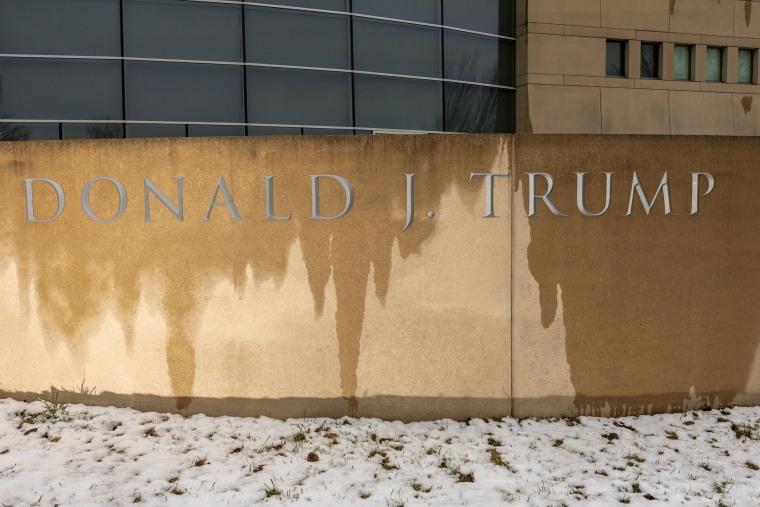
Donald J. Trump U.S. Institute of Peace
The U.S. Institute of Peace headquarters in Washington last year.Alex Kent / Bloomberg via Getty Images file
The first federal building to be named after a sitting U.S. president was the U.S. Institute of Peace headquarters in downtown Washington in December 2025. The agency was named by Congress when it was established through legislation in 1984.
The renaming was carried out by the State Department.
“President Trump will be remembered by history as the President of Peace. It’s time our State Department display that,” Secretary of State Marco Rubio said in a post on social media on Dec. 3, 2025.
The Donald J. Trump and John F. Kennedy Memorial Center for the Performing Arts
The Kennedy Center in Washington last year.Al Drago / Bloomberg via Getty Images file
About two weeks after the Institute of Peace renaming, the president’s handpicked board at the John F. Kennedy Memorial Center for the Performing Arts voted to add his name to the storied performance venue as well.
“The unanimous vote recognizes that the current Chairman saved the institution from financial ruin and physical destruction,” a spokesperson for the center said at the time.
Democrats and some Kennedy family members say the name change is illegal, since the center was established as a living memorial to Kennedy. Rep. Joyce Beatty, D-Ohio, who’s an ex officio member of the board, filed a suit challenging the change. The case is still in litigation.
Trump-class battleships
“Trump-class” battleships were announced at Mar-a-Lago last year.Tasos Katopodis / Getty Images file
Also in December, then-Navy Secretary John Phelan unveiled “Trump-class” warships during an event at Trump’s Mar-a-Lago estate in Florida.
The “Trump-class battleships,” including a vessel dubbed the USS Defiant, will be “the largest, deadliest and most versatile and best-looking warship anywhere on the world’s oceans,” Phelan said.
“Hopefully we never have to use them, but there will never be anything built like these,” Trump said at the event.
The Trump gold card
President Donald Trump displayed a “Trump gold card” visa aboard Air Force One last year.Mandel Ngan / AFP – Getty Images file
The president unveiled his “Trump gold card” visa in December. Foreign nationals can pay $1 million to obtain the card, which enables them to legally live and work in the U.S. once they’re approved.
It’s “the green card on steroids,” Trump said as he displayed the card at the White House. He said companies can buy the gold cards for students so they can stay in the country instead of being “shipped out” after graduation.
As of late April, only one person has been approved for the card, The Associated Press reported.
Trump coins
Designs for Semiquincentennial gold coins featuring President Trump.Treasury United States Mint
In March, a federal commission consisting solely of Trump-appointed members approved a 24-carat commemorative gold coin depicting the president in honor of the country’s 250th anniversary.
The design approved by the Commission of Fine Arts features an image of Trump in the Oval Office on one side and a bald eagle on the other. The coin needs to be approved by the Treasury Department, which has already announced plans to release a separate $1 coin featuring the president as part of the anniversary celebration.
Trump dollar bills
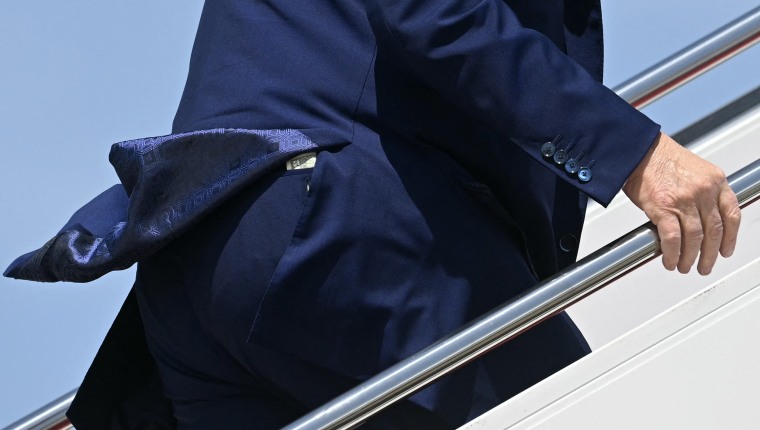
The President boarding Air Force One with a $50 bill sticking out of his pocket last year.Jim Watson / AFP via Getty Images file
The Treasury Department announced in March it would be adding Trump’s signature to “future paper currency” as another part of the country’s 250th anniversary.
“There is no more powerful way to recognize the historic achievements of our great country and President Donald J. Trump than U.S dollar bills bearing his name, and it is only appropriate that this historic currency be issued at the Semiquincentennial,” Treasury Secretary Scott Bessent said in his announcement.
Paper currency typically only bears the signature of the treasury secretary and treasurer, and has never featured that of a sitting president.
Trump passports
The State Department will be releasing a limited series of U.S. passports featuring an image of President Trump.U.S. State Dept.
The State Department announced in April that it would be issuing a limited number of U.S. passports with a large image of Trump on the inside cover as part of the 250th celebration as well.
Olivia Wales, a White House spokesperson, said in a statement that the “new patriotic passport design provides yet another great way Americans can join in the spectacular celebrations for America’s 250th birthday.”
Trump national park pass
The Interior Department revealed in November that it was featuring Trump and George Washington on the front of its annual park pass, citing the 250th anniversary.
That move led to a lawsuit from an environmental group, alleging the department violated a 2004 law requiring the pass to carry a picture by the winner of an annual photo contest. The winner for this year had been image of Glacier National Park in Montana.
Trump banners
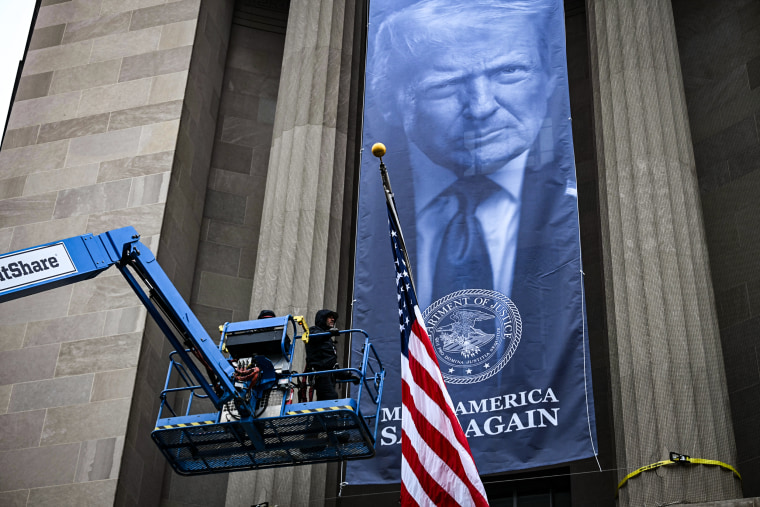
The Department of Justice headquarters in Washington earlier this year.Brendan Smialowski / AFP – Getty Images
Large banners of Trump have been hung from the Justice, Agriculture and Labor departments.
“We are proud at this Department of Justice to celebrate 250 years of our great country and our historic work to make America safe again at President Trump’s direction,” a DOJ spokesperson said when the banner was hung in February.
TrumpIRA.gov
Trump issued an executive order in April directing the Treasury Department to launch a new website called TrumpIRA.gov.
A “Trump Accounts” event in Washington in January.Win McNamee / Getty Images file
The Trump administration is launching new savings accounts for children this summer called Trump Accounts.
Created under the “big, beautiful bill,” Trump Accounts are tax-advantaged investment accounts for children under 18. Babies born from Jan. 1, 2025, to Dec. 31, 2028, will get $1,000 from the Treasury Department to kick-start their accounts.
“This is something that’s so special,” Trump said at his State of the Union speech in February.
TrumpRx.gov
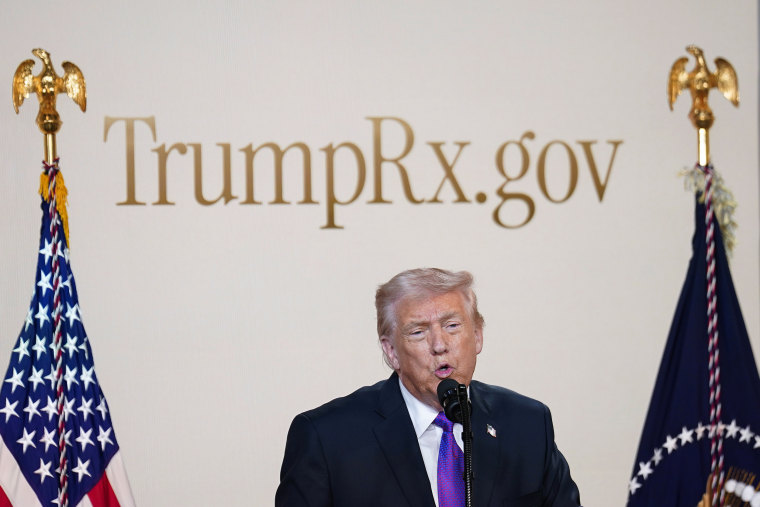
The launch of “TrumpRx.gov”, which the adminstration said would help to lower prescription drug prices, at the White House in February.Nathan Howard / Getty Images file
In February, the administration launched TrumpRx.gov, a self-pay prescription drug website. It offers coupons that people can take to the pharmacy where they fill their prescriptions.
“You’re going to save a fortune,” Trump said at the news conference launching the site. “And this is also so good for overall healthcare.”
We’re nearing Pride Month, and you know what the means–the queer books will soon be visible, and this month is prepping us very well in a variety of genres.
A scorching second-chance romance between a talented screenwriter and a phenomenal musician from the New York Times bestselling author of Before I Let Go.
“A triumph of art and emotion.” —Talia Hibbert, New York Times bestselling author
You never forget your first love. Isn’t that what they say? Verity Hill knows this truth intimately. She didn’t simply miss Wright “Monk” Bellamy when they parted ways in college. She’s haunted by his touch. Every kiss, any lover since—it’s a shadow of what they had.
Time heals all wounds. Isn’t that what they say? Monk doesn’t believe that for a second. He wasn’t simply betrayed when he and Verity split. He was devastated, with parts of him left behind in the ruins of all that was destroyed.
More than a decade after their disastrous breakup, Verity and Monk must work together on the set of an epic Harlem Renaissance biopic. With Monk, now a world-class musician, creating the score, and Verity, an award-winning screenwriter, penning the script, there’s Oscar buzz before shooting even begins. This once-in-a-lifetime project could catapult them both to new heights, but can they can put the past behind them for the sake of the film … for the sake of something more?
Hard to imagine anyone reading a romance site doesn’t know when Queen Kennedy Ryan’s got a new book coming, but you may not have known that her newest–the second in the Hollywood Renaissance series–stars a bi female lead and features a steamy m/f/f threesome before we even hit chapter three. It’s a hard-won second chance as Verity and Monk find their way back to each other from then, including a diagnosis of bipolar disorder for Verity in between, and because it’s Ryan, you know the story is treated with the respect and care it deserves. (Emph. mine-A.)
I love this video. John Fugelsang is a wonderful person to elaborate on the bible and he does so as a follower of Jesus, not Paul or the Old Testament. His mother was a nun and his father was a monk and the way he describes his father wearing his robes is as the Christian jedi of Flatbush. He explains how those using the bible to attack or bash others including the LGBTQ+ are not following Jesus that they are following Paul. He explains clearly how Jesus brought a new covenant for the people doing away with the old one in Leviticus. He explained how those using the bible to bash others and not feed & clothe the stranger/ immigrant are totally against what Jesus preached. He also mentioned how those trying to force the Old Testament of the bible in schools never want the words of Jesus hung in classrooms in public schools, they never want the sermon on the mount posted on the walls. Those kind of people only want authoritarian laws or do and dont do pushed on kids. Enjoy the video, I listen to him on The Daily Beans (news with swearing) friday newscast and his Sirius talk show. Hugs
As Congress finalizes its funding for fiscal year 2027, Republicans are attempting to include five anti-LGBTQ riders in the National Security and Department of State Appropriations Act.
A rider is an unrelated provision tacked onto a bill that must pass — in this instance, the bill provides funding for national security policy and for the State Department.
The riders range from restricting Pride flags in federal buildings to banning transgender healthcare, but all aim to limit the visibility and rights of LGBTQ Americans.
Section 7067(a) prohibits Pride flags from being flown over federal buildings.
Section 7067(c) restricts the United States’ ability to appoint special envoys, representatives, or coordinators unless expressly authorized by Congress. These roles have historically been used to promote U.S. interests in international forums — including advancing human and LGBTQ and intersex rights and other policy priorities. The change would halt what the Congressional Equality Caucus describes as providing “critical expertise to U.S. foreign policy and leadership abroad.”
Section 7067(d) reinforces multiple anti-equality executive orders signed by President Donald Trump, effectively requiring that foreign assistance funded by the United States comply with those orders. This includes rescinding federal contractor nondiscrimination protections, including for LGBTQ people.
Section 7067(e) prohibits funding for any organization that provides or promotes medically necessary healthcare for trans people or “promotes transgenderism” — effectively banning funds for organizations that recognize trans people exist. This is despite the practice of gender-affirming care being supported by nearly every major medical association.
Section 7067(g) reinforces two global gag rules put forward by the Trump-Vance administration. One is the Trans Global Gag Rule, which prohibits foreign assistance funding for organizations that acknowledge the existence of trans people or advocate for nondiscrimination protections for them, among other activities. The second is the DEI Global Gag Rule, which prohibits foreign assistance funding for organizations that engage in efforts to address the ongoing effects of racism, sexism, and other forms of bigotry outside the United States.
The global gag rule has its roots in anti-abortion policy introduced by President Ronald Reagan in 1984, when the 40th president barred foreign organizations receiving U.S. global health assistance from providing information, referrals, or services for legal abortion, or from advocating for access to abortion services in their own countries. Planned Parenthood notes that the policy also affects programs beyond abortion, including efforts to expand access to contraception, prevent and treat HIV/AIDS, combat malaria, and improve maternal and child health.
If organizations funded by the State Department engage in these activities, they could lose funding.
This anti-LGBTQ push aligns with broader actions from the Trump-Vance administration since the start of Trump’s second term, which have focused on restricting human rights — particularly those of trans Americans.
The House Appropriations Committee is responsible for drafting the appropriations legislation. U.S. Rep. Tom Cole (R-Okla.) serves as chair, with U.S. Rep. Rosa DeLauro (D-Conn.) as ranking member. The committee includes 34 Republicans and 27 Democrats.
For FY27 appropriations, Congress is supposed to pass and have the president sign the funding bills by Sept. 30, 2026.
The Palm Warbler is unusual among the Western Hemisphere’s wood-warbler family. While the majority of warblers are sexually dimorphic, with males noticeably brighter in the breeding season, the male and female Palm Warbler are nearly identical, and can be impossible to tell apart. Warblers, in general, spend a majority of their time in trees and shrubs, but the Palm Warbler is quite comfortable on the ground. Rather than hopping like their arboreal relatives, these birds take to walking or running. Like other warblers, the Palm Warbler often joins mixed-species flocks outside of the breeding season. However, though most warblers tend to flock up with other arboreal species, the Palm Warbler is just as likely to be found foraging with sparrows along hedgerows and in open weedy fields.
Palm Warblers share another habit more typical of ground-dwelling birds in that they continuously bob their tails. This behavior is also seen in other birds typical of open habitats, including the Spotted Sandpiper and Black Phoebe, where the rate of bobbing is thought to vary with the bird’s level of excitement, and thus plays a role in communication. In many ways, the Palm Warbler behaves more like a sparrow or pipit than a typical wood-warbler — even its monotonous trilled song is remarkably similar to that of a Dark-eyed Junco or Chipping Sparrow. Though perhaps an oddball among its own family, this unique bird has found a niche all its own, somewhere between a sparrow and a warbler. (snip-MORE)