Some points I wish to make. First tRump couldn’t take not having his name seen on a building that was to honor the Kennedy family so he kept the tarps up. But why is this building and its prominence that attracts him? The way our society sees and has seen the Kennedy family has long been an issue and sore spot for tRump. In his mind his own family should be the US fake royalty not a war hero president and classy first lady. He raged against predient Kennedy’s son constantly angered that the press never covered his kids the same way. Well that is because while the Kennedy’s were doing good works for the public the tRump kids were ingaged in crimes and money laundering. tRump is fully consumed by his stature and standing with the public and how he is perceived because he is a poor man in a wealthy situation and he is a weak man pretending to be the model strong man. Remember he told Queen Elisabeth that his kids were equal to her kids because he was US royalty like she was British royalty. Hug
Attorneys for Beatty said in a statement that the new naming effort appears to defy a judge’s ruling this year that the center’s board does not have the authority to rename what was intended as a “living memorial” for an assassinated president.
The board voted to change the name of the building to “The John F. Kennedy Center for the Performing Arts Restored and Renovated by President Donald J. Trump.”
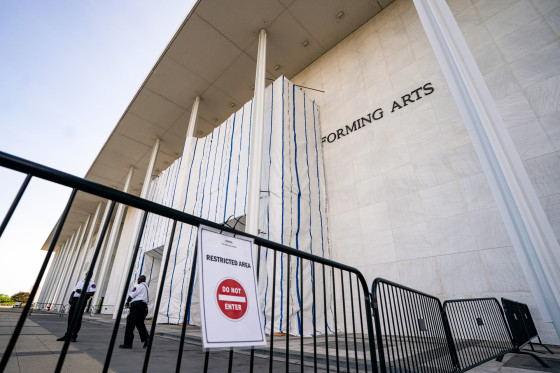
Scaffolding and tarps cover the building name at the John F. Kennedy Center for the Performing Arts in Washington on June 30.Al Drago / The Washington Post via Getty Images file
The Trump-appointed Kennedy Center board voted Thursday to partially close the iconic arts center for up to two years during renovations and to re-add President Donald Trump’s name to the building’s facade, according to a person who attended the virtual board meeting and a second person familiar with the meeting.
The decision would close the Kennedy Center’s main building and keep a smaller addition, known as the Reach, open for some events in response to a May court order requiring the board to maintain the center as a memorial to President John F. Kennedy.
After an almost two-hour Zoom meeting, the board voted 20-3 to change the name of the building to “The John F. Kennedy Center for the Performing Arts Restored and Renovated by President Donald J. Trump” and the physical location to “President Donald J. Trump Plaza.” Commerce Secretary Howard Lutnick proposed the name change.
Trump, who appointed himself chairman of the board last year, joined the call for several minutes, according to the source who attended the meeting.
The three people voting against it are the ex officio members from Congress, Rep. Joyce Beatty, D-Ohio; Sen. Sheldon Whitehouse, D-R.I.; and Rep. Rick Larsen, D-Wash.
“This latest development is a transparent effort to circumvent the Court’s ruling, and flies in the face of the statutes that Congress passed,” Beatty, who was one of the plaintiffs in a lawsuit challenging the Kennedy Center’s renaming, said in a statement. “I will continue to fight for this treasured national monument.”
Attorneys for Beatty said in a statement that the new naming effort appears to defy a judge’s ruling this year that the center’s board does not have the authority to rename what was intended as a “living memorial” for an assassinated president.
“A federal judge already rejected the board’s unlawful attempt to rename the Kennedy Center, and told Donald Trump’s handpicked board that its last closure vote was ill-informed and preordained. Today’s vote is more of the same, and a show of blatant disrespect to the courts,” said the lawyers, Norm Eisen of Democracy Defenders Action and Nathaniel Zelinsky of Washington Litigation Group.
U.S. District Judge Christopher Cooper’s order in May, which temporarily blocked the Kennedy Center’s planned closure last month, also asked that the board provide a financial plan to justify the decision to close it. Keeping the smaller venue open would allow ticket sales for some events, including performances by the National Symphony Orchestra, which is the Kennedy Center’s chief tenant.
The orchestra has performed there since the early 1970s, when the center — conceived by Jaqueline Kennedy as a memorial to her slain husband — opened.
In recent years, under the baton of music director and principal conductor Giancarlo Noseda, it has been rising in stature — but its future is now uncertain because the Kennedy Center’s Concert Hall will not be available. A search for other venues in the area has been underway.
The Kennedy Center’s future has been in limbo for months as Trump moves to reshape the iconic art institution in his image, one of several major Washington renovation projects.
After Trump named himself the Kennedy Center’s chairman last year and filled its board with allies, the board voted unanimously in March to close the center for two years for renovations.
Cooper’s order temporarily blocked the construction work and ordered that Trump’s name be removed, which it was in June.
He also said the board could still ultimately close the center “should it come to this decision anew after independently balancing its multiple obligations to the Center in a prudent fashion.”
Cooper also found the board did not have the authority to rename the center or add a name to it without the approval of Congress, which initially named it.
“The Kennedy Center’s organic statute makes crystal clear that the Center is to be named for President Kennedy, and it cannot bear any other formal name or public memorial based on the Board’s unilateral say-so,” Cooper said in his May decision.
“May the John F. Kennedy Center for the Performing Arts be renamed absent Congressional authorization? The answer, plain from the face of the statute, is no. Nor can any other individual be memorialized on the front portico of the building. Congress gave the Kennedy Center its name, and only Congress can change it.”
The decision to close the center and add Trump’s name to the building has sparked outrage from the administration’s critics, as well as members of the Kennedy family.
Former Rep. Joseph Kennedy III, a grandnephew of the late president, said in a statement last year that the center “is a living memorial to a fallen president and named for President Kennedy by federal law. It can no sooner be renamed than can someone rename the Lincoln Memorial, no matter what anyone says.”
I posted the Rachel Maddow video of this. Greenland has a law against any oil drilling or even attempting to find oil in their area. According to what Maddow said the company just doesn’t care being willing to lie and then saying they had permission from tRump. tRump doesn’t run Greenland. But you see the goal is to rape the place of all resources and these companies don’t respect local law or people. And of course tRump is making profit off it. But because of fear of tRump and what he may do in a fit of rage they seem ready to let the country break the laws. Hugs
Island’s government says no approval given after Greenland Energy brings kit ashore for exploratory drilling
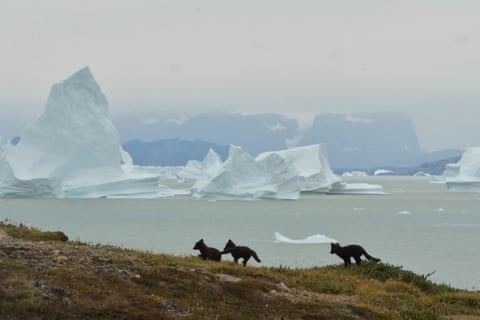
Jameson Land, a remote part of Greenland where the US company Greenland Energy has landed drilling equipment.
Trump’s Truth Social post.
Illustration: truthsocial.com/realDonaldTrump
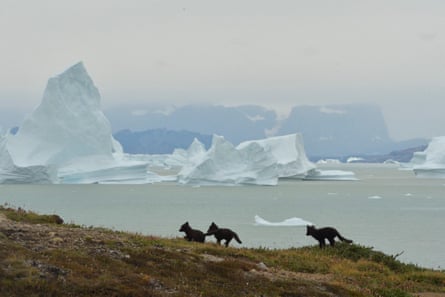
Young arctic foxes in the tundra in Jameson Land.
Photograph: Biosphoto/Alamy
An American oil company connected to Donald Trump is preparing to sink wells in remote Greenland despite not having received permission from the local authorities.
As the US president renews his threats to claim the vast Arctic territory, materials to prepare for drilling were brought ashore in recent days on Greenland’s eastern coast.
That has prompted Greenland’s government to issue a “strong warning” that no approval had been granted to land the kit. “All future logistical matters must be advised and approved by the mineral resources authority – before they are carried out,” the government said in a statement.
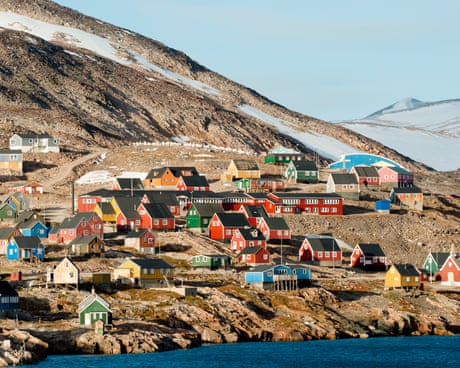
Two days later, Trump made his latest menacing post on Truth Social, showing himself looming over a Greenlandic village.
Trump’s Truth Social post. Illustration: truthsocial.com/realDonaldTrump
Executives of Greenland Energy, a Texas company set up last year, have claimed that $1tn of crude may lie beneath the Jameson Land region. They announced plans to spend $60m drilling two wells to find out.
Although Greenland stopped issuing new oil licences in 2021 on environmental grounds, a UK company called 80 Mile had secured exploration rights in Jameson Land. Greenland Energy’s corporate filings say it will take a majority stake in the project in exchange for funding the exploration, though it still needs government permission to proceed.
Licensed to drill? How a Trump-linked Texas oil company is elbowing its way into Greenland
Read more
Greenland Energy has retained Phil McGraw, better known as Dr Phil, a prominent rightwing former chatshow host who served on Trump’s religious freedom commission, to make a documentary series that will “capture the mission of these modern-day wildcatters”.
It has also appointed as a director a US navy veteran who is working on Golden Dome, the missile defence plan for which Trump says controlling Greenland is “vital”.
Larry Swets, Greenland Energy’s chair and a big shareholder, appears to enjoy access to Trump’s circle. He has said the oil project is “not related to American annexation”.
After a company representative falsely claimed at a Jameson Land community meeting in June that it had permission to land drilling equipment, Swets said: “Our enthusiasm for the project led us to communicate in a way that created confusion.”
But the next month, local people in the sparsely populated region noticed a tug pulling a barge shorewards and unloading a dozen containers. “The goal was to get the equipment onshore at Nunap Qeqqa [Jameson Land] in connection with planned oil exploration drilling,” the Greenland government’s statement said.
The Danish investigative outlet Danwatch quoted the head of the shipping company as confirming the delivery was for Greenland Energy.
Young arctic foxes in the tundra in Jameson Land. Photograph: Biosphoto/Alamy
Greenland Energy has declined to respond to questions from the Guardian. A letter it sent to shareholders on Thursday said: “Recent high-level meetings between project leadership and Greenlandic regulatory and oversight authorities have been constructive, and we continue to be encouraged by the progress being made toward the remaining approvals required for drilling.” It said that after those discussions, just one well would be drilled to begin with.
As a semi-autonomous territory of Denmark, decisions about Greenland’s natural resources rest with its local elected leaders, who now face a delicate decision. They could grant permission for oil drilling, even though the planned wells appear to fall within a conservation area protected by the Ramsar convention on wetlands. Or they could refuse and, some worry, give Trump a pretext to advance his imperialist agenda.
The Greenland government’s statement said it “would not be proportionate” to demand the equipment be removed. An application for permission remained under processing, it added.
A Greenland Energy representative has said a vessel carrying its 300 shipping containers of drilling equipment is to set sail from Canada on 12 September. Sinking the wells would begin in October.
Jeff Landry, the hard-right Louisiana governor serving as Trump’s Greenland envoy, has said Greenland could be pumping oil next year.
If you read the law it lets anyone claim to be offended by any media and that it doesn’t need to be declared obscene to be labeled obscene. Why is that? Because to a small group of very vocal haters just the existence of LGBTQ+ people is obscene. It offends their god so it offends them. But don’t try to claim the Bible is obscene or pushes offensive stuff it has special carve outs that make all the icky bad parts OK. I hope this will be appealed to the full appeals court as this attempt to errase an entire population of people based on bigotry must not be allowed to stand. I also just read where the education department under the hypermaga education secretary will not be enforcing or even recording the bullying and abuse of the LGBTQ+ kids at school. Her view is let the little fagots fend for themselves it seems. Remember she and her husband turned a blind eye to the many young boys being sexually assaulted by the wrestlers in their group.
Also the majority of the three judges panel said that the three patrons did not have standing to object because no books had been banned yet. They seem to have a wait and see if the victim is stabbed before taking the knife from the threatening person. That is stupid. Everyone knows what the law is intended to do and the writers of the law admit that openly. It seems the tRump appointed judges want to let attacks on the librarians and on the books that mention gay, lesbian, bisexual, transgender, non-binary, and questioning kids / people be removed as soon as possible knowing it is harder to put them back than to ban them in the first place. Hugs.
The “social section” in Crawford County Library’s Van Buren branch (Screenshot from court documents)
A federal appeals court ruled Thursday that Arkansas’ 2023 law restricting access to library materials can go into effect, three years after a judge blocked two sections of the law on First Amendment grounds.
The three-judge panel from the 8th U.S. Circuit Court of Appeals in St. Louis ruled that the 18 plaintiffs had no standing to challenge one section of Act 372 and failed to prove that the other section was unconstitutionally vague.
The two sections create criminal liability for librarians who distribute content that some consider “obscene” or “harmful to minors,” and give city and county governing bodies the final say over library content.
Republican Attorney General Tim Griffin praised the ruling, saying it “allows Arkansas to move forward in enforcing a law that protects children from obscene materials while increasing accountability for public-library curation decisions.”
The plaintiffs challenging the law include libraries, bookstores, advocacy groups and individual library patrons. Their lead attorney, John Adams, said in a statement that the legal team is “evaluating all available legal options, including further review by the courts,” after Thursday’s ruling.
“Libraries and bookstores should be places where people can freely explore ideas — not where booksellers and librarians face criminal liability for selling, checking out, or even just shelving constitutionally protected books,” Adams said. “The freedom to read is fundamental to a free society and has always been protected by the First Amendment.”
Griffin said Act 372 was meant to “to address legitimate concerns about minors’ access to obscene materials and to establish a process for reviewing challenged content.”
School and public libraries already had content challenge policies before Act 372. The law stalled in the Legislature in 2023 before it was amended to say library materials would be relocated to an area inaccessible to minors, not removed from the premises, if elected officials find them to be “obscene.”
Section 5 of Act 372 allows city and county governing bodies to relocate challenged material if a challenger disagrees with a library panel’s decision to keep it in its original section.
Another section of the law that gave school boards the same authority over school library materials had not been challenged.
Adams told the appeals court in June that Crawford County, a defendant in the case, showed what the law’s restrictions would look like in practice. The county’s five library branches separated LGBTQ+ children’s books from the rest of the collection after public outcry, and county officials cited Act 372 as a reason to maintain these “social sections,” even before the legislation became law.
Crawford County lost a separate federal lawsuit in 2024 after three parents alleged that the “social sections” violated the First Amendment.
The three library patrons who sued over the state law do not have standing because Section 5’s book challenge and relocation policies do not harm the plaintiffs, the appeals court panel said Thursday.
“Plaintiffs are speculating libraries might decide to segregate certain books as part of their curation policies, which they have not yet adopted, or in response to challenges, which have not yet been filed,” the panel wrote.
The librarian and bookstore plaintiffs have standing to challenge the other section of the law because they would be at risk of prosecution for noncompliance, according to the ruling, but the three judges disagreed with Adams’ claim that Section 1 of Act 372 was too vague.
This section makes “furnishing a harmful item to a minor” a Class A misdemeanor. Conviction would lead to a maximum prison sentence of one year.
U.S. District Judge Timothy Brooks wrote that the law’s lack of a definition for terms like “furnishing” and “harmful” could lead to violations of the First Amendment right to freedom of speech.
An unchallenged provision of Act 372 removes schools and public libraries from the part of Arkansas state code that previously exempted them from prosecution for disseminating obscene content. Another unchallenged provision made school and public library employees liable for a Class D felony if they “knowingly” distribute obscene material or inform others of how to obtain it. A Class D felony conviction carries a maximum prison sentence of six years.
However, the language of Section 1 “limit[s] its application to situations when a person knowingly furnishes an item to a minor knowing of the item’s harmful character” and therefore is not too vague, the appeals court ruled.
Chief Judge Steven Colloton wrote in a concurring opinion Thursday that he understood the plaintiffs’ vagueness claim but disagreed with it “because third-party library patrons have no constitutional right to receive unfettered access to books of their choice at taxpayer expense.”
Colloton was appointed to the court in 2003 by then-President George W. Bush and has been chief judge since 2024. President Donald Trump appointed the panel’s other two judges, Ralph Erickson and L. Steven Grasz, in 2017.
Erickson was on the three-judge panel in April that allowed a 2023 Iowa law to go into effect, requiring the removal of books containing “descriptions or visual depictions of a sex act” from Iowa public school libraries.
The removal of the injunction on Act 372 comes as the Arkansas Department of Education has been considering requiring public libraries to restrict children’s access to “sexually explicit materials” in order to receive state funding.
Dozens of Arkansans told the education department in June that they oppose requiring libraries to ensure patrons age 16 or younger cannot check out materials that depict or describe sexual contact and behavior.
The Arkansas State Library Board will meet Aug. 14 to consider sending the rules to a legislative panel for further approval. Republican Gov. Sarah Huckabee Sanders appointed all six board members.
Author Info
Tess Vrbin
Tess Vrbin came to the Advocate from the Arkansas Democrat-Gazette, where she reported on low-income housing and tenants’ rights, and won awards for her coverage of 2021 flooding and tornado damage in rural Arkansas. She previously covered local government for The Commercial Dispatch in Mississippi and state government for the Columbia Daily Tribune in Missouri.
Arkansas Advocate is part of States Newsroom, the nation’s largest state-focused nonprofit news organization.
The Trump administration plans to end a subsidy program that helped hold down premiums for Medicare drug plans, a move that could leave many seniors facing higher rates for their prescription coverage next year.
The move will eliminate a program that is giving insurance companies an estimated $3.6 billion in subsidies this year to blunt increases in premiums for the Medicare prescription plans, known as Part D. The program will end after 2026, according to administration officials.
High drug costs are a perennial issue—especially for seniors on fixed incomes—and healthcare affordability is expected to be a focus in the midterm elections. Roughly 25 million people have Part D plans, and they will learn about their 2027 rates in the fall. Medicare drug coverage premiums are rising because the plans have been hit by growing expenses for GLP-1 medications and other specialty drugs.
BREAKING WSJ:The Trump admin plans to end a subsidy program that helped hold down premiums for Medicare drug plans — a move that could leave many seniors facing higher rates for their prescription coverage next year.
More hate and bigotry enacted against all the medical safety data available. Guess I am just not being understanding today because these laws are not only not needed but also very harmful. They cause a lot more problems than the pretended harm they claim to solve. It is the attempt to regulate and restrict sexual / gender standards into the laws. It just causes kids and people problems for no reason and promotes anger / bigotry against a small minority of people. Hugs
The United Kingdom’s Department of Education has published its updated guidance for “Keeping Children Safe in Education 2026” (KCSIE) and it will take effect on September 1. However, the guidance is likely to put trans and gender-non-conforming children at greater risk.
“We criticise numerous aspects of the guidance, especially as to how schools should approach requests related to ‘social transition,’” The Good Law Project wrote in a statement responding to the draft guidance earlier this year. “We also emphasise its failure to properly explain how schools should accommodate the needs of trans pupils in accessing various aspects of school life, such as toilets, changing facilities, and sports.”
Last year, the United Kingdom’s Supreme Court ruled that, for the purposes of the 2010 Equality Act, the legal definition of “woman” is based on “biological sex.” In the aftermath, the Equality and Human Rights Commission released temporary guidance on barring trans people from single-sex spaces. They’ve now released their finalized plan, which says that businesses and institutions should prevent trans people using a single-sex spaces, and that if they allow trans people to use them, they will no longer be considered single-sex spaces.
The aggressive new schools guidance set out in KCSIE is set to comply with the EHRC’s updated policies around single-sex spaces, ruling that trans and gender-questioning children cannot use spaces aligned with their gender identity, even if they have socially transitioned.
Never Miss a Beat
Subscribe to our newsletter to stay ahead of the latest LGBTQ+ political news and insights.
Email Email Email
Email *
Frequency *
Daily Brief
Week in Review
Week in Good News
———————————————————————————————————————–
“Schools must not allow children into toilets designated for the opposite biological sex,” the guidance reads. “This includes where schools are responding to a request to support any degree of social transition for children who are questioning their gender.”
The same policy is applied to changing rooms for those over 11 years old, nor should the students “share overnight accommodation with a child of the opposite biological sex,” it states.
The guidance allows for single-use restrooms “if a gender-questioning child does not want to use the toilet designated for their biological sex.” However, there is no actual requirement for this, but only the suggestion that “schools and colleges should consider whether they can provide an alternative toilet facility—for example self-contained individual toilets—without compromising the provision of single-sex facilities.”
When it comes to all of these arrangements, the guidance clearly states, “These alternative arrangements should not compromise the safety, comfort, privacy or dignity of the child, or of any other children.”
However, such arrangements in their own right will challenge the safety and dignity of trans children. One plaintiff in a lawsuit challenging Idaho’s bathroom bill died by suicide earlier this year. Before her death she said of similar provisions, “It is scary having to look around before to see if anyone will see me going into the single-user restroom, as I worry about people gossiping and speculating about me being transgender.”
When it comes to social transition at school, the guidance advises against staff and teachers supporting it, citing concerns raised in the controversial Cass Review. The guidance sets out extensive hurdles before any member of staff at a school or colleges can be supportive of a social transition.
The guidance establishes that “parents and carers should be actively involved and their views treated with importance.” That rule alone amounts to a forced outing policy that could put trans children at risk of harm if their family are not supportive. While the guidance goes on to carve out an exception for “rare circumstances” where involving parents and carers could pose a “greater risk,” such a policy would require a lot of trust and a careful hand from school administrators who are inexperienced with such matters.
The possibility of the school deciding not to allow the social transition is not only laid out but encouraged. The guidance notes that “when considering a child’s request for support with social transition will be to consider what is in the best interests of the child and other children, and a decision relating to social transition may not be the same as a child’s wishes.” They also note that, for younger children, support for a social transition should be “agreed very rarely.”
More of the choice is taken away from trans children and their families with the note that for “pre-pubertal children” clinical involvement should be part of the decision-making process and that “should include advising on the risks and benefits of social transition as a planned intervention, referencing best available evidence. This is not a role that can be undertaken by staff without appropriate clinical training.”
Subscribe to the LGBTQ Nation newsletter and be the first to know about the latest headlines shaping LGBTQ+ communities worldwide.
This is what all the medical data and medical science shows which is why laws were passed to promote transgender acceptance. Then some people decided it was an insult to their god, some decided that they needed everyone to be the same as they are in life, and politicians realized it was a way to distract and get people to vote for them. There is no medical reason, no safety reason, and no social reason for hate towards trans people and other LGBTQ+. To be so dismissive of the needs of other people who cause you no harm is crazy and I do not understand the motivation of the bigots. Hugs
Good Law Project claims U.K. health secretary Wes Streeting’s department fought to block freedom of information requests for data on trans youth suicides.
John Russell (He/Him)February 12, 2026, 3:30 pm EST· Updated on February 13, 2026
The U.K. government appears to have covered up a dramatic rise in transgender youth suicides, according to data obtained by U.K.-based government accountability non-profit the Good Law Project.
As Erin in the Morning reports, data the non-profit obtained from the National Health Service (NHS)-funded National Child Mortality Database (NCMD) via a Freedom of Information request sharply contrasts with the government’s official report on trans youth suicides in the wake of the 2020 Bell v. Tavistock ruling.
As the Good Law Project notes, following the U.K. High Court of Justice’s initial ruling in Tavistock, which found that minors under 16 could not legally consent to receive puberty blockers for the treatment of gender dysphoria, the National Health Service (NHS) substantially limited access to gender-affirming care for minors. Those limits reportedly remained in place even after the Tavistock ruling was overturned in 2021.
The U.K. government commissioned its 2024 Appleby Report after the Good Law Project reported that two whistleblowers with the Tavistock gender clinic alerted the organization to a significant rise in suicides among young people on the NHS’s waitlist for appointments to begin gender-affirming care in the wake of the Tavistock case.
————————————————————————————————————————
Insights for the LGBTQ+ community
Subscribe to our briefing for insights into how politics impacts the LGBTQ+ community and more.
Frequency Email *
Email *
Frequency *
Daily Brief
Week in Review
Week in Good News
——————————————————————————————————————–
According to Good Law Project, the Appleby Report identified only 12 suicide deaths among current or former Gender Identity Development Service (GIDS) patients at the Tavistock clinic between 2018 and 2024. However, as Erin in the Morning notes, the report disregarded young people who were unable to access GIDS care due to long wait times, which, post-Tavistock, now last an average 25 years.
At the same time, Good Law Project submitted a Freedom of Information request with the NCMD, and has only just published the data it received.
“Good Law Project can confirm that in 2021–2022 suicides of trans children in England surged to 22, a marked increase from 5 and 4 the previous two years,” the organization wrote in a February 7 release. “This spike follows the decision by NHS England to pull down the shutters on gender-affirming healthcare for young trans people” following the Tavistock case.
In total, the NCMD data show 46 transgender children in the U.K. died by suicide between 2019 and 2025. In addition to the nine accounted for between 2019–2021 and the alarming spike to 22 between 2021–2022, the data also show 10 suicide deaths between 2022–2023. And, according to Good Law Project, NCMD added that “the numbers reported in more recent years will likely be underestimated, due to a higher proportion of child death reviews that have not yet been completed.”
Good Law Project said it was “appalled” that U.K. health secretary Wes Streeting “commissioned and published a report to reassure the public that there was no significant rise in suicide rates, when 22 children took their own lives in a single year: 2021-22.” The Appleby report, they said, “denied the reality of trans deaths, as Streeting’s ban on puberty blockers denied the reality of trans lives.”
The nonprofit claims that Streeting department “fought tooth and nail” to block its freedom of information requests.
“To silence those raising the alarm on rising trans suicides as ‘dangerous’ while ramping up the policies correlating with that rise is an act of grave moral wickedness,” the group said.
Trans journalist Erin Reed said of these findings, “More alarming is what appears to be an explicit attempt to cover up trans youth suicide deaths. Those who seek to restrict gender-affirming care also seek to restrict any information showing those restrictions may lead to harm. Among the far right, claims have emerged that transgender youth are in no danger of suicide from the withdrawal of gender-affirming care, but this could not be further from the truth.”
Editor’s note: If you or someone you know is struggling or in crisis, help is available. Call or text 988 or chat at 988lifeline.org. The Trans Lifeline (1-877-565-8860) is staffed by trans people and will not contact law enforcement. The Trevor Project provides a safe, judgement-free place to talk for youth via chat, text (678-678), or phone (1-866-488-7386). Help is available at all three resources in English and Spanish.
Subscribe to the LGBTQ Nation newsletter and be the first to know about the latest headlines shaping LGBTQ+ communities worldwide.
Again racism for the sake of saving white fraigle feelings. Nothing the president and this white nationalism administration have done to erase the true history of the US has worked to make them feel better about what the white people did in the past to the black people then and what the system is doing to black people now. The right and the white Christian nationlist desperatly always seem to need a scapegoat villain to keep their feelings from being hurt by preconceived slights that the loss of their privileges makes them feel. When everything is given to you automatically, when everything is just normally your privilege to be first and suddenly you have to start standing in line with others it seems like oppression rather than simply being equal to others. Hugs
If President Donald Trump gets his way, the first thing visitors to the Smithsonian’s National Museum of American History will be greeted with are signs warning them that because of “inaccurate information presented in the Museum” they should seek “accurate information” elsewhere.
The president on Friday ordered the installation of temporary “warning” signs on the museum’s sidewalks, marking a major escalation in his campaign to pressure the Smithsonian Institution to rewrite American history to better align with his administration’s ideology.
The executive order directs Interior Secretary Doug Burgum, Office of Management and Budget Director Russell Vought and several other Cabinet officials to utilize “all available authorities to encourage” the Smithsonian Institution to “correct the issues found” in a scathing White House report released on July 4 that accused the museum of “extreme political activism” and claimed it “cannot be trusted to tell America’s story honestly and in a way that is inspiring, unifying, and worthy of our great republic.”
The sidewalks and walkways outside of the popular museum, which welcomes just shy of two million visitors annually, are federal property controlled by the National Park Service. The signs would “notify visitors that the Museum exhibits should be renovated consistent” with the findings of the July 4 report. They would also “direct visitors to locations and resources for accurate information regarding America’s history.”
Trump also accused the museum of failing to “to appropriately honor the 56 signers of the Declaration of Independence during this 250th anniversary year of the founding of our country,” and instructed Burgum to install “temporary exhibits” on Smithsonian walkways to correct “inaccurate information presented in the Museum.”
“The Report demonstrates that the Smithsonian leadership does not present American history as a shared national inheritance to be taught and celebrated, but instead views American history as a ‘prime tool’ to advance ideas of social justice and the radical transformation of our society,”according to the newly signed executive order.
The signage order followed a week of congressional testimony by Smithsonian officials in hearings called by House Republicans in response to the White House report. Anthea Hartig, head of the National Museum of American History, was grilled over her patriotism and dedication to country.
Hartig said the White House report “does not fairly characterize the full body of work of this museum.” And under questioning from GOP lawmakers she reaffirmed her allegiance to her country multiple times, at one point answering, “I love this country unconditionally.”
The report, oversight hearings and signage demand compound more than a year of the Trump administration’s pressure campaign against the world’s largest museum, education and research complex. In March 2025, Trump signed an executive order that vowed to strip federal funding from Smithsonian programs that present what he viewed as “improper, divisive, or anti-American” ideology.
The Trump administration has since threatened to withhold federal funding from the Smithsonian Institution unless a number of its museums submit documentation for an expansive content review.
Sydney Carruth is a breaking news reporter covering national politics and policy for MS NOW. You can send her tips from a non-work device on Signal at SydneyCarruth.46 or follow her work on X and Bluesky.
Why do these haters hate so much towards the LGBTQ+ people? We never hurt them, but they claim we hurt their god. But if that is true then can’t their all powerful god fix such an offense? Unless he made the LGBTQ+ people as he wanted them to be.
I want to point out the total switch and bait these haters use. Read the article to see the hate and refusal to accept anyone not straight and cis. Here is a quote from this person; notice how he frames it just to incite outrage.
Forcing local schools to permit a teenage boy who ‘identifies’ as a girl to use changing rooms, locker rooms, and bathrooms with five-year-old girls.”
See the bait and switch? A teen boy is somehow threatening your little 5 yr old girl. Oh the humaity.
Congressman Brian Babin, R-Texas, Chairman of the House Science, Space, and Technology Committee, speaks about the introduction of the Birthright Citizenship Act at a press conference on Thursday, Jan. 23, 2025. | Jack Gruber / USA TODAY NETWORK
A Republican member of Congress went to an event hosted by a hate group and, during a prayer, thanked God for sending Donald Trump to stop children from being led “down the path of homosexuality and perversion.”
“Lord, we beseeched thee,” prayed Rep. Brian Babin (R-TX) at the Family Research Council’s (FRC) National Gathering for Prayer and Repentance event at the Museum of the Bible in D.C. on February 4. The FRC is classified as an anti-LGBTQ+ hate group by the Southern Poverty Law Center.
“Our prayers were answered in getting us a new president and taking a different direction in our country than we had seen for the previous four years,” he continued. “Apostasy, blasphemy, taking our children down the path of homosexuality and perversion. Open borders. Criminals running rampant in our streets.”
“Lord, we have new leadership, and we thank you for that. But Lord, we know that government is not going to save our country. It’s going to be the American people returning to the path that you have set out for us and our Founding Fathers.”
Babin has consistently gotten a score of “0” on HRC’s Congressional Scorecard for the past several sessions of Congress, showing his solid opposition to LGBTQ+ equality.
In 2022, Babin was one of several Congressional Republicans who introduced a federal bill in the House to ban schools, libraries, hospitals, government entities, or other organizations from “hosting or promoting any program, event, or literature involving sexually-oriented material.” The bill defined “sexually-oriented material” to include anything that discusses LGBTQ+ people.
In 2015, Babin was outraged that the Supreme Court ruled in favor of allowing same-sex couples to marry in its Obergefell v. Hodges decision.
“As a strong supporter of traditional marriage and a firm believer in state sovereignty, I am deeply disappointed that five members of the U.S. Supreme Court have over-ruled tens of millions of Americans – including millions in the State of Texas – who have voted to enact state statutes and state Constitutional amendments to define marriage as between one man and one woman,” he said at the time.
“Traditional marriage has been under assault as courts and some state legislatures have sought to both redefine marriage as something other than between one man and one woman and to penalize and discriminate against those who have religious and conscience convictions against the redefinition of marriage,” he continued.
In 2016, he introduced a bill to roll back Obama-era protections for transgender students, saying that those protections were “throwing common sense and decency out the window and forcing local schools to permit a teenage boy who ‘identifies’ as a girl to use changing rooms, locker rooms, and bathrooms with five-year-old girls.”
The Obama-era protections did not allow for boys to use girls’ facilities. Instead, they were recommendations about how schools could accommodate transgender students, which included allowing them to use facilities associated with their gender identity.
Subscribe to the LGBTQ Nation newsletter and be the first to know about the latest headlines shaping LGBTQ+ communities worldwide.



 Jameson Land, a remote part of Greenland where the US company Greenland Energy has landed drilling equipment.