
Category: LGBTQ+ / Gay / Trans / Gender
Political news I want to share. 8-30-2026
i'm getting team TPM at work on an exclusive if they can find a Collins staffer who isn't a nazi http://www.washingtonpost.com/politics/202…
— Josh Marshall (@joshtpm.bsky.social) 2026-08-27T13:32:55.715Z


Most likely Trump has Grant at the bottom because he relentlessly hunted down and dismantled the original Ku Klux Klan. pic.twitter.com/2XgCzIx2LC
— Ron Filipkowski (@RonFilipkowski) August 28, 2026
Imagine, just imagine, if any other president – Reagan, Bush, Clinton, Obama, Biden – had posted something like this about themselves. They would be a laughing stock. There’d be no other story in the media. Their own party members would be slamming them.
— Mehdi Hasan (@mehdirhasan) August 27, 2026
How/when did we… https://t.co/7wjGgIb6RS
Woodrow Wilson up top? Coolidge towards the bottom? And no Reagan? Can someone unplug the President, shake him, and plug him back in? https://t.co/Q50UdVZr4J
— Erick Erickson (@EWErickson) August 27, 2026
Best news all day.He couldn’t make 9/11 all about him, so decided not to come to NYC. Good riddance.www.nytimes.com/2026/08/27/u…
— Michelangelo Signorile (@msignorile.bsky.social) 2026-08-28T00:43:02.272Z
Pirro’s special grand jury isn’t, as some suspected, being used to investigate Trump’s most high-profile perceived political enemies. WaPo reports it’s being used to look into DC schools… http://www.washingtonpost.com/national-sec…
— Anna Bower (@annabower.bsky.social) 2026-08-27T16:21:39.286Z
Exclusive: Republican efforts to prosecute Dr. Anthony Fauci for contempt of Congress have hit a wall.
— The Wall Street Journal (@wsj.com) 2026-08-27T14:26:31.530155Z
BREAKING: The Trump administration appeals the latest ruling blocking his mail voting order from taking effect.
— The Associated Press (@apnews.com) 2026-08-28T19:48:23Z
Wyoming Republican Gov. Mark Gordon expresses concern over how election observers from the U.S. Justice Department observed the state’s primaries, saying it was “aggressive” and “irregular.”
— NBC News (@nbcnews.com) 2026-08-27T20:00:27.670Z
With pivotal elections less than 70 days away, I’m grateful a federal judge again blocked President Trump’s efforts to weaponize the Postal Service and limit mail-in ballots. (1/2)apnews.com/article/trum…
— Sen. Maria Cantwell (@cantwell.senate.gov) 2026-08-28T05:40:08.410Z
A federal judge once again spurns Donald Trump’s effort to erase his hush money conviction, rejecting the president’s bid to move the state court case to federal court and have it dismissed on presidential immunity grounds. ny1.com/nyc/all-boro…
— Steve Herman (@newsguy.bsky.social) 2026-08-28T17:22:50.780Z
Trump Updates Defamation Suit Against The New York TimesThe president has argued that the news organization sought to undermine his 2024 presidential campaign by disparaging his reputation as a businessman. The Times has moved to dismiss the lawsuit.
— BanmarNJ (@banmarnj.bsky.social) 2026-08-28T17:27:09.881Z
If this happens, it won't be the last. Or the smallest.www.notus.org/agencies/tru…
— Jim Whittington🔥 (@jimwhittington.bsky.social) 2026-08-28T09:56:59.860Z
Semafor refers to "Washington’s custodianship" of Venezuela's oil. Just like Bonnie & Clyde served as "custodians" for bank deposits.
— Mark Jacob (@markjacob.bsky.social) 2026-08-28T15:14:55.338Z

Trump is speaking to complete silence at the NASA center. Not a single person is applauding or reacting to anything he says during his brazenly partisan speech.
— Aaron Rupar (@atrupar.com) 2026-08-28T16:42:13.023Z
Arkansas librarian fired after opposing book ban efforts to receive $275K in settlement arkansasadvocate.com/2026/08/27/a…
— Arkansas Advocate (@arkansasadvocate.com) 2026-08-27T22:17:20.381Z
All they needed to do was go after gangs. They've wasted billions of dollars and destroyed countless lives for MAGA Media Entertainment.ICE plans to buy robot ‘dogs’ for some immigration enforcement operations http://www.nbcnews.com/politics/imm…
— Jay Lee (@jayleec.bsky.social) 2026-08-28T18:41:35.884Z
Share this:
Loser Enes Freedom Kantor Picks Fight With WNBA Players
Share this:
Political news I want to share. 8-29-2026
According to Equality Ohio and TransOhio, the Ohio BMV will now only accept an updated birth certificate as proof of gender change. Read more ⏩ tinyurl.com/3fc45nr3?utm_medium=social&utm_source=bluesky_
— The Blade (@toledonews.bsky.social) 2026-08-18T19:00:10.215Z
Breaking News: Trump officials are moving to open nearly 45 million acres of wilderness in national forests to new roads and logging, removing protections that had been in place since 2001.
— The New York Times (@nytimes.com) 2026-08-18T16:54:24.234503Z
Gas prices are up 30%, diesel prices are up 48%, jet fuel is up 73%, AND we are at our lowest level in emergency oil reserves in 40 years thanks to Trump's illegal war in Iran.Are we great again? #gasprices #costofliving #diesel #trump #jetfuel
— Defiance Dispatch (@defiancedispatch.bsky.social) 2026-08-18T18:30:58.390Z
"The US will sanction the president of the international criminal court (ICC) and a prosecutor tasked with investigating crimes committed by Israel during its war on Gaza."
— John Autry (@johnautry.bsky.social) 2026-08-18T18:34:34.571Z
Rubio just imposed sanctions against ICC President Tomoko Akane, a woman who is currently wanted in Russia because she issued an arrest warrant for Putin for war crimes 1/2
— John Hudson (@johnphudson.bsky.social) 2026-08-18T17:53:44.891Z
Rubio also imposed sanctions on ICC senior trial lawyer Abdoulaye Seye. The press release only says Seye engaged in efforts to arrest "officials whose government has not consented to ICC jurisdiction." Left unsaid is Seye's work led to Netanyahu's ICC arrest warrant 2/2
— John Hudson (@johnphudson.bsky.social) 2026-08-18T17:53:45.756Z
YOU don’t belong in congress, you cheating POS! pic.twitter.com/jzPaR3ZIHS
— jim koz (@soburone) August 17, 2026
👀 Rep. Randy Fine caught looking through homeowner's mailbox while campaigning.
— TMZ (@TMZ) August 18, 2026
Exclusive details: https://t.co/3A4P65jr7p pic.twitter.com/JtLSL6olbS
Although the fate of the ballroom is tied up in court, the Trump administration argues that the project is too far along to be stopped now. BULLSHIT!#TrumpMustGo #KingOfTreason #RepublicansDidThis #NoRepublicansEverAgain #USPol
— Democracy Matters! (@democracymatters.bsky.social) 2026-08-18T21:04:26.480Z
An AirTag hidden inside a rare book was tracked to a training facility in Las Vegas that houses a team focused on tearing books from their spines and scanning pages.
— Ars Technica (@arstechnica.com) 2026-08-18T13:55:24.685Z
Share this:
Political news I want to share. 8-26-2026



Share this:
Weak Guys Disrupt WNBA | Beans Talk
This broadcast has important information on the trans issue being pushed by bigots in women’s sports. They discuss how this really is an attack on the rights of all women making them inferior to men in our society. It is part of project 2025 to lower the rights of women using trans people. Hugs
Share this:
Political news I want to share. 8-19-2026.
Sixth Circuit rejects religious law firm’s suit over hate group label @ryanluetkem https://t.co/zmPMmlpja1
— Courthouse News (@CourthouseNews) August 14, 2026
Supreme Court asked to hear case on Texas law requiring Ten Commandments in schools
— Freedom Writers Collaborative (@fwcollaborative.bsky.social) 2026-08-17T18:00:00Z
Scores of James Talarico donors are exceeding federal donation limits, with regulators at the FEC identifying 143 such donors who exceeded the legal limit, according to a letter they sent to the Texas Democrat campaign this month.
— NOTUS (@notus.com) 2026-08-17T14:11:02.278407873Z
AP on Trump's rule by rich people: "The number of people worth at least $100 million whom the Republican president has appointed to his administration is more than four times the combined total under the three previous presidents."
— Michael Derby (@michaelsderby.bsky.social) 2026-08-17T15:39:02.719Z
Trump: "The people that are opposing the ballroom are people that in my opinion are very disloyal to our country. Very very disloyal to our country."
— Aaron Rupar (@atrupar.com) 2026-08-17T18:10:42.193Z
Trump says he's talked with Kim Jong Un since yesterday and demands South Korea pay up
— Aaron Rupar (@atrupar.com) 2026-08-17T18:06:33.919Z
"I asked for $10 billion" — Trump demands protection payment from South Korea
— Aaron Rupar (@atrupar.com) 2026-08-17T18:04:24.278Z
hours after threatening military strikes, Trump says he'd "handle Oman very easily"
— Aaron Rupar (@atrupar.com) 2026-08-17T17:59:47.162Z
If you lost your right to have and use a firearm due to a felony conviction, now, promises Todd Blanche, you can get it back. The right sum paid in crypto to the Trump Bros will insure a prompt decision. http://www.wsj.com/politics/pol…
— Scott Horton (@robertscotthorton.bsky.social) 2026-08-17T18:45:41.831Z
The U.S. and Iran on Monday missed their 60-day deadline to reach a deal to curtail Iran’s nuclear program under the terms of the cease-fire they agreed to in June, underlining the breakdown of a truce that President Trump promised would end the war. Here's what to know.
— The New York Times (@nytimes.com) 2026-08-17T09:25:07.323481Z
Iran decided to shift its policy from defensive to ‘fully offensive’ due to the deadlock in efforts to agree to end to its war with the US, a senior Iranian official told Reuters. Progress towards peace ground to a halt since the conflict began in February reut.rs/4x4EuNZ
— Reuters (@reuters.com) 2026-08-17T16:31:37.489Z
Not how any of this is supposed to work
— Molly Jong-Fast (@mollyjongfast.bsky.social) 2026-08-14T22:36:13.104Z
At the end of his life, when he stands before God in judgment, J.D. Vance wants to be able to say he did everything he could to help MAGA Rep. Brandon Gill get re-elected. http://www.peoplefor.org/rightwingwat…
— Right Wing Watch (@rightwingwatch.bsky.social) 2026-08-17T16:16:32.463Z
Ken Paxton says he's probing widespread noncitizen voting, claiming that tens of thousands voted illegally in a single Texas election. Three have been prosecuted. Of 53 cases referred for investigation, at least five are US citizens. http://www.nbcnews.com/politics/ele…
— Sahil Kapur (@sahilkapur.bsky.social) 2026-08-17T14:18:22.365Z
Trump says he has a good relationship with Kim Jong Un, asks the lifeguard he's honoring to co-sign his attacks on the press, and then snaps at a woman reporter: "Be quiet! Be quiet!"
— Aaron Rupar (@atrupar.com) 2026-08-17T18:07:39.031Z
Photos like this are the reason why minority people and women who were sexually abused don't trust law enforcement. Look who they cheer for.
— Paul Graf (@paulginva.bsky.social) 2026-08-16T21:19:32.066Z
Hasan Piker Threatens Scott Jennings with Defamation Lawsuit Over ‘Lynchings’ Claim
— Mediaite (@mediaite.com) 2026-08-17T14:52:41Z
It used to be that once a NIH grant award hit “status 19,” the money was about to go out the door.That’s not the case anymore. The Trump administration has enacted an unprecedented political review process, pushing hundreds of awards into limbo.
— NOTUS (@notus.com) 2026-08-17T11:05:58.0452125Z
The number of parents in the U.S. choosing not to vaccinate their children rose dramatically in the last school year, according to data CDC data released Monday. @erikaedwards.bsky.social @nbcnews.com
— sara g miller (@saragmiller.bsky.social) 2026-08-17T21:13:06.999Z
Nation’s Largest Reservoirs Are Drying Up, Threatening Life in the Southwest http://www.nytimes.com/2026/08/17/c…
— Justin Felder (@justinbluepal.bsky.social) 2026-08-17T21:26:52.463Z
ICE pitches legal insurance to help shield local officers who make immigration arrestsapnews.com/article/ice-…
— Dave Shutton (@daveshuttonpbs.bsky.social) 2026-08-17T22:05:15.259Z
Luigi Mangione's September trial is off as defense tries to get state charges dismissed gothamist.com/news/luigi-m…
— Gothamist (@gothamist.com) 2026-08-17T20:43:52.308885Z
Share this:
Political news I want to share 8-18-2026. Part 1
After 31 Years, a Quirky Gay Gossip Website Shuts Down http://www.nytimes.com/2026/08/16/s…
— Chris Sullivan (@chrissullivan.bsky.social) 2026-08-17T12:57:02.450Z
Authoritarianism on display.Prosecutors Examined Firm With Tie to Judge in Trump Hush Money Trial http://www.nytimes.com/2026/08/15/u…
— Mannwich (@mannwich.bsky.social) 2026-08-15T10:59:43.764Z
A federal court in Nevada became the 22nd consecutive district court to reject the Trump administration’s campaign to force states to turn over their unredacted voter rolls, dismissing the Department of Justice’s case and denying its motion to compel. https://t.co/553Vyw9JI0
— Marc E. Elias (@marceelias) August 14, 2026
“We raised our hand to defend the Constitution. Congress takes the same oath, and unfortunately, we’re not seeing that same level of service over self today in Washington.”I spoke with @TB_Times about our race and what it means to selflessly serve your country.www.tampabay.com/news/florida…
— leelagray.bsky.social (@leelagray.bsky.social) 2026-08-12T18:51:49.065Z
We are less than one week away from the August 18th Primary! I welcome you to join us in Safety Harbor next Tuesday to celebrate the community we are building and all of the hard work we have accomplished together since my campaign launched. (1/2)
— leelagray.bsky.social (@leelagray.bsky.social) 2026-08-12T11:38:33.679Z
Luna's words are offensive to survivors of abuse everywhere – and she should immediately apologize to Rep. Miller's wife and family, and return the money she has raised from this alleged violent criminal. x.com/Sollenberger…
— leelagray.bsky.social (@leelagray.bsky.social) 2026-08-06T22:13:20.722Z
Kentucky Gov. Andy Beshear says he has heard “absolutely nothing back” from Sen. Mitch McConnell after requesting updates on the senator’s condition.
— Face The Nation (@FaceTheNation) August 16, 2026
Beshear (D-KY) says while he wishes McConnell “good health,” the senator should address the public directly. “His boss are the… pic.twitter.com/hnnbQBo4JR
Newly confirmed Attorney General Todd Blanche is speaking at a Trump rally to endorse Bruce Blakeman
— Aaron Rupar (@atrupar.com) 2026-08-14T18:55:58.325Z
Welker: "Trump pardoned everyone who attacked the Capitol on Jan. 6, including 172 people who pleaded guilty to assaulting police officers. How is that consistent with your pledge to always protect law enforcement?"
— The Bulwark (@BulwarkOnline) August 16, 2026
Blanche: "There is nothing inconsistent."
Welker: "On Jan. 6… pic.twitter.com/DKqvQKabSU
Angry at the Supreme Court, liberals push a slew of plans for overhauling it http://www.washingtonpost.com/politics/202…
— Timothy McBride (@mcbridetd.bsky.social) 2026-08-16T11:35:06.422Z
— Rep. Jim Jordan (@Jim_Jordan) August 16, 2026
CBS News poll on whether Democrats split over socialism, and how Americans see parties in today's economy https://t.co/wV39VuxjmW
— CBS News (@CBSNews) August 16, 2026
EXCLUSIVE: Two DHS Sources Confirm to Migrant Insider — The ICE Agent Who Pointed His Gun at a U.S. Citizen in Virginia Is Martin Lagunas https://t.co/1xtlQ8APhI
— Pablo Manríquez (@PabloReports) August 15, 2026
“On the day Renée Good died, he’d posted about her death on his own Facebook page.
— Jeremy Konyndyk (@JeremyKonyndyk) August 15, 2026
The caption was one word: “FAFO.” https://t.co/BcZysDlwRx
This is the same kind of behavior that led to the murder of two American citizens.
— Senator Ruben Gallego (@SenRubenGallego) August 11, 2026
Trump’s violent goon squad is out of control. We need to completely clean house and rebuild from the bottom. https://t.co/meSn5G23AM
My reporting follows the outstanding gumshoe work of Unraveled Press, which you can find here: https://t.co/Ut1wyCZbvi
— Pablo Manríquez (@PabloReports) August 15, 2026
Law enforcement loves these shock gloves—in large part so that they can harm people and avoid being sued for it.
— Mother Jones (@motherjones.com) 2026-08-15T12:59:00.652Z
— Unofficial Trump on X (@trump_repost) August 15, 2026
❤️ If you’d like to help support my self-funded independent journalism consider making a donation:
— Cam Higby 🇺🇸 (@camhigby) August 15, 2026
PayPal: dcbhigby@gmail.com
Venmo: Cameron-Higby
Cashapp: $c4mhigby
X Money: @camhigby
I also get fees on this coin: solana:D3pHN7kAJMvcbWrUBECjcr2MZjPgNTrzo3kCerYwpump
Trump says that after Iran is defeated he’s going to declare the Strait of Hormuz a territory of the United States
— Aaron Rupar (@atrupar.com) 2026-08-14T19:56:59.178Z
Democratic primary turnout has soared in some states. Can it carry over to November? https://t.co/KeAVXUvMHy
— Local 4 WDIV Detroit (@Local4News) August 15, 2026
🚨SEND PETE HOEKSTRA PACKING🚨The House of Commons petition calling for U.S. Ambassador Pete Hoekstra to be declared persona non grata has already reached 171,392 signatures.🔗 Petition e-7531: http://www.ourcommons.ca/petitions/en…🔗 sendpetepacking.ca❤️🍁🇨🇦TEAM CANADA FOREVER🇨🇦🍁❤️❤️🍁🇨🇦VIVE LE CANADA🇨🇦🍁❤️
— 🍁🇨🇦Team Canada Forever🇨🇦🍁 (@teamcanadaforever.bsky.social) 2026-08-15T17:06:46.285Z
Dr. Anthony Fauci declines request to appear before a second Senate panel after GOP contempt vote
— WJTV 12 News (@wjtv.bsky.social) 2026-08-15T01:03:07.536Z
ANOTHER WAPO SCOOP:The Navy is considering a major redesign of its new aircraft carriers to better match President Donald Trump’s aesthetic preferences for the warships, according to seven current and former U.S. officials familiar with the matter. http://www.washingtonpost.com/national-sec…
— Dan Lamothe (@danlamothe.bsky.social) 2026-08-15T12:34:34.412Z
The reckless & shameless “American” media completely & intentionally misrepresent the USS Abraham Lincoln.
— Pete Hegseth (@PeteHegseth) August 14, 2026
The brave Sailors of that Strike Group are very proud of their tough & historic mission. They embody resilience & excellence. @DeptofWar @USNavy & @CENTCOM have their back. https://t.co/2Yi08wMxYm
Wife of Service Member Rips Trump Administration’s ‘Infuriating’ Denial About Conditions Aboard USS Abraham Lincoln
— Mediaite (@mediaite.com) 2026-08-14T22:29:07Z
Trump wakes up this morning threatening to bomb Oman. Welcome to another week with an unhinged madman running the country.
— Ron Filipkowski (@ronfilipkowski.bsky.social) 2026-08-17T11:26:04.397Z
They said no new wars.
— Rep. Jason Crow (@RepJasonCrow) August 17, 2026
Now they’re saying they will stay in the Middle East “indefinitely.”
Americans don’t want more forever wars.https://t.co/WI3tGe1Zkt pic.twitter.com/eV9cYTeoP7
North and South Korea are still technically at war. Our ability to help defend our ally against the North Koreans is because our forces are well trained and able to coordinate with the South Koreans. Hollowing out these joint exercises is shortsighted and a mistake. pic.twitter.com/VLO3t7Ghbf
— Captain Mark Kelly (@CaptMarkKelly) August 16, 2026
Trying to imagine the reaction from Republicans if Obama had begun a statement with ‘Based on my very good relationship with Kim Jong Un, of North Korea…’ before announcing a reduction in military cooperation with a top US ally.
— Mehdi Hasan (@mehdirhasan) August 16, 2026
Oh the Trump double standards! https://t.co/fG93GDb1Fm
Trump has taken a look at North and South Korea and concluded that Kim Jong Un and the North Koreans are the good guys and we should be with them. Fuck MAGA.
— Ron Filipkowski (@RonFilipkowski) August 16, 2026
When it comes to strengthening the resolve of totalitarian dictators, Donald Trump is the gift that keeps on giving.
— Rahm Emanuel (@RahmEmanuel) August 16, 2026
He never misses an opportunity to miss an opportunity to be small, petty, and narrow-minded when America stands for everything else.
Our friends and adversaries… pic.twitter.com/GBiipGtDJd
For the first time in US history, America betrays South Korea, one of our closest allies for over 75 years. These exercises in various forms have taken place every year since 1974. pic.twitter.com/WoA5Dg8Yti
— Ron Filipkowski (@RonFilipkowski) August 16, 2026
NEWS: Trump says he has ordered Pete Hegseth to “substantially reduce” joint U.S.-South Korea military exercises, citing his relationship with North Korean leader Kim Jong Un and calling the drills “hostile.”
— MeidasTouch (@MeidasTouch) August 16, 2026
Trump says he is helping North Korea because South Korea refused to… pic.twitter.com/hT7IULtRui
They are discussing using nuclear weapons on Iran in strategy meetings.
— Former Congresswoman Marjorie Taylor Greene🇺🇸 (@FmrRepMTG) August 16, 2026
Yes you read that correctly. It’s real. I’m not speculating, I know.
And it’s pure evil.
The last time a nuclear weapon was used was August 6th and 9th of 1945 on two cities in Japan, Hiroshima and…
A US Navy guided-missile destroyer spent four days last month without working toilets, galley services and air conditioning in the blistering heat of the South China Sea after the warship lost power. https://t.co/0zyRNvuse9 pic.twitter.com/wjO1V1s2lf
— CNN (@CNN) August 17, 2026
Amazing. Amazingly awful.
— Stephen Richer (@stephen_richer) August 16, 2026
I'd thought she would get a spot in the Trump admin.
But her impact here will be more direct.
Brilliant play @jaredpolis… couldn't have waited to commute until, say, Wednesday, November 4?
h/t @yvonnewingett https://t.co/7Y1Y1kOomo
POV: you bring the receipts.
— The White House (@WhiteHouse) August 15, 2026
➡️ Prescription drug prices record sharpest drop in more than 60 years. pic.twitter.com/v00kCY2D3D
More Americans are delinquent on their credit card payments now than at any other point since the Great Recession.
— Frank Luntz (@FrankLuntz) August 16, 2026
About 13% of all credit card balances are currently overdue by 90 days or more.https://t.co/ojN54yLp6p
Exclusive: A Wyoming woman alleges in a federal lawsuit that her stepfather used the Grok chatbot to transform a childhood photo into child sexual abuse material. https://t.co/FBAjtClETk
— The Washington Post (@washingtonpost) August 15, 2026
Mike Johnson: "We put in this Congress into place all the economic conditions to let the economy take off like a rocket, and beginning in the first quarter of this year that's what was happening, and then we got into the conflict with Iran … that's the big headwind we have right now."
— Aaron Rupar (@atrupar.com) 2026-08-15T16:32:14.821Z
Wait 🤔
— Jose M (@JMLV51) August 15, 2026
Did Mike Johnson just admit on fox news that President Trump Iran war fucked up their own economic plans?
So we had an economy taking off like a rocket until Trump decided to play bodyguard for Bibi?
Well sh*t, thanks for clearing that up, Mike 🤟
"'I never thought leopards would eat MY face,' sobs woman who voted for the Leopards Eating People's Faces Party.”–Adrian Bott, 2015
— Mark Jacob (@markjacob.bsky.social) 2026-08-16T12:45:19.586Z
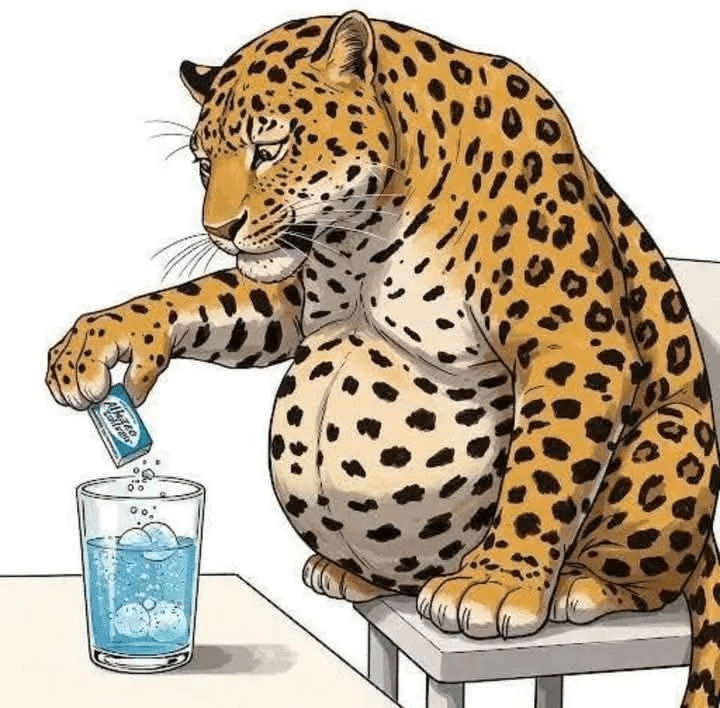
A metaphor for what Trump has done to our country in less than 2 years. pic.twitter.com/NQulsg8Urx
— Amy Siskind (@Amy_Siskind) August 16, 2026
Look what VANDALS did to the grass connecting the vandalized World War II Monument and the vandalized Reflecting Pool, which will be opened again, and better than ever, shortly. Anybody who thinks the Reflecting Pool wasn't vandalized should go back to Law School! President… pic.twitter.com/q9tJjfwoKX
— Unofficial Trump on X (@trump_repost) August 17, 2026
U.K. Prime Minister Andy Burnham engaged with messages from somebody impersonating one of Donald Trump’s closest advisers, four officials have told POLITICO.
— POLITICO Europe (@politico.eu) 2026-08-17T05:18:12.986Z
A person without any govt position, who has numerous financial conflicts of interest, should not conduct US foreign policy.And that’s before we get to the fact that he uses this role to corruptly solicit money for himself.It’s wrong. Many seem to have accepted it, but I’ll never stop objecting.
— Nicholas Grossman (@nicholasgrossman.bsky.social) 2026-08-17T01:32:45.694Z
Demand for Canadian citizenship certificates is soaring, fuelled by Americans. Backlog of applications now at 121,800 and archives are swamped with requests. http://www.cbc.ca/news/politic…
— Elizabeth Thompson (@lizt1.bsky.social) 2026-08-17T10:30:22.831Z
AI slop is swamping a House office that drafts US laws
— Politico (@politico.com) 2026-08-17T08:50:40.869Z
Share this:
Political news I want to share. 8-14-2026
Democrats demand Trump reveal stock managers, explain suspicious trades
— CNBC (@cnbc.com) 2026-08-13T12:07:32.576Z
In addition to trying to re-scrawl his name on the Kennedy Center facade by adding “Restored and Renovated By President Donald J. Trump,” Trump's trying to rename the physical site “the President Donald J. Trump Plaza.”
— Roger Parloff (@rparloff) August 13, 2026
Opposing attys' statement below. (Wash Litig Grp & @DDFund_) pic.twitter.com/JMEoaKjJ0x
Orange Man is so in need of affirmation that he will stop at nothing to slap his name on any edifice in DC. Sad, pathetic and illegal. Astounding what can happen to a person whose Daddy didn’t hug him enough. http://www.nytimes.com/2026/08/13/a…
— Howard Sherman (@hsherman.bsky.social) 2026-08-13T17:56:13.905Z
White House to host crypto, prediction market executives next week
— Politico (@politico.com) 2026-08-13T20:03:40Z
Greenland authorities have forced a US oil company connected to Donald Trump to postpone drilling wells in the Arctic territory, defying claims by the US president’s envoy that Americans could be extracting crude by next year. http://www.theguardian.com/world/2026/a…
— Scott Horton (@robertscotthorton.bsky.social) 2026-08-13T03:19:23.000Z
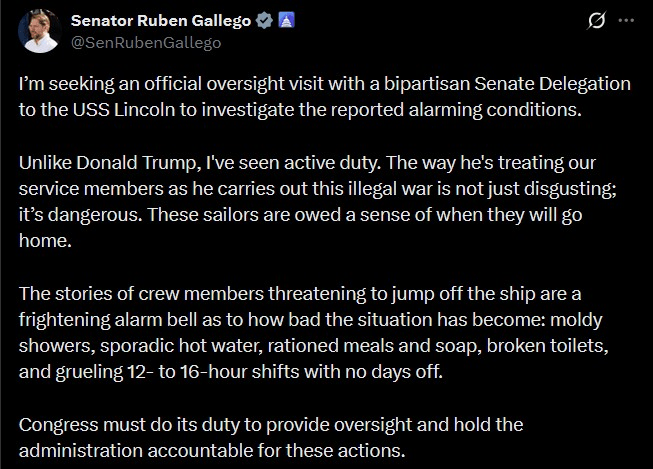
The reports from the USS Abraham Lincoln about multiple sailors attempting to jump into the sea are disturbing. Long deployments are hard. They are a lot harder when the mission isn’t well defined and there is no end in sight. Here is some information on how to get help:… https://t.co/06a8Nu1ckx
— Senator Mark Kelly (@SenMarkKelly) August 13, 2026
The Department of the Navy must allow a bipartisan Congressional Delegation to visit the USS Lincoln to conduct oversight investigation into this horrible situation.
— Ruben Gallego (@RubenGallego) August 13, 2026
CODELs have visited war zones to inspect the conditions of our troops. There is no reason to be denied access. https://t.co/l1OwrXwJo1
NEW: The USS Abraham Lincoln was supposed to come home in May — instead, under Trump's Navy, its sailors are grinding through a ninth month at sea with no end date, and the crew is so broken that multiple have attempted suicide. This should be a national scandal.
— Mike Nellis (@MikeNellis) August 13, 2026
The U.S. has long miscalculated due to intelligence failures. Case in point: The war on Iran. Now, an even bigger miscalculation on the Strait of Hormuz.
— Seyed Abbas Araghchi (@araghchi) August 13, 2026
Worse than fake news is fake intelligence. Be careful.
Allah is Great, Greater than ANY power on Earth. In Allah we trust.
🎁GIFTwww.wsj.com/us-news/trum…
— PJ walker (@pj1304.bsky.social) 2026-08-13T21:02:08.312Z
EXCLUSIVE: The wife of the USS Lincoln sailor who jumped overboard last week says she wasn't notified about the incident until four days after & said her husband repeatedly expressed concerns over his mental health but was "brushed off." w/@PriyaReporting https://t.co/jJlmtDHHNC
— Lindsey Pipia (@LP_Reports) August 13, 2026
".. deployed for more than 250 days and it has not made a port call in 200 days, setting a record for consecutive days at sea .."@wsj.com http://www.wsj.com/politics/nat…
— Carl Quintanilla (@carlquintanilla.bsky.social) 2026-08-13T15:36:37.689Z

The Pentagon will soon cover the cost for some service members to freeze their sperm or eggs. 🔗Link to article in comments ⬇️
— Military Times (@militarytimes.bsky.social) 2026-08-12T20:53:31Z
NEW: The U.S. military has lost at least 45 MQ-9 Reaper drones during the war with Iran, or roughly 25 percent of its fleet, according to three U.S. officials familiar with the matter. The high-demand drones cost between $30 million and $50 million a piece. w/ @noahjrobertson…
— Tara Copp (@TaraCopp) August 13, 2026
Tenant groups intervene to save Mamdani's rent freeze after landlord challenge gothamist.com/news/tenant-…
— Gothamist (@gothamist.com) 2026-08-13T19:24:09.707308Z

Q: A lot of people around here can't afford to fly. Can you say something about gas prices being a dollar more than they were a year ago?SEAN DUFFY: No one complained about Joe Biden's inflation, which was wildQ: Can you talk about gas prices?
— Aaron Rupar (@atrupar.com) 2026-08-13T13:43:28.548Z
NYP: Kari Lake, Scott Jennings and Spencer Pratt are seen as possible contenders who could replace White House Press Secretary Karoline Leavitt.
— Politics & Poll Tracker 📡 (@PollTracker2024) August 13, 2026
Link to article: https://t.co/tqqFENRHXo pic.twitter.com/T5JUZvyDF0
Here’s my conversation with @ErinBurnett about my essay in today’s @nytimes. https://t.co/TDzc335oya https://t.co/yhsNNu5zqx
— Jonathan Reiner (@JReinerMD) August 13, 2026
I Was Dick Cheney’s Cardiologist. Trump Has Not Looked Well, and We Should Know Why. http://www.nytimes.com/2026/08/12/o…
— Elizabeth West (@limeylizzie.bsky.social) 2026-08-12T15:15:51.480Z
Florida allows voucher schools to cite their faith as a reason to deny admission to gay students.
— Scott Maxwell (@Scott_Maxwell) August 12, 2026
But the AG says the same schools can't cite their faith as a reason to deny admission to anti-vaxxers.
What a selective version of faith and “freedom.”https://t.co/tdSfAUJwhi
GOP Rep Falsely Claims 82% of Women Vaccinated in First Two Trimesters Miscarried
— Mediaite (@mediaite.com) 2026-08-11T23:13:17Z
The “covered up” data was published in the New England Journal of Medicine in September 2021, where it has sat, publicly, for five years. It shows vaccinated women miscarried at the same rate as everyone else, about 1 in 8. The 82% figure comes from a denominator error: it counts… https://t.co/HtVOF5dDkR
— Jake Scott, MD (@jakescottMD) August 12, 2026
Ted Cruz has been better than a lot of Republicans, but as it turns out even “better” is pretty bad. https://t.co/AAEaEINybq
— Richard Hanania (@RichardHanania) August 12, 2026
Shame on you @tedcruz. This is a bald faced lie. You are lying. You are purposely lying. You are purposely spreading malicious & dangerous disinformation. How the fuck do you live with yourself? Shame on you. https://t.co/1s040cuCAZ
— Joe Walsh (@WalshFreedom) August 12, 2026
This is a disgusting, disgraceful, reckless statement from Senator Cruz.
— Brad Polumbo (@brad_polumbo) August 12, 2026
Not only are these statistics and claims totally, objectively wrong and false.
The data he's referencing was NEVER "covered up" by Dr. Fauci.
It's been public since its 2021 publication in NEJM.
And… https://t.co/i99Oh2sWFq
🚨BREAKING: A Nebraska court Wednesday rejected the RNC’s lawsuit seeking to block certain U.S. citizens abroad from voting in the state, handing the national GOP another major loss in its escalating legal campaign against overseas voters. https://t.co/4nHl5KtzSE
— Marc E. Elias (@marceelias) August 12, 2026
This is one of the cringiest things I’ve ever watched. Is he mad at it? If this is his idea of campaigning, Gina has a real shot.
— Sara McGee for Texas HD 132 (@SaraForTexLege) August 12, 2026
Also, thanks for reminding us that we can’t afford beef. https://t.co/DkNg0gl8KH
BREAKING WaPo:Republican Rep. Max Miller's ex-wife has filed a federal civil rights lawsuit against Miller and his attorney — alleging that they "recklessly published" a nude image of Miller's 2-year-old daughter online.
— Kyle Griffin (@kylegriffin1.bsky.social) 2026-08-13T03:05:42.548Z
BASH: It sounds like you're saying you're not going to return Max Miller's donations because you believe himLAWLER: 😮 Look, this is a private family matter. Max has also made allegations against his ex-wife. Nothing has been corroborated here. Do you have information that proves the allegations?
— Aaron Rupar (@atrupar.com) 2026-08-13T16:51:53.128Z

Watching the media and Democrats fall all over themselves defending Graham Platner is truly next level.
— Mike Lawler (@lawler4ny) June 12, 2026
After all the sanctimonious lectures about everything, it turns out, they don’t actually care about Nazi affiliations or sexual abuse and harassment. pic.twitter.com/pV9FrBbO0x



Abdul El-Sayed’s best pal and campaign partner says the USA should resume lynchings against black people.
— Scott Jennings (@ScottJenningsKY) August 12, 2026
Listen for yourself and understand what the socialists have in store for the black community pic.twitter.com/N3ntbIHefw
CNN contributor Scott Jennings just falsely accused Hasan Piker of supporting lynchings using out-of-context clips in an attempt to attack Abdul El-Sayed's campaign. Defamation like this is highly unlawful and can result in millions of dollars in damages if Piker sues. pic.twitter.com/7mqYoacwGm
— Fifty Shades of Whey (@davenewworld_2) August 13, 2026
This is beyond insane, even for TX: Fort Worth police just ARRESTED a man for saying "bullshit" while speaking at last week's Tarrant County meeting opposing a plan to cut nearly 50% of Election Day voting locations. He's charged with disrupting a meeting, @startelegram reports.
— Jen Rice (@jen_rice_) August 12, 2026

Man arrested after profanity at last week’s Tarrant commissioners meeting, from @startelegram https://t.co/i6LsUVw4sa pic.twitter.com/ykdJYJIR5O
— Jen Rice (@jen_rice_) August 12, 2026
Marni von Wilpert is hosting a congressional campaign fundraiser at a San Diego nightclub known for LGBTQ nightlife and adult-themed specials.https://www.foxnews.com/politics/california-dem-ripped-perverted-agenda-fundraiser-risque-nightclub
— The Right News, Right Now. (@bradporcellato.bsky.social) 2026-08-13T13:39:24.833088Z
I’m very disappointed that SacAnime has disinvited me from a Halo 25 reunion at their conference next month. If you thought we defeated Cancel Culture in 2024, guess again! pic.twitter.com/DSEWcIEjDA
— Marty O'Donnell (@MartyTheElder) August 11, 2026
“Does not feel safe”
— Brandon Herrera (@TheAKGuy) August 11, 2026
Because they are intellectual children who see a calmly articulated opposing worldview as violence.
Its as simple as just not being an asshole dude. You're not entitled to be at an event when you speak out against the rights of the people organizing it.
— Zack Hatrick (@BionicZack) August 11, 2026
You cant hate the left enough.
— Vismier 🇺🇸 (@Vismier17) August 11, 2026
They preach about acceptance yet the secound you are not 99.9% aligned with them they turn on you like a bunch of rabid dogs.
Truly, leftist are a bane on not only American society, but the world at large.
Be cool if we could just send them all…

Buttigieg’s plan to help Dems win again starts with the Indiana state legislature http://www.politico.com/news/2026/08…
— Timothy McBride (@mcbridetd.bsky.social) 2026-08-13T13:13:51.790Z
CNBC: Do you regret voting for RFK Jr?BILL CASSIDY: If you want to tell me that somebody didn't tell me the truth, and I should've seen in the future they were not gonna tell the truth, you can say, 'Bill you should've seen into the future'
— Aaron Rupar (@atrupar.com) 2026-08-13T12:23:16.808Z
This is scandalous waste, fraud, and abuse. http://www.nytimes.com/2026/08/13/u…
— William Snyder (@profsnyder.bsky.social) 2026-08-13T10:16:40.682Z
KILMEADE: DHS plans to spend $20 million on electric shock gloves to aid federal agents. How would that work?HOMAN: It's another device to help someone be compliant when they're not. You can't have the first thing you go for be lethal force.
— Aaron Rupar (@atrupar.com) 2026-08-13T12:02:01.282Z
This isn't going to become some anomalous method of arresting people. They will be shocking people like this as a matter of course. pic.twitter.com/U9SuvaMTvu
— David J. Bier (@David_J_Bier) August 13, 2026
Pastor David Ritchie is charged with solicitation of prostitution. He is one of eight men arrested during an undercover operation. https://bit.ly/4xs0mDH
— (@news4sa.bsky.social) 2026-06-16T13:34:00.258008598Z
BREAKING NYT:A federal judge in Boston just dismissed an antisemitism lawsuit against Harvard University — dealing a blow to the Trump admin's efforts to force the university into a settlement.
— Kyle Griffin (@kylegriffin1.bsky.social) 2026-08-13T16:20:19.545Z
The Trump administration is abandoning controversial Biden-era plans to help developers build power lines in areas that badly need increased transmission infrastructure.
— NOTUS (@notus.com) 2026-08-12T22:09:02.21911961Z
Share this:
US Supreme Court Is Legalizing Sex Discrimination
Some very important points about trans athletes. As he says the bans only apply to trans women but not trans boys / guys. Plus as he also points out, the court and society don’t care about a smaller weaker boy getting their ass handed to them by a much bigger boy but a girl losing to another bigger girl is now against the law and the bigger girl must summit to have someone look at their genitals to make sure. Hugs

