I want to thank https://personnelente.wordpress.com/2025/12/31/attacking-ukraine/ for the link to this news article. I think it is seriously important we realize Ukraine is suffering to keep the rest of the world safe. If Putin has his way he will recreate the world of the USSR in the 1980s again, taking territory of other countries by force and stealing their resources, just as tRump thinks the US should be able to do the countries the US deals with or are in our hemisphere. None of this will come to any good for the world. Right from the start Ukraine should have been given the weapons it needed with no restraint on how to use them. Biden did as much to damage Ukraine as Putin’s military did. Biden forced Ukraine to fight with their hands tied behind their backs. Thankfully Europe is realizing that mistake and removing the no attacks on Russian soil restrictions. Hugs
In 2025, Russian troops carried out a record number of air attacks on the territory of Ukraine. According to the United24 platform, the enemy used more than 60 thousand guided bombs, about 2.4 thousand missiles and more than 100 thousand drones of various types.
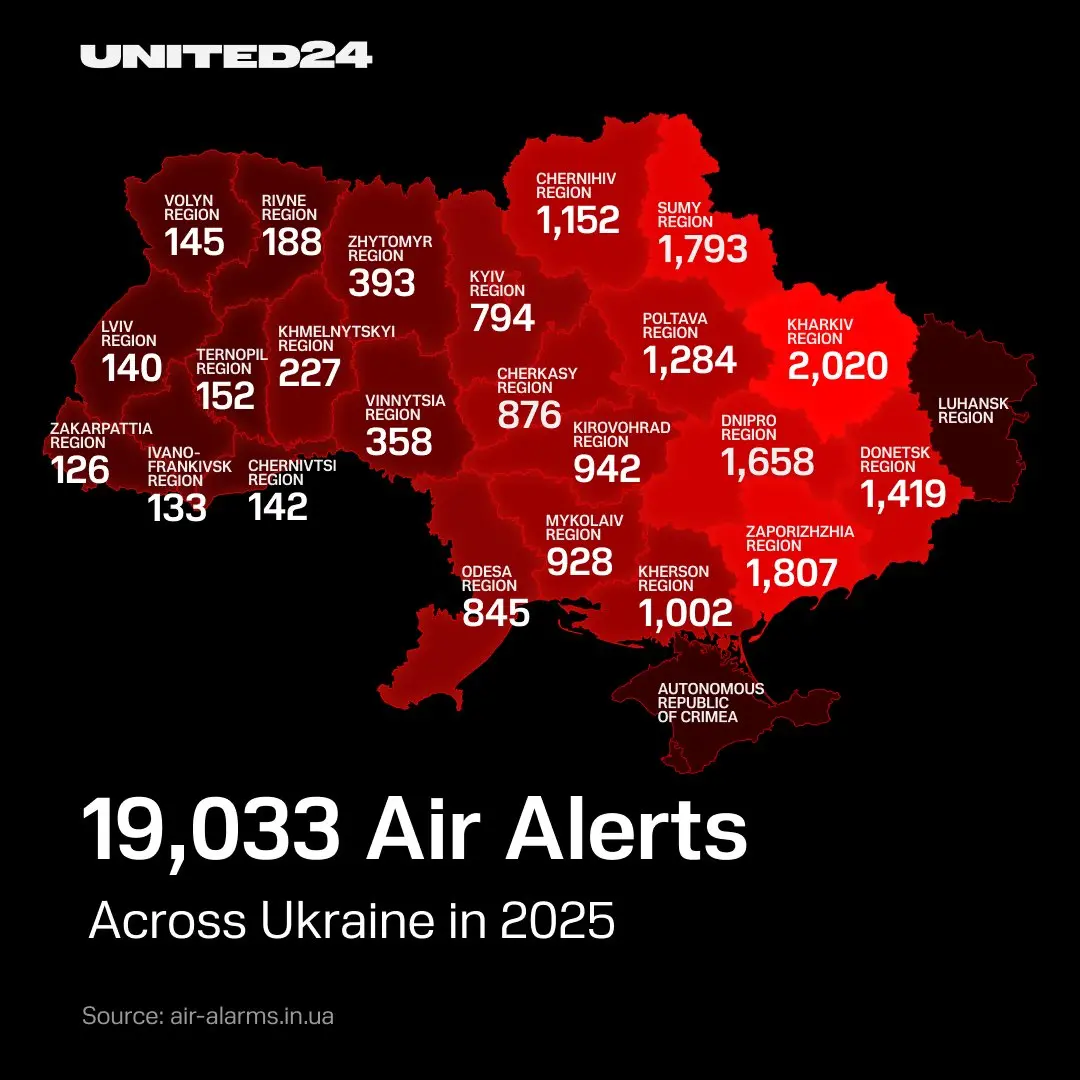
Number of air alerts in Ukraine in 2025 / United 24
During the year, at least 19,033 air alerts were announced throughout the country. The sirens sounded most often in the Kharkiv region (2,020 times), Zaporizhia (1,807 times) and Sumy region (1,793 times). The fewest alerts were recorded in Transcarpathia (126 times), Ivano-Frankivsk region (133 times) and Lviv region (140 times).
If in the winter and spring months there were one or two major attacks per month, then since June-July their number has increased significantly. During individual strikes, the enemy used up to 60 missiles and hundreds of drones, sometimes up to 700–800 drones in a single attack.
The most massive attacks of 2025:
January 15: 177 targets (of which 43 missiles and 74 drones, air defense destroyed 30 missiles and all drones)
February 1: 165 targets (of which 42 missiles and 123 drones)
March 7: 261 (of which 67 missiles and 194 drones)
April 24: 215 (of which 70 missiles and 145 drones)
May 25: 367 (of which 69 missiles and 298 drones)
Starting in June, the shelling has intensified significantly:
June 29: 537 targets (of which 60 missiles and 477 drones)
July 9: 728 drones.
In August, the number of attacks remained at a high level:
August 21: 614 targets (including 40 missiles and 574 drones)
August 28: 629 targets (including 31 missiles and 598 drones)
August 30: 582 targets (including 45 missiles and 537 UAVs).
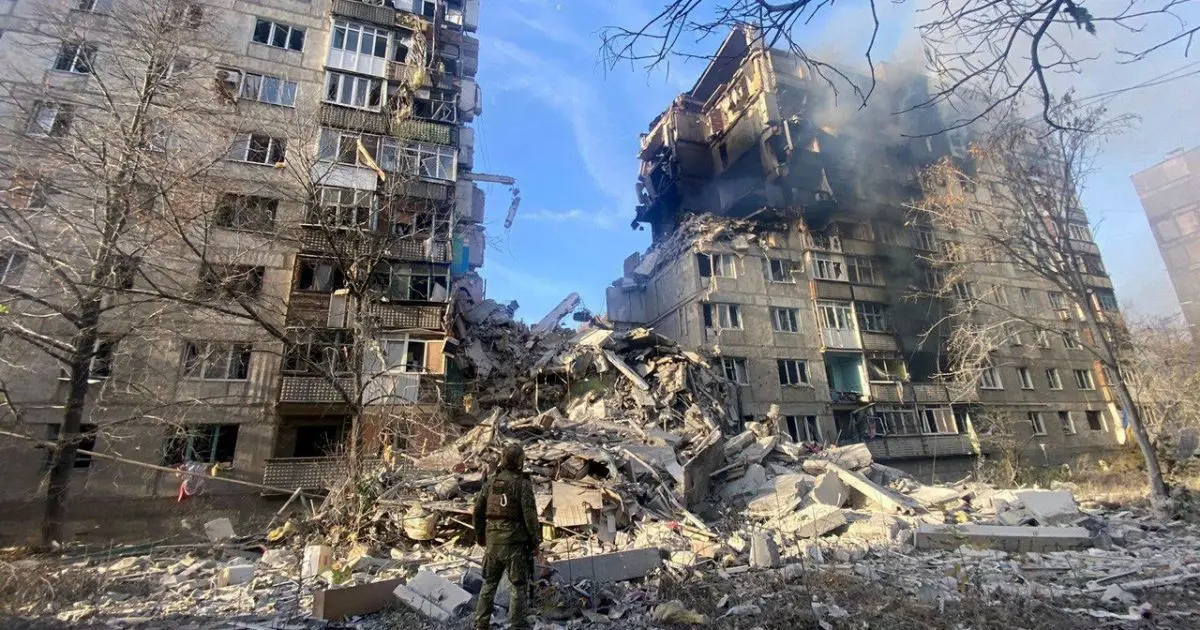
Consequences of the shelling of Donetsk : National Police of Ukraineregion
A record number of drones was recorded on September 7 – 823 targets (including 810 drones and 13 missiles), and on October 30 the enemy launched 705 targets (including 52 missiles and 653 drones). During November and December, massive attacks continued: the number of missiles reached 51, drones – up to 653 in one shelling.
United24 emphasizes that human suffering cannot be fully measured in numbers, but statistics clearly demonstrate the scale of the threat and confirm that Ukraine needs enhanced air defense and support from international partners.
This will be interesting. Which master does tRump serve? Does he do as Putin asks or does he do as the oil companies ask? Also that the ship would be carrying just oil makes no sense, as each country involved produces its own oil. I think the ship has weapons. Iran is a big seller of arms and has been supplying Russia with different types of weapons. Was Iran trying to sell arms to Venzualia? Hugs
The tanker, which had been sailing to Venezuela to pick up oil, has claimed Russian protection, although the U.S. authorities say it is a stateless vessel.
A U.S. Coast Guard helicopter flying in Puerto Rico last month.Credit…Eva Marie Uzcategui/Reuters
The government of Russia has made a formal diplomatic request that the United States stop its pursuit of an oil tanker that had been sailing for Venezuela and is now fleeing the Coast Guard in the Atlantic Ocean, according to two people with knowledge of the matter.
The request was delivered late on New Year’s Eve to the State Department, said the people, who discussed the diplomatic message on the condition of anonymity. It was also sent to the White House’s Homeland Security Council, one of the people said.
The dispute over the tanker comes as President Trump is trying to negotiate a peace deal between Russia and Ukraine and has repeatedly complained about his inability to end the war. Earlier this week, Mr. Trump hosted President Volodymyr Zelensky of Ukraine at Mar-a-Lago, his private club and residence in Florida, and the two leaders expressed optimism about ending the war even as they appeared to make little progress on the thorny issues of security guarantees and territory swaps.
Russia’s request that the United States stop chasing the vessel could add a new wrinkle to the negotiations and heighten tensions between the two nations over Venezuela.
American forces have been tracking the tanker, known as the Bella 1, for nearly two weeks. The ship, which started its journey in Iran, had been on its way to pick up oil in Venezuela when U.S. forces tried to stop and board it in the Caribbean Sea. The U.S. authorities said the ship was not flying a valid national flag, making it a stateless vessel susceptible to boarding under international law, and said they possessed a seizure warrant. But the crew of the Bella 1 refused to comply and sailed back toward the Atlantic.
In the days since, the ship has tried to claim the protection of Russia, with its crew painting a Russian flag on the side and radioing the Coast Guard to say they were sailing under Russian authority. The Bella 1 recently appeared in Russia’s official register of ships, under a new name, the Marinera, with a home port of Sochi, on the Black Sea.
The White House declined to comment on the record. But a U.S. official who spoke on condition of anonymity to discuss an ongoing law enforcement matter said the Trump administration continued to view the tanker as “stateless” because it was flying a false flag when it was first approached by the Coast Guard. The State Department and the Russian Embassy in Washington did not immediately respond to requests for comment.
Although securing Russian protection may be a long shot for the Bella 1 under international law, Russia’s diplomatic intervention could complicate the attempt to seize the tanker, which stems from the United States’ continuing conflict with Venezuela.
David Tannenbaum, a former sanctions compliance officer at the Treasury Department, said earlier this week that it was “unclear” whether Russia’s providing “overnight flag registration” to the ship would prove valid.
Mr. Maduro has ordered the Venezuelan Navy to accompany some tankers leaving his country and has considered putting troops on board, potentially heightening the chances of an armed confrontation with U.S. forces on the high seas.
Last week, in a call between Venezuela’s and Russia’s foreign ministers, Russia “reaffirmed its all-out support and solidarity with the leaders and people of Venezuela,” according to a summary of the call from Russia’s foreign ministry.
Nicholas Nehamas is a Washington correspondent for The Times, focusing on the Trump administration and its efforts to transform the federal government.
Edward Wong reports on global affairs, U.S. foreign policy and the State Department for The Times.
Tyler Pager is a White House correspondent for The Times, covering President Trump and his administration.
Why I do these posts. This is three days of Joe My God that got away way from me. So why do I do these long news posts? Because I comb the Joe My God comment section for the best memes and snarkiest comments. It dawned on me I could post his news articles for those that want to read them. But three days is a lot to go throw and it is much easier just to quickly scan and snatch the comments rather than post them. So I need some inputs from everyone. Are these posts worth it? Or would you rather go to Joe My God yourselves. Or I can keep doing these. Up to you. Hugs
—————————————————————————————————————————-
tRumps Grifts / Scams / Ripping off the rubes / tRump’s ego / tRump’s Crimes / tRump’s health / Republican grifts & payouts for supporting tRump / other trump scammers
The Trump Golf Tracker estimates that the president’s golf trips have cost taxpayers some $110,600,000 so far in 2025. But that estimate, which was based on a 2019 Government Accountability Office (GAO) report on four golf trips during his first term, doesn’t even take into account the month of December.
The right wing media / the media arms of the GOP & Republican Party / The over the top thuggery and complete disrespect for common decency / Ask if you would like your child to act this way …. because maga does want their kids to be this crass as it makes them feel good / Kennedy Center debacle
The video was shared by Vice President JD Vance. FBI director Kash Patel said he is aware of the video and the FBI is investigating. The YouTuber says he is uncovering new fraud in Minnesota, but media outlets like KSTP reported more than a year ago about more than 62 investigations into Minnesota child care centers.
What this is really about is they are afraid Walz will run for office and win as he is so well liked. They are trying to gin up a fake scandal to Benghazi him like they did with Hillary Clinton. I posted yesterday how fake and full of lies / misinformation the “report” the YouTuber did was. In the article above this one you can see how the Republican Party had a hand in helping the right wing influencer to push a fake story. The state has been investigating these things for several years. Hugs
$175 billion for a “golden dome” that experts doubt would actually work, but only $2 billion in humanitarian aid for the United Nations. It’s what Jesus would want.
Space based weapons are forbidden by treaties that the US signed. That said do we have space based weapons … well I was sending commands somewhere for something when I was in the Army Sat coms / intel unit. You decide. Hugs
Maga hate fail / tRump lost in court / tRump supporters doing what they do not want you to know about / ICE lies / tRump’s DOJ / Misinformation / Trying to change history by spewing & omitting facts or what really happened
The emails, which were made public as part of a newly unsealed judicial order, largely reflected communications about the case that Robert E. McGuire, the acting U.S. attorney in Nashville, had with members of his staff and with Aakash Singh, a top official in Mr. Blanche’s office. They raised serious questions about whether the Justice Department had misled Judge Waverly D. Crenshaw Jr., who is overseeing the case, by telling him that local prosecutors had acted alone in charging Mr. Abrego Garcia.
Hate / Bigotry / DEI / White Supremacy / Christian Nationalism / US aid to only white countries or white dominated areas / US Healthcare / For Profit drug prices rip off the US public /
The civil probes are proceeding under the umbrella of the False Claims Act, which has traditionally been used to go after contractors who bill the government for work that was never performed or inflate the cost of services rendered.
The U.S. slashed its aid spending this year, and leading Western donors such as Germany also pared back assistance as they pivoted to increased defense spending, triggering a severe funding crunch for the United Nations.
U.N. data shows total U.S. humanitarian contributions to the U.N. fell to about $3.38 billion in 2025, equating to about 14.8% of the global sum. This was down sharply from $14.1 billion the prior year, and a peak of $17.2 billion in 2022.
The idea behind the legislation originated with the Alliance Defending Freedom, a conservative Christian legal advocacy group that has gained prominence for its work to incorporate religion in public spaces.
West last appeared here for his bill that would create a database of abortion patients.
In 2024, we heard from West for his bill to ban Pride flags at public schools and government buildings.
He appeared here in 2023 for his bill that would make it a felony to perform drag in the view of minors. His bill called for a $20,000 fine and up to two years in prison.
West first appeared here in 2021 when Gov. Kevin Stitt signed his bill making it legal to run over protesters.
The tweet below refers to West’s attempt to pass this same bill earlier this year.
tRump’s attack on Colorado because they won’t bow to the whim of the tyrant. His withholding money is illegal but no republican will stand up to the demented king.
This is another act of war committed by the US on a sovereign country. What tRump is doing attacking boats and seizing tankers now doing land attacks is no difference from what Putin / Russia is doing to Ukraine. Plus only congress can authorize a war, not tRump. tRump is very honest as to why he is committing war crimes, he wants the oil for US companies and to get it he needs Maduro to leave office. The oil belongs to Venezuela and its people / government. It is not US oil nor US land. tRump is being a total school yard bully in that he attacks a smaller country that can’t fight back well while completely giving in to Putin who he fears. Hugs
The administration provided no details of what the president said was an attack last week linked to U.S. efforts to disrupt drug trafficking from Latin America.
Such an attack would be the first on land since President Trump began his military campaign against Venezuela.Credit…Eric Lee for The New York Times
President Trump said in a radio interview that the United States had knocked out “a big facility” last week as part of his administration’s campaign against Venezuela, an apparent reference to an American attack on a drug trafficking site.
American officials said that Mr. Trump was referring to a drug facility in Venezuela and that it was eliminated, but provided no details. Military officials said they had no information to share, and the Central Intelligence Agency declined to comment. The White House declined to comment.
Mr. Trump made his statement on Friday during an interview with John Catsimatidis, the Republican billionaire and supporter of the president who owns the WABC radio station in New York. The two men were discussing the U.S. military campaign to disrupt drug trafficking from Latin America by striking boats suspected of carrying narcotics.
“They have a big plant or a big facility where the ships come from,” Mr. Trump said, without saying where it was or explicitly identifying Venezuela as the target. “Two nights ago we knocked that out.”
Asked about the incident on Monday, Mr. Trump declined to say how the attack had been carried out or by whom but said it was along a shoreline.
“There was a major explosion in the dock area where they load the boats up with drugs,” he told reporters at Mar-a-Lago, his club and residence in Florida. “They load the boats up with drugs. So we hit all the boats, and now we hit the area. It’s the implementation area, that’s where they implement, and that is no longer around.”
The attack appears to be the first known to have been carried out on land since he began his military campaign against Venezuela. U.S. officials declined to specify anything about the site the president said was hit, where it was located, how the attack was carried out or what role the facility played in drug trafficking. There has been no public report of an attack from the Venezuelan government or any other authorities in the region.
While some officials called the facility struck a drug production site, it is not clear what role in narcotics trafficking the facility would have played. Venezuela is well known for its role in trafficking drugs, especially cocaine produced in Colombia, but has not been a major producer of narcotics.
Mr. Trump has been promising strikes on land in Venezuela for weeks, part of an intensifying pressure campaign on Nicolás Maduro, the authoritarian leader of Venezuela, who is under indictment in the United States for his role in the drug trade.
Mr. Trump authorized the C.I.A. to begin planning covert operations inside Venezuela months ago.
The United States has been conducting military strikes on boats in the Caribbean and the Pacific since September. The administration maintains that the vessels are transporting cocaine. The operations have killed at least 105 people so far, and have been called extrajudicial killings by critics who say the U.S. military has no legal basis for lethal strikes against civilians. The administration has defended the attacks by asserting that the United States is in a conflict with what it calls narco-terrorists who can only be stopped with military force.
Those boat strikes were originally developed as part of a two-phase operation. The second phase, which has yet to be officially announced, was to include strikes on drug facilities in Venezuela, people familiar with the planning have said.
Since beginning the strikes, Mr. Trump has announced what he has called a blockade of Venezuela as the United States has begun trying to intercept oil tankers, cutting off a vital source of income for the Maduro government.
Exactly what operations Mr. Trump had in mind for the C.I.A. were not clear, but they could include both sabotage operations and psychological operations meant to prod Mr. Maduro into making some mistake.
Eric Schmitt, Edward Wong and Maria Abi-Habib contributed reporting.
Tyler Pager is a White House correspondent for The Times, covering President Trump and his administration.
Julian E. Barnes covers the U.S. intelligence agencies and international security matters for The Times. He has written about security issues for more than two decades.
The United States is offering Ukraine security guarantees for a period of 15 years as part of a proposed peace plan, Ukrainian President Volodymyr Zelenskyy said Monday, though he said he would prefer an American commitment of up to 50 years to deter Russia from further attempts to seize its neighbor’s land by force.
U.S. President Donald Trump hosted Zelenskyy at his Florida resort on Sunday and insisted that Ukraine and Russia are “closer than ever before” to a peace settlement.
Negotiators are still searching for a breakthrough on key issues, however, including whose forces withdraw from where in Ukraine and the fate of Ukraine’s Russian-occupied Zaporizhzhia nuclear power plant, one of the 10 biggest in the world. Trump noted that the months long U.S.-led negotiations could still collapse.
“Without security guarantees, realistically, this war will not end,” Zelenskyy told reporters in voice messages responding to questions sent via a WhatsApp chat.
Ukraine has been fighting Russia since 2014, when it illegally annexed Crimea and Moscow-backed separatists took up arms in the Donbas, a vital industrial region in eastern Ukraine.
Details of the security guarantees have not become public, but Zelenskyy said Monday they include how a peace deal would be monitored as well as the “presence” of partners. He didn’t elaborate, but Russia has said it won’t accept the deployment in Ukraine of troops from NATO countries.
Trump and Putin discuss peace efforts by phone
Trump on Monday had “a positive call” with Russian President Vladimir Putin about the war, White House press secretary Karoline Leavitt said in a post on X. The two leaders had also spoken shortly before Trump’s talks with Zelenskyy on Sunday as the American president tries to steer the countries toward a settlement.
Later, to reporters, the U.S. president similarly characterized the call as “a very good talk” and said “we have a few very thorny issues, as you can imagine” in the negotiations to end the war.
“If we get them resolved, you’re going to have peace,” he added.
Putin’s foreign affairs adviser Yuri Ushakov said Trump is pushing Ukraine to seek a comprehensive peace agreement and not demand a temporary respite for its military through a ceasefire. Putin has insisted on a full settlement before any truce.
In Monday’s call, Putin told Trump that Ukraine attempted to attack the Russian leader’s residence in northwestern Russia with long-range drones almost immediately after Trump’s Sunday talks with Zelenskyy.
The attack “certainly will not be left without a serious response,” Ushakov said, adding that Moscow will now review its negotiating position.
Zelenskyy denied the Russian claim of an attack, describing it as an attempt to manipulate the peace process. He said it was “another lie” and came about because Moscow is unnerved by progress in peace efforts.
Russian Foreign Minister Sergey Lavrov said Ukraine launched an attack on Putin’s residence in the Novgorod region overnight from Sunday to Monday using 91 long-range drones.
“I don’t like it. It’s not good,” Trump said of the alleged attack on Putin’s home, confirming the Russian leader informed him of it during their call Monday morning.
Russia claims its forces are advancing
As indications suggest negotiations could come to a head in January, before the fourth anniversary of Russia’s full-blown invasion of Ukraine on Feb. 24, 2022, Putin on Monday claimed that Russian troops are advancing in the eastern Donetsk region of Ukraine and are also pressing their offensive in the southern Zaporizhzhia region.
Putin has sought to portray himself as negotiating from a position of strength as Ukrainian forces strain to keep back the bigger Russian army.
He emphasized at a meeting with senior military officers the need to create military buffer zones along the Russian border. “This is a very important task as it ensures the security of Russia’s border regions,” Putin said.
French President Emmanuel Macron said Kyiv’s allies will meet in Paris in early January to “finalize each country’s concrete contributions” to the security guarantees.
Trump said he would consider extending U.S. security guarantees for Ukraine beyond 15 years, according to Zelenskyy. The guarantees would be approved by the U.S. Congress as well as by parliaments in other countries involved in overseeing any settlement, he said.
Zelenskyy said he wants the 20-point peace plan under discussion to be approved by Ukrainians in a national referendum.
However, holding a ballot requires a ceasefire of at least 60 days, and Moscow has shown no willingness for a truce without a full settlement.
Ukrainians doubt Putin’s sincerity
On the snowy streets of Kyiv, the Ukrainian capital, people were skeptical about the chances of peace.
One military veteran who uses the call sign Sensei, in keeping with the rules of the Ukrainian military, said Putin’s record in power shows he can’t be trusted. Sensei joined the military in 2022 and was wounded that year during the battle for the Ukrainian city of Bakhmut. Now, he said, almost nobody from his company is still alive.
“But all these sacrifices, they are not in vain, because we need to prove … that we exist, that we are, that we have the right to our existence, to our territory, to our culture, to our language,” the 65-year-old veteran told The Associated Press.
Denys Shpylovyi, a 20-year-old student who was home for the holidays, said Trump’s willingness to accept Putin’s arguments has put Zelenskyy in a difficult situation.
“But I’m thankful for some progress. They are speaking, and maybe someday there will be hope,” he said.
Oleh Saakian, a Ukrainian political scientist, said it was a good sign that Zelenskyy is managing to build a relationship with Trump, although he noted that “nothing has been adopted yet, nothing has been signed yet.”
“I don’t see these negotiations bringing us closer to real peace, because they are based on equality between the aggressor and the victim, they are based on complete disregard for international law, and … disregard for European security,” he said.
___
Associated Press journalists Seung Min Kim in Washington, and Vasilisa Stepanenko and Volodymr Yurchuk in Kyiv, Ukraine, contributed to this report.
More tRump stupidity / tRump putting his branding everywhere / is he the president or chief architect / Fluffing tRump’s ego / tRump’s grifting / tRump’s lies & misinformation
That’s $100,000/head. tRump doesn’t care as he spends the taxpayers money / countries treasury like a drunk spending other peoples money. He is a tryant in that he thiinks that money is his todo what he wants even though the law states that only congress controls spending. This is human traficing plain and simple. Hugs
In September 2025, Turner’s agency sponsored a far-right anti-LGBTQ extremist to lead a massive Christian nationalist rally on Washington DC’s National Mall, the first-ever such event formally sanctioned by the federal government.
In June, it was reported that Turner is moving to take over the former National Science Foundation building as his agency’s headquarters, where he has demanded a full-floor executive suite, a private dining room, and parking for his five personal cars.
It is not lost on me that the above story is a woman with a career telling other woman they need to be stay at home mothers / trad wives to please a man because of religious dogma. Hugs
Yarborough appeared here last month for his bill that would ban Pride flags at government buildings, including public schools.
He appeared here in April 2025 for his bill that would ban thousands of books, including classic novels, over sexual content.
Yarborough appeared here March 2025 for his bill that would ban civil rights ordinances enacted by cities and counties, including, presumably, LGBTQ protections.
He first appeared on JMG in 2010, when as a member of the Jacksonville City Council he declared that gays, Muslims, and atheists should not be permitted to hold public office, otherwise God will smite the country.
In April 2023, lawmakers approved Yarborough’s ban on drag shows before minors. Yarborough is also the author several anti-trans bills.
Borrero appeared here in 2023 for a ban on Pride flags that died in committee. He tried again last year, but that attempt died after passage in its first committee hearing.
Borerro first appeared on JMG in January 2022 for his successful bill mandating that Florida public schools recognize an annual “Victims Of Communism Day.”
Oltmann appeared here last year when he called for executing Joe Biden, adding, “I want to send the mainstream media to the gallows, radical leftists to the gallows, traitors to our nation to the gallows, and they all kind of fit in the same bucket.”
In 2022, he appeared here when he announced that he would lead a “well-armed action” to install Kari Lake as governor of Arizona.
In 2021, he appeared here when he called for executing the 19 Republican Senators who voted to avert a government shutdown.
2025 has been filled with relentless and unprecedented attacks against the LGBTQ community in the U.S. President Donald Trump’s anti-LGBTQ policies have spilled over to countries abroad, including heading north to some conservative Canadian provinces like Alberta.
Despite this, there have been moments of hope. Here is Uncloseted Media’s 2025 LGBTQ year in review.
Jan. 1
Liechtenstein’s Marriage Act, passed in 2024, officially takes effect, opening marriage to same-sex couples and aligning the microstate with 21 other European nations that already recognize same-sex marriage.
Meta introduces new rules to their platforms. They remove their third-party fact-checking program and roll back hate speech restrictions, which allows anti-LGBTQ rhetoric to flourish. A report by Uncloseted Media identifies users who spew trans and homophobic language. One user wrote, “Look at this disgusting piece of fag shit here !” Another told someone to go to “the insane asylum where you belong, tranny freak.” Both of these comments are still up on the platform.
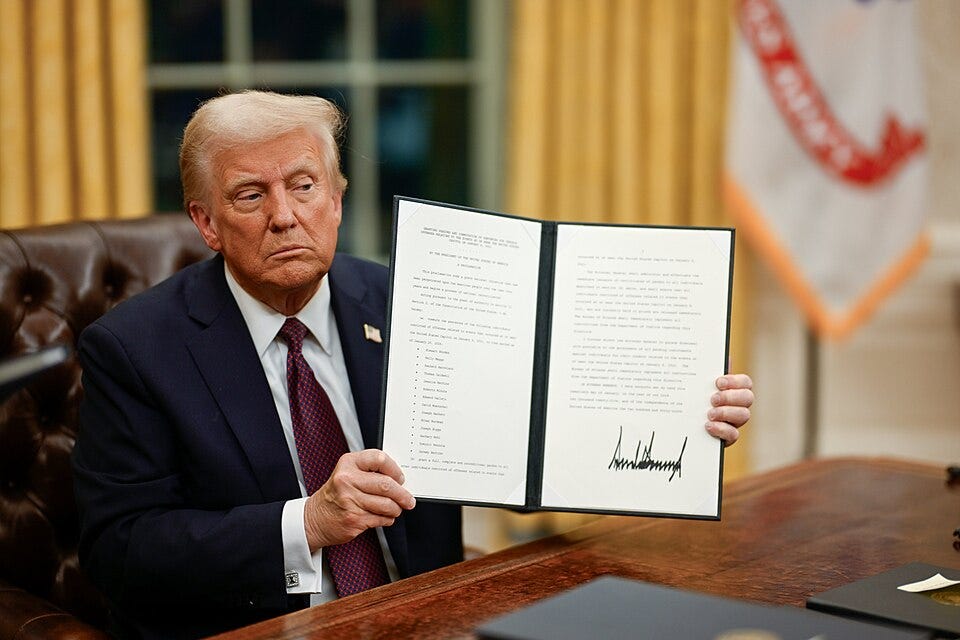
On the first day of his second term, President Trump signs an executive order titled “Defending Women from Gender Ideology Extremism and Restoring Biological Truth to the Federal Government.” The order forces federal agencies to treat sex as a fixed male and female binary “assigned at conception,” calls for “gender” to be scrubbed from federal guidance, halts federal funding for gender-affirming care and mandates trans women in prison to be sent to male facilities. Trump also issues a stop-work order for PEPFAR, the biggest HIV/AIDS relief program in the world. This kicks off a broader pattern of cuts to HIV prevention and research.
Over the next three months, Trump continues his attacks on the LGBTQ community by signing another executive order that bans trans women and girls from competing on sports teams that match their gender identity. He also directs agencies to curb gender-affirming care for anyone under 19 and to strip funding from schools that allow social transition, inclusive bathrooms or the use of affirming names and pronouns.
Jan. 23
Same-sex marriage becomes the law of the land in Thailand, making it the first country in Southeast Asia to recognize marriage equality and equal adoption rights for gay couples.
Jan. 27
The Idaho House passes a resolution urging the U.S. Supreme Court (SCOTUS) to revisit and overturn Obergefell v. Hodges, signaling a renewed appetite to attack marriage equality at the federal level.
Feb. 6
Australia amends its federal Criminal Code to add sexual orientation, gender identity and intersex status as protected characteristics in hate-crime law. This creates stronger penalties for perpetrators of anti-LGBTQ hate crimes across the country.
Feb. 13
Sam Nordquist, a trans man from Minnesota, is found dead in Upstate New York after a woman he met online kidnapped and tortured him for weeks in a hotel room. Seven people connected to his death have been charged with murder. Sam’s friend, Jax Seeger, spoke to Uncloseted following the tragedy:
“From my understanding, they came out and said it wasn’t a hate crime … and part of their reasoning was because one or two of the suspects self-identified within the [LGBTQ] community. … Like, you can’t say that just because they identified as LGBTQ, they’re incapable of committing a hate crime. Sammy wasn’t just physically abused. He was psychologically abused and they didn’t go into what that consisted of, but I think that’s something to keep in mind. As well as just the level of abuse you know? Trans people deserve the same respect and the same love as everyone else.”
The week after our interview with Seeger, prosecutors upgrade the charges against Nordquist’s accused killers to first-degree murder.
Feb. 14
The Stonewall National Monument. Photo by TheCatalyst31.
The National Park Service (NPS) erases mentions of transgender people from the Stonewall memorial, furthering conservative efforts to push “LGB” without the “T.” A few months later, NPS would go on to remove mentions of bisexuals as well.
Feb. 25
Mexico City Pride 2025. Photo by Wotancito.
Mexico City’s Congress approves a resolution to reform the Law for the Recognition and Attention of LGBTTTI+ Persons. This move effectively recognizes nonbinary people.
Feb. 28
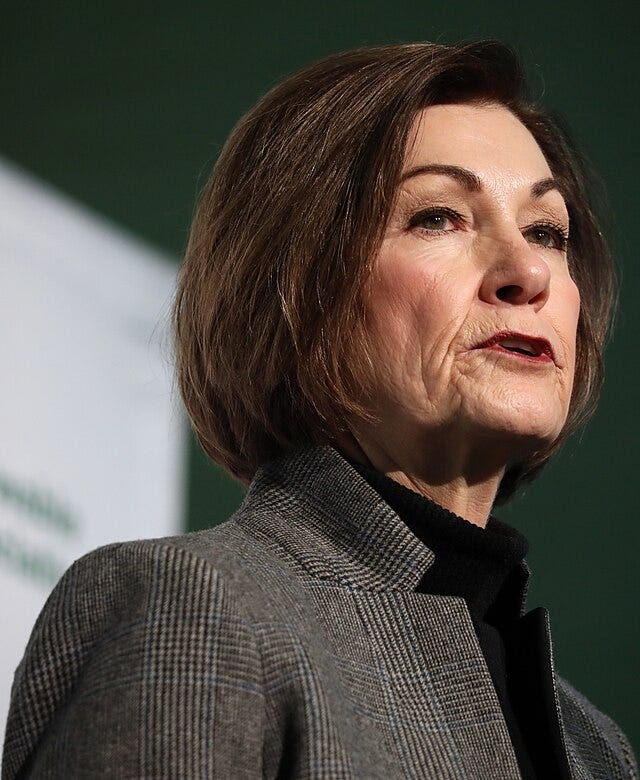
Kim Reynolds in 2024. Photo by Gage Skidmore.
Iowa Gov. Kim Reynolds signs SF 418 into law. This move officially removes “gender identity” from the Iowa Civil Rights Act’s list of protected classes in housing, employment and public accommodations. Iowa becomes the first state to remove civil rights from a previously protected group.
March 27
Gov. Spencer Cox announces that Utah will become the first state to ban LGBTQ pride flags in government buildings and public schools, effective May 7. While the move is framed as a “neutrality” measure, it is widely seen as part of a broader effort to erase public displays of queer identity. In protest, the Utah Pride Center unveils what it calls “the world’s largest transgender flag” in front of Utah’s State Capitol building in Salt Lake City.
April 4
A conversion therapy ban in New South Wales (NSW), Australia, goes into effect. This makes it illegal for therapists and religious leaders to practice conversion therapy on gay and trans people. In a media release, the NSW attorney general writes:
“This follows ongoing work by the NSW Government to progress reforms that ensure all members of our community feel valued, respected and equal.”
“This report not only rejects health care best practices for transgender people — it goes a step further by recommending conversion therapy, though under a new, rebranded name, ‘exploratory therapy’. Despite the report’s claims, this is, in fact, the same harmful practice of conversion therapy, just using friendlier language.”
May 6
Trump’s transgender military ban goes into effect. The change requires active trans service members to self-separate from the military or risk losing some of their Veterans Affairs benefits. Alaina Kupec, a retired transgender U.S. Navy lieutenant, says the decision punishes people who are qualified and want to serve the country:
“[This is] a really dark day for our country where basically we’re allowed to discriminate against a class of people.”
May 19
A Russian court fines Apple roughly $130,000 for four offenses, including the violation of Russia’s expanded “LGBT propaganda” law. The Russian law labels the “international LGBT movement” as extremist and treats queer visibility as a threat to state security. Anything that promotes “non-traditional sexual relations” violates the law.
May 30
Puerto Rico’s Supreme Court rules that residents can request an “X” gender marker on their birth certificates. This move explicitly recognizes nonbinary people and strengthens case law around self-determined gender in the U.S. territory.
Amid relentless attacks from the federal government, WorldPride takes place in Washington D.C. Ahead of the event, the African Human Rights Coalition calls for a boycott because of Trump’s swath of anti-LGBTQ policies. While roughly 1.2 million people attend, The Washington Post reports that the turnout is less than half of what organizers expected.
June 18
In a 6–3 decision, SCOTUS upholds Tennessee’s law banning gender-affirming care for minors, including puberty blockers and hormones. The ruling signals that similar bans in other Republican-controlled states are likely to stand, sharply narrowing access to medically recommended care for trans youth nationwide. Ten days after the ruling, five trans youth speak to Uncloseted Media, with Dylan Brandt, 20, saying:
“Lawmakers don’t need to be involved in my doctor visits. They have no right. They have no knowledge. … They’ve got a lane and they should stay in it.”
In defiance of a government ban on Pride events, roughly 100,000 people march the streets of Budapest, Hungary, to celebrate. The march was seen as both a showing of support for LGBTQ rights and a protest against Prime Minister Viktor Orbán’s conservative government.
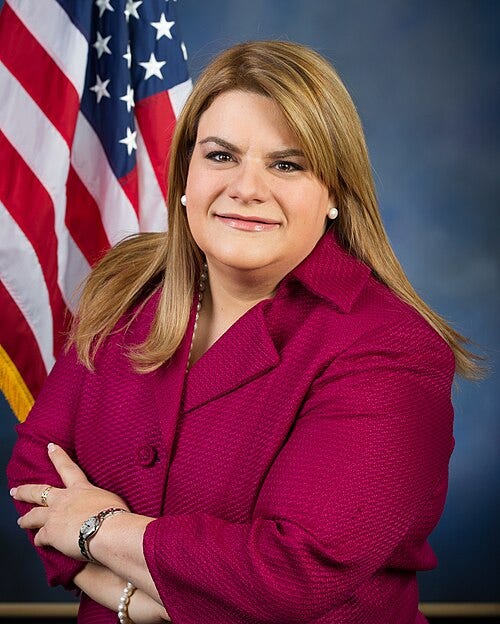
Puerto Rico’s governor, Jenniffer González-Colón, signs one of the harshest anti-trans health care laws in the northern hemisphere. The law bans gender-affirming care for anyone under 21 and threatens to cut off public funding for hospitals that don’t comply. It also threatens doctors with up to 15 years in prison and loss of licensure for violations. Puerto Rico’s LGBTQ+ Federation and GLAAD release a joint statement condemning the bill:
“Banning this care and stripping the rights of parents to make the best medical decisions for their families would create unbearable burdens for the most marginalized in Puerto Rico. Lawmakers must vote to protect access to health care that saves lives, and allow families to make private health care decisions that help loved ones be themselves, be safe, and to thrive.”
July 17
The Trump administration shuts down the LGBTQ suicide hotline, a life-saving resource that had received over 1.3 million calls, chats and texts since it launched in 2022. Genna Brown, a 16-year-old queer kid in North Carolina, who had used the hotline, spoke with Uncloseted Media about the impact it had on her mental health:
“I was an extremely self-loathing, suicidal kid who was under the impression that God hated me and I was gonna burn in hell for eternity. … Connecting with someone who gets it was really helpful. … Because at home, I was so isolated and I didn’t really interact with other queer people.”
July 18
Cuba’s National Assembly passes a law allowing trans people to change their legal gender without any requirement for genital surgery. In a post on X, Minister of Justice Oscar Silvera Martínez writes that the new law “will allow the country to have a modern civil registry” provided by “the issuance of digital documents with full validity and efficiency.”
July 29
In a move hailed by human rights groups, the Caribbean nation of St. Lucia strikes down colonial-era laws criminalizing “buggery,” effectively decriminalizing consensual same-sex intimacy between adults.
Aug. 20
In the middle of the night, Florida’s Department of Transportation paints over a rainbow crosswalk made to honor the victims of the Pulse nightclub terrorist attack that left 49 people dead. Advocates respond in protest by installing rainbow-colored bike racks.
Sept. 1
Burkina Faso’s Transitional Legislative Assembly passes a law explicitly criminalizing homosexuality. The law imposes a two- to five-year prison sentence and fines on people convicted of same-sex activity, deepening the criminalization of queer people in West Africa.
Sept. 10
The assassination of Charlie Kirk at Utah Valley University (UVU) kicks off a wave of anti-trans vitriol, including calls to criminalize the community and designate them as terrorists. In September, Uncloseted Media interviewed five current and former LGBTQ students at UVU. Simone Goodheart, a trans woman who had recently attended the school, spoke about how students were suggesting she was the murderer and how they were harassing her on campus:
“I would say a few of them were asking me to share my school schedule, which thankfully I’m not a student right now. But like damn, if that was the case? A few of them just make awful comments about my appearance, who I am as a person. Basically they just wanted to make sense [of it], but also they wanted to get their outrage out. Because yeah, somebody they cared for died. They are going through the grieving process and like there is outrage and frustration but they were misdirected and misconnected and just utilized by awful algorithms that try to boost the most amount of outrage possible in order to encourage engagement.”
Sept. 26
Slovakia’s parliament passes a constitutional amendment that formally recognizes only two genders, restricts legal gender transition and prohibits adoption by same-sex couples nationwide.
Oct. 6
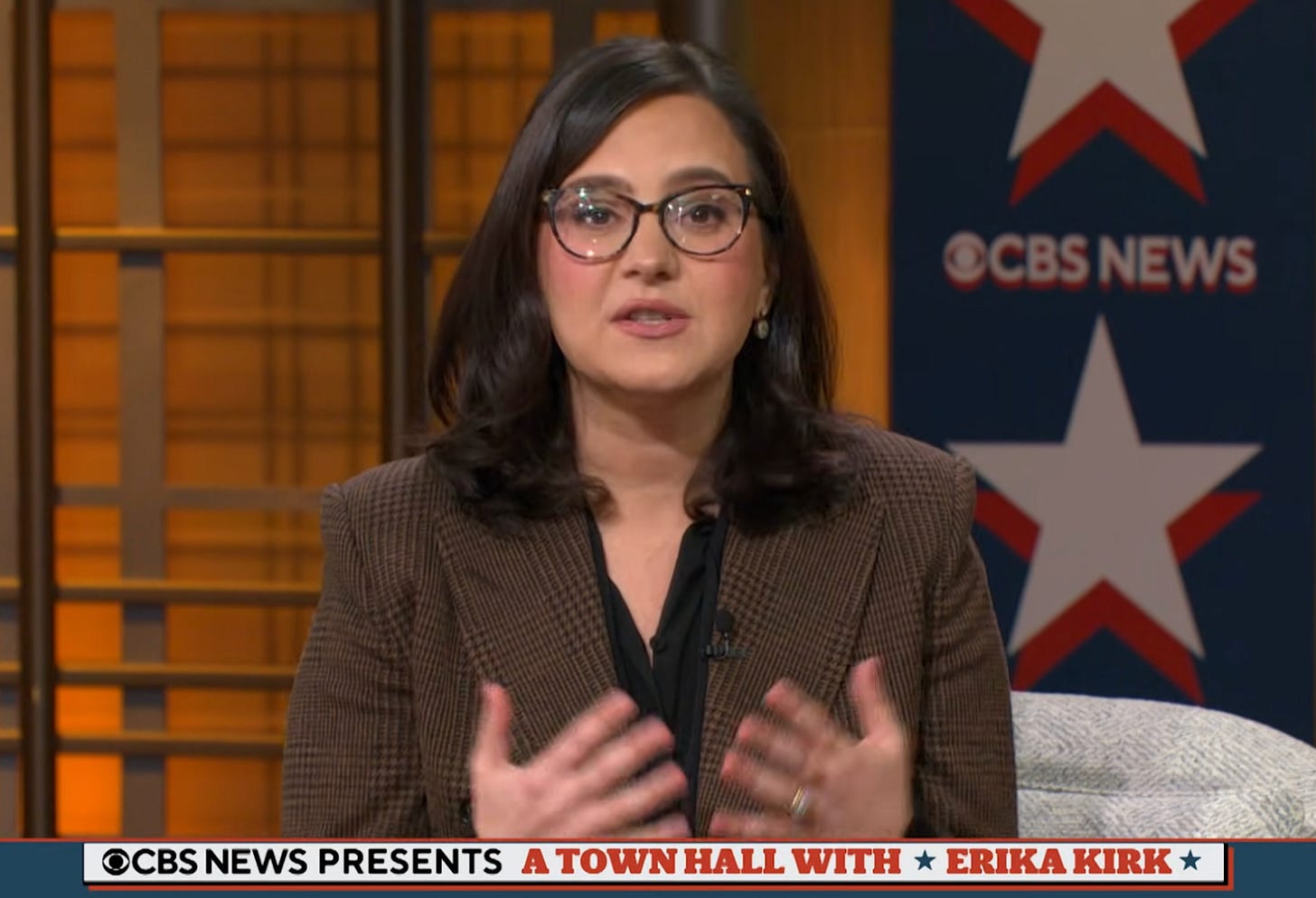
Bari Weiss hosting a CBS News Town Hall with Erika Kirk. Screenshot/CBS News.
Bari Weiss is appointed editor-in-chief of CBS News, making her the first openly gay person to lead the network. Weiss often angles herself as an independent thinker and is known for criticizing the mainstream media. She has no experience in broadcast news and has surrounded herself in controversy, accusing former colleagues at The New York Times of bullying her. She has also railed against Diversity, Equity and Inclusion (DEI) initiatives, writing articles with headlines such as “Bari Weiss: End DEI.”
“It is time to end DEI for good. No more standing by as people are encouraged to segregate themselves. No more forced declarations that you will prioritize identity over excellence. No more compelled speech. No more going along with little lies for the sake of being polite.”
Oct. 7
SCOTUS appears poised to rule against a Colorado law that bans the discredited practice of conversion therapy on minors. The justices repeatedly question the state over whether the law hinders free speech.
The high-stakes case could roll back the rights of LGBTQ youth across the country. Colorado is one of more than 20 states that have banned conversion practices, and a ruling in favor of removing the ban could make those laws in other states vulnerable to similar challenges.
Zohran Mamdani, one of the most outspokenly pro-trans politicians in the country, is elected mayor of New York City. Meanwhile, anti-LGBTQ Republicans are defeated in Virginia’s and New Jersey’s gubernatorial elections. On the night of his win, Mamdani reaffirms his support for those who elected him:
“In this moment of political darkness, New York will be the light. Here, we believe in standing up for those we love, whether you are an immigrant, a member of the trans community, one of the many black women that Donald Trump has fired from a federal job, a single mom still waiting for the cost of groceries to go down, or anyone else with their back against the wall. Your struggle is ours, too.”
In a massive win for gay rights, SCOTUS rejects Kim Davis’ appeal and won’t revisit the landmark decision that legalized same-sex marriage nationwide in 2015. This signifies a major defeat for the new push to overturn the ruling, which was spearheaded by Davis and her lawyers from Liberty Counsel.
Nov. 17
Across Alberta, Canada, anti-trans legislation takes effect. A trans sports ban for students also forces sports organizations and schools to collect sensitive personal information that risks outing trans and gender diverse youth. Alberta Premier Danielle Smith announces plans to circumvent legal opposition to the province’s ban on gender-affirming care for minors by invoking the notwithstanding clause, a constitutional provision that will stop such challenges for five years. The measure was also used in Alberta in 2000 to advance legislation opposing gay marriage.
Nov. 19
New Zealand’s health minister, Simeon Brown, announces a halt to new prescriptions of puberty blockers for minors with gender dysphoria. Brown says the ban will remain until a British clinical trial is completed. Existing patients can continue treatment.
Nov. 25
The European Union’s (EU) top court rules that member states must recognize same-sex marriages contracted in any EU country for purposes such as residence and free movement, binding more conservative governments such as Poland, Bulgaria, Romania and Slovakia to acknowledge queer couples’ marital status even if they refuse to perform such marriages at home.
Dec. 2
ADF International, the global arm of U.S. anti-LGBTQ legal group Alliance Defending Freedom, publicly backs a South Australian woman threatening legal action over a Headspace Berri mental-health presentation that mentioned LGBTQ issues, incest and bestiality in a classroom context. Elenie Poulos, an expert on the intersection of religious and political discourses, describes their impact as “huge,” saying:
“They have a very longstanding and aggressive approach to the rights of LGBTIQ people. They fight it in the courts in the US, they fight it politically, locally and in communities, and their aggressive anti-gay stance is extremely harmful.”
Dec. 18
Robert F. Kennedy Jr. and Dr. Oz announcerestrictive measures designed to block minors’ access to gender-affirming care. The plan proposes federal Medicare and Medicaid cuts to all hospitals that provide this care to minors. “The multitude of efforts we are seeing from federal legislators to strip transgender and nonbinary youth of the health care they need is deeply troubling,” says Rodrigo Heng-Lehtinen of The Trevor Project.
Dec. 21
CBS News shelves a planned 60 Minutes segment on men deported to CECOT, an infamous prison in El Salvador. Internal sources indicate that the move to cancel the story came from the network’s editor-in-chief Bari Weiss, who reportedly raised concerns about the Trump administration’s lack of response to the reporter’s outreach.
If objective, nonpartisan, rigorous, LGBTQ-focused journalism is important to you, please consider making a tax-deductible donation through our fiscal sponsor, Resource Impact, by clicking this button:
Israeli police have released a soldier from custody after he was filmed running his vehicle over a Palestinian man who was praying outside the city of Ramallah in the occupied West Bank.
A silent video of the incident, which both Israeli and Palestinian outlets reported on Thursday, shows an Israeli settler with a rifle slung over his back driving his all-terrain vehicle (ATV) toward a 23-year-old Palestinian man as he knelt in prayer on the roadside.
After barrelling over the man, the settler shouted something in his direction and backed up, then gestured for him to move.
The settler then turned his ATV around, got off, and shouted something at a Palestinian taxi driver. The injured Palestinian man then stood up, approaching the cab. The settler again shooed him off before hopping back on the ATV and speeding away.
Majdi Abu Mokho, the father of the Palestinian man, said his son now has pain in both legs after he was struck.
Mokho toldAgence France-Presse: “The assailant is a known settler. He set up an outpost near the village, and with other settlers he comes to graze his livestock, blocks the road, and provokes the residents.”
He also said the settler blinded him with pepper spray after hitting his son, though this is not shown in the video.
The Israel Defense Forces (IDF) identified the driver as an Israeli reserve soldier with one of its regional defense units. These battalions have dramatically expanded in recent years with backing from Israel’s right-wing government, which contains many officials at the center of the settler movement.
Breaking the Silence, a group of Israeli military veterans critical of the occupation of Palestine, has referred to the regional defense units—which have been responsible for many other attacks on Palestinian civilians in the West Bank—as “no more than settler militias in uniform.”
The IDF said the soldier’s weapon has been confiscated and that he’s been suspended due to the “severity of the incident,” which the IDF said it was investigating. The IDF has not released the soldier’s name.
An initial probe found that the same settler had opened fire in the village of Deir Jarir, north of Ramallah, earlier that same day, in an incident that resulted in a young Palestinian man being injured by gunfire.
During that altercation, which was also caught on film, a group of masked settlers was seen hurling rocks at the village’s entrance. According to Palestinian sources who spoke with the Israeli newspaper Haaretz,the targets of the attack were villagers who were grazing their cattle near their homes.
In another video, a masked man—who the IDF identified as the same reservist responsible for the ATV attack—is seen firing his weapon in the direction of the camera. The IDF said that by opening fire inside the village while in civilian clothes, the soldier had committed a “serious breach of his authority.”
According to the Times of Israel, Israeli police released the settler reservist from custody on Friday. He has been placed under house arrest for five days and is banned from approaching Deir Jarir, where the incident occurred, or from contacting anyone else connected with the case.
The violent incident is the latest in a year that has seen a record number of attacks by Israeli settlers and soldiers against Palestinian villagers.
According to official figures, Israeli forces and illegal settlers have killed at least 1,130 Palestinians in the occupied West Bank, injured nearly 11,000, and detained around 21,000, since October 2023, when Israel launched its two-year genocide in Gaza following Hamas’ attack.
On the same day as the ATV attack, Israeli police announced that they had arrested five Israeli settlers over their alleged involvement in an ambush against a Palestinian home, which resulted in “moderate injuries to the face and head” of an eight-month-old Palestinian girl, according to the Palestinian news agency WAFA.
While the IDF says it is investigating the ATV attack along with local police, attacks by Israeli settlers are often treated with leniency.
In January 2025, the Israeli watchdog group Yesh Din reported that across more than 1,700 reports of religious or politically motivated hate crimes committed by Israelis against Palestinians in the West Bank over the past two decades, nearly 94% of them were closed without any indictment being filed, and only 3% resulted in a conviction.
Although there has been a documented rise in killings by Israeli settlers since October 2023, not a single one of those cases has resulted in an indictment, and only about a quarter have resulted in investigations by Israeli authorities.
Critics found the punishment of the reservist to be similarly lackluster and the latest example of settlers’ immunity from justice.
“Israeli reserve soldier intentionally runs over Palestinian praying on the side of the road,” said Rabbi David Mivasair, an activist with the Canadian group Independent Jewish Voices. “His punishment: his weapon was taken away, and he was suspended from the reserves… nothing more.”
Breaking the Silence called the punishment “just a slap on the wrist” and “state-backed impunity for state-backed terror.”
Others noted that nearly 8,000 Palestinians are currently being held in Israeli prisons indefinitely without trial, including in Israel’s “administrative detention” system, which allows them to be confined based on secret evidence that they and their lawyers cannot see.
Israel has justified it as a measure to prevent terrorism. However, in January, the government banned Israeli settlers from being held under those same administrative detention orders, with Defense Minister Israel Katz saying the goal was “to convey a clear message of strengthening and encouraging the settlements.”
Ihab Hassan, a Palestinian human rights activist, said of the ATV attack: “Had the victim been Israeli and the attacker Palestinian, the sentence would be life in prison. That is why it is called apartheid.”
Following the attack, the Council on American-Islamic Relations (CAIR) reiterated its calls for the US Congress to stop sending military aid to the Israeli government.
“This shocking and dehumanizing act is yet another example of the unchecked violence and abuse Palestinians face daily under Israel’s illegal occupation,” the group said. “Brazenly running over a man while he prays is enabled by a system that grants near-total impunity to illegal settlers. The Trump administration must end its silence and take concrete steps to hold the Israeli government accountable for these ongoing human rights abuses.”
Trump has retaliated against Colorado Gov. Jared Polis by denying FEMA reliefs for floods and wildfires and by ordering the dismantling of the nation’s premiere climate research facility.
tRump bribes / Fascism / Right wing media take over /
Mr. Trump has privately said Larry Ellison assured him that he would turn CBS News, which the Ellisons took over when they bought Paramount, into a more conservative outlet, two people with knowledge of the president’s comments said.
What Trump means is that he has to confer with his master in Moscow first.
Hate / DEI / Bigotry / Christians trying to take over the US / Christians forcing their church doctrines on all / Using the US might to enforce the Christian view / ICE / DHS
Earlier this month it was reported that Mahmoud, who remains jailed without bond, may present a “gay panic” defense, which is legal in Florida but banned in 20 states and Washington DC.
Government officials have traditionally steered clear of such overtly religious language, as the Constitution bans an official state religion. The First Amendment’s establishment clause prohibits the government from establishing a religion or favoring one religion over another, while the free exercise clause protects the religious expression of all faiths.
Earlier this month, members of the Centers for Disease Control and Prevention’s vaccine advisory committee — whom Kennedy selected after firing the previous group — suggested digging into concerns about aluminum salts, though large studies have found them to be safe.
December 27, 1914 The International Fellowship of Reconciliation (IFOR), an inter-religious peace group, was founded in Cambridge, England. “The International Fellowship of Reconciliation (IFOR) is an international spiritually based movement composed of people who commit themselves to active nonviolence as a way of life and as a means of transformation – personal, social, economic and political.” “Your goal is, in my opinion, the only reasonable one and to make it prevail is of vital importance.” –Albert Einstein, in a letter to the FOR Read more
December 27, 1971 Vietnam Veterans Against the War staged a peace protest at historic Betsy Ross House, Philadelphia.
December 27, 2002 North Korea ordered U.N. nuclear inspectors to leave the country and said it would restart the Yongbyon plutonium Plant to meet the fuel needs of its nuclear power reactor. The plant had been shut down and sealed by the U.N. in 1994 in exchange for shipments of fuel oil. When it was discovered that the North Korean had been pursuing a uranium-based weapons program, the U.S. and Japan, South Korea and the European Union suspended the fuel shipments.
December 27, 2002 1500 people gathered in Tel Aviv, Israel, the protest the Israeli military occupation of land beyond the 1948 borders of the country. With the slogans “End the Occupation” and “No to Racism,” and dressed mostly in black, they used a variety of means – drumming, singing, art installations, giving away olives and olive oil – to express their frustration and anger over the ongoing occupation. Alternative Ten commandments at demonstration in Tel Aviv, Israel The Coalition of Women for Peace also showed a movie, Jenin, Jenin, which had been banned for public showing, in defiance of police orders to stop the projector. Shown on a large outdoor screen, it was a narrative about the actions of the Israeli army the previous Spring in the occupied West Bank town of Jenin.











_(cropped).jpg)
.jpg)

#/media/File:2025.06.07_World_Pride,_Washington,_DC_USA_158135_05745_(54582538995).jpg)

.jpg)
.jpg)