I can’t understand living just to hate and harm others who are not doing anything that harms you. To carry that bitterness and to work so hard to deny to others what you demand for yourself seems like poisoning one’s self. With so much to enjoy in diversity and inclusion why work so hard to create a homogeny of everyone being the same. Hugs
As the M4L annual summit kicks off this weekend, here’s how one of the group’s original chapters is sowing chaos and pushing anti-LGBTQ policies in Indian River County.
Mink Tyner says some people call her a “helicopter parent” because of how protective she is over her kids. Despite this, she wasn’t concerned about bringing her daughter, then 14, to the Indian River County, Florida, school board meeting in August 2023, where they were discussing changes to the state’s curriculum relating to race and slavery.
That’s why she was shocked when she saw community members at the podium reading excerpts of sexual content from books.
“I hate lights out now because my D has a mind of its own,” one woman read. Then a man came up and read, “When Doris had just turned 11, her current stepfather started having sex with her.” And a third person read, “He took a long long time peeling off my jeans and T-shirt, pink bra and panties, and a longer time stroking and kissing me.”
The meeting had turned into more of a stunt led by protestors affiliated with the local chapter of Moms for Liberty (M4L), a Southern Poverty Law Center-designated far-right extremist group.
“I’m not gonna have my kid in here listening to these adults doing this shit,” Tyner remembers thinking.
She took her daughter out of the room and pleaded with security to intervene, but they refused. So she spoke up to disrupt the meeting herself, only for security from the Sheriff’s office—who told Uncloseted Media their deputies responded “appropriately and in accordance with established procedures”—to escort her out.
As she was leaving, conservative pastor John Amanchukwu, who had attended the meeting with M4L, confronted her while recording a video that he would later post to X calling her “demonic” and lashing out about her being pro-LGBTQ: “You’re okay with DEI. … You’re okay with Pride Month. You’re okay with the rainbow flag. You’re okay with all that junk,” he yelled. Tyner responded by calling him a “fucking weirdo” and walked out.
That video opened a floodgate of harassment that tormented Tyner and her family for years: She received insults, accusations of pedophilia, and persistent threats of violence from a Facebook account displaying the name CURTIS COUSINS who called her a “fent-using fat fucking dyke” and told her she deserved to have “a potato peeler peel her clit right off to the bone.”
“I never know if this week or 10 years from now somebody’s gonna show up [to my business] based on some kind of misinformation that Moms for Liberty started about me [or] want to harm me and my family,” Tyner, who owns a tattoo shop, told Uncloseted Media.
Indian River County is home to one of the first of M4L’s 320 chapters nationwide. The group’s annual summit is this weekend and will feature a variety of politicians with anti-LGBTQ track records, including Oklahoma’s former state superintendent Ryan Walters, who made headlines for making anti-trans comments after the death of 16-year-old trans teen Nex Benedict. Last year, conservative heavyweights spoke at the event, including President Trump, Tulsi Gabbard and Sebastian Gorka.
Over the last four years, M4L have built a reputation for chaos and controversy. Members have made the news for quoting Hitler, stripping at a school board meeting and offering bounties to report teachers who teach about “critical race theory.”
At one point in Indian River County, close allies of M4L made up a majority of the school board where they pressured the district to ban scores of books, many of which contain LGBTQ themes, and reverse a racial equity policy—all while harassing, doxing and defaming their adversaries.
Maurice Cunningham, a retired professor of political science from the University of Massachusetts, says what’s playing out in Indian River County is a microcosm for so many other chapters across the country.
“[The media are] falling like suckers for this story that they’re a grassroots moms organization. They are not, they are connected to … the far right establishment,” he says. “And that’s become … more and more apparent. So this whole grassroots thing is hogwash.”
Beginnings
Moms for Liberty was founded in Florida in 2021 by three current and former school board members: Tiffany Justice, Tina Descovich and Bridget Ziegler, the latter of whom has since left the group after being involved in a sex scandal wherein her husband allegedly prowled local bars to solicit women for threesomes.
Shortly after M4L launched, Justice tapped Jennifer Pippin, who had made a name for herself for leading activism against COVID-19 restrictions, to lead the chapter for her home county, Indian River.
While the anti-mask circles that would later be folded into M4L always had a conservative lean, multiple county residents told Uncloseted Media that the group’s discriminatory views were not initially apparent.
Tyner, a lesbian who identifies as politically independent, actually felt welcomed by the group when she worked with them on their anti-mask mandate advocacy. However, that changed as M4L’s focus turned towards opposing LGBTQ inclusion measures in schools.
“Once they organized and got the appearance of a grassroots start … and many people in the community that were siding with them, it’s like they took the steering wheel and they just steered another direction,” she says.
When Tyner began speaking up against this rhetoric, she says she was blocked from the group’s Facebook pages. But as she continued to oppose them publicly, Justice offered to meet with her to address her concerns.
Over breakfast at a local cafe, Tyner says Justice gave her a “scripted” response in the hopes of winning back her support. She even invited Tyner to an M4L chapter meeting. However, Tyner declined as the meeting was allegedly to be hosted by a community member who had made an online post suggesting necrophilia and pedophilia are part of the LGBTQ umbrella.
“I was like, ‘Alright, this is not a good or a safe movement,” says Tyner.
Justice did not respond to a request for comment. In an email, Pippin told Uncloseted Media that M4L have “members and members children that are LGB in [their] chapter and across the country.”
Another local parent, who requested anonymity due to concerns about his job security, says while he’d initially been on board with M4L’s parental rights advocacy, he ran into conflict with the group when they started opposing the school district’s racial equity policies and tried to ban books with antiracist themes, including Ibram X. Kendi’s “Antiracist Baby”and “Stamped: Racism, Antiracism, and You.” Like Tyner, he says he was approached by Justice and Pippin to win him over again but was ultimately unconvinced.
After he split from M4L, he began publicly criticizing the group’s book bans. In retaliation, some M4L members accused him of supporting pedophiles.
When he reached out to Pippin to ask for the people making such accusations against him to be held accountable, he says she waved him off—all while blocking him on social media and accusing him of “bullying.” He also says that she doxed him after another dispute—a major factor in his decision to remain anonymous.
“Her response to me basically was ‘free speech,’ ‘we don’t control what our members say.’ And I’m like, ‘But Jennifer, you know me, and you know I’m not a pedophile, and this is unacceptable,’” he told Uncloseted Media.
Building Political Power
The Indian River County School District’s J.A. Thompson Administrative Center. Photo by Kiran891.
Efforts to ban LGBTQ and racial justice-related books in schools are part of M4L’s national ammo that helped them quickly explode in popularity.
Cunningham says M4L were boosted by high-profile connections on the right. Ziegler and Descovich both served as presidents of the Florida Coalition of School Board Members, a group billed as a conservative alternative to the Florida School Board Association. Ziegler’s husband, Christian, was vice chairman of Florida’s Republican Party at the time and worked as a media surrogate for the Trump campaign in 2016.
Since their launch, M4L have had their conferences and events sponsored by the Heritage Foundation and the Leadership Institute; were directly advised by Leadership Institute founder Morton Blackwell; and were a part of Project 2025’s advisory board. And this summer, Justice was hired as executive vice president of Heritage Action.
In 2022, the Indian River County chapter leveraged this influence to carve out power in local government: They got two close allies, Jacqueline Rosario and Dr. Gene Posca, elected to the school board, and they developed closerelationships with the Ron DeSantis-backed county sheriff Eric Flowers. Pippin was even appointed by Florida’s Department of Education to a statewide workgroup to develop compliance training for Florida’s classroom censorship policies, including the infamous “Don’t Say Gay” law.
As M4L became notorious for pushing exclusionary measures in schools, some officials—including school board member Peggy Jones—criticized the group. In retaliation, Jones reportedly received so many death threats that the district had to increase security detail at all school events where she was present.
In the midst of increasing chaos surrounding M4L, the group mounted a campaign of hundreds of requests to ban books containing “sexual content.”
While some librarians continued to hold the majority of books where bans were unsuccessful, M4L convinced Flowers to investigate one school library, alleging that keeping the books on the shelf could constitute a sex crime. While the investigation found that no crime had been committed, Flowers concluded that “we do not feel that this content is appropriate for young children,” putting even further pressure on local librarians.
Pippin at the school board meeting in August 2023. Photo via YouTube.
This kind of direct action proved very effective. Even the reading protest where Tyner was escorted out won them 34 additional book bans from a unanimous board vote.
“You can’t deny that the kind of tactics that they have have been useful,” Cunningham says. “Some of the places they’ve taken over, [including] Sarasota County, where Bridget Ziegler was on the board, became much more conservative over the past few years.”
Silencing Opposition
In addition to school board meetings, the group has a track record of trolling progressive events. Tyner and the anonymous parent remember an incident where a group of M4L members showed up to a local National Association for the Advancement of Colored People (NAACP) meeting that had been organized to discuss plans for opposition against new state regulations that required classes to portray slavery in a more positive light.Tyner says white M4L members attempted to shout down NAACP speakers, with one member allegedly using the n-word. Thomas Kenny, a M4L member who was at the event, said this “did not happen” and that one of their members using the n-word is “an absolute lie.”
Cunningham says these disruptions are part of M4L’s playbook. He pointed to the example of Jennifer Jenkins, the liberal school board member who unseated Tina Descovich in neighboring Brevard County, who says protestors spurred by M4L have turned up outside her home calling her a pedophile and burning “FU” in her lawn.
“They [use the] same kind of tactics … over and over again,” says Cunningham.
Pippin
Chapter leader Jennifer Pippin has mastered those tactics, becoming widely known as one of the most influential book banners in the country. She’s also made headlines for filing a complaint against the Kilted Mermaid, a Vero Beach wine bar, alleging that they had hosted an all-ages drag event with sexual content, which the bar owner denies. M4L rallied against the bar online, spamming the posts of one of the bar’s drag performers, telling the queen to “stay away from children.” This stunt caught the attention of Florida’s Attorney General James Uthmeier, who launched an investigation and issued subpoenas for video recordings of the bar on the day of the event as well as identifying documents for employees and performers.
Pippin has also claimed to be a nurse, despite no public records showing that she has a license, and appeared on the antisemitic and homophobic far-right news website TruNews, where she claimed, without evidence, that anti-M4L activists have been killing pets and livestock owned by the group’s members.
Fear
Tyner and the other anonymous parent both say that they’ve had to take a step back from the school board and local activism because of the toxic environment M4L have created.
“It’s been turned into such a circus,” Tyner says.
In the meantime, things have gotten worse for the LGBTQ community in Indian River County, and in Florida overall, between the “Don’t Say Gay” law and anti-LGBTQ legislation that requires teachers to deadname trans students unless they have signed parental permission slips. The anonymous parent says he’s watched many of the LGBTQ people in his life, including one of his own children, who is a teacher, leave the state due to the hostile environment.
“It’s not safe for a lot of people,” he says.
Greener Pastures?
Despite all of this, a sea change may be on the horizon. A 2024 Brookings report found that the success rates of M4L-endorsed candidates were on the decline, and in Indian River County’s elections last year, both of M4L’s school board candidates lost. With the continued controversies of the Trump administration and the growing popularity of groups that oppose M4L’s ideology, Cunningham feels the tide may be turning for M4L’s influence in Indian River County and across America.
“In school board races, the Moms for Liberty label is toxic, so try to not get attached to that,” he says. “They’ve had quite an impact … I don’t wanna downplay that. But in terms of popular appeal and growth, I think it’s much more limited than it is portrayed.”
Editor’s Note: In an email, Jennifer Pippin responded to the allegations made about her in this story. You can read them here.
If objective, nonpartisan, rigorous, LGBTQ-focused journalism is important to you, please consider making a tax-deductible donation through our fiscal sponsor, Resource Impact, by clicking this button:
He has additionally espoused a view of the United States as a white, Christian nation, claiming that white people are undergoing a “cultural genocide” and deliberate replacement.
Multiple Trump nominees have had histories of racist, violent, white supremacist, and even pro-Nazi tweets. But almost all of them still end up being confirmed by Senate Republicans.
NPR identified more than a dozen files released by the DOJ on Friday that are no longer available Saturday afternoon, including one that shows President Trump’s photo on a desk among several other photographs. The removed files also show various works of art, including those containing nudity.
A video posted to Instagram by the University of South Florida’s Muslim Student Association (MSA) shows three men interrupting students during their morning prayer, spitting and yelling at them, and waving strips of bacon at them. USF said that their police department is currently gathering evidence and anticipates asking the state attorney to bring criminal charges.
Last Tuesday morning, Nov. 18, several MSA members gathered on top of a parking garage on USF’s Tampa campus for Fajr, Islam’s morning prayer. A livestream by Warriors for Christ—an organization recognized by the SPLC as a hate group—shows Muslim students kneeling in prayer as one of the men, identified in the video only as Ricardo, approaches with a painted cardboard box that reads “KAABA 2.0 JESUS IS LORD.” The Kaaba is a stone building at the center of the holiest site in Islam. While praying, Muslims face the geographical direction of the Kaaba.
The man sets up the box in front of the crowd while two other men, identifiable via their social medias (where they posted the video along with many other similar videos at other locations) as Richard Penkoski of Oklahoma and Christopher Svochak of Illinois, start to “insult” the Muslim prophet, Muhammad, in obscene and sexual ways. One of the men calls them all terrorists. “Go back to Mecca,” he shouts.
At one point, Penkoski brings out a small Wawa container with bacon in it and waves it around while snacking from it.
“We do care about you, so we brought you some bacon,” Penkoski says. “It’s really good. Bacon? Bacon? Anybody?”
Like all pork products, bacon is considered haram, meaning Islam’s rules forbid eating it. All of the students remain kneeling and continue on with their prayer.
“I spit on the grave of Muhammad,” the man identified as Ricardo says before spitting on the ground within a few feet of the students, who are still praying on the ground.
“Take that towel off of your head,” he says, pointing to a woman in the back wearing a religious head covering. At this point, after several minutes of the men shouting at the largely silent students, Ricardo lunges towards a student and points his finger in his face, prompting the student to briefly grab his wrist. Immediately, all three Christian men say this is evidence that Islam is a violent religion.
“This is not how you preach,” one of the students can be heard saying. “Brother, you’re harassing us,” he says to Penkoski.
“You’re not my brother,” Penkoski responds. “This isn’t harassment; this is free speech. But thank you for doing what you did to give us more ammo to prove you’re a bunch of violent psychopaths.”
The video continues like this until the students leave and the Christian content creators do the same. “That was awesome. That was fun,” one of the men can be heard saying as they walk away.
“By the way, don’t ever spit on the ground. It’s actually illegal,” one of the Christians says to the man identified as Ricardo. “What? Spitting on the ground?” “Yes, it’s illegal.” “Well, uh, I didn’t know that.”
Penkoski later posted a screenshot from the MSA group chat, in which one member gives an update on legal proceedings with the state attorney’s office.
“It’s not a hate crime,” Penkoski writes in the caption. “For a ‘hate crime’ to exist, there has to be an actual crime first.”
Florida Statute 871.01, which makes disrupting religious assembly a crime, reads: “Whoever willfully and maliciously interrupts or disturbs any school or any assembly of people met for the worship of God, … commits a misdemeanor of the first degree.” In Florida, a first-degree misdemeanor is punishable by up to a $1,000 fine and one year in prison.
Florida Statute 775.085 contains rules for hate crime enhancement when there is evidenced prejudice against “race, color, ancestry, ethnicity, religion, sexual orientation, national origin, homeless status, or advanced age of the victim.” This bumps first-degree misdemeanors up to third-degree felonies. Third-degree felonies are punishable by up to $5,000 in fines and five years in prison.
Florida Statute 784.0493 deals with harassment based on religious or ethnic heritage. It makes it illegal (first-degree misdemeanor) to “willfully and maliciously harass or intimidate another person based on the person’s wearing or displaying of any indicia relating to any religious or ethnic heritage.”
The man, identified as Ricardo repeatedly told two women with religious head coverings to “get that towel off your head,” and called one a “wicked woman” and a “Jezebel dog.”
As the men left the parking garage, Svochak spoke to the camera, saying Jesus helped him and Penkoski beat drug addiction.
“What did he save you from?” Penkoski asks Ricardo. “I used to be a heathen,” Ricardo replies.
The state attorney typically decides what initial charges to bring. The 13th Circuit State Attorney’s Office has plans to speak with Creative Loafing Tampa Bay this morning, but as a policy it waits to start a case until police send investigative information along.
A statement issued by USF says that campus police are still trying to identify the men in the video. USF also said that it has reached out to the affected students, and will issue trespass warnings to the men who interrupted the prayer. They anticipate referring the perpetrators to the state attorney for criminal charges.
This wouldn’t be the first time Penkoski found himself in court over a stunt. The Christian content creator takes videos of himself and others “street preaching,” often insulting and demeaning nearby targets. Penkoski uploads the videos to his social media accounts and makes other targeted posts and includes a donation link through a Venmo account under his wife’s name.
In 2022, Penkoski was accused of targeting two leaders of Oklahoma for Equality, who later filed for a protective order against him. They were granted the protective order, but it was overturned on appeal by the Oklahoma Supreme Court in a 5-4 decision, since Penkoski was targeting organizations rather than individuals.
Penkoski has also been the plaintiff in several legal battles, including an attempt to overturn federal marriage equality for gay couples, a suit against the mayor of Washington D.C. for allowing a “Black Lives Matter” mural, and a lawsuit against a school district that sent his daughter home for wearing a shirt that said “homosexuality is a sin.”
Svochak gave this reporter a statement about his religious beliefs over Instagram DM, but would not answer specific questions. Svochak, who is affiliated with the recognized hate group Warriors for Christ, said that he is trying to spread Jesus’ message of love.
An Uncloseted Media investigation finds that Alberta’s government is using many of the same tactics that were used to pass anti-LGBTQ bills in the Deep South.
Jay, a 24-year-old trans man who immigrated from East Africa to Canada in 2016, used to think of Canada as a safe place for queer people. But with Alberta—arguably Canada’s most conservative province—attempting to pass the country’s first gender-affirming care ban, he doesn’t feel this way anymore. “It’s really heartbreaking as a person who, back home, would not be able to live the way that I do, seeing the same rights being stripped away from folks here,” says Jay, who asked to go by first name because he’s not out to everyone in his life.
Since September, when Alberta’s anti-trans sports ban and pronoun policy officially went into effect, Jay has felt his province’s values inch closer to those of the U.S.
“I’m constantly thinking maybe I should leave this province. It’s not very safe for me here,” he told Uncloseted Media. “It’s starting to feel like a foreign place.”
Alberta’s anti-trans policy push started making headlines last year. On Dec. 3, 2024, more than 80 Albertan politicians assembled in the province’s capital, Edmonton, to debate the Health Statutes Amendment Act, also known as Bill 26. The act—which is likely to go into effect—would impose the strictest ban on gender-affirming care for minors that Canada has ever seen.
Conservative Adriana LaGrange, who in 2019 introduced an amended act that made it legal for parents to be notified if their child joins a gay-straight alliance, sponsored the bill. During the assembly, LaGrange told her colleagues a ban “would preserve choice so that [minors] can make adult decisions in the future,” and that while “Albertans know that our government is committed to safeguarding individuals’ rights … there are times when public health measures must be taken to keep our communities safe.”
As the legislative debate continued, Sarah Hoffman, a member of the Legislative Assembly for the New Democratic Party (NDP), accused Alberta Premier Danielle Smith and those closest to her of “playing political games that will have potentially deadly consequences for teens.” And Peggy Wright, another member of the NDP, referenced American trans kids whose lives have been upended from similar state bans: “Kids in the United States shouldn’t have to travel away from home to get the health care that they deserve, and neither should the kids that I know that are already thinking about what it is that they’re going to do once this [Canadian] legislation is passed. … As a mom, as a grandma, I am asking that every single person in this House think about those kids in your life. What kind of a future do you want for them?”
Alberta Legislature, facing the front entrance. Photo by Daryl Mitchell.
After this assembly, Alberta’s plans for the ban were stalled when families of transgender children and LGBTQ groups took legal action against the province. But on Nov. 17, Premier Smith announced her government will attempt to nullify this litigation and enact the ban by using a constitutional provision called the notwithstanding clause. If it goes through, this clause—which was used inAlberta in 2000 to push through legislation opposing gay marriage—will override efforts to stop the ban for up to five years.
“I’m not aware, and I have looked into it, of any other constitutional democracy in the world that has a similar provision,” says Bennett Jensen, director of legal at Egale Canada, one of the groups that pursued legal action against Alberta.
“[Smith] has been following in the steps of some of the worst actions of lawmakers in the United States,” he says. “It’s really important, especially for Americans, to understand that with the exception of the pronoun component of this, all these other laws are new in Canada. No government has ever acted to ban gender-affirming care for minors before.”
Following in Alabama’s Footsteps
Jensen sees a connection between Alberta’s anti-trans policy and that of the United States, where the American Civil Liberties Union (ACLU) is tracking over 600 anti-LGBTQ bills. He points to the provincial government’s citation of an Alabama ban, known as the Vulnerable Child Compassion and Protection Act, that prohibits the prescription of hormones and puberty blockers for minors, as well as gender-affirming surgeries. This legislation also establishes criminal penalties for doctors who violate the ban and requires parents to be notified if their child wishes to change their name or pronouns in school.
The Alberta government submitted an affidavit to the provincial court citing Alabama’s ban. This included the Alabama bill as well as a written statement by Clay Crenshaw, the state’s chief deputy attorney general.
Crenshaw spent nearly $1 million to defend the Alabama ban and told legislators he hired “lawyers from the Cooper & Kirk law firm up in D.C. to help [them] with the transgender litigation.” This law firm is known for legislating against LGBTQ rights and led the defense when Californians challenged their state’s decision to prohibit same-sex marriage.
Alberta’s ban mirrors Alabama’s in that it prohibits surgeries, puberty blockers and hormone replacement therapy for minors, though—unlike Alabama—they would allow youth who are already receiving gender-affirming care to continue receiving it.
“[The Alberta government] relied on information from the government of Alabama in the context of its ban on gender-affirming care,” says Jensen. “So the government seems to be deeply informed by the actions of American lawmakers, and that is deeply troubling.”
A Shared Expert Witness
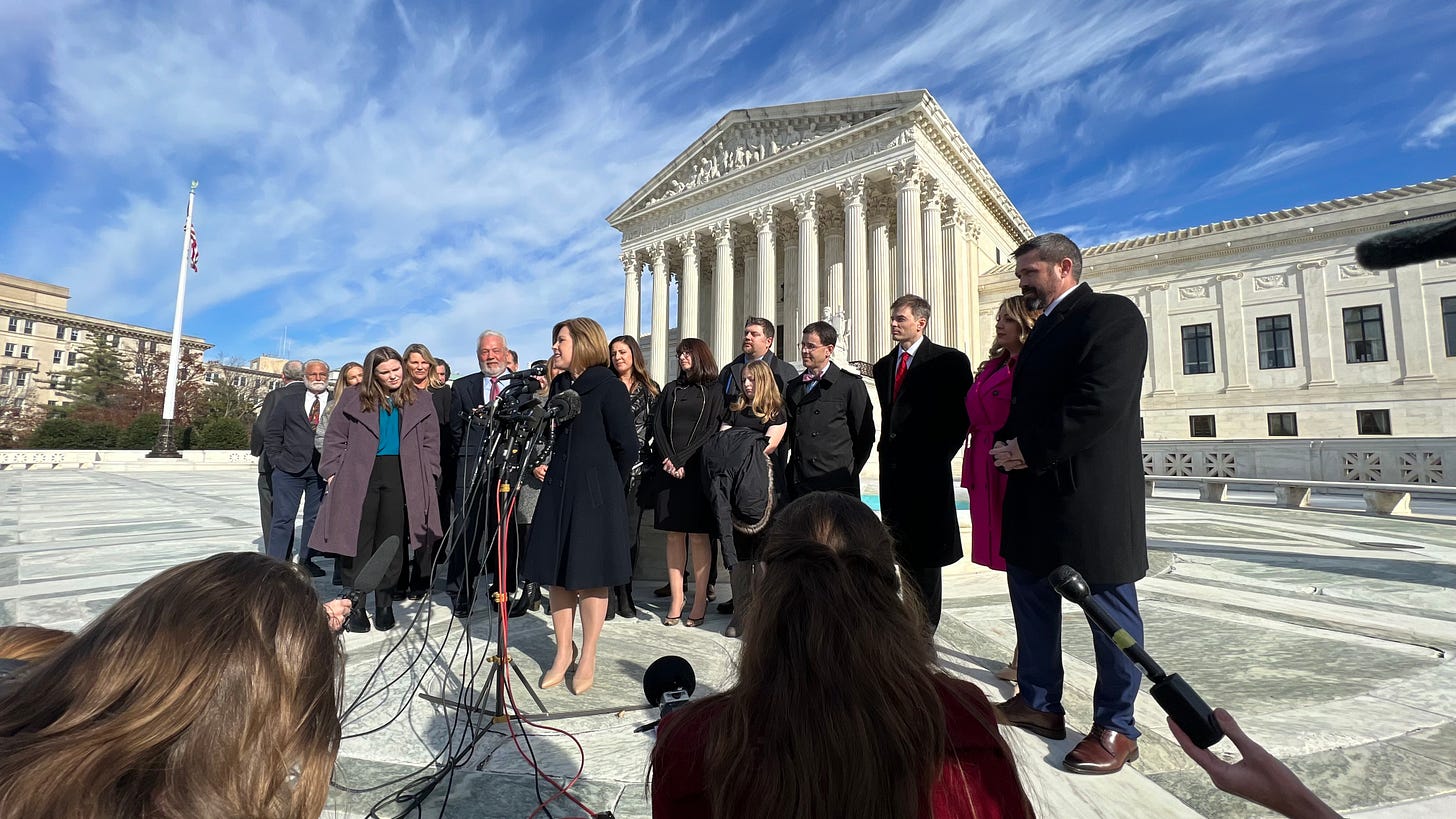
Alberta also hired James Cantor, one of the expert witnesses that Alabama used to push its ban through. Cantor is a Canadian psychologist who has acted as an expert witness in dozens of U.S. cases on trans issues. He was first hired in 2021 by the Southern Poverty Law Center-designated anti-LGBTQ hate group Alliance Defending Freedom. The Christian legal group has advocated for laws banning sodomy, has helped overturn Roe v. Wade, and is currently arguing the Supreme Court to overturn Colorado’s conversion therapy ban.
In a 2024 interview, Cantor told Uncloseted Media that his perspective on trans rights makes him “marketable” to U.S. conservatives. He compares his testimony to Marisa Tomei’s feisty character in “My Cousin Vinny” and references “Ally McBeal” and musical comedy “Schmigadoon!” as theatrical elements involved in being an expert witness.
“The first time I was going in court, we were just laughing,” says Cantor. “It was just teasing about how I love being a performer on stage enjoying an audience, and here I am doing it in a courtroom. … In Ohio, there was a television camera for the news at the courtroom. The next day on social media, all I kept hearing was what a good hair day I was having.”
Cantor is cited at least 36 times throughout Alabama’s defense of its gender-affirming care ban.
In his expert witness testimony in Alberta, Cantor makes dubious claims, including that trans adults consist “primarily of biological males and only those sexually attracted to females” and that kids identifying as trans “is a distinct phenomenon that, without social transition, usually desists.”
In taking legal action against the Alberta government, Egale Canada stated in February that “Dr. Cantor’s astonishing lack of insight into the limitations of his own expertise is wholly inconsistent with the role of an expert in a court proceeding and is disqualifying in itself.” And in a West Virginia Court case where they used Cantor’s expert testimony, the ACLU argued that Cantor’s “views, which pathologize transgender people … are irrelevant, harmful, and unfit for use by the Court.”
Even in Alabama, one of America’s most conservative states, U.S. District Judge Liles C. Burke wrote in his opinion and order that he gave Cantor’s testimony as an expert witness “very little weight” after it was uncovered that he had never treated a transgender child.
Still, Alberta hired him as an expert witness.
Subscribe for LGBTQ-focused, accountability journalism.
Uthmeier focused on how he’s working to ensure that concerned parents can continue their “movement … based on faith, based on family, ensuring that we have the freedom to raise our kids in God’s image.”
“I’m about eight months on the job now as Attorney General, and as I tell my team every day, our No. 1 priority is, and will always be, protecting our kids. There’s a lot of evil out there. There’s a lot of evil, a lot of danger. There will always be crime, no matter how much we fight it. But our first priority must always be protecting our kids,” he said to applause.
Uthmeier went on to describe his Office’s legal actions against Target for its “transgender children’s clothing line” with “bras for little boys, some tuckable underwear.”
“Gross. Absolutely disgusting,” he said. “We’re going to hit them in their wallets.”
“Predators are all over that app, all the apps, but that one in particular. It’s their preferred vehicle to go after kids,” Uthmeier said.
“And they’re crafty, they’re smart, they’re patient. They’ll use fake pictures. They’ll talk in a dialect. They’ll get your kids to, you know, drop their guard. They’ll tap into their insecurities, and they’re willing to spend weeks or months to develop a relationship before they start soliciting information, soliciting photos, soliciting locations. And since we’ve sued them, we’ve made dozens of arrests of child predators that have gone after kids through this app.”
Uthmeier also described how his Office is able to enforce the law, including by serving as a “law firm for parents out there” who might be concerned by what school districts do.
“If you’re identifying one of these wrongs that’s violating your rights and that’s subjecting our kids to danger and evil, then we want to know about it, and we’re going to bring the heat in court to shut it down.”
The AG also quipped about a recent call to people to report their exes for immigration violations, noting one gender predominantly was dropping the dime on the other.
“Y’all ladies are savage, I’ve got to tell you. These calls come in and these ladies, I mean, they’ve got date of birth, nickname, frequented bars. I mean, all the details. So to the handful of men out there, treat your women right or they will absolutely get you.”
A court in Japan has decided the ban on equal marriage is constitutional (usuke Harada/NurPhoto via Getty Images)
In a blow to the Japanese LGBTQ+ community, a court has ruled the country’s ban on same-sex marriage is constitutional.
The decision handed down by Tokyo’s High Court on Friday (28 November) outlined that Japan‘s ban on equal marriage does not violate Article 24(1) and (2) or Article 14(1) of the Constitution.
The judgement is the final ruling in a series of six high court lawsuits on same-sex marriage that were filed between 2019 and 2021 in cities including Tokyo, Osaka and Sapporo. With all the high court decisions now made, a Supreme Court ruling is expected.
Judge Ayumi Higashi said a unit between a heterosexual couple and their children is a rational legal definition of a family and the exclusion of same-sex marriage is valid. Alongside this, the court also dismissed damages of one million yen ($6,400) which was sought by each of the couples in the lawsuits.
“I’m outraged and appalled”
Speaking outside court, as quoted by the Associated Press, plaintiff Hiromi Hatogai said the decision left her “disappointed”: “Rather than sorrow, I’m outraged and appalled by the decision. Were the judges listening to us?”
Her partner, Shino Kawachi, said it was “difficult to comprehend”, adding: “What is justice? Was the court even watching us? Were they considering the next generation?”
“We only want to be able to marry and be happy, just like anyone else,” another plaintiff, Rie Fukuda, told reporters.
“I believe the society is changing. We won’t give up.”
Japan is the only G7 country that does not recognise equal marriage or offer legal protection to queer couples, whilst in wider Asia only Taiwan, Thailand and Nepal offer same-sex marriages.
Participants for Tokyo Pride events march on the busy streets of Shibuya in Tokyo, Japan, on June 8, 2025. (Yusuke Harada/NurPhoto via Getty Images)
Commenting on the decision, Amnesty International criticised the ruling and said it effectively means discrimination against LGBTQ+ couples in Japan is permissible under the law.
“The court’s decision today marks a significant step backwards for marriage equality in Japan,” Amnesty International’s East Asia researcher Boram Jang said.
“The ruling in Tokyo – the final high court ruling of six lawsuits filed across the country and the only ruling to say, in effect, that discrimination against same-sex couples is constitutional – cannot be allowed to hamper progress.
“But it should serve as a warning of the reluctance to acknowledge the concept of same-sex marriage and the reality of same-sex couples living in Japan.
“While these cases work their way to the Supreme Court, the government can resolve this issue through legislation without further delay.
“The Japanese government needs to be proactive in moving towards the legalisation of same-sex marriage so that couples can fully enjoy the same marriage rights as their heterosexual counterparts.
“Japan remains the only G7 country without legal recognition for same-sex couples. The law passed by the government in 2023 to promote understanding of LGBTI people is not enough.
“There need to be solid, legal measures in place to protect same-sex couples and the LGBTI community in Japan from all forms of discrimination.”
Previously, in 2024, Sapporo District Court in northern Japan came to an opposite conclusion and ruled the civil code which limits marriage to between a man and a woman is “unconstitutional [and] discriminatory”.
“Enacting same-sex marriage does not seem to cause disadvantages or harmful effects,” the High Court said in its ruling, adding it was “strongly expected” that parliament would “institutionalise an appropriate law” in the future.
“Living in accordance with one’s gender identity and sexual orientation is an inalienable right rooted in important personal interests,” the court also said.
The Sapporo decision followed prior decisions by courts in Nagoya and Tokyo – a separate lawsuit to the one detailed above – which also declared the ban unconstitutional.
What happens next?
Now that each of the six high court cases are completed, Japan’s highest court – the Supreme Court of Japan – is expected to manage the appeals and make a final decision on the matter.
Research has previously shown that most of the Japanese population is in favour of legalising same-sex marriage, with an opinion poll from 2023 revealing that two-thirds of Japanese people believe equal marriage should be legally recognised.
However, the legalisation of same-sex marriage still looks set to be a long way off, with Japan’s first female prime minister, Sanae Takaichi, has expressed opposition to same-sex marriage, describing it as a “very difficult problem” in the past.
What amazes me is how frightened straight cis hegemony is over anything that is different from how they live / perceive the world. They can’t seem to be able to live in a society with people who are different from them or how they live. It scares them to their core and makes them think the world is ending. They reject anything that moves from their past comfort zones. The idea of coexistence with others is emotionally shattering to them. They are so fragile. So small in their thinking. They need to make sure anything different is not seen as if removing all evidence of it makes it not exist anymore. That is so stupid I shouldn’t have to address it. But OK let me explain, in the 1950s the only representation of homosexuality was negative and strongly biased toward hating, yet gay kids were born to straight parents, the entire LGBTQ+ had no representation yet all existed. Hugs
Lawmakers in Kazakhstan are following the lead of Russian President Vladimir Putin with a bill to ban so-called “LGBTQ propaganda” in the former Soviet republic.
The lower house of Kazakhstan’s parliament on Wednesday approved the measure outlawing “LGBT propaganda” online and in the media, with fines mandated for violators, and up to 10 days in jail for repeat offenders, Reuters reports.
The legislation now moves to the Kazakh senate, where it’s likely to pass.
President Kassym-Jomart Tokayev has expressed support for the anti-LGBTQ+ bill, which, like similar laws passed in Russia, Georgia and, Hungary, has been promoted as a bulwark against “degenerate” values imported from the West.
“Children and teenagers are exposed to information online every day that can negatively impact their ideas about family, morality, and the future,” Kazakh Education Minister Gani Beisembayev told lawmakers before the vote.
Deputy Irina Smirnova cited library books and cartoons featuring same-sex relationships as examples of the “propaganda” addressed by the bill.
“I saw books in the library that promote LGBT, where a prince falls in love with a prince, two boys,” she told lawmakers. “There are cartoons that allow this to be shown, there are magazines and comics where all this is promoted.”
For months, President Tokayev has lobbied hard for passage of the bill — which is essentially copycat legislation of Russia’s own “anti-LGBTQ propaganda” measure — stressing the need to uphold what he and Putin call their countries’ “traditional values”.
Parties loyal to Tokayev dominate the lower house and voted unanimously in favor of the ban.
With the fall of the Soviet Union in the 1990s, Kazakhstan legalized homosexuality as it drew politically closer to Europe and the West.
But while the Muslim-majority nation is officially secular, it remains deeply conservative when it comes to social issues. With Putin‘s prodding, far-right politicians have exploited those social fissures to push the country back into Russia’s sphere of influence.
“We live in an independent and sovereign republic. Or are we already a colony of the Russian Federation?” Zhanar Sekerbayeva, co-founder of the feminist initiative, Feminita, asked at a recent LGBTQ+ rights roundtable in the country.
Arj Tursynkan, an activist with the NGO Education Community, explained that language in the legislation was sweeping.
“Because of these amendments, people can be punished for anything – jokes, drawings, hugs,” he said.
The activist argued that the legislation is not just a legal text, but a test of Kazakhstan’s commitment to international norms of dignity and freedom.
Ahead of the vote, Belgium-based group International Partnership for Human Rights condemned the measure, saying it would “blatantly violate Kazakhstan’s international human rights commitments.”
Subscribe to the LGBTQ Nation newsletter and be the first to know about the latest headlines shaping LGBTQ+ communities worldwide.
So Ron and his sister arrived two days ago. Lucky for me she is a doer who jumps in to do stuff and doesn’t wait for others to do for her. She has really helped Ron get a lot of stuff done. She helps when my back goes out. She is doing supper right now so I can catch up on the last few days of news. I really hope she finds a place to her tastes here as she is a good influence for Ron. Hugs, loves to all, and best wishes to all who wish them. Scottie
Thanks to Ron’s sister jumping in and doing all the extra stuff I have been trying to do I can rest my back while doing my posting. I could get used to this. Hugs
tRump’s illegal war for profit to please the corporations he told to give him a billion dollars for his campaign and he would do what ever they asked. Wow US military young adults sold for tRump’s profit. Hugs
The $1,776 per person bonuses, unveiled by Trump in his nationwide address Wednesday night, will be covered with funding approved in the Big Beautiful Bill that passed in July, according to the congressional officials and later confirmed by the Pentagon. The payouts — which will cost roughly $2.6 billion — will be a “one-time basic allowance for housing supplement to all eligible service members,” said the official.
The Trump administration announced several moves Thursday that will have the effect of essentially banning gender-affirming care for transgender young people, even in states where it is still legal.
The second would block all Medicaid and Medicare funding for any services at hospitals that provide pediatric gender-affirming care.
Really stupid things say and blame democrats for just because they think it sounds good not realizing how dumb it seems.
As Democracy Docket previously reported, in his previous role as a prosecutor in the Los Angeles district attorney’s office, Neff was put on leave after bringing charges against an election software executive based on information from conspiracy-driven election denier group True the Vote. The saga ultimately cost taxpayers $5 million to settle a lawsuit over the flawed prosecution.
Neff is also affiliated with True The Vote, the far-right QAnon group featured in Dinesh D’Souza’s debunked “2000 Mules” film.
Slumped over in his chair at the Resolute desk, Trump’s face slackened—eyes drooping, the corners of his mouth sagging—as he fought off sleep. The elderly president has now been caught appearing to doze off at four official events in six weeks.
1,300 bed concentration camp with no way out just for not being able to pay the rent. If you watch the video you see these anti-homeless lock them up solutions to make homeless disappear are coming from right wing billionaire funded think tanks. Again this is a war on the poor. And seriously with costs going up how long until being poor is anyone the wealthy don’t like. So many dystopian movies have this same start. Hugs