Iowa KWQC morning anchor Dustin Nolan announced his departure from the station Friday in an emotional message that made clear he does not intend to remain in the news industry. Nolan told viewers he believes “that we as a local news station have to be more than trends or sanitized news” and added, “That’s why the facts matter and that’s why we do what we do here.”
Nolan was near tears from the beginning of his message. “I’ll try to get through this. Well, before we go this morning, I have an announcement. Today is my last day here at KWQC TV6. I have chosen to step away from the news industry,” the Emmy Award winning anchor began. “Before I say goodbye, I just want to say, I hope everyone of you that’s allowed me to be a part of your mornings know just how important that I have taken this job. How much it means to me that you’ve trusted … that you’ve trusted me these past few years to bring you the news in the morning.”
He continued: “I promise you I’ve given you everything I have. I’ve never tried to be perfect or what many think a newsman is supposed to be. But I’ve always done my best to be transparent, bring you the facts, and I’ve always been myself. I’ve loved being able to provide a public service to this place we all call home, the Quad Cities.”
Nolan then made it clear he wasn’t leaving to pursue a role at another station. “When it comes to this job, all I’ve ever wanted to do is report on the issues that really matter. I’ve always believed that we as a local news station, owe you, the viewers, the best that we can do because without you, none of us would be able to do this job,” he explained. “I also believe that we as a local news station have to be more than trends or sanitized news because it makes people feel uncomfortable. That’s why the facts matter and that’s why we do what we do here. We have to take people out of their bubbles and comfort zones and make them think about the world we all live in.”
Nolan began working at the station in November 2022, according to his LinkedIn. profile. He is married to his former co-anchor, Jenna, whom he thanked on the show.
Stephanie is a reporter at TheWrap. She has been covering news, politics, entertainment, media, and sports (mostly women’s basketball) for over 15 years. Her experience includes The Guardian, People, the BBC, SB Nation and more.
Every autocracy has a central ideological mission. The current United States government wants to transform America from a multiracial democracy into a White Christian male-dominated ethnostate. This fanatical mission is increasingly influencing the administration’s policies, propaganda, and visuals produced by this United States government.
Their goal is to change who counts as an American, who can have leadership roles in government and society, who can vote, and who can walk the streets without fear of being imprisoned or deported.
This agenda of authoritarian transformation is the connective tissue binding the many news stories we see each day, whether it is the Trump administration deporting an estimated 17,500 immigrants to countries they have never visited, to White Christian Holy Warrior Pete Hegseth blocking promotions by female and Black Navy officers, to the wrecking of the Voting Rights Act.
Remember that Nazi salute given by Elon Musk at Trump’s Inauguration festivities, and that other Nazi salute given soon after by Steve Bannon at CPAC? They were not aberrations or provocations, but rather the opening shots of a race war now unfolding.
That war seeks to remove agency and mobility and rights and freedoms of non-Whites, while implementing schemes of population redesign, reducing the numbers of immigrants by disappearances, mass detentions, and deportations by government authorities.
MAGA is now a potent project of White race hegemony that feeds on several vectors: the long and tragic history of violence and legal and other effacements of Black people in America, the history of anti-immigrant xenophobia, and the example of authoritarian racial utopias that promoted some while cleansing society of others.
Foreign Policy, National Security Policy, and Elections
Transforming a multiracial and multifaith democracy into a White Christian ethnostate requires a holistic approach, and for months I have been tracking the attempts to achieve greater cohesion of government policy around this goal.
In a recent speech, Secretary of State Marco Rubio defended “Western civilization” as the shared identity of the United States and Europe and depicted mass migration as a threat to that civilization.
I have also examined how suppressing free and fair elections fits into this scheme.
Here I add the tool of population reengineering, which is embraced by White House policy advisor Stephen Miller, Musk, and many other MAGA luminaries. A throughline of the far-right from Benito Mussolini to Musk is Great Replacement Theory, the idea that Whites are being outperformed demographically by non-Whites, necessitating measures to save “civilization” from “erasure” and Whites from annihilation.
The Fascists provided the template. “Cradles are empty and cemeteries are expanding,” Mussolini declared in 1927. “The entire White race, the Western race, could be submerged by other races of color that multiply with a rhythm unknown to our own.” In a speech that year, Il Duce cast himself in the role of a “clinician” who undertook “necessary hygienic actions” to defend Italian people from criminals, leftists and other political dissidents. “We remove these individuals from circulation just like a doctor does with an infected person,” he concluded chillingly.
A vast network of penal colonies, confinement zones, and prisons appeared to “quarantine” the “abnormal.” This “therapeutic” approach to governance, as official Giuseppe Bottai called it, was later applied to Italian Jews, and in Italian Ethiopia the regime experimented with apartheid-style racial segregation to stop the wrong kinds of babies from being conceived.
This idea of state action to protect White Christian civilization and the “natural family” –one man, one woman, and both white–continues among the far right today, as does the attachment to Great Replacement theory.
“I think there is a deliberate plan to erase everything that identifies us: culture, Nation, family are under attack,” stated Giorgia Meloni, a neo-Fascist, in March 2019. As Prime Minister, Meloni champions White motherhood as an antidote to population changes caused by non-White immigration.
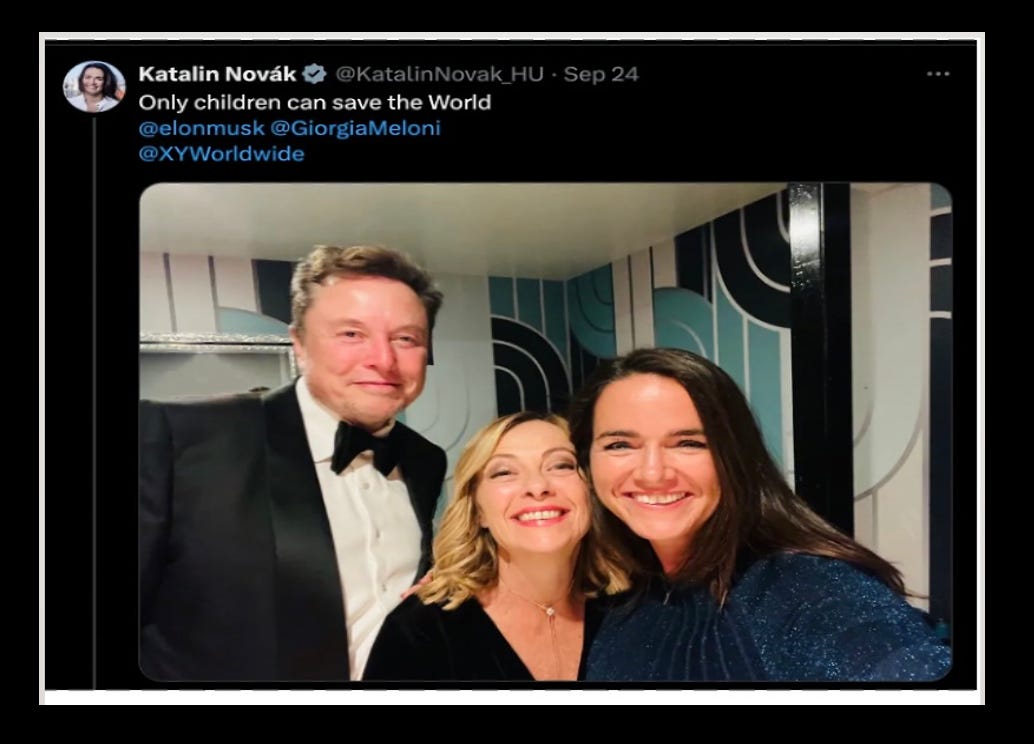
Having the right kinds of babies in the right numbers and keeping out undesirable races and births was a mainstay of the former Viktor Orban government. “Europe has become the continent of the empty crib,” said Hungarian Family Minister (and future President) Katalin Novak in 2019, echoing Mussolini. Novak had to resign from the presidency after she pardoned a pedophile, but she continues to advocate for “saving nations” from “a collapsing global birthrate,” this time through x-y, an organization she founded in 2024.
Musk, Meloni, and Novak at the launch of x-y.
X-y has been supported by Musk, who shares Novak’s preoccupation about Whites being replaced and civilization ending. A Washington Post investigation found that Musk posted 850 times in recent months on the topic of population and Whites being “a rapidly dying minority,” which triples his posting rate on these subjects in the previous 2 years.
An Optics of White Supremacy
We can expect X and other MAGA-friendly social media platforms to increase their messaging about a supposed race emergency, and we’ll likely see the Trump administration become more aggressive in its attempts to create an optics of White hegemony in government spaces.
This idea of an all-White governing class was tested in Trump’s first term, as I warned in a 2018 CNN essay on White House interns.
There will also be a ramping up of removals of non-White immigrants from the public sphere, as the massive Amazon-style warehouses ICE is repurposing for people would indicate.
Our Identities Cannot Be Erased
This administration will never succeed in wrecking our multiracial and multifaith society, no matter how much damage it does to our democratic political system. It is who we are. Our identities cannot be taken away from us. And the attempts at mass disenfranchisement will backfire; a new civil rights movement is already starting.
In trying to create a homogeneous society and ban talk of diversity, this government is merely drawing attention to what makes the United States special, and the power of our roots, identities, and traditions. These will serve us well in the coming years as we pursue peaceful resistance to restore our democracy.
Under a single spotlight, a tall figure in a hooded robe strutted onto the stage, their back to the audience. After a suspenseful beat, three words in large bolded lettering lit up the screen behind them: “NATURE IS GAY.”
With a twirl to the crowd, Pattie Gonia unveiled their ginger-red hair and matching mustache, dancing in an earthy blue-and-green crop top and skirt barely covering their chiseled body. The crowd of over a thousand broke into roaring applause.A 2019 video of Bill Nye the Science Guy, pulled from his appearance on John Oliver’s “Last Week Tonight,” punctuated the dramatic reveal. “By the end of the century, if emissions keep rising, the average temperature on Earth could go up another 4 to 8 degrees,” Nye said. “What I’m saying is, the planet’s on fucking fire.”
These are just the first few seconds of environmental activist and drag queen Pattie Gonia’s “Save Her” tour, a one-of-a-kind show that calls for the protection of the dolls — and the planet. The drag queens and kings who created and star on the tour aim to counter the exclusion of their communities by promoting the inclusion of everyone.
For eight years, Pattie Gonia, who goes by Wyn Wiley out of drag, has amassed an impressive following of over 2 million people across their social channels and through their environmental activism on and off the stage. They’ve pushed boundaries, set records and earned accolades, including being featured as one of TIME’s most influential creators in 2025, named as one of National Geographic’s 33 “agents of change” and invited to speak at TED Talk. They have also raised millions of dollars for environmental and social justice non-profits, co-founded the environmental equity organization Outdoorist Oath and a job board to help the queer community and allies find work in the environmental sector.
Last year, Pattie Gonia completed a 100-mile trek from Point Reyes National Seashore to San Francisco’s Golden Gate Bridge in full drag — hair, heels and all — to raise $1 million for non-profit environmental and social justice organizations.
Pattie Gonia performs at the “Save Her! Environmental Drag Show” during Climate Week, Tuesday, Sept. 24, 2024, in Brooklyn, New York. (Alyssa Goodman/AP Photo)
Last month, they did it again, completing a five-day hike at Yosemite.
As show attendee and D.C. drag king Lionel Bitchie said, “She’s not one of the most followed drag queens for no reason.”
But they haven’t done all this work without ruffling a few orange-tinted feathers — and sparking division even among their own fans. During the 2024 presidential campaign season, they were targeted in a Trump campaign ad. Most recently, Pattie Gonia has been in the news for getting sued by the clothing brand Patagonia.
The lawsuit arose after Pattie Gonia filed a trademark application for exclusive rights to use the Pattie Gonia brand on commercial products and events, a move that Patagonia claims would compromise its brand identity. The drag queen responded on social media, posting that suing a climate activist is a “betrayal” of Patagonia’s core mission. Patagonia, for its part, acknowledged their shared goal of caring for the planet and the outdoors, but has held firm on the conditions to end the litigation.
Online, people in Pattie Gonia’s own fanbase have expressed conflict. While some view the lawsuit as harmful to the queer community and stopped using Patagonia’s products as a result, others disagree the clothing brand unfairly sued the drag artist.
Pattie Gonia said the timing of the lawsuit, filed on January 21, hits especially hard because it has come at a time when marginalized communities have been under fire. Several climate, gender and equity-related terms have been erased and banned from federal agencies. The Trump administration has rolled back key protections and visibility for LGBTQ+ communities, including limiting access to gender affirming care, removing mentions of LGBTQ+ history in national parks and banning transgender service members in the military. It also has slashed environmental safeguards for clean air and water, gutted funding for national parks and public lands, and expanded the use of polluting fossil fuel industries.
All the while, Pattie Gonia has embraced their own form of protest in the national “Save Her” tour, focusing it on climate activism and partnering with local drag queens at each of the tour’s stops, in more than 20 cities. At the 9:30 Club in Washington, D.C. — a historically inclusive space for Black performers steps from U Street’s former Black Broadway and a 20-minute drive from the White House — artists and attendees weren’t afraid to get political.
“A lot of time drag can be escapist, and not confronting the reality of dealing with fascism and climate decline, so I like drag that is a call to action and inspiring,” local drag artist and attendee Brooke N. Hymen said. “Pride month can be a celebration and it should be, but it should also be resistance against the forces that want to see us eliminated. And I feel like climate activism goes hand in hand with trans and queer activism.”
“Drag is political, so in a way this is like a rally,” Lionel Bitchie added.
One by one, each act gave their own climate-themed performance, with the majority of them stripping down to their “Fuck Donald Trump” pasties and underwear. Between acts, a parodied Smokey the Bear logo on stage read: “Only you can prevent fascist liars.”
Drag artists Brooke N. Hymen (left) and Lionel Bitchie (right) attended Pattie Gonia’s 9:30 Club show. “Drag is political, so in a way this is like a rally,” Bitchie said. (Jenae Barnes for The 19th)
“It’s a fantastic outlet for joy and rage all in one,” said attendee Kirby Callaway, who works in the environmental space. She said when she saw Pattie Gonia perform at a previous drag show, her “cheeks were hurting because I was smiling so much.”
“It’s so unique, [and] so much of the way that I interact with it in the real world is very doom and gloom,” Callaway said. “I don’t feel like a lot of places get to celebrate and find joy and laugh at these issues.”
Co-headliner and drag queen Sequoia (yes, like the tree) donned an upcycled outfit made of clothing relics from their closeted past and did a performance about the gender fluidity of plants and animals. The screen behind them displayed the words, “Nature is queer, and so am I.”
Going for a wildly humorous take on the issue, drag king Uncle Freak shuffled on stage to perform a striptease as a geriatric man, complete with a fake white mustache and a receding hairline that even NASA couldn’t find on the Hubble telescope. The environmental theme? How climate change worsens the effects of aging.
“Climate change accelerates biological aging in older adults by increasing vulnerability to extreme heat, dehydration and air pollution,” read the screen they pointed at with their cane on the stage.
But the show wasn’t all fun, games and nipple tassels. D.C. drag royalty King Molasses performed to Phil Collins’ ‘80’s hit “In the Air Tonight,” using the tune’s famous crescendo of intensity to parallel the “rising tension” of the climate crisis.
“In the Air felt very correct, in the sense of this urgency that we are now as a people finding ourselves in when it comes to saving the planet. By saving, I mean the impact of technology, of data centers, the climate skewing hotter, the ice caps melting, storms getting more severe,” the inaugural winner of the “King of Drag” reality TV show told The 19th. “There are so many things that are becoming more and more pressing at an alarming rate. And there will be a point where the consequences of our actions will be impossible to ignore.”
King Molasses performs to Phil Collins’ ‘80’s hit “In the Air Tonight.” (Maya Lopez)
Pattie Gonia came on and sang a heartfelt “bird song” about resilience and visibility in times of hardship. “No one can erase us, we’re here and we’re staying, we sing cause we made it, we made it through the night,” they sang as the crowd softened during the piano-accompanied tune and several people melted with tears and hugs.
Co-headliners Sequoia and Vera! joined Pattie at the climax of the show to perform a piece on social justice in front of the backdrop of an American flag. Written on each stripe, a different call to action: “Eat the rich. Protect the dolls. Free Palestine. Black lives still matter. No one is illegal on stolen land.”
Amid rampant erasure, censorship and oppression of the queer community and environmental advocates, the tour is more than a late-night rendezvous; it’s a rallying cry, Molasses said.
“The opportunity that this tour gives all of us artists is that drag allows us to play and show something that feels like entertainment,” Molasses said. “But if we can do it in a particular way, we are able to not only entertain but are able to call our community to action.”
On Friday, the Trump administration declined to submit a court-requested sworn declaration to a federal judge, noting that the $1.8 billion so-called “anti-weaponization” fund was officially obsolete. Instead of solidifying that claim in writing, the DOJ wrote in a notice to the court, “Such declarations are unnecessary and the compelled testimony of senior officials from the Executive Branch implicates serious separation of powers concerns.”
It’s a big help to see things like this; it helps to understand why things are happening that don’t make sense. The other night, we had so much rain, my backyard was a shallow pond. Not a swamp, or rice paddies or whatever, but a literal pond. That hasn’t happened in years, for one thing, but I was mostly looking out and hoping it wasn’t going to turn into a brown ocean (which I learned of in another weather video on this site.)
Three things I love in one video. I really enjoy The Majority Report, I love why they have Digby on, and I am very supportive of Platner’s progressive anti establishment corporate democrats policies. As Digby says the party is much more left today that it used to be since the 90s and the center is much more right than it was. She says we have to push back hard against the push to the right that the establishment cooperate democrat’s leadership has made. Hugs
Republican gubernatorial candidate Bobby Charles is one of the leading contenders to become Maine’s next governor, and his recent comments should alarm anyone who values evidence, competence, or basic reality.
Charles has suggested he would personally counsel women out of having abortions, claimed transgender identities are impossible because of Noah’s Ark, repeated the debunked “litter box” conspiracy theory about schools, and embraced a culture-war agenda that seems ripped straight from social media misinformation.
Yet despite these bizarre remarks, he’s a serious candidate with a real shot at winning the Republican nomination.
The bar she drank at, the bed she recuperated in, the canals she daytripped to, the studio she stormed out of, the easel she painted her final masterpiece at … ahead of a major Tate show, our writer finds Kahlo’s spirit alive in Mexico City
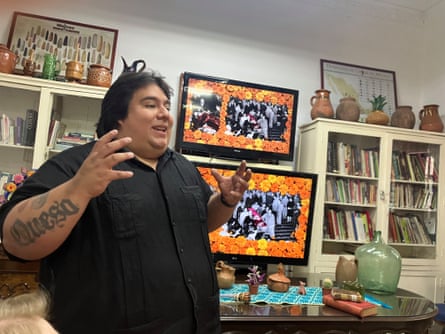
Today you’re going to eat art,” says Federico Valdez, a chef at the School of Mexican Cuisine and a man so passionate about food he has the word Queso (Cheese) tattooed on his forearm. “Today,” continues Valdez, “you’re going to eat history.” What unfolds, in a sun-filled dining room lined with Mexican flowers, books and artefacts, is a three-course feast inspired by Frida Kahlo, her life, her art and her loves, including her first lesbian affair.
The starter, rooted in her childhood fascination with revolution, is a lightly spiced Mexican take on Russian pirozhki. The main dish – served with pulque, an agave-derived drink Kahlo loved – taps into her rebellious spirit. “It’s called Frida Against the World,” says Valdez, as we are presented with a giant stuffed chilli that sits amid a nutty, beany sauce similar to the one eaten at Kahlo’s wedding to Diego Rivera, then the most famous artist in the world, now firmly in her shadow.
“I wanted this to be hot and horny,” says Valdez, explaining that halved figs were added to reference Kahlo’s sexuality. “Her first love, with a female teacher, happened at a time when Mexico wasn’t so open. I wanted to get in all that spicy gossip. I’m not a big fan of playing it safe.”
I’m in Mexico City with a Tate delegation just as the huge jacaranda trees are blooming purple and violet across its parks and boulevards – to follow in Kahlo’s footsteps ahead of Frida: The Making of an Icon, a show of more than 30 of her works at Tate Modern in London that seems destined to be a summer blockbuster, adding yet more fuel to Fridamania.
‘This is going to blow your mind’ … chef Federico Valdez. Photograph: Courtesy Andrew Gilchrist
One work, Self Portrait With Thorn Necklace and Hummingbird, was painted in 1940 after her painful divorce from Rivera. A spider monkey, similar to the one he gave her as a present, is pulling on her thorn necklace, drawing blood. The two soon remarried, Kahlo inscribing the clocks in their house with the years of their separation and reunion.
“The exhibition is like a movie,” says Tobias Ostrander, its curator. “Frida is the star but it’s also about her life, her people, her impact.” Charting Kahlo’s rise from unknown painter to global phenomenon, the show will also examine merch (expect a Kahlo Barbie) and gauge her influence on later artists.
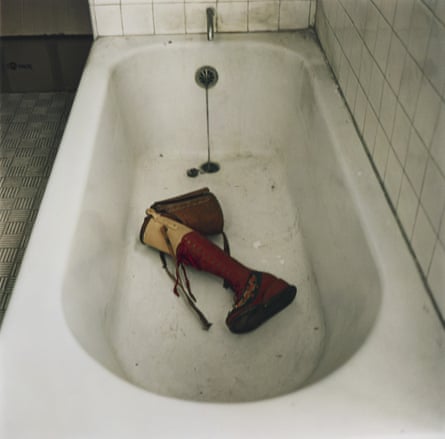
On display, too, will be many of the artist’s treasured possessions, including her brilliantly patternedtehuana dresses. Graciela Iturbide’s ghostly photographs of her crutches, customised medical corsets and prosthetic leg will also feature. These were taken 50 years after Kahlo’s death, when all her belongings were finally freed from the bathroom in which Rivera had ordered them to be locked away.
Unseen for 50 years … Kahlo’s prosthetic leg, captured in Graciela Iturbide’s photograph. Photograph: Courtesy of the artist
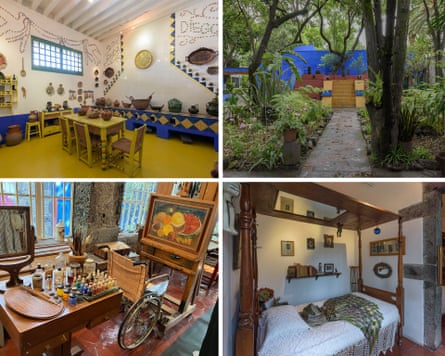
This took place at Casa Azul, the house in Coyoacán (The Place of the Coyote Owners) where Kahlo was born and spent most of her 47 years. It’s now a beautiful, beguiling museum with smooth exterior walls painted a gorgeous blue. These border shiny red concrete paths that thread through fountains and lush gardens bursting with palm, yucca, cactus and bougainvillaea. Off in a corner, seen through trees, a maroon pyramid with yellow steps displays on its ledges Rivera and Kahlo’s pre-Hispanic, Aztec and Toltec artefacts.
“We don’t know exactly where the blue came from,” says Perla Labarthe Álvarez, the museum director. “But in her diary, Frida expressed what the colour meant to her: purity, electricity and love. Because of her health – she had surgery all her life, more than 30 operations – she was at home a lot so it had to be a comfortable place where she could rest. Many of her still lifes were done in the garden. She called her home A Place Full of Places.”
It’s a perfect description. For this is a breathtakingly evocative location, even leaving aside the fact that Trotsky lived here for two years with his wife, having a brief affair with Kahlo.
‘A place full of places’ … Kahlo’s kitchen and garden at Casa Azul; her bed with its overhead mirror; and the easel adapted so she could paint on her back or in her wheelchair. Composite: Bob Schalkwijk/Andrew Gilchrist
Tours begin in the living room, with its hefty pyramid-style fireplace designed by Rivera and, as an old photo shows, once flanked by two of his macabre Judas dolls, papier-mache devils that are stuffed with fireworks and set alight at festivals. Opposite is Kahlo’s mesmerising portrait of her beloved photographer father, painted 15 years after he died, his eyes as captivating as hers.
On the walls, photos and texts detail the polio Kahlo contracted at the age of six, leaving her with one shorter leg, and the trolley-bus crash at 18 that impaled her on an iron handrail and left her in pain for much of her life, as well as unable to have children.
She could never paint this accident, even though what she did paint was often deeply painful and personal – and these works were largely created at Casa Azul, upstairs in her studio, where visitors can see the easel adapted to allow her to use brushes lying on her back or seated in her wheelchair.
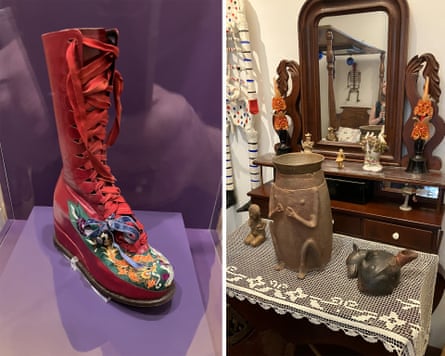
‘One kick and it could take the house down’ … Kahlo’s customised boot and her ashes in an urn. Composite: Courtesy Andrew Gilchrist
In the next room is the four-poster single bed in which her mother placed an overhead mirror, giving Kahlo, frequently confined there, both a distraction and a subject. “I paint myself,” she once said, “because I am so often alone and I am the subject I know best.”
As well as her corsets, she customised her orthopaedic footwear, turning one stepped-up mid-calf red boot into a work of art. Embroidered with patterns and adorned with a blue ribbon, the chunkily laced boot now proudly stands in its own case, extraordinarily alive, looking like it could take the whole house down with one kick. Meanwhile, on a dresser, Kahlo’s ashes sit in a delightfully playful ancient urn. Boasting cartoon-like arms and legs, it’s shaped like a toad, a nod to her affectionate term for Rivera. “You found me torn apart,” says a sign, “and you took me back full and complete.”
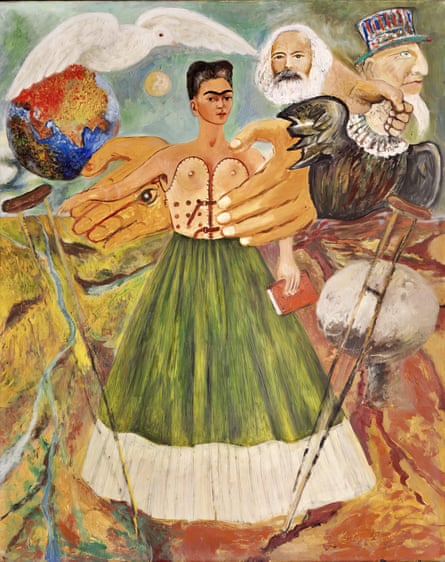
Across the courtyard, you can see Kahlo’s crutches and corsets, one decorated with a hammer and sickle. She painted herself in these corsets, too. In Marxism Will Give Health to the Sick, a 1954 work that hangs close by, the garment has morphed into her skin, her bare breasts. A bald eagle wearing an Uncle Sam hat is being throttled while Marx’s enormous hands reach out to cradle Kahlo. As ever, her penetrating, all-seeing eyes stare out beneath that monobrow.
Throttling Uncle Sam … Marxism Will Give Health to the Sick. Photograph: Artium/Alamy
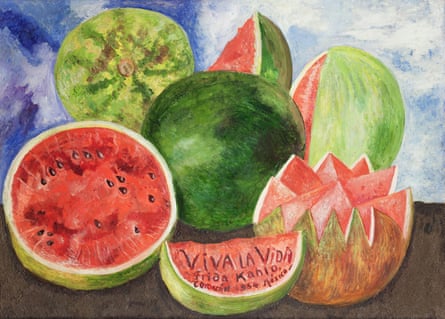
The most stunning work at Casa Azul, though, is the last one she ever painted, completed eight days before her death in 1954. Called Viva la Vida, or Long Live Life, it portrays several sun-drenched watermelons, the de facto national fruit of Mexico. In some places, their flesh is as red as blood. One has been cut in half in a crisscross pattern, echoing the Vs of the title, which appears in big black letters on another slice. It’s as if the fruit itself, life itself, is talking to you, imploring you. Live, live.
What you take from Casa Azul is an almost overwhelming sense of Kahlo’s talent, resilience and rebelliousness. “Tell us about the bomb,” someone says to Álvarez at one point, but she is out of earshot. “Is it true Frida bombed her school?” Actually, what she and her friends planted was more of a firecracker, albeit one powerful enough to blow out several windows. No one was hurt and, unlike some, Kahlo escaped expulsion.
‘It’s as if the fruit – life itself – is imploring you’ … Kahlo’s final painting, Viva la Vida. Photograph: The Artchives/Alamy
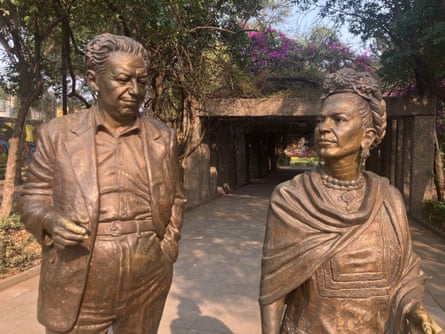
There’s a park not far off, now named after her, with a pyramid by a fountain and lifesize bronze statues of Rivera and Kahlo. She’s ahead of him, purposeful, her head half-turned, as he follows happily in her wake, smiling gently and clearly in awe of this woman, despite all his affairs. The bar they liked, La Guadalupana, still stands, a shrine to el toreo with the heads of bulls on its walls, as well as paintings and posters of fighters. Perhaps it’s more appealing if you’ve had, as Rivera and Kahlo sometimes did, “a tequila or 10”.
Downtown, we find, the streets are not so tranquil. Some are barricaded and hoarding has been placed around national monuments. These were erected in response to a recent march of 180,000 women, furious at the rates of femicide in Mexico. About 2,500 women are murdered a year, but less than a third are categorised as femicides even though there is evidence they should be. Less than a quarter of femicides are punished.
‘Clearly in awe of this woman’ … statues of Diego Rivera and Kahlo in the park named after her. Photograph: Courtesy Andrew Gilchrist
Would Kahlo have painted this outrage if she were alive today? She already did. In 1935’s Unos Cuantos Piquetitos, or A Few Small Nips, Kahlo recreates a story she read in the paper that left her incensed. A woman lies slashed and naked on a blood-splattered bed, murdered by her husband, who holds a knife and would later dismiss his crime to the police with the words of the title. Initially, Kahlo put the children in, as they witnessed the entire horror, but this was just too brutal and they have now gone.
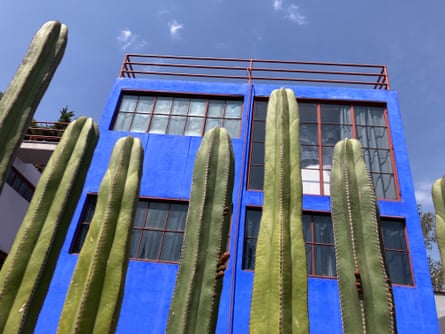
Kahlo also painted in a studio across town, in the bohemian neighbourhood of San Ángel. It’s a beautiful, boxlike, three-storey building painted that signature blue. A rooftop bridge links it to Rivera’s much bigger workplace, a white-and-ochre structure where he would often put in 15-hour days.
Built on modernist Le Corbusier lines and now part of a museum, these studios caused a sensation when they first appeared, unadorned constructivist creations sitting among the elaborate residences of San Ángel. They’re still ringed by a superb perimeter fence of tall, perfectly placed pole-like cactuses, this being a way for both artists to bring Mexico and nature into their workplaces.
At one with nature … Kahlo’s studio with its cactus fence. Photograph: Courtesy Andrew Gilchrist
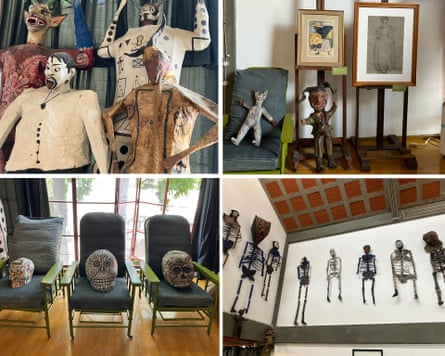
Rivera’s studio is magnificent, overflowing with ceramics and artefacts from his folk-art collection, all arranged alongside paintings and paintpots. There’s an almost party vibe: death masks sit grinning on chairs, crowds of Judas dolls leer conspiratorially around the windows, while chorus lines of strangely joyous skeletal figures dance wildly across the walls above. It feels appropriate: the parties here were legendary, attended by presidents, revolutionaries and exiles alike, as well as Hollywood stars such as Charlie Chaplin.
Over the bridge, above the bath in Kahlo’s studio toilet, you can see a copy of What the Water Gave Me, her 1938 painting of her feet as she bathed, with elements adrift on the water symbolising events in her life, from exotic plants to nude figures on a bed to an erupting volcano. There’s not a whole lot else to see in her studio, Kahlo having packed everything up and left after catching Rivera in bed with her sister. According to the museum guide, she told him: “I am going to get all my furniture and get out of here because I hate you.”
What the Water Gave Me is the favourite Kahlo painting of Helena Chávez Mac Gregor, writer of The Ribbon and the Bomb, a book about the artist’s continuing and even growing relevance. Its title refers to the words French surrealist André Breton used to describe Kahlo’s work – “a ribbon around a bomb” – although Mac Gregor thinks there’s “maybe no ribbon, only bombs” and they’re still exploding through times beyond her own, as new generations of (largely) women see themselves, their bodies, their sexualities and their struggles mirrored in her masterpieces.
“There’s the bomb of her illness,” says Mac Gregor, as she joins us for lunch at the fabulous San Ángel Inn, a former Carmelite monastery opposite the studios famed for its gardens and margaritas. “She’s vulnerable yet she’s strong and erotic, not what you might expect of someone so ill. And she was so ahead of her time, making the personal political, living on her own terms, playing with gender roles and cutting her hair. Then there are the bombs of femicide and abortion, her own.” This was chiefly to safeguard her damaged pelvis. “Frida painted these things people didn’t talk about. Even with this illness – and one year she managed only one work – she created such beauty.”
‘The parties were legendary’ … Judas dolls, paintings, skeletons and death masks at Rivera’s studio. Photograph: Courtesy Andrew Gilchrist
Clearly delighted, Mac Gregor adds: “Frida is more important than Diego Rivera now, which is weird because she was the artist she was because of him. He was a macho Mexican womaniser but he loved and supported her. And the essays he wrote about her work are amazing, talking about her representations of the interior and the exterior. He said she was going to be the most important artist in Mexico.” Kahlo didn’t stop there. When The Dream (The Bed) fetched $54.7m in 2025, this set a new world record for a female artist.
The Tate has been lucky to get any works at all, given how proud and protective Mexicans are of Kahlo, especially with the World Cup having just kicked off in their country. This was brought home to me at the Museo de Arte Moderno, where you can linger all you want in front of, say, a María Izquierdo – but gaze too long at a Kahlo and you’ll soon start to feel the pressure from other visitors to move on.
This happened to me twice: first in front of The Two Fridas, in which she explores her mixed heritage, dressing one self in European attire, the other in Mexican; and secondly at Self-Portrait with Monkeys (see top), in which Kahlo, faintly moustached, is seen with four of the creatures she kept as pets. They are often seen to represent the four pupils, nicknamed Los Fridos, who stuck with her even as her health made teaching harder and harder. Kahlo would also say that the monkeys in her work symbolised the children she could not have.
No visit to Mexico City is complete without a trip south to the floating gardens and canals of Xochimilco, for a voyage on one of the 500 colourful big gondola-like boats that ply its busy waterways. Kahlo loved to come with her family to these canals, which were created by the Aztecs. There’s a famous photo of her face hovering over the water, looking serene as she dips her arm in up to the elbow.
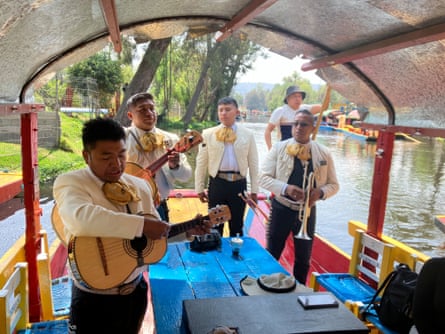
A song for £10 … the Axolotls board Rosamaria. Photograph: Courtesy Andrew Gilchrist
“Every boat has a female name,” says the captain of Rosamaria, our vessel, “because they are like flowers.” As we set off, smaller, faster boats speed by, bearing vendors of pulque and tacos. Before long, we are being pursued by two very loud mariachi bands, one called the Pintorescos, meaning the Picturesques, the other the Axolotls, named after the tiny, endangered and ridiculously cute species of salamander native to these waters. The Axolotls win, boarding our boat in seconds and performing for £10 a song, first Cielito Lindo (Lovely Sweet One) with its rousing singalong chorus, and then of course La Bamba.
As the Axolotls speed off in a blur of strings, brass and tight trousers, peace returns and we idle along as the afternoon sun beats fiercely down. I dangle my arm into the cool water, just like Kahlo did, and remember something Federico Valdez said as he unveiled the final course of his feast, a rice-pudding-like dish in a watermelon sauce, washed down with a liquor made from Chihuahua apples.
“This dessert is going to blow your mind,” he said, as a picture of Kahlo’s funeral appeared on the screen behind him. “Frida died – but she didn’t pass away. She was like a rocket. She just went up and up.”

Dustin Nolan (Credit: KWQC TV6)