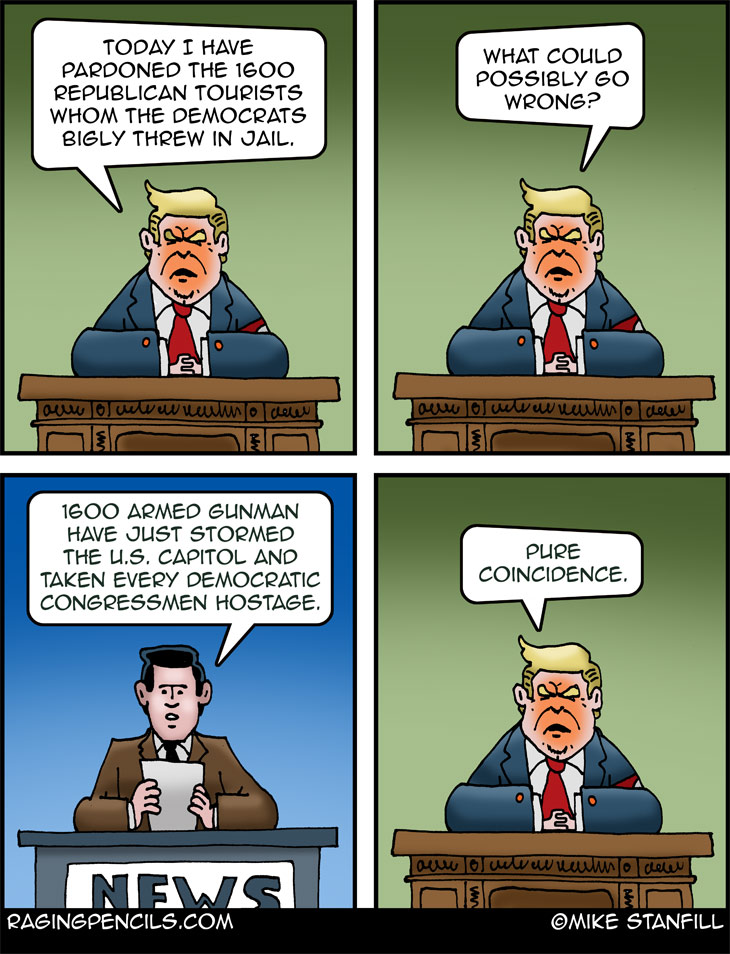
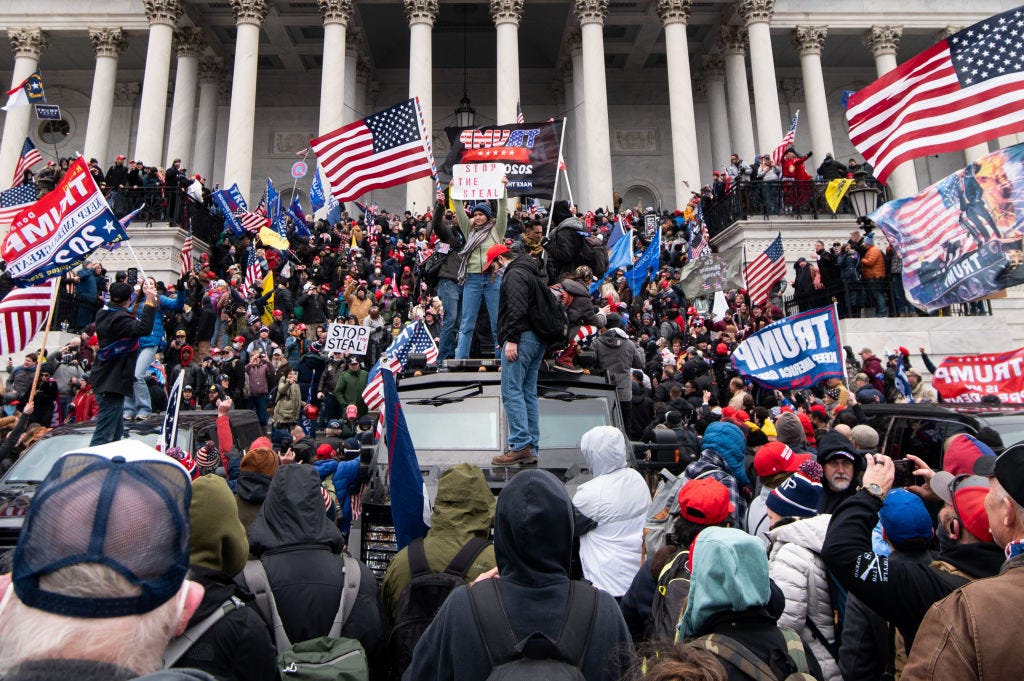
Trump flags fly as rioters take over the steps of the Capitol on the East Front on Wednesday, Jan. 6, 2021. (Bill Clark/CQ-Roll Call, Inc via Getty Images)
Five years ago today, on January 6, 2021, a violent mob stormed the Capitol building. Following the attack, over a hundred major companies released statements condemning the insurrection and promising to stop donating to the 147 members of Congress who voted to overturn the 2020 election, or to halt all political donations entirely.
Since returning to office, President Trump has continued to push false claims that the 2020 election was “rigged,” “stolen,” and filled with “fraud.” On Trump’s first day as president, he issued sweeping pardons and commutations for some of those involved in the Capitol insurrection. In a presidential action, Trump wrote that the pardons and commutations ended “a grave national injustice.”
The current members of Congress who voted to overturn the 2020 election have embraced Trump’s return to the White House. None has expressed any regret for their vote.
Nevertheless, most companies that pledged to stop donating to these lawmakers have broken their promise.
After January 6, 2021, for example, a Cigna spokesperson gave CNN the following statement:
There is never any justification for violence or the kind of destruction that occurred at the U.S. Capitol last week – a building that stands as a powerful symbol of the very democracy that makes our nation strong. Accordingly, CignaPAC will discontinue support of any elected official who encouraged or supported violence, or otherwise hindered a peaceful transition of power.
Cigna, however, has since donated hundreds of thousands of dollars to lawmakers who voted to overturn the election. In April 2021, a spokesperson for the company told the New York Times that resuming donations to members of Congress who voted to overturn the election did not violate its pledge because congressional voting is “by definition, part of the peaceful transition of power.” Cigna argued that its pledge only applied to “those who incited violence or actively sought to obstruct the peaceful transition of power through words and other efforts.”
Comcast, however, has since broken its pledge and donated hundreds of thousands of dollars to lawmakers who voted to overturn the election. Comcast also donated $1 million to Trump’s 2025 inaugural fund and was among the donors to Trump’s new White House ballroom, according to a list released by the White House.
After January 6, 2021, a spokesperson for General Mills said it had “suspended contributions to any member of Congress who voted to override the results of the U.S. presidential election.” In January 2025, Popular Information reported that the company had thus far upheld its pledge. Last year, however, General Mills resumed donations to lawmakers who voted to overturn the election. On March 27, the company donated $1,000 to Representative Kevin Hern (R-OK). On June 12, the company donated $1,000 to Representatives Glenn Thompson (R-PA) and Adrian Smith (R-NE), and an additional $1,000 to Hern.
Popular Information is an independent newsletter dedicated to accountability journalism since 2018. It is made possible by readers who upgrade to a paid subscription.
The promise keepers
While many companies have broken the pledges they made after January 6, 2021, some companies have kept their promises. Popular Information identified 10 companies that have upheld their promise to stop donating to members of Congress who voted to overturn the 2020 election
Farmers Insurance
Following the Capitol insurrection, former Farmers Group CEO Jeff Dailey released a statement promising to suspend political donations. “Like many Americans, we were horrified by the acts of violence that took place in our nation’s capital. While we recognize and support all Americans’ right to peacefully protest and exercise free speech, we strongly condemn acts of violence and hateful rhetoric,” Dailey said in the statement, according to CNN. Since January 6, 2021, the insurance company has kept its promise and has not donated to any members of Congress who voted to overturn the election.
Unlike Farmers Group, several other insurance companies — including Blue Cross Blue Shield and Allstate — broke their promises to withhold their money from those who voted against certifying the 2020 election results.
Airbnb
After January 6, 2021, Airbnb released a statement promising to withhold donations from those who voted against certifying the election. “Airbnb strongly condemns last week’s attack on the US Capitol and the efforts to undermine our democratic process,” the company said. The company also released a safety plan for the 2021 inauguration, including canceling Airbnb reservations in Washington, D.C., made by those associated with a hate group and banning individuals involved in the Capitol insurrection from the platform. Since January 6, 2021, Airbnb has kept its promise and has not donated to any members of Congress who voted to overturn the election.
Expedia Group
While Expedia Group and Airbnb have not given any money to election deniers since 2021, other travel and hospitality companies have reneged on their vows to do the same. Marriott International and Hilton Worldwide, for example, both donated to former Republican House Speaker Kevin McCarthy.
Nike
In January 2021, Nike released a statement promising to halt donations to members of Congress who voted to overturn the election. “Nike’s Political Action Committee (PAC) helps our employees support elected officials who understand our business and whose values align with our mission of serving athletes. These nonpartisan values rely upon upholding the principles of democracy,” the statement said. “Nike’s PAC will not support any member of Congress who ignores these principles, including those who voted to decertify the Electoral College results.” Since the Capitol insurrection, Nike has kept its promise and has not donated to any members of Congress who voted to overturn the election.
Clorox
Since 2021, Clorox has not donated any money to election deniers’ campaigns. Ecolab, a company selling similar products to Clorox’s, promised to stop donating to all congressional candidates, according to CNN. But during the 2024 election cycle, Ecolab donated thousands of dollars to Representative Steve Scalise (R-LA), Hern, and other members of Congress who tried to overturn the 2020 election.
Eversource Energy
On January 13, 2021, Eversource Energy, a large electricity provider in the Northeast, announced that it would not donate to any of the members of Congress who voted against certifying the 2020 election results. In a statement, Eversource’s Chief Communications Officer Jim Hunt said, “at Eversource, we were deeply disturbed by the intentional disruption of our democratic process and the violence that occurred at the Capitol last week.”
Eversource has kept its promise not to donate to any election deniers and has made few political contributions in general. NRG Energy, a competing electricity provider serving some of the same states as Eversource, also promised not to donate to any election deniers, but has since reneged.
Holland & Hart LLP
Holland & Hart, among the top 200 earning law firms in the world, has not donated to anyone who voted to overturn the 2020 elections. In contrast, Cozen O’Connor, an even bigger firm, reneged on its promise.
Qurate Retail
Unlike other retail brands like Amazon and Walmart that have not followed through on their vows not to give money to election deniers, Qurate Retail — which has since been rebranded as QVC Group — has kept its promise.
Lyft
Lyft has kept its promise to withhold donations to election deniers after January 6. While Uber never made such a promise, the company and its CEO donated $2 million to Trump’s inauguration fund.
Whirlpool
Whirlpool has not given any money to people who voted to overturn the 2020 election. The company terminated its political action committee in 2023.
In some places in the US cops are maga not enforcers of public peace and honoring the constitution. We have the right in the constitution to address the government with protests of their actions. How far have we moved to a fascist nation where the rule of law is simply might be delivered by thugs makes right. Agree with us or else … A horrible place we are in. Hugs
WATCH: Woman Arrested Mid-Interview After Protesting Against Trump’s Venezuela Strike
A Michigan protest organizer was arrested on camera while giving a TV interview criticizing President Donald Trump’s actions in Venezuela on Saturday.
Jessica Plichta, a 22-year-old preschool teacher and Grand Rapids Opponents of War organizer, was speaking to local ABC affiliate WZZM about a weekend protest condemning the capture of Venezuelan President Nicolás Maduro when police officers moved in behind her and placed her in handcuffs. The patrol car had been visible in the background moments earlier, its presence unremarked upon until the interview abruptly ended.
“It’s not just a foreign issue, it’s our tax dollars that are being used to commit these war crimes,” Plichta said on camera. “It is also the duty of us, the people, to stand against the Trump regime, the Trump administration, that are committing crimes both here in the U.S. and against people in Venezuela.”
As she was escorted to the police vehicle, she could be heard saying, “I am not resisting arrest.”
The clip quickly went viral, with WZZM later reporting that police said Plichta was arrested for “obstructing a roadway and failure to obey a lawful command from a police officer.”
Prior to her detention, Plichta told WZZM she had recently returned from Venezuela, where she attended the People’s Assembly for Peace and Sovereignty of Our America summit.
A police department spokesperson issued the following statement to AlterNet following the arrest:
A group was marching in the roadway. Over 25 announcements were made from the PA system of a marked police cruiser for the group to leave the roadway and relocate their activities to the sidewalk. Blocking traffic in this manner is a direct violation of city and state law,” the spokesperson stated. “The group refused lawful orders to move this free speech event to the sidewalk and instead began blocking intersections until the march ended. Patrol officers consulted with their sergeant and the watch commander who informed the officers that if the individuals could be located, they were subject to arrest. The adult woman who was arrested was positively identified by officers, and the lawful arrest was made.
After her release from jail, Plichta spoke with Zeteo about the incident.
“I don’t think it’s a coincidence that as soon as I finished an interview speaking on Venezuela, I was arrested – the only person arrested out of 200 people,” she told the outlet.
It was all a lie. Rubio has always pushed for regime change in Cuba, and may experts say it should start with Venuzalia. Rubio doesn’t care about the oil, he wants all support for Cuba stopped so the US can go into Cuba and return it to what his family fled so many years ago when they were abusing the locals for profit. It is all a personal agenda he hopes will lead him to the presidency. Hugs
The Trump administration has set its sights on Venezuela in its latest campaign against illegal drugs, but data shows that the country is responsible for just a sliver of drug trafficking directly to the United States.
The Get the Facts Data Team analyzed data on cocaine and fentanyl trafficking. While Venezuela is a player in cocaine manufacturing and trafficking, drug seizure data shows that it’s not as prominent a supplier of cocaine to the U.S. as other South American and Latin American countries.
There is also no evidence that any significant level of illegal fentanyl — the primary killer in U.S. overdose deaths — is produced in South America, according to the United Nations Office on Drugs and Crime (UNODC).
UNODC analyzes global drug trafficking based on reporting from its member states, open sources and drug seizure information.
Yet President Donald Trump has linked his administration’s attacks on drug vessels in Latin America to the fentanyl crisis, among other drugs.
After the Sept. 19 attack on a boat in the Caribbean that killed three people, Trump posted on Truth Social, claiming that the boat was carrying drugs and headed for America. “STOP SELLING FENTANYL, NARCOTICS, AND ILLEGAL DRUGS IN AMERICA,” his post said.
The next day, in a speech, Trump said that thousands are dying because of “boatloads” of fentanyl and drugs. He’s also repeatedly said that each boat strike would save 25,000 lives.
As of Friday, the number of known boat strikes was 35, and the number of people killed stands at least 115, according to the Trump administration.
Previously, Trump said that the U.S. is engaged in an “armed conflict” with drug cartels and has justified the boat strikes as necessary to stem the flow of drugs into the U.S. Hearst Television’s partner PolitiFact labeled that 25,000 number mathematically dubious.
Maduro’s capture on Jan. 3
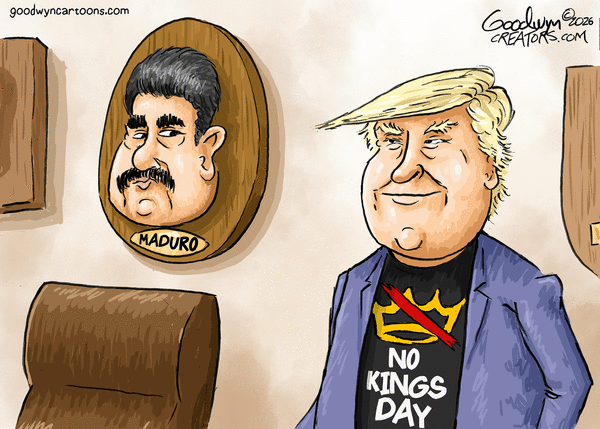
On Saturday, the Trump administration struck Venezuela in a new, stunning way, capturing its leader, Nicolas Maduro, and his wife. Both are being taken to the United States to face charges related to drug trafficking.
The strike followed a monthslong Trump administration pressure campaign on the Venezuelan leader, including a major buildup of American forces in the waters off South America and attacks on boats in the eastern Pacific and Caribbean accused of carrying drugs. Last week, the CIA was behind a drone strike at a docking area believed to have been used by Venezuelan drug cartels — the first known direct operation on Venezuelan soil since the U.S. began strikes in September.
Venezuela’s role in cocaine trafficking
Venezuela is not among the primary direct traffickers of cocaine to the U.S.
Like fentanyl, most cocaine enters the U.S. from Mexico and typically gets to Mexico via maritime transportation on both the Pacific and Caribbean sides, according to UNODC research officer Antoine Vella. Some also arrives in Mexico via land transportation.
While the Trump administration’s early September attacks targeted Venezuelan boats, there is no known direct cocaine trade route from Venezuela to the U.S. via sea. The only known direct Venezuela to U.S. trafficking route is via air, according to drug seizure data from UNODC. Cocaine could still arrive from Venezuela to the U.S. through intermediary countries.
Colombia, Ecuador and Panama are among the main direct traffickers of cocaine to the U.S. via boat.
From harvest to production
Coca, the plant that cocaine is made from, is grown primarily in Colombia, Peru and Bolivia.
Once coca is harvested, the cocaine in the leaf needs to be extracted. That processing occurs at illegal manufacturing facilities around the globe.
The three coca-growing countries also have the most illegal processing facilities. Colombia had by far the most of any country at about 26,400 detected and dismantled from 2019 to 2023, according to UNODC data. It’s followed by about 3,200 processing facilities in Bolivia and 2,400 in Peru.
Venezuela, which neighbors Colombia, had about 260 illegal processing facilities detected and dismantled from 2019 to 2023, according to UNODC data. It’s ranked fifth among countries with the most processing facilities.
“Every country that borders Colombia has an issue with cocaine in terms of cocaine trafficking,” Vella said.
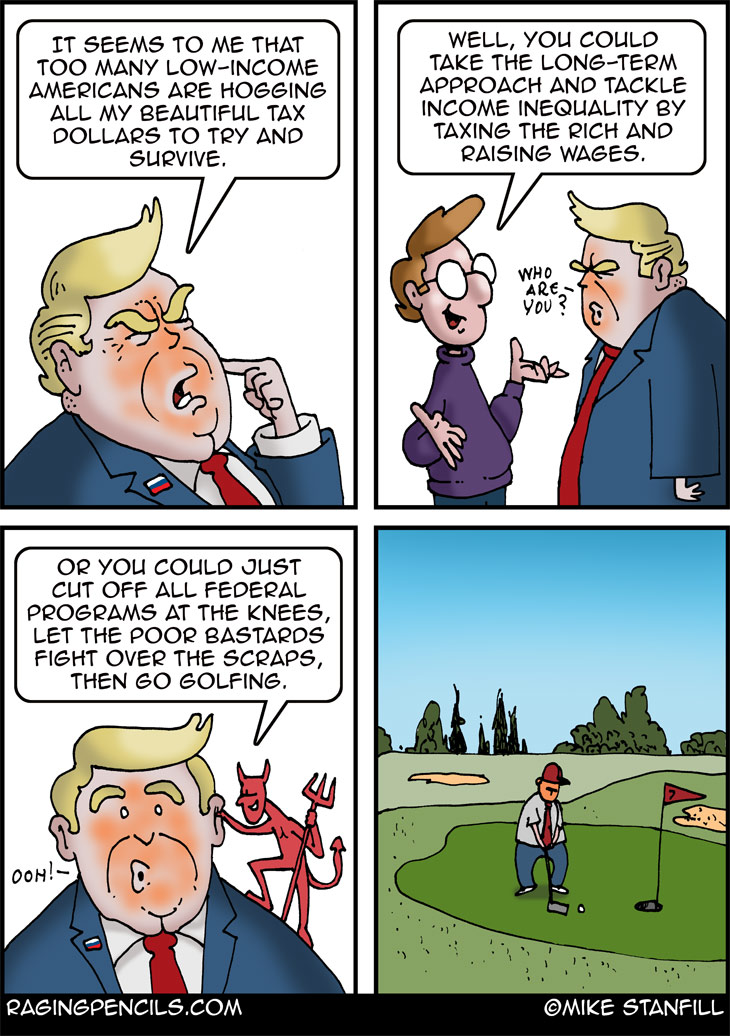
No healthcare subsidies, no money to feed poor people or kids who need government help to have lunch. As a kid often the only meal I got was lunch at school. No one monitored if I paid or not I was given food to eat like every other kid. In Jr / Senior high school, say from 13 to 18 again my only meal was lunch or snacks at school. But yes the tRump admin was cutting every safety net program and even halting child care so it hurts Walz, and stopping FEMA funds to states run by democrats among other cuts to already congress approved funding. All illegally I will add but the republicans in congress are too scared of tRump to object to his being a tyrant. But we have plenty of money for companies and businesses to extract oil.
On The Majority Report I am listening to an oil person saying that the price of oil has fallen below $50 a barrel because of a glut on the market, and that Venezuelan oil is “sour oil” meaning it is hard to refine. He says that to make a profit on that prices have to be over $80 dollars a barrel. Which means this demented daydream of Rubio’s and Miller’s is not about oil so much as territorial control over other countries and Rubio has long wanted Cuba to fall to the US so his parent’s lands and money can be claimed from the rightful owners of it now. Rubio’s family fled Cuba as refugees and lost all their holdings in Cuba, he has made a career of wanting it all back and toppling Castro. But … well Rubio and the neocons claim that if we can make Venzualia fall into line then all the other Latin American countries will fall in line also and Cuba’s government will be destroyed. Just like if we take out Saddam Hussein then the entire Middle East will embrace democracy. Same story different location. And it is all lies. Just an excuse to use the US military might and have a reason to deny any public relief or safety nets at home. Hugs
President Donald Trump said he believes the U.S. oil industry could get expanded operations in Venezuela “up and running” in fewer than 18 months.
“I think we can do it in less time than that, but it’ll be a lot of money,” Trump told NBC News in an interview Monday.
“A tremendous amount of money will have to be spent, and the oil companies will spend it, and then they’ll get reimbursed by us or through revenue,” he said.
Whether the U.S. government ultimately agrees to reimburse the oil industry’s costs in Venezuela, or alternatively, decides that future revenue is sufficient repayment, will likely be a key factor for the oil companies as they consider their options.
Trump declined to say how much money he believes it would cost companies to repair and upgrade Venezuela’s aging oil infrastructure.
“It’ll be a very substantial amount of money will be spent” by the oil companies, Trump said. “But they’ll do very well.”
“And the country will do well,” he added.
Despite Trump’s optimism, oil companies have appeared skeptical of quickly entering, expanding or investing in Venezuela. A history of state asset seizures, the ongoing U.S. sanctions and the latest political instability all feed into this caution.
Gas prices are already at multiyear lows. The average retail gas price on Monday was $2.81, according to AAA. That’s the lowest since March 2021.
“Having a Venezuela that’s an oil producer is good for the United States because it keeps the price of oil down,” Trump also added.
While lower oil prices could make gas cheaper at the pump, it would likely also mean lower revenues for the same big oil companies that Trump is counting on to bankroll the rebuilding of Venezuela’s oil industry to the tune of billions of dollars in foreign investment.
Asked if the administration had briefed any oil companies ahead of Saturday’s military operation to capture deposed Venezuelan leader Nicolás Maduro, Trump said, “No. But we’ve been talking to the concept of, ‘what if we did it?'”
“The oil companies were absolutely aware that we were thinking about doing something,” Trump said. “But we didn’t tell them we were going to do it.”
Trump told NBC News it was “too soon” to say whether he had personally spoken to top executives at America’s three largest oil producers, Exxon Mobil, Chevron and ConocoPhillips.
“I speak to everybody,” he said.
ConocoPhillips declined to comment Monday on Trump’s plans for Venezuela’s oil reserves. Chevron told NBC News it does not comment “on commercial matters or speculate on future investments.” Exxon did not immediately respond to questions.
Energy Secretary Chris Wright plans to meet with executives from Exxon and ConocoPhillips this week about Venezuela’s oil industry, Bloomberg News reported Monday, citing people familiar with the matter.
Wright will be a point person for the Trump administration’s broader campaign to rebuild Venezuela’s oil infrastructure, a White House official said Monday.
The Trump administration has repeatedly claimed that the U.S. oil industry is eager to return to Venezuela, nearly two decades after the country last nationalized billions of dollars’ worth of oil company assets.
“They want to go in so badly,” Trump told reporters Sunday evening.
Despite Venezuela’s massive reserves of crude oil, large U.S. oil firms have a good reason to pause before committing to expand operations in Venezuela.
In the 1970s, the Venezuelan government nationalized energy assets there, including those owned by Exxon Mobil and ConocoPhillips. In the years since, the companies have tried unsuccessfully to recover billions of dollars.
In 2006 and 2007, the Venezuelan government nationalized even more assets. Then-President Hugo Chávez allowed foreign oil firms to remain, but on less favorable terms, leading to the full departure of Exxon and Conoco.
Chevron, however accepted the terms and remains to this day, thanks in large part to a limited waiver exempting it from U.S. sanctions on Venezuelan oil.
Exxon Mobil CEO Darren Woods recently expressed caution about re-entering Venezuela.
“We’ve been expropriated from Venezuela two different times,” he told Bloomberg News in November, replying to a question about whether Exxon would be interested in Venezuela’s oil or gas. “We’d have to see what the economics look like.”
Throughout its history, the United States has characteristically remained a country of two things: a country of immigrants, and a country of unmatched religious diversity. And yet when compared with the rest of the world – where these two very factors alone have so often engendered horrible religious wars and decades of enduring conflict – the history of religious conflict in the United States seems almost nonexistent.
That is not to say the United States has been immune to its share of conflict explicitly rooted in religion. This paper explores the various manifestations of religious conflict throughout the history of the United States, from the Revolutionary War to the attacks of September 11th and their fallout. A distinction is drawn between religious intolerance, which is not the focus of this paper, and outright religious persecution or violence. Similarly, the paper reflects efforts made to de-conflate religious conflict from ethnic and racial conflict, which has been much more prominent throughout the history of the United States. In examining the history of religious violence, intolerance, discrimination, and persecution in the United States, we arrive at some possible explanations for why the United States has seen such minimal religious conflict despite being so religiously diverse.
The Revolution
It has been said that the United States is a nation founded on religious conflict. The colonies were settled by those escaping religious persecution in Europe. There is even some evidence that religion played a major role in the American Revolution and that revolutionaries believed it was willed by God for the Americans to wage war against the British.[1]
As the Church of England was striving to establish one, uniform religion across the kingdom, colonial America was divided, each of the colonies being dominated by their own brand of Christianity. Due to the distance from England and the room in the colonies, many religions were able to establish themselves in America, colony by colony. For example, Anglicans, who conformed to the Church of England, populated Virginia. Massachusetts was home to the Puritans. Pennsylvania was full of Quakers. Baptists ruled in Rhode Island. And Roman Catholics found a haven in Maryland, where they could establish themselves amid the other colonists’ protestant majority. Each of these colonies maintained a distinct religious character and favored one religious denomination’s power.
The American colonists saw the revolution not only as a war for political independence, but to protect the religious diversity of the thirteen colonies. Put in other terms, it was a war for religious independence and freedom. To sever ties with Mother England would be to ensure that the various Christian denominations could co-exist on the American continent. The conflict was, in part, a conflict that pitted the various American religious denominations against the Church of England, who wanted to impose a uniform, Anglican religion on the colonies.
Early Religious Persecution
The period after the Revolutionary War saw a lot of infighting between the various states and Christian denominations. Virginia, which was home to the largest portion of Anglicans loyal to the Church of England, was the scene of notorious acts of religious persecution against Baptists and Presbyterians. Anglicans physically assaulted Baptists, bearing theological and social animosity. In 1771, a local Virginia sheriff yanked a Baptist preacher from the stage at his parish and beat him to the ground outside, where he also delivered twenty lashes with a horsewhip. Similarly, in 1778, Baptist ministers David Barrow and Edward Mintz were conducting services at the Mill Swamp Baptist Church in Portsmouth, Virginia.[2] As soon as the hymn was given out, a gang of men rushed the stage and grabbed the two ministers, took them to the nearby Nansemond River swamp, and dunked and held their heads in the mud until they nearly drowned to death.
The period during and soon after the Revolutionary War also saw abundant political manifestations of religious conflict. At the time, some states abolished churches, while supporting others, issued preaching licenses, and collected tax money to fund and establish state churches. Each state constitution differed in its policy on religious establishment, or state-supported religion. It would not be until well after the adoption of the Constitution of 1789 and the First Amendment religion clauses that the disestablishment for which the United States is so recognized became the de facto practice.
1800s
The early part of the 19th Century was relatively quiet in terms of religious conflict in America. The religious conflict that stands out in this period involves tensions between Catholics and Protestants, culminating in violence directed at Irish Catholic immigrants. The surge in immigration from Europe during the 19th Century coincided with and influx of Catholics and the rise of activist Protestantism in the U.S. As strong Protestant values permeated the country, immigrants who were Catholic also became viewed as outsiders and undemocratic. These views are separate from, but on top of, the harsh anti-Irish sentiment that also spread during the period.
In the 1830s and 1840s, anti-Catholic violence broke out in the Northeast and elsewhere. In 1835, one incident was ignited by a speaking tour by Lyman Beecher, who published Plea for the West, a book about a Catholic plot to take over the U.S. and impose Catholic rule. After Beecher’s speaking tour passed through Charlestown, Massachusetts, a mob set fire to the Ursuline convent and school.[3] In Philadelphia in 1844, pitched gun battles broke out between “native” Americans and mostly Irish Catholics. Martial law had to be declared in order to end the violence.[4]
The Mormon War, the Utah War
Around the same time as anti-Catholic violence broke out in the Northeast, another religious group was being chased out of the same area. The Mormons, who emerged after the 1830 discovery of The Book of Mormon, were a religious community chased out of New York, out of Ohio, out of Missouri, and out of Illinois, to Utah, where they finally settled.
In Illinois in 1839, the Mormons settled Nauvoo and built a thriving Mormon town there, complete with a large Mormon temple. In the short period of three years, the Mormons prospered, announced the doctrine of polygamy, and founder Joseph Smith announced his candidacy for president of the United States. Locals were intimidated and envious. Smith and his brother Hyrum were arrested on morals charges and held in jail. On June 27, 1844, an anti-Mormon mob attacked Nauvoo and burned it to the ground.[5] They also invaded the jail cells where Smith and his brother were being held, and executed them.
Shortly after the sacking of Nauvoo, Brigham Young announced his leadership of the Mormons and led them to Utah, where they flourished. In 1857, fears of a religious state of Mormons grew and the president ordered federal troops to enforce the installation of federal judges and a new non-Mormon governor. At some point in the interim, this is still a subject of debate, the infamous Mountain Meadow Massacre happened – in which local Mormons slaughtered a group of 120 California-bound pioneers who were openly hostile toward their religion and making threats to return from California to attack them.[6]
The massacre only fueled anti-Mormon sentiment. Tensions escalated. The Mormon army, also known as the Nauvoo Legion, was called out to respond to the imminent arrival of 2,000 U.S. Army troops. Salt Lake City was evacuated on standing orders to burn the city should an invasion occur. No violence was to break out, as attention was diverted to the Civil War.
As the federal government focused its energies on fighting the Civil War, legal sanctions and political oppression of the Mormons continued that virtually dissolved the church by 1887. It wasn’t until the 1890s, when the Mormons ended the practice of polygamy, that Utah finally achieved statehood in 1896.[7]
The Jewish Experience
At the end of the 1890s, the U.S. began seeing the first wave of anti-Semitism, just as the federal government began restricting immigration from Europe. While concentrations of Jews have lived in America since colonial times, they were largely tolerated and discriminated against in localized incidents. By the 1920s, immigration quotas had taken effect and limits on the basis of national origin. These quotas were not repealed during the Holocaust, even as Jewish refugees were fleeing Hitler’s Europe.
Between 1933 and 1939, the period of the Great Depression, anti-Semitic fervor reached heights never before seen or later seen in entire the history of the Jewish experience in America. In urban areas such as New York and Boston, Jews were violently attacked.[8] Most anti-Jewish sentiment was manifested in social and political discrimination. Assaults, propaganda and intimidation were mostly carried out by special societies, such as the Silver Shirts or the Ku Klux Klan.
Overall, the experience of Jews in America has been encouragingly free from the violent persecution seen elsewhere in the world. Indeed, racial and social intolerance persisted since the colonial days until the 1950s, as Jews were not allowed membership in country clubs, excluded from colleges, banned from practicing medicine, and from holding political office in many states. However, religious conflict rooted in anti-Semitism has been largely non-violent.
Hate Crimes as Religious Conflict
The incidents of violence against individual Jews that characterized the anti-Semitism of the Great Depression would have fallen under the category of religious hate crimes if the FBI, then known as the Bureau of Investigation, were collecting those statistics at the time. Despite the diversity of the United States, in all aspects such as race, national origin, religion and sexual orientation, the federal government (by way of the FBI) did not start keeping tabs on hate crimes until 1992. Religiously speaking, anti-Semitic hate crimes have always dominated the national hate crime statistics gathered by the FBI for the past ten years. However, the current numbers paint a changing landscape.
According to the ACLU, the U.S. is home to more than 1,500 religions and 360,000 religious centers.[9] Christianity has long dominated the country’s religious make-up, followed by Judaism. According to the latest statistics released by the Harvard University Religious Pluralism Project, Islam has surpassed Judaism and is the country’s Number Two religion.[10]
Following the terrorist attacks of September 11th, the FBI found that anti-Muslim sentiments spiked and verifiable, religiously motivated hate crimes against Muslims in the U.S. increased 1,600 percent in 2001 from the prior year.[11]
In fact, the FBI, which has tracked hate crimes since 1992, reports that Anti-Muslim hate crimes had previously been the second-least reported. But in 2001, they became the second-highest reported, second only to anti-Jewish hate crimes. It should be noted that these statistics are separate from crimes motivated against race, national origin or ethnicity – these are crimes against person and property in which religion was a motivating negative factor.
Conclusion
The U.S. has been fortunate in that it has not witnessed religious war and conflict of the scale seen in the Middle East and Europe. Although the number of different religions in the U.S. has steadily grown over the decades, this diversity has not let to conflict. Some propositions for why this may be:
The United States as a country of immigrants
This factor defuses historical and religious claims to territory, which are not as strong as they are in places such as the West Bank and Ireland. It also may explain a greater likelihood for a system of conflict to eventually resolve itself in favor of tolerance rather than further conflict, as each new group of immigrants to America has generally shared a story of persecution.
Constitutional protections and religious disestablishment
The American tradition of the separation of church and state cannot be overlooked in mediating and possibly preventing religious conflict to erupt. In many other parts of the world, religion is still highly influential and, in some cases, sponsored by the state. However, in a country with such religious diversity, religious disestablishment has proved necessary so that the government could not take sides in a religious conflict.
Diversity creates tolerance
The argument also exists that the immense diversity in and of itself has promoted tolerance among religions. Religious pluralism inspires attitudes that homogeneity is a natural part of the religious environment and that there is room for each religion to exist in America.
As the United States enters the 21st Century, these important factors will prove to be influential in the face of catastrophic events, and economic, social and political changes that challenge the level of religious tolerance the nation has maintained for over two centuries.
Since returning to office, Donald Trump’s personal wealth has nearly doubled, from $3.9 billion in 2024 to $7.3 billion this past September, which includes $2 billion from his cryptocurrency ventures that no one had been buying into prior to his reelection. Donald Trump Jr. is now worth six times what he was in 2024, also due in part to the family crypto scam.
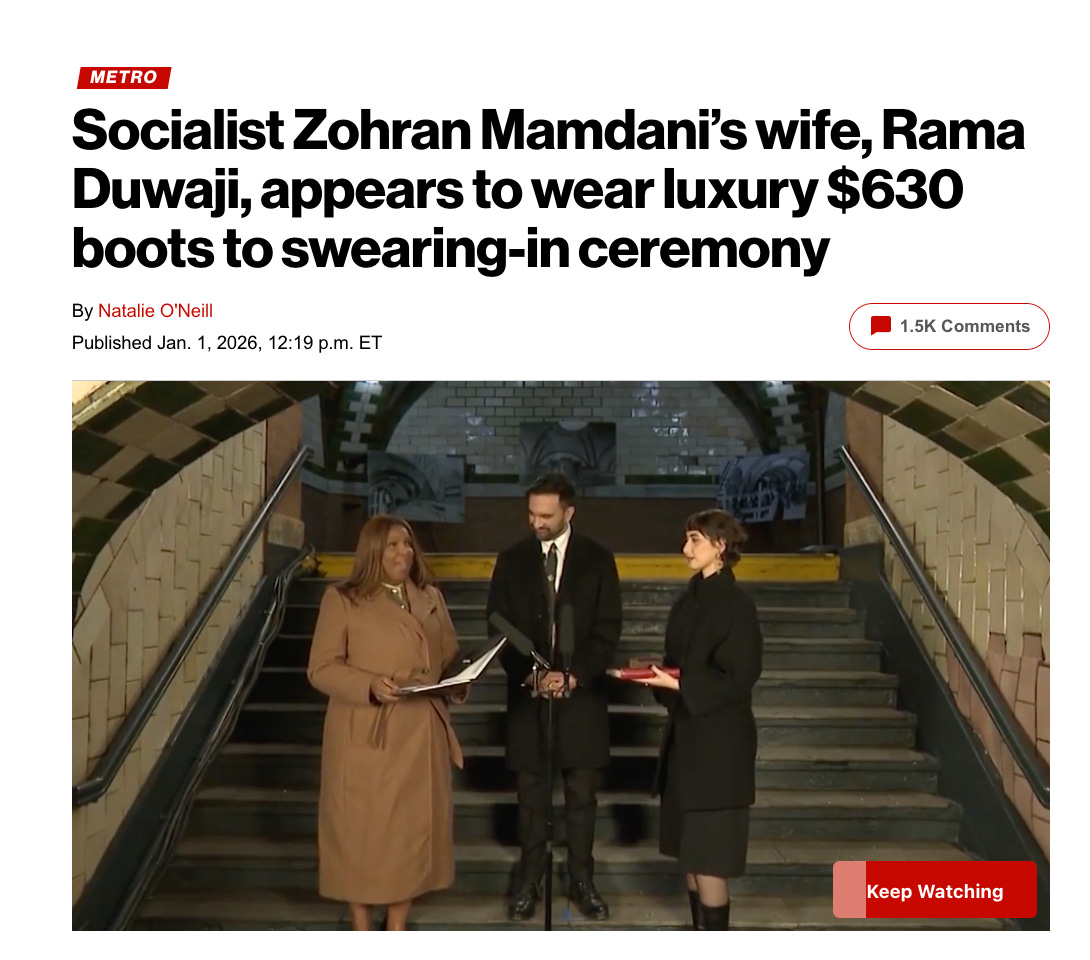
But did you hear? Zohran Mamdani’s wife, Rama Duwaji, wore some cute boots to his inauguration like a common Imelda Marcos! Quelle horreur!
Their “affordability” agenda got off on the wrong foot.
New York City’s first ladyRama Duwaji appeared to wear $630 “artisan” leather boots from a high-end designer to her Democratic socialist husband Zohran Mamdani’s mayoral swearing-in ceremony — a luxury look that flew in the face of the politician’s “everyman” image, eagle-eyed critics said Thursday.
Duwaji, a 28-year-old artist, gave more socialite than socialist on New Year’s Day as she apparently rocked one of the fashion house Miista’s pricey boot designs — one which is said to be crafted from “vegetable tan cow leather” and feature an “ultra-cushioned memory foam insole.”
Not “vegetable tan cow leather”! NOT A MEMORY FOAM INSOLE!
Not that it matters, really, but $630 for boots is not “luxury.” I mean that technically. Obviously $630 is a good amount of money, but it’s not luxury. It’s what’s called “bridge” — meaning that it’s high quality and expensive, but not at the same level as actual luxury brands, which cost at least twice that. It’s not Chanel or Versace or Alexander McQueen or Louis.
Rama wore a vintage Balenciaga coat from Albright Fashion Library and archival earrings from New York Vintage, both rented during a single marathon day spent diving into the racks and cupboards of the city’s best small, circular fashion businesses. […]
C’mon formal shorts!! Those are from The Frankie Shop, and the boots are *ON LOAN* from Miista.
I’m just going to have to get comfortable with the fact that people on the internet do not understand what being lent a SAMPLE that has been borrowed before and will be borrowed again means but, you know what, that’s okay.
This is a big part of what stylists do. Most of the time, when you see a celebrity wearing something fancy on the red carpet or at an event like this, it’s not something from their own closet, it’s on loan from a designer (because cheap advertising) or something like the Albright Fashion Library. This is also how a lot of wardrobing for television and movies works.
But even if they weren’t on loan, the idea that “it’s hypocrisy for a Democratic socialist or even a regular liberal to wear nice boots!” is absurd. It only seems like “hypocrisy” to people who think socialism means everyone should be poor and miserable and standing in bread lines all day wearing cardboard boxes on their feet instead of shoes.
The reality is … that’s capitalism. Like, for most people, that is capitalism, except you don’t even get any free bread out of it. Indeed, most of the people in the comments on the Post’s tweet for the article were talking about how they, the proud capitalists that capitalism is definitely working out really well for, only spend $40 on boots at Walmart or Amazon. Actually, buying shoes that will only last a season (and will fuck up your feet) because that’s all you can afford, instead of boots that cost a lot up front but last forever, is a perfect example of why it costs more to be poor than it does to be rich. (This is not to say that you can’t get decent boots for a not-crazy price — I do very well at Nordstrom Rack and Marshalls, thank you very much — but you get my point.)
What we want is for people to not have to spend $2,000 a month on health insurance or on rent so that they can have nice things, so that they can buy a nice pair of boots or a warm winter coat. So that they can go out to dinner sometimes without worrying about breaking the bank. That is the whole damn point! That’s the “hearts starve as well as bodies; give us bread, but give us roses too” of it all.
Right now, 60 percent of Americans cannot afford $1,000 for an emergency expense. That’s not socialism that did that, that’s capitalism as practiced in the United States of America. Our economy literally has poverty built into the system. We literally cannot function without people to work the kind of jobs that currently do not pay enough for survival. Austerity is a way of life for a very large percentage of us, which also means that those whose income is dependent on other people having expendable income are also screwed.
New NYC Mayor Zohran Mamdani’s affordability plans don’t just benefit the poor, they benefit everyone. If people aren’t taking certain jobs because transportation costs too much to make it worth their while or they can’t afford to live in the city, everyone’s quality of life goes down. A city where only rich people can afford to live is a city where rich people have absolutely nothing to do, which kind of defeats the whole point of being rich in the first place.
The commenters complaining about all the people they could supposedly feed with the $630 those boots cost are also missing the point. Besides clearly not being how socialism is supposed to work, caring for the poor by way of charity and philanthropy is lovely, but it’s not the most effective and efficient way of doing so. Taxes are. Social programs are. GoFundMe raises about $650 million a year for medical causes, with some people getting far more than they could ever need and others getting nothing. That is a stupid way of doing things. You want to spend less on healthcare? Make the entire United States one giant insurance group with a shit ton of leverage and bulk buying power, make medical school free and invest tax money into creating more internship programs. That is how you take care of people, not by not buying a pair of shoes.
Capitalists want philanthropy to replace taxation. Right-wing libertarians frequently argue that if you just didn’t tax the rich, they would happily give huge chunks of their fortunes away to the poor, which is patently ridiculous (and, again, not effective or efficient even if things did shake out that way).
Champagne socialists are good, actually. Why on earth would it be better to be a miserly rich person than a rich person who actually believes they should be taxed at a fair rate because they want to see everyone living well? The idea that the Left wants a world in which everyone lives like they’ve taken a vow of poverty and no one gets to be “successful” is a fantasy created by rich assholes who don’t want to share and don’t care if they live in a society where everyone has at least their basic needs met.
We actually love success, which is why we want more of it for more people, rather than just one percent of one percent of people. We love people, which is why we want a safety net that keeps them from falling so far they can’t get back up again. We love ingenuity, which is why we want people to be able to go into business for themselves without having to worry about what will happen to their kids if they can’t afford good health insurance on their own right away. We want their kids to feel like it’s not hopeless to try their best in school because they don’t think they’ll be able to afford to go to college without being in debt the rest of their lives. We don’t think it’s enough that people can “dream” of being billionaires but factually never be able to afford their own home.
And yes, we even want some people to be able to afford to actually buy $630 shoes, so that other people can get paid a fair wage for designing, making and selling those $630 shoes.

 Updated: 4:23 PM EST Jan 3, 2026