Very informative and heart felt. Aron Ra is well known for his thought approach to atheism and science, delivering it in a way that a normal person can understand. The things he says at the end and the pictures he shows makes clear that as he says this is not about protecting anyone but about enforcing bigotry. Hugs
That pesky thing called the US CONSTITUTION says that the people have a right to protest the government. The last ten or more years the federal government has been trying to restrain the rights of the people to protest or have their voices heard. This is another example. Hugs
DHS is urging law enforcement to treat even skateboarding and livestreaming as signs of violent intent during a protest, turning everyday behavior into a pretext for police action.
The Department of Homeland Security is urging local police to consider a wide range of protest activity as violent tactics, including mundane acts like riding a bike or livestreaming a police encounter, WIRED has learned.
Threat bulletins issued during last month’s “No Kings” protests warn that the US government’s aggressive immigration raids are almost certain to accelerate domestic unrest, with DHS saying there’s a “high likeliness” more Americans will soon turn against the agency, which could trigger confrontations near federal sites.
Blaming intense media coverage and backlash to the US military deployment in Los Angeles, DHS expects the demonstrations to “continue and grow across the nation” as protesters focused on other issues shift to immigration, following a broad “embracement of anti-ICE messaging.”
The bulletins—first obtained by the national security nonprofit Property of the People through public records requests—warn that officers could face assaults with fireworks and improvised weapons: paint-filled fire extinguishers, smoke grenades, and projectiles like bottles and rocks.
At the same time, the guidance urges officers to consider a range of nonviolent behavior and common protest gear—like masks, flashlights, and cameras—as potential precursors to violence, telling officers to prepare “from the point of view of an adversary.”
Protesters on bicycles, skateboards, or even “on foot” are framed as potential “scouts” conducting reconnaissance or searching for “items to be used as weapons.” Livestreaming is listed alongside “doxxing” as a “tactic” for “threatening” police. Online posters are cast as ideological recruiters—or as participants in “surveillance sharing.”
One list of “violent tactics” shared by the Los Angeles–based Joint Regional Intelligence Center—part of a post-9/11 fusion network—includes both protesters’ attempts to avoid identification and efforts to identify police. The memo also alleges that face recognition, normally a tool of law enforcement, was used against officers.
Vera Eidelman, a senior staff attorney with the American Civil Liberties Union, says the government has no business treating constitutionally protected activities—like observing or documenting police—as threats.
DHS did not respond to a request for comment.
“Exercising those rights shouldn’t be justification for adverse action or suspicion by the government,” Eidelman says. Labeling something as harmless as skateboarding at a protest as a violent threat is “disturbing and dangerous,” she adds, and could “easily lead to excessive force against people who are simply exercising their First Amendment rights.”
“The DHS report repeatedly conflates basic protest, organizing, and journalism with terroristic violence, thereby justifying ever more authoritarian measures by law enforcement,” says Ryan Shapiro, executive director of Property of the People. “It should be sobering, if unsurprising, that the Trump regime’s response to mass criticism of its police state tactics is to escalate those tactics.”
Fusion centers like JRIC play a central role in how police understand protest movements. The intelligence they produce is rapidly disseminated and draws heavily on open-source data. It often reflects broad, risk-averse assumptions and includes fragmentary and unverified information. In the absence of concrete threats, bulletins often turn to ideological language and social media activity as evidence of emerging risks, even when tied to lawful expression.
DHS’s risk-based approach reflects a broader shift in US law enforcement shaped by post-9/11 security priorities—one that elevates perceived intent over demonstrable wrongdoing and uses behavior cues, affiliations, and other potentially predictive indicators to justify early intervention and expanded surveillance.
A year ago, DHS warned that immigration-related grievances were driving a spike in threats against judges, migrants, and law enforcement, predicting that new laws and high-profile crackdowns would further radicalize individuals. In February, another fusion center reported renewed calls for violence against police and government officials, citing backlash to perceived federal overreach and identifying then-upcoming protests and court rulings as likely triggers.
At times, the sprawling predictions may appear prescient, echoing real-world flashpoints: In Alvarado, Texas, an alleged coordinated ambush at a detention center this week drew ICE agents out with fireworks before gunfire erupted on July 4, leaving a police officer shot in the neck. (Nearly a dozen arrests have been made, at least 10 on charges of attempted murder.)
In advance of protests, agencies increasingly rely on intelligence forecasting to identify groups seen as ideologically subversive or tactically unpredictable. Demonstrators labeled “transgressive” may be monitored, detained without charges, or met with force.
Social movement scholars widely recognize the introduction of preemptive protest policing as a departure from late-20th century approaches that prioritized de-escalation, communication, and facilitation. In its place, authorities have increasingly emphasized control of demonstrations through early intervention, surveillance, and disruption—monitoring organizers, restricting public space, and responding proactively based on perceived risks rather than actual conduct.
Infrastructure initially designed to combat terrorism now often serves to monitor street-level protests, with virtual investigations units targeting demonstrators for scrutiny based on online expression. Fusion centers, funded through DHS grants, have increasingly issued bulletins flagging protest slogans, references to police brutality, and solidarity events as signs of possible violence—disseminating these assessments to law enforcement absent clear evidence of criminal intent.
Surveillance of protesters has included the construction of dossiers (known as “baseball cards”) with analysts using high-tech tools to compile subjects’ social media posts, affiliations, personal networks, and public statements critical of government policy.
Obtained exclusively by WIRED, a DHS dossier on Mahmoud Khalil, the former Columbia graduate student and anti-war activist, shows that analysts drew information from Canary Mission, a shadowy blacklist that anonymously profiles critics of Israeli military action and supporters of Palestinian rights.
In federal court Wednesday, a senior DHS official acknowledged that material from Canary Mission had been used to compile more than 100 dossiers on students and scholars, despite the site’s ideological slant, mysterious funding, and unverifiable sourcing.
Threat bulletins can also prime officers to anticipate conflict, shaping their posture and decisions on the ground. In the wake of violent 2020 protests, the San Jose Police Department in California cited the “numerous intelligence bulletins” it received from its local regional fusion center, DHS, and the FBI, among others, as central to understanding “the mindset of the officers in the days leading up to and throughout the civil unrest.”
Specific bulletins cited by the SJPD—whose protest response prompted a $620,000 settlement this month—framed the demonstrations as possible cover for “domestic terrorists,” warned of opportunistic attacks on law enforcement and promoted an “unconfirmed report” of U-Haul vans purportedly being used to ferry weapons and explosives.
Subsequent reporting in the wake of BlueLeaks—a 269-gigabyte dump of internal police documents obtained by a source identifying as the hacktivist group Anonymous and published by transparency group Distributed Denial of Secrets—found federal bulletins riddled with unverified claims, vague threat language, and outright misinformation, including alerts about a parody website that supposedly paid protesters and accepted bitcoin to set cars on fire, despite a clear banner labeling the site “FAKE.”
Threat alerts—unclassified and routinely accessible to the press—can help law enforcement shape public perception of protests before they begin, laying the groundwork to legitimize aggressive police responses. Unverified DHS warnings about domestic terrorists infiltrating demonstrations in 2020, publicly echoed by the agency’s acting secretary on Twitter, were widely circulated and amplified in media coverage.
Americans are generally opposed to aggressive protest crackdowns, but when they do support them, fear is often the driving force. Experimental research suggests that support for the use of coercive tactics hinges less on what protesters actually do than on how they’re portrayed—by officials, the media, and through racial and ideological frames.
Dell Cameron is an investigative reporter from Texas covering privacy and national security. He’s the recipient of multiple Society of Professional Journalists awards and is co-recipient of an Edward R. Murrow Award for Investigative Reporting. Previously, he was a senior reporter at Gizmodo and a staff writer for the Daily … Read More
One voice was yelling he was a US citizen. The conditions are horrible. They get their drinking water from the toilet. Maxwell Frost is a progressive treasure. Hugs
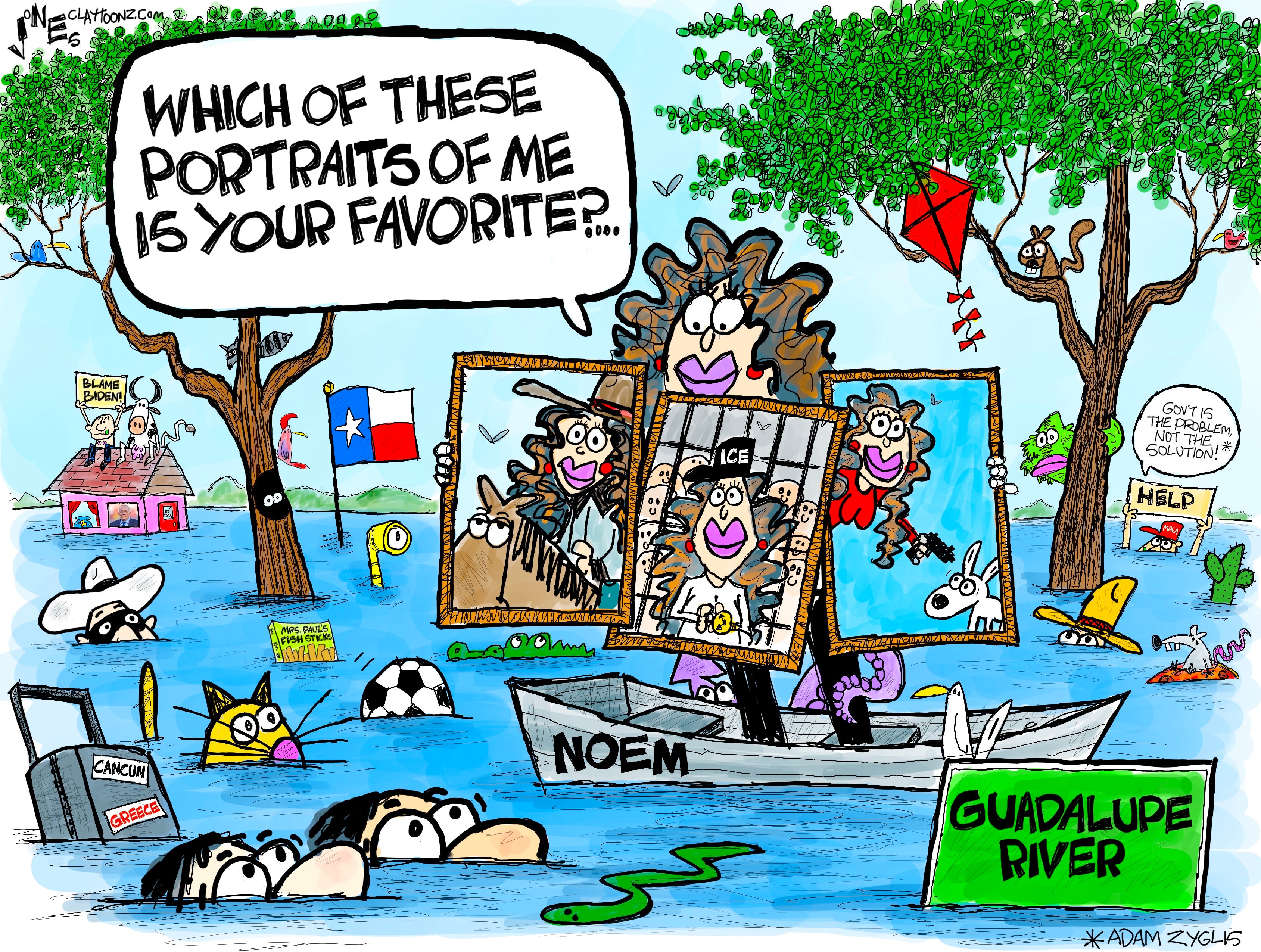
Noem is more interested in her face than in providing assistance to the Texas flood survivors Read on Substack
ICE Barbie, Kristi Noem, the Director of Homeland Security, is failing at her job miserably.
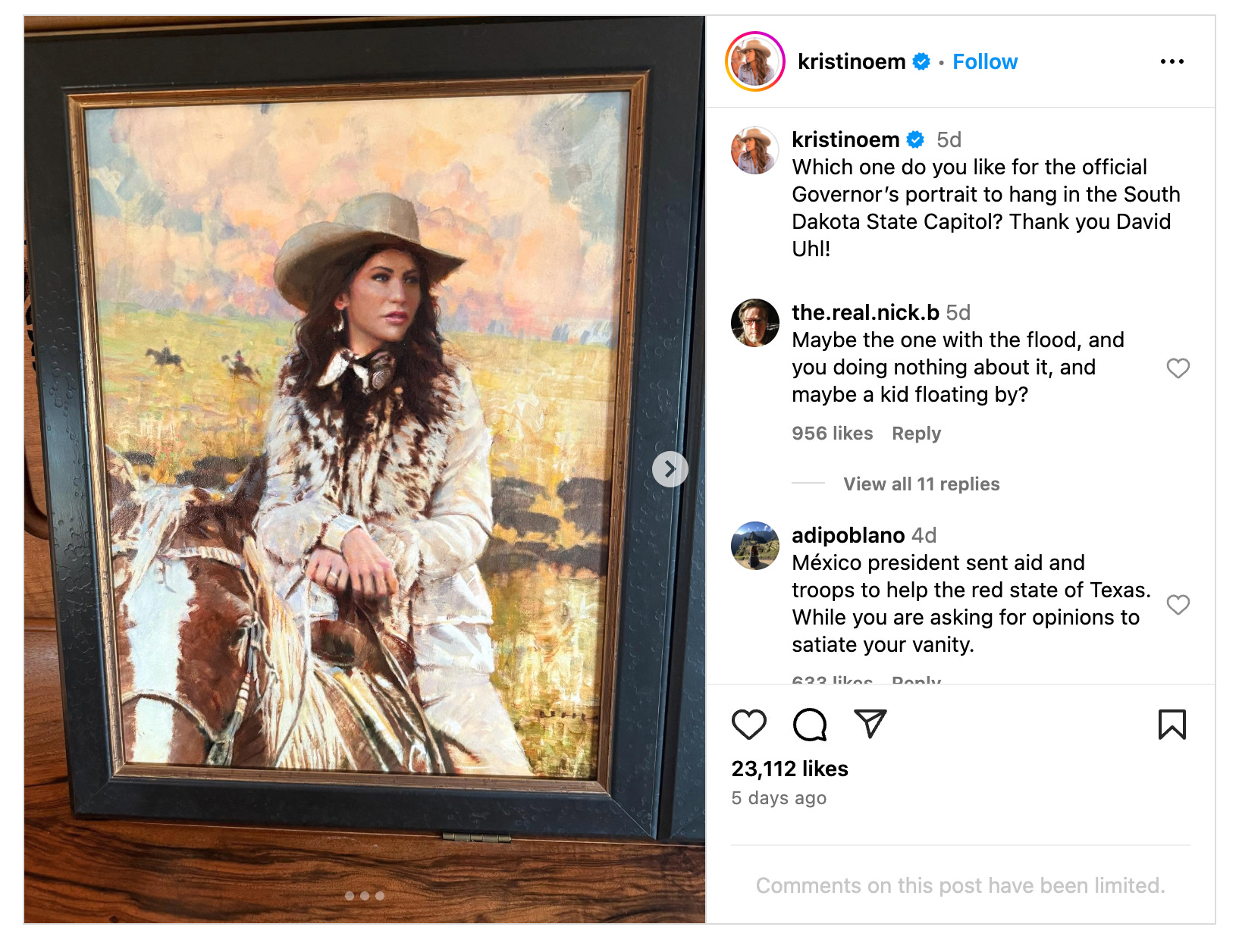
A portrait of Noem is going to be displayed in the South Dakota Capitol building, and there are three options. Who gives a shit, right? Kristi Noem, that’s who. Noem went on Instagram and posted to her creepy followers, “Which one do you like for the official Governor’s portrait to hang in the South Dakota State Capitol? Thank you David Uhl!” She added the three paintings of herself on horseback by artist David Uhl.”
She did this five days ago, during the floods in Texas that have killed at least 120 so far.
Here are the other two portraits.
I wonder how much South Dakota tax money was spent on this.
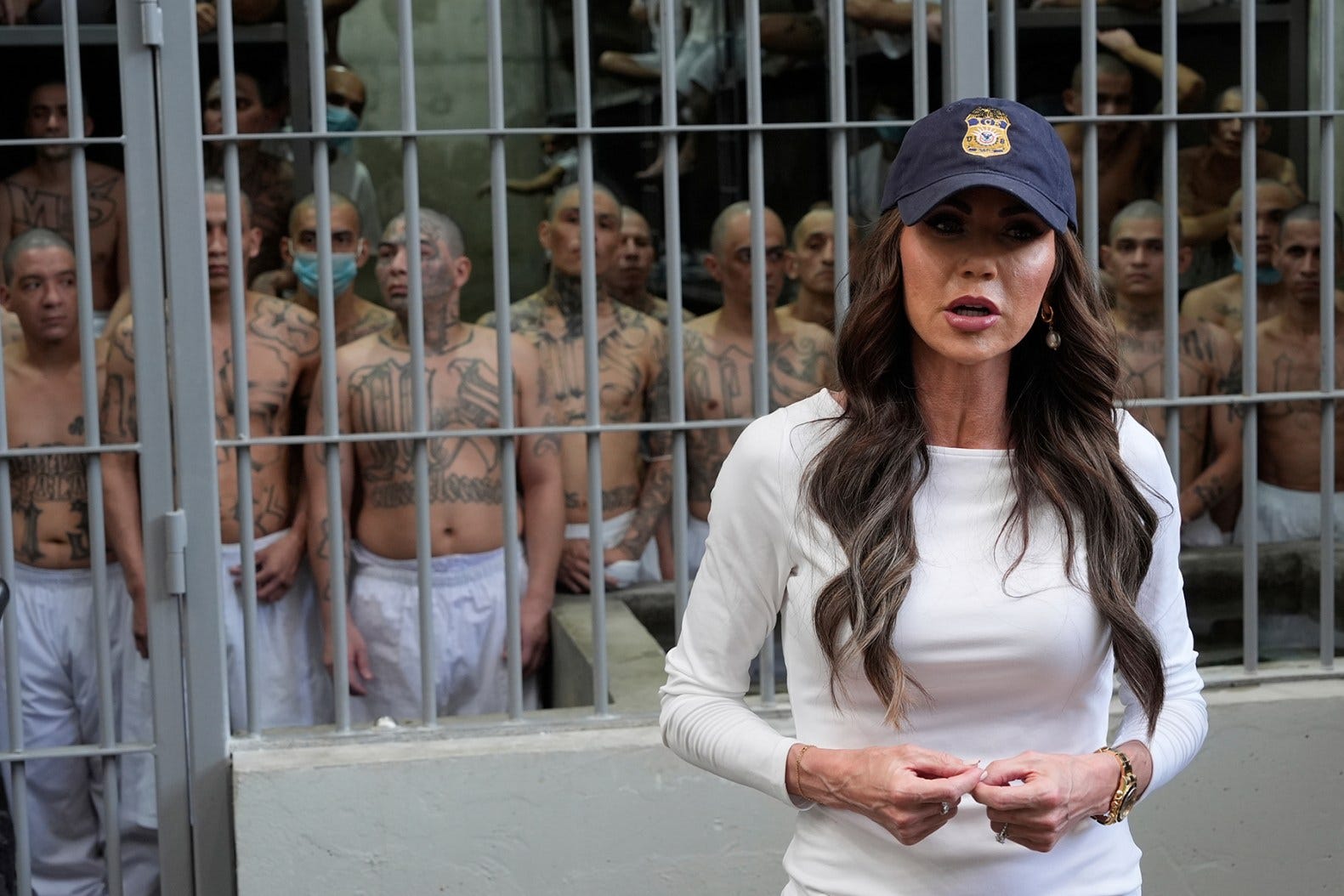
Before Noem’s survey about herself, Puppy-Killah Kristi did her stupid photo-op in El Salvador with the notorious prison behind her, with Trump deportees as props. She was in full makeup while making sure her shiny $10,000 Rolex was visible, which is probably less than her teeth cost.
She’s done other photos with guns, posing as an ICE agent. In one of them, she wasn’t holding the gun correctly and got roasted for it online. I bet she can’t ride a horse either.
We should be relieved that she didn’t shoot that ICE agent in the face. In her defense, she does know how to shoot a gun because that’s how she murdered her puppy. So there, critics.
Kristi is the kind of person that if you went out to dinner with her, she’d humbly say at some point, “Enough of me talking about myself. Now let’s hear you talk about me.” She can’t get over herself. She might be the female equivalent of Donald Trump. She already has the fake hair, and now she just needs the ridiculous tie, the orange make-up, and an adult diaper that hasn’t been changed since his first flip-flop on tariffs.
Remember, Kristi used to look like this…
…before she looked like this.
She definitely went for the Melania look, which is an improvement over the look for hunting wolves from a helicopter. She even got free dental work while she was governor, on the condition that she make a commercial for the Texas dentist who did her work.
It seems that’s the only time she’s interested in Texas, when she can get free dental work, but not when there’s a disaster.
According to The New York Times, two days after catastrophic floods roared through Central Texas, the Federal Emergency Management Agency (FEMA) did not answer nearly two-thirds of calls to its disaster assistance line.
An anonymous source close to the issue said the lack of responsiveness happened because the agency had fired hundreds of contractors at call centers.
FEMA, which is a part of Homeland Security (I have to include that because trolls are commenting on this cartoon on Facebook asking, “What’s DHS got to do with FEMA?”), laid off the contractors on July 5 after their contracts expired and were not extended, according to the documents and the person briefed on the matter. Noem, who has instituted a new requirement that she personally approve expenses over $100,000, did not renew the contracts until Thursday, five days after the contracts expired, and about a week after the floods started.
Where was ICE Barbie? She was probably spending her time looking at herself in a mirror, or maybe she confused Texas for one of the seven Native American tribes that banned her from their reservations.
Adam Zyglis: There’s a part of this cartoon that is my standing in solidarity with my colleague Adam Zyglis. So what happened with Adam? Adam, who works for the Buffalo News, drew a cartoon mocking Republican hypocrisy, asking for federal aid after protesting against federal disaster relief for other states. This has upset Republicans, which shows more hypocrisy for the gang that shouts “snowflake” at their political opponents. They even cried on Fox News about it.
Now, an event at the Buffalo History Museum by the Buffalo News Guild, which was to feature Adam among other journalists, has been postponed because of “credible” death threats toward Adam and his family.
And just today, a MAGAt posted on one of my client’s shares of a cartoon of mine about how Democrats are the violent ones. (snip-MORE, and it’s great)
There is a video at the link below. I watched this. ICE went in to terrorize and prove they could. They had a military style attack helicopter. This is going to get worse. They are the tRump admin Gestapo, armed thugs who follow no rules attacking people who have violated no criminal laws. Even if they were undocumented they had broken no laws as crossing the border illegally is a civil offense like speeding. Hugs
Border Czar Tom Homan on Friday angrily condemned the violence at a California pot farm as proof anti-ICE protests will turn deadly, blaming the inflammatory rhetoric of Democrats comparing agents to Nazis.
Homan spoke out the morning after protesters were seen hurling rocks — and one even appeared to fire a gun — at agents stamping down on a massive marijuana operation where they found 10 illegal-migrant juveniles, eight of whom were there without an adult.
“What happened in California is just another example of protesters becoming criminals, and they’ve been emboldened by even members of Congress who compare ICE to Nazis and racists and terrorists,” Homan said on “Fox & Friends” Friday morning.
A protester flees as ICE officers fire chemical agents into the crowd during a raid in Camarillo, California.AFP via Getty Images
“I said months ago, it’s going to end up with a loss of life — and we had one the other day in Texas, and it’s not over,” he said, referencing the gunman who opened fire on border patrol agents walking into work in McAllen Monday.
Immigration agents who descended on Glass House Farms in the city of Camarillo — one of the biggest cannabis farms in Southern California — were met by dozens of demonstrators gathered on a road between fields where the uniformed officers stood in a line across from them.
A military-style helicopter flew overhead, video shows.
Tear gas billows from canisters thrown by federal agents toward protesters in Camarillo, California.via REUTERS
Protesters shouted and screeched until agents used canisters with an unknown substance and fired less-than-lethal rounds, forcing them to retreat. Several of the protesters threw what appeared to be rocks back at the officers, according to ABC 7.
As they retreated, a masked man in all black appeared to let off a few shots among a crowd of other protesters scampering away from advancing agents.
The FBI has now launched an investigation into the alleged shooting and is offering a reward up to $50,000 for information leading to a conviction.
An individual was spotted allegedly firing a weapon toward federal agents.ABC 7
The clash lasted four hours as US Customs and Border Protection set up a blockade with military-style vehicles in the pastoral region.
Video from ABC 7 shows numerous workers being taken into custody at the scene. It’s unclear exactly how many were detained.
Five people were taken to the hospital, according to the Los Angeles Times.
The farm is now under investigation for child labor violations, CBP Commissioner Rodney Scott announced late Thursday night after 10 juveniles — “all illegal aliens” — were found at the facility, including eight without an adult, he said.
Protesters stand in front of ICE agents near a pot farm in Camarillo, California.Getty Images
Glass House Farms said it “fully complied with agent search warrants.”
The stand-off drew widespread criticism from California leaders, including U.S. Congressman Salud Carbajal, who was denied entry when he tried to get past federal agents into the farm.
Newsom’s office accused President Trump’s advisor, Stephen Miller, of sparking “terror” in local communities.
A protester washes eye with milk after federal immigration agents tossed tear gas during a raid in Camarillo, California.AP
“There’s a real cost to these inhumane immigration actions on hardworking families and communities, including farmworker communities, across America,” Newsom’s office said.
“Instead of supporting the businesses and workers that drive our economy and way of life, Stephen Miller’s tactics evoke chaos, fear and terror within our communities at every turn.”
I see that our recycling center has closed until further notice. International Paper, downsizing, has closed its recycling plant in Wichita, laying off all those employees, I saw on the newscast from the station I linked. Their story links a release from IP about all their closures and their plans for the year. The release is dated Feb. 13, of 2025. There’s another release from the Wichita Business Journal about the Wichita plant, but it says little to nothing. (No link from them; they’re mostly Kansans and Americans For Prosperity, anyway.)
Earlier, I got the idea to search if IP’s downsizing is due to recission of tax cuts and to tariffs. Gemini (who always volunteers though I never ask, preferring to find a link to a known source) says that while it cannot state that those things cause the downsizing in full, it also cannot state that those aren’t in the mix. (Because I do skim Gemini’s stuff.)
So, this hurts a bit: the closing of our recycling facility, as well as the Wichita one. During the first Trump admin, when POTUS began that trade war with China, China reciprocated by, possibly among other things, refusing anymore plastic recycling from the US. Our facility couldn’t find a place that did the recycling; no one else does it. China does it very economically though of course there is the question of what it’s really doing with the plastic, but another story for another time.
Anyway, in those days, I was an active BPW member. One of the things we worked hard on was getting a recycling collection facility here in town. We lobbied hard, both the public and the council, for use of an unused building (the former firehouse,) and possibly the use of a big truck for hauling the recycling collected to the recycler. We asked for no funding, we had willing volunteers; all the civic organizations set up volunteer schedules. We just needed the facility and a way to haul. Before the facility came about, I became a member of the city Planning Commission, so I couldn’t continue in that effort until after it was decided by the council. But, it was a happy circumstance that there was a plan for recycling in the existing Strategic Plan, even then! That’s always a big help, when something’s in the Strat Plan.
So, this was not a thing that came before the Planning Commission. I was not on Zoning Appeals at that time, so I have no idea if they got it, but as it came to reality, that wouldn’t have been necessary. It was decided that that firehouse building would become the collection facility, it would be staffed with volunteers but with a city worker or two there because it’s city property and insurance insists on that, and a city worker would do the hauling. Yay! It was open each Saturday from 9 until noon, and people needed to bring their recycling, preferably sorted, to the facility where volunteers then helped getting things where they went.
Eventually it grew, and there weren’t enough volunteers every Saturday to keep the lines moving reasonably. It went before the council to staff another one or two. There would still be volunteers there to keep things moving without too much staff. (People here in town like nice things, but don’t like paying for them.) The council approved, and the facility also opened on Mondays from 11 AM to 1 PM. That way, downtown business, who go through a lot of corrugated cardboard and bubble wrap, could get theirs done without as many of the public. Also, the staffers could actually get the stuff loaded in time for it to go to the recycler.
I just went there last week to drop recycling. We usually accrue enough corrugated cardboard and chipboard to unload at least once per month. We’ve cut paper back a lot, and again, plastic hasn’t been accepted since Trump p.o.’d China last term, so that’s not so much. Even so, where we usually have a single trash bag to go out for pickup, I think we’re going to have more that now has to go to the landfill.
I may be taking it too seriously, but I feel the way I did when the SCOTUS overturned their own decision in Roe v. Wade. We worked hard for it, we had it, it was good for all, and now it’s gone.
I hope this hasn’t bored anyone very much. It’s more sentimental than I usually am when posting such stuff. Still, our recycling collection facilities closing, or really, any big companies downsizing, is happening everywhere, and is affecting many, many people. I feel for all the Wichita workers who will have no jobs just in time for school shopping. So, I thought I’d post, because we all have to keep our eyes open for this happening around us everywhere. Thanks for your time! 🌞
I was struck by the backlash to the Texan pediatrician who was ostracized and lost her job because she pointed out that decisions have consequences, and all those who voted for drumpf in Texas are experiencing those painful consequences. Painful words uttered in despair, but damn – that doesn’t make them any less true.
How many times have we heard the line that “now isn’t the time to talk about this”? We’ve seen it with the debate on gun laws, and now we see it on this horrible consequence of firing those who warn us of dangerous weather.
But once again people have died, children have died, destruction and despair are gripping our nation, and the cause of that horror is not open for discussion? It’s being political in a time of national mourning? It’s insensitive? Decisions made in comfort and greed by those untouched by the disaster have exacted the ultimate cost, and they once again seek to control the conversation by denying the ability to explore how it happened!
So, is it safe to talk about these things now? Is it ok to talk about how stripping the social safety nets have consequences? Is it ok to seek to examine what we as a country believe in now, or are we waiting for the next disaster to blow through, the NEXT time parents weep looking for lost and dead children, or will it be one of the times after that? How long must we listen to the powerful deny the impact of greed, arrogance and ignorance.
And, to respond to this fool Abbott; Smart teams look to see if the wrong plays were called, or more likely, the wrong people were making the wrong decisions.










 Scottie's Playtime