As the flu and covid are on the rise again vaccines are on the decline due to the tRump admin claiming that the best science we have is wrong based on feelings and in the case of the people like JFK Jr it is greed. People don’t realize he makes his money suing drug manufacturers that produce vaccines. Every time he thinks he has some wacked out idea he sues and nothing they can show him will matter to him, all he wants is money and to stop vaccines for other people, as his families kids are protected. Think on it, he is vaccinated, their family has the money to get the vaccines without medical insurance, all he is doing is making it harder and more costly for your kids to get them because you need the medical insurance to help pay for it. Hugs
Under Robert F. Kennedy Jr.’s guidance, the CDC no longer recommends routine vaccination to protect against meningococcal disease.
Jan. 11, 2026, 7:00 AM EST
By Kaitlin Sullivan
Deaths from a rare and dangerous bacterial infection could rise if fewer teens are vaccinated, doctors warn.
After the Centers for Disease Control and Prevention recommended that all adolescents get vaccinated against meningococcal disease in 2005, cases of the potentially deadly illness plummeted in the United States by 90%.
However, cases have sharply risen since 2021, likely due to a combination of mutating bacteria and declining rates of vaccination overall, especially among teens getting a booster dose for bacterial meningitis, doctors suggest.
Dr. Luis Ostrosky, an infectious disease doctor at UT Health in Houston, is concerned that as cases of bacterial meningitis climb in the United States, the CDC’s recent overhaul of the childhood vaccine schedule could lead to more deaths.
Under Health Secretary Robert F. Kennedy Jr.’s guidance, the CDC is no longer recommending a meningitis vaccine for all adolescents. The vaccine and booster protect against the most common types of the infection in the U.S., serogroups A, C, Y, W.
“We see quite a few cases of meningitis per year,” Ostrosky said.
Under the new guidance, the vaccines will be recommended for “high-risk groups,” although parents can still ask doctors to vaccinate their children through a process called “shared clinical decision making.”
Teenagers and college-age adults, who often spend a lot of time in groups or communal living spaces such as dorms, and people with HIV are considered at highest risk for the infection, caused by a group of bacteria called Neisseria meningitidis.
Vaccination is important not because the disease is common — around 3,000 people are diagnosed with bacterial meningitis in the U.S. each year — but because the infection is both extremely serious and fast-moving.
Bacterial meningitis can progress quickly, causing the brain to swell and limbs to develop gangrene and sepsis, and can kill within 24 hours.
Symptoms such as headache, stiff neck, vomiting and fever come on suddenly, and may be mistaken for other minor illnesses. It can be treated with antibiotics, but even with rapid diagnosis, about 15% of patients die.
Fast-acting and life-threatening
Why some people are susceptible isn’t well understood. The infection develops when usually harmless bacteria travel through the respiratory tract and infiltrate the membranes surrounding the brain and spinal cord, causing severe inflammation. These bacteria, which commonly live in the back of the throat, can spread from person to person through close contact.
It can lead to a life-threatening infection in someone whose immune system is compromised — sometimes by a simple cold or flu virus — or who doesn’t have immunity to those bacteria. Viruses and fungi can also cause meningitis, but bacterial meningitis is the most serious.
Among patients who survive, as many as 20% have lifelong disability or complications, including amputated limbs, hearing impairment and neurological problems.
“You can die from a brain hernia, or from sepsis,” Messacar said. “And if you survive a brain hernia, you will most likely have severe complications.”
In 2024, the CDC issued an alert about a rise in cases of a type of invasive meningococcal disease. More than 500 cases were reported, the highest since 2013. Most of the infections were due to a specific strain of the Y serogroup of bacteria, which is included in the previously recommended vaccine. The cases were more common in adults ages 30 to 60, in Black people and in people with HIV.
“It’s even more important now that we get meningococcal vaccines out to people given that we are seeing a spike in this Y strain,” Messacar said.
The Food and Drug Administration has approved three types of meningitis vaccines. In 2005, the CDC began recommending that 11- and 12-year-olds get vaccinated against the most common meningococcal serotypes, A, C, Y and W. Because of waning immunity, the CDC in 2011 added a booster recommendation for 16-year-olds to protect them through young adulthood. A vaccine for meningitis B and a combined shot are available for children or babies who are considered at high risk.
In a statement Monday, Kennedy said that the CDC’s new childhood vaccine schedule was “aligning the U.S. childhood vaccine schedule with international consensus.”
Dr. Peter Chin-Hong, an infectious disease doctor at the UCSF School of Medicine in San Francisco, said the new approach to meningitis vaccination in the U.S., which is based on Denmark’s, is flawed.
“You can’t just look at another country’s vaccine approach and photocopy it. You really have to look at what is happening in your own country,” Chin-Hong said. Given the safety of meningitis vaccines, “it makes sense to vaccinate.”
Alicia Stillman, who serves on a World Health Organization task force for eliminating meningitis, worries that by moving the vaccine into shared decision making, the CDC is creating hurdles for parents who want to protect their children.
Stillman’s daughter, Emily, died from meningitis B in 2013. Emily had been vaccinated against meningitis A, C, W and Y, but the FDA didn’t approve a vaccine for meningitis B until 2014.
Emily Stillman, pictured with her mother, Alicia, was 19 when she died from meningitis B. Courtesy Alicia Stillman
Because many types of bacteria can cause bacterial meningitis, different vaccines are needed. The meningitis B vaccine hasn’t been recommended for all children but is available for people at high risk through the shared decision making process.
“I have watched medical professionals not bring [meningitis B vaccination] up,” said Stillman, who is the co-executive director of the American Society for Meningitis Prevention. “I have watched parents who are maybe a little less educated and not know how to ask about it, or they go to a public clinic instead of a private clinic where they have less time with a provider.”
She believes that could happen more broadly with the changed guidance.
What the research says
A CDC statement said the changes to the recommendation reflect the need for more data on certain vaccines, “including placebo-controlled randomized trials and long-term observational studies to better characterize vaccine benefits, risks, and outcomes.”
While there haven’t been placebo-controlled trials for meningitis vaccines — which would test how well a vaccine works either by deliberately infecting people with bacteria or by seeing how well they fare if they are infected in the real world — there have been many randomized clinical trials and other studies that use decades of data collected from both vaccinated and unvaccinated individuals in the real world.
Chin-Hong said placebo-controlled trials aren’t realistic or ethical for every drug, especially for life-threatening and rare diseases.
“A well-designed observational study, especially using decades of experience, can be just as informative as a randomized controlled trial,” Chin-Hong said.
A 2020 CDC report analyzed 20 clinical trials on meningococcal disease vaccines, including data from the Vaccine Adverse Event Reporting System (VAERS) and the Vaccine Safety Datalink (VS). The most common reported side effects were “mild to moderate,” and included swelling, fever and headache.
In 2005, Katie Thompson, now 39, was infected with an antibiotic-resistant strain of bacterial meningitis when she was a college freshman, the same month the FDA approved the first MenACWY vaccine.
“I don’t know how to describe it besides it’s pure hell,” she said.
After five weeks in the hospital and nearly dying, she went home, but not without lifelong complications. Thompson, who lives outside of Charleston, South Carolina, still struggles with migraines and vestibular disorders that cause vertigo and nausea. The infection was hard on her organs and she uses a bladder stimulator that helps regulate both her bladder and nerves in the base of her spine.
“It’s just not a disease that you want to take a risk on,” she said. “It’s not one that you want to gamble with your child’s life.”
Two vaccines that remain universally recommended by the CDC — the Haemophilus influenzae type b, or Hib, vaccine and the pneumococcal vaccine — protect against some causes of bacterial meningitis. However, these vaccines don’t protect against meningitis A, C, W, Y or B.
Kaitlin Sullivan
Kaitlin Sullivan is a contributor for NBCNews.com who has worked with NBC News Investigations. She reports on health, science and the environment and is a graduate of the Craig Newmark Graduate School of Journalism at City University of New York.
Randy in a post asked the question I think many ask here. Why do I champion the trans community so forcefully? Nan asked me a few years ago if I was feeling like I was trans, and no I am a cis gay male and happy in it. Although if not for my past I would have liked to be free to explore a more feminine side of myself. Ron and I do have trans people in our family but I have never met them. The truth is in the page why I do this. I want to give a voice to those that have no voice and right now the most targeted unfairly groups are trans people / kids and brown skinned people ICE is going after. Why do I put so much effort in to giving them a voice? Because as an abused little boy people in my town knew I was being abuse but no one gave me a voice, no one spoke up for me. Hugs.
How Americans are manipulated by online misinformation and political rhetoric.
Joseph McConville’s first memory of being online was at 13 years old when he started playing Neopets, a virtual pet game, at his home in Boynton Beach, Fla. At the time, he had no clue that just months later, the internet would suck him into the alt-right.
As a young, white man, McConville says he was taught to believe that he’d have everything he wanted.
He started to realize this dream wouldn’t come to fruition when he was pulled out of private school as his parents struggled during the 2008 recession.
McConville quickly graduated from kids games to popular social media sites like Myspace and Facebook. But it was when he found FunnyJunk.com in ninth grade that he started being exposed to alt-right content.
The website gave users the ability to upload memes and upvote popular content. When McConville began using it, he was initially exposed to dark humor and edgy right-wing memes.
He then migrated to 4chan, a website known for hosting anonymous, fringe, right-wing communities, where he started engaging with content used to stoke extremist meaning —pushing us vs. them narratives that alienated McConville from his multicultural South Florida community.
“Everyone else is wrong. … These guys are right. These guys get it,” says McConville. The deeper he got, the more anger he felt—especially towards transgender people.
“It’s all a psyop … there’s a big trans psyop to destroy manhood,” McConville remembers believing for nearly a decade. “It’s all about making men hate themselves, to become women, to weaken the American hegemony.”
McConville, now 30, eventually found his way out of the alt-right world around 2018 when he was deradicalized by a friend who had previously been a part of the community.
But since then, the pervasiveness of this thinking has grown. What was once conspiratorial thinking on fringe websites has now become commonplace. “The [2016] Trump election changed a lot of things, it all became serious,” McConville told Uncloseted Media and GAY TIMES. “You feel like, ‘Wow, we’re actually being listened to—we’re changing the mainstream talking points.’”
Transgender Americans have been one of the biggest targets of this alt-right rhetoric, and it’s effective. Since 2022, Americans have increased their favorability towards laws limiting protections for trans people and have become less favorable towards policies safeguarding them.
The site of Charlie Kirk’s assassination after it took place. (KSL News Utah)
This change in public perception may be because of the growing claims that falsely link transgender people as perpetrators of mass violence and domestic terrorism. After Charlie Kirk’s death in September, these narratives reached a boiling point.
But how did Americans get taken to believe this anti-LGBTQ lie? And what does it say about how people can be brainwashed to hate?
Who’s Pushing the False Link Between Trans People and Domestic Terrorism?
One reason many Americans began to believe that trans people are more likely to be linked to terrorism is because trusted sources in mainstream conservative spaces are telling them it’s true. Even though the overwhelming majority of mass shooters are cisgender men, the Heritage Foundation, notably behind Project 2025, recommended the FBI create a category of domestic terrorism called Transgender Ideology-Inspired Violent Extremism, which suggests transgender people pose an imminent threat.
“I think some people know that this is false, but push it,” Thekla Morgenroth, a professor of psychology at Purdue University, told Uncloseted Media and GAY TIMES. “It’s worth giving false information if you get people on your side and support your opinion, and I think that is malicious.”
Unlike when McConville was in the alt-right, many of the people behind the rhetoric today hold powerful positions in the government. After a shooting in August at a Minnesota Catholic school perpetrated by a transgender person, Rep. Lauren Boebert falsely said there was a “pattern of transgender violence in our country.” Trump officials and other members of Congress used this as an excuse to attack gender-affirming care. And Harmeet Dhillon, an assistant attorney general at the Department of Justice, has insisted that hormone replacement therapy played a role in the shooting, although officials do not believe the perpetrator was using hormones.
This narrative has bled into the mainstream media who are used to trusting government sources. Just a few hours after Kirk was pronounced dead, The Wall Street Journal and other media outlets picked up claims from the Bureau of Alcohol, Tobacco, Firearms and Explosives that the bullet case engravings pointed to a motive related to “transgender ideology,” a term coined by transphobic commentators. The bullet casings ultimately did not have any reference to transgender people.
Nevertheless, suspicions around this shooter being connected to the transgender community spread like wildfire.
Megyn Kelly in her video. (Megyn Kelly on YouTube)
Former Fox News personality Megyn Kelly posted a video titled “Megyn Kelly Reveals the Truth About the ‘Trans’ Phrases Found on Ammo of Gun Which Shot Charlie Kirk,” to YouTube on Sept. 11, 2025, where she falsely told over 4 million subscribers, “There’s a particularly high percentage [of transgender people] committing crimes these days and it is responsible and important to say so.” The video now has 2.1 million views and Kelly has not retracted these comments.
Her followers—who believed her false claims—began calling for extreme action in the video’s comment section. @WonkoTheDork wrote, “Trans insanity needs to end. I don’t care how, this has to stop.” And @kathleenbarton-m6c wrote, “As an American, I completely agree that this [Trans] movement needs to be completely eradicated.”
Referencing Kirk as a martyr, Texas Attorney General Ken Paxton took it a step further, writing in a press release that “corrupted ideologies like transgenderism and Antifa are a cancer on our culture and have unleashed their deranged and drugged-up foot soldiers on the American people.”
The Social Psychology of Transphobia
Morgenroth thinks many people who endorse rhetoric around transgender domestic terrorism are threatened or afraid of otherness and of the breaking of traditional gender norms.
“People are very attached to the way that they think about gender because it gives them a sense of certainty—it gives them a sense of who they are and who they’re not,” they say.
Morgenroth says people come up with justifications for their discomfort, even if they don’t make sense.
“‘Here’s an explanation for why I should be scared. I’m gonna endorse that and I’m gonna believe that regardless of whether that makes logical sense or not,’” they told Uncloseted Media and GAY TIMES. “I think that’s what’s happening and why people are so willing to endorse these conspiracy beliefs or theories about trans people.”
Joseph Vandello, a psychology professor at the University of South Florida, says that when influential figures ramp up a threat, it triggers an emotional response of fear or anger, which leads to a desire to punish or exclude people.
“This is the same playbook that people were using against gay people going back to the 1970s or against other kinds of marginalized or minority groups like Jews,” Vandello told Uncloseted Media and GAY TIMES, referencing the gay panic of that era. “I think there’s this idea that if you frame the issue in terms of a threat, then it becomes an issue of moral protection of the community.”
Another One Down the Rabbit Hole
Vandello says many young men fall for anti-trans narratives because they confirm their place of privilege in the world and validate their insecurities. He coined the term “precarious manhood,” which is the idea that manhood is a social status that has to be won and can be lost. His research indicates that threats to one’s sense of manhood—like trans and queer identities—provoke not only insecurity, but aggression.
Jordan Peterson (right) being interviewed by Sean Hannity in 2025. (Fox News)
Ten years ago, Justin Brown-Ramsey became a case study of precarious manhood, lashing out when he began thinking that trans people were a threat. At 18 years old, and in search of an escape from his parents’ divorce, he started binge-watching YouTube lectures from Jordan Peterson, a clinical psychologist who’s best known as an outspoken anti-trans thought leader and has said that using someone’s preferred pronouns is the road to authoritarianism.
“He has a degree, he’s working at an institution, it seems like if that’s the kind of guy that has this opinion, I should probably also have that opinion,” Brown-Ramsey told Uncloseted Media and GAY TIMES.
This intellectualized version of transphobia appealed to the sense of insecurity Brown-Ramsey faced growing up in a household with strictly enforced gender roles.
Eventually, Brown-Ramsey became an active participant in anti-trans rhetoric. As an anonymous keyboard warrior, he’d fight in the YouTube comments against the #MeToo, feminist and trans rights movements.
Near the end of his senior year of high school, Brown-Ramsey brought this hatred into the real world against another classmate.
“They mentioned they were trans, and I recall always taking issue with that for seemingly no reason, and being just generally antagonistic about that,” says Brown-Ramsey, now 28.
He purposefully misgendered the student in class and started lashing out against friends, family and romantic partners until he was almost totally isolated.
“I think over time, the less acceptable my behavior was for people in person, the more it became acceptable to lean into the online version of that,” he says. “It went from those lecture videos to watching long rant videos about trans people and gay people, or seeking out stuff that was more 4chan-adjacent.”
Brown-Ramsey, who eventually left the alt-right after deeply engaging with U.S. history in college, believes he was manipulated to hate trans people because it helped him displace his anger about other elements of his life. “I think it was the fact that I was lower working class or lower middle class, and didn’t have an economic future ahead of me,” he says. “I was like, ‘Well if the world is that way then I just might as well be hateful and try to be more powerful than somebody.’”
Undercover in the Alt-Right
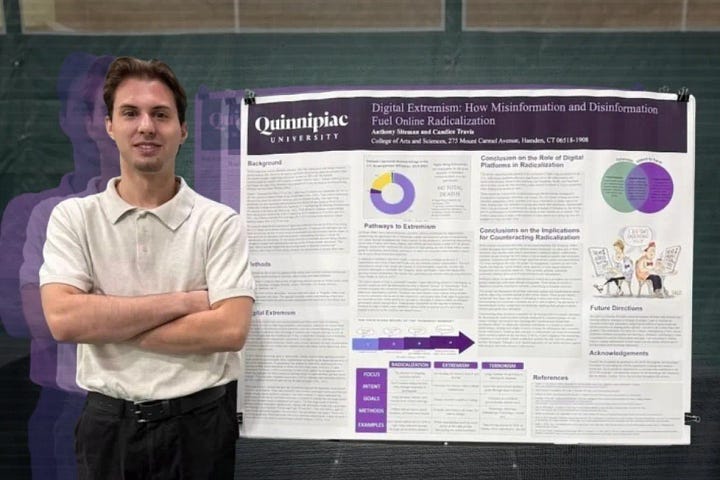
Anthony Siteman (Photo courtesy of Siteman, design by Sam Donndelinger)
This phenomenon of young men getting drawn in by alt-right algorithms fascinated 21-year-old Anthony Siteman, who started investigating online extremism ahead of the 2024 presidential election.
“My main goal was to understand how and why people became radicalized,” Siteman, a senior at Quinnipiac University, told Uncloseted Media.
Siteman immersed himself on right-wing sites like Rumble and Gab as well as encrypted messaging apps like Telegram where he joined channels that included Proud Boys. He noticed trends that draw people in: all caps text, red alarm emojis and inflammatory language, which all trigger a sense of urgency and concern.
He saw constant racist, sexist and transphobic language, but also violent videos and memes created from the livestreamed footage of the 2019 mosque shootings in New Zealand that left 51 people dead.
Even though he entered this project to learn about indoctrination, sometimes he felt his own views slipping. “ I was really questioning myself and what I believed,” he says, adding that he had to turn to his professor to keep him grounded. “They make you really question all of reality.”
“Social media companies are feeding people more extreme content, more emotional content,” Vandello says. He explained that emotionality is what has made the online alt-right successful at manipulating users against transgender people.
Siteman agrees: “ It’s always framed about fear, anger, and just some sense of belonging.”
The Way Out
Siteman believes that to exit these spaces, people outside the alt-right should use empathetic communication to help those in their network who have been radicalized.
For Brown-Ramsey, it was a professor that pulled him out.
“Unlike online spaces, where I curated the information that I wanted to see, and the algorithm fed me more of the same bigoted, hateful content, college was perhaps the first time I was required to engage with media outside of my usual diet,” Brown-Ramsey published in an essay about his experience.
Brown-Ramsey had to read books aloud in class like “Narrative of the Life of Frederick Douglass,” which detailed the abolitionist’s experience being born into slavery. “The narrative turned a mirror onto me and, in upsetting detail, showed me that my inclinations toward antagonizing those who looked, acted, or believed differently than myself [were the same beliefs that] led to Douglass’ dehumanization,” he wrote.
“That trajectory is really just me learning, ‘Why should I be at odds with a trans person if both of us work crappy jobs and can’t pay our bills?’ Obviously, that’s not who I should be angry at, but it took a while to get around to that,” Brown-Ramsey says.
If objective, nonpartisan, rigorous, LGBTQ-focused journalism is important to you, please consider making a tax-deductible donation through our fiscal sponsor, Resource Impact, by clicking this button:
Discover the cosmos! Each day a different image or photograph of our fascinating universe is featured, along with a brief explanation written by a professional astronomer.
2026 January 7 Simeis 147: The Spaghetti Nebula Supernova Remnant Image Credit & Copyright: Saverio Ferretti
Explanation: Its popular nickname is the Spaghetti Nebula. Officially cataloged as Simeis 147 and Sharpless 2-240, it is easy to get lost following the looping and twisting filaments of this intricate supernova remnant. Seen toward the boundary of the constellations of the Bull (Taurus) and the Charioteer (Auriga), the impressive gas structure covers nearly 3 degrees on the sky, equivalent to 6 full moons. That’s about 150 light-years at the stellar debris cloud’s estimated distance of 3,000 light-years. The supernova remnant has an estimated age of about 40,000 years, meaning light from this powerful stellar explosion first reached the Earth when woolly mammoths roamed free. Besides the expanding remnant, this cosmic catastrophe left behind a pulsar, a fast-spinning neutron star that is the remnant of the original star’s core. The featured image was captured last month from Forca Canapine, Italy.
Portal Universe: Random APOD Generator Tomorrow’s picture: hidden galaxy in the giraffe
Tiny, nimble, and sporting a bold black mask and “bib” under its bill, the Golden-winged Warbler might be mistaken for a Black-capped Chickadee at first glance. But it’s the long, thin bill and the splashes of vivid golden-yellow on its crown and wings that distinguish this long-distance migratory warbler.
Though they are denizens of shrubby, early successional habitats (areas that are in the early stages of regenerating following a disturbance, such as a fire or a clearcut) in the nesting season, Golden-winged Warblers and their recently fledged young relocate to nearby mature forests that provide adequate cover for fledglings from predators. The loss of quality brushy, young forest habitat across much of its breeding range has contributed to sharp declines in an already uncommon warbler.
Another threat comes from a close relative, the Blue-winged Warbler, which shares more than 99 percent of its genetic material with the Golden-winged Warbler. The two species regularly hybridize, and the once-uncommon Blue-winged Warbler has surged northward into the Golden-winged’s range. The Golden-winged Warbler has become much scarcer and is at risk of being genetically “swamped” by its more numerous and widespread relative where their ranges meet.
To gain a foothold and begin to recover from the loss of more than 60 percent of its population, the Golden-winged Warbler needs active habitat conservation throughout its annual life cycle, from the shrubby, early successional habitats where it nests to the open forests of Latin America and the Caribbean, where it spends its nonbreeding season.
Threats
Birds around the world are facing threats, and many species are declining. The Golden-winged Warbler has experienced a drop in its population of more than 60 percent, including a loss of nearly all of its population in the Appalachians. In addition to competition and hybridization with the Blue-winged Warbler, the Golden-winged Warbler faces challenges throughout its full annual cycle from habitat loss and degradation, and collisions. (snip-More on the page, including the songs)
Why I do these posts. This is three days of Joe My God that got away way from me. So why do I do these long news posts? Because I comb the Joe My God comment section for the best memes and snarkiest comments. It dawned on me I could post his news articles for those that want to read them. But three days is a lot to go throw and it is much easier just to quickly scan and snatch the comments rather than post them. So I need some inputs from everyone. Are these posts worth it? Or would you rather go to Joe My God yourselves. Or I can keep doing these. Up to you. Hugs
—————————————————————————————————————————-
tRumps Grifts / Scams / Ripping off the rubes / tRump’s ego / tRump’s Crimes / tRump’s health / Republican grifts & payouts for supporting tRump / other trump scammers
The Trump Golf Tracker estimates that the president’s golf trips have cost taxpayers some $110,600,000 so far in 2025. But that estimate, which was based on a 2019 Government Accountability Office (GAO) report on four golf trips during his first term, doesn’t even take into account the month of December.
The right wing media / the media arms of the GOP & Republican Party / The over the top thuggery and complete disrespect for common decency / Ask if you would like your child to act this way …. because maga does want their kids to be this crass as it makes them feel good / Kennedy Center debacle
The video was shared by Vice President JD Vance. FBI director Kash Patel said he is aware of the video and the FBI is investigating. The YouTuber says he is uncovering new fraud in Minnesota, but media outlets like KSTP reported more than a year ago about more than 62 investigations into Minnesota child care centers.
What this is really about is they are afraid Walz will run for office and win as he is so well liked. They are trying to gin up a fake scandal to Benghazi him like they did with Hillary Clinton. I posted yesterday how fake and full of lies / misinformation the “report” the YouTuber did was. In the article above this one you can see how the Republican Party had a hand in helping the right wing influencer to push a fake story. The state has been investigating these things for several years. Hugs
$175 billion for a “golden dome” that experts doubt would actually work, but only $2 billion in humanitarian aid for the United Nations. It’s what Jesus would want.
Space based weapons are forbidden by treaties that the US signed. That said do we have space based weapons … well I was sending commands somewhere for something when I was in the Army Sat coms / intel unit. You decide. Hugs
Maga hate fail / tRump lost in court / tRump supporters doing what they do not want you to know about / ICE lies / tRump’s DOJ / Misinformation / Trying to change history by spewing & omitting facts or what really happened
The emails, which were made public as part of a newly unsealed judicial order, largely reflected communications about the case that Robert E. McGuire, the acting U.S. attorney in Nashville, had with members of his staff and with Aakash Singh, a top official in Mr. Blanche’s office. They raised serious questions about whether the Justice Department had misled Judge Waverly D. Crenshaw Jr., who is overseeing the case, by telling him that local prosecutors had acted alone in charging Mr. Abrego Garcia.
Hate / Bigotry / DEI / White Supremacy / Christian Nationalism / US aid to only white countries or white dominated areas / US Healthcare / For Profit drug prices rip off the US public /
The civil probes are proceeding under the umbrella of the False Claims Act, which has traditionally been used to go after contractors who bill the government for work that was never performed or inflate the cost of services rendered.
The U.S. slashed its aid spending this year, and leading Western donors such as Germany also pared back assistance as they pivoted to increased defense spending, triggering a severe funding crunch for the United Nations.
U.N. data shows total U.S. humanitarian contributions to the U.N. fell to about $3.38 billion in 2025, equating to about 14.8% of the global sum. This was down sharply from $14.1 billion the prior year, and a peak of $17.2 billion in 2022.
The idea behind the legislation originated with the Alliance Defending Freedom, a conservative Christian legal advocacy group that has gained prominence for its work to incorporate religion in public spaces.
West last appeared here for his bill that would create a database of abortion patients.
In 2024, we heard from West for his bill to ban Pride flags at public schools and government buildings.
He appeared here in 2023 for his bill that would make it a felony to perform drag in the view of minors. His bill called for a $20,000 fine and up to two years in prison.
West first appeared here in 2021 when Gov. Kevin Stitt signed his bill making it legal to run over protesters.
The tweet below refers to West’s attempt to pass this same bill earlier this year.
tRump’s attack on Colorado because they won’t bow to the whim of the tyrant. His withholding money is illegal but no republican will stand up to the demented king.
Claims about economy, war in Ukraine, measles were among the top falsehoods of past year
President Donald Trump listens during a ceremony for the presentation of the Mexican Border Defense Medal in the White House on Dec. 15, 2025. (Anna Moneymaker/Getty Images)
ANALYSIS —Since he entered politics, President Donald Trump has been a regular on our end-of-year list of the most egregious and noteworthy falsehoods and distortions. With Trump back in the White House in 2025, it’s no surprise that he dominates this year’s whoppers.
Trump is known for rhetoric that uses inaccurate and exaggerated claims, which he repeats again and again. In his second term, several such claims were used to justify a whirlwind of policy changes and announcements. Using a method economists said wasn’t legitimate, he calculated “reciprocal tariffs” for goods imported from other countries. In firing the head of the Bureau of Labor Statistics, he claimed without evidence that low job growth figures were “phony” or “rigged.” In supporting a freeze on foreign aid, Trump said $50 million was being used to buy condoms for Hamas in Gaza, a claim refuted by the contractor identified by the State Department.
In a falsehood-filled press conference, Trump, along with Health and Human Services Secretary Robert F. Kennedy Jr., touted an unproven link between autism and taking Tylenol during pregnancy. Kennedy, long known for spreading inaccurate information about vaccines, also features prominently in this year’s compilation. In his efforts to change the nation’s vaccine and public health recommendations, he pushed unproven therapeutics for treating measles and made false claims about the COVID-19 vaccines.
There are other politicians on our full list below, which is in no particular order.
Analysis
Tylenol and autism. Trump said a late September press conference would reveal “one of the biggest [medical] announcements … in the history of our country,” but instead the headline news was an unproven link between autism and the use of Tylenol, or acetaminophen, during pregnancy. Trump repeatedly told pregnant women, “don’t take Tylenol,” and offered the unsound medical advice to “tough it out.”
The administration didn’t point to any new original research on the topic, which has been studied. Some studies have shown an association between using acetaminophen during pregnancy and an increased likelihood of having a child with autism, but no causal link has been established. Recent research indicates there likely isn’t a link.As for Trump’s medical advice, untreated pain or fever during pregnancy can be harmful to both mother and child, and medical groups have long recommended pru45reeeeeeeeeeeeeeeeeeeeeeeeeeeeeeeeeeeeeeeeeeeeeeeeeeeeeeeeeeeeeeeeeeeeeeeeeeeedent use of the drug — taking acetaminophen when needed in consultation with a doctor.
HHS Secretary Kennedy later falsely claimed that two circumcision-related studies provided evidence that acetaminophen causes autism when given to children. That’s not what the studies found. In November, the Centers for Disease Control and Prevention changed a webpage to say that its previous statement that “vaccines do not cause autism” is “not an evidence-based claim,” echoing Kennedy’s prior misrepresentations of science.
Inflation has not “stopped.” As cost-of-living issues continue to be a top concern for voters, Trump has repeatedly claimed that inflation is “stopped,” “dead” or at a lower rate than it actually is, falsely saying the country saw “the worst inflation” in history (or “probably” did so) under former President Joe Biden. That’s not the case. This month, in a speech about the economy in Pennsylvania, Trump wrongly said he “inherited the worst inflation in the history of our country.”
The annualized inflation rate was 3 percent when Trump took office in January, and it was 3 percent again for the 12 months ending in September, the latest data available from the Bureau of Labor Statistics. Inflation did rise considerably in the first half of Biden’s term, but it then cooled substantially. From July to December 2024, the annual increase in the Consumer Price Index was below 3 percent.
The CPI went up 2.7 percent for the 12 months ending in November, BLS said today, noting that data collection for the month began Nov. 14 due to the government shutdown.
The worst inflation increase year-to-year occurred after World War I, a 23.7 percentrise from June 1919 to June 1920. There have been numerous other times with inflation higher than the peak point under Biden.
As we head into the midterms, we’d caution voters that politicians often blame their opponents for rising prices, but the causes of inflation are usually more complicated than that. For instance, Labor Day claims from the Democratic Congressional Campaign Committee blamed House Republicans for “driving up the price of burgers.” But drought conditions in recent years, among other factors, drove up the cost of ground beef.
Russia, not Ukraine, started the war. After U.S. and Russian officials met in Saudi Arabia in February to discuss an end to Russia’s war in Ukraine, Trump falsely reprimanded Ukraine, saying, “You should have never started it.” He said Ukraine “could have made a deal.” As we wrote, the war started on Feb. 24, 2022, when Russia launched a full-scale invasion, two days after Russia recognized two separatist territories in eastern Ukraine as independent states and sent Russian troops into Ukraine’s Donbas region. While Russian President Vladimir Putin gave “a long list of grievances” to justify the attack, Jeffrey Mankoff, a senior associate with the Europe, Russia, and Eurasia Program at the Center for Strategic and International Studies, wrote in an April 2022 report that the “fundamental issue” was “the legitimacy of Ukrainian identity and statehood.”
Throughout the year, Trump also repeatedly and wrongly claimed that the U.S. has provided more money in aid to Ukraine than Europe has. The opposite is true.
“Twisted and manipulated” report that wasn’t.When the Washington Post reported via anonymous sources that a government intelligence assessment concluded the Venezuelan government was not directing the migration of members of the Tren de Aragua gang to the U.S., Tulsi Gabbard, the director of national intelligence, dismissed the report.She said those “behind this illegal leak of classified intelligence” had “twisted and manipulated [the information] to convey the exact opposite finding.” But when a redacted copy of the intelligence memo was publicly released the following month, it corroborated the Washington Post’s account. According to the intelligence memo, Venezuelan President Nicolás Maduro’s “regime probably does not have a policy of cooperating with TDA and is not directing TDA movement to and operations in the United States.”
A few months later, Gabbard wrongly claimed to have uncovered “overwhelming evidence” that former President Barack Obama and others in his administration manipulated intelligence to “lay the groundwork for what was essentially a years-long coup against President Trump.”
RFK Jr.’s dubious measles therapeutics. In March, during a measles outbreak in Texas, Kennedy claimed there were “very good results” from treating patients with a certain steroid and antibiotic, as well as cod liver oil, saying “those therapeutics have really been ignored” by the CDC “for a long, long time.” Neither the steroid nor antibiotic is a specific treatment for measles, experts said, and cod liver oil, which contains vitamin A, also isn’t recommended.
Vitamin A itself is recommended around the world for measles, as a couple high-dose bursts of the vitamin have been shown to reduce measles mortality in lower-income countries where deficiencies exist. But the benefit is unclear in the U.S. and countries without such deficiencies. Cod liver oil would need to be consumed in a potentially dangerous amount to get the vitamin A dosage used for measles.
In other comments, Kennedy downplayedthe outbreak, which ultimately killed two children, and made unsupported and misleading claims about the measles vaccine, which is safe and effective in preventing the highly contagious disease.
No evidence of “phony” Bureau of Labor Statistics numbers. After a BLS report showed less-than-stellar job growth, Trump lashed out at the BLS commissioner, saying “her numbers were wrong,” “phony” and “rigged,” and firing her. There’s no evidence anyone manipulated the data.William Beach, the BLS commissioner during Trump’s first term, wrote on X that the firing of Commissioner Erika McEntarfer, a Biden appointee who had worked in the federal government for more than 20 years, was “totally groundless” and “sets a dangerous precedent and undermines the statistical mission of the Bureau.”
Trump also wrongly claimed that “days before the election,” McEntarfer “came out with these beautiful numbers trying to get somebody else elected” and then reduced the employment estimates “right after the election.” That’s not what happened. On Nov. 1, 2024, just before the election, the BLS report showed growth of just 12,000 jobs in October and downward revisions for the prior two months.
Signalgate: Not “total exoneration.” Defense Secretary Pete Hegseth claimed that he received “total exoneration” in an investigative report by the Defense Department’s Office of Inspector General regarding a Signal group chat about a military attack in Yemen. But the report contradicted that assessment, concluding that Hegseth’s messages “created a risk to operational security that could have resulted in failed U.S. mission objectives and potential harm to U.S. pilots.” The report also faulted Hegseth for using a personal cell phone to relay sensitive DoD information and for not retaining the Signal conversations as official records, as required by federal law and Pentagon policy.
Trump’s chart on “reciprocal” tariffs. In a Rose Garden announcement in April of sweeping new “reciprocal tariffs,” Trump held aloft a chart that claimed to give a breakdown of the tariffs other countries charge the U.S. and the corresponding tariff that the U.S. would as a result impose against those countries. But it turned out the values assigned to other countries were not, in fact, the tariff rates other countries were placing on imports of U.S. goods, but rather a calculation of what the administration deemed would be necessary to balance trade with various countries. Economists told us that was not a legitimate way to calculate reciprocal tariffs for countries.
The misleading “reciprocal tariffs” chart, which informed the tariff rates he then set, was just one of the president’s false and misleading talking points on tariffs. Among them, Trump repeatedly, and wrongly, claimed that the tariffs he imposed would be paid by other countries and not, at least partly, by American consumers in the form of higher prices.
mRNA vaccine misinformation. Kennedy, and HHS, made a series of false statements about mRNA vaccines, the technology behind the Pfizer/BioNTech and Moderna COVID-19 vaccines. In announcing the termination of half a billion dollars of funding for mRNA vaccine projects, Kennedy said: “We reviewed the science, listened to the experts, and acted,” claiming that “the data show these vaccines fail to protect effectively against upper respiratory infections like COVID and flu.”
The science — peer-reviewed scientific literature — and many experts refute that. Studies repeatedly demonstrated the vaccines’ effectiveness and safety, with some estimates of millions of lives saved during the pandemic, and the technology has shown encouraging results against the flu. HHS later released a 181-page list of papers that claimed to show vaccine harms, a document that wasn’t peer-reviewed and was written by people who have spread unsupported claims about COVID-19 vaccination and treatment.
Kennedy also claimed the COVID-19 vaccines posed a “profound risk” to children, even though serious side effects are rare. In ending funding to Moderna for developing mRNA vaccines against influenza viruses, HHS spokespeople wrongly said the mRNA technology is “under-tested.”
DOGE distortions, $50 million not for condoms for Gaza. Before taking office, Trump said entrepreneur Elon Musk would head his new Department of Government Efficiency. Musk had initially promised to cut “at least $2 trillion” in wasteful government spending. Foreign aid was one of the first targets, with Trump setting the tone for questionable information that would plague the program by claiming, “We identified and stopped $50 million being sent to Gaza to buy condoms for Hamas.” The contractor identified by the State Department said it provides hospital services in Gaza and has not used U.S. funds “to procure or distribute condoms.”
In his address to Congress in March, Trump made the inflated claim that DOGE had “found hundreds of billions of dollars of fraud.” However, the DOGE website at the time stated that the department had only generated $105 billion in savings and only purported to provide evidence to support $19.8 billion of that total. (The website currently claims DOGE created $214 billion in savings, providing information on about $61 billion. It’s unclear how much, if any, of that is related to fraud.)
Trump also claimed DOGE had identified millions of dead individuals who were incorrectly labeled as alive in the Social Security database, and misleadingly claimed that “money is being paid to many of them.” Social Security Administration internal audits showed that the number of dead recipients still being sent benefits is likely in the thousands, not the millions.
Crime claims behind National Guard deployments. In making claims about high crime or lawlessness in cities as justification for the deployment of National Guard troops, Trump at times exaggerated or got the facts wrong. In early October, he claimed that Portland, Oregon, “is burning to the ground” or has “fires all over the place.” But Portland Fire & Rescue reported few calls about potential fires near a federal building, the site of protests against Immigration and Customs Enforcement, and Portland Police told us the protests “are nowhere near city-wide.”
Trump’s statements about the need for National Guard troops in Portland and Chicago focused on overall crime. “These are unsafe places,” he said. But in court filings and other correspondence, the administration said troops were needed to protect ICE officials and federal property.
In Washington, D.C., where the president is the commander in chief of the National Guard, Trump wrongly said that “murders in 2023 reached the highest rate probably ever.” Murders had been declining since 2023, when the rate was less than half the rate in 1991. After a federal takeover of the city’s law enforcement, Trump falsely said an 11-day period with no murders was the “first time that’s taken place in years.” There was a 16-day period earlier this year.
Considered sacred by several Mesoamerican civilizations, the Resplendent Quetzal remains culturally significant to this day. The Resplendent Quetzal likely inspired Quetzalcoatl, the “plumed serpent” god of Mesoamerica. Legend has it that Quetzalcoatl helped create Earth. Rulers and nobility wore headdresses made from this quetzal’s shining green feathers, which symbolically connected them to the god.
In some Mesoamerican cultures, it was considered a crime to kill a quetzal, so the plumes were procured by capturing the bird, plucking its long tail feathers, and setting it free. In several Mesoamerican languages, the term for quetzal can also mean “precious” or “sacred.”
These iridescent green tail feathers also symbolized spring plant growth to the Aztecs and Maya, who viewed the quetzal as the “god of the air” and as a symbol of goodness and light. The Maya also viewed the quetzal as a symbol of freedom (due to the difficulty of keeping them in captivity) and wealth and status, as its feathers were used as money. Even today, the currency of Guatemala is called the quetzal.
The Resplendent Quetzal is also the national bird of Guatemala, pictured on the country’s flag and coat of arms. It was thought to be the spirit guide of a Maya ruler and hero, Tecún Umán, who fought against the Spanish conquest. According to legend, Tecún Umán was killed as he fought the conquistador Pedro de Alvarado. As Tecún Umán lay dying, a quetzal flew down and landed on his chest, dipping its feathers in the hero’s blood. This is supposedly how the bird acquired its red breast and belly feathers.
This spectacular species belongs to the trogon family, a group of colorful, fruit-eating birds found in the Americas, Asia, and Africa. Other family members found in the Americas include the Golden-headed Quetzal, the Elegant Trogon, and Haiti’s national bird, the Hispaniolan Trogon.
Threats
Birds around the world are declining, and many of them, like the Resplendent Quetzal, are facing ever-increasing threats. Partners in Flight includes the Resplendent Quetzal on its Red Watch List as a species of high conservation concern, and also classifies it as a “Tipping Point” species — one that has lost more than 50 percent of its population within the past 50 years. (snip-so much more!)
This is not true. The construction industry has crashed in Florida. No workers so nothing being built. Half crews means nothing built. The work is far to hard for most people. Hugs
In his first year back in office, Mr. Trump has unabashedly adopted the trappings of royalty just as he has asserted virtually unbridled power to transform American government and society to his liking. In both pageantry and policy, Mr. Trump has established a new, more audacious version of the imperial presidency that goes far beyond even the one associated with Richard M. Nixon, for whom the term was popularized half a century ago.
Trump is expected to announce plans to build a new, large warship that Trump is calling a “battleship” and is part of his larger vision to create a “Golden Fleet” that includes as many as 50 support ships, according to people familiar with the matter who were not authorized comment publicly.
Bigotry / Hate / Racism / DEI Misinformation / White Supremacy











 Scottie's Playtime

