
Category: Technology
Protesters Are Trump’s Next Target
Arting (Or Not!) With Jenny Lawson
Posting especially because of the final photo, with which many of us can identify … 🤭
Unfinished business
Jenny Lawson (thebloggess) Feb 16, 2026
Hello, friend!
Okay, confession time.
Last week I recorded the audiobook for How To Be Okay When Nothing Is Okay and then I collapsed in a limp pile of exhaustion, which is embarrassing because why is “just talking” for two days so hard? Regardless, I spent several nights that I would have normally been drawing while watching 90-Day-Fiance (don’t judge me) instead just hiding under the covers and recovering from being human in public for too long. And that’s why this week’s doodle is unfinished:

But the good news is that because it’s unfinished you can print it out and color it or draw on it and then you can share your version in the comments if you want. EVERYONE WINS.
Here’s a fun tip: I sometimes use the recolor app to upload my drawings and color them:

(PS. I’m not getting paid to plug them. It’s just a free app I stumbled on.)
So anyway…this is just to remind you that it’s okay to not hit every deadline (or any deadline) because you are so much more than your output. And so am I.
Thank goodness.
Hugs,
me

PS. As tax for not having a finished drawing, please accept this picture of a very sleepy Dorothy Barker intentionally laying on my art so that I will pet her instead of drawing.
Everyone’s a critic.
It happened again…
The video played shows how ICE gang thugs narrated a scenario they hoped the courts would believe, but the videos show they rammed the woman, shot her in 2 seconds with no warnings or words, just rammed her car and then shot her five times. The video shows they lied about being boxed in as no one was in front of them. The wanted a legal kill because they were pissed at the people honking their horns at them, with the driver saying it is time to get aggressive. ICE are gang thugs with anger issues who think they have the right to do to people what ever they want. So another couple cases taken to court where they claimed domestic terrorists attacked ICE only to have them dismissed because of the ICE thugs and their bosses lies. But the victims are still stuck with hospital bills, lawyers bills, and car repairs that ICE thugs don’t have to pay for but the victims do. Hugs
New video disputes 2 ICE agents’ account of shooting, feds open investigation
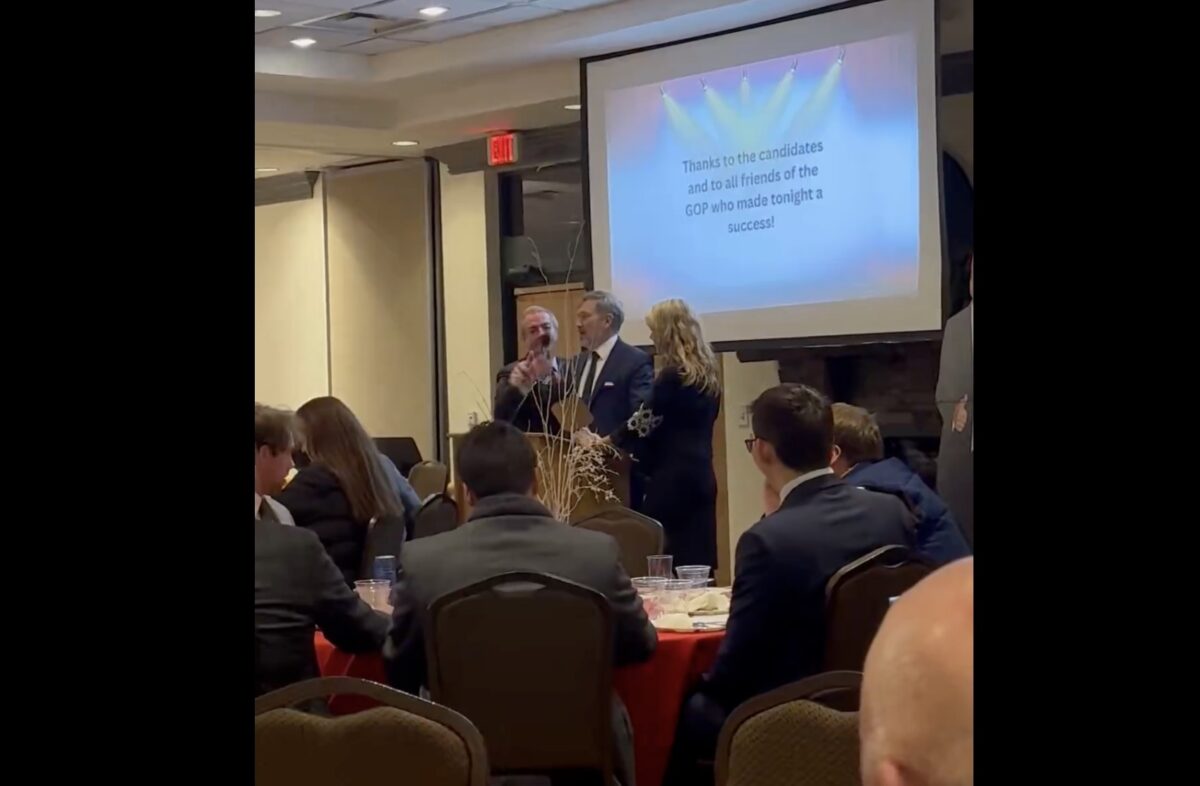
GOP Official Snatches Thomas Massie’s Mic In the Midst of Comments at Kentucky Event
As much as they wish to deny it maga republicans cannot stand an independent Republican not sucking up to tRump so they yanked his mic before he could convince the audience of the truth / reality. Hugs
GOP Official Snatches Thomas Massie’s Mic In the Midst of Comments at Kentucky Event
Feb 7th, 2026, 3:48 pm
Rep. Thomas Massie (R-KY) had a microphone snatched right out of his hand Friday night as he spoke at the Oldham County, KY, Republican Party’s Lincoln Day Dinner.
Massie was in the midst of saying, “If you are a congressman, you work not for the Speaker of the House, I work for you!” pointing to the audience, when event emcee and state House Speaker David Osborne (R) decided he’d heard enough.
Osborne grabbed the mic away as someone yelled, “Welcome to the snake pit, baby!”
Massie then walked off “in solidarity” with supporters who left the event because he’d been cut off, according to the Louisville Courier Journal.
Massie told the paper that he joined supporters for drinks at Ernesto’s Mexican Cuisine in La Grange.
“I said, ‘Well, if they’re going to walk out for me, I’ll walk out and meet with them,’” Massie said.
Oldham County Republican Party Chair Blaine Anderson said Massie’s mic was taken only because he had gone over his allotted time limit.
In a text message to the paper, Anderson said Massie and his primary opponent Ed Gallrein were given “explicit instructions that they had five minutes to speak.”
After Massie was given an extra minute “as a courtesy,” Anderson said Osborne took away the mic.
“This had nothing to do with what was being said by the Congressman,” Anderson wrote. “It was about speaking time expiring.”
Massie called Anderson a “great guy” and said he didn’t blame the chairman for the mic incident. “But he’s swimming upstream,” Massie added. “There’s some Massie Derangement Syndrome in Oldham County among the establishment.”
President Donald Trump threw his support behind Gallrein after a series of rogue moves Massie made against House Republicans. Massie has stood firm in his call for a full release of the Epstein files, condemned U.S. involvement in Iran, and denounced Trump’s “One Big Beautiful Bill” that became law last summer.
Earlier Friday, Trump called Massie a “moron” while remarking at the National Prayer Breakfast in Washington, D.C.
“There’s something wrong with him,” Trump said of Massie who continues to challenge the president on the release of the Epstein files. “We call him Rand Paul Jr. They just vote no. They love voting no. They think it’s good politically.”
DHS is using administrative subpoenas to retaliate against dissenters
The power of te federal government to make people’s lives miserable. This is an important story on how the tRump faist goveernment is using all the levers of power to keep people from speaking up. Imagine the expense of needing to get a lawyer to fight the US government. Hugs
Body Cams Won’t Protect Us
Notice that she mentions that Schumer caved on the one demand the democrats were fighting for during the government shutdown, while the public supported us. He got a promise for a worthless vote in the senate but not the House. A vote he knew would fail. Why cave, because the filibuster was on the line and both parties are desperate to keep that to prevent the status quo of supporting the donor class from changing. She is talking about body cam footage which the democrats are demanding, but 90+% of the time they were not used against the officer but the victim. The officers who killed Pretti had body cams but that footage has not been released. Hugs
Resistance Is Everywhere
Berkeley Students Make 300,000 Wikipedia Edits to Preserve Queer History Against Trump
Their work has already racked up nearly 100 million views.
By Abby Monteil January 27, 2026
Amid the Trump administration’s ongoing attempts to erase queer and trans history, a University of California Berkeley professor’s students are working to right these wrongs — through Wikipedia edits.
Over the past decade, students in ethnic studies, gender and women’s studies, and performance studies professor María Rodríguez’s courses have edited and even created Wikipedia articles about LGBTQ+ history, with an emphasis on queer and trans people of color. The assignment currently replaces a final paper in three of her classes: “Documenting Marginal Lives,” “Queer of Color Cultural Production,” and “Queer of Color Critique.”
Rodríguez’s Wikipedia assignments take place in partnership with Wiki Education, a nonprofit that works with university professors in the United States and Canada. The professors’ students add content to course-related Wikipedia articles, which, according to the organization’s website, helps them gain skills like “media literacy, writing and research development, and critical thinking,” while simultaneously filling Wikipedia “content gaps.”
“Wikipedia is a public-facing project — it’s the largest encyclopedia in the world,” Rodríguez told UC Berkeley News in a December interview. “In a political moment where these histories are actively being erased from public view, having students work on a platform like Wikipedia becomes even more important.”
According to The Daily Californian, as of January 26, Rodríguez’s students have contributed over 300,000 edits and 3,000 citations to Wikipedia. At the time of writing, their work has garnered a whopping 96 million-plus views. Her students’ topics run the gamut, touching upon local history like the resonance of queer life in San Francisco’s Chinatown, as well as more international focus areas (for instance: worldwide sex worker movements).
As Rodríguez explained to UC Berkeley News, her students’ edits often help address the disparities between the amount of Wikipedia information about white, Anglo LGBTQ+ populations versus LGBTQ+ populations of color.
“It becomes particularly important to document these subcultures within these communities,” she said. “Because it’s not just queer Latinas — it’s queer goth Latinas, it’s queer comics of color, it’s African American slaying, right? It’s very specific topics that might really vary by region, by historical moment, and of course at different places around the world. Those topics, in Wikipedia and in real life, remain really under-studied and really under-researched.”
These contributions carry a newfound weight during the second Trump administration, in which officials have repeatedly attempted to erase references to queer and trans history. In February 2025, National Park Service websites removed the word “transgender” from multiple pages for historical programs and monuments, as well as references to trans figures such as Marsha P. Johnson. Meanwhile, in June, an unnamed Defense Department official told Military.com that Trump timed an order to remove LGBTQ+ icon Harvey Milk’s name from a military ship to coincide with Pride Month.
“Right now, the Trump administration is trying to erase the very existence of transgender people, so having information about those histories, as well as present challenges facing queer and trans communities, is particularly urgent,” Rodríguez told The Daily Californian via email. “Queer and trans people have always been here, and adding that information to the world’s largest open access encyclopedia is one way to make sure that these stories remain available.”
https://www.them.us/story/berkeley-college-students-wikipedia-lgbtq-history-edits
 Scottie's Playtime