This was the first report I watched on this. This one is longer because he tells the whole story and shows clips he took on his phone at the time. The mob was going to kill him after the IDF set the group up to be murdered at the hands of illegal settlers. The military told them to go to the spot where the settlers were hiding. Please watch to see the very illegal and horrific ways Israeli is treat people to simply drive them off of and steal their lands. Hugs
US Embassy ABANDONS Journo After Israeli Mob Attack
A 55-year-old Palestinian woman, Umm Saleh Abu Alia, was hospitalized after being brutally attacked by a masked Israeli settler in Turmus Ayya, West Bank. Captured on video by US journalist Jasper Nathaniel, the unprovoked assault shows the woman struck unconscious and hit again on the ground. Settlers continue to harass Palestinian farmers during the olive harvest, while the Israel Defense Forces claim to have intervened. This horrifying incident highlights escalating tensions and ongoing violence in the occupied West Bank.
Israeli settlers burn trees, assault Palestinians in occupied West Bank olive harvest attacks
In the occupied West Bank, armed Israeli settlers systematically attack Palestinian olive harvesters and farmers, burning trees and beating farmers. These assaults, often protected by Israeli forces, have caused severe injuries. Palestinians, joined by international activists, continue harvesting to avoid surrendering their land, despite the violence and threats aimed at driving them away. For them, this is a fight for their very livelihood and homeland.
Israel’s Next Move: Create ‘Six Little Gazas’ In West Bank | Jasper Nathaniel | TMR
October 23, 1915 33,000 women marched in New York City demanding the right to vote. Known as the “banner parade” because of the multitude of flags and banners carried, it began at 2 o’clock in the afternoon and continued until long after dark, attracting a record-breaking crowd of spectators. Motor cars brought up the rear decorated with Chinese lanterns; once darkness fell, Fifth Avenue was a mass of moving colored lights. The history of women’s suffrage in the U.S.
October 23, 1945 Jackie Robinson and pitcher John Wright were signed by Branch Rickey, president of the Brooklyn Dodgers Baseball Club, to play on a Dodger farm team, the Montreal Royals of the International League.Robinson became the first black baseball player to play on a major league team. Jackie Robinson
October 23, 1947 The NAACP filed formal charges with the United Nations accusing the United States of racial discrimination. “An Appeal to the World,” edited by W.E.B. DuBois, was a factual study of the denial of the right to vote, and grievances against educational discrimination and lack of other social rights. This appeal spurred President Truman to create a civil rights commission.
October 23, 1956 The Hungarian revolution began with tens of thousands of people taking to the streets to demand an end to Soviet rule. More than 250,000 people, including students, workers, and soldiers, demonstrated in Budapest in support of the insurrection in Poland, demanding reforms in Hungary. Hungarian students,1956 Hungarian revolution monument The day before, the students had produced a list of sixteen demands, including the removal of Soviet troops, the organization of multi-party democratic elections, and the restoration of freedom of speech. On the evening of the 23rd a large crowd pulled down the statue of Josef Stalin in Felvonulási Square. Hungary 1956 and the Political Revolution More
October 23, 1984 The Fact-Finding Board looking into the assassination of Filipino democratic leader Benigno Aquino confirmed that his death was the result of a military conspiracy, and indicted Chief-of-Staff General Fabian Ver, the first cousin of dictator Ferdinand Marcos. Marcos had blamed the chair of the Communist Party for the assassination, despite the fact that Aquino had been in the custody of the Aviation Security Command and surrounded by military personnel as he disembarked from the plane returning him to the Philippines. The chair of the Board, Corazon J. Agrava, was pressured into submitting a minority report clearing General Ver. He and the 25 other military officials charged were all acquitted.
Senators, House members and even a mayor expressed outrage and demanded accountability after our investigation detailed how at least 170 citizens have been held by immigration agents this year.
Democrats in the House and Senate announced plans for a wide-ranging investigation into immigration agents’ detention of citizens after a ProPublica story found that more than 170 Americans have been held by immigration officials this year.
Minority leaders of the House Oversight and Government Reform Committee and the Senate’s Permanent Subcommittee on Investigations said the joint investigation into the detention of U.S. citizens and other allegations of misconduct by immigration agents would include a hearing in Los Angeles.
“Over 170 U.S. Citizens are being arrested. Why? Because they look like me. Because they are of Latino origin. Or because they are suspected to not be a U.S. citizen, or because they are suspected of crimes they have not committed,” Rep. Robert Garcia of California, the ranking Democrat on the House committee, said during a Monday press conference in Los Angeles with Mayor Karen Bass.
Garcia said the investigators are demanding all records and documents showing how U.S. citizens are treated by immigration officials in Los Angeles and around the country. “We want to understand what they are doing in our neighborhoods, how it is being funded,” he said.
Our investigation found that at least 50 citizens have been detained based on questions about their citizenship as of Oct. 5. They were almost all Latino. Roughly 130 others have been detained after raids or protests on allegations of assaulting officers or interfering with arrests. Many of those cases have wilted under scrutiny.
We found Americans have been dragged, tackled, beaten, tased and shot by immigration agents. At least two dozen citizens have reported being held for at least a day without access to a phone or a lawyer.
Bass and Garcia said the mistreatment of citizens has come amid the arrests of immigrants reporting for check-ins and immigration court, and the administration’s repeated blocking of congressional attempts to visit and conduct oversight in federal detention facilities like the one in Los Angeles.
“It’s important that we say today that what is happening to undocumented residents is also happening to U.S. citizens, which means this can happen to anyone, to all of us, at any period of time,” Bass said.
In one letter sent on Monday to DHS Secretary Kristi Noem, Garcia and Sen. Richard Blumenthal, D-Conn., said citizens in cities like Los Angeles have borne the brunt of the administration’s aggressive immigration enforcement.
“The impact of these arrests has not been evenly distributed across the country, and cities like Chicago, Portland, Washington, D.C., and Los Angeles have been targeted,” Garcia and Blumenthal wrote. “Troublingly, the pattern of U.S. Citizen arrests coincides with an alarming increase in racial profiling — particularly of Latinos — which has been well documented in Los Angeles.”
Asked about the concerns from elected leaders, DHS spokesperson Tricia McLaughlin rejected claims that immigration agents have been engaging in racial profiling. She said in a statement to ProPublica that a temporary ruling by the Supreme Court in September had “vindicated” the administration “whether Mayor Bass or Rep. Garcia like it or not.”
“DHS enforces federal immigration law without fear, favor, or prejudice,” McLaughlin wrote. “Claims by the media, agitators, and sanctuary politicians like Mayor Bass and Rep. Garcia that ICE is targeting U.S. citizens, making unconstitutional arrests, and ‘trampling on civil liberties’ are FALSE.”
White House Deputy Press Secretary Abigail Jackson told ProPublica in an email that “unhinged rhetoric from activists and Democrat politicians” was responsible for an increase in assaults on ICE officers.
On social media, Deputy Chief of Staff Stephen Miller derided Bass’ press conference as “abject lies.”
“Violent leftists have been arrested and charged with illegally obstructing federal law enforcement, a felony,” Miller wrote Monday night on X. “Let that sink in: open borders Democrats have incited leftists to violently attack ICE.”
Of the cases we tracked through Oct. 5, we found nearly 50 instances where charges have never been filed or the cases were dismissed. Our count found at least eight citizens have pleaded guilty, mostly to misdemeanors, including for failing to follow orders. Others are still facing charges for more serious accusations, including for allegedly ramming an agent’s car. (The driver has pleaded not guilty.)
Our account did not count citizens arrested later, after some sort of judicial process, or those detained by local law enforcement or the National Guard. That included cases of some people charged with serious crimes, like throwing rocks or tossing a flare to start a fire.
October 21, 1837 Osceola painted by George Catlin, 1838 The U.S. Army, enforcing President Andrew Jackson’s 1830 Indian Removal Act, captured Seminole Indian leader Osceola (meaning “Black Drink”) by inviting him to a peace conference and then seizing him and nineteen others, though they had come under a flag of truce. Under the law, they and the others of the “Five Tribes” (Choctaws, Chickasaws, Creeks and Cherokees) were to be moved, by force if necessary, west of the Mississippi to Indian Territory (Arkansas and Oklahoma). The Seminole had moved to Florida (then under the control of Spain) from South Carolina and Georgia as they were forced from their ancestral lands, then forced further south into the Everglades where they settled. Read more about Osceola
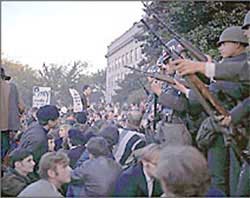
October 21, 1967 In Washington, D.C., more than 100,000 demonstrators from all over the country surrounded the reflecting pool between the Washington and Lincoln monuments in a largely peaceful protest to end the Vietnam War.It was organized by “the Mobe,” the National Mobilization Committee to End the War in Vietnam. Some then marched on, encircled and attempted to storm the Pentagon in what some considered to be civil disobedience; 682 were arrested and dozens injured. This protest was paralleled by demonstrations in Japan and Western Europe, the most violent of which occurred outside the U.S. Embassy in London where 3,000 demonstrators attempted to storm the building. at the Pentagon Read two different accounts of the day with photographs:
October 21, 1983 In the first public action of the new Seattle Nonviolent Action Group (SNAG), 12 people blockaded the Boeing Cruise Missile plant in Kent, Washington; none were arrested.
October 21, 1994 In an “Agreed Framework” to “freeze” North Korea’s nuclear program, the United States and North Korea (Democratic Peoples’ Republic of Korea or DPRK) agreed over the next 10 years to construct two new proliferation-resistant light water-moderated nuclear power reactors (LWRs) in exchange for the shutdown of all their existing nuclear facilities. The DPRK also agreed to allow 8,000 spent nuclear reactor fuel elements to be removed to a third country; to remain a party to the Nuclear Non-Proliferation Treaty (NPT); and to allow inspections by the International Atomic Energy Agency. In the deal negotiated by Ambassador at Large Robert Gallucci, the U.S. agreed to normalize economic and diplomatic relations with Pyongyang and to provide formal assurances against the threat or use of nuclear weapons by the United States. The details of the agreement and what has followed Interview with Robert Gallucci, Dean, Walsh School of Foreign Service, Georgetown U.
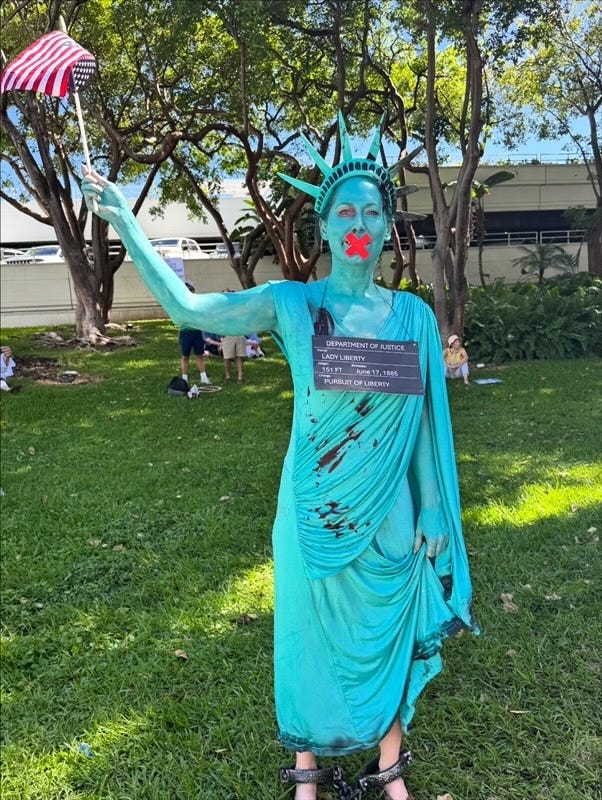
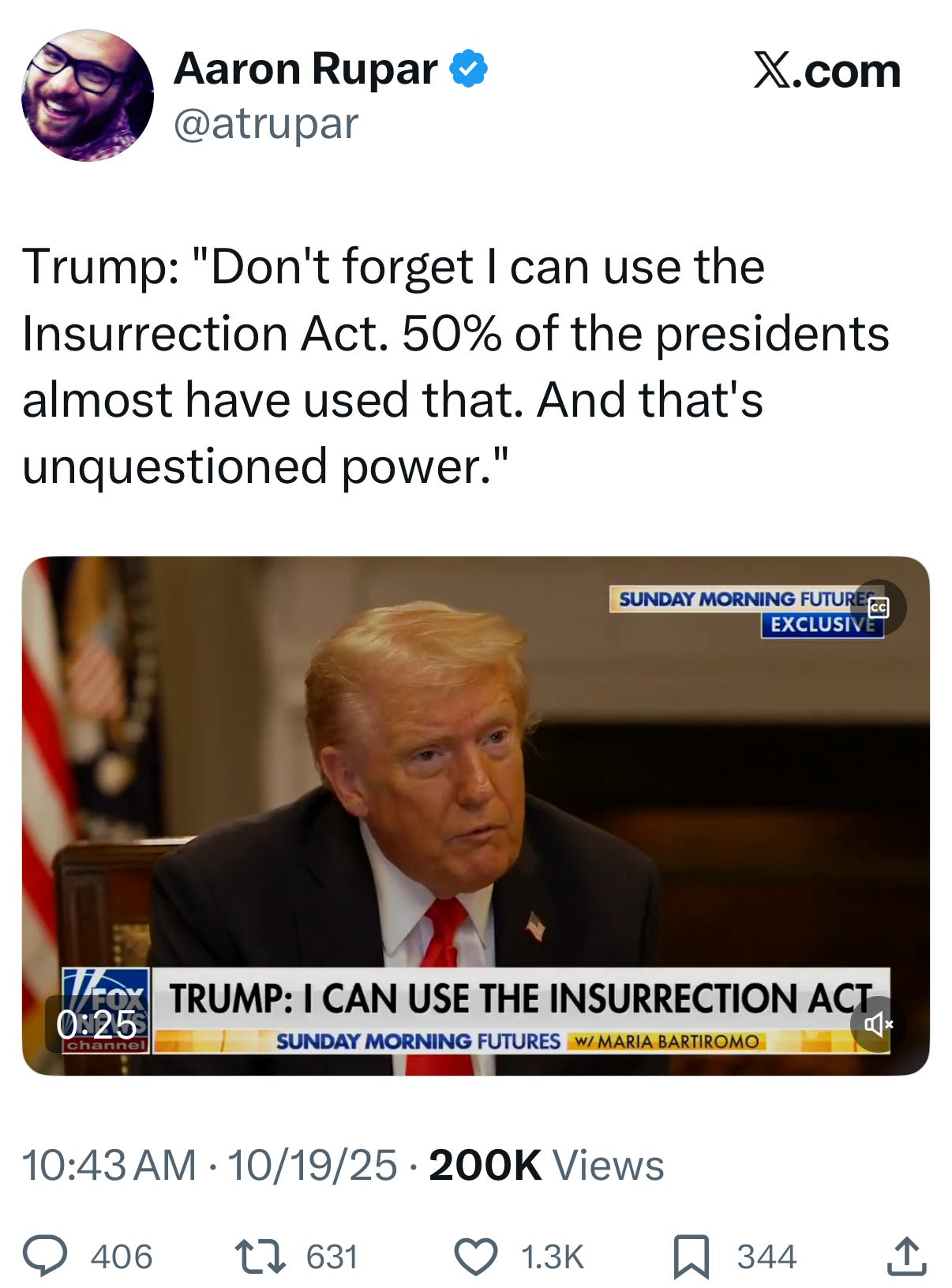
Apparently, Donald Trump felt threatened by a successful, peaceful protest and by seeing millions of us out in the streets protesting against him. Saturday night, he posted a childish, petulant video, portraying himself as the king of sh*t. Then, this morning, he resorted to a temper tantrum, insisting he would use his “absolute power” to invoke the Insurrection Act.
Of course, 50% of presidents have not invoked the Act. Wrong again.
Trump’s renewed focus on the Insurrection Act comes on the heels of a Seventh Circuit decision last week declining to permit Trump to deploy troops to Chicago. “Political opposition is not rebellion,” wrote a panel of the Seventh Circuit Court of Appeals, affirming District Judge April Perry. You can read the court’s order here. The panel consisted of appointees from the administrations of Presidents George H.W. Bush, Barack Obama, and Donald Trump.
That case is not about the Insurrection Act, however. Trump has, so far, stopped short of invoking it, instead using related authority that the administration maintains allows it to federalize National Guard troops, even over a governor’s objection.
The appellate judges in the Chicago case affirmed the portion of Judge Perry’s order that temporarily enjoined the administration from deploying the Guard within Illinois. They held that even affording Trump the substantial deference owed to a president’s decisions, Trump had failed to show he met the predicates for doing so. Under 10 U.S.C. § 12406, the administration had to establish that there was either (1) a rebellion or a danger of one or (2) that the situation on the ground made it impossible for the President to execute the laws of the United States with regular forces.
Among their justifications for that decision: “Despite President Trump’s federalization of Guard troops as necessary to enforce federal immigration law, DHS and ICE have touted the success of Operation Midway Blitz. In an October 3 press release, DHS stated that ICE and CBP have effected more than 1,000 immigration arrests since the start of the Operation. In a September 26 DHS press release, the Department declared that protests had not slowed ICE down, and, in fact, ICE has significantly increased its deportation and arrest numbers year over year.” The government contradicted its own case in its self-congratulatory press releases.
There is a technical legal point here. Because the plaintiffs had asked the court to prevent Trump both from federalizing the Guard and from deploying them, the panel looked at those two separately. To obtain an injunction, one of the elements plaintiffs have to establish is that they will be irreparably injured without it. The court held that “the administration’s likely violation of Illinois’s Tenth Amendment rights by deploying Guard troops in the state over the state’s objection ‘constitutes proof of an irreparable harm’” and enjoined their deployment. But it made a different finding when it came to Trump’s ability to federalize Guard troops, holding that it would not enjoin that action because the injury “appears to be relatively minimal.” This effectively gives the state the relief it sought, while interestingly, putting federalized state National Guard troops on the federal payroll during the shutdown, perhaps a topic for another day.
A key point we’ve been tracking in these cases reemerged in this one: Trump’s inexorable march towards obtaining more power for himself. The administration argued, as it has before, that a president’s decision to federalize National Guard troops under § 12406 cannot be reviewed by a judge. That really would make Trump a king. But the panel dismissed the argument, at least at this stage in the proceedings, rejecting the administration’s attempt to use an older case, Martin v. Mott, which we’ve discussed here and here, as going too far. That case involved an effort by militia men to override a presidential decision during a time of open war, and the panel said that did not suggest that the judicial branch of government could not review decisions by the executive branch. They concluded that nothing in the statute “makes the president the sole judge” of whether the reason for invoking it passes muster.
The Solicitor General filed an emergency appeal to the Supreme Court, which means we’ll spend at least part of the week ahead court watching.
All of that legal wrangling explains why Trump returns to threats to invoke the Insurrection Act whenever courts step in to check his authority. With the National Guard, there are clearly some limits on presidential power. Trump seems to believe none of them come into play when the Insurrection Act is involved. The first parts of the Act became law in 1792. It permits the president to deploy the military on domestic soil and use American soldiers against American citizens, making it the chief exception to the Posse Comitatus Act, which would otherwise prohibit that. There are exceptional circumstances where that sort of extreme action is necessary—the opening moments of the Civil War involved President Lincoln using it for just that purpose. But the law has been described by experts as “dangerously overbroad and ripe for abuse.”
Chief among its problems is language that could easily be interpreted as giving the president sole authority to determine when it should be invoked, without resort to the courts for constitutional review. This is why the Supreme Court’s decision about the reach of Martin v. Mott in Chicago and other cases will be so important. Whether the Court will finally take steps to curtail Trump’s attempt to consolidate all power in his own hands remains to be seen.
For the record, even Twitter AI Grok says that Trump got it wrong when it came to the number of presidents who’ve invoked the Insurrection Act: “15 U.S. presidents have invoked the Insurrection Act since its passage in 1807, including Thomas Jefferson, Abraham Lincoln, Dwight D. Eisenhower, and George H.W. Bush. It has been used about 30 times total for events like the Civil War, civil rights enforcement, and riots. That’s roughly a third of presidents, not half as claimed.” And a far better question is, how many times has it been invoked over the objection of the governor, which is a much smaller number.
The most recent use of the Act happened at the request of California’s governor, when sustained riots broke out following the April 29, 1992, acquittal of four Los Angeles police officers who were captured on videotape brutally beating Rodney King, a Black motorist. PresidentGeorge H.W. Bush deployed the National Guard and U.S. troops to restore order after both the governor and the mayor requested federal assistance to help stop the shootings, arson, looting, and other violence in the city that resulted in the deaths of more than 50 people, thousands of injuries and arrests, and property damage of more than $1 billion. That’s the sort of situation the Act is meant for. Not ones where a president trumps up baseless claims of out-of-control crime and violence to serve his own political purposes.
There is no good faith basis underlying Trump’s asserted justification for bringing in the Guard or potentially invoking the Insurrection Act. But that doesn’t matter if you’ve decided you’re a king.
So, when has the Insurrection Act been used absent a request for the governor and local officials? That happened during the Civil Rights Movement in a few extreme situations where the state was interfering with the enforcement of Supreme Court decisions. And in Alabama, George Wallace’s threatened stand in the schoolhouse door to prevent school integration faded away when President Kennedy sent in federal troops using a measure related to the Insurrection Act.
It’s important to understand that Trump is using a fictitious basis for invoking a statute designed for use in only the most serious of situations. There is no rampant crime that local law enforcement can’t handle as well without federal troops as they could with them, and certainly no rebellion. Trump has no plans to use federal forces to enforce Americans’ civil rights. Instead, it’s the same theme we’ve seen since he took office: An effort to seize more and more power and create a lopside executive branch that can rule over the rest of government—and the American people. (snip)
There is more going on this week, although that feels like enough.
The Courts. As the shutdown continues, the federal courts are preparing to run out of funding on Monday. They will maintain “limited operations necessary to perform the Judiciary’s constitutional functions” for as long as the shutdown continues. Constitutional litigation and criminal cases will continue to move forward, but staff will be furloughed and much of the courts’ civil work will slow down to a snail’s pace.
Abrego Garcia. A hearing on Abrego Garcia’s motions for selective and vindictive prosecution in the Tennessee-based criminal case the Justice Department charged him in after his return from deportation has been scheduled for November 4 and 5. In advance, we are learning some information about the evidence he plans to put on.
Abrego Garcia wants to call at least seven witnesses to testify. The government is apparently preparing to attempt to quash subpoenas for high-level officials at DHS and DOJ, and possibly someone from the White House. Abrego Garcia has also identified a series of emails between the U.S. Attorney’s Office and main Justice that he requests access to, to see if they shed any light on the decision to indict him for old crimes, which required obtaining the cooperation of a more culpable individual by promising to terminate his deportation proceedings. Abrego Garcia complains that he’s received very little information from the government in discovery because the local U.S. Attorney believes what he has requested is protected by a number of government privileges including deliberative process and attorney work product. This case, which has dropped off the radar screen in recent weeks, is about to return in a big way, setting the stage for similar motions in the Trump revenge cases as well.
Comey Motions. This case is still scheduled for trial on January 5, 2026, because the Eastern District of Virginia is the rocket docket. Comey’s first round of motions are due on Monday. The government will have two weeks to respond. It’s unclear which motions we will see, but there will likely be several to dismiss the case entirely, including ones arguing the U.S. Attorney was appointed improperly, rendering the indictment invalid, along with selective and vindictive prosecution motions.
Book tour. Also, this week I’m off on my book tour. Giving Up Is Unforgivable will officially be on sale on Tuesday. If you haven’t already, grab your copy here. If you’re in New York City, Preet Bharara and I will be at the 92nd Street Y, and they’ve moved us to a larger space, so there are more tickets available, if you weren’t able to get them earlier. I’d love to get to see you!
There may be lighter posting than usual this week and next while I’m traveling, but I’ll be here for all the important developments, and I’ll try to share pictures from the road with you too! Please make sure you say hi if you’re able to join me at one of our other tour locations.
As usual, that is omitted, then people believe it when other people say Dems do nothing. Elected Dems are doing all they can. Sen. Rand Paul is also involved, as Libertarians will be in matters of war.
Amid a wave of U.S. military strikes in the Caribbean and plans for covert operations in Venezuela, Sen. Tim Kaine, D-Va., is leading a bipartisan effort to force a vote to stop President Trump from unilaterally declaring war on the South American nation.
Kaine, a longtime proponent of Congress’ powers to declare war, filed the resolution late Thursday, a move that will force the Senate to take up the legislation after a 10-day waiting period. Sens. Adam Schiff, D-Calif., and Rand Paul, R-Ky., co-sponsored the plan.
Kaine said concerns about war in the Latin American region are growing.
“The pace of the announcements, the authorization of covert activities and the military planning makes me think there’s some chance this could be imminent,” Kaine told reporters.
Sen. Tim Kaine, D-Va., speaks to reporters outside the Senate chamber on Oct. 1. Kaine is hoping to prevent President Trump from unilaterally waging war on Venezuela without approval from Congress.Anna Moneymaker/Getty Images
This week, Trump said the U.S. had conducted another military strike on an alleged drug boat in the Caribbean and announced that he had authorized CIA operations in Venezuela. He also said he was considering land operations in the country.
“We’ve almost totally stopped it by sea. Now we’ll stop it by land,” Trump said from the Oval Office on Wednesday about alleged drug smuggling.
Last week, Kaine and Schiff forced a Senate vote to limit Trump’s war powers in the Caribbean. While that vote failed 48-51, two Republicans, Paul and Sen. Lisa Murkowski of Alaska, joined Democrats in support.
Paul has been a vocal critic of the new military strikes, saying they set a precedent for the U.S. to shoot first without asking questions.
“The American people do not want to be dragged into endless war with Venezuela without public debate or a vote,” Paul said in a statement. “We ought to defend what the Constitution demands: deliberation before war.”
Kaine, Paul and Schiff are hoping more Republican members will vote in favor of the new limits. Several Republicans have voted for other war powers and use of military force resolutions led by Kaine in the past.
“I think it’s probably 10 or so [Republicans] who voted yes on at least one of them,” he said. “So we’ll start to work that.”
It remains unclear whether there are enough Republican votes for the measure to succeed.
Kaine said Congress continues to face a “black hole” of information related to action against Venezuela. Lawmakers say the administration still has not shared evidence to justify the boat strikes, which Kaine and others believe are illegal and unconstitutional.
Since September, Trump has ordered at least five U.S. military strikes on boats that the administration has claimed were smuggling illegal drugs. So far, at least 27 people have been reported killed, but their identities have yet to be shared.
Growing up as someone who is different from the majority is difficult no matter the circumstances. For the LGBTQ+ it is horrific when just your very existence is called an abomination and you are equated with the worst being in history. Especially when your parents and your god are pushing the idea that you are a monster who can only be cured if you follow their god, their church doctrines, have their feelings about everything in your life. Hugs.
A guest essay by Sean Robinson – Spencer’s boyfriend.
Subscribe
When I was around 10 years old, I remember horsing around in the grass with my oldest brother. I asked him the meaning of homosexuality, a word that I had heard from my parents and from the New Order Amish and Mennonite communities I was surrounded by growing up in upstate New York and rural Virginia.
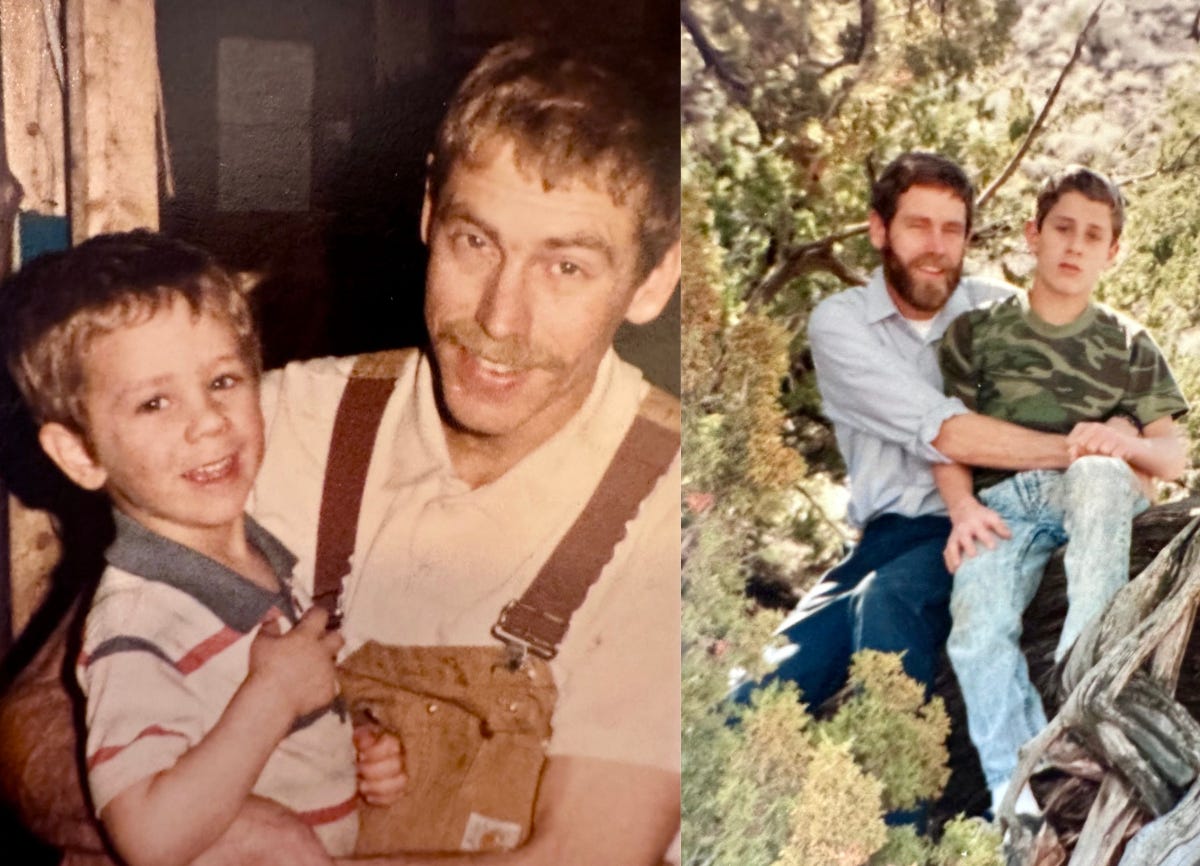
Sean and his dad Upstate New York. Photo courtesy of Sean.
While I wasn’t certain what the word meant, I knew it was bad and I was pretty sure it was me. So when my brother responded to my question by saying that homosexuality is “demonic,” I pushed those thoughts down.
A few years later, my dad told me that once someone becomes a homosexual, they will “want more and more and more” and it will lead to a sexual desire for “children, then animals, then blood.”
Sean and his dad through the years. Photos courtesy of Sean.
Subscribe
Hearing these ideas persistently and consistently made me feel like there was this horrible thing inside of me that I just hated. I had learned that it was akin to being a pedophile, and that’s how I felt about myself.
These feelings created so much shame and fear but most of all a level of embarrassment that was so intense that I vowed to myself I would take my secret to the grave.
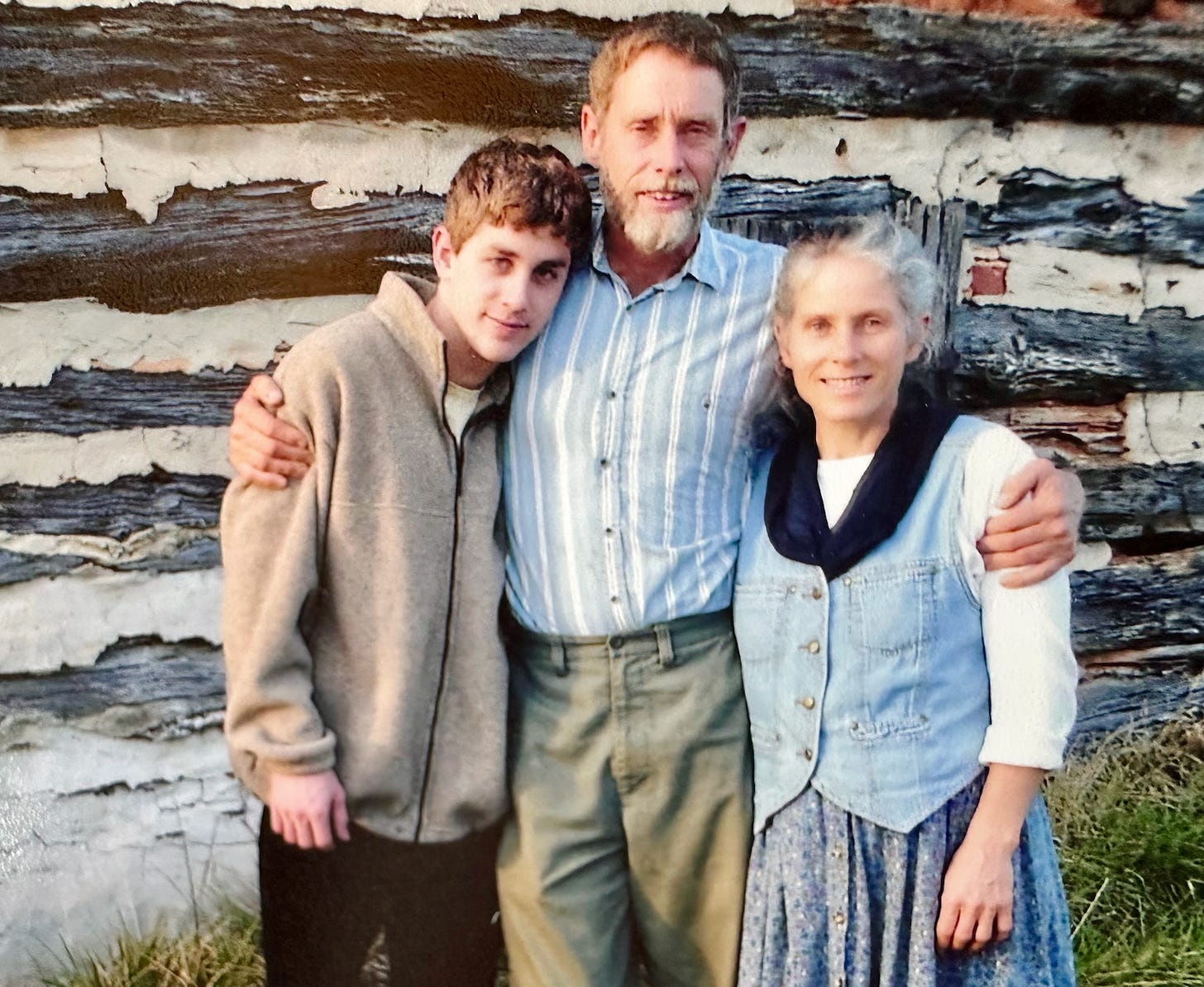
Sean and his parents. Photo courtesy of Sean.
Subscribe
But I didn’t. When I met just one gay person at Danville Community College, I felt a small but significant rumbling of hope. This encounter gave me the courage to leave. So at 17, I told my parents I was moving to New York City to pursue the performing arts.
While I was semi-interested in being on screen, I saw NYC as a symbol of a new life where I could be my authentic self. A few months after I moved, I came out to my mom over the phone, who later told me—through a puddle of tears—that I might as well have died in a car accident.
I had to dig to make a life for myself with few people in my corner. I utilized NYC social programs like SNAP benefits, free health care and low-income housing. These services gave me the bootstraps I needed to pull myself up.
The years of familial and community rejection and efforts to change me through conversion therapy took more than two decades of treatment, medication and supportive friendships to help me find a formula where today—at 40 years old—I can manage my depression, anxiety, tics (that were at one point debilitating), no-contact relationship with my parents and low self-esteem.
I am so grateful to the heroes who helped me through these years: Paul Warner, Jerry Meadors and countless others. You lifted me up, taught me the ropes, allowed me to couch surf and showered me with love.
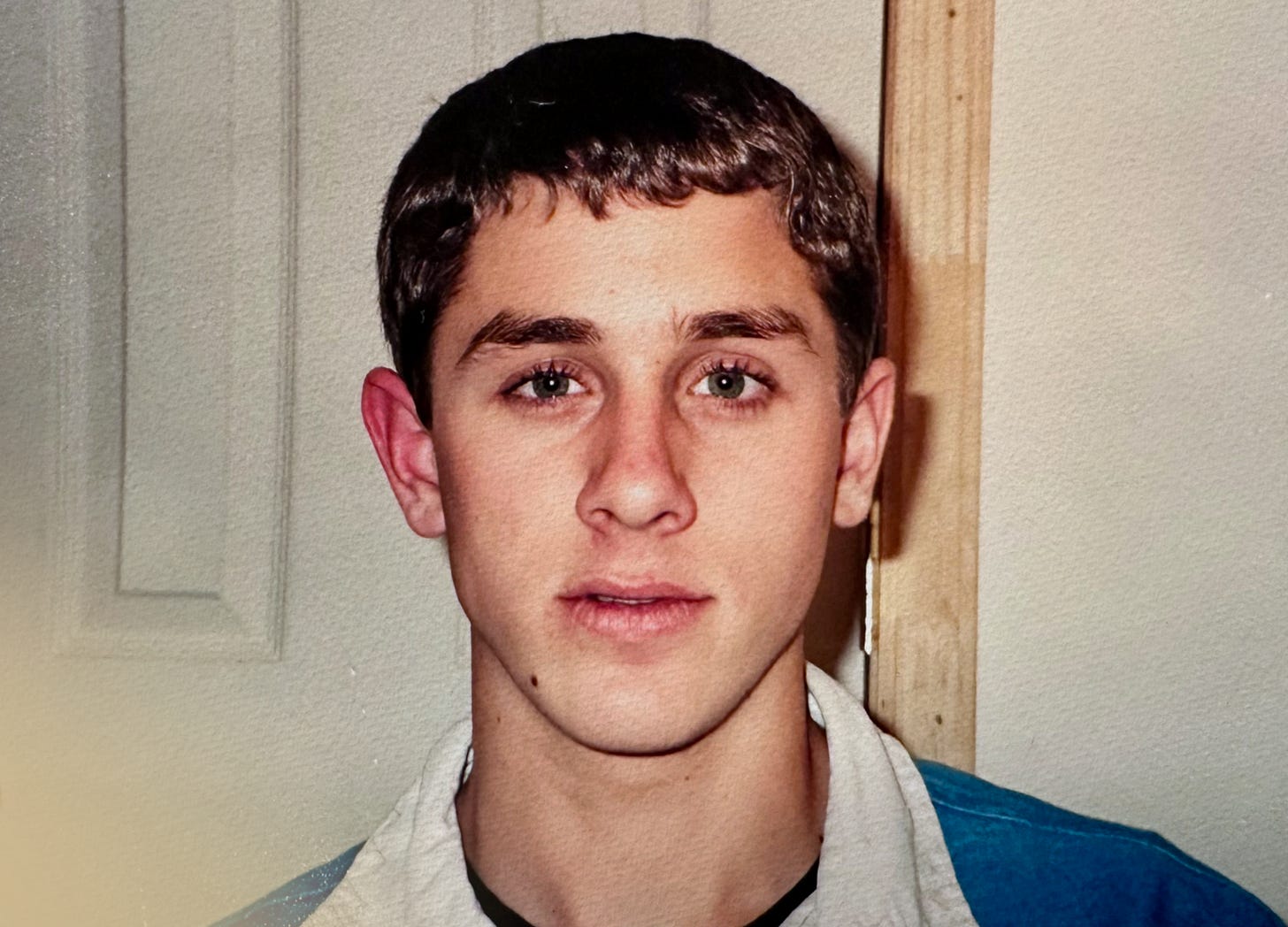
Sean in his teens. Photo courtesy of Sean.
Fighting the demons of my past, including years of religious trauma and physical abuse disguised as “corporal punishment,” is something I’d wish on nobody. When I read Uncloseted stories that discuss how nearly 40% of LGBTQ kids seriously considered suicide in the last year, my heart breaks because I know that could have been me if my path had veered a degree in a different direction.
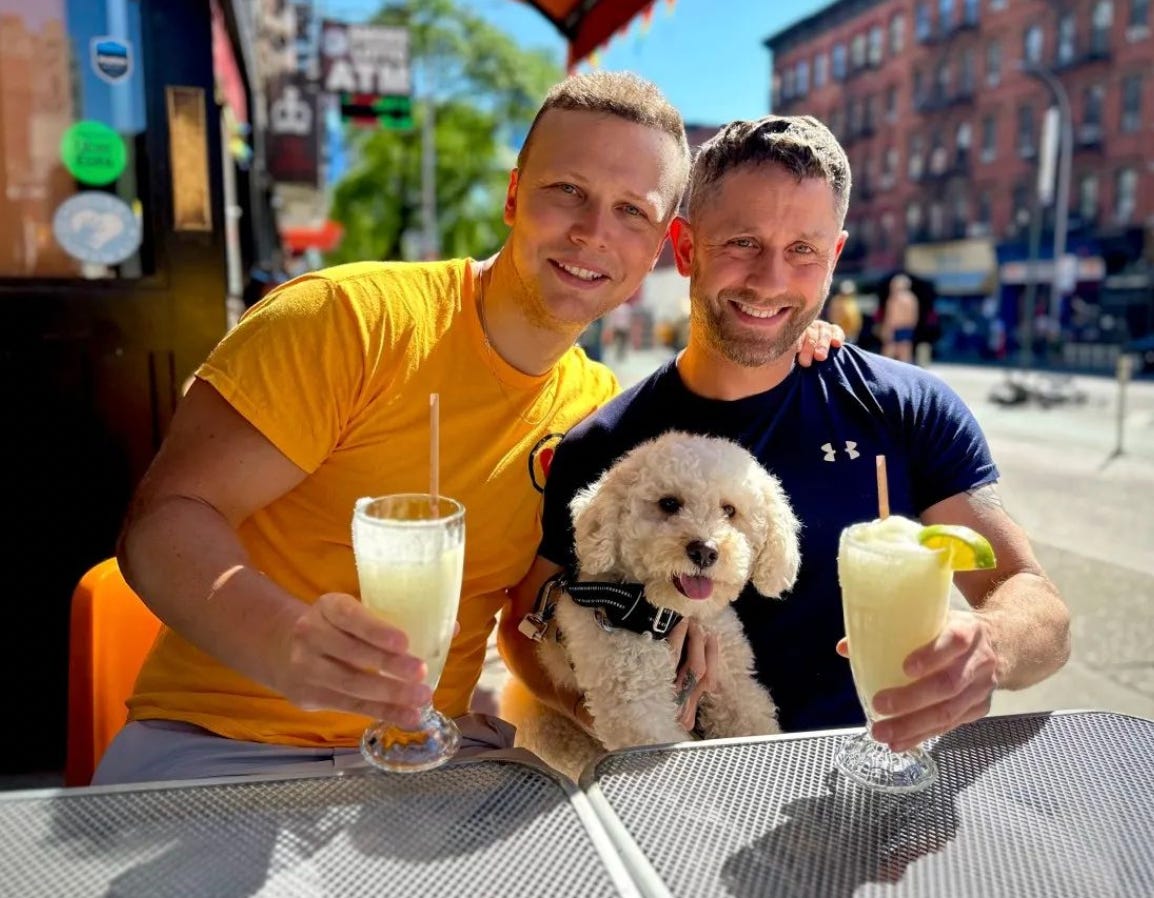
Sean with Spencer and his psychiatric service dog Carson. Photo courtesy of Sean.
Flash forward 20 years and I’m sitting next to Spencer, who’s helping shine a spotlight on the very thing I tried to suppress in the darkness of my mind. I am now a video editor at MTV, working on RuPaul’s Drag Race, the groundbreaking television show that has helped so many queer kids across America feel seen and feel safe—something every child deserves.
I’ve always been resilient and tough.
But finally, I feel calm and free.
Response from Sean’s Dad:
In a text message to Uncloseted Media, Sean’s dad, Chris Robinson, wrote that he remembers saying that “when the moral fabric of societies begin to decay it usually starts with the sin of not acknowledging Almighty God, the Giver and Sustainer of life. [If] that condition of man continues then more sin comes [including] adultery, fornication and general unfaithfulness. The next level is men allowing women and children to rule. This would have been the feminist movement of the 60’s. Next comes homosexuality then bestiality and finishing up with child and adult sacrifice and much shedding of blood. This progression is recorded in Genesis and through the Chronicles and Kings in the Bible.”
In response to Sean’s references to corporal punishment, his dad wrote that he remembers being “shocked at [Sean’s] fearless defiance to [his] authority … as being the one responsible for order in the home” and that he would punish him—after multiple verbal warnings for misbehavior—by giving him “4 or 5 good licks with the switch and [would then] give him a hug and prayer and hope he got the message.” His dad added that he and Sean had many good times too and that he “still shed[s] a tear at times in memory of [his] little Seany.”
Response from Sean’s Mom:
In a text message to Uncloseted Media, Sean’s mom, Michelle Robinson, does not remember telling Sean after he came out that he might as well have died in a car accident. “My mind is blank for anything specific,” she wrote.
In response to Sean’s reference to corporal punishment, his mom says that out of the hundred times where corporal punishment was administered correctly through biblical spanking done with love, there were “a handful of times when his father admits he acted more in anger as [an] immediate reaction because of Sean’s behavior and he realizes he should’ve done that differently [and that his dad] always immediately apologized and they always had special time together and they worked through that.”
“We believed in honoring God with our life. We were not perfect but our heart was to please God,” she wrote, adding that Sean was treated with love as a child and through adulthood.
Sean’s brother did not respond to Uncloseted Media’s request for comment.
If objective, nonpartisan, rigorous, LGBTQ-focused journalism is important to you, please consider making a tax-deductible donation through our fiscal sponsor, Resource Impact, by clicking this button:








 Scottie's Playtime