The video below shows another shooting where the ICE thug fired into a car striking a person when he shifted his weapon to his other hand. The car was not moving and full of pepper spray. The man was not trying to drive. Yet ICE told a judge the man had weaponized his vehicle in an attempt to run over ICE thugs. The judge dismissed the case because ICE refused to hand over the body cam footage that showed what the ICE thug did and that DHS was lying. Again. Hugs
U.S. President Donald Trump has turned Greenland into a geopolitical hotspot with his demands to own it(Note: there is a video of this report on the page, if you prefer; click the title just above -A)
By EMMA BURROWS AP european security correspondent January 16, 2026, 12:17 AM
In their words: Greenlanders talk about Trump’s desire to own their Arctic island
(Snippet:)
NUUK, Greenland — U.S. President Donald Trump has turned the Arctic island of Greenland into a geopolitical hotspot with his demands to own it and suggestions that the U.S. could take it by force.
The island is a semiautonomous region of Denmark, and Denmark’s foreign minister said Wednesday after a meeting at the White House that a “fundamental disagreement” remains with Trump over the island.
The crisis is dominating the lives of Greenlanders and “people are not sleeping, children are afraid, and it just fills everything these days. And we can’t really understand it,” Naaja Nathanielsen, a Greenlandic minister said at a meeting with lawmakers in Britain’s Parliament this week.
Here’s a look at what Greenlanders think:
Trump has dismissed Denmark’s defenses in Greenland, suggesting it’s “two dog sleds.”
By saying that, Trump is “undermining us as a people,” Mari Laursen told AP. (snip-MORE)
==========
(It’s like another world inside my state, which is sorta nice. -A)
TOPEKA — Union leader Jake Lowen told the hundreds of workers who gathered Wednesday in the first floor rotunda of the Statehouse to look around and take in “the house that labor built.”
He referenced the stonemasons who cut every piece of limestone in the walls. The iron and steel workers who raised the dome, with the help of operating engineers who ran the hoists built by machinists. Plumbers, boilermakers and electricians brought light, heat and water.
Lowen, the executive secretary-treasurer of the Kansas State AFL-CIO, said some of the workers who started building the Statehouse, which took 37 years to construct, never saw it finished. At least seven gave their lives in the process, he said.
“The work was hard and the price was high, and yet they persevered,” he told the crowd that was gathered for an annual “solidarity day” labor rally.
He said the workers were building a Statehouse by day and a movement by night. In 1890, the year they raised the Statehouse dome, workers formed the Kansas State Federation of Labor, he said. (snip-MORE)
I’ve updated the web version of the post, but I wanted to send out an email update too so that readers on the ground in the Twin Cities are aware of the resource.
I’ll republish Governor Walz’s quote for emphasis:
“Tonight, I want to share another way you can help: Witness.
Help us establish a record of exactly what’s happening in our communities.
You have an absolute right to peacefully film ICE agents as they conduct their activities.
So carry your phone with you at all times.
And if you see ICE in your neighborhood, take out that phone and hit record.
Help us create a database of the atrocities against Minnesotans – not just to establish a record for posterity, but to bank evidence for future prosecution.”
If you are local to the Twin Cities, and feel safe and able, this is a concrete way in which you can help.
Miles Taylor explains how in tRump’s first term he was shocked to find the president had checks on his authority / power. Once he heard about the insurrection act he kept talking as if it gave him total power and control over the US, the kind of power he has always craved person power to rule by decree like in his personal business. Hugs
🌿This note has struck a chord and gotten some attention, so I just wanted to say that anyone who wants to share from this note, please feel free, in any way you like :)🌿
Last week, I wrote to my Senator, Angus King, asking him to please focus on three priorities in the new year: 1) Stop foreign invasions 2) Release the Epstein files 3) Restore ACA subsidies.
Senator King wrote me back, because he’s actually really good about answering constituent correspondence. And one of the things he said is that he is increasingly concerned with the “growing gulf between the left and right and the shrinking middle.”
I see this argument a lot, actually, from all these avowed “centrists.” And I will tell you, it pisses me off. It’s an entire mischaracterization of this moment in history.
This is what I wrote:
Senator King,
Thank for your recent response. One of the concerns that you expressed was regarding the “growing gulf between the left and right and the shrinking middle.”
I want to re-frame this, because it’s a mischaracterization.
When we talk about political ideology, the center of the spectrum in the United States is meant to be the Constitution and the rule of law. That is the standard, the baseline, the bare minimum of agreement against which the full right-to-left spectrum of policy negotiations and compromises must ultimately be tested. (emphasis mine)
The gulf that has developed today is not about polarization. The left and right are not migrating further apart. The right has launched off the edge of the chart into violent authoritarianism. There is no corresponding leftward lurch towards social revolution.
The overwhelming and growing public reaction, these thousands and millions of protestors flooding the phones and taking to the streets to demand that the law and the Constitution be followed – we ARE the center!
I tried to explain this to Congressman Jared Golden, too. He really, really wants me to be a far-left activist extremist. But I’m just a wife and a mom living in a cabin in the Maine woods. We chop firewood for heat, we harvest maple syrup tree by tree, our kids work on local shellfish farms. We are deeply ordinary.
But our most basic and fundamental civil rights and liberties are increasingly under assault. If an ICE agent doesn’t like the way I follow their instructions, they will shoot me in the face, call me a f****** b****, and the President will say that according to his own morality in his own mind, that was legal and I deserved it.
As I asked Jared months ago, just how far right do you have to travel to start believing that asking elected officials to follow the Constitution and the rule of law is Progressive Activism?
We are not far left extremists becoming increasingly polarized. We are masses of Americans asking for adherence to the Constitution and the rule of law. We are asking for the bare minimum.
The center is not supposed to be negotiated ever rightward into fascist dictatorship. The center is supposed to be uncompromisingly anchored in the Constitution and the rule of law. This is supposed to be the line of absolute principle.
That is why I am disappointed every single time you vote with the regime. It’s not because I’m polarized. It’s because you’re negotiating with people who don’t believe in the center at all. You are negotiating with terrorists.
What you are witnessing today is not a shrinking middle. The center is actually growing in a rising tide. Millions of Americans are suddenly deadly aware that every Constitutional right that they thought was firmly enshrined is threatened by one single group of far-right, power-hungry, violent rogue extremists.
So if the center is really what you stand for, I have good news for you. Now is your time! The center is the largest it has ever been! Millions of dead-center Americans are as awake, as alert, as active as they have been in a generation. We are demanding the absolute center of political ideologies, and the bare minimum of governance – the restoration of Constitutional democracy. So join us! But understand this about the center. It is not the place for compromise.
Snip-please go read the rest at Annie’s (I didn’t leave a lot out here, so that won’t take long;) and then quickly but thoughtfully join people who are working hard to retain our democracy, and fix the holes. Not doing anything is really simply asking for these very bad things to continue, and history has shown how that ends. Thank you!
The democrats have to stand on this issue. Why have a budget if all the constitutional rights and laws of our country can just be ignored by the current administration? Hugs
They want guardrails on immigration agents. The issue has risen to the fore ahead of a key Jan. 30 deadline after an ICE officer shot and killed an American woman in Minneapolis.
ICE officers question a man’s status on Lake Street near Karmel Mall in Minneapolis in 2025.Christopher Juhn / Anadolu via Getty Images file
WASHINGTON — Democrats are wrestling with whether to use a key Jan. 30 deadline to demand constraints on President Donald Trump’s immigration crackdown after an Immigration and Customs Enforcement officer shot and killed an American woman in Minneapolis.
Progressives in the House and Senate are calling on their party to hold firm in opposition to a funding bill for the Department of Homeland Security unless it comes with conditions — such as requiring agents to wear identification, limiting Customs and Border Protection agents to the border and requiring judicial warrants to arrest suspects in immigration cases.
They say Trump is using autocratic tactics by deploying masked agents in cities to intimidate Americans who don’t support him.
“Democrats cannot vote for a DHS budget that doesn’t restrain the growing lawlessness of this agency,” Sen. Chris Murphy, D-Conn., the top Democrat on the Appropriations subcommittee overseeing DHS, wrote on X after the Minneapolis shooting.
The Congressional Progressive Caucus announced Tuesday that its members have formally voted to oppose any bill to fund DHS “unless there are meaningful and significant reforms to immigration enforcement practices.”
The blowback from Democrats to the Minnesota ICE shooting, which Homeland Security Secretary Kristi Noem and the White House have defended, may pose a problem for Republicans in Congress who will need at least some Democratic votes to fund the government — including DHS — before Jan. 31 or risk a shutdown.
Democratic opposition has already frozen a DHS measure that was slated to be added to an appropriations package getting a Senate vote this week. Republicans control Congress and have largely stood by Trump on ICE deployments across the country, but such a bill requires 60 votes to pass the Senate.
Congress may have to fall back on a stopgap bill to prevent a funding lapse for DHS. That’s where things get trickier for Democrats. If House Republicans pass a continuing resolution on their own, which would keep DHS running on autopilot, Senate Democrats would again have to choose between accepting it and forcing a partial shutdown.
Senate Majority Leader John Thune, R-S.D., wouldn’t say whether he’s open to guardrails on immigration enforcement when asked Tuesday by NBC News.
But he called on Democrats not to allow another shutdown.
“I think government shutdowns are stupid. I don’t think anybody wins. I hope the Democrats share that view,” he said, while acknowledging that DHS funding is “the hardest one, and it’s possible that if we can’t get agreement, there could be some sort of a CR that funds some of these bills into next year.”
The record-long shutdown last fall, triggered over a health care dispute, yielded no concessions for Democrats. And unlike the Affordable Care Act, a winning issue for Democrats, some in the party are more leery of a standoff over immigration. The center-left group Third Way is encouraging Democrats to steer clear of reviving the “abolish ICE” discourse.
And some Democrats note that the $170 billion infusion of funding for immigration enforcement was approved by Republicans on a party-line basis in Trump’s “big, beautiful bill” last summer. That wouldn’t be affected even if DHS funding through the normal appropriations process expires.
One Democratic aide, discussing the sensitive topic on condition of anonymity, noted that a stopgap funding bill for DHS would provide fewer guardrails and more flexibility for Noem to move money around as she sees fit.
Senate Minority Leader Chuck Schumer, D-N.Y., sidestepped questions about whether he favors withholding DHS funding to slap restrictions on ICE, calling it “one of the major issues that appropriators are confronting right now.”
“The appropriators are working on that right now with the four corners and trying to come up with an agreement,” he said.
House Democrats’ strategy on ICE was a major topic of conversation during a closed-door party meeting Tuesday, according to attendees. But the conversation focused more on finding ways to hold the Trump administration accountable, other than withholding money for the agency.
One example of how they plan to do that: Democrats on the House Judiciary Committee will hold a field hearing in the Minneapolis area on Friday, where they plan to highlight the impact of ICE in the community.
“That was a big bulk of what we talked about,” said Rep. Becca Balint, D-Vt., who plans to attend the hearing. “The plea was to the caucus was that we have to hold people accountable. We have to do oversight when our colleagues won’t do it.”
Rep. Pramila Jayapal, D-Wash., the ranking member of the House Judiciary subcommittee overseeing immigration and former Progressive Caucus chair, said that if Democrats wait until next year, “a lot of people are going to die between now and then, because this is now a federalized military force that’s being unleashed.”
“Obviously, the Senate has more leverage than the House, but I do think it’s also critically important for us to be on the record against this amount of funding, number one, and funding without any accountability or guardrails,” she said. “So we have a list of guardrails that we have been working with our leadership and the Senate.”
House Minority Leader Hakeem Jeffries, D-N.Y., slammed ICE and Noem as “totally out of control” and in need of “commonsense” restraints that reflect law enforcement conduct.
“What’s in front of us right now is a spending bill that will go either one of two ways,” he told reporters. “Either Republicans will continue their ‘my way or the highway’ approach as it relates to the Homeland Security bill, and if that happens, then it’s going to be on them to figure out a path forward.”
Before the Minneapolis shooting, a national poll by The Associated Press found last month that just 38% of U.S. adults approve of Trump’s handling of immigration, while 60% disapprove.
A YouGov/Economist poll taken Jan. 9-12, after the Minneapolis shooting, found that 69% of American adults said they saw video of it, while another 22% said they had heard about it. Seventy-three percent said ICE agents should wear uniforms during arrests, and 56% said they shouldn’t be allowed to wear masks while arresting people. A plurality said ICE was making the U.S. “less safe.” And respondents said 46%-43% they support “abolishing ICE,” within the survey’s margin of error.
So far, the Justice Department has released only about one percent of the files it has on Jeffrey Epstein, Donald Trump’s involvement with the serial child molester, and the government’s failure to hold Epstein accountable. It’s the sort of thing Congress should be demanding action on, but the House Oversight Committee was instead planning to spend this week grilling Bill and Hillary Clinton about their long-ago contacts with Epstein, because that would take the spotlight off Trump.
Yesterday, the Clintons sent a scathing four-page letter (New York Times archive link) to committee chair James Comer (R-Kentucky) telling him why they wouldn’t be playing along, arguing that instead of demanding the Justice Department comply with the law requiring release of the Epstein Files, Comer and the Oversight Committee “have prevented progress in discovering the facts about the government’s role.”
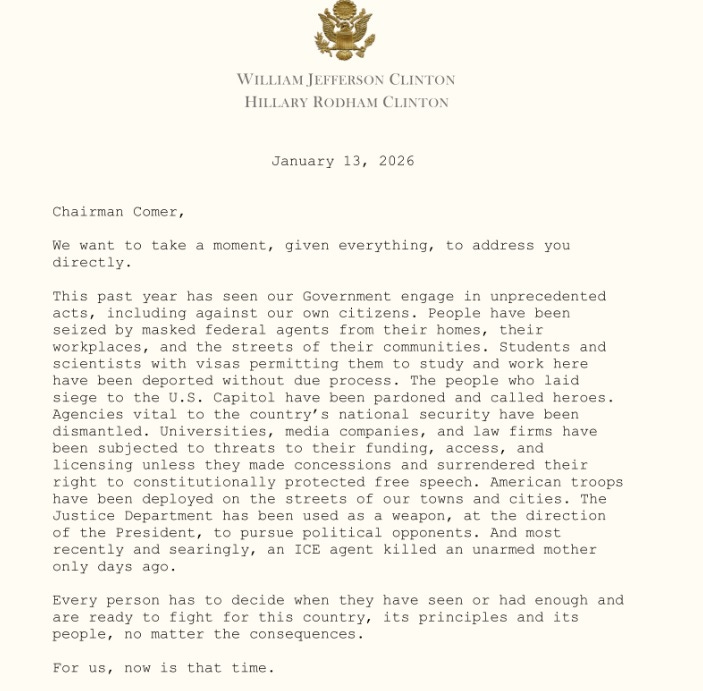
You should definitely give the full Clinton letter a read, because it lays out not just why the Clintons won’t go along with Comer’s attempt to shift attention away from Trump and the DOJ’s foot-dragging, but also why this government’s corruption must be resisted wherever possible, from the streets to closed-door hearing rooms. The letter, not from their attorneys but from the Clintons themselves, starts by laying out the unprecedented attacks on the rule of law by Trump’s government, and sums up:
Every person has to decide when they have seen or had enough and are ready to fight for this country, its principles and its people, no matter the consequences.
For us, now is that time.
The letter also notes, again, that Bill Clinton has repeatedly called for the DOJ to release every last bit of information about him from the Epstein Files, which isn’t exactly what somebody trying to hide something would say. As opposed to, let’s say, a president who has fought every single attempt to release everything.
Separately, the Clintons’ attorneys sent Comer a more conventional letter explaining why they consider the committee’s subpoenas “invalid and legally unenforceable,” which may be useful if Comer follows through on his threat to charge the Clintons with contempt of Congress. But the Clintons’ letter, like Comer’s attempt to drag them before the committee for show, is openly and unabashedly political.
In what may have been a deliberate throwback, the Clinton letter is in good old-fashioned typewriter text (or a digital recreation of it), not a more obvious laser-printed Times New Roman or Arial, as if to suggest that in contrast to a clumsy Twitter message or a random email blast, the IBM Selectric is an elegant communications device for a more civilized age:
While Comer accepted sworn, written declarations from eight other people the committee subpoenaed, he’s only demanded that the Clintons show up in person to be grilled behind closed doors. But no thanks, they write, we aren’t going to help you create a sideshow that detracts from the administration’s stonewalling on releasing the files:
We have tried to give you the little information that we have. We’ve done so because Mr. Epstein’s crimes were horrific. If the Government didn’t do all it could to investigate and prosecute these crimes, for whatever reason, that should be the focus of your work — to learn why and to prevent that from happening ever again. There is no evidence that you are doing so.
Predictably, Comer is now rattling on about charging Bill Clinton with contempt of Congress for not appearing Tuesday, and Hillary as well, since there was little chance she’d show up for her scheduled deposition today. Anticipating that, they basically tell him in the letter, BRING IT:
Despite everything that needs to be done to help our country, you are on the cusp of bringing Congress to a halt to pursue a rarely used process literally designed to result in our imprisonment. This is not the way out of America’s ills, and we will forcefully defend ourselves.
Indeed, bringing the Republicans’ cruel agenda to a standstill while you work harder to pass a contempt charge against us than you have done on your investigation this past year would be our contribution to fighting the madness.
If that’s the direction Comer goes, the letter warns, get ready, because while they’re still willing to testify in a public hearing, the Clintons will also “defend ourselves in the public arena and ensure this country knows exactly why you are doing so, instead of helping the American people who need this Congress’s work and protection.”
The letter closes with another warning, with a nice jab at MAGA obsessions with the perfectly legal and cromulent use of autopens on official documents, which is fun to read in a letter that looks as if it came from a typewriter. (Are the signatures here digital or handwritten, and does anyone care?)
It’s a hell of a read, and it matters because unlike all the ways Trump and his sycophants have thrown norms (and the law) under the bus, this letter makes clear that the Clintons are defying the subpoenas not out of contempt, but to highlight that the GOP “investigation” is itself a political act aimed at intimidating Trump’s enemies. This isn’t an attempt to escape answering tough questions — they’ll happily do that in the open and in a sworn written statement. It’s civil disobedience, because this is a goddamned emergency.
Rebecca Solnit writes that we need to see more of this from people whose privilege usually protects them. They could testify in private and ride out the political screeching (neither would be at any risk) but they’re instead saying hell no and courting a contempt charge because it would bring attention to Trump’s crimes:
It’s significant that they’ve come out fighting. This is specifically about James Comer’s attempt to force them to testify about all things Epstein, even as this administration covers up for Epstein’s best friend, refuses to release 95% of the Epstein files, etc. What’s striking here is that the Clintons articulate it’s all of a piece with all the other appalling and lawless things the Trumpists are doing. That these supremely status quo/high status people see themselves as under attack in illegitimate ways and are now fighting back with broad accusations matters, not least because it may shake up some other people with high status/status quo positions, including high up in the Democratic Party.
We also wholeheartedly endorse Solnit’s caution that “I don’t really want or need to hear about why you don’t like the Clintons,” because yes, that conversation has been ongoing for 35 years, but this is something new, and because hey, did you notice the whole building is on fire?
Warren was my preferred candidate in 2020. I would vote for her again if she runs. The country needs progressives who understand how hard it is for the average person in the US today. Due to the strangling of wages/ incomes for the majority and the increasing moving of all the countries wealth upward to the top few, people can not survive in this society. Hugs
Supporting and learning from trans people is essential in fostering an inclusive and compassionate world. Members and allies of the trans community recognize the unique struggles and challenges that trans individuals currently face: discrimination, marginalization, and dangerous legislation.
By actively supporting and learning from trans activists and leaders, we can better understand these challenges and work together to create an environment where everyone is treated with respect and dignity, regardless of their gender identity.
We’ve compiled a list of impactful quotes from trans activists to foster understanding and appreciation for the trans community.
Please share and utilize these quotes to promote support for trans people and create a more inclusive, respectful, and supportive environment for everyone.
Explore inspirational transgender quotes and captions — to help celebrate trans liberation & fight for trans rights
“I’ve never been interested in being invisible and erased.” — Laverne Cox
“Trans people are extraordinary, strong, intelligent, persistent and resilient. We have to be. And we will not stand for the picking and choosing of rights. We still have hope.” — Grace Dolan-Sandrino
“Despite the constant hatred we face as the LGBTQ+ community, we must stand united and strong in spreading our message of love.” — Jazz Jennings, in a tweet
“I think trans women, and trans people in general, show everyone that you can define what it means to be a man or woman on your own terms. A lot of what feminism is about is moving outside of roles and moving outside of expectations of who and what you’re supposed to be to live a more authentic life.” — Laverne Cox
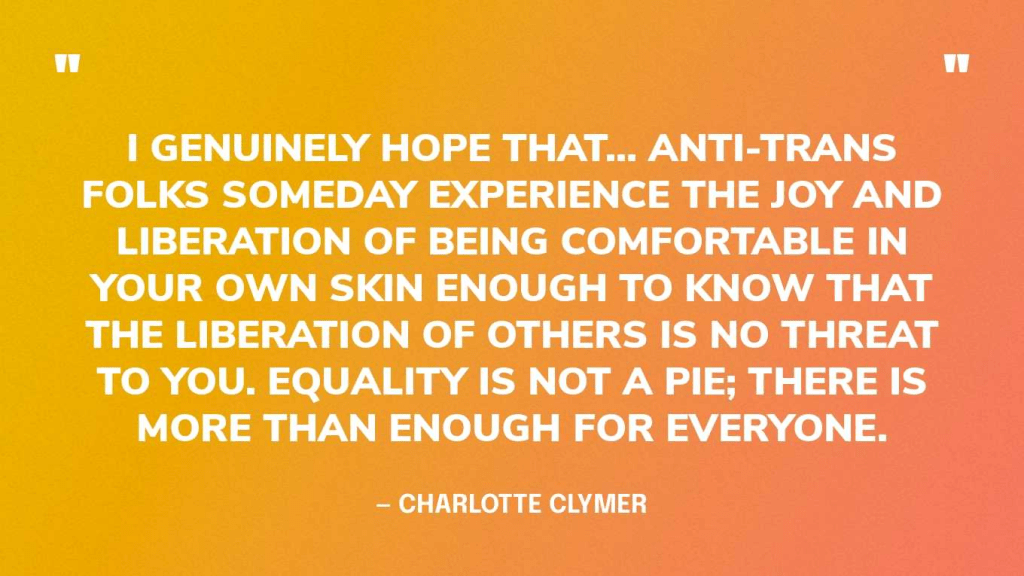
“They can try to ban us. They can try to get rid of our health care. They can try to deny us housing, credit, and public accommodations. They can try to shame us. They can try all they want to erase us, but at some point, they will realize the trans community is never going away. Trans people are everywhere. Every country, every race, every ethnicity, every religion, every socioeconomic level, every period of human history — we are everywhere. We are natural. You can’t rid of what’s natural. I think they know that, and it terrifies them.” — Charlotte Clymer
“I want to make a difference in the world by speaking out and spreading hopeful messages. I want to send the message of “you are not alone and you are safe” to other transgender kids.” — Rebekah Bruesehoff
“We have to be visible. We are not ashamed of who we are.” — Sylvia Rivera
“Being transgender is not just a medical transition. … [It’s about] discovering who you are, living your life authentically, loving yourself, and spreading that love towards other people and accepting one another.” — Jazz Jennings
“We have to remain visible. They have to see us, they have to know that we’re not going [nowhere], that we’ve been here ever since God made man and woman, and they have to get over it. I don’t need their permission to exist; I exist in spite of them. I want you to train and teach and love on and create families within my community and gender non-conforming people, so that we can understand that we have a culture, we have a history, we have a reason to be here. We have a purpose. We’re entitled to be loved, and seek happiness, and share that with the people that we care about.” — Miss Major Griffin-Gracy
Snip-There are a few more, and some graphics with the quotes that we can snag and share, too.
to spread brightness in as much space around us as we can, especially if we’re in an area endangered by the Trump enforcement brigades we’re seeing. But even if we’re not, we can extend these actions locally to build community so we’ll be safer when it is our turn.
“We, at Wrecktangle, at all locations for the rest of the weekend, are going to donate one pizza for every single pizza sold, to families and friends that are affected by the increased ICE presence in Minneapolis,” one representative said.
In the caption, they noted that they are “set on volunteers” who would deliver pizza and other goods to people unable to leave home, but added: “We could really use some help raising funds to keep the momentum and keep people safe inside during these disturbing and uncertain times.”
Wrecktangle leaders said they started with $2,000 in donations from family and friends, and figured if they posted their Venmo information, they might be able to double that.
The support exceeded their expectations.
In addition to the collection of non-perishable foods and home essentials, two days later, they announced that they had received over $83,000 in donations.
Along with the donations, the local chain sold 2,291 pizzas between Thursday and Sunday.
During this time, they distributed 600 pizzas, non-perishables, and toiletries to vulnerable families, adding that “we have been working only with volunteers we personally know and trust to ensure the safety of our community.”
But thousands more meals are being made and prepared for free delivery as quickly as possible.
Wrecktangle co-owner Breana Evans told Bring Me The News that nearly every local restaurant in their area has been negatively impacted by the presence of ICE.
“We have staff, coworkers who are directly affected and scared to come to work,” Evans said. “It’s not fair for our friends to be scared to provide for their families and make a living. We know how to make food. So, we said, let’s just start making food.”
The company began donating their 13-inch frozen pizzas privately by connecting with their network of neighboring businesses and organizations. But then they realized the community could expand their efforts even wider.
Trusted volunteers were sent off to deliver free pizzas and meal kits, and others came to the shop to help assemble the goods.
“I think that’s a testament to our community and that there’s more good in the world than this horrible bad that they’re making us go through,” Evans said.
After meeting an immediate need to distribute food, Wrecktangle owners are working to figure out how to best use the funds they raised to help the community.
A screenshot of an Instagram story from Wrecktangle, sharing a weekend total of donated pizzas. Photo courtesy of Wrecktangle/Instagram
“We are working hard with nonprofit organizations to make sure these funds do the most good. We have not yet touched a cent,” they shared on social media. “As soon as we have updates as to specifically where your kindness is going, outside of purchasing food and home products, we will keep you thoroughly updated.”
And on Sunday, to finish out the campaign, Wrecktangle encouraged supporters to spend their money with other local restaurants. For one day only, they accepted emails containing a photo of a receipt from any Minnesota restaurant, and an additional meal was donated on their behalf.
“A lot of our community wants to come back to work, and we need to make sure these restaurants can help support their staff,” Evans said in a social media video. “We need you to be there.”
s of Monday morning, Wrecktangle shared on an Instagram story that they received 176 emailed receipts, which translates to 176 more meals for vulnerable community members.
“This week has spread so much love and friendship,” the company added in an Instagram story. “And we couldn’t be more grateful.”




![Screenshot of Clinton letter: 'Continue to mislead Americans about what is truly at stake, and you will learn that Americans are better at finding the truth than you are at burying it. Continue to pursue autopens instead of penning laws Americans need, and you will learn that you are signing away any remaining chance of being on the right side of history. Continue to abet the dismantling of America, and you will learn that it takes more than a wrecking ball to demolish what Americans have built over 250 years. Sincerely, [signatures] Bill Clinton / Hillary Rodham Clinton'](https://substackcdn.com/image/fetch/$s_!_WOJ!,f_auto,q_auto:good,fl_progressive:steep/https%3A%2F%2Fsubstack-post-media.s3.amazonaws.com%2Fpublic%2Fimages%2F6516cc3d-9699-4259-9e53-77fab75b5f17_747x548.jpeg "Screenshot of Clinton letter: 'Continue to mislead Americans about what is truly at stake, and you will learn that Americans are better at finding the truth than you are at burying it. Continue to pursue autopens instead of penning laws Americans need, and you will learn that you are signing away any remaining chance of being on the right side of history. Continue to abet the dismantling of America, and you will learn that it takes more than a wrecking ball to demolish what Americans have built over 250 years. Sincerely, [signatures] Bill Clinton / Hillary Rodham Clinton'")


 Scottie's Playtime