Scores of James Talarico donors are exceeding federal donation limits, with regulators at the FEC identifying 143 such donors who exceeded the legal limit, according to a letter they sent to the Texas Democrat campaign this month.
AP on Trump's rule by rich people: "The number of people worth at least $100 million whom the Republican president has appointed to his administration is more than four times the combined total under the three previous presidents."
If you lost your right to have and use a firearm due to a felony conviction, now, promises Todd Blanche, you can get it back. The right sum paid in crypto to the Trump Bros will insure a prompt decision. http://www.wsj.com/politics/pol…
The U.S. and Iran on Monday missed their 60-day deadline to reach a deal to curtail Iran’s nuclear program under the terms of the cease-fire they agreed to in June, underlining the breakdown of a truce that President Trump promised would end the war. Here's what to know.
Iran decided to shift its policy from defensive to ‘fully offensive’ due to the deadlock in efforts to agree to end to its war with the US, a senior Iranian official told Reuters. Progress towards peace ground to a halt since the conflict began in February reut.rs/4x4EuNZ
At the end of his life, when he stands before God in judgment, J.D. Vance wants to be able to say he did everything he could to help MAGA Rep. Brandon Gill get re-elected. http://www.peoplefor.org/rightwingwat…
Ken Paxton says he's probing widespread noncitizen voting, claiming that tens of thousands voted illegally in a single Texas election. Three have been prosecuted. Of 53 cases referred for investigation, at least five are US citizens. http://www.nbcnews.com/politics/ele…
Trump says he has a good relationship with Kim Jong Un, asks the lifeguard he's honoring to co-sign his attacks on the press, and then snaps at a woman reporter: "Be quiet! Be quiet!"
It used to be that once a NIH grant award hit “status 19,” the money was about to go out the door.That’s not the case anymore. The Trump administration has enacted an unprecedented political review process, pushing hundreds of awards into limbo.
The number of parents in the U.S. choosing not to vaccinate their children rose dramatically in the last school year, according to data CDC data released Monday. @erikaedwards.bsky.social @nbcnews.com
A federal court in Nevada became the 22nd consecutive district court to reject the Trump administration’s campaign to force states to turn over their unredacted voter rolls, dismissing the Department of Justice’s case and denying its motion to compel. https://t.co/553Vyw9JI0
“We raised our hand to defend the Constitution. Congress takes the same oath, and unfortunately, we’re not seeing that same level of service over self today in Washington.”I spoke with @TB_Times about our race and what it means to selflessly serve your country.www.tampabay.com/news/florida…
We are less than one week away from the August 18th Primary! I welcome you to join us in Safety Harbor next Tuesday to celebrate the community we are building and all of the hard work we have accomplished together since my campaign launched. (1/2)
Luna's words are offensive to survivors of abuse everywhere – and she should immediately apologize to Rep. Miller's wife and family, and return the money she has raised from this alleged violent criminal. x.com/Sollenberger…
Kentucky Gov. Andy Beshear says he has heard “absolutely nothing back” from Sen. Mitch McConnell after requesting updates on the senator’s condition.
Beshear (D-KY) says while he wishes McConnell “good health,” the senator should address the public directly. “His boss are the… pic.twitter.com/hnnbQBo4JR
Welker: "Trump pardoned everyone who attacked the Capitol on Jan. 6, including 172 people who pleaded guilty to assaulting police officers. How is that consistent with your pledge to always protect law enforcement?"
EXCLUSIVE: Two DHS Sources Confirm to Migrant Insider — The ICE Agent Who Pointed His Gun at a U.S. Citizen in Virginia Is Martin Lagunas https://t.co/1xtlQ8APhI
❤️ If you’d like to help support my self-funded independent journalism consider making a donation:
PayPal: dcbhigby@gmail.com Venmo: Cameron-Higby Cashapp: $c4mhigby X Money: @camhigby I also get fees on this coin: solana:D3pHN7kAJMvcbWrUBECjcr2MZjPgNTrzo3kCerYwpump
🚨SEND PETE HOEKSTRA PACKING🚨The House of Commons petition calling for U.S. Ambassador Pete Hoekstra to be declared persona non grata has already reached 171,392 signatures.🔗 Petition e-7531: http://www.ourcommons.ca/petitions/en…🔗 sendpetepacking.ca❤️🍁🇨🇦TEAM CANADA FOREVER🇨🇦🍁❤️❤️🍁🇨🇦VIVE LE CANADA🇨🇦🍁❤️
ANOTHER WAPO SCOOP:The Navy is considering a major redesign of its new aircraft carriers to better match President Donald Trump’s aesthetic preferences for the warships, according to seven current and former U.S. officials familiar with the matter. http://www.washingtonpost.com/national-sec…
The reckless & shameless “American” media completely & intentionally misrepresent the USS Abraham Lincoln.
The brave Sailors of that Strike Group are very proud of their tough & historic mission. They embody resilience & excellence. @DeptofWar@USNavy & @CENTCOM have their back. https://t.co/2Yi08wMxYm
North and South Korea are still technically at war. Our ability to help defend our ally against the North Koreans is because our forces are well trained and able to coordinate with the South Koreans. Hollowing out these joint exercises is shortsighted and a mistake. pic.twitter.com/VLO3t7Ghbf
Trying to imagine the reaction from Republicans if Obama had begun a statement with ‘Based on my very good relationship with Kim Jong Un, of North Korea…’ before announcing a reduction in military cooperation with a top US ally.
Trump has taken a look at North and South Korea and concluded that Kim Jong Un and the North Koreans are the good guys and we should be with them. Fuck MAGA.
For the first time in US history, America betrays South Korea, one of our closest allies for over 75 years. These exercises in various forms have taken place every year since 1974. pic.twitter.com/WoA5Dg8Yti
NEWS: Trump says he has ordered Pete Hegseth to “substantially reduce” joint U.S.-South Korea military exercises, citing his relationship with North Korean leader Kim Jong Un and calling the drills “hostile.”
They are discussing using nuclear weapons on Iran in strategy meetings.
Yes you read that correctly. It’s real. I’m not speculating, I know.
And it’s pure evil.
The last time a nuclear weapon was used was August 6th and 9th of 1945 on two cities in Japan, Hiroshima and…
— Former Congresswoman Marjorie Taylor Greene🇺🇸 (@FmrRepMTG) August 16, 2026
A US Navy guided-missile destroyer spent four days last month without working toilets, galley services and air conditioning in the blistering heat of the South China Sea after the warship lost power. https://t.co/0zyRNvuse9pic.twitter.com/wjO1V1s2lf
Exclusive: A Wyoming woman alleges in a federal lawsuit that her stepfather used the Grok chatbot to transform a childhood photo into child sexual abuse material. https://t.co/FBAjtClETk
Mike Johnson: "We put in this Congress into place all the economic conditions to let the economy take off like a rocket, and beginning in the first quarter of this year that's what was happening, and then we got into the conflict with Iran … that's the big headwind we have right now."
Did Mike Johnson just admit on fox news that President Trump Iran war fucked up their own economic plans? So we had an economy taking off like a rocket until Trump decided to play bodyguard for Bibi?
Look what VANDALS did to the grass connecting the vandalized World War II Monument and the vandalized Reflecting Pool, which will be opened again, and better than ever, shortly. Anybody who thinks the Reflecting Pool wasn't vandalized should go back to Law School! President… pic.twitter.com/q9tJjfwoKX
U.K. Prime Minister Andy Burnham engaged with messages from somebody impersonating one of Donald Trump’s closest advisers, four officials have told POLITICO.
A person without any govt position, who has numerous financial conflicts of interest, should not conduct US foreign policy.And that’s before we get to the fact that he uses this role to corruptly solicit money for himself.It’s wrong. Many seem to have accepted it, but I’ll never stop objecting.
Demand for Canadian citizenship certificates is soaring, fuelled by Americans. Backlog of applications now at 121,800 and archives are swamped with requests. http://www.cbc.ca/news/politic…
NEW: Legal filings say Rep. Max Miller made “false statements” to a court in order to get a Civil Protection Order against his ex-wife. Miller told the court he had an eyewitness refuting claim he assaulted Moreno. Then his lawyers recanted the evidence. https://t.co/Z0reqwCip4
Karoline Leavitt is getting glowing reviews of her performance as press secretary when she dodged, attacked, and obfuscated for the most part. A few examples of the lies we heard: claiming the US spent $50M on condoms for Gaza, calling the Epstein files a 'hoax,' denying war… pic.twitter.com/0RM3GYZctJ
Pirro has convened a special grand jury, an extremely rare move in DC. That could potentially pave the way for her office to investigate some of its biggest cases.
Read more about what a special grand jury is and what it could mean for the office. https://t.co/1umfkKIPt0
Todd Blanche's first address to DOJ: "We will always back the blue… Any time somebody assaults a federal law enforcement officer, we'll prosecute them."
73 Capitol Police and 65 MPD officers injured on Jan 6, 2021, would love to have a word.
‘We will always respect the role of the judiciary’: Says new AG who has led Justice Department which has not respected the rule of law at all http://www.politico.com/news/2026/08…
Lawyers for the former Olympian David Hearn filed a motion on Thursday seeking to bar federal prosecutors from reviving a felony charge that he vandalized the Lincoln Memorial Reflecting Pool, saying they needed to head off possible “prosecutorial harassment” prompted by President Trump.
President Donald Trump's administration on Friday asked the U.S. Supreme Court to allow it to continue construction of his $400 million White House ballroom after an appeals court ruled the project lacked the necessary approval from Congress.
President Trump is planning for gold-colored presidential seals on the outside of his White House ballroom, breaking with the restrained aesthetic of the executive mansion, according to new renderings.
A top Forest Service official (and billionaire Trump appointee) demanded help to fight a 7-acre fire on his Idaho property.The response amounted to “9 aircraft, including helicopters, air tankers and tactical planes.”It cost over $100,000 and diverted precious resources.🎁🔗 : wapo.st/4wZEqPD
Trump's new Navy Secretary is very concerned about an implacable foe:"Witchcraft," which has "really taken over" in places like California.www.businessinsider.com/hung-cao-gop…
🚨EXCLUSIVE: Military families and service members are now describing horrific conditions across MULTIPLE ships: human waste flooding bathrooms, virtually no food, water or soap, months without port calls, exhausted crews, and no end in sight.This crisis is far bigger than just the Lincoln.
Part of the World War II Memorial on the National Mall was covered in soapy bubbles and red graffiti in an incident the U.S. Park Police was investigating.Red graffiti spelled out “Clean hands dirty $” beneath the arch.
🇬🇧 Netanyahu: Britain could be the first nuclear-armed “Islamic republic”Netanyahu on Britain:“You might call Britain the ‘Islamic Republic of Britain.’Someone said that the first Islamic republic with nuclear weapons will be the Islamic Republic of Britain.”
Flock, the country’s most prominent seller of automated license-plate readers, said it will require stricter oversight after a Post investigation found dozens of officers had misused its cameras to spy on their exes and romantic interests.
In addition to trying to re-scrawl his name on the Kennedy Center facade by adding “Restored and Renovated By President Donald J. Trump,” Trump's trying to rename the physical site “the President Donald J. Trump Plaza.” Opposing attys' statement below. (Wash Litig Grp & @DDFund_) pic.twitter.com/JMEoaKjJ0x
Orange Man is so in need of affirmation that he will stop at nothing to slap his name on any edifice in DC. Sad, pathetic and illegal. Astounding what can happen to a person whose Daddy didn’t hug him enough. http://www.nytimes.com/2026/08/13/a…
Greenland authorities have forced a US oil company connected to Donald Trump to postpone drilling wells in the Arctic territory, defying claims by the US president’s envoy that Americans could be extracting crude by next year. http://www.theguardian.com/world/2026/a…
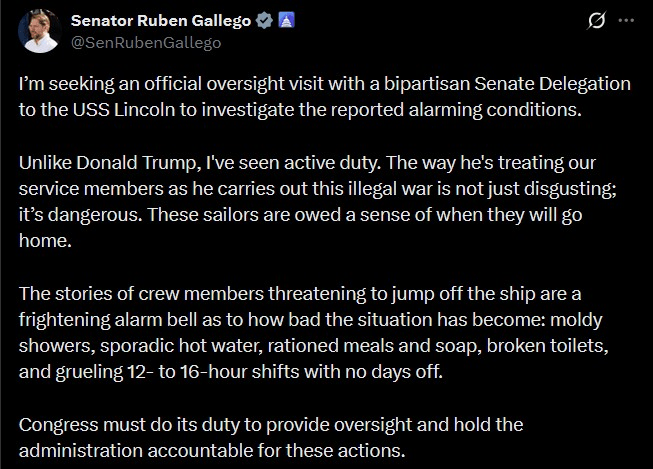
The reports from the USS Abraham Lincoln about multiple sailors attempting to jump into the sea are disturbing. Long deployments are hard. They are a lot harder when the mission isn’t well defined and there is no end in sight. Here is some information on how to get help:… https://t.co/06a8Nu1ckx
The Department of the Navy must allow a bipartisan Congressional Delegation to visit the USS Lincoln to conduct oversight investigation into this horrible situation. CODELs have visited war zones to inspect the conditions of our troops. There is no reason to be denied access. https://t.co/l1OwrXwJo1
NEW: The USS Abraham Lincoln was supposed to come home in May — instead, under Trump's Navy, its sailors are grinding through a ninth month at sea with no end date, and the crew is so broken that multiple have attempted suicide. This should be a national scandal.
The U.S. has long miscalculated due to intelligence failures. Case in point: The war on Iran. Now, an even bigger miscalculation on the Strait of Hormuz.
Worse than fake news is fake intelligence. Be careful.
Allah is Great, Greater than ANY power on Earth. In Allah we trust.
EXCLUSIVE: The wife of the USS Lincoln sailor who jumped overboard last week says she wasn't notified about the incident until four days after & said her husband repeatedly expressed concerns over his mental health but was "brushed off." w/@PriyaReportinghttps://t.co/jJlmtDHHNC
".. deployed for more than 250 days and it has not made a port call in 200 days, setting a record for consecutive days at sea .."@wsj.com http://www.wsj.com/politics/nat…
NEW: The U.S. military has lost at least 45 MQ-9 Reaper drones during the war with Iran, or roughly 25 percent of its fleet, according to three U.S. officials familiar with the matter. The high-demand drones cost between $30 million and $50 million a piece. w/ @noahjrobertson…
Q: A lot of people around here can't afford to fly. Can you say something about gas prices being a dollar more than they were a year ago?SEAN DUFFY: No one complained about Joe Biden's inflation, which was wildQ: Can you talk about gas prices?
Florida allows voucher schools to cite their faith as a reason to deny admission to gay students. But the AG says the same schools can't cite their faith as a reason to deny admission to anti-vaxxers. What a selective version of faith and “freedom.”https://t.co/tdSfAUJwhi
The “covered up” data was published in the New England Journal of Medicine in September 2021, where it has sat, publicly, for five years. It shows vaccinated women miscarried at the same rate as everyone else, about 1 in 8. The 82% figure comes from a denominator error: it counts… https://t.co/HtVOF5dDkR
Shame on you @tedcruz. This is a bald faced lie. You are lying. You are purposely lying. You are purposely spreading malicious & dangerous disinformation. How the fuck do you live with yourself? Shame on you. https://t.co/1s040cuCAZ
🚨BREAKING: A Nebraska court Wednesday rejected the RNC’s lawsuit seeking to block certain U.S. citizens abroad from voting in the state, handing the national GOP another major loss in its escalating legal campaign against overseas voters. https://t.co/4nHl5KtzSE
— Sara McGee for Texas HD 132 (@SaraForTexLege) August 12, 2026
BREAKING WaPo:Republican Rep. Max Miller's ex-wife has filed a federal civil rights lawsuit against Miller and his attorney — alleging that they "recklessly published" a nude image of Miller's 2-year-old daughter online.
BASH: It sounds like you're saying you're not going to return Max Miller's donations because you believe himLAWLER: 😮 Look, this is a private family matter. Max has also made allegations against his ex-wife. Nothing has been corroborated here. Do you have information that proves the allegations?
Watching the media and Democrats fall all over themselves defending Graham Platner is truly next level.
After all the sanctimonious lectures about everything, it turns out, they don’t actually care about Nazi affiliations or sexual abuse and harassment. pic.twitter.com/pV9FrBbO0x
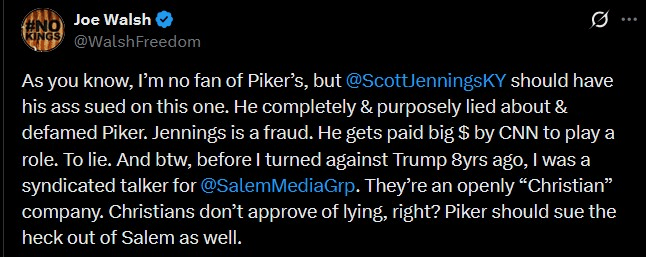
CNN contributor Scott Jennings just falsely accused Hasan Piker of supporting lynchings using out-of-context clips in an attempt to attack Abdul El-Sayed's campaign. Defamation like this is highly unlawful and can result in millions of dollars in damages if Piker sues. pic.twitter.com/7mqYoacwGm
This is beyond insane, even for TX: Fort Worth police just ARRESTED a man for saying "bullshit" while speaking at last week's Tarrant County meeting opposing a plan to cut nearly 50% of Election Day voting locations. He's charged with disrupting a meeting, @startelegram reports.
I’m very disappointed that SacAnime has disinvited me from a Halo 25 reunion at their conference next month. If you thought we defeated Cancel Culture in 2024, guess again! pic.twitter.com/DSEWcIEjDA
Its as simple as just not being an asshole dude. You're not entitled to be at an event when you speak out against the rights of the people organizing it.
CNBC: Do you regret voting for RFK Jr?BILL CASSIDY: If you want to tell me that somebody didn't tell me the truth, and I should've seen in the future they were not gonna tell the truth, you can say, 'Bill you should've seen into the future'
KILMEADE: DHS plans to spend $20 million on electric shock gloves to aid federal agents. How would that work?HOMAN: It's another device to help someone be compliant when they're not. You can't have the first thing you go for be lethal force.
This isn't going to become some anomalous method of arresting people. They will be shocking people like this as a matter of course. pic.twitter.com/U9SuvaMTvu
Pastor David Ritchie is charged with solicitation of prostitution. He is one of eight men arrested during an undercover operation. https://bit.ly/4xs0mDH
BREAKING NYT:A federal judge in Boston just dismissed an antisemitism lawsuit against Harvard University — dealing a blow to the Trump admin's efforts to force the university into a settlement.
The Trump administration is abandoning controversial Biden-era plans to help developers build power lines in areas that badly need increased transmission infrastructure.
Some points I wish to make. First tRump couldn’t take not having his name seen on a building that was to honor the Kennedy family so he kept the tarps up. But why is this building and its prominence that attracts him? The way our society sees and has seen the Kennedy family has long been an issue and sore spot for tRump. In his mind his own family should be the US fake royalty not a war hero president and classy first lady. He raged against predient Kennedy’s son constantly angered that the press never covered his kids the same way. Well that is because while the Kennedy’s were doing good works for the public the tRump kids were ingaged in crimes and money laundering. tRump is fully consumed by his stature and standing with the public and how he is perceived because he is a poor man in a wealthy situation and he is a weak man pretending to be the model strong man. Remember he told Queen Elisabeth that his kids were equal to her kids because he was US royalty like she was British royalty. Hug
Attorneys for Beatty said in a statement that the new naming effort appears to defy a judge’s ruling this year that the center’s board does not have the authority to rename what was intended as a “living memorial” for an assassinated president.
The board voted to change the name of the building to “The John F. Kennedy Center for the Performing Arts Restored and Renovated by President Donald J. Trump.”
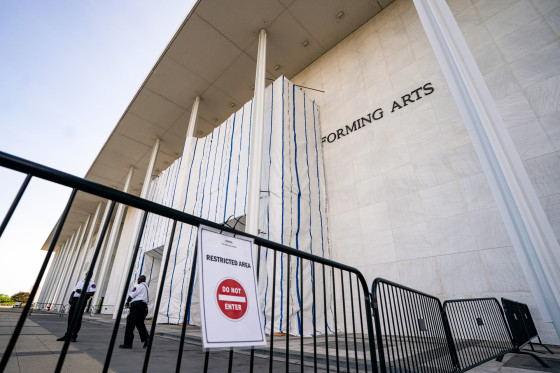
Scaffolding and tarps cover the building name at the John F. Kennedy Center for the Performing Arts in Washington on June 30.Al Drago / The Washington Post via Getty Images file
The Trump-appointed Kennedy Center board voted Thursday to partially close the iconic arts center for up to two years during renovations and to re-add President Donald Trump’s name to the building’s facade, according to a person who attended the virtual board meeting and a second person familiar with the meeting.
The decision would close the Kennedy Center’s main building and keep a smaller addition, known as the Reach, open for some events in response to a May court order requiring the board to maintain the center as a memorial to President John F. Kennedy.
After an almost two-hour Zoom meeting, the board voted 20-3 to change the name of the building to “The John F. Kennedy Center for the Performing Arts Restored and Renovated by President Donald J. Trump” and the physical location to “President Donald J. Trump Plaza.” Commerce Secretary Howard Lutnick proposed the name change.
Trump, who appointed himself chairman of the board last year, joined the call for several minutes, according to the source who attended the meeting.
The three people voting against it are the ex officio members from Congress, Rep. Joyce Beatty, D-Ohio; Sen. Sheldon Whitehouse, D-R.I.; and Rep. Rick Larsen, D-Wash.
“This latest development is a transparent effort to circumvent the Court’s ruling, and flies in the face of the statutes that Congress passed,” Beatty, who was one of the plaintiffs in a lawsuit challenging the Kennedy Center’s renaming, said in a statement. “I will continue to fight for this treasured national monument.”
Attorneys for Beatty said in a statement that the new naming effort appears to defy a judge’s ruling this year that the center’s board does not have the authority to rename what was intended as a “living memorial” for an assassinated president.
“A federal judge already rejected the board’s unlawful attempt to rename the Kennedy Center, and told Donald Trump’s handpicked board that its last closure vote was ill-informed and preordained. Today’s vote is more of the same, and a show of blatant disrespect to the courts,” said the lawyers, Norm Eisen of Democracy Defenders Action and Nathaniel Zelinsky of Washington Litigation Group.
U.S. District Judge Christopher Cooper’s order in May, which temporarily blocked the Kennedy Center’s planned closure last month, also asked that the board provide a financial plan to justify the decision to close it. Keeping the smaller venue open would allow ticket sales for some events, including performances by the National Symphony Orchestra, which is the Kennedy Center’s chief tenant.
The orchestra has performed there since the early 1970s, when the center — conceived by Jaqueline Kennedy as a memorial to her slain husband — opened.
In recent years, under the baton of music director and principal conductor Giancarlo Noseda, it has been rising in stature — but its future is now uncertain because the Kennedy Center’s Concert Hall will not be available. A search for other venues in the area has been underway.
The Kennedy Center’s future has been in limbo for months as Trump moves to reshape the iconic art institution in his image, one of several major Washington renovation projects.
After Trump named himself the Kennedy Center’s chairman last year and filled its board with allies, the board voted unanimously in March to close the center for two years for renovations.
Cooper’s order temporarily blocked the construction work and ordered that Trump’s name be removed, which it was in June.
He also said the board could still ultimately close the center “should it come to this decision anew after independently balancing its multiple obligations to the Center in a prudent fashion.”
Cooper also found the board did not have the authority to rename the center or add a name to it without the approval of Congress, which initially named it.
“The Kennedy Center’s organic statute makes crystal clear that the Center is to be named for President Kennedy, and it cannot bear any other formal name or public memorial based on the Board’s unilateral say-so,” Cooper said in his May decision.
“May the John F. Kennedy Center for the Performing Arts be renamed absent Congressional authorization? The answer, plain from the face of the statute, is no. Nor can any other individual be memorialized on the front portico of the building. Congress gave the Kennedy Center its name, and only Congress can change it.”
The decision to close the center and add Trump’s name to the building has sparked outrage from the administration’s critics, as well as members of the Kennedy family.
Former Rep. Joseph Kennedy III, a grandnephew of the late president, said in a statement last year that the center “is a living memorial to a fallen president and named for President Kennedy by federal law. It can no sooner be renamed than can someone rename the Lincoln Memorial, no matter what anyone says.”
Kudos to @luciengreaves.bsky.social and everyone else who spent so much time on this case. Thanks for your service. This is huge. reason.com/2026/04/02/s…
Inbox: LGBTQ org @EqualityFlorida is condemning an attack text linking to a 2020 report about CD 24 candidate @ShevrinJones being turned away from a blood drive due to his sexuality.
Equality, which endorsed Jones, says it didn't pay for the text, which the text says it did. pic.twitter.com/6fd6bpPhYm
NEW: The DOJ asked SCOTUS to quickly allow the Trump administration to implement his anti-voting executive order after a federal judge issued a nationwide block on the measure.The push underscores the administration's urgency to impose sweeping mail voting restrictions for the midterms.
Since you’re too afraid to debate me, how about you “hold me accountable” on a football field instead. Tackle, no pads like we used to play when we were kids. I’d be happy to show you much I love football. https://t.co/6oQ6sunxZn
TOWN HALL CALLER: Hi Paxton, nice to meet you. I'm just wondering — why did you cheat on you wife?
KEN PAXTON: Um. I'm not going to talk about personal issues that relate to my family, just like I don't think you would want to discuss your marriage on a call with thousands of… pic.twitter.com/9en7qlSdVM
Exclusive: The Trump administration plans to spend at least $900 million on White House grounds construction, a significantly larger price tag than previously reported.Taxpayers would cover most of the cost, according to records reviewed by The Post.
Trump lies out his ass:Q: Why was it too dangerous for you to fly on Air Force One but not for the press?TRUMP: Well, I don't know, I think actually the plane I that I flew on was at greater riskQ: Why do you say that?TRUMP: Because that would be the plane they would be more likely to go for
Every parent wants to keep their children safe, and vaccines are among the most powerful tools for doing that, making deadly diseases preventable. @WHO is concerned that recent changes to US immunization policy are not aligned with decades of evidence that show when children… pic.twitter.com/vCfgJFrFGK
Trump Administration Kills a Flagship Annual Report on the ArcticThe top of the world is warming faster than any other region. For 20 years, the Arctic Report Card chronicled the extraordinary transformation.
Authoritarianism isn’t down the street or around the corner — it's here right now.
The For Our Republic Act lays out a clear roadmap of the actions Congress can take to fight back against Trump’s authoritarian takeover and save our republic!https://t.co/3QKQvPhRwa
🚨SEND PETE HOEKSTRA PACKING🚨The House of Commons petition calling for U.S. Ambassador Pete Hoekstra to be declared persona non grata has already reached 56,215 signatures.🔗 Petition e-7531: http://www.ourcommons.ca/petitions/en…🔗 sendpetepacking.ca❤️🍁🇨🇦TEAM CANADA FOREVER🇨🇦🍁❤️❤️🍁🇨🇦VIVE LE CANADA🇨🇦🍁❤️
Donald Trump and Mike Collins want to pay your tax dollars to violent thugs who ransacked the Capitol to undermine our elections and attacked police officers on January 6th. Georgians will vote accordingly. https://t.co/rnkRI1vU5s
I helped pass this law in 2020. It's purpose is to prevent drug traffickers, Russian & Chinese kleptocrats, and other international criminals from setting up anonymously owned companies to hide their money in the US. Trump's Treasury Dept. is doing this to help criminals. 1/ https://t.co/k7zRPDlwoH
"Beneficial ownership information" is just a record of who actually owns a company. That's all that was being reported here, so that we didn't have LLCs in Delaware laundering millions of dollars through the US and into offshore banks on behalf of totally anonymous people. 2/
Treasury deleting the beneficial ownership info it already gathered is utterly crazy. This database was not public — it was just for law enforcement to use in investigating crimes. It's like Trump ordering the deletion of the FBI's fingerprint database. 3/
Why is the Trump administration doing this? I don't know. But it's certainly good news for rich Russians who want to buy his condos, or Gulf royals buying his fake crypto. The true identities of people he's done business with, if registered with Treasury, will now be deleted. 4/
Congress passed a law — with strong Republican support BTW — saying Treasury had to collect and keep beneficial ownership info. The Trump administration cannot say "we're just not going to do it." 5/
The corruption is endless and staggering, with new examples every day. I continue to post all of it, day after day, and hope at some point enough voters care about it to make a difference against Republicans who refuse to do any oversight. pic.twitter.com/n0sW3BWWdD
Exclusive: The Justice Department has convened a special grand jury in D.C., a rare legal body that officials say could pave the way for federal prosecutors in the nation’s capital to investigate some of its biggest and most controversial cases.
Gov. Newsom: That $400 million Qatari plane? That's not a $400 million gift — it cost you $936 million. That was what was appropriated as he's cutting food stamps and cutting your Medicaid.
A federal judge in D.C. dismissed a lawsuit concerning the cancellation of a concert following the addition of President Trump's name to the venue's facade.
The FCC has played a leading role in Trump’s attacks on news broadcasters, and a third Republican to cast votes at commission meetings will give Chairman Brendan Carr more support for his policies.
🚨BREAKING: President Donald Trump signaled Tuesday he’s willing to declare a national security emergency in an attempt to take over American elections. https://t.co/uosyDUTWN4
There is zero reason to not take Trump at his word that he and his team are planning sonething alarming to disrupt the midterms and beyond. https://t.co/WzNKfAmkDZ
A federal judge in Massachusetts issued another order blocking the US Postal Service from implementing President Donald Trump’s sweeping attack on mail voting and his attempt to create a national voter registration list before the midterm elections. http://www.democracydocket.com/news-alerts/…
Jadon MacCormack, the anti-LGBTQ Christian extremist who ran for State House in Connecticut, has lost his primary.Republicans petitioned to add someone to the ballot so Jadon wouldn't make it to November and drag other candidates down. The plan worked.www.friendlyatheist.com/p/connecticu…
Jadon MacCormack,(announced he's running 2028, CT Congressional District 2) is a proponent of murdering gays. And he lies that he has Repub Party's endorsement in this year's CT House race. (He doesn't.) He's insane. 🤬
This interview highlights the differences between Evangelical hopes and dreams vs Catholic SCOTUS accomplishments.Mike Johnson “has been hapless & ineffective at governing. But has he advanced the cause of Christian nationalism?” he’s been wildly successful.”www.nytimes.com/2026/08/09/u…
Musk gave $1.5 million last month to the Aurora Action Network, a Wisconsin-based political action committee that has already collected contributions from numerous billionaire mega donors.
Count Binface, a self-described intergalactic space warrior, has landed in the center of the U.K.’s political universe ahead of a special election Thursday that was derided as a farce long before the ballot was packed with nearly three dozen candidates — many from the silly end of the spectrum.
Many people say Venezuela rigged the election against Mike Lindell because they don’t like his pillows. Never seen anything like it. https://t.co/qPVqmwLr2w
Civil rights groups are challenging President Trump’s new effort to limit “birth tourism.”https://www.notus.org/immigration/civil-rights-groups-challenging-birth-tourism-order
“The supreme court justice Samuel Alito gained up to $2.9m from his fossil fuel interests between 2005 and 2024, a new review of financial disclosures shows.”
Families of sailors aboard the aircraft carrier USS Abraham Lincoln spoke to Military Times about multiple incidents in which sailors have attempted to go overboard amid the ship's extended deployment in support of combat operations in the Middle East
Trump on the Iran war this morning:"We are low keying it," and plans to wait Iran out economically. “It will work out. It always works out.”www.axios.com/2026/08/09/t…
Breaking: Israel has rejected US President Donald Trump's Board of Peace 15-point plan for Gaza, and will not withdraw until Hamas fully disarms, Prime Minister Benjamin Netanyahu said on Sunday.english.alarabiya.net/News/middle-…
"Immigration and Customs Enforcement officers may soon be outfitted with gloves that can deliver painful electric shocks intended to gain compliance from combative individuals."Susan Collins & Congressional Republicans voted to fund all of this.
David Ellison Threatens to Pull Paramount Out of California Starting Oct. 1 if States Refuse to Negotiate Settlement in Antitrust Suit https://t.co/N8bTxtYGWd
California 🤝 @anthropic.comWe're entering a partnership to strengthen cybersecurity and provide Claude to state agencies at a discount.The Golden State helped build Silicon Valley — and every Californian should benefit from the responsible use of their latest innovations.
Taylor Farms contributed $2 million to Trump & Republicans as they postponed a rule to help the govt. limit the spread of foodborne illnesses.Read @premthakker.bsky.social's deep dive into how Taylor Farms' successful lobbying led to the current outbreak of cyclospora: zeteo.com/p/taylor-far…
A frankly insane story about how a Trump-linked American drilling company is setting up equipment in Greenland to make exploratory borehole, *despite* being denied permission by the Greenlandic government. So much for sovereignty, I guess. https://t.co/L6vrd4qpV5
Dear Greenland, dear Denmark, Don’t even think about allowing this. If you give them an inch they’ll take 100 miles. Kick them out now or accept that you just opened the floodgates. Like Putin, you can’t negotiate with Trump. Showing weakness will just guarantee the next outrage. https://t.co/mzt4ooInVs
A draft rule reviewed by WIRED would prevent the census from counting undocumented immigrants. To protect against “distortions,” it would also bar questions about race and sexual orientation. http://www.wired.com/story/census…
NYT: Kennedy Stirred Vaccine Fears in Pennsylvania Years Before Measles Outbreak By Teddy Rosenbluth @nytimes.com @teddyrosenbluth.bsky.social nyti.ms/4i5wbg5
Between cheeto face falling asleep, RFK Jr. shaking like a leaf like he's going through withdrawal, and some flight attendant wannabee holding her stomach twisting around like a loon, this is the most Hee Haw administration ever.
Negotiations surrounding a possible federal plea deal for Luigi Mangione were ongoing between his lawyers and prosecutors, according to media outlets. (AP photo)
Ben Folds, former Artistic Director of the National Symphony Orchestra, testified before a congressional forum titled “Monumental Waste: How Donald Trump Is Spending Millions Destroying American Landmarks”stereogum.com/2505928/ben-…
Trump Administration Kills a Flagship Annual Report on the ArcticThe top of the world is warming faster than any other region. For 20 years, the Arctic Report Card chronicled the extraordinary transformation.