There is a video at the site linked. How ever as you read through this remember that this is the group that wrote project 2025 and the main author of that Christian nationalist screed is Russell Vought who has a powerful position in the tRump administration. This is entirely about pushing a fundamentalist Christian lifestyle and worldview on the US public with heavy emphasis on quiverful which ishave as many children as possible for Christian families most of whom in that movement lived impoverished on one income. The idea is more kids butts in church pews now leads to more adult butts in those pews increasing tithes and money in the collection plates. Church attendance has decreased steadily and this is designed to increase it again. Plus it removes rights for women and LGBTQ+ families. The parents get the money only if women / the mothers marry young, forgo an advanced education, stay out of the work place, and have child after child after child like a breeding stock farm animal. It is only for the “right or correct types of families” and harms those who are not the “right” kinds of families. Plus it is totally racist with the poor people being cut out of the funds. The fact is minorities make on average far less than white families due to inherent racism and CRT, which is a real thing. Hugs
Last week, I wrote about the Heritage Foundation’s Saving America by Saving the American Family: A Plan for the Next 250 Years. The plan is, essentially, to make women drop out of school, marry young, have tons of babies, rely financially on their husbands, be unable to divorce, and wind up in the poor house if they don’t follow these rules. But I wanted to zero in specifically on the policy section of the piece, which comes at the very end and which I haven’t seen get the coverage it deserves. Because what the Heritage Foundation is proposing is a massive cash transfer from poor single mothers to better-off married couples. This really is the plan: Take from the poor to give to the “right” kind of families. Make poor mothers work, and pay better-off ones to stay home. Further impoverish single mothers to force them to marry.
The Heritage Foundation wants to eventually end cash welfare as we know it (“Credits designed specifically to benefit poor single mothers may be well intended, but they have proven to incentivize single motherhood in poor communities,” Heritage laments). They don’t propose totally doing away with welfare benefits here, I suspect because they realize that would be a nonstarter. But they do propose taking resources that currently mostly benefit poorer families and redirecting them to wealthier ones, so long as those wealthier families have married parents. The Heritage proposal would only give its proposed benefits to married couples (policies should “privilege marriage as directly and explicitly as possible,” Heritage writes, emphasis theirs). It would only give benefits to married couples in which one partner works and makes above a certain income. And it would incentivize women dropping out of the workforce… unless they’re poor or single.
Here are the specifics.
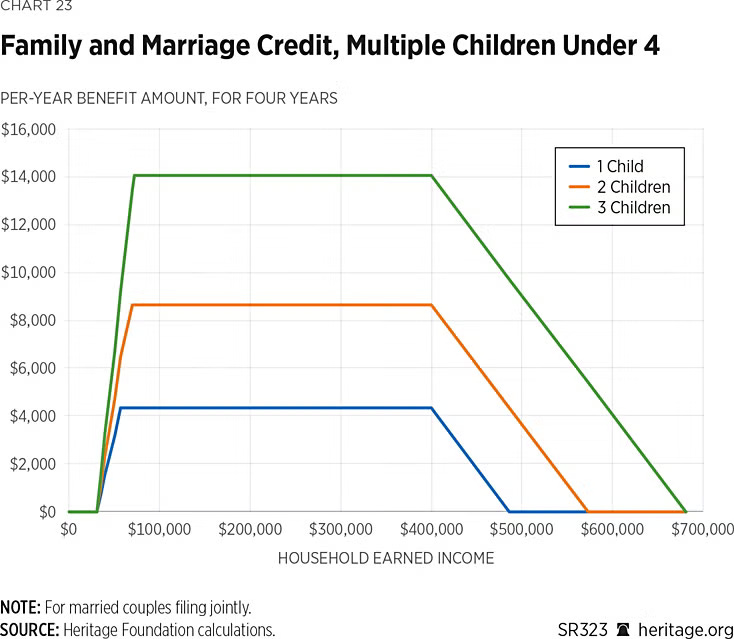
Child tax credits only for married couples who are the child’s biological parents, who are working, and who make at least $30,500. The Heritage proposal would get rid of the Earned Income Tax Credit, because that credit gives more money to struggling single parents than better-off married ones, as well as the Child Tax Credit, and replace them with what they call a Family and Marriage (FAM) tax credit of $4,418 per child per year for four years. But this credit would phase in for families once they’re earning $30,500 per year — in other words, poor families wouldn’t qualify. It would only go to married parents — single parents wouldn’t qualify. It would only go to biological parents — step parents wouldn’t qualify. A person could be working full-time, but even if they’re earning above minimum wage, they may not qualify for this tax credit.
Bonuses for larger families — but only for married couples, only for biological parents, and not for the poor. Additionally, Heritage proposes a 25% per-child bonus to their FAM tax credit for third children and beyond. But, again, poor families are out of luck, as only couples with at least one working spouse qualify, and that spouse has to make at least $30,500.
More money for higher earners, none for the lowest. The FAM credit phases in at $30,500, and goes up from there relative to income. That’s right: This is government family support that gives more money to families that already have more money. And it gives the most money to families that are the most stable: Those with two married parents who make more than six figures. The credit doesn’t begin to scale down until a family makes $110,000, and even then, the wind-down is small (beginning at just 5%). Why set up a program that gives people more money as they make more money? Because “the FAM credit’s phase-in would incentivize work.” All of this means that a married couple with three children making $400,000 a year would get $14,000 additional dollars from the US taxpayer — while a single mom making $20,000 a year would get nada.
No help after a child’s fourth birthday. As it stands, parents can claim the Child Tax Credit until a child’s 17th birthday. The Heritage plan cuts parents off when their kid turns four. They claim that these early years are when parents need the most help. But children don’t stop needing food and a roof over their heads once they’re kindergarten age. The Heritage Foundation is clear that the purpose of this plan isn’t to support children, but to incentivize parents to have more of them: “The FAM credit is designed specifically for families with newborns or young children. Lawmakers interested in family policy may be inclined simply to expand the CTC. However, this approach would be inefficient as a family formation incentive. Only a small fraction of the benefit would go toward new parents, while most of it would go to families that are already formed.” They continue: “many other family benefits, such as the CTC, are backloaded to later in life when many parents are on more solid financial footing and may be past their prime child-bearing years.” Emphasis mine, because this is truly stunning: The Heritage Foundation only wants to give parents tax credits for their (expensive) children if those parents (mothers) are in their “prime child-bearing years” and might make more babies. Eggs too old? No child tax credits for you.
Pay women to stay home. The Heritage Foundation could have proposed a generous paid leave program, which would allow parents of newborns to stay home and care for them in that crucial first year. But their aim is not to make sure that young children receive the best possible care. Their aim seems to be to get women out of the workforce. And so they’ve instead offered a $2,000 per-child credit for one parent (almost always the mother) to stay home and care full-time for her child — but again, this only applies to married couples where one spouse (almost always the husband) is working and makes more than $30,500 per year. You’re a single mom who wants to stay home with your child? Tough luck, get to work. You’re a low-income married parent who wants to stay home with your child? Tough luck, get to work. If the concern really were for children — if the view really was that young children are best off being cared for at home by a parent — then this policy would apply to all parents of young children. But that’s not the concern. The concern is that women aren’t living their lives in the way Heritage deems acceptable.
Fund this whole scheme by getting rid of Head Start. Head Start is an incredible program that has had vast positive impacts, increasing high school and college graduation rates, adult incomes, health outcomes, and overall wellbeing. Studies have found it even decreases child abuse and neglect. This proposal would effectively end it, and use the money saved to give tax breaks to wealthy married couples with children.
Pay people to marry young. The final Heritage policy is a $2,500 deposit into a savings account for every new baby born in the US — but the only way to get the full benefit of that money as an adult is to marry well before the age of 30. That is, when an American is born, the government will deposit $2,500 into a savings account for them, which they cannot touch until they either marry or turn 30. At either marriage or age 30, they can start to withdraw from the account, but only over three years — so about a third of the original value per year. They get the full withdrawal amount each year (roughly one-third of the total account value) if, in each year, they are married but not yet 30. If they’re over 30, whether they’re married or not, they pay a tax penalty. In other words, to get the full benefit, you have to marry by 27 — below the average age of first marriage for women (28.6) and men (30.2) alike. Again, the point is not to incentivize marriage; it’s to incentivize women especially marrying as young as possible, despite early marriage being tied to higher divorce rates.
xx Jill
Subscribe to Throughline by Jill Filipovic
Hundreds of paid subscribers
Connecting the dots. Politics, culture, women’s rights, foreign affairs, law, and more.
Again all this is about is a Christian nationalist desire to mimic Russia and remove all LGBTQ+ representation from the public view in the name of “protecting children from porn” as if just being or media representing LGBTQ+ people is pornographic and sexual. These people feel anything not straight and cis is sexualizing and abusing children simply because they do not want the LGBTQ+ people to exist. Hugs
Side note. Ron got home last night 3-2-2026 about 6 pm. I made him a supper of a salad and two hamburgers with the fixings. He was so happy. I was happy. We went to bed and snuggled which made Tupac who has snuggled me every night a bit unhappy but he pressed in from the other side. All day Ron and I have been together, unloading the car, doing laundry, Ron started on the floors in the kitchen, and we are making a pork tenderloin, potatoes, brown gravy, carrots, and greenbeans for supper. It is so good to have my husband home. I understood why he had been gone for the better part of three months but it sure is grand to have him home. I feel better, anxieties lower, and happy feeling up. Also for those worried I was not eating which I was not, I ate like a pig at a trough tonight, having a first heaping plate of everything and then going back for a second heaping plate. The end of the second one was a bit challenging to finish but I did. I offered to pick up the last bits of left overs but ron said he would do it. I think he noticed I was trying to hide that I was swaying and wobbleing when I walked due to my pain levels. Hugs
Discussion of gender is not sexualization. Making books available to students that represent the diversity of their experiences and showcase the numerous ways to be a person in the world is not sexualizing them. Such an interpretation says far more about the adults and the perspectives they’re applying to books than it does about the books or their intended audiences.
Following this week’s State of the Union Address, House Republicans worked quickly to advance legislation to ban books from public schools nationwide. House Resolution 7661 (H.R. 7661), also known as the “Stop the Sexualization of Children Act” would modify the Elementary and Secondary Education Act of 1965 by prohibiting use of funds under the act “to develop, implement, facilitate, host, or promote any program or activity for, or to provide or promote literature or other materials to, children under the age of 18 that includes sexually oriented material, and for other purposes.”
The bill was introduced by House Representative Mary Miller (Republican, Illinois). 17 additional Representatives cosigned it.
H.R. 7661 is an anti-trans bill, and tucked within its provisions are those that ban books for those under 18 that “include sexually oriented material.” This is the same vague language used in numerous states across the U.S. to ban books from public schools and public libraries. This bill includes “lewd” and “lascivious” dancing as prohibited topics or themes. No such books for young readers exist, but facts don’t matter to a regime seeking total and complete control.
The bill goes on to further define “sexually oriented material” as anything broaching the topics of “gender dysphoria or transgenderism.” The latter is an intentionally harmful word used as a cudgel to harm trans people. Such a broad definition also ensures that this kind of bill could be applicable in any situation where it would benefit the banners. It isn’t a stretch to see a bill like this used to outright ban all books by or about LGBTQ+ people under the guise of it being “sexually oriented.”
Though this legislation would apply to institutions using funds from the Elementary and Secondary Education Act of 1965, there’s little question that it would expand to include all public libraries, not just those in public schools. We’ve already seen this very thing play out across the country.
These local-level policies, alongside state-level policies like Iowa’s Senate File 496 and Idaho’s House Bill 710–both still working their way through numerous lawsuits–provided the roadmap for the proposal of federal-level book ban legislation. It was only a matter of time, and the ongoing onslaught of anti-trans legislation and rhetoric that has grown exponentially under the Trump-Vance regime made this the prime moment.
Discussion of gender is not sexualization. Making books available to students that represent the diversity of their experiences and showcase the numerous ways to be a person in the world is not sexualizing them. Such an interpretation says far more about the adults and the perspectives they’re applying to books than it does about the books or their intended audiences.
You can read the full text of H.R. 7661 here, including its list of cosponsors. Right now, your best way to have your voice heard about this hateful and discriminatory bill is to call your House representatives and urge them to veto this bill at every opportunity. There are years’ worth of resources from which you can pull about where and how all of these bills are calculated and targeted, and you can pull from the numerous ongoing lawsuits challenging similar bills and policies at the local and state level. Let your lawmakers know that you’re watching them and their voting records, especially if they’re among the roster of those proposing the legislation.
These bills aren’t about removing books; books are just one of the tools. These bills are about the complete and total erasure and removal of queer people from American life.
Don't be fooled by this bill's name– this is a book banning bill that will exclude LGBTQ books from all public schools NATIONWIDE.Call your congresspeople and tell them to VOTE NO on this nakedly bigoted book banning bullshit. http://www.congress.gov/bill/119th-c…
The conflation of porn and LGBTQ (but specifically trans) issues is purposeful. It's part of the Project 2025 plan to criminalize LGBTQ+ ppl.It starts with books. It moves to bathrooms. Then it moves to govt IDs. We're in it already.You don't need to be an expert to see where this goes next.
Nazi Republican Mary Miller who has quoted Hitler in the past now wants to ban strippers in public schools…and she's all in with banning any book that dares mention LGBTQ+ issues…www.lgbtqnation.com/2026/02/gop-…
First the judges started questioning the truth of government officials and attorneys. Then the judges accused the DOJ / ICE of ignoring court rulings and orders. Now in this case Bondi’s posts clearly violate a judges orders and the constant posting on social media is designed to color or bias the public and potential jurors. The coruptin of this administration if beyoung anything we have ever seen in the US. I just read that Kash Patel has ordered the elete tatical teams around the country to rotate providing complete security and transportation. Not the regular FBI but the strategic elite teams. Hugs
“The government failed to respect Ms. Flores’s dignity and privacy, exposed her to a risk of doxxing, and generally thumbed its nose at the notion that defendants are innocent until proven guilty. The post also directly violated a court order sealing the case,” the judge wrote. “Notwithstanding, the government now seeks an accommodation from the Court that it blatantly failed to give Ms. Flores and her codefendants.”
The attorney general’s posts included names and photographs of the defendants.
Attorney General Pam Bondi’s posts made the government’s request for court-ordered discretion for its agents “eyebrow-raising, to say the least,” one judge wrote. | Allison Robbert/AP
Two federal judges have raised concerns about Attorney General Pam Bondi’s use of social media to publicize a wave of arrests last month of people charged with interfering with federal officers during an immigration enforcement surge in Minnesota.
In an order earlier this week, Magistrate Judge Dulce Foster said Bondi’s posts on X including the names and, in many instances, photographs of the defendants shortly after their arrests “violated a court order” placing those cases under seal.
Foster leveled the criticism in connection with the prosecution of Nitzana Flores, a South Haven, Minnesota, resident accused of assaulting two Border Patrol officers during a scuffle last month in Minneapolis surrounding the arrest of another person for allegedly ramming a government vehicle.
The judge said Bondi’s posting of the names and arrest photos undercut prosecutors’ request for an order to prohibit defense attorneys from publicly disclosing personal information about immigration agents involved in the case against Flores. The requested order would also prohibit any defense counsel from sharing that information with their client.
Foster said Bondi’s social media posts made the government’s request for court-ordered discretion for its agents “eyebrow-raising, to say the least.”
“The government failed to respect Ms. Flores’s dignity and privacy, exposed her to a risk of doxxing, and generally thumbed its nose at the notion that defendants are innocent until proven guilty. The post also directly violated a court order sealing the case,” the judge wrote. “Notwithstanding, the government now seeks an accommodation from the Court that it blatantly failed to give Ms. Flores and her codefendants.”
Foster modified the government’s proposal by broadening it to cover any party, victim or witness, while narrowing it to details such as phone numbers, residential addresses, email addresses and dates of birth. The judge also declined to restrict what evidence Flores can see and declined to prohibit disclosure of identities, which would include names and photographs.
At a hearing in a separate Minneapolis case last week, another magistrate judge, Shannon Elkins, directed prosecutors to “address whether the public posting of photographs violated the Court’s sealing order.” The government missed a deadline Tuesday to respond. Elkins later agreed to extend the deadline until Monday.
Justice Department spokespeople did not respond to requests for comment, but there are signs that Bondi got the magistrates’ messages.
On Friday, Bondi was careful not to jump the gun when announcing a new, massive wave of arrests in connection with a disruptive immigration-related protest at a St. Paul church last month. The new indictment Bondi announced added 30 defendants to the nine people already charged, who include former CNN anchor Don Lemon.
“YOU CANNOT ATTACK A HOUSE OF WORSHIP,” Bondi wrote in an X post that went up within a minute of the indictment being unsealed in the court’s online docket. “If you do so, you cannot hide from us — we will find you, arrest you, and prosecute you. This Department of Justice STANDS for Christians and all Americans of faith.”
While booking photos or mugshots are public in many states, the federal government has traditionally cited privacy concerns to resist making them public in federal criminal cases. In 2012, the Obama administration instituted a nationwide Justice Department policy to refuse release of such photos, except where necessary to track down a fugitive or for investigative reasons.
That policy appears to have been abandoned after President Donald Trump returned to office last year. The Justice Department has for decades routinely publicized the names, ages and hometowns of people arrested by including that information in press releases.
A recent article from Jesse Singal in the New York Times seemed to indicate the organization might be quietly retreating from supporting trans youth care.
Erin In The Morning is a reader-supported publication. To receive new posts and support my work, consider becoming a subscriber.
Yesterday, anti-transgender activist and columnist Jesse Singal published a piece claiming there were “cracks in the wall” around gender-affirming care (which you can find fully fact-checked here). To make that case, he relied heavily on a statement from the American Society of Plastic Surgeons that bypassed the organization’s normal scientific review process and was advanced under pressure from leadership aligned with the Trump administration, including a president who is a major Republican donor. Singal also invoked the American Psychological Association, suggesting the organization was retreating from its 2024 position supporting transgender care and rejecting claims that gender identity is “caused” by external factors. But a representative for the APA tells Erin In The Morning that the organization stands firmly by its 2024 guidelines supporting transgender youth care and provided documentation indicating Singal mischaracterized its position.
“No, APA’s position has not changed,” says a representative speaking for the APA, attaching a link to their 2024 policy statement which provided broad support for gender-affirming care. “APA continues to support unobstructed access to evidence-based care for transgender and gender-diverse individuals of all ages.”
The 2024 policy statement is to date one of the most significant supportive stances of any medical organization for gender-affirming care. It states that gender-affirming medical care is medically necessary, opposes bans on gender-affirming care, declares that being transgender is not caused by autism or post-traumatic stress, establishes the organization’s support for combatting disinformation on transgender healthcare, and finds that rejection of a trans youth’s gender identity can increase their risk of suicide and harm their psychological wellbeing. The policy was passed overwhelmingly, 153-9, with each voter representing a large subset of the organization’s 157,000 members. Now, the organization says that it is not accurate to claim that there is any regression on support for transgender youth care from the organization.
The organization also disputes Singal’s portrayal of a 2025 letter written by Katherine McGuire to the Federal Trade Commission. In his piece, Singal claims the APA “cautioned that gender dysphoria diagnoses could be the result of ‘trauma-related presentations’ rather than a trans identity,” and noted that “co-occurring mental health or neurodevelopmental conditions (e.g., depression, anxiety, autism spectrum disorder) … may complicate or be mistaken for gender dysphoria,” framing this as evidence that the organization is retreating from its 2024 policy supporting transgender youth care. That interpretation is incorrect, according to an APA representative, who says the letter does not contradict the organization’s 2024 position and does not represent a regression in its support for evidence-based transgender care.
The FTC letter sent by APA Services was not saying that transgender identity can be caused by autism or depression. Rather, it was describing what any competent psychologist does with any patient: assess the whole person, including whether conditions like depression or anxiety are present. The letter does not say that depression or anxiety or autism cause gender dysphoria; it says that psychologists are careful about not mistaking these conditions for gender dysphoria. Notably, the letter was written in direct response to the Trump administration’s FTC, which had accused gender-affirming care providers of deceiving consumers, and McGuire was explaining that psychologists conduct thorough, individualized assessments—not that the organization’s position on care or “causes” of being transgender had changed. Had McGuire not indicated that psychologists were making these determinations, the FTC would likely then accuse the organization of not investigating its crank theories on gender dysphoria.
You can view the letter here:
American Psychological Assocation Response To Ftc Rfi Gender Affirming Care 9 26 2025 Signature (1)
“The 2024 policy statement and the 2025 FTC letter are consistent. The 2024 statement reflects the organization’s policy position on access to care. The 2025 FTC letter describes what competent psychologists do in individual clinical practice: they do not make generalized claims to families but instead provide individualized, evidence-based assessment. Both documents reflect APA’s consistent commitment to evidence-based psychological care,” says the representative.
The American Psychological Association’s reaffirmation of its support for transgender youth health care is significant. The organization is among several reportedly under FTC investigation as part of a broader effort to pressure medical bodies to retreat from transgender youth care. It is also facing a coordinated pressure campaign from anti-trans activists like Jesse Singal and outlets such as The New York Times, both of which have repeatedly sought to cast doubt on established standards of care. That context makes Singal’s portrayal especially consequential. Readers were left with the impression that the APA was backtracking. According to the organization itself, that is false. What Singal presented as evidence of “cracks in the wall” was yet another attempt to manufacture doubt around the professional consensus supporting transgender youth care.
Erin In The Morning is a reader-supported publication. To receive new posts and support my work, consider becoming a subscriber.
I have posted roughs here and there since my stroke, but I haven’t done a blog of them. I didn’t expect to be drawing that many since it’s kind of difficult to draw, but lo and behold, I’ve been drawing a lot of roughs lately. To share those, I figure the best thing to do would be to bring back the blogs of roughs.
There may be a few of these that I have already published, but I can’t remember them all, and I’m not going back through my blogs to see what I have and haven’t published.
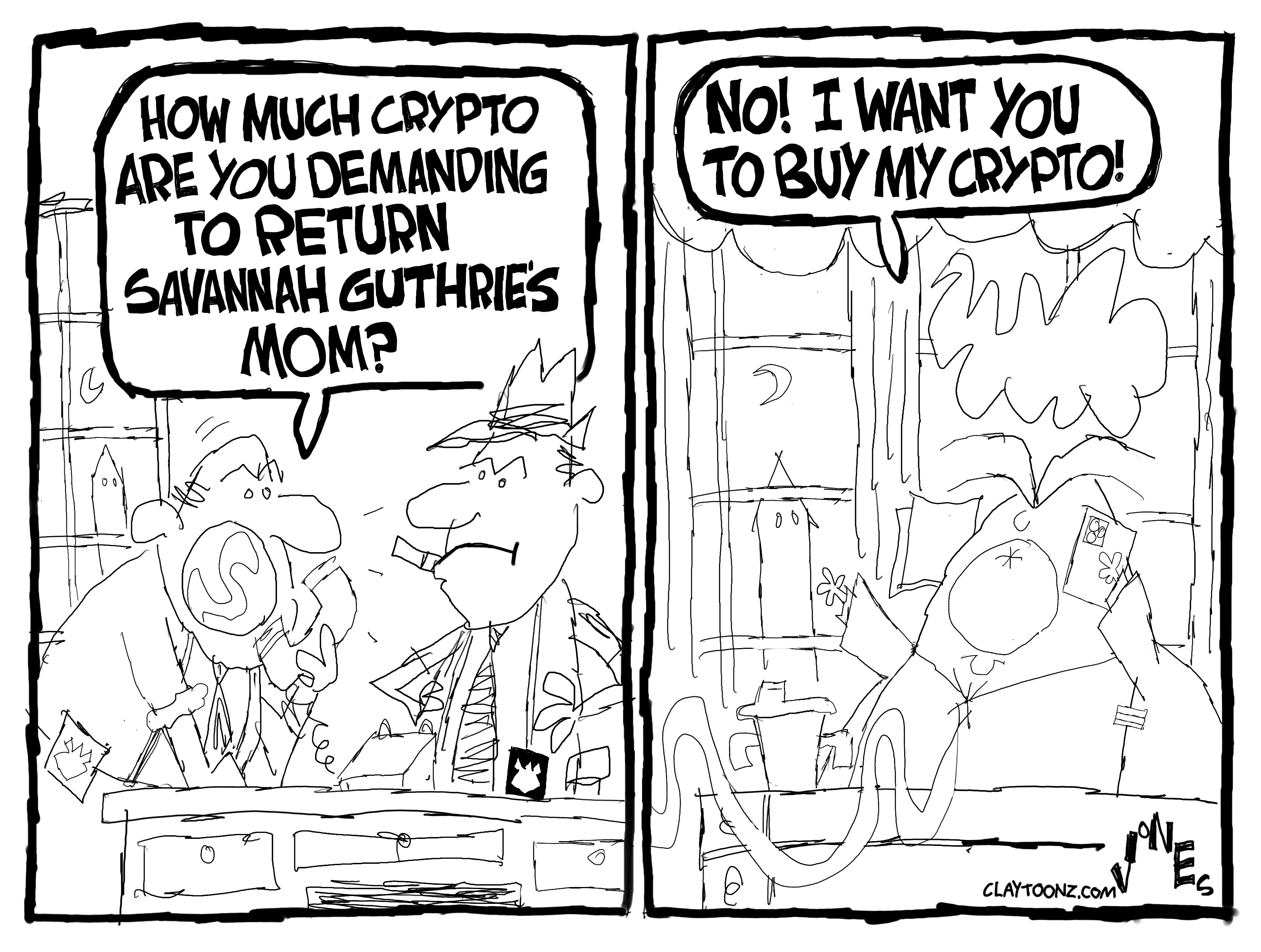
I’ve been sitting on this one for about two weeks. I like the idea of them being in the same location, with the tell being the Washington Monument.
I don’t remember if I shared this one already, but it was drawn on February 18. The cartoon I eventually drew and published that day was the right one.
I didn’t think this was going to work, and the two people I showed it to didn’t get it, even though they had seen the movie The Jerk. (snip-MORE)
Did you watch the State of the Union last night? If you didn’t, no worries. I got you. And if you did not watch, no one can blame you. At an hour and 47minutes, it was the longest State of the Union address to Congress ever, even breaking the previous record, which also belonged to Donald Trump. When it comes to giving long-ass boring speeches that don’t seem like they want to end, Donald Trump is the Fidel Castro of American politicians.
To give you the gist of the speech, I’ll share what a few writers from The New York Times stated: “A tedious, tiresome performance,” “crabby rambling,” “the heat mongering continues,” and “long, exhaustive, and repetitive.” The speech probably did very little to lift Trump up from his current 36% approval rating.
Trump didn’t give a lot of details of his agenda or programs last night, so he killed time by handing out awards like it was a game show because, you know, showmanship. He handed out two Congressional Medals of Honor, one Purple Heart, and the Presidential Medal of Freedom to a hockey player. These are all awards that Donald Trump would love to give himself. (snip-MORE)
Welcome back to Cover Snark! These covers were all sent in by the community!
From Jane Buehler: At first glance (small thumbnail) I thought he was shooting out a laser beam from his chest!
Sarah: That’s an interesting place for a stigmata.
Amanda: Why is he so grainy, like his skin is the texture of a basketball.
Sarah: Wait. WAIT. Whatever this cheetah-print thing is, it is both above and below his pec. What IS that?! Why is it partially encircling his pec? Why is it shooting out pink silly string? WHAT IS THIS.
And this is only the first cover. God help me with this set.
From Jen: My cousin introduced me to you guys a while back. We have a regular cousin chat about your Cover Snark because it cracks us up.
Recently I was at a gift shop and saw this gem. I immediately shared it to the cousin chat and they encouraged me to submit it!
Thanks for giving us all so many laughs.
Sarah: At first glance this looks unremarkable, but the more I looked the tiltier my head got. Why does his chest hair patch match the small patch of hair on his arm? I’m presuming the Yankee’s logo is backwards on purpose but also ????
And her boobs are going in very different directions – unless she’s got one of those bathing suit tops that only holds in one tit and the other is free to roam. I Hate suits like that. Also she’s reading a book called HOWL and that’s very funny.
There are a lot of stylistic choices that I really like, and also some details that I do not get.
Claudia: I have one question — why he doesn’t seem to have eyes?
Sarah: I was wondering that, too! It looks like they got blurred or something? Why does she have features while he does not?
Amanda: Why are we not talking about the fact that he’s a satyr?!
Sarah: A satyr in that shirt!
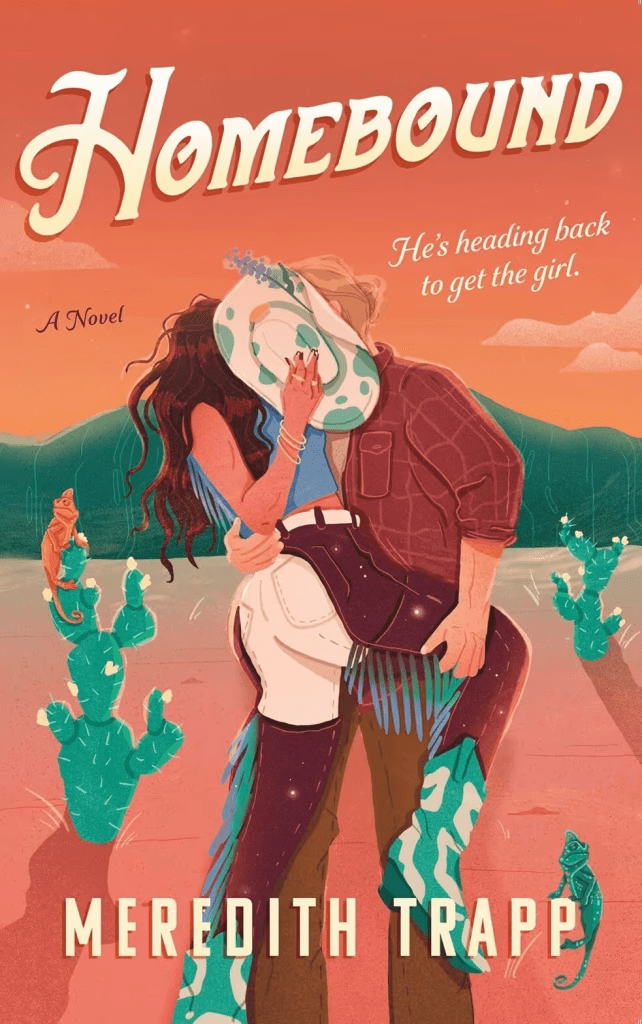
From Marianne: This popped up in my edelweiss+ pre-approved and I had to embiggen because what was I even looking at? Who wears light beige jeans with their chaps???
Sarah: WHAT is WITH the cowboy-hat-hides-the-faces trend? Do people not like drawing faces? Or is kissing difficult (I imagine it is) to draw?
And WHY would anyone wear light jeans with chaps. I get that it’s a Look, but also it’s a Laundry.
Amanda: It reminds me of when you’re in middle school and you draw people with their hands in their pockets or behind their back so you can avoid it.
Sarah: “Where’s your teal and white cow print cowboy hat?”
“Why?”
“I need it for reasons.”
From Deborah: Is he giving himself a simultaneous breast and pelvic exam under the watchful eyes of Dr Giant Tree Wolf?
Sarah: That’s a very intimidating way to do a breast exam.
Amanda: It also looks like he’s checking his crotch. Perhaps he’s just making sure everything is where it should be.
Sarah: So many cover models do that. Should we be worried? (snip)













 Scottie's Playtime