As Swiss glaciers melt at an ever-faster rate, new species move in and flourish, but entire ecosystems and an alpine culture can be lost
Photographs by Nicholas JR White By Katherine Hill
From the slopes behind the village of Ernen, it is possible to see the gouge where the Fiesch glacier once tumbled towards the valley in the Bernese Alps. The curved finger of ice, rumpled like tissue, cuts between high buttresses of granite and gneiss. Now it has melted out of sight.
People here once feared the monstrous ice streams, describing them as devils, but now they dread their disappearance. Like other glaciers in the Alps and globally, the Fiesch is melting at ever-increasing rates. More than ice is lost when the giants disappear: cultures, societies and entire ecosystems are braided around the glaciers.
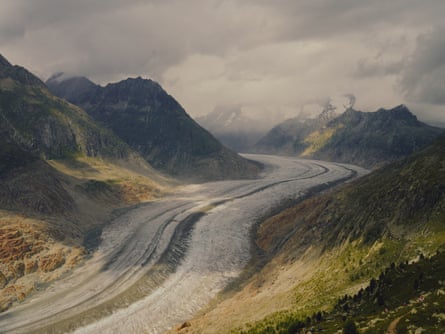
The neighbouringGreat Aletsch, like the Fiesch, flows from the high plateau between the peaks of the Jungfrau-Aletsch, a Unesco region in the Swiss canton of Valais and Europe’s longest glacier. It is receding at a rate of more than 50 metres a year, but from the cable car above it remains a mighty sight.
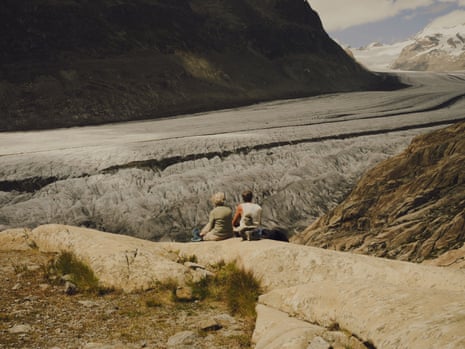
The Aletsch glacier viewed from Moosfluh, looking towards the Olmenhorn and Eggishorn peaks
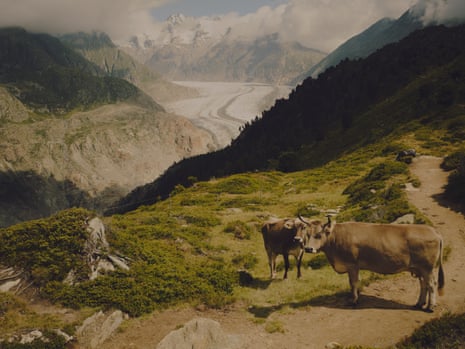
Clouds scud across the sky and shafts of light marble the ice. On the rocky slopes leading down to the glacier from the ridge, there are pools of aquamarine brilliance, the ground speckled with startling alpine flowers. The ice feels alive, with waterfalls plunging into deep crevasses and rocks shimmering in the sun.
“It’s just so diverse, these harsh mountains and ice, and up the ridge, a totally different habitat,” says Maurus Bamert, director of the environmental education centre Pro Natura Aletsch. “This is really special.”
Participants now pray for the glacier not to vanish, but they once prayed for it to retreat and stop swallowing their meadows
Many of the living worlds in the ice and snow are not visible to the human eye. “You don’t expect a living organism on the ice,” Bamert says. But there is a rich ice-loving biotic community and surprising biodiversity that thrives in this frozen landscape.
Springtails or “glacier fleas” survive on the snow’s crust – this year alone, five new species were identified in the European Alps. But there are also algae, bacteria, fungi and ice worms, as well as spiders and beetles, which feed on springtails.
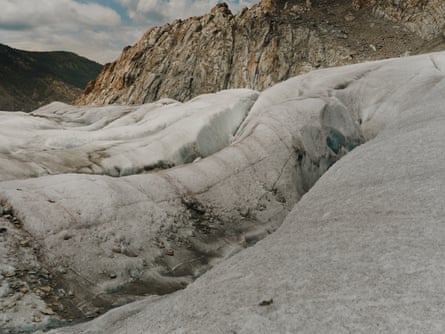
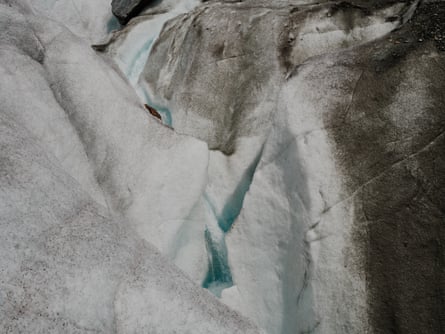
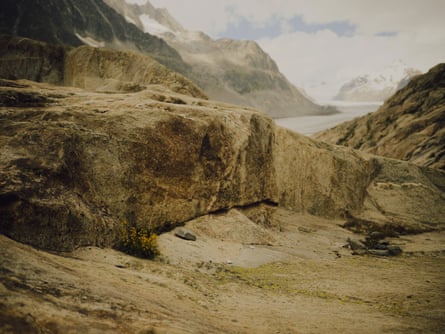
Folds on the glacier showing the sooty crust left on the ice from fossil fuels, wildfires, mineral dust and organic matter. The bare rock shows the retreat of the ice, leaving meltwater pools and rivulets cutting through the ice
As ice melts, this landscape and its inhabitants, human and non-human, are all affected. Along the glacier’s path, ice turns to water and the rushing sound of the river becomes audible. In 1859, at the greatest extent of its thickness, the glacier reached 200 metres higher than it does now.
The landscape revealed by the melt is mostly bare rock, riven with fissures that spill across the hillside. Jasmine Noti from Aletsch Arena,the regional tourism organisation, says these widen each year, new cracks appear and routes are redesigned. The ice acts like a massive buttress, gluing the hillside together, and as it melts, slippage and instability increase.
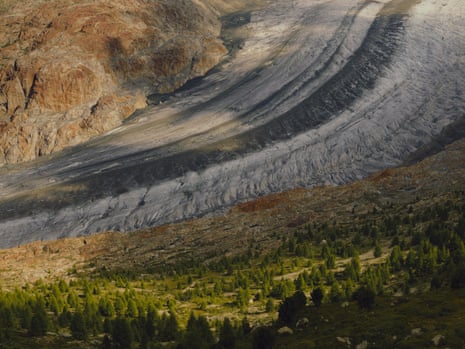
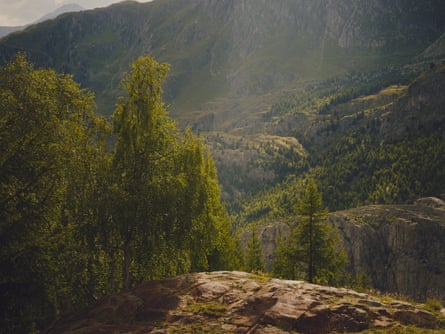
As the edges of the glacial valley descend into the cool cover of the Aletschwald forest, “it’s like walking through time”, says Bamert. On the higher slopes, older pines dominate, but lower down the trees thin, and the pioneer species of larch and birch cover the hillside: early signs of newer postglacial reforestation.
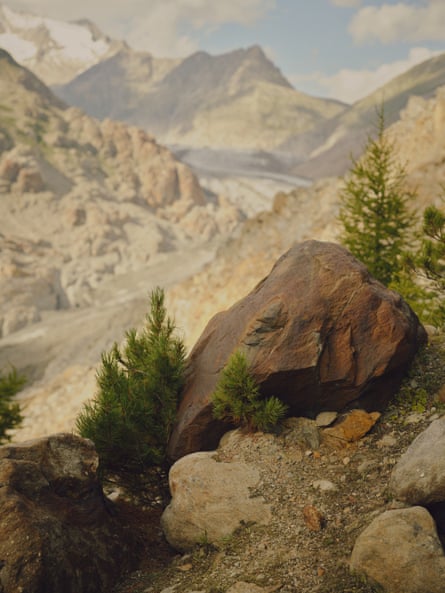
It only takes about five to 10 years for plants to colonise the land. Further down yellow saxifrage and mountain sorrel cling to the rocks. All this was once under ice sheets, but the succession of growth tells a story of glacial retreat, historic and recent.
Larch and birch are beginning to cover hillsides laid bare by the retreating glacier, with pines higher up the slopes
Tom Battin, professor of environmental sciences at Lausanne’s Swiss Federal Institute of Technology, says glacial margins are a transitional landscape where ecosystems are vanishing and appearing. An expert on the microbiology of stream ecosystems, Battin led a multiyear project on vanishing glaciers and what is lost with them.
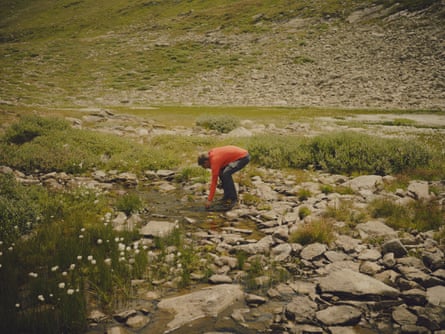
As he walks down to the Märjelensee, one of the Aletsch’s glacial lakes, this transition is readily apparent. In this mountain hollow, there was once an expansive lake with ice cliffs around its rim. Today, the pools of water are lit by patchy sun and rain, fish jumping and bog cotton dancing in summer light.
Battin points to aquatic mosses. These, he says, could never live in glacial streams which are fast flowing and extreme. Wading into the water, he searches for the golden-brown blooms of a particular alga, Hydrurus foetidus, which is a keystone species that thrives in glacier-fed rivers, fixing carbon dioxide into organic matter.
Prof Tom Battin inspects a stream near the Märjelensee. He studies the biodiversity that will be lost with glaciers
Lee Brown, professor of aquatic sciences at Leeds University, has studied invertebrate communities in glacier-fed rivers around the world, and says we do not yet know the full importance of those that are likely to disappear.
“It’s a challenge to communicate,” he says, pointing out the crucial roles that tiny organisms have in the “trophic networks” – the nutrients flowing between organisms within an ecosystem – that connect ice, rivers, land and oceans. Biofilms, or communities of micro-organisms that stick to the surface of ice and rivers, filter the water. Glaciers wash down vital nutrients from the mountain, but their rivers may run dry when the ice melts.
Without this biodiversity which you can’t see, all that other biodiversity that people care about might disappear
Tom Battin
There are whole worlds in and around the ice, poorly known and understood until recently. Mountains are like high islands, Battin says, with unique ecosystems and endemic species.
“Without this biodiversity which you can’t see,” he says, “all that other biodiversity that people care about might disappear.”
Pioneering plants and trees such as birch and larch colonising the slopes above the Aletschwald
Francesco Ficetola is a professor of environmental science at Milan University who leads the PrioritIce project examining emerging ecosystems in glacial forelands, or land exposed by the retreating ice. As it melts, he says, “there’s a powerful combined effort of organisms” to create new and increasingly complex habitats.
As something is gained, however, much is lost. Cold-climate specialists such as ptarmigan and Alpine ibex are retreating up mountains, their habitats becoming ever smaller. The Swiss pines, on whose seeds nutcracker birds feed, are also moving upwards. Specialist alpine flowers and other pioneer plants at glacier edges are threatened, pushed out by the succession of forests and meadows.
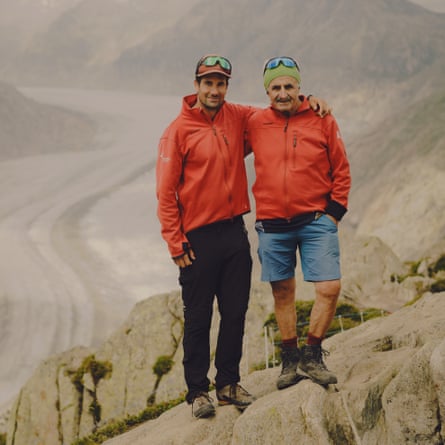
Admiring the Aletsch glacier. A timeless landscape, but for how much longer?Local guides, father and son Martin and Dominik Nellen
For the people of this region, too, life alongside the glacier is changing. The guides Martin Nellen and his son, Dominik, have lived with the Aletsch glacier all their life. Martin jokes that the older he gets, the farther he must climb from the ridge to the glacial valley as the ice melts. “It’s rubbish,” he says.
Martin was instrumental in raising funds for information boards, which he also helped design, that explain the life story of the Aletsch. Dominik says they feel “sad, of course” about the glacier’s retreat, but they are also proud to educate people about glaciers and the distinctive landscape of snow-covered peaks and lush pastures.
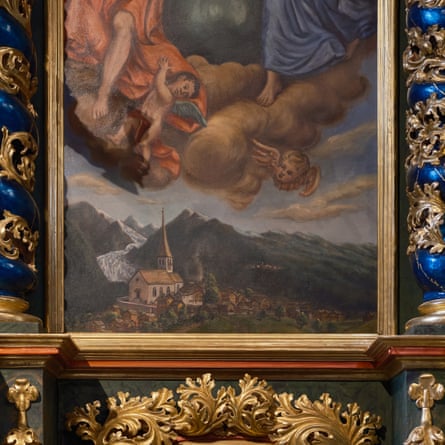
Every year at 6am on 31 July people gather for a procession that winds from the church in Fiesch to the Mariahilf chapel in the forest above. Participants now pray for the glacier not to vanish, but they once prayed for it to retreat and stop swallowing their meadows and grazing land.
An altarpiece in the chapel in Ernen, showing the Fiesch glacier
Divine assistance was first requested in 1652. Rosa, one of those gathered for the pilgrimage, remembers the deep snow and cold of past years. “I have been going since I was five,” she says. “There used to be more people.”
This procession is special for the reversal of its request, but similar stories exist across the Alps. They are a reminder that something intangible is lost as glaciers disappear. The great rivers of ice have shaped the imaginations of inhabitants and visitors. Not everyone sees the glacier through the lens of faith, but many visitors – whether praying, guiding or educating – worry what the future holds.
At a place called Baseflie, a cross still stands, erected in 1818 to banish the Aletsch glacier when it threatened pastures. Today, the wooden silhouette against a blue sky seems like a memorial to all that may be lost as glaciers vanish.
Hi everyone. I have a video started to address a lot of what happened. But I had a horrible week and only wanted to hide from life. Long story short if I don’t finish the video as so often happen. At the beginning of the week I talked to my primary care doctor about my childhood in vague terms, the intrusive thoughts that have gotten worse, and the nightmares / yelling out at night. He admitted he was out of his depth on the issue but would help as much as they could and that they have a therapist on site that works with a psychiatrist and if I would see her she could help me better. Next week I will call her. He prescribed a medication to help me but I won’t take it. It kills your sex drive and ability entirely. Ron got on it before we knew what it did, and so now he will try to get off it. For a long time we did not know or understand why his desire and ability just stopped, now we know that it was the medication. Then Thursday coming home from the allergist the car broke down. I was lucky I was able to get it safety off the road on to a side street. Then I dealt with the getting it towed and all that. Then Friday I saw a podiatrist and found out that there is nothing they can do to help me, another one thing I have to learn to live with. It was all too much for me. Today we are finishing the floor in the small bathroom and reseating the toilet which is a horrible hard job for a weakening 70 year old man and a disabled 62 yr old with bone / muscle / nerve problems. My plan for this weekend is to catch up on all the comments I missed over the week by withdrawing from everything. Thanks to everyone for being here and to Ali and Randy for all the posts they make. Hugs
Charlie Kirk, the far-right commentator and ally of Donald Trump, was killed on Wednesday doing what he was known for throughout his career – making incendiary and often racist and sexist comments to large audiences.
If it was current and controversial in US politics, chances are that Kirk was talking about it. On his podcasts, and on the podcasts of friends and adversaries, and especially on college campuses, where he would go to debate students, Kirk spent much of his adult life defending and articulating a worldview aligned with Trump and the Maga movement. Accountable to no one but his audience, he did not shy away in his rhetoric from bigotry, intolerance, exclusion and stereotyping.
Here’s Kirk, in his own words. Many of his comments were documented by Media Matters for America, a progressive non-profit that tracks conservative media.
On race
If I see a Black pilot, I’m going to be like, boy, I hope he’s qualified.
– The Charlie Kirk Show, 23 January 2024
If you’re a WNBA, pot-smoking, Black lesbian, do you get treated better than a United States marine?
If I’m dealing with somebody in customer service who’s a moronic Black woman, I wonder is she there because of her excellence, or is she there because of affirmative action?
If we would have said that Joy Reid and Michelle Obama and Sheila Jackson Lee and Ketanji Brown Jackson were affirmative action picks, we would have been called racists. Now they’re coming out and they’re saying it for us … You do not have the brain processing power to otherwise be taken really seriously. You had to go steal a white person’s slot to go be taken somewhat seriously.
We record all of it so that we put [it] on the internet so people can see these ideas collide. When people stop talking, that’s when you get violence. That’s when civil war happens, because you start to think the other side is so evil, and they lose their humanity.
– Kirk discussing his work in an undated clip that circulated on X after his killing.
Prove me wrong.
– Kirk’s challenge to students to publicly debate him during the tour of colleges he was on when he was assassinated.
On gender, feminism and reproductive rights
Reject feminism. Submit to your husband, Taylor. You’re not in charge.
– Discussing news of Taylor Swift and Travis Kelce’s engagement on The Charlie Kirk Show, 26 August 2025
The answer is yes, the baby would be delivered.
– Responding to a question about whether he would support his 10-year-old daughter aborting a pregnancy conceived because of rape on the debate show Surrounded, published on 8 September 2024
We need to have a Nuremberg-style trial for every gender-affirming clinic doctor. We need it immediately.
I think it’s worth it to have a cost of, unfortunately, some gun deaths every single year so that we can have the second amendment to protect our other God-given rights. That is a prudent deal. It is rational.
– Event organized by TPUSA Faith, the religious arm of Kirk’s conservative group Turning Point USA, on 5 April 2023
On immigration
America was at its peak when we halted immigration for 40 years and we dropped our foreign-born percentage to its lowest level ever. We should be unafraid to do that.
The great replacement strategy, which is well under way every single day in our southern border, is a strategy to replace white rural America with something different.
We’ve been warning about the rise of Islam on the show, to great amount of backlash. We don’t care, that’s what we do here. And we said that Islam is not compatible with western civilization.
Longtime readers of the Post know that I hate the summer months of June, July, and August with the intense heat of a thousand suns (which is often what those months feel like).
Summer is overrated. I think there’s a secret summer society that has people brainwashed that June, July, and August are the perfect months. The sun! The heat! The beaches! The cookouts! To which I would add: The bugs! The sweltering heat! The sunburns!
Remember those Country Time lemonade mix commercials, the ones that lamented that “summer will be a short 94 days?” I used to think, really, it’s going to be that long?
I bet if you really pinned people down and promised to keep their responses anonymous, they would actually admit that fall is better than summer.
(Kids aren’t factored in that polling because they get out of school in the summer and are carefree for three months (though I bet they love getting new school supplies). I have to do the same exact things I do the other months of the year; the only difference is I sweat more.)
I like the “Ber” months,” the months of fall and early winter: September, October, November, December.
There’s a great argument to be made that the new year should start in September instead of January. I wouldn’t make that argument myself, but I could!
Vacations are over, kids are back in school, adults have a new focus on work, people are making plans, the weather is changing. There’s an energy that happens in the fall that you don’t get in the lazy days of summer. There’s more of a fresh, new-feeling start as the calendar ticks over from August to September than there is when we go from December to January. Labor Day could be the new New Year’s.
There’s also better food in the fall and winter. Comfort foods like hot, hearty soups and chili. Pasta and stews and pies. We can turn on the oven again in the “Ber” months.
What do we eat in the summer? A salad? Yeah, that’s comforting.
Holidays? I’ll take Halloween, Thanksgiving, and Christmas over St. Patrick’s Day, Easter, and the Fourth of July. All of the holidays from March until August put together don’t add up to the three big holidays you get in the fall and winter.
Clothing? In the warm, sticky months you wear shorts and gross flip-flops. I don’t need to see anyone’s feet. In the “Ber” months, there are more clothing options, and I’m actually more comfortable in jeans, a sweatshirt, or a flannel shirt than I am with less clothing in the summer.
You say the “Ber” months are the “Brrr” months? So what? Are you a construction worker? Are you a mail carrier? Then why are you concerned with how cold it is? Go inside your home and turn up the heat. Wrap yourself in a blanket and make yourself a cup of tea.
Tea is the official drink of fall and winter, by the way.
Even arts and entertainment are better in the fall. The movies seem to be of better quality, the big books come out. Sure, fall TV isn’t quite what it used to be (new shows premiere year-round now), but people still look forward to September and October when new seasons of their old favorite shows start.
Every August, local newscasters and meteorologists sigh heavily that the summer is ending. The nice temperatures are going away! Can’t we prolong the summer a little bit longer? They get all upset that instead of it being 90 it’s 68, which apparently is some unbearable temperature.
I submit to you that “nice weather” in the summer is actually pretty rare. I’d rather view the spectacular brown and gold treescape above or snowy winter scenes than a bright sun broiling asphalt.
You say I can just turn on the air conditioner in the summer if it’s too hot and humid? I don’t have an air conditioner, and people who don’t have an air conditioner can’t escape the heat and humidity (I don’t know what it’s like where you live, but here in New England, all homes come with heat but you usually have to add the A/C yourself). You can always put on another piece of clothing if it’s too cold. If you keep taking off an article of clothing when it’s too hot, eventually someone will call the police (and they’ll be filming you on their phone and putting it online).
Of course, a lot of this is a regional thing. There are more warm months in places like Texas and Arizona and Florida, and it’s a regular thing for them. Which is why I would never live in Florida (and the weather is only one of approximately eleven reasons why I would never live in Florida).
So I’m happy that it’s after Labor Day. The next four months are the most wonderful time of the year. And even when the “Ber” months are over, everything is still good because then we get the “Ary” months. As a lover of the cold and snow, I welcome them too.




 Scottie's Playtime