
Tag: Bigotry
Democrat Bucks Schumer With Anti-ICE Video
ICE’s Tracing Tool
I saw this yesterday and intended to post it for Sunday morning. It’s suppertime on Sunday, so it goes live Monday morning. It’ll keep until then. Click on through; it’s not too long. There are good graphics there, and that helped me.
Here is the User Guide for ELITE, the Tool Palantir Made for ICE
Joseph Cox ·Jan 30, 2026 at 9:49 AM
404 Media is publishing a version of the user guide for ELITE, which lets ICE bring up dossiers on individual people and provides a “confidence score” of their address.
Earlier this month we revealed Immigration and Customs Enforcement (ICE) is using a Palantir tool called ELITE to decide which neighborhoods to raid.
The tool lets ICE populate a map with potential deportation targets, bring up dossiers on each person, and view an address “confidence score” based on data sourced from the Department of Health and Human Services (HHS) and other government agencies. This is according to a user guide for ELITE 404 Media obtained.
404 Media is now publishing a version of that user guide so people can read it for themselves. (snip-MORE)
In the Wake of Another ICE Killing | Wali Khan | TMR
Ok to be honest why do all these new journalists seem like young teens to me? They are all cute and I want to advise them to go out and play. Sorry, that is the most ageist thing I know to say. But look at this young man and don’t tell me you don’t see him as a kid like I did the first time I watched this. Hugs
How to Block ICE | Rep. Ro Khanna | TMR Please see note below.
I often complain that democrats don’t use the media or appear on it enough for the public to understand what the party stands for. This is a congress critter who goes on numerous podcasts and media. I don’t always agree with him, but I am glad he is putting his / our voice out there. I just can’t help but wonder, where is the leadership of the party? They should either be standing next to these younger people supporting them as they voice the party possition or they should move aside and let these younger people take leadership. Hugs
Beginning Black History Month 2026
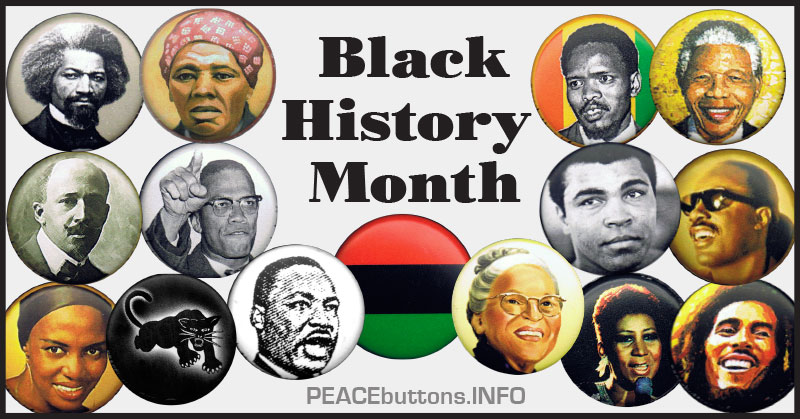
So far, it’s not illegal for us to acknowledge that February is Black History Month, so here we are, doing just that. Ha! There is even some Black History for this very date in Peace and Justice History:
February 1, 1960 Greensboro first day: Ezell A. Blair, Jr. (now Jibreel Khazan), Franklin E. McCain, Joseph A. McNeil, and David L. Richmond leave the Woolworth store after the first sit-in on February 1, 1960. Four black college students sat down at the Woolworth’s lunch counter in Greensboro, North Carolina, and were refused service because of their race. To protest the segregation of the eating facilities, they remained and sat-in at the lunch counter until the store closed. Four students returned the next day, and the same thing happened. Similar protests subsequently took place all over the South and in some northern communities. By September 1961, more than 70,000 students, both white and black, had participated, with many arrested, during sit-ins.  On the second day of the Greensboro sit-in, Joseph A. McNeil and Franklin E. McCain are joined by William Smith and Clarence Henderson at the Woolworth lunch counter in Greensboro, North Carolina. “Segregation makes me feel that I’m unwanted,” Joseph McNeil, one of the four, said later in an interview, “I don’t want my children exposed to it.“ Listen to Franklin McCain’s account of what happened |
| February 1, 1961 On the first anniversary of the Greensboro sit-in, there were demonstrations all across the south, including a Nashville movie theater desegregation campaign (which sparked similar tactics in 10 other cities). Nine students were arrested at a lunch counter in Rock Hill, South Carolina, and chose to take 30 days hard labor on a road gang. The next week, four other students repeated the sit-in, also chose jail. |
In light of current events, I thought it’d be good to review how Black History Month came to be. Below is a bit on its beginnings.
The History of Black History Month
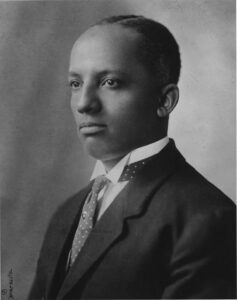
Black History Month was first observed as Negro History Week in February 1926, but the inspiration for the commemoration began over a decade earlier through a steady stream of electrifying events, discoveries, and other celebrations of Black excellence. In 1915, American historian Dr. Carter G. Woodson attended the national celebration of the fiftieth anniversary of emancipation in Washington D.C. This event was widely attended and proved to be profoundly inspiring for Dr. Woodson who, later that year, joined forces with A. L. Jackson, William B. Hartgrove, George Cleveland Hall, and James E. Stamps to establish the Association for the Study of Negro Life and History, known today as the Association for the Study of African American Life and History (ASALH 2024). ASALH had the ambitious goal of educating the public about the achievements, inventions, and progress made by Black Americans, and though the Association’s intellectual efforts were remarkable – they began to publish The Journal of Negro History in 1916 and founded Negro History and Literature Week in 1924 – Dr. Woodson had a wider vision of his mission. Wishing to continue to discover and celebrate the history of the Black past, Dr. Woodson announced the celebration of Negro History Week through a press release.
Accounts of the contributions of Black Americans were notably absent from history books, credited to white men, or omitted altogether. Progressive communities and schools were ripe for the rich history that Negro History Week offered. Matching the popularity of the week, Woodson and the Association established an annual theme for the celebration to guide and inspire educators. Weary of those simply wishing to capitalize on a popular event, “Woodson warned teachers not to invite speakers who had less knowledge than the students themselves” (ASALH 2024). Additionally, ASALH expanded their offerings to provide study materials: pictures, lessons for teachers, plays for historical performances, and posters of important dates and people. This cemented the celebration of Black history in schools and communities, and Negro History Week grew in popularity throughout the following decades, with mayors across the United States endorsing it as a holiday.
Negro History Week grew into Black History Month in 1970 under the leadership of Black educators and students at Kent State University and would become a federally recognized event six years later. President Gerald Ford recognized Black History Month in 1976 during the celebration of the United States Bicentennial. He urged Americans to “seize the opportunity to honor the too-often neglected accomplishments of Black Americans in every area of endeavor throughout our history” (Franklin 2022). Today, nearly one hundred years after that initial celebration, it is prudent to reflect on the designed purpose of Black History Month and discover that after all this time, these lessons are still relevant, inspiring, and necessary. As Dr. Woodson said, “Real education means to inspire people to live more abundantly, to learn to begin with life as they find it and make it better” (Woodson 1933).
Pictured: Dr. Carter G. Woodson, The “father of Black history”
Photo Credit: Addison Norton Scurlock, Public domain, via Wikimedia Commons
Bibliography
ASALH. 2024. The Founders of Black History Month: The Origins of Black History Month. December 18. Accessed January 16, 2025. asalh.org/about-us/origins-of-black-history-month/.
ASALH. 2024. Carter G. Woodson Timeline: ASALH – the Founders of Black History Month. December 19. Accessed January 16, 2025. asalh.org/carter-g-woodson-timeline/.
Franklin, Jonathan. 2022. Here’s the Story behind Black History Month – and Why It’s Celebrated in February. February 1. Accessed January 16, 2025. www.npr.org/2022/02/01/1075623826/why-is-february-black-history-month.
Woodson, Carter G. 1933. The Mis-Education of the Negro. Trenton: Africa World Press.
==========
All right! So, we see that Black History Week then Month has been around for at least 20 years longer than our current POTUS, who seems to be ignoring the month’s existence. But, there’s no reason any of the rest of we the people have to! Including all history makes the US so much richer in knowledge. Most local historical and cultural organizations are going to have commemorations this month. What fun it will be, and how community-unifying for each of us to find an activity near us, and join in!
Some posts I found while doing the cartoon / memes / news round up but the post was getting far too long. All I feel are important but I can’t all of them fully.
DHS Reacts After Agents Accused of Leaving ‘Death Cards’ in Detainees Cars
ICE is a white supremacy white nationlist / Christian nationalist group that is driven to remove nonwhite people and non-Christian people from the country. They are driven by hate and malice. They are former / current gang thugs that live to terrorize those they disagree with or hate. In their minds might makes right and so they always go around in packs picking on easy prey. Hugs
Jan 27, 2026 at 01:43 PM EST
updated
Jan 27, 2026 at 01:44 PM EST
U.S. Immigration and Customs Enforcement (ICE) is investigating allegations that agents left “racist death cards” in the vehicles of detained individuals.
“ICE is investigating this situation but unequivocally condemns this type of action and/or officer conduct. Once notified, ICE supervisors acted swiftly to address the issue,” a Department of Homeland Security (DHS) spokesperson wrote in a statement to Newsweek. “The ICE Office of Professional Responsibility will conduct a thorough investigation and will take appropriate and swift action.”
Why It Matters
ICE is facing growing scrutiny over its tactics amid President Donald Trump’s ramped up immigration enforcement. Support for the agency has dwindled in recent weeks—a recent YouGov poll found Americans are split about whether to abolish ICE. Forty-five percent each said they support and oppose the proposal. It surveyed 1,722 adults from January 16-19, 2026.
What to Know
In Colorado, an advocacy group named Voces Unidas said last week that ICE agents who detained nine Latino individuals left ace of spades cards inside the abandoned vehicles. The cards identify ICE’s field office in Denver and were later found by their family members, according to the organization’s statement.
Alex Sánchez, president and CEO of Voces Unidas, said in a statement the group was “disgusted” by their actions.
ICE agents approach a house before detaining two people on January 13, 2026, in Minneapolis, Minnesota. | Stephen Maturen/Getty Images“Leaving a racist death card behind after targeting Latino workers is deliberate intimidation rooted in a long history of racial violence. This is an abuse of power, and it has no place in any society that claims to value human dignity,” Sánchez said.
During the Vietnam War, soldiers used the Ace of Spades card as an intimidation tactic against the Viet Cong, according to HistoryNet.com. Voces Unidas described their use in Colorado as “deliberate psychological harassment.”
The DHS spokesperson also told Newsweek that ICE is held “to the highest professional standard.”
“As our brave law enforcement arrests and removes dangerous criminal illegal aliens, including murderers, rapists, and gang members from our communities, America can be proud of the professionalism our officers bring to the job day-in and day-out,” the spokesperson said.
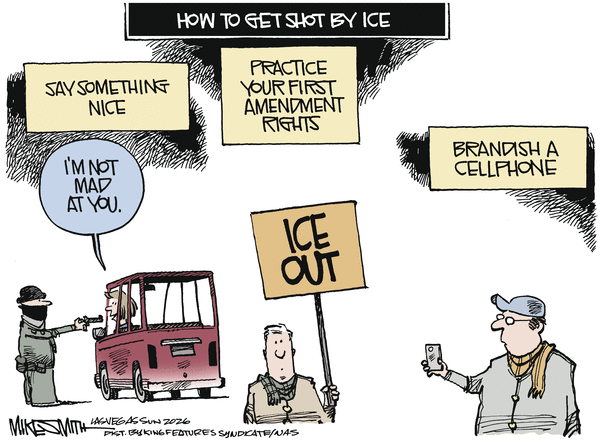
ICE has ramped up enforcement in states like Minneapolis and Maine over recent weeks. In Minneapolis, two individuals, Renee Nicole Good and Alex Pretti, both 37-year-old U.S. citizens, have been fatally shot by federal agents from ICE and U.S. Border Patrol, drawing increased scrutiny toward the administration’s hardline immigration approach. Some agents are expected to depart from Minneapolis as early as Tuesday.
What People Are Saying
Author Seth Abramson wrote to X: “ICE agents in Colorado have been leaving ace of spades cards behind when they detain someone, a psychological warfare technique the United States Armed Forces used against its mortal enemies during the Vietnam War. If you don’t think Trump is at war with his country, think again.”
The Colorado Democratic Party wrote to X: “This is disgusting on so many levels. Families of those arrested by ICE near Vail say agents left behind branded ‘death cards’ after arrests, a racist intimidation tactic, according to advocates and community leaders. Our communities deserve better, and we await the results of DHS’ investigation.”
What Happens Next
ICE operations continue across the country as Trump aims to carry out his campaign pledge of mass deportations. Criticism is also likely to continue, with a government shutdown possible over funding for ICE over the situation in Minnesota.


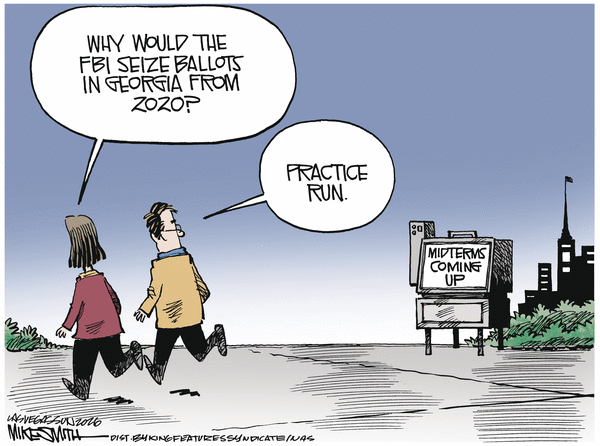
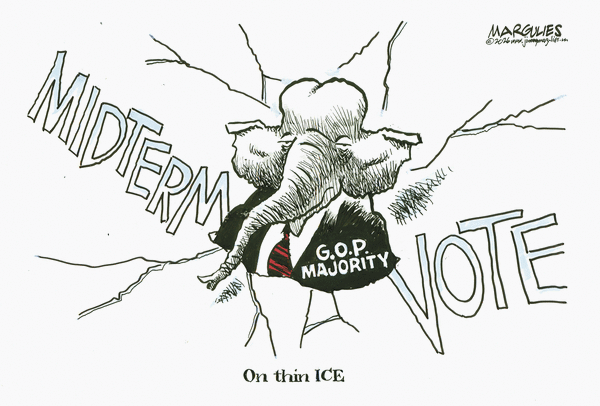
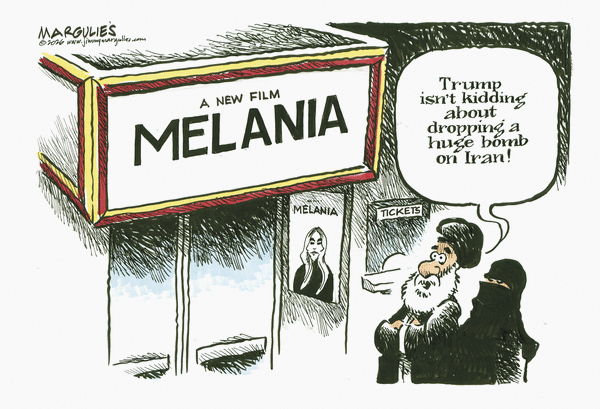
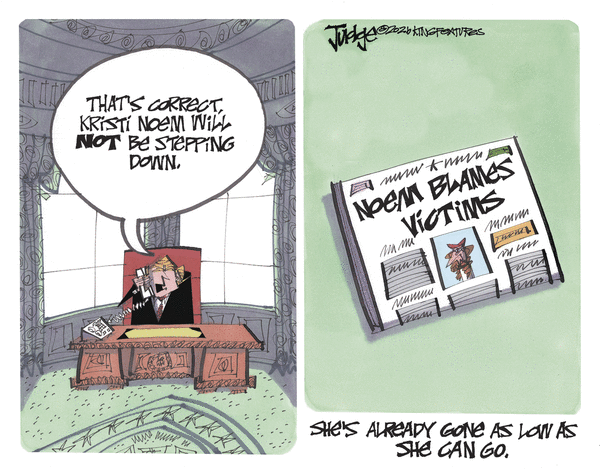
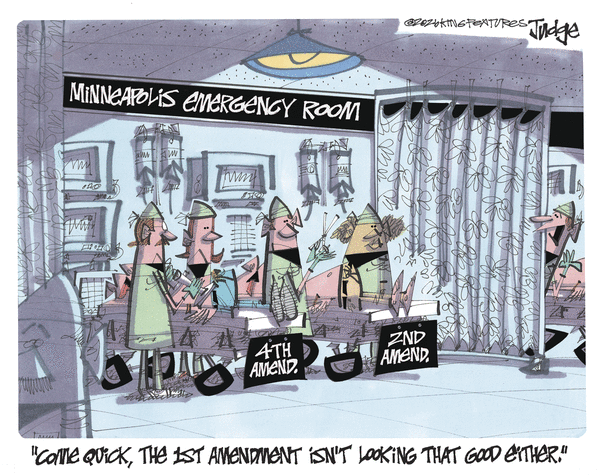
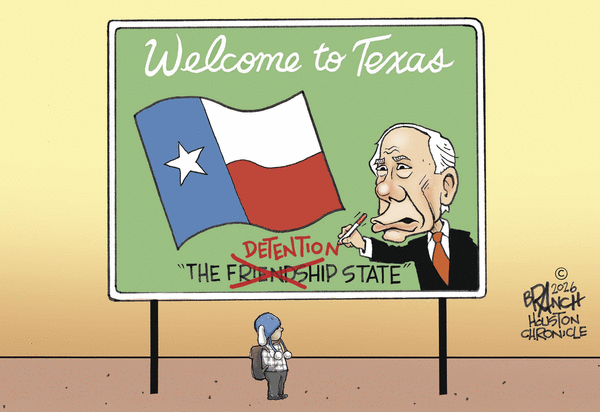
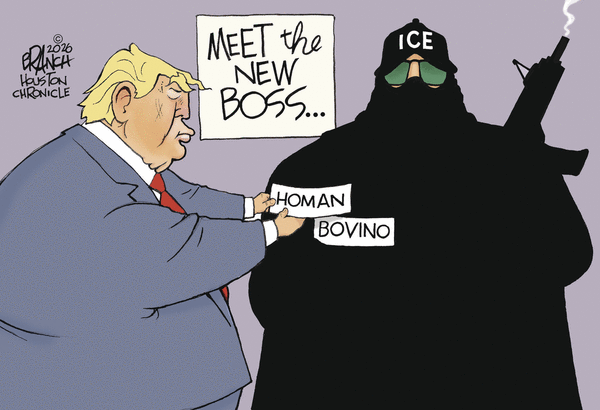
Politcal cartoons / memes /and news I want to share. 2-1-2026











 The Greenville Daily News, South Carolina, July 8, 1919
















House Republicans propose voting changes as Trump administration eyes the midterms
As republicans lose control due to the public being upset with what they are doing they don’t change their views / actions, but instead they try harder to restrict voters rights to vote. They don’t believe in democracy or being public servants; they believe in a one party rule where they are the party in control. Why? Because it gives them all they want, power, fame, fortune, and the ability to control how other people live. The goals of these people who are not interested in others living as who they are and having happy quailty lives but in having total control over how others live to force them to live according to the church doctrines of their version of the religion. But the thing about this SAVE act is it would keep married women from voting if they have not updated all of their identification and other requirements. I experienced this when Ron and I got married. I took his last name. I think everyone who reads the blog understands why. I had to change everything and then take all that documentation to the election supervisor’s office: my marriage certificate, my socialsecurity name change, and so much more. How many people fail to do that and then go to vote and can’t? Hugs
FILE- Voting booths are set up at a polling place in Newtown, Pa, April 23, 2024. (AP Photo/Matt Rourke, File)
Updated 9:04 PM EST, January 29, 2026House Republicans are proposing sweeping changes to the nation’s voting laws, a long-shot priority for President Donald Trump that would impose stricter requirements, including some before Americans vote in the midterm elections in the fall.
The package released Thursday reflects a number of the party’s most sought-after election changes, including requirements for photo IDs before people can vote and proof of citizenship, both to be put in place in 2027. Others, including prohibitions on universal vote-by-mail and ranked choice voting — two voting methods that have proved popular in some states — would happen immediately. The Republican president continues to insist that the 2020 election he lost to Democrat Joe Biden was rigged.
“Americans should be confident their elections are being run with integrity — including commonsense voter ID requirements, clean voter rolls, and citizenship verification,” said Rep. Bryan Steil, chairman of the House Administration Committee, in a statement.
“These reforms will improve voter confidence, bolster election integrity, and make it easy to vote, but hard to cheat,” said Steil, R-Wis.
The legislation faces a long road in the narrowly-split Congress, where Democrats have rejected similar ideas as disenfranchising Americans’ ability to vote with onerous registration and ID requirements. The effort comes as the Trump administration is turning its attention toward election issues before the November election, when control of Congress will be at stake.
The top Democrat on the House Administration Committee, Rep. Joe Morelle of New York, said Trump and the Republican Party are trying to “rig” the system.
“This is their latest attempt to block millions of Americans from exercising their right to vote,” Morelle said in a statement. He said he would “fight the bill at every turn.”
Republicans are calling their new legislation the “Make Elections Great Again Act” and say their proposal should provide the minimum standard for elections for federal offices.
The 120-plus-page bill includes requirements that people present a photo ID before they vote and that states verify the citizenship of individuals when they register to vote, starting next year.
More immediately, this fall it would require states to use “auditable” paper ballots in elections, which most already do; prohibit states from mailing ballots to all voters through universal vote-by-mail systems; and ban ranked choice voting, which is used in Maine and Alaska.
States risk losing federal election funds at various junctures for noncompliance. For example, states would be required to have agreements with the attorney general’s office to share information about potential voter fraud or risk losing federal election funds in 2026.
And starting this year, it would require states to more frequently update their voting rolls, every 30 days.
Stephen Richer, a Republican who clashed with Trump over the president’s false election conspiracy theories while he served as the recorder in Maricopa County, Arizona, posted on the social media site X that the bill is reminiscent of a Democratic effort to reshape national elections in the opposite direction that floundered during Biden’s term.
He wrote that the legislation “flattens federalism, and takes away many rights from the states.”
Similar Republican proposals have drawn alarm from voting rights group, which say such changes could lead to widespread problems for voters.
For example, prior Republican efforts to require proof of citizenship to vote have been criticized by Democrats as disenfranchising married women whose last names do not match birth certificates or other government documents.
The Brennan Center for Justice and other groups estimated in a 2023 report that 9% of U.S. citizens of voting age, or 21.3 million people, do not have proof of their citizenship readily available. Almost half of Americans do not have a U.S. passport.
Trump has long signaled a desire to change how elections are run in the United States. Last year he issued an executive order that included a citizenship requirement, among other election-related changes.
At the time, House Republicans approved legislation, the “Safeguard American Voter Eligibility Act,” that would cement Trump’s order into law. That bill has stalled in the Senate, though lawmakers have recently revived efforts to bring it forward for consideration.
….
Associated Press writer Nicholas Riccardi in Denver contributed to this report.
 Scottie's Playtime