after his first cataract surgery. Eat all the ice cream, Scottie!

Open comments for well wishes, jokes, etc. —

after his first cataract surgery. Eat all the ice cream, Scottie!
Open comments for well wishes, jokes, etc. —
Enjoy!
| August 29, 1758 The first Indian reservation, Brotherton, was established in New Jersey. A tract of three thousand acres of land was purchased at Edge Pillock, in Burlington County. The treaty of 1758 required the Delaware Tribes, in exchange for the land, to renounce all further claim to lands anywhere else in New Jersey, except for the right to fish in all the rivers and bays north of the Raritan River, and to hunt on unenclosed land. History Of The Brotherton Reservation |
| August 29, 1949 The Soviet Union detonated its first atomic bomb in a test at Semipalatinsk in eastern Kazakhstan. It was known as Joe 1 after Josef Stalin, then General Secretary of the Communist Party.  ” Joe 1, the first Soviet atomic bomb Andrei Dmitrievich Sakharov, key developer of the Soviet bomb, later worked for peace The Semipalatinsk test site |
| August 29, 1957 Following consultations among the NATO allies and other nations, the Western (non-Communist) countries presented to the United Nations a working paper entitled, “Proposals for Partial Measures of Disarmament,” intended as “a practical, workable plan to start on world disarmament.” The plan proposed stopping all nuclear testing, halting production of nuclear weapons materials, starting a reduction in nuclear weapons stockpiles, reducing the danger of surprise attack through warning systems, and beginning reductions in armed forces and armaments. |
August 29, 1957 African Americans in Milledgeville, Georgia, wait in line to vote following the Civil Rights Act of 1957. The U.S. Congress passed the Civil Rights Act, the first such law since reconstruction. The bill established a Civil Rights Commission which was given the authority to investigate discriminatory conditions. A Civil Rights Division was created in the Department of Justice, allowing federal prosecutors to obtain court injunctions against interference with the right to vote, among other things. In an ultimately futile attempt to block passage, then-Democrat, former Dixiecrat, and later Republican Senator Strom Thurmond of South Carolina set the all-time filibuster record: 24 hours, 19 minutes of non-stop speaking on the floor of the Senate. A filibuster is the deliberate use of prolonged debate and procedural delaying tactics to block action supported by a majority of members. It can only be stopped with a 60% majority voting to end debate.  Senator Strom Thurmond with his 24-hour filibustering speech |
August 29, 1961 Robert Moses,leader of SNCC The Student Nonviolent Coordinating Committee (SNCC) was pursuing its voter registration drive in Amite County, Mississippi. Of 5000 eligible Negro voters in the county, just one was registered to vote. SNCC leader Robert Moses was attacked and beaten this day outside the registrar’s office while trying to sign up two voters. Nine stitches were required but the three white assailants were acquitted. Bob Moses recorded the incident Hear Moses recall the time |
| August 29, 1970 Between 15 and 30 thousand predominantly Chicanos (Americans of Mexican descent) gathered in East LA’s Laguna Park as the culmination of the Chicano National Moratorium. It was organized by Rosalio Munoz and others to protest the disproportionate number of deaths of Chicano soldiers in Vietnam (more than double their numbers in the population).  There had been more than 20 other such demonstrations in Latino communities across the southwest in recent months.  Three died when the anti-war march turned violent. The Los Angeles Police Department attacked and one gunshot, fired into the Silver Dollar Bar, killed Ruben Salazar, a Los Angeles Times columnist and a commentator on KMEX-TV (he had been accused by the LAPD of inciting the Chicano community). The Chicano Moratorium Ruben Salazar LA Times |
https://www.peacebuttons.info/E-News/peacehistoryaugust.htm#august29

| August 22, 1958 President Dwight Eisenhower announced a voluntary moratorium on nuclear weapons testing. A report outlining a system for monitoring and verifying compliance of a complete ban on such testing had been released just the day before. The Conference of Experts, as it was known, had been meeting in Geneva, Switzerland, to work out the details on detection of violations of such a treaty. The U.S. delegation was led by Nobel physics laureate Ernest Lawrence from the University of California (the Lawrence Livermore National Laboratory is named after him). Eisenhower predicated his moratorium on U.S.S.R. and U.K. agreement to the same limitations. All three countries agreed to the one-year halt in testing and to begin negotiations on a complete test ban at the end of October; all three performed last-minute (atmospheric) tests before the opening of talks. |
August 22, 1964 Singing at a boardwalk demonstration: Hamer (with microphone), Stokely Carmichael, (in hat), Eleanor Holmes Norton, Ella Baker. Fannie Lou Hamer, leader of the Mississippi Freedom Democratic Party (MFDP), testified in front of the Credentials Committee at the Democratic National Convention. She was challenging the all-white delegation that the segregated regular Mississippi Democrats had sent to the presidential nominating convention.  Mississippi’s Democratic Party excluded African Americans from participation. The MFDP, on the other hand, sought to create a racially inclusive new party, signing up 60,000 members. The hearing was televised live and many heard Hamer’s impassioned plea for inclusion of all Democrats from her state.The hearing was televised live and many heard Hamer’s impassioned plea for inclusion of all Democrats from her state. In her testimony she spoke about black Mississippians not only being denied the right to register to vote, but being harassed, beaten, shot at, and arrested for trying. Concerned about the political reaction to her statement, President Lyndon Johnson suddenly called an impromptu press conference, thereby interrupting television broadcast of the hearing. Hear her testimony Link to photo gallery |
August 22, 1971 The FBI (Federal Bureau of Investigation) arrested twenty in Camden, New Jersey, and five in Buffalo, New York, for conspiracy to steal and destroy draft records. Eventually known as the Camden 28, most were Roman Catholic activists, including four priests, and a Lutheran minister.“We are not here because of a crime committed in Camden but because of a war committed in Indochina….” Cookie Ridolfi The Camden 28 |
| August 22, 1972 Rhodesia’s team was banned from competing in the Olympic Games with just four days to go before the opening ceremony in Munich, Germany. The National Olympic Committees of Africa had threatened to pull out of the games unless Rhodesia was barred from competing. Though the Rhodesian team included both whites and blacks, the government was an illegal one, controlled by whites though they represented just 5% of the country’s population. It had broken away from the British Commonwealth over demands from Commonwealth member nations that power be yielded to the majority. Read more |
August 22, 1986 The Kerr-McGee Corporation agreed to pay the estate of the late Karen Silkwood $1.38 million ($2.68 in 2008), settling a 10-year-old nuclear contamination lawsuit. She had been active in the Oil, Chemical and Atomic Workers union, specifically looking into radiation exposure of workers, and spills and leaks of plutonium. The story of Karen Silkwood |
https://www.peacebuttons.info/E-News/peacehistoryaugust.htm#august22
Exclusive: largest data analysis of its kind counters Trump’s aggressive efforts to deny trans minors’ existence
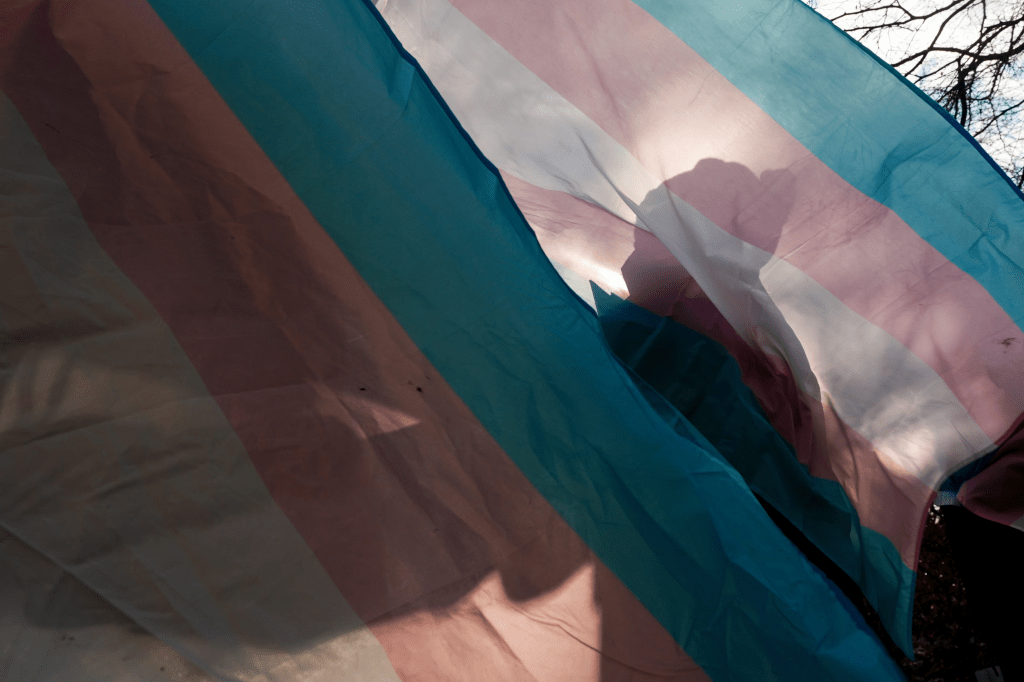
View image in fullscreen A protester is silhouetted against a trans pride flag during a pro-transgender rights protest outside of Seattle children’s hospital on 9 February. Photograph: Lindsey Wasson/AP
More than 2.8 million people now identify as transgender in the US, including an estimated 724,000 youth, according to a new data analysis that is the largest of its kind to date.
Researchers from the University of California, Los Angeles (UCLA) Williams Institute used federal surveys and data from state health agencies to identify the size and demographics of the trans population in each state.
The analysis, shared with the Guardian and released on Wednesday, documented thousands of trans youth living in all 50 states and the District of Columbia. The findings counter Donald Trump’s aggressive efforts to deny the existence of trans minors, as his administration removes references to trans people across federal agencies and widely erodes protections and programs for LGBTQ+ communities.
The report builds on federal data collection efforts that the White House is now eliminating. The authors warn their study could be the last comprehensive portrait of the nation’s trans population for a decade or more as trans people are erased from vital US surveys, including health reports and crime data analyses.
The Williams Institute primarily relied on data from 2021 to 2023 from Centers for Disease Control and Prevention (CDC) surveys and records disclosed by state health agencies. Some of the key findings include:
“Trans people live everywhere and are represented in every state,” said Dr Jody Herman, senior scholar of public policy at the Williams Institute and co-author of the report, noting the total US trans population was greater than the individual populations of more than a dozen states. “This is a substantial population that has unique concerns and barriers to getting their needs met, and lawmakers need to keep that in mind.”
The Williams Institute, a leading LGBTQ+ policy research center, has published national trans population counts since its 2011 report, which was the first of its kind as state-level data on gender identity became available. The estimates are considered the best available data and were cited by the US supreme court in its recent majority opinion upholding Tennessee’s ban on trans youth healthcare.
The quality and sources of the researchers’ data have improved from one report to the next, the researchers said, making it difficult to assess changes over time. But the researchers noted that the overall estimates of trans adults have remained relatively steady, while the latest data shows how younger people are now significantly more likely to identify as trans than older groups.
There are many factors contributing to youth identifying as trans at higher rates, including that younger people are more likely to answer these kinds of survey questions, said Dr Andrew Flores, Williams Institute distinguished visiting scholar and associate professor of government at American University.
“Younger people are growing up among other younger people who already hold more accepting attitudes toward LGBT and transgender people more broadly,” said Flores, a report co-author, citing increasingly visible signs of support, such as student walkouts in Florida in protest of anti-trans policies. “In this generation, they might be more willing and safe to identify that they are transgender, because they don’t see as much of a harm or threat as older generations.”
While some conservatives and anti-trans advocates have presented a reported rise in trans youth as a “social contagion”, suggesting youth are copying their peers, “the growth comes as people are now in an environment that allows them to fully express who they are,” Flores said.
Shifting language also affects generational differences, he said, noting how older groups were more likely to identify as lesbian or gay while younger people are more likely to identify as bisexual or pansexual. And while older trans people are more likely to identify as men or women, younger trans people more frequently identify as non-binary.
The report also found that the race and ethnicity of trans people was largely similar to broader US demographics, with Indigenous, Latino and multiracial adults slightly more likely to identify as trans than other groups.
The Trump administration, which has widely attacked data collection efforts across government, has moved to remove trans identity questions from two critical CDC behavioral health surveys and from Department of Justice surveys on crime victimization and sexual violence. The US Census Bureau has also taken steps to exclude gender identity from multiple surveys, according to the former director who resigned in February.
Those efforts followed Trump’s day-one executive order “restoring biological truth” to the government, which suggested that trans identity was “false” and directed the state department to deny trans people accurate passports.
The data loss will make it impossible for the Williams Institute to continue its analyses in their current form, and even if the next administration restored the surveys, the public would still be losing up to 10 years of data, which would be a devastating erosion of knowledge, the researchers said.
“We didn’t really have decent national data until around 10 years ago, so we just very recently got a grasp on how many people identify as trans in the US and what their characteristics are,” said Herman. “For these data sources to just suddenly disappear, it is a major setback. The population is not going to go away; we’re just not going to know more about them than what we have from our current sources.”
The data has frequently been cited by journalists, school boards, public health experts, civil rights lawyers, advocates fighting discriminatory legislation and lawmakers expanding trans rights. The researchers had hoped federal data could help illuminate how trans people were moving within the US as some have fled red states due to anti-trans laws, but that will be hard to track without national surveys, they said.
“In some policy circles, they say if you can’t be counted, you don’t count,” Flores added. “And for members of the LGBTQ+ community, to be able to see numbers that reflect their lived experiences is quite important.”
Imara Jones, founder of news organization TransLash Media, said there was no easy fix for the loss of national data backed by federal resources.
“It is meant to erase, and that erasure is meant to have real-world impacts, making it harder for people to be who they are,” Jones said.
Flores said the institute and others were discussing ways to fill the gaps and continue data collection without the federal government: “We’re not just going to close up shop. We’re going to try to find a way to keep telling these stories and be persistent.”
Here is a short, which is hilarious. Beneath it is his entire set, posted last night as he did it; it is wonderful! It depends how much time you have. I recommend the longer one, if you can only watch one. The short is contained within the longer one, but won’t spoil anything if you watch it first. Obviously, there is a lot more varied material in the full set. Enjoy!
========================
Jill is a friend and ally of Playtime, and I’m pretty sure I’m not her only reader here:
 Scottie's Playtime