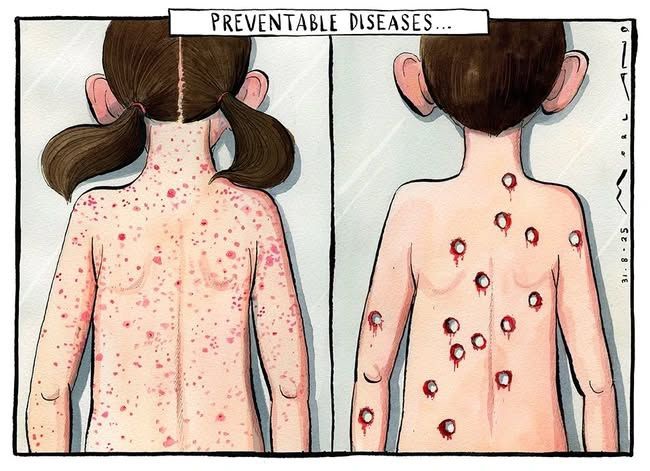
For those that don’t know the Kobayashi Maru is a no win situation in Star Trek to train cadets. It is how I see life right now. No way to win, I can only survive.


September 15, 2025
| By Joseph Llobrera and Luis Nuñez
Food is an essential human need, and even more so for infants and toddlers during the critical early months of rapid growth and development. The United States has the resources to ensure everyone has enough to eat. Yet millions of people across the U.S. experience food insecurity, meaning they struggle to afford enough food for an active, healthy life year-round. In 2023, the most recent data available, 33.6 million adults and 13.8 million children — including nearly 2 million children under 3 years old — lived in food-insecure households, meaning more than 1 in 8 households (13.5 percent) in the U.S. had difficulty acquiring food due to lack of resources.[1]

Households with young children are more likely to experience food insecurity. More than 1 in 7 (15.5 percent) households with infants and toddlers under 3 were food insecure in 2023, compared to 11.9 percent of households without children and 13.5 percent of all households. Nationally, more than 1 in 6 (17.1 percent) children under 3 lived in food-insecure households in 2023 and this share varies across states. (See Table 1.) These shares also vary by race and ethnicity, with children under 3 in American Indian or Alaska Native (30.3 percent), Hawaiian or Pacific Islander (26.3), Black (25.9), and Hispanic (22.4) households more likely to live in food-insecure households than those in Asian (5.5) or white (10.9) households.[2]
Roughly half of the children under age 3 who lived in food-insecure households didn’t experience food insecurity themselves, but the adults in those households were food insecure. Parents often find ways to maintain normal meal patterns for their children, even when they are food insecure themselves; these families often face other challenges as a result of their precarious financial circumstances. And in many households, food insecurity among children is so severe that caregivers report that children were hungry, skipped a meal, or did not eat for a whole day because there was not enough money for food.
Children are especially vulnerable to poverty, financial strain, and hardship. For infants and young children, the lack of access to good nutrition can lead to less favorable life-long outcomes. Caregivers’ struggles paying for food and other bills are linked to worse child outcomes.[3] Material hardship such as the lack of food also increases the risk for child welfare involvement due to neglect and abuse.[4] There is growing awareness among researchers that the consequences of adversity — poverty, abuse or neglect, parental substance use disorder or mental illness, housing instability, and exposure to violence — during the early years of life can extend well beyond childhood and affect people’s physical, mental, and economic well-being as adults.[5]
Conversely, when public policies provide economic security for their families, children tend to have better educational, health, and behavioral outcomes.[6]
The Supplemental Nutrition Assistance Program (SNAP) delivers more nutrition assistance to low-income children than any other federal program, making it the nation’s largest child nutrition program. In 2024, SNAP helped about 16 million children each month — about 1 in 5 U.S. children — including 2.8 million children under the age of 3.
While SNAP provides only a modest benefit — just $6.20 on average per person per day — it forms a critical foundation for the health and well-being of children in the U.S., lifting millions of families and their children out of poverty and improving food security. Food insecurity among children fell by roughly a third after their families received SNAP benefits for six months, a USDA study found.[7]
For young children in particular, SNAP’s benefits last a lifetime. Studies have found children have improved birth outcomes and better health, education, and employment outcomes as adults if they had SNAP access during early childhood or if their parent had SNAP access during pregnancy.[8] Access to SNAP among families with children is associated with reductions in child maltreatment reports and child welfare involvement.[9] Emerging evidence also suggests that SNAP helps decrease decades-long racial inequities in food security, reducing the gap between white households and Black and Hispanic households, who are more likely to experience food insecurity because of starkly unequal opportunities and outcomes in education, employment, health, and housing.[10]
The federally funded WIC program — more formally known as the Special Supplemental Nutrition Program for Women, Infants, and Children — also improves lifetime health for low-income pregnant and postpartum parents, their infants, and young children. Among other health and developmental improvements, WIC participation is associated with reduced risk of premature birth, low birthweight, and infant mortality. This is especially important because pregnancy-related complications and mortality, as well as infant mortality, are higher for families of color than for white families, again due to unequal access to health care and broader inequities in health, economic, and other systems for people of color.
Despite these benefits, only about half of all people eligible for WIC were enrolled in 2022. Less than half (46 percent) of eligible pregnant parents participated in WIC. Only 64.1 percent of eligible infants and children under the age of 3 participated.[11] And participation declines as children grow older. While nearly 4 in 5 (78.4 percent) infants eligible for WIC participated in the program in 2022, the rate drops to 65 percent, 50 percent, 44 percent, and 25 percent among children 1 to 4 years old, respectively.[12]
There are many opportunities for state agencies to reach more eligible families with low incomes, and these efforts are showing promise, with take-up and participation increasing in recent years. While data on WIC coverage rates for 2023 and 2024 are not yet available, nationwide average monthly participation increased by 7.1 percent between fiscal years 2022 and 2024, suggesting that coverage rates may have increased modestly.[13]
Increasing WIC take-up across the board — and for pregnant parents of color and their infants in particular — can be an important part of a strategy to improve pregnancy-related and child health, mitigate the large pregnancy-related health disparities affecting these communities, and advance racial equity in other aspects of pregnancy-related and child health and food security.[14]
The harmful Republican megabill, H.R. 1, enacted on July 4, 2025, will dramatically raise costs and reduce food assistance for millions of people by cutting federal funding for SNAP by $187 billion (about 20 percent) through 2034, the largest cut to SNAP in history. These cuts will increase poverty, food insecurity, and hunger, including among children.
The bill includes a major structural change that will cut billions in federal funding for most states’ basic food benefits, with a new requirement that most states will have to pay between 5 and 15 percent of SNAP benefits. This amounts to billions of dollars each year that states across the country would now be required to pay. If a state can’t or won’t make up for some or all of these massive federal cuts with tax increases or spending cuts elsewhere in its budget, it will have to cut its SNAP program or it could opt out of the program altogether, terminating SNAP food assistance entirely in the state, including to households with young children.
If children lose SNAP, they will also experience harmful ripple effects in other child nutrition programs, such as free school meals and summer EBT, due to the loss of automatic eligibility that comes from receiving SNAP. To make up for the federal cuts and avoid cutting nutrition assistance as well as other priorities affecting young children, such as health care or education, state policymakers will need to either raise new revenue or rollback recent tax cuts to raise the funds needed to prevent harmful cuts.
| TABLE 1 | |||
|---|---|---|---|
| Nearly 2 Million Children Under 3 Years Old Lived in Food-Insecure Households, Thousands Across Every State | |||
| Children Under 3 Years Old in Food-Insecure Households | |||
| State | Number | Share | |
| Alabama | 38,000 | 21% | |
| Alaska | 5,000 | 16% | |
| Arizona | 55,000 | 23% | |
| Arkansas | 21,000 | 20% | |
| California | 172,000 | 13% | |
| Colorado | 27,000 | 14% | |
| Connecticut | 17,000 | 15% | |
| Delaware | 5,000 | 16% | |
| District of Columbia | 3,000 | 11% | |
| Florida | 102,000 | 16% | |
| Georgia | 60,000 | 16% | |
| Hawai‘i | 6,000 | 13% | |
| Idaho | 14,000 | 19% | |
| Illinois | 45,000 | 10% | |
| Indiana | 45,000 | 17% | |
| Iowa | 15,000 | 12% | |
| Kansas | 16,000 | 14% | |
| Kentucky | 39,000 | 25% | |
| Louisiana | 35,000 | 20% | |
| Maine | 8,000 | 21% | |
| Maryland | 28,000 | 12% | |
| Massachusetts | 25,000 | 12% | |
| Michigan | 63,000 | 19% | |
| Minnesota | 32,000 | 14% | |
| Mississippi | 21,000 | 20% | |
| Missouri | 38,000 | 17% | |
| Montana | 5,000 | 14% | |
| Nebraska | 15,000 | 19% | |
| Nevada | 18,000 | 18% | |
| New Hampshire | NA | NA | |
| New Jersey | 35,000 | 13% | |
| New Mexico | 16,000 | 22% | |
| New York | 95,000 | 14% | |
| North Carolina | 67,000 | 18% | |
| North Dakota | 6,000 | 17% | |
| Ohio | 59,000 | 14% | |
| Oklahoma | 29,000 | 20% | |
| Oregon | 19,000 | 15% | |
| Pennsylvania | 58,000 | 16% | |
| Rhode Island | NA | NA | |
| South Carolina | 28,000 | 16% | |
| South Dakota | 5,000 | 14% | |
| Tennessee | 34,000 | 14% | |
| Texas | 237,000 | 19% | |
| Utah | 23,000 | 15% | |
| Vermont | NA | NA | |
| Virginia | 36,000 | 11% | |
| Washington | 36,000 | 13% | |
| West Virginia | 11,000 | 18% | |
| Wisconsin | 27,000 | 15% | |
| Wyoming | 5,000 | 23% | |
| Total | 1,808,000 | 16% | |
Note: Sum does not equal total due to rounding. Counts are rounded to the nearest 1,000, and shares to the nearest whole number. “NA” refers to states whose sample size was too small to calculate reliable estimates. These estimates rely on ten years of data due to small sample sizes in many states. However, for the 13 states that had large enough sample sizes, their five-year estimates of the share of children under 3 in food-insecure households were similar to the ten-year estimates presented here.
Source: CBPP analysis of 2014-2023 Current Population Survey Food Security Supplement
Topics: Food Assistance


As Swiss glaciers melt at an ever-faster rate, new species move in and flourish, but entire ecosystems and an alpine culture can be lost
Photographs by Nicholas JR White By Katherine Hill
From the slopes behind the village of Ernen, it is possible to see the gouge where the Fiesch glacier once tumbled towards the valley in the Bernese Alps. The curved finger of ice, rumpled like tissue, cuts between high buttresses of granite and gneiss. Now it has melted out of sight.
People here once feared the monstrous ice streams, describing them as devils, but now they dread their disappearance. Like other glaciers in the Alps and globally, the Fiesch is melting at ever-increasing rates. More than ice is lost when the giants disappear: cultures, societies and entire ecosystems are braided around the glaciers.
The neighbouring Great Aletsch, like the Fiesch, flows from the high plateau between the peaks of the Jungfrau-Aletsch, a Unesco region in the Swiss canton of Valais and Europe’s longest glacier. It is receding at a rate of more than 50 metres a year, but from the cable car above it remains a mighty sight.

Clouds scud across the sky and shafts of light marble the ice. On the rocky slopes leading down to the glacier from the ridge, there are pools of aquamarine brilliance, the ground speckled with startling alpine flowers. The ice feels alive, with waterfalls plunging into deep crevasses and rocks shimmering in the sun.
“It’s just so diverse, these harsh mountains and ice, and up the ridge, a totally different habitat,” says Maurus Bamert, director of the environmental education centre Pro Natura Aletsch. “This is really special.”
Participants now pray for the glacier not to vanish, but they once prayed for it to retreat and stop swallowing their meadows
Many of the living worlds in the ice and snow are not visible to the human eye. “You don’t expect a living organism on the ice,” Bamert says. But there is a rich ice-loving biotic community and surprising biodiversity that thrives in this frozen landscape.
Springtails or “glacier fleas” survive on the snow’s crust – this year alone, five new species were identified in the European Alps. But there are also algae, bacteria, fungi and ice worms, as well as spiders and beetles, which feed on springtails.


As ice melts, this landscape and its inhabitants, human and non-human, are all affected. Along the glacier’s path, ice turns to water and the rushing sound of the river becomes audible. In 1859, at the greatest extent of its thickness, the glacier reached 200 metres higher than it does now.
The landscape revealed by the melt is mostly bare rock, riven with fissures that spill across the hillside. Jasmine Noti from Aletsch Arena, the regional tourism organisation, says these widen each year, new cracks appear and routes are redesigned. The ice acts like a massive buttress, gluing the hillside together, and as it melts, slippage and instability increase.
As the edges of the glacial valley descend into the cool cover of the Aletschwald forest, “it’s like walking through time”, says Bamert. On the higher slopes, older pines dominate, but lower down the trees thin, and the pioneer species of larch and birch cover the hillside: early signs of newer postglacial reforestation.
It only takes about five to 10 years for plants to colonise the land. Further down yellow saxifrage and mountain sorrel cling to the rocks. All this was once under ice sheets, but the succession of growth tells a story of glacial retreat, historic and recent.

Tom Battin, professor of environmental sciences at Lausanne’s Swiss Federal Institute of Technology, says glacial margins are a transitional landscape where ecosystems are vanishing and appearing. An expert on the microbiology of stream ecosystems, Battin led a multiyear project on vanishing glaciers and what is lost with them.
As he walks down to the Märjelensee, one of the Aletsch’s glacial lakes, this transition is readily apparent. In this mountain hollow, there was once an expansive lake with ice cliffs around its rim. Today, the pools of water are lit by patchy sun and rain, fish jumping and bog cotton dancing in summer light.
Battin points to aquatic mosses. These, he says, could never live in glacial streams which are fast flowing and extreme. Wading into the water, he searches for the golden-brown blooms of a particular alga, Hydrurus foetidus, which is a keystone species that thrives in glacier-fed rivers, fixing carbon dioxide into organic matter.

Lee Brown, professor of aquatic sciences at Leeds University, has studied invertebrate communities in glacier-fed rivers around the world, and says we do not yet know the full importance of those that are likely to disappear.
“It’s a challenge to communicate,” he says, pointing out the crucial roles that tiny organisms have in the “trophic networks” – the nutrients flowing between organisms within an ecosystem – that connect ice, rivers, land and oceans. Biofilms, or communities of micro-organisms that stick to the surface of ice and rivers, filter the water. Glaciers wash down vital nutrients from the mountain, but their rivers may run dry when the ice melts.
Without this biodiversity which you can’t see, all that other biodiversity that people care about might disappear
Tom Battin
There are whole worlds in and around the ice, poorly known and understood until recently. Mountains are like high islands, Battin says, with unique ecosystems and endemic species.
“Without this biodiversity which you can’t see,” he says, “all that other biodiversity that people care about might disappear.”


Francesco Ficetola is a professor of environmental science at Milan University who leads the PrioritIce project examining emerging ecosystems in glacial forelands, or land exposed by the retreating ice. As it melts, he says, “there’s a powerful combined effort of organisms” to create new and increasingly complex habitats.
As something is gained, however, much is lost. Cold-climate specialists such as ptarmigan and Alpine ibex are retreating up mountains, their habitats becoming ever smaller. The Swiss pines, on whose seeds nutcracker birds feed, are also moving upwards. Specialist alpine flowers and other pioneer plants at glacier edges are threatened, pushed out by the succession of forests and meadows.


For the people of this region, too, life alongside the glacier is changing. The guides Martin Nellen and his son, Dominik, have lived with the Aletsch glacier all their life. Martin jokes that the older he gets, the farther he must climb from the ridge to the glacial valley as the ice melts. “It’s rubbish,” he says.

Martin was instrumental in raising funds for information boards, which he also helped design, that explain the life story of the Aletsch. Dominik says they feel “sad, of course” about the glacier’s retreat, but they are also proud to educate people about glaciers and the distinctive landscape of snow-covered peaks and lush pastures.
Every year at 6am on 31 July people gather for a procession that winds from the church in Fiesch to the Mariahilf chapel in the forest above. Participants now pray for the glacier not to vanish, but they once prayed for it to retreat and stop swallowing their meadows and grazing land.

Divine assistance was first requested in 1652. Rosa, one of those gathered for the pilgrimage, remembers the deep snow and cold of past years. “I have been going since I was five,” she says. “There used to be more people.”
This procession is special for the reversal of its request, but similar stories exist across the Alps. They are a reminder that something intangible is lost as glaciers disappear. The great rivers of ice have shaped the imaginations of inhabitants and visitors. Not everyone sees the glacier through the lens of faith, but many visitors – whether praying, guiding or educating – worry what the future holds.

At a place called Baseflie, a cross still stands, erected in 1818 to banish the Aletsch glacier when it threatened pastures. Today, the wooden silhouette against a blue sky seems like a memorial to all that may be lost as glaciers vanish.
Find more age of extinction coverage here, and follow the biodiversity reporters Phoebe Weston and Patrick Greenfield in the Guardian app for more nature coverage
Both Ron and I worked ICUs and we have seen people who had strokes. I had a small stroke in early 2023. Ron and I agree that tRump has suffered a stroke and that was why he was out of sight for a week and why he has repeated bruising on his hand. Hugs

Yes, it will be 2 more clicks. Trust me, you’ll be better for the clicking!