Gender Liberation and Warm Fuzzies tells the story of the class trip Stephie went to. Do you remember all the drama that happened then?!
Also, I added the Legend of The Rarest Genders to it because that story was just so awesome and it makes this book the longest I’ve ever published :O Yay!!
I have dysphasia from a stroke in 2023 but it doesn’t effect my typing, I just spell really bad anyway. Hugs
Holy shit his son is creepy.
The Ellisons are going to strip assets from their acquisitions that were built by talented artists and truly skilled professionals and create new content that caters to these douchebags.
The same people who felt Benghazi was mishandled will have absolutely no interest in all our embassies being destroyed and all our staff left stranded due to DOGE budget cuts.
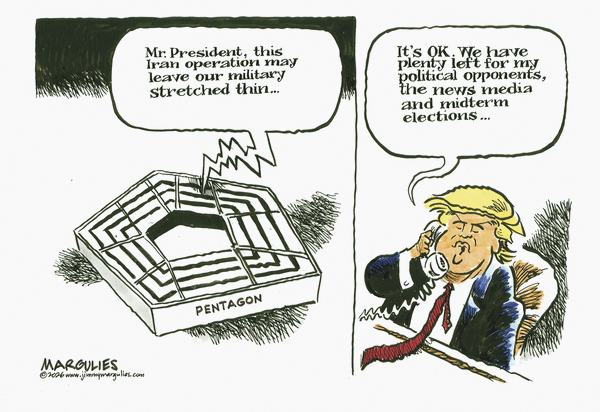
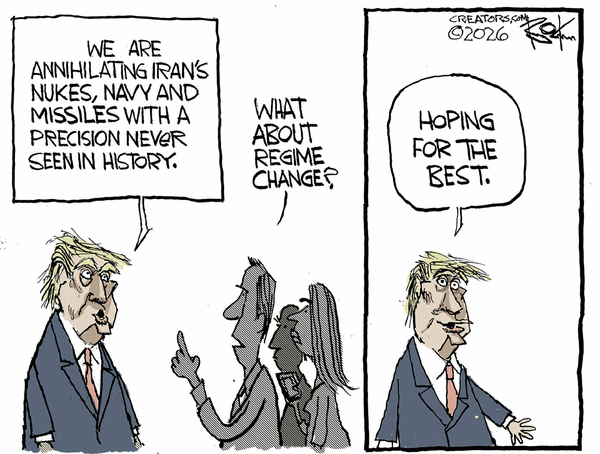
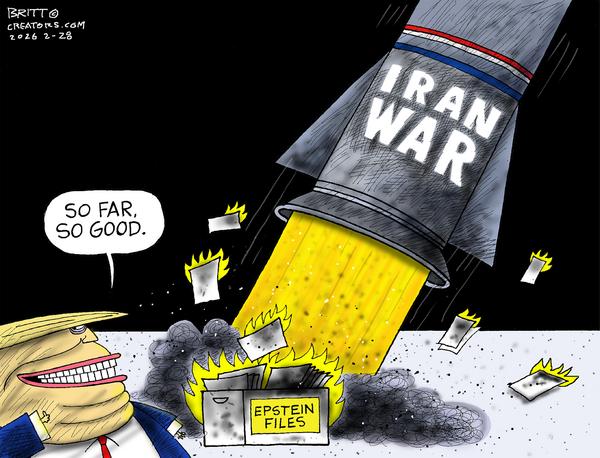
“With these strikes, the President sends a powerful message to the world. We’ll let you know when we figure out what it is.”
The point is both cruelty and wiping trans people from public society. The not only don’t understand being trans, don’t feel trans so it must not be real, and being transgender seems to upset their god they feel. Their god created the trans person trans but that doesn’t fit with the world view of these Christians. So if their god is not powerful enough to get rid of trans people then the entire LGBTQ+ they will do it for him. Sound like they created god in their image rather than being in his. Hugs
A trans Kansas resident recently changed her name but not her gender marker on her license, fearing what Kansas may do if she did. The Kansas DMV still flagged her ID.
by Nate Zuke
Andrea Ellis of Wellington, KS was one of many transgender Kansans who opened her mail on February 25 to learn that in less than 24 hours, her driver’s license would be invalid. The letter, issued by the Kansas Department of Revenue, informed her that because House Substitute for Senate Bill 244 (S.B. 244) “requires Kansas-issued driver’s license and identification cards to reflect the credential holder’s sex at birth,” her current license would become “invalid immediately” on February 26.
Ellis had been following the news closely in the past few months. She knew S.B. 244 would be going into effect. But she never expected the state to send her a letter invalidating her license.
That’s because Ellis had never changed the sex marker on her license in the first place.
Ellis last updated her driver’s license on January 7, 2026, after completing a legal name change in December 2025. Fearing her license would be revoked if she updated her sex marker, she deliberately held off on doing so.
“I saw the writing on the wall after listening to [Attorney General] Kobach’s testimony for H.B. 2426,” she said. H.B. 2426, containing the original transphobic legislation sponsored by Republican Kansas Representative Susan Humphries, would later be repurposed as S.B. 244 using the Kansas State Legislature’s “gut and go” trick. This allowed legislators to strip the original contents of S.B. 244, replace it with the contents of H.B. 2426, and pass S.B. 244 without giving the public time to weigh in, dodging accountability for the bill’s contents.
Most bills being passed during this session of the Kansas Legislature won’t go into effect until July 1, 2026. S.B. 244, however, contains a provision that allowed it to go into effect as soon as it was published in the Kansas Register, the state newspaper of record, on February 26. This tactic echoed 2025, when the Kansas Legislature made the same maneuver with Senate Bill 63 to rapidly ban gender-affirming care for minors in Kansas.
On February 25, transgender Kansans like Ellis started receiving letters in the mail informing them that as of February 26, their licenses would be rendered invalid. With no grace period, many recipients of these letters found themselves with less than 24 hours to figure out what to do in a rural state where driving is necessary for most people.
Ellis was confused about the letter she received, but felt as though she had no choice but to comply. She spends nearly an hour and a half each day driving to and from her job in Park City. Thursdays are one of her days off, so she didn’t have to call out of work on the 26th to go to the DMV. Still, having to suddenly get a new driver’s license was extremely inconvenient, as it would be for anyone.
“Wellington doesn’t have a DMV, so when I got the letter in the mail, I had to decide between going to the DMV in Winfield or the DMV in Derby,” said Ellis. Both locations were over thirty minutes away.
When Ellis left her house on Thursday morning, her license was officially invalid. She couldn’t comply with the new law unless she was able to get to a DMV, but in order to get to the DMV, she was forced to break the law. Every minute she was on the road, she was at risk of being arrested, jailed, or fined. Fortunately, she reached her destination without any trouble.
Once Ellis arrived at the DMV, she presented the letter to a confused employee. “It seemed like none of the DMV staff had any idea what was going on. I don’t think there was time for them to have any training on how to handle the SB244 stuff,” Ellis said. After presenting her letter, she was forced to surrender the license she had been issued less than two months ago and watch as the DMV employee cut a large chunk out of it, rendering it officially invalid. Her altered license was returned to her alongside her new temporary paper license. Both credentials designated her sex as “M.”
Paper license in hand, Ellis got in her car and started driving northeast to El Dorado, a town roughly 40 minutes away. “With a background like mine, I have to do something when there’s a crisis going on. I can’t just sit still,” Ellis said, referencing her past military service and reflecting on her deployments to Afghanistan. That morning, Equality El Dorado, the town’s local LGBTQ+ organization, had posted on Facebook asking for volunteers to help drive trans Kansans to the DMV, as well as cash donations to help people cover the unexpected cost of a replacement license. Other organizations, such as the LGBTQ Foundation of Kansas, also sprung into action to try and help transgender community members.
Ellis was ready to pitch in once she arrived in El Dorado, but she was stopped in her tracks. When she parked her car and checked her phone, she learned the Derby DMV had called her and left a message requesting that she come back to the DMV as soon as she could. Apparently, there was a problem with the new license she had just been issued. She tried to call the DMV back to get more information, but no one answered her calls. Frustrated, she got back in her car, canceled a doctor’s appointment she had scheduled for later that afternoon, and resigned herself to the fact that she was going to have to spend the majority of her day off at the DMV.
The DMV employee had to call a manager over for assistance, and Ellis waited patiently as the DMV staff tried to solve the issue. “They didn’t tell me what the problem was, but I overheard them saying there was a ‘flag’ tied to my ID in their system that they had to remove,” Ellis explained. Eventually, she was given another temporary paper license. Just like the license that had been cut up that morning, just like the first temporary paper license she had been issued as a replacement, and just like her original Alabama birth certificate, the sex marker printed on her newest paper license identified her as “M.”
By the time Ellis met up with me at Pennant Coffee/Good Company in Wichita, a local queer spot, a coffee shop by day and bar by evening, she’d driven a total of over 131 miles and spent close to three hours on the road. Sitting at Pennant, surrounded by pride flag decorations and chatting with the visibly queer and trans staff, it felt surreal to think that we were in one of the worst states in the U.S. to be transgender. But Ellis’s story proved the extent the state was willing to go to torment its transgender residents.
“I had never even changed my sex marker. All I did was change my name in December, so that’s the only way they could’ve flagged me,” Ellis said.
The fact that Ellis was flagged for her name change alone suggests the state of Kansas is intensely monitoring transgender citizens. In a state where changing one’s legal sex marker has now been rendered impossible, Ellis’s story shows that even just changing one’s name can be enough for a transgender person in Kansas to be identified, targeted, and forced to surrender their legal documents.
On February 27, 2026, the ACLU of Kansas announced it would be filing a lawsuit challenging S.B. 244. However, for the time being, S.B. 244 remains in effect. With the 2026 Kansas gubernatorial election looming large in November, it is extremely concerning to see the way the state is already using its power to not only disenfranchise its citizens, but effectively immobilize them in a state where driving is so essential to daily life.
Nate Zuke (he/him) is originally from Omaha, Nebraska. He has lived in Wichita, Kansas since 2016. His Bluesky handle is @natezuke.bsky.social
This is total white supremacy Christian nationalism and an attempt to both roll back all civil rights of minorities and project a fake white Christians were the only good people in the country mentality. Propaganda in other words to support fragile white men’s egos and prop up declining church attendance. This is driven by people who don’t want to share the country equally with others but want everything for their group only. They want to remove an entire group of people from society, the LGBTQ+ community and go back to the pre1960s civil rights for nonwhites. Hugs
An internal government database first reported, by the Washington Post and posted on two public on Monday revealed the scope of the Trump administration’s effort to revise or remove information on African-American history, LGBT rights, climate change and other topics at hundreds of national park sites.
“The narrative being advanced is false and these draft, deliberative internal documents are not a representation of final action taken by the department,” an Interior Department spokesperson said. The National Park Service is part of the Interior Department.
United States Department of the Interior logo and U.S. flag are seen in this illustration taken April 23, 2025. REUTERS/Dado Ruvic/Illustration
The U.S. Interior Department said a database revealing how President Donald Trump’s administration planned to revise information on key phases of American history at national park sites was deliberative and the employees who released it “will be held accountable.”
An internal government database first reported, by the Washington Post and posted on two public on Monday revealed the scope of the Trump administration’s effort to revise or remove information on African-American history, LGBT rights, climate change and other topics at hundreds of national park sites.
“The narrative being advanced is false and these draft, deliberative internal documents are not a representation of final action taken by the department,” an Interior Department spokesperson said. The National Park Service is part of the Interior Department.
Trump has targeted cultural and historical institutions – from museums to monuments to national parks – to remove what he calls “anti-American” ideology.
His declarations and executive orders have led to the dismantling of exhibits on slavery, the restoration of Confederate statues and other moves that civil rights advocates say could reverse decades of progress.
The Interior Department spokesperson alleged the internal working documents were edited in a misrepresenting way before being released. The spokesperson also labeled the release as inappropriate and illegal, without specifying the law it allegedly violated.
“Employees who altered internal records and leaked in an effort to hurt the Trump administration will be held accountable,” the spokesperson added.
The Trump administration has sought to stifle internal dissent within government agencies and taken action against employees who have criticized its policies.
Last year, some employees at the Federal Emergency Management Agency were put on leave after they signed an open letter against the agency’s leadership, while some Environmental Protection Agency employees were fired after they signed a letter critical of the government’s actions.
Reporting by Kanishka Singh in Washington; Editing by Thomas Derpinghaus
Doesn’t make it better news, just local. I want to add:
This came about because there is a Republican supermajority in Kansas’s legislature. And that came about because the Republicans, who were in trouble in KS because of things they tried to pull (think Missouri/abortion, etc.) that voters don’t want, were worried that they could lose their majority in the Houses. They told Republican voters that if they didn’t keep a solid majority, there would never be a Republican elected ever again because Dems would redistrict Republicans to that place in Egypt. (But they weren’t that funny about it.) So, Republican voters, yet again, voted Republican even though they had strong misgivings, gave us a supermajority, and now the SOB legislators are doing what they, and only what they, want to do. And here we are on the trans issue, and it’s not the only issue they’re going to force.
I strongly, so strongly advise everyone reading to please please please pay attention to the down ticket elections, who is running, and what they’ve done and what they’re saying they’ll do. You have to elect people who understand they work for you, not vice versa. And now, on with the story.
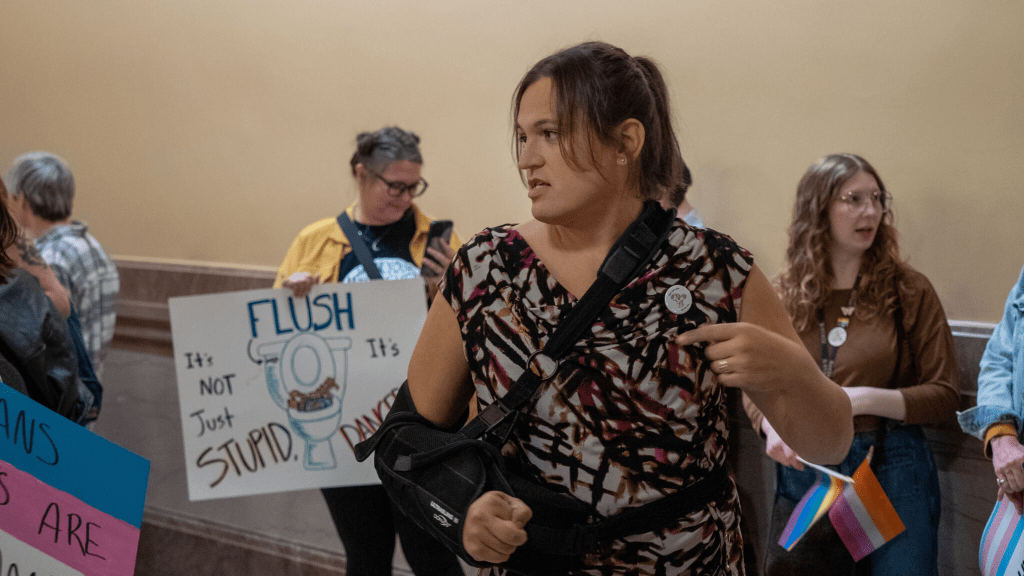
Jaelynn Abegg, a trans rights activist from Wichita, leads a group of around 50 people who used bathrooms Feb. 6, 2026, throughout the Statehouse to demonstrate what she called the absurdity of a state bathroom ban. The same law that includes the bathroom ban also invalidates driver’s licenses for transgender people. (Photo by Sherman Smith/Kansas Reflector)
TOPEKA — Transgender rights activist Jaelynn Abegg was furious Thursday morning when she received a letter from the state informing her that her driver’s license had been invalidated because of a new state law.
Abegg, a Wichita resident, said she would only get a new driver’s license if she needs one before fleeing the state, which she plans to do as soon as she can afford it. In the meantime, she figures her U.S. passport will be “ID enough.”
“When things like this happen, I honestly get a little bit of a demon of rebellion in me, and I’m not sure exactly how I’m going to manifest that, if at all right now, but I can tell you that I’m very angry,” Abegg said. “I’m heartbroken. “This is my home state. I’ve lived here all but two years of my life, and yet, every year since I’ve been living as a woman and having come out as transgender, this state has done nothing but break my heart. If this state was a romantic partner, I would definitely call this an abusive relationship at this point.”
The Kansas Department of Revenue this week sent a letter to Kansans affected by a new law, which took effect Thursday, that requires the gender marker on a driver’s license to match a person’s sex at birth.
The letter informs trans Kansans that because the Legislature didn’t include a grace period for updating credentials, they are “invalid immediately, and you may be subject to additional penalties if you are operating a vehicle without a valid credential.” A spokesman for the agency told Kansas Reflector the law invalidated about 1,700 licenses.
The letter directed trans Kansans to surrender their driver’s license to the state before they can receive a new one, which will cost them $8.
“We apologize for the inconvenience this causes you,” the unsigned letter said.
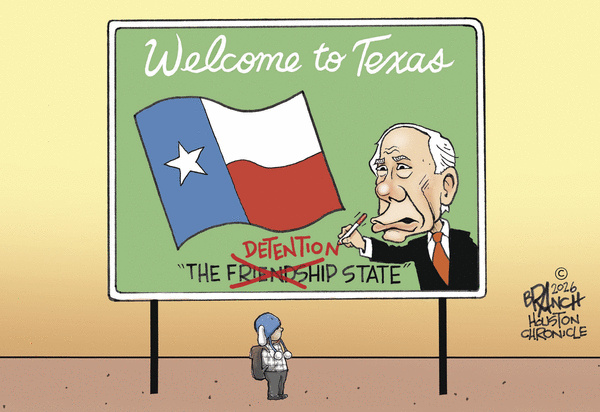
Republicans in the Legislature placed transgender Kansans in their crosshairs at the start of this year’s session. The House Judiciary Committee scheduled a hearing with less than 24 hours notice on the second day of the session for a bill that would invalidate their driver’s licenses. The bill was a response to a Kansas Court of Appeals ruling last year that determined there was no harm in letting people change their gender markers, which Kansans have done since at least 2002 with no complaints.
A week after the rushed hearing, in a flurry of procedural maneuvers, the committee took action on the bill without warning. Republicans added language that would make it illegal for someone to use a public building bathroom, or similar space, like a locker room, that conflicts with their sex at birth. They then inserted the contents of the House bill into an unrelated Senate bill that passed the year before. That allowed the House and Senate to pass Senate Bill 244 the next day without ever holding a public hearing on the bathroom provision.
Democratic Gov. Laura Kelly vetoed the bill on Feb. 13. The House and Senate subsequently overrode her veto with all but one Republican, Rep. Mark Schreiber of Emporia, voting in favor of the bill.
Abegg, who organized a Feb. 6 “pee-in” protest, in which trans people and their allies filled a bathroom at the Statehouse, said lawmakers were “blatantly subverting the democratic process … because they know they’re going to get blowback.”
“This is a hallmark of a Legislature and of a government that has a deep, deep sickness in it, and it really saddens me that we’re living to see days like this, where there’s that sort of situation going on, and there’s not a greater public outcry about it,” Abegg said. “This should be a concern to everyone who values democracy and who values Kansas as a free state.”
Trans Liberty, a political action committee that fights for trans rights, issued its first-ever statewide evacuation order Thursday, when it urged transgender Kansans to flee.
Samantha Boucher, founder of Trans Liberty PAC, said in a statement there is “something deeply wrong with a government that erases its own citizens’ legal identities.”
Abegg said the warning to leave is “absolutely the right approach.”
“I don’t think that legislators in Kansas are done harassing trans people,” Abegg said. “I think that transgender health care for adults is coming next. It would not shock me within the next two to five years to see them come after name changes for transgender people. The cruelty has always been the point, and the objective has always been the complete erasure of transgender people from public life.”
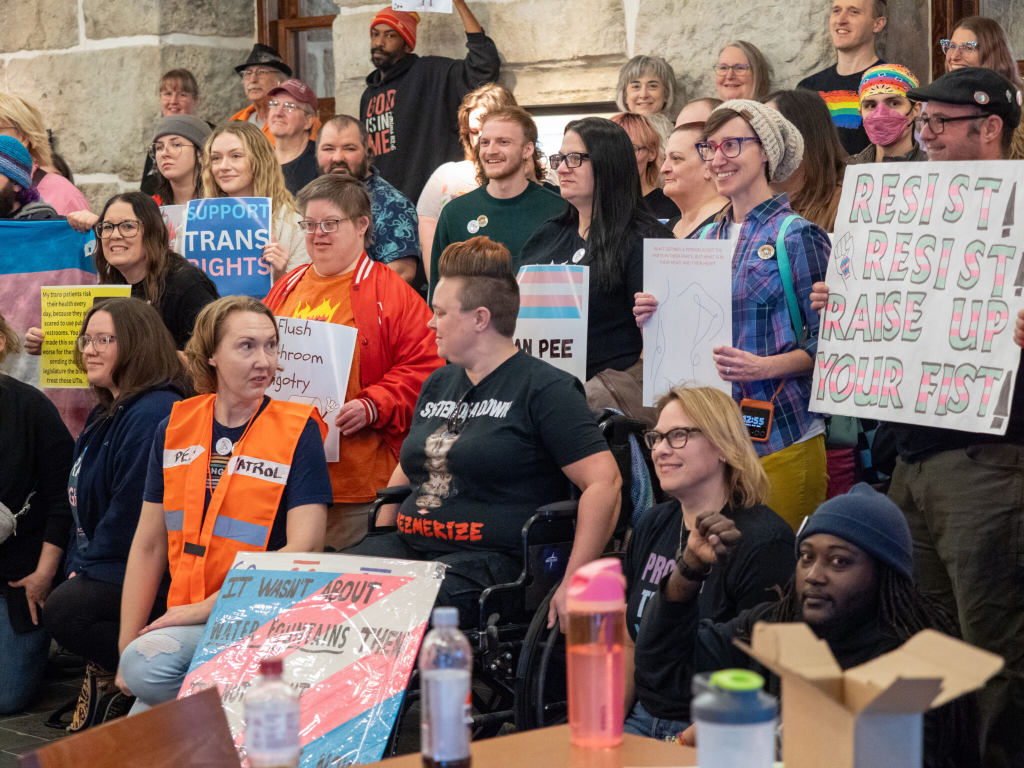
Trans people and their supporters rally Feb. 6, 2026, at the Statehouse in opposition to Senate Bill 244. (Photo by Sherman Smith/Kansas Reflector)
Jessie Lawson, a trans woman from Wichita, initially planned to go to the DMV and refuse to pay for a new license, then decided against it.
“I can work from home and, for the moment, minimize the risk of getting pulled over,” Lawson said.
She said her first thought when she read the letter from the state was to wonder “how conservatives can live with so much fear and hate in their hearts.”
“Even at my most angry, I’ve never wanted to see an entire demographic of people wiped off the planet the way they do. It’s unreal,” she said. “The second thought is how I’m going to survive now that bigotry has been officially sanctioned by the state of Kansas.”
Lawson said she has wrestled with whether she should leave the state where she has lived her entire life.
“I have a great job and own my own home,” Lawson said. “All of my friends are here. Leaving would be very difficult for me. At the same time, this place is becoming increasingly hard for me to exist safely as bigotry takes more and more control of the state government.”
She added: “Please publish whatever you get from us. There needs to be a record that we existed and strove for peace and joy as long as we could.”
Rep. Brooklynne Mosley, D-Lawrence, posted on her Facebook page that she would be available Friday to drive people to the DMV to replace their birth certificates. She said she was willing to personally pay for up to five individuals’ fees if they have financial constraints.
The new law also affects birth certificates.
Jill Bronaugh, spokeswoman for the Kansas Department of Health and Environment, said individuals will be responsible for contacting the Office of Vital Statistics to replace their invalidated birth certificates, and a $20 fee will apply.
The agency identified 1,849 birth certificates on which the sex has been changed, which can be attributed to correcting data entry errors or recognizing gender changes, she said.
“Each amended birth certificate will be reviewed manually by staff to determine if the birth certificate must be invalidated and amended,” Bronaugh said. “This process is expected to take several months to complete.”
This next cartoon is seriously important. It is how every parent of a gay kid who accepts their child’s sexuality feels. Can you imagine a father who accepts his gay son talking to them about lube? And I don’t even want to discuss the parents who refuse to accept their child’s sexuality and instead try to force them to change. Hugs
It is a fact that most mass shooters are males, mostly white males. But right wing media are so desperate to slander and smear trans people the same way it was tried to before the internet with other media against gay people. The know what they are creating is false but they don’t care because they know that others will believe it and repeat it everywhere. It is a sickness and curse to want to create that much hate and chaos against the most vulnerable communities in society. Hugs





































































































 Scottie's Playtime