There is a video at the site linked. How ever as you read through this remember that this is the group that wrote project 2025 and the main author of that Christian nationalist screed is Russell Vought who has a powerful position in the tRump administration. This is entirely about pushing a fundamentalist Christian lifestyle and worldview on the US public with heavy emphasis on quiverful which ishave as many children as possible for Christian families most of whom in that movement lived impoverished on one income. The idea is more kids butts in church pews now leads to more adult butts in those pews increasing tithes and money in the collection plates. Church attendance has decreased steadily and this is designed to increase it again. Plus it removes rights for women and LGBTQ+ families. The parents get the money only if women / the mothers marry young, forgo an advanced education, stay out of the work place, and have child after child after child like a breeding stock farm animal. It is only for the “right or correct types of families” and harms those who are not the “right” kinds of families. Plus it is totally racist with the poor people being cut out of the funds. The fact is minorities make on average far less than white families due to inherent racism and CRT, which is a real thing. Hugs
Last week, I wrote about the Heritage Foundation’s Saving America by Saving the American Family: A Plan for the Next 250 Years. The plan is, essentially, to make women drop out of school, marry young, have tons of babies, rely financially on their husbands, be unable to divorce, and wind up in the poor house if they don’t follow these rules. But I wanted to zero in specifically on the policy section of the piece, which comes at the very end and which I haven’t seen get the coverage it deserves. Because what the Heritage Foundation is proposing is a massive cash transfer from poor single mothers to better-off married couples. This really is the plan: Take from the poor to give to the “right” kind of families. Make poor mothers work, and pay better-off ones to stay home. Further impoverish single mothers to force them to marry.
The Heritage Foundation wants to eventually end cash welfare as we know it (“Credits designed specifically to benefit poor single mothers may be well intended, but they have proven to incentivize single motherhood in poor communities,” Heritage laments). They don’t propose totally doing away with welfare benefits here, I suspect because they realize that would be a nonstarter. But they do propose taking resources that currently mostly benefit poorer families and redirecting them to wealthier ones, so long as those wealthier families have married parents. The Heritage proposal would only give its proposed benefits to married couples (policies should “privilege marriage as directly and explicitly as possible,” Heritage writes, emphasis theirs). It would only give benefits to married couples in which one partner works and makes above a certain income. And it would incentivize women dropping out of the workforce… unless they’re poor or single.
Here are the specifics.
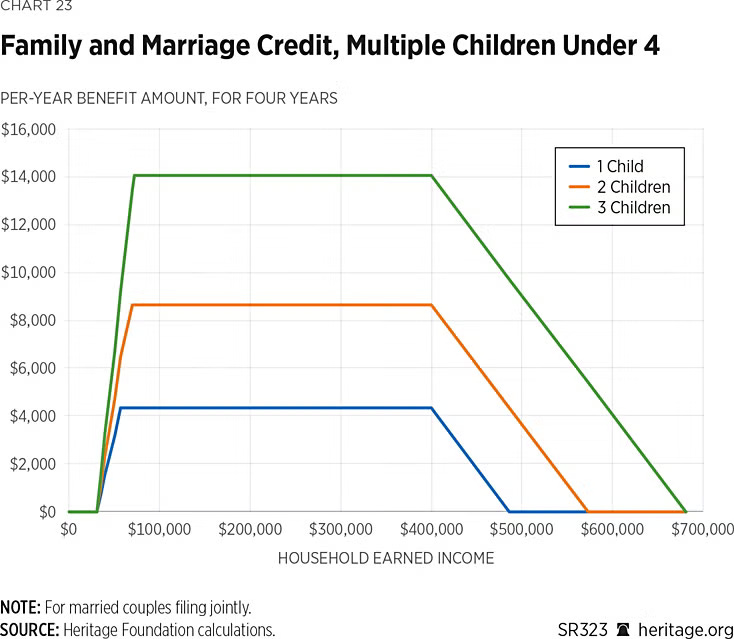
Child tax credits only for married couples who are the child’s biological parents, who are working, and who make at least $30,500. The Heritage proposal would get rid of the Earned Income Tax Credit, because that credit gives more money to struggling single parents than better-off married ones, as well as the Child Tax Credit, and replace them with what they call a Family and Marriage (FAM) tax credit of $4,418 per child per year for four years. But this credit would phase in for families once they’re earning $30,500 per year — in other words, poor families wouldn’t qualify. It would only go to married parents — single parents wouldn’t qualify. It would only go to biological parents — step parents wouldn’t qualify. A person could be working full-time, but even if they’re earning above minimum wage, they may not qualify for this tax credit.
Bonuses for larger families — but only for married couples, only for biological parents, and not for the poor. Additionally, Heritage proposes a 25% per-child bonus to their FAM tax credit for third children and beyond. But, again, poor families are out of luck, as only couples with at least one working spouse qualify, and that spouse has to make at least $30,500.
More money for higher earners, none for the lowest. The FAM credit phases in at $30,500, and goes up from there relative to income. That’s right: This is government family support that gives more money to families that already have more money. And it gives the most money to families that are the most stable: Those with two married parents who make more than six figures. The credit doesn’t begin to scale down until a family makes $110,000, and even then, the wind-down is small (beginning at just 5%). Why set up a program that gives people more money as they make more money? Because “the FAM credit’s phase-in would incentivize work.” All of this means that a married couple with three children making $400,000 a year would get $14,000 additional dollars from the US taxpayer — while a single mom making $20,000 a year would get nada.
No help after a child’s fourth birthday. As it stands, parents can claim the Child Tax Credit until a child’s 17th birthday. The Heritage plan cuts parents off when their kid turns four. They claim that these early years are when parents need the most help. But children don’t stop needing food and a roof over their heads once they’re kindergarten age. The Heritage Foundation is clear that the purpose of this plan isn’t to support children, but to incentivize parents to have more of them: “The FAM credit is designed specifically for families with newborns or young children. Lawmakers interested in family policy may be inclined simply to expand the CTC. However, this approach would be inefficient as a family formation incentive. Only a small fraction of the benefit would go toward new parents, while most of it would go to families that are already formed.” They continue: “many other family benefits, such as the CTC, are backloaded to later in life when many parents are on more solid financial footing and may be past their prime child-bearing years.” Emphasis mine, because this is truly stunning: The Heritage Foundation only wants to give parents tax credits for their (expensive) children if those parents (mothers) are in their “prime child-bearing years” and might make more babies. Eggs too old? No child tax credits for you.
Pay women to stay home. The Heritage Foundation could have proposed a generous paid leave program, which would allow parents of newborns to stay home and care for them in that crucial first year. But their aim is not to make sure that young children receive the best possible care. Their aim seems to be to get women out of the workforce. And so they’ve instead offered a $2,000 per-child credit for one parent (almost always the mother) to stay home and care full-time for her child — but again, this only applies to married couples where one spouse (almost always the husband) is working and makes more than $30,500 per year. You’re a single mom who wants to stay home with your child? Tough luck, get to work. You’re a low-income married parent who wants to stay home with your child? Tough luck, get to work. If the concern really were for children — if the view really was that young children are best off being cared for at home by a parent — then this policy would apply to all parents of young children. But that’s not the concern. The concern is that women aren’t living their lives in the way Heritage deems acceptable.
Fund this whole scheme by getting rid of Head Start. Head Start is an incredible program that has had vast positive impacts, increasing high school and college graduation rates, adult incomes, health outcomes, and overall wellbeing. Studies have found it even decreases child abuse and neglect. This proposal would effectively end it, and use the money saved to give tax breaks to wealthy married couples with children.
Pay people to marry young. The final Heritage policy is a $2,500 deposit into a savings account for every new baby born in the US — but the only way to get the full benefit of that money as an adult is to marry well before the age of 30. That is, when an American is born, the government will deposit $2,500 into a savings account for them, which they cannot touch until they either marry or turn 30. At either marriage or age 30, they can start to withdraw from the account, but only over three years — so about a third of the original value per year. They get the full withdrawal amount each year (roughly one-third of the total account value) if, in each year, they are married but not yet 30. If they’re over 30, whether they’re married or not, they pay a tax penalty. In other words, to get the full benefit, you have to marry by 27 — below the average age of first marriage for women (28.6) and men (30.2) alike. Again, the point is not to incentivize marriage; it’s to incentivize women especially marrying as young as possible, despite early marriage being tied to higher divorce rates.
xx Jill
Subscribe to Throughline by Jill Filipovic
Hundreds of paid subscribers
Connecting the dots. Politics, culture, women’s rights, foreign affairs, law, and more.
Immigration and Customs Enforcement (ICE) faced a major legal setback as federal judges in New Jersey and Texas criticized the agency over prolonged detentions and repeated violations of court orders.
A federal judge in New Jersey wrote a withering critique of the agency and the Department of Justice (DOJ) over what he described as widespread violations of court orders in immigration matters. Meanwhile, in Texas, another federal judge ordered that an ICE detainee be given a bond hearing or be released, continuing a string of rulings challenging the agency’s mandatory detention policy.
A Department of Homeland Security agent wearing an Immigration and Customs Enforcement patch and badge at Royalston Square on January 22 in Minneapoli… | Jim Watson – Pool/Getty Images
These back-to-back rulings place ICE’s operations under increased court scrutiny amid ongoing tensions between immigration authorities and federal judges. Courts across the country have increasingly pushed back against what they view as procedural lapses or administrative overreach in detention practices under the Trump administration’s expansion of mandatory detention and mass deportations.
DHS has frequently criticized federal judges whose rulings slowed or blocked deportations, often labeling them as “activist judges.” Trump officials have argued that these judicial interventions interfere with enforcement priorities and complicate efforts to remove individuals quickly, framing the courts as obstacles to the administration’s immigration agenda.
New Jersey Judge Slams ICE Over Repeated Court-Order Violations
New Jersey District Judge Michael Farbiarz issued a strongly worded order pointing to dozens of instances in which ICE and the DOJ failed to comply with judicial directives concerning the detention and transfer of immigration detainees, according to a court filing reviewed by Newsweek.
The case involves Baljinder Kumar, who filed a habeas petition challenging his detention without a bail hearing. A January 26 injunction barred ICE from transferring Kumar out of the district, but the agency moved him to Texas on January 31, per the filings.
Farbiarz noted the scale of the problem, writing in a court opinion that “no-transfer injunctions issued by New Jersey district judges have been recently violated 17 times by the Respondents,” about “three every two weeks.”
The court acknowledged an investigation by the U.S. Attorney’s Office, which concluded that the transfers “occurred inadvertently due to logistical delays in communicating the court order to the relevant custodians or to administrative oversight of the court order,” and that ICE had “agreed to return the petitioner to the District of New Jersey to regain compliance.”
Court filings showed violations of more than 50 orders over roughly 10 weeks, including cases in which detainees were moved or deported despite explicit court prohibitions.
“The revelation that the Department of Homeland Security violated dozens of judicial orders in New Jersey is shamefully unsurprising. This isn’t just inadvertent or sloppy; the Trump administration has repeatedly flouted judicial orders and attacked the integrity of judges,” ACLU-NJ Executive Director Amol Sinha said in a statement.
Texas Ruling Orders Bond Hearing or Release for ICE Detainee
A federal judge in the Western District of Texas has ordered ICE to either hold a bond hearing or release a Mexican national who has been detained for more than eight months without a final removal order at the Camp East Montana detention facility, according to court filings.
On March 2, Senior U.S. District Judge David C. Guaderrama ruled that Victor Zamudio Sanchez’s continued detention without a hearing violated the Fifth Amendment’s Due Process Clause.
Guaderrama wrote in court documents, “Respondents, by detaining Petitioner without the opportunity for a custody redetermination hearing, have deprived Petitioner of his procedural due process rights.”
The judge directed that if Sanchez was not released by March 9, ICE must provide a bond hearing before an immigration judge.
At that hearing, the government would be required to prove, “by clear and convincing evidence, the dangerousness or flight risk justifying Petitioner’s continued detention,” according to the filing.
Sanchez, who has lived in the United States for more than two decades, has been held without a meaningful opportunity to challenge his confinement, the court said. Guaderrama emphasized that the prolonged detention, absent any individualized assessment, posed a serious risk of “erroneous deprivation of [Petitioner’s liberty] interest.”
The court found that Sanchez had been caught in a procedural limbo, with ICE failing to issue a timely Notice to Appear and repeatedly denying him a bond hearing. While the agency eventually initiated formal removal proceedings, the judge ruled that Sanchez’s indefinite detention violated the Fifth Amendment’s Due Process Clause, ordering ICE either to release him or provide a bond hearing.
The administration has interpreted federal law to allow ICE to hold many noncitizens without bond hearings, applying mandatory detention to people who entered the United States without inspection, even if they have lived in the country for years. This represents a departure from decades of practice, when many detainees could seek release while their cases proceeded.














































































 Scottie's Playtime