“Hey hey, ho ho, Donald Trump has got to go,” protestors chanted in the middle of Times Square, among a sea of signs that read “love reigns not kings,” “gays against faux-king Trump,” “we stand with … our trans family” and “the future is coming.”
On Saturday, independent analysts estimated that the No Kings March drew between 5 and 8 million people, and organizers say over 7 million people attended 2,700 events across all 50 states. The event, which was organized to push against the rise of authoritarianism in the U.S., was the largest single-day protest in America since 1970.
Over 100,000 New Yorkers marched in all five boroughs in NYC on Saturday. Photo by Jelinda Montes.
Among the crowd were countless LGBTQ people, fighting back against an administration that has introduced a litany of anti-LGBTQ executive orders and used vile rhetoric to denigrate queer people. This backsliding of LGBTQ rights, according to experts, has a deep connection to authoritarianism, with research showing that when governments weaken protections for queer and trans people, they often turn to broader democratic institutions next.
“Threats to democratic institutions and threats to LGBTQ rights are mutually reinforcing, generating a vicious cycle that strengthens authoritarian control,” Ari Shaw, director of International Programs at the Williams Institute, told Uncloseted Media. “Increased persecution of minority groups, including LGBTI people, is itself evidence of democratic backsliding by indicating the erosion of liberal democratic norms [meant to protect] minority rights.”
Legal Abuse of Power
One of the ways the Trump administration’s abuse of power has been most evident is through its legal actions.
He’s also slashed HIV funding at a staggering rate. Uncloseted Media estimates that the National Institutes of Health has terminated more than $1 billion worth of grants to HIV-related research, including 71% of all global HIV grants.
Jeffrey Cipriano at the NYC No Kings protest Saturday. Photo by Jelinda Montes.
It was these cuts that prompted Brooklynite Jeffrey Cipriano to turn out to protest. “The specific reason that I’m protesting is actually on the shirt I’m wearing,” says Cipriano.
“My best friend works for an organization called AIDS United. … His job is to travel the country and help people get AIDS medication, specifically trans and unhoused community members. But his job is at risk,” he says. “The end outcome of his work is that people who have issues in their lives have the issues resolved and that’s going away under the current administration.”
Executive orders are based on powers granted to the president by the U.S. Constitution or by Congressional statutes. The president cannot use an executive order to create new laws or spend money unless Congress has authorized it. They are meant to direct how existing laws are implemented. But Trump has ignored democratic norms, often filling agencies with loyal supporters, using orders to go after political opponents and pushing the limits of what the law allows.
In some cases, he has moved illegally. “The President is directing various executive branch officials to adopt policy that has either not yet been adopted by Congress or is in violation of existing statutory law,” says Jodi Short, professor of law at UC Law San Francisco. “The analogy to a king and what has troubled many about this presidency is the sheer consolidation of executive branch power in one individual.”
Short’s colleague, Dave Owen, agrees. “Illegality has been rampant,” he told Uncloseted Media in an email. “People are often cynical about the government, and they might think what Trump’s doing is nothing new. But most of the time, the executive branch takes the law seriously, and both legal constraints and norms of good governance matter,” he wrote. He says that through history, there’s been “a lot more integrity and a lot less lawlessness than most people realize.”
“This administration has broken with those traditions,” he adds.
Revolt Against Executive Orders
Many Americans have recognized this. A survey from April found that 85% of Americans agreed or strongly agreed that the president should obey federal court rulings even if he doesn’t like them.
In response to Trump’s overreach, more than 460 legal challenges have been filed across the country challenging his executive actions. One of these is a federal lawsuit by Lambda Legal and the Human Rights Campaign Foundation that challenges the constitutionality of the Trump administration’s ban on military service by transgender people. Another lawsuit challenges Trump’s order directing federal agencies to withhold funds from medical providers and institutions that provide gender-affirming medical treatments for people under 19.
Zoe Boik and her father, Derik, protesting on Saturday. Photo by Sean Robinson.
Both of those lawsuits are one reason 17-year-old Zoe Boik came out to protest with her friends and her dad. “Obviously, I’m disappointed and kind of helpless because there’s nothing I can directly do to change or impact anything that’s going on,” says Boik, who identifies as pansexual and gender fluid and is not legally allowed to vote.
Boik—who was seven years old when Trump announced his run for presidency in 2015—says she’s doing a research paper on Trump’s trans military ban and is frustrated because she sees it as inexplicable discrimination. “They’re not letting trans people serve … which doesn’t make any sense.”
Zoe as a child with her dad, Derik. Photo courtesy of Boik.
LGBTQ Rights and Democratic Backsliding
This type of blatant discrimination is often a key sign of a country moving closer to authoritarianism and away from democracy. According to a 2023 research paper by Shaw and his colleagues, anti-LGBTQ stigma may contribute “to the erosion of democratic norms and institutions.”
The paper found that when a country with relatively high acceptance of LGBTQ rights introduces anti-LGBTQ legislation, it clashes with what most people believe and can weaken public trust in democracy, deepen political divides and make it easier for populist or extremist movements to gain power.
“The level of acceptance of LGBTQ people is closely associated with the strength of democracy in a country,” Shaw says. “In some cases, we even saw that rising anti-LGBTQ rhetoric or policies preceded a broader decline in democracy.”
In Brazil, for example, early democratic gains coincided with rising LGBTQ acceptance, including legal recognition of same-sex unions and workplace protections. But as populist President Jair Bolsonaro came into power in 2019, he began questioning—without evidence—the security of Brazil’s voting systems, saying he would only lose his re-election campaign if there were fraud. He was also accused of trying to intervene in operations held by the Federal Police about the alleged criminal conduct of his sons, and he told his ministers that he had the power and he would interfere—without exception—in all cabinet ministries. At the same time, LGBTQ protections were rolled back, and schools and civil society faced censorship, suggesting that falling LGBTQ acceptance may have “preceded Brazil’s democratic erosion,” according to Shaw’s paper. In September of this year, Bolsonaro was sentenced to 27 years in prison for plotting a military coup.
Another example is Poland’s democracy weakening since 2015 under the Law and Justice Party, which consolidated power by undermining the Constitutional Tribunal, installing loyal judges and restricting independent media. Anti-LGBTQ rhetoric became central to the party’s nationalist platform, fueling the creation of nearly 100 “LGBT ideology free zones,” inciting violence against LGBTQ individuals and stymying legal recourse through politicized courts.
When it comes to LGBTQ rights, Trump has mimicked the moves of these leaders even though most of his constituents don’t want it: A 2022 survey from the Public Religion Research Institute found that 80% of Americans favor laws that would protect LGBTQ people against discrimination.
“The definition of an authoritarian system is a system where power is consolidated in one individual whose power is unchecked by any other institution. And I fear that in certain domains, that’s the direction in which this administration is trying to move us,” says Short. “I think it’s incredibly dangerous.”
Attacks on Higher Education
Another common tool in the authoritarian playbook is attacking higher education.
While many universities are rejecting Trump’s demands, others are experiencing a chilling effect, changing their policies before the administration tries to hold up funds.
James Revson, Maddy Everlith and Shay Wingate holding their signs at the No Kings protest. Photo by Jelinda Montes.
“I’m here because I’m angry and I feel that we aren’t angry enough,” Maddy Everlith, a sophomore gender studies major at Pace University, told Uncloseted Media as she marched with her friends. “Being a woman of color in America and having so many intersectional identities is also what affects me. … I want to stand up and advocate for other people.”
Everlith’s university responded to Trump’s threats in September by renaming its DEI office to the “Division of Opportunity and Institutional Excellence.”
“I am beyond horrified how quickly our university was willing to bend the knee on this decision,” Austin Chappelle, a senior at Pace, told the student newspaper. This change comes in the midst of uncertainty under the Trump administration, which has already caused many LGBTQ students to feel uneasy on campus.
“It’s part of an electoral strategy to try to mobilize right-wing voters to distract from other sorts of political or economic scandals,” Shaw says, adding that this tactic is another way to gain power.
Lars Kindem protesting for his trans sister at the No Kings protest. Photo by Sean Robinson.
The pain of this rhetoric has affected millions of trans Americans and allies alike, including Lars Kindem, a 64-year-old retired pilot from Minnesota who was marching to support his transgender sister.
“What Trump has done is he’s taken people that haven’t done anything wrong and has turned them into scapegoats,” he says, adding that Trump’s language is “hateful, petty, mean and hurtful.”
He says his sister and her partner are having issues getting the correct gender markers issued on their passports. Because of the Trump administration’s treatment of the community, they are making plans to move to Denmark, where “there’s a lot more acceptance.”
Christian Nationalism
This scapegoating has played into the hands of Trump’s voter base of white evangelical Protestants, the only major Christian denomination in the U.S. in which a majority believes society has gone too far in accepting transgender people.
Since 2020, Trump has increasingly embraced Christian nationalism in his rhetoric and imagery. He’s sold Bibles, created a federal task force on anti-Christian bias and been intrinsically linked to Project 2025, the 920-page plan calling for the establishment of a government imbued with “biblical principles” and run by a president who holds sweeping executive powers.
Experts say that “a strong authoritarian streak” runs through conservative Christianity. A 2023 study found that supporters of Christian nationalism tend to support obedience to authority and the idea of authoritarian leaders who are willing to break the rules. Nearly half of Christian nationalists support the notion of an authoritarian leader.
“They are trying to use the language of Christianity, but they are abusing it and misusing it constantly,” Rev. Chris Shelton, a gay pastor at the protest, told Uncloseted Media. “Our faith is all about reaching out to the marginalized, reaching out to the people who are ostracized by society and embracing them and offering love and welcome and a sense of dignity and worth. And to see any human being’s worth being denied is just a mockery of our faith.”
Rev. Chris Shelton marched in Saturday’s NYC protest. Photo by Sean Robinson.
Heidi Beirich, the vice president and co-founder of the Global Project Against Hate and Extremism, says that “the LGBTQ community is the prime target of modern authoritarian regimes.”
“For Christian nationalists, attacking LGBTQ rights is the first pillar in destroying civil rights for all. This has happened in countries like Hungary and Poland as authoritarianism consolidated and now it’s happening here,” Beirich told Uncloseted Media.
Moving Forward
As the country bleeds toward authoritarianism, LGBTQ protestors are encouraging people to use their voice, something the queer community is familiar with doing: One 2012 survey found that queer folks are 20 times more likely to be active in liberal social movements than their straight, cis counterparts.
“It is imperative that people continue to pay attention,” Short says. “There is so much going on, a lot of it is disturbing and intense, and there’s such a strong impulse to look away. But we have to engage in political action and resist inappropriate assertions of authority and continue to show up and vote for our democracy.”
17-year-old Zoe Boik is ready. She remembers being in second grade and crying the day after Trump won his first election in 2016. She couldn’t believe how he could lead the country despite “all the bad things he said.”
Boik can’t wait until the midterm elections, when she will be 18 and finally able to vote. “If we don’t vote, then our voices won’t be heard,” she says.
Despite this, she’s also concerned about her freedom to exercise that right being jeopardized.
“My fears about Trump don’t stem specifically from me being queer, but from his authoritarianism as a whole,” she says. “I am scared about how far he will move into dictatorship, [and] my biggest fear is that our right to vote will be compromised, leaving us no recourse.”
If objective, nonpartisan, rigorous, LGBTQ-focused journalism is important to you, please consider making a tax-deductible donation through our fiscal sponsor, Resource Impact, by clicking this button:
He has additionally espoused a view of the United States as a white, Christian nation, claiming that white people are undergoing a “cultural genocide” and deliberate replacement.
Multiple Trump nominees have had histories of racist, violent, white supremacist, and even pro-Nazi tweets. But almost all of them still end up being confirmed by Senate Republicans.
NPR identified more than a dozen files released by the DOJ on Friday that are no longer available Saturday afternoon, including one that shows President Trump’s photo on a desk among several other photographs. The removed files also show various works of art, including those containing nudity.
A video posted to Instagram by the University of South Florida’s Muslim Student Association (MSA) shows three men interrupting students during their morning prayer, spitting and yelling at them, and waving strips of bacon at them. USF said that their police department is currently gathering evidence and anticipates asking the state attorney to bring criminal charges.
Last Tuesday morning, Nov. 18, several MSA members gathered on top of a parking garage on USF’s Tampa campus for Fajr, Islam’s morning prayer. A livestream by Warriors for Christ—an organization recognized by the SPLC as a hate group—shows Muslim students kneeling in prayer as one of the men, identified in the video only as Ricardo, approaches with a painted cardboard box that reads “KAABA 2.0 JESUS IS LORD.” The Kaaba is a stone building at the center of the holiest site in Islam. While praying, Muslims face the geographical direction of the Kaaba.
The man sets up the box in front of the crowd while two other men, identifiable via their social medias (where they posted the video along with many other similar videos at other locations) as Richard Penkoski of Oklahoma and Christopher Svochak of Illinois, start to “insult” the Muslim prophet, Muhammad, in obscene and sexual ways. One of the men calls them all terrorists. “Go back to Mecca,” he shouts.
At one point, Penkoski brings out a small Wawa container with bacon in it and waves it around while snacking from it.
“We do care about you, so we brought you some bacon,” Penkoski says. “It’s really good. Bacon? Bacon? Anybody?”
Like all pork products, bacon is considered haram, meaning Islam’s rules forbid eating it. All of the students remain kneeling and continue on with their prayer.
“I spit on the grave of Muhammad,” the man identified as Ricardo says before spitting on the ground within a few feet of the students, who are still praying on the ground.
“Take that towel off of your head,” he says, pointing to a woman in the back wearing a religious head covering. At this point, after several minutes of the men shouting at the largely silent students, Ricardo lunges towards a student and points his finger in his face, prompting the student to briefly grab his wrist. Immediately, all three Christian men say this is evidence that Islam is a violent religion.
“This is not how you preach,” one of the students can be heard saying. “Brother, you’re harassing us,” he says to Penkoski.
“You’re not my brother,” Penkoski responds. “This isn’t harassment; this is free speech. But thank you for doing what you did to give us more ammo to prove you’re a bunch of violent psychopaths.”
The video continues like this until the students leave and the Christian content creators do the same. “That was awesome. That was fun,” one of the men can be heard saying as they walk away.
“By the way, don’t ever spit on the ground. It’s actually illegal,” one of the Christians says to the man identified as Ricardo. “What? Spitting on the ground?” “Yes, it’s illegal.” “Well, uh, I didn’t know that.”
Penkoski later posted a screenshot from the MSA group chat, in which one member gives an update on legal proceedings with the state attorney’s office.
“It’s not a hate crime,” Penkoski writes in the caption. “For a ‘hate crime’ to exist, there has to be an actual crime first.”
Florida Statute 871.01, which makes disrupting religious assembly a crime, reads: “Whoever willfully and maliciously interrupts or disturbs any school or any assembly of people met for the worship of God, … commits a misdemeanor of the first degree.” In Florida, a first-degree misdemeanor is punishable by up to a $1,000 fine and one year in prison.
Florida Statute 775.085 contains rules for hate crime enhancement when there is evidenced prejudice against “race, color, ancestry, ethnicity, religion, sexual orientation, national origin, homeless status, or advanced age of the victim.” This bumps first-degree misdemeanors up to third-degree felonies. Third-degree felonies are punishable by up to $5,000 in fines and five years in prison.
Florida Statute 784.0493 deals with harassment based on religious or ethnic heritage. It makes it illegal (first-degree misdemeanor) to “willfully and maliciously harass or intimidate another person based on the person’s wearing or displaying of any indicia relating to any religious or ethnic heritage.”
The man, identified as Ricardo repeatedly told two women with religious head coverings to “get that towel off your head,” and called one a “wicked woman” and a “Jezebel dog.”
As the men left the parking garage, Svochak spoke to the camera, saying Jesus helped him and Penkoski beat drug addiction.
“What did he save you from?” Penkoski asks Ricardo. “I used to be a heathen,” Ricardo replies.
The state attorney typically decides what initial charges to bring. The 13th Circuit State Attorney’s Office has plans to speak with Creative Loafing Tampa Bay this morning, but as a policy it waits to start a case until police send investigative information along.
A statement issued by USF says that campus police are still trying to identify the men in the video. USF also said that it has reached out to the affected students, and will issue trespass warnings to the men who interrupted the prayer. They anticipate referring the perpetrators to the state attorney for criminal charges.
This wouldn’t be the first time Penkoski found himself in court over a stunt. The Christian content creator takes videos of himself and others “street preaching,” often insulting and demeaning nearby targets. Penkoski uploads the videos to his social media accounts and makes other targeted posts and includes a donation link through a Venmo account under his wife’s name.
In 2022, Penkoski was accused of targeting two leaders of Oklahoma for Equality, who later filed for a protective order against him. They were granted the protective order, but it was overturned on appeal by the Oklahoma Supreme Court in a 5-4 decision, since Penkoski was targeting organizations rather than individuals.
Penkoski has also been the plaintiff in several legal battles, including an attempt to overturn federal marriage equality for gay couples, a suit against the mayor of Washington D.C. for allowing a “Black Lives Matter” mural, and a lawsuit against a school district that sent his daughter home for wearing a shirt that said “homosexuality is a sin.”
Svochak gave this reporter a statement about his religious beliefs over Instagram DM, but would not answer specific questions. Svochak, who is affiliated with the recognized hate group Warriors for Christ, said that he is trying to spread Jesus’ message of love.
An Uncloseted Media investigation finds that Alberta’s government is using many of the same tactics that were used to pass anti-LGBTQ bills in the Deep South.
Jay, a 24-year-old trans man who immigrated from East Africa to Canada in 2016, used to think of Canada as a safe place for queer people. But with Alberta—arguably Canada’s most conservative province—attempting to pass the country’s first gender-affirming care ban, he doesn’t feel this way anymore. “It’s really heartbreaking as a person who, back home, would not be able to live the way that I do, seeing the same rights being stripped away from folks here,” says Jay, who asked to go by first name because he’s not out to everyone in his life.
Since September, when Alberta’s anti-trans sports ban and pronoun policy officially went into effect, Jay has felt his province’s values inch closer to those of the U.S.
“I’m constantly thinking maybe I should leave this province. It’s not very safe for me here,” he told Uncloseted Media. “It’s starting to feel like a foreign place.”
Alberta’s anti-trans policy push started making headlines last year. On Dec. 3, 2024, more than 80 Albertan politicians assembled in the province’s capital, Edmonton, to debate the Health Statutes Amendment Act, also known as Bill 26. The act—which is likely to go into effect—would impose the strictest ban on gender-affirming care for minors that Canada has ever seen.
Conservative Adriana LaGrange, who in 2019 introduced an amended act that made it legal for parents to be notified if their child joins a gay-straight alliance, sponsored the bill. During the assembly, LaGrange told her colleagues a ban “would preserve choice so that [minors] can make adult decisions in the future,” and that while “Albertans know that our government is committed to safeguarding individuals’ rights … there are times when public health measures must be taken to keep our communities safe.”
As the legislative debate continued, Sarah Hoffman, a member of the Legislative Assembly for the New Democratic Party (NDP), accused Alberta Premier Danielle Smith and those closest to her of “playing political games that will have potentially deadly consequences for teens.” And Peggy Wright, another member of the NDP, referenced American trans kids whose lives have been upended from similar state bans: “Kids in the United States shouldn’t have to travel away from home to get the health care that they deserve, and neither should the kids that I know that are already thinking about what it is that they’re going to do once this [Canadian] legislation is passed. … As a mom, as a grandma, I am asking that every single person in this House think about those kids in your life. What kind of a future do you want for them?”
Alberta Legislature, facing the front entrance. Photo by Daryl Mitchell.
After this assembly, Alberta’s plans for the ban were stalled when families of transgender children and LGBTQ groups took legal action against the province. But on Nov. 17, Premier Smith announced her government will attempt to nullify this litigation and enact the ban by using a constitutional provision called the notwithstanding clause. If it goes through, this clause—which was used inAlberta in 2000 to push through legislation opposing gay marriage—will override efforts to stop the ban for up to five years.
“I’m not aware, and I have looked into it, of any other constitutional democracy in the world that has a similar provision,” says Bennett Jensen, director of legal at Egale Canada, one of the groups that pursued legal action against Alberta.
“[Smith] has been following in the steps of some of the worst actions of lawmakers in the United States,” he says. “It’s really important, especially for Americans, to understand that with the exception of the pronoun component of this, all these other laws are new in Canada. No government has ever acted to ban gender-affirming care for minors before.”
Following in Alabama’s Footsteps
Jensen sees a connection between Alberta’s anti-trans policy and that of the United States, where the American Civil Liberties Union (ACLU) is tracking over 600 anti-LGBTQ bills. He points to the provincial government’s citation of an Alabama ban, known as the Vulnerable Child Compassion and Protection Act, that prohibits the prescription of hormones and puberty blockers for minors, as well as gender-affirming surgeries. This legislation also establishes criminal penalties for doctors who violate the ban and requires parents to be notified if their child wishes to change their name or pronouns in school.
The Alberta government submitted an affidavit to the provincial court citing Alabama’s ban. This included the Alabama bill as well as a written statement by Clay Crenshaw, the state’s chief deputy attorney general.
Crenshaw spent nearly $1 million to defend the Alabama ban and told legislators he hired “lawyers from the Cooper & Kirk law firm up in D.C. to help [them] with the transgender litigation.” This law firm is known for legislating against LGBTQ rights and led the defense when Californians challenged their state’s decision to prohibit same-sex marriage.
Alberta’s ban mirrors Alabama’s in that it prohibits surgeries, puberty blockers and hormone replacement therapy for minors, though—unlike Alabama—they would allow youth who are already receiving gender-affirming care to continue receiving it.
“[The Alberta government] relied on information from the government of Alabama in the context of its ban on gender-affirming care,” says Jensen. “So the government seems to be deeply informed by the actions of American lawmakers, and that is deeply troubling.”
A Shared Expert Witness
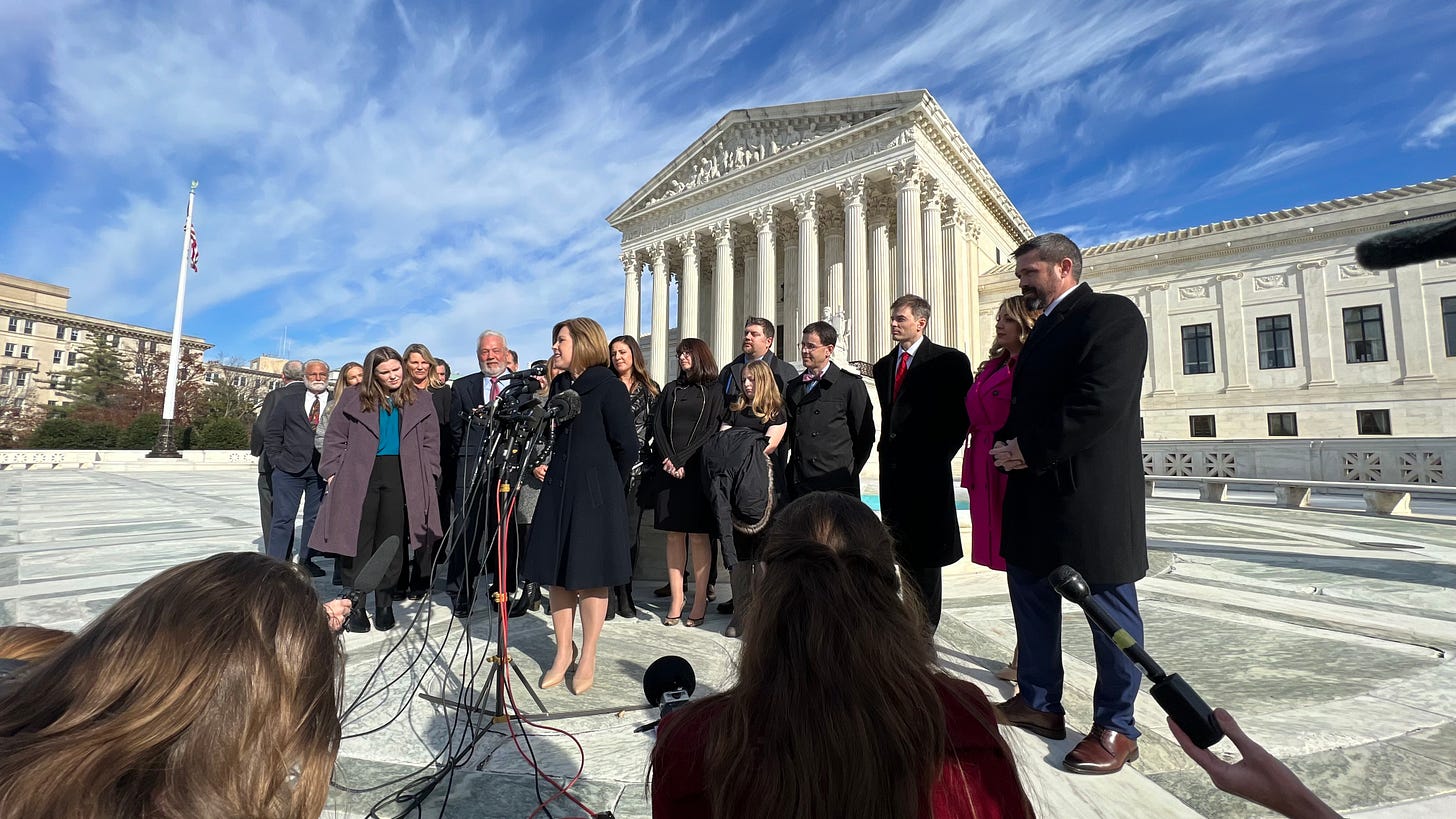
Alberta also hired James Cantor, one of the expert witnesses that Alabama used to push its ban through. Cantor is a Canadian psychologist who has acted as an expert witness in dozens of U.S. cases on trans issues. He was first hired in 2021 by the Southern Poverty Law Center-designated anti-LGBTQ hate group Alliance Defending Freedom. The Christian legal group has advocated for laws banning sodomy, has helped overturn Roe v. Wade, and is currently arguing the Supreme Court to overturn Colorado’s conversion therapy ban.
In a 2024 interview, Cantor told Uncloseted Media that his perspective on trans rights makes him “marketable” to U.S. conservatives. He compares his testimony to Marisa Tomei’s feisty character in “My Cousin Vinny” and references “Ally McBeal” and musical comedy “Schmigadoon!” as theatrical elements involved in being an expert witness.
“The first time I was going in court, we were just laughing,” says Cantor. “It was just teasing about how I love being a performer on stage enjoying an audience, and here I am doing it in a courtroom. … In Ohio, there was a television camera for the news at the courtroom. The next day on social media, all I kept hearing was what a good hair day I was having.”
Cantor is cited at least 36 times throughout Alabama’s defense of its gender-affirming care ban.
In his expert witness testimony in Alberta, Cantor makes dubious claims, including that trans adults consist “primarily of biological males and only those sexually attracted to females” and that kids identifying as trans “is a distinct phenomenon that, without social transition, usually desists.”
In taking legal action against the Alberta government, Egale Canada stated in February that “Dr. Cantor’s astonishing lack of insight into the limitations of his own expertise is wholly inconsistent with the role of an expert in a court proceeding and is disqualifying in itself.” And in a West Virginia Court case where they used Cantor’s expert testimony, the ACLU argued that Cantor’s “views, which pathologize transgender people … are irrelevant, harmful, and unfit for use by the Court.”
Even in Alabama, one of America’s most conservative states, U.S. District Judge Liles C. Burke wrote in his opinion and order that he gave Cantor’s testimony as an expert witness “very little weight” after it was uncovered that he had never treated a transgender child.
Still, Alberta hired him as an expert witness.
Subscribe for LGBTQ-focused, accountability journalism.
DEARBORN, MI — A pair of dueling demonstrations unfolded along Schaefer Road and Michigan Avenue on Tuesday, Nov. 18, as anti-Islam activists and pro-Muslim counter-protesters clashed in front of a heavy police presence before moving toward Dearborn City Hall for the evening council meeting.
The city, home to one of the largest Muslim populations in the United States, has recently become a repeated target for out-of-state activists who falsely claim it operates under “Sharia law.”
The tensions began when Jake Lang, a Jan. 6 rioter who has described himself as a political prisoner, arrived on Michigan Avenue attempting to burn a Quran.
Lang tried several times to ignite the book, holding it up with a lighter, but counter-protesters repeatedly knocked it from his hands.
At one point, Lang stepped into the center of Michigan Avenue and tapped the Quran with a slab of bacon before a Muslim counter-protester snatched the book and ran off with it.
Lang’s group later marched toward City Hall ahead of the 7 p.m. meeting.
Curtis Hertel, chair of the Michigan Democratic Party, released the following statement.
“Attempting to burn a religious document is an unacceptable act of hate,” Hertel said. “Dearborn is a beloved, multicultural city with tens of thousands of people who are cherished friends, family members, and neighbors.”
A pro-Muslim and pro-Palestinian supporter holds a sign reading “Defeat Trump’s Fascist Movement” during a counterprotest in Dearborn on Nov. 18, 2025.Fuad Shalhout — MLive.com
A Dearborn police officer told MLive there were about seven police cars stationed nearby to help keep the situation calm.
At the same time this was happening, Michigan gubernatorial candidate Anthony Hudson, who had previously organized a separate protest without affiliation to Lang, walked with supporters along the sidewalk.
Hudson’s and Lang’s demonstrations were unrelated but appeared in the city on the same afternoon, drawing a mix of residents, activists, and counter-protesters on both sides of Michigan Avenue.
Yet after visiting three mosques in the area, Hudson declared “that there are many false and misleading narratives about Dearborn being spread and that all he found from Muslims in Dearborn was hospitality.” He further stated that he was opposed to outsiders coming to Dearborn with plans to burn the Quran.
As a result, Lang spray-painted the word “cuck” on what appeared to be Hudson’s campaign bus in Dearborn, accusing the Republican candidate of “selling out” for visiting mosques and expressing sympathy toward Muslims.
Hudson later denied the bus belonged to him.
Michigan gubernatorial candidate Anthony Hudson walks with supporters during a protest on Michigan Avenue in Dearborn on Nov. 18, 2025.Fuad Shalhout — MLive.com
One Hudson supporter, Kelly Elias, said she drove several hours from Northern Michigan because she wanted to see the situation firsthand.
“I just wanted to come and see what the mainstream media (is reporting) — if they’re lying to us. I’m Arabic too. I’m from the God of love. I don’t want to hurt anybody. If we’re in danger or if there’s any problem, I want to know. But if not, let’s be peaceful with each other and solve this problem. We need to work together and be just. Love each other. We don’t need any problems. Anybody with hate.”
Elias described herself as culturally mixed.
“I’m Lebanese, I’m Syrian, Italian,” she said. “I’m a mix.”
She said she has long viewed Dearborn positively.
“I’ve always thought it was a wonderful area. I’ve had friends here. I worked in Detroit. I lived in Detroit,” Elias said.
On the other side of the street, Muslim and pro-Palestinian counter-protesters rallied in response to Lang’s actions and the broader anti-Islam messaging.
Dearborn resident Karrar Haidar explained why he attended the protest.
“To show the American people that we are a religion of peace and we can coexist as the Abrahamic religions have coexisted in previous times,” Haidar said. “Some people are a little bit more extreme in their ideology, but we’re here to show them that we also have a voice and this is our country, too.
“Everybody comes from some sort of immigration, and we’re all happy to be here. We all pay our taxes, we go to work and try to provide for our family.”
Haidar also addressed claims that Dearborn is governed by Sharia law.
“If they really do believe Sharia is the jurisdiction here in Dearborn, when you walk in, you see a monument in regards of Maryam and Prophet Jesus,” he said.
He said protesters coming to Dearborn misunderstand the community.
“I think they lost their core beliefs with Christianity,” Haidar said. “I feel like there’s a form of Christianity that exists in this country that is more toward spreading hate. Because if you go towards Ford Road, you’ll see a mosque and two churches side by side, standing strong in solidarity. So, I don’t know what their ideology is. I think it’s more of a political extremist view rather than a religious one.”
Muslim demonstrators pray outside Dearborn City Hall during protests on Nov. 18, 2025.Fuad Shalhout — MLive.com
As both sides continued chanting and walking toward City Hall, police kept a perimeter on the sidewalks and along Michigan Avenue, intervening briefly when tensions escalated over Lang’s attempted Quran burning.
One person was seen arrested at the Dearborn City Hall. No injuries were immediately reported.
Fuad Shalhout
Fuad Shalhout is the business and community reporter at MLive.com-The Flint Journal. He joined MLive in July 2022 and covers a range of topics from new business openings, property sales and human interest…
“Hey hey, ho ho, Donald Trump has got to go,” protestors chanted in the middle of Times Square, among a sea of signs that read “love reigns not kings,” “gays against faux-king Trump,” “we stand with … our trans family” and “the future is coming.”
On Saturday, independent analysts estimated that the No Kings March drew between 5 and 8 million people, and organizers say over 7 million people attended 2,700 events across all 50 states. The event, which was organized to push against the rise of authoritarianism in the U.S., was the largest single-day protest in America since 1970.
Over 100,000 New Yorkers marched in all five boroughs in NYC on Saturday. Photo by Jelinda Montes.
Among the crowd were countless LGBTQ people, fighting back against an administration that has introduced a litany of anti-LGBTQ executive orders and used vile rhetoric to denigrate queer people. This backsliding of LGBTQ rights, according to experts, has a deep connection to authoritarianism, with research showing that when governments weaken protections for queer and trans people, they often turn to broader democratic institutions next.
“Threats to democratic institutions and threats to LGBTQ rights are mutually reinforcing, generating a vicious cycle that strengthens authoritarian control,” Ari Shaw, director of International Programs at the Williams Institute, told Uncloseted Media. “Increased persecution of minority groups, including LGBTI people, is itself evidence of democratic backsliding by indicating the erosion of liberal democratic norms [meant to protect] minority rights.”
Legal Abuse of Power
One of the ways the Trump administration’s abuse of power has been most evident is through its legal actions.
He’s also slashed HIV funding at a staggering rate. Uncloseted Media estimates that the National Institutes of Health has terminated more than $1 billion worth of grants to HIV-related research, including 71% of all global HIV grants.
Jeffrey Cipriano at the NYC No Kings protest Saturday. Photo by Jelinda Montes.
It was these cuts that prompted Brooklynite Jeffrey Cipriano to turn out to protest. “The specific reason that I’m protesting is actually on the shirt I’m wearing,” says Cipriano.
“My best friend works for an organization called AIDS United. … His job is to travel the country and help people get AIDS medication, specifically trans and unhoused community members. But his job is at risk,” he says. “The end outcome of his work is that people who have issues in their lives have the issues resolved and that’s going away under the current administration.”
Executive orders are based on powers granted to the president by the U.S. Constitution or by Congressional statutes. The president cannot use an executive order to create new laws or spend money unless Congress has authorized it. They are meant to direct how existing laws are implemented. But Trump has ignored democratic norms, often filling agencies with loyal supporters, using orders to go after political opponents and pushing the limits of what the law allows.
In some cases, he has moved illegally. “The President is directing various executive branch officials to adopt policy that has either not yet been adopted by Congress or is in violation of existing statutory law,” says Jodi Short, professor of law at UC Law San Francisco. “The analogy to a king and what has troubled many about this presidency is the sheer consolidation of executive branch power in one individual.”
Short’s colleague, Dave Owen, agrees. “Illegality has been rampant,” he told Uncloseted Media in an email. “People are often cynical about the government, and they might think what Trump’s doing is nothing new. But most of the time, the executive branch takes the law seriously, and both legal constraints and norms of good governance matter,” he wrote. He says that through history, there’s been “a lot more integrity and a lot less lawlessness than most people realize.”
“This administration has broken with those traditions,” he adds.
Revolt Against Executive Orders
Many Americans have recognized this. A survey from April found that 85% of Americans agreed or strongly agreed that the president should obey federal court rulings even if he doesn’t like them.
In response to Trump’s overreach, more than 460 legal challenges have been filed across the country challenging his executive actions. One of these is a federal lawsuit by Lambda Legal and the Human Rights Campaign Foundation that challenges the constitutionality of the Trump administration’s ban on military service by transgender people. Another lawsuit challenges Trump’s order directing federal agencies to withhold funds from medical providers and institutions that provide gender-affirming medical treatments for people under 19.
Zoe Boik and her father, Derik, protesting on Saturday. Photo by Sean Robinson.
Both of those lawsuits are one reason 17-year-old Zoe Boik came out to protest with her friends and her dad. “Obviously, I’m disappointed and kind of helpless because there’s nothing I can directly do to change or impact anything that’s going on,” says Boik, who identifies as pansexual and gender fluid and is not legally allowed to vote.
Boik—who was seven years old when Trump announced his run for presidency in 2015—says she’s doing a research paper on Trump’s trans military ban and is frustrated because she sees it as inexplicable discrimination. “They’re not letting trans people serve … which doesn’t make any sense.”
Zoe as a child with her dad, Derik. Photo courtesy of Boik.
LGBTQ Rights and Democratic Backsliding
This type of blatant discrimination is often a key sign of a country moving closer to authoritarianism and away from democracy. According to a 2023 research paper by Shaw and his colleagues, anti-LGBTQ stigma may contribute “to the erosion of democratic norms and institutions.”
The paper found that when a country with relatively high acceptance of LGBTQ rights introduces anti-LGBTQ legislation, it clashes with what most people believe and can weaken public trust in democracy, deepen political divides and make it easier for populist or extremist movements to gain power.
“The level of acceptance of LGBTQ people is closely associated with the strength of democracy in a country,” Shaw says. “In some cases, we even saw that rising anti-LGBTQ rhetoric or policies preceded a broader decline in democracy.”
In Brazil, for example, early democratic gains coincided with rising LGBTQ acceptance, including legal recognition of same-sex unions and workplace protections. But as populist President Jair Bolsonaro came into power in 2019, he began questioning—without evidence—the security of Brazil’s voting systems, saying he would only lose his re-election campaign if there were fraud. He was also accused of trying to intervene in operations held by the Federal Police about the alleged criminal conduct of his sons, and he told his ministers that he had the power and he would interfere—without exception—in all cabinet ministries. At the same time, LGBTQ protections were rolled back, and schools and civil society faced censorship, suggesting that falling LGBTQ acceptance may have “preceded Brazil’s democratic erosion,” according to Shaw’s paper. In September of this year, Bolsonaro was sentenced to 27 years in prison for plotting a military coup.
Another example is Poland’s democracy weakening since 2015 under the Law and Justice Party, which consolidated power by undermining the Constitutional Tribunal, installing loyal judges and restricting independent media. Anti-LGBTQ rhetoric became central to the party’s nationalist platform, fueling the creation of nearly 100 “LGBT ideology free zones,” inciting violence against LGBTQ individuals and stymying legal recourse through politicized courts.
When it comes to LGBTQ rights, Trump has mimicked the moves of these leaders even though most of his constituents don’t want it: A 2022 survey from the Public Religion Research Institute found that 80% of Americans favor laws that would protect LGBTQ people against discrimination.
“The definition of an authoritarian system is a system where power is consolidated in one individual whose power is unchecked by any other institution. And I fear that in certain domains, that’s the direction in which this administration is trying to move us,” says Short. “I think it’s incredibly dangerous.”
Attacks on Higher Education
Another common tool in the authoritarian playbook is attacking higher education.
While many universities are rejecting Trump’s demands, others are experiencing a chilling effect, changing their policies before the administration tries to hold up funds.
James Revson, Maddy Everlith and Shay Wingate holding their signs at the No Kings protest. Photo by Jelinda Montes.
“I’m here because I’m angry and I feel that we aren’t angry enough,” Maddy Everlith, a sophomore gender studies major at Pace University, told Uncloseted Media as she marched with her friends. “Being a woman of color in America and having so many intersectional identities is also what affects me. … I want to stand up and advocate for other people.”
Everlith’s university responded to Trump’s threats in September by renaming its DEI office to the “Division of Opportunity and Institutional Excellence.”
“I am beyond horrified how quickly our university was willing to bend the knee on this decision,” Austin Chappelle, a senior at Pace, told the student newspaper. This change comes in the midst of uncertainty under the Trump administration, which has already caused many LGBTQ students to feel uneasy on campus.
“It’s part of an electoral strategy to try to mobilize right-wing voters to distract from other sorts of political or economic scandals,” Shaw says, adding that this tactic is another way to gain power.
Lars Kindem protesting for his trans sister at the No Kings protest. Photo by Sean Robinson.
The pain of this rhetoric has affected millions of trans Americans and allies alike, including Lars Kindem, a 64-year-old retired pilot from Minnesota who was marching to support his transgender sister.
“What Trump has done is he’s taken people that haven’t done anything wrong and has turned them into scapegoats,” he says, adding that Trump’s language is “hateful, petty, mean and hurtful.”
He says his sister and her partner are having issues getting the correct gender markers issued on their passports. Because of the Trump administration’s treatment of the community, they are making plans to move to Denmark, where “there’s a lot more acceptance.”
Christian Nationalism
This scapegoating has played into the hands of Trump’s voter base of white evangelical Protestants, the only major Christian denomination in the U.S. in which a majority believes society has gone too far in accepting transgender people.
Since 2020, Trump has increasingly embraced Christian nationalism in his rhetoric and imagery. He’s sold Bibles, created a federal task force on anti-Christian bias and been intrinsically linked to Project 2025, the 920-page plan calling for the establishment of a government imbued with “biblical principles” and run by a president who holds sweeping executive powers.
Experts say that “a strong authoritarian streak” runs through conservative Christianity. A 2023 study found that supporters of Christian nationalism tend to support obedience to authority and the idea of authoritarian leaders who are willing to break the rules. Nearly half of Christian nationalists support the notion of an authoritarian leader.
“They are trying to use the language of Christianity, but they are abusing it and misusing it constantly,” Rev. Chris Shelton, a gay pastor at the protest, told Uncloseted Media. “Our faith is all about reaching out to the marginalized, reaching out to the people who are ostracized by society and embracing them and offering love and welcome and a sense of dignity and worth. And to see any human being’s worth being denied is just a mockery of our faith.”
Rev. Chris Shelton marched in Saturday’s NYC protest. Photo by Sean Robinson.
Heidi Beirich, the vice president and co-founder of the Global Project Against Hate and Extremism, says that “the LGBTQ community is the prime target of modern authoritarian regimes.”
“For Christian nationalists, attacking LGBTQ rights is the first pillar in destroying civil rights for all. This has happened in countries like Hungary and Poland as authoritarianism consolidated and now it’s happening here,” Beirich told Uncloseted Media.
Moving Forward
As the country bleeds toward authoritarianism, LGBTQ protestors are encouraging people to use their voice, something the queer community is familiar with doing: One 2012 survey found that queer folks are 20 times more likely to be active in liberal social movements than their straight, cis counterparts.
“It is imperative that people continue to pay attention,” Short says. “There is so much going on, a lot of it is disturbing and intense, and there’s such a strong impulse to look away. But we have to engage in political action and resist inappropriate assertions of authority and continue to show up and vote for our democracy.”
17-year-old Zoe Boik is ready. She remembers being in second grade and crying the day after Trump won his first election in 2016. She couldn’t believe how he could lead the country despite “all the bad things he said.”
Boik can’t wait until the midterm elections, when she will be 18 and finally able to vote. “If we don’t vote, then our voices won’t be heard,” she says.
Despite this, she’s also concerned about her freedom to exercise that right being jeopardized.
“My fears about Trump don’t stem specifically from me being queer, but from his authoritarianism as a whole,” she says. “I am scared about how far he will move into dictatorship, [and] my biggest fear is that our right to vote will be compromised, leaving us no recourse.”
If objective, nonpartisan, rigorous, LGBTQ-focused journalism is important to you, please consider making a tax-deductible donation through our fiscal sponsor, Resource Impact, by clicking this button:
Uthmeier focused on how he’s working to ensure that concerned parents can continue their “movement … based on faith, based on family, ensuring that we have the freedom to raise our kids in God’s image.”
“I’m about eight months on the job now as Attorney General, and as I tell my team every day, our No. 1 priority is, and will always be, protecting our kids. There’s a lot of evil out there. There’s a lot of evil, a lot of danger. There will always be crime, no matter how much we fight it. But our first priority must always be protecting our kids,” he said to applause.
Uthmeier went on to describe his Office’s legal actions against Target for its “transgender children’s clothing line” with “bras for little boys, some tuckable underwear.”
“Gross. Absolutely disgusting,” he said. “We’re going to hit them in their wallets.”
“Predators are all over that app, all the apps, but that one in particular. It’s their preferred vehicle to go after kids,” Uthmeier said.
“And they’re crafty, they’re smart, they’re patient. They’ll use fake pictures. They’ll talk in a dialect. They’ll get your kids to, you know, drop their guard. They’ll tap into their insecurities, and they’re willing to spend weeks or months to develop a relationship before they start soliciting information, soliciting photos, soliciting locations. And since we’ve sued them, we’ve made dozens of arrests of child predators that have gone after kids through this app.”
Uthmeier also described how his Office is able to enforce the law, including by serving as a “law firm for parents out there” who might be concerned by what school districts do.
“If you’re identifying one of these wrongs that’s violating your rights and that’s subjecting our kids to danger and evil, then we want to know about it, and we’re going to bring the heat in court to shut it down.”
The AG also quipped about a recent call to people to report their exes for immigration violations, noting one gender predominantly was dropping the dime on the other.
“Y’all ladies are savage, I’ve got to tell you. These calls come in and these ladies, I mean, they’ve got date of birth, nickname, frequented bars. I mean, all the details. So to the handful of men out there, treat your women right or they will absolutely get you.”
Sign up forThe Agenda, Them’s news and politics newsletter, delivered Thursdays.
The European Union’s (EU) highest court has ruled that EU countries must recognize same-sex marriages between EU citizens lawfully conducted in another EU country, even if same-sex marriage is not legal in their home country.
On Tuesday, November 25, the Court of Justice of the European Union ruled that Poland must recognize the marriage of a same-sex Polish couple who married in Berlin while living in Germany in 2018. When the couple — who have only been identified by their initials in the case — returned to Poland and requested that their German marriage certificate be transcribed into the Polish civil register, authorities refused, because Polish law doesn’t permit same-sex marriages or civil partnerships. When the couple challenged that refusal, the Polish Supreme Administrative Court referred it to the Court of Justice.
“The spouses in question, as EU citizens, enjoy the freedom to move and reside within the territory of the Member States and the right to lead a normal family life when exercising that freedom and upon returning to their Member State of origin,” the court said in a press release.
The court added that “such a refusal is contrary to EU law” and “infringes not only the freedom to move and reside, but also the fundamental right to respect for private and family life.”
“This ruling is historic,” Pawel Knut, a lawyer representing the couple involved in the lawsuit, said in a statement, per Reuters. “It marks a new beginning in the fight for equality and equal treatment
MEP Emma Wiesner Meanwhile, during a Tuesday press conference in Strasbourg, France, Swedish MEP Emma Wiesner called the ruling “a great victory for love.”
The court also clarified that the ruling does not require member nations to subsequently legalize same-sex marriage in their national laws. While member states enjoy a “margin of discretion” to choose the procedures for recognizing a marriage conducted in another EU country, “those procedures must not render such recognition impossible or excessively difficult or discriminate against same-sex couples on account of their sexual orientation.”
The Guardian reports that although Poland’s prime minister, Donald Tusk, has been working on a same-sex marriage bill, his efforts have been met with resistance from Polish president Karol Nawrocki, an ally of the country’s right-wing, anti-LGBTQ+ Law and Justice party. Nawrocki has said that he would veto “any bill that would undermine the constitutionally protected status of marriage.”
A court in Japan has decided the ban on equal marriage is constitutional (usuke Harada/NurPhoto via Getty Images)
In a blow to the Japanese LGBTQ+ community, a court has ruled the country’s ban on same-sex marriage is constitutional.
The decision handed down by Tokyo’s High Court on Friday (28 November) outlined that Japan‘s ban on equal marriage does not violate Article 24(1) and (2) or Article 14(1) of the Constitution.
The judgement is the final ruling in a series of six high court lawsuits on same-sex marriage that were filed between 2019 and 2021 in cities including Tokyo, Osaka and Sapporo. With all the high court decisions now made, a Supreme Court ruling is expected.
Judge Ayumi Higashi said a unit between a heterosexual couple and their children is a rational legal definition of a family and the exclusion of same-sex marriage is valid. Alongside this, the court also dismissed damages of one million yen ($6,400) which was sought by each of the couples in the lawsuits.
“I’m outraged and appalled”
Speaking outside court, as quoted by the Associated Press, plaintiff Hiromi Hatogai said the decision left her “disappointed”: “Rather than sorrow, I’m outraged and appalled by the decision. Were the judges listening to us?”
Her partner, Shino Kawachi, said it was “difficult to comprehend”, adding: “What is justice? Was the court even watching us? Were they considering the next generation?”
“We only want to be able to marry and be happy, just like anyone else,” another plaintiff, Rie Fukuda, told reporters.
“I believe the society is changing. We won’t give up.”
Japan is the only G7 country that does not recognise equal marriage or offer legal protection to queer couples, whilst in wider Asia only Taiwan, Thailand and Nepal offer same-sex marriages.
Participants for Tokyo Pride events march on the busy streets of Shibuya in Tokyo, Japan, on June 8, 2025. (Yusuke Harada/NurPhoto via Getty Images)
Commenting on the decision, Amnesty International criticised the ruling and said it effectively means discrimination against LGBTQ+ couples in Japan is permissible under the law.
“The court’s decision today marks a significant step backwards for marriage equality in Japan,” Amnesty International’s East Asia researcher Boram Jang said.
“The ruling in Tokyo – the final high court ruling of six lawsuits filed across the country and the only ruling to say, in effect, that discrimination against same-sex couples is constitutional – cannot be allowed to hamper progress.
“But it should serve as a warning of the reluctance to acknowledge the concept of same-sex marriage and the reality of same-sex couples living in Japan.
“While these cases work their way to the Supreme Court, the government can resolve this issue through legislation without further delay.
“The Japanese government needs to be proactive in moving towards the legalisation of same-sex marriage so that couples can fully enjoy the same marriage rights as their heterosexual counterparts.
“Japan remains the only G7 country without legal recognition for same-sex couples. The law passed by the government in 2023 to promote understanding of LGBTI people is not enough.
“There need to be solid, legal measures in place to protect same-sex couples and the LGBTI community in Japan from all forms of discrimination.”
Previously, in 2024, Sapporo District Court in northern Japan came to an opposite conclusion and ruled the civil code which limits marriage to between a man and a woman is “unconstitutional [and] discriminatory”.
“Enacting same-sex marriage does not seem to cause disadvantages or harmful effects,” the High Court said in its ruling, adding it was “strongly expected” that parliament would “institutionalise an appropriate law” in the future.
“Living in accordance with one’s gender identity and sexual orientation is an inalienable right rooted in important personal interests,” the court also said.
The Sapporo decision followed prior decisions by courts in Nagoya and Tokyo – a separate lawsuit to the one detailed above – which also declared the ban unconstitutional.
What happens next?
Now that each of the six high court cases are completed, Japan’s highest court – the Supreme Court of Japan – is expected to manage the appeals and make a final decision on the matter.
Research has previously shown that most of the Japanese population is in favour of legalising same-sex marriage, with an opinion poll from 2023 revealing that two-thirds of Japanese people believe equal marriage should be legally recognised.
However, the legalisation of same-sex marriage still looks set to be a long way off, with Japan’s first female prime minister, Sanae Takaichi, has expressed opposition to same-sex marriage, describing it as a “very difficult problem” in the past.