Idaho state Rep. Stephanie Mickelsen, R-Idaho Falls, has spoken up on behalf of migrant workers — a stand that attracted social media taunts and a call for Immigration and Customs Enforcement raids at her farms from a far-right political opponent.
Sarah A. Miller/Idaho StatesmanPresident Donald Trump’s second term was only in its second day when Ryan Spoon — vice chair of the local Republican Party apparatus in Idaho’s Ada County — turned the force of the federal government against a political enemy.
“Could you please send some illegal immigration raids to the businesses owned by Idaho state Rep. Stephanie Mickelson?” he wrote in an X post, misspelling Mickelsen’s last name and tagging Trump’s border czar Tom Homan. “She has been bragging about how many illegals her businesses employ.”
As his social media posts about contacting ICE began to rack up more than 2,000 shares, Spoon stressed that simply sharing on social media wasn’t enough. He was officially reporting Mickelsen’s farming businesses to the Immigration and Customs Enforcement tip line and website.
“You can report her, too!” he wrote in a post festooned with flexing muscle and American flag emojis.
Three days later, Mickelsen said, ICE agents appeared at Mickelsen Farms, where a slew of varieties of commercial and seed potatoes grow across thousands of acres in southeastern Idaho.
“They just showed up out of the blue Friday morning,” said Mickelsen, a moderate Republican legislator and the former director for the Idaho Farm Bureau, a lobbying group for the agriculture industry.
By Jan. 27, just one week into the second Trump administration, a Mickelsen Farms employee had been arrested by ICE. Records reviewed by InvestigateWest show that a Mexican immigrant who listed his employer as Mickelsen Farms on his Facebook page was being held at a Nevada Southern Detention Center in Las Vegas.
As the Trump administration attempts to carry out its campaign promise of mass deportations, it’s promoted the official ICE tip line as a vital part of its strategy. The phone tip line was so overwhelmed the day after Trump’s inauguration, Spoon wrote on X, that he hung up and submitted a tip on the ICE website instead.
Some on the right have wielded threats of ICE reports as kind of a gloating taunt — a way of rubbing Trump’s election in the faces of undocumented immigrants and anyone who supports them. A postcard sent to a Californian immigration non-profit, for example, touted the ICE tip line with the words “Have your bags packed — Trump’s coming” written on the return address line.
On X, Ada County Republican Central Committee Vice Chair Ryan Spoon has taken a scorched earth approach to those he sees as defending illegal immigration — including reporting at least one Republican state legislator to ICE.Daniel Walters/InvestigateWestBut Spoon targeting a Republican state legislator by calling up ICE is particularly noteworthy – and all the more so because ICE responded within days.
“It’s so ripe for abuse,” Chris Thomas, a Colorado-based attorney with 28 years of experience practicing immigration law, said about the use of the federal tip line. “We’ve got the government under enormous pressure to respond to every tip they receive. … It’s just very clear that at all levels, this is a full assault on undocumented people in the country.”
Spoon, who moved to Boise from San Francisco in 2019 to work remotely as a loss prevention specialist, and Mickelsen, a state legislator who is one of the biggest potato producers in southeast Idaho, are on opposite ends of the state’s Republican Party. And immigration is a particularly incendiary flashpoint: Mickelsen argues migrants are an essential part of the agricultural economy, while Spoon portrays both undocumented immigrants and legal refugees as a sinister foreign invasion force.
Mickelsen had beaten back attempts by the hard right to defeat her in a primary — and even strip her of the Republican label. But Spoon’s tactics represented a new avenue of attack. For farm owners, it raises the possibility that speaking out — or running for office or backing the wrong bill — could trigger a political enemy to try to call down an ICE raid.
Mickelsen knows who the employee is, that he’s a father of three and that his criminal record was what got him deported. But even now, she said, she doesn’t exactly know the exact nature of the man’s immigration status during the time he worked for her family business. Employers of migrants can face legal risks if they inquire too aggressively into the immigration statuses of their employees.
Immigration is a complicated topic, Mickelsen wrote in a statement to InvestigateWest, but using the issue to “bully individuals and businesses trying to navigate complicated and often competing employee documentation laws is a disgusting and reprehensible way to act and should not be tolerated by anyone.”
She’s unsettled. She removed the names of her businesses from her campaign site, believing it would be unfair to subject her family to the same level of nastiness that politicians have come to expect.
“I’m being way more cautious in the bills that I’m standing up against, because I’m afraid of being targeted,” Mickelsen said. “Which makes me a less effective legislator for my community right now.”
Deportation glee
In early January, Homan, Trump’s pick for border czar, floated the immigration tip line as a “fresh idea.”
“I want a place where American citizens can call and report,” he told NBC News. “We need to take care of the American people.”
ICE, to be clear, has had a tip line for over two decades.
“The difference is, in many ways, the tip line in the past was a black hole,” Thomas said. “People would make tips and usually nothing would ever come of it.”
Thomas said immigration tips are always prone to be taken advantage by those with scores to settle — abused by bitter exes and business rivals. In the past, he’s defended at least three companies — a janitorial service, an agricultural company and a bakery — who were reported to ICE by competitors. But after Trump’s second inauguration, he said, the entire framework of the federal government was refocused on immigration-related offensives.
Ryan Spoon, vice chair of the Ada County Republican Central Committee, called for federal immigration raids at Rep. Stephanie Mickelsen’s farms in a series of posts on X just days after President Trump was inaugurated.Ada County Republican Central Committee
“They have to arrest certain numbers of undocumented people each week,” Thomas said. “They need to serve employers each week with notices of inspection. … They’re even under pressure to conduct raids.”
Effectively, Thomas said, ICE was being forced to rely on the tip line and the online tip website to fill its quotas. ICE tips had been transformed from mostly inert to a live weapon.
While overall deportations have fallen due to fewer border crossings, Reuters reported, ICE arrests surged during the first week of Trump’s administration. In the weeks since, the agency indicated there’s been so much ICE activity that it’s too busy to provide many specifics about ICE activity.
Asked about Mickelsen, an ICE spokesperson said that because of their “operational tempo” and increased interest in their agency, they were not able to respond to queries about rumors or routine operations.
The news of actual ICE raids, along with the string of false reports and hoaxes, have made migrant farmworkers afraid. No matter their immigration status, many don’t want to come to work, much less attend protests or share their stories publicly.
“Nobody’s wanting to raise their head and speak up,” said Ben Tindall, executive director of Save Family Farming, a group representing farmers in neighboring Washington state. “Regardless of whether they’re here legally or not, they’re afraid they’re going to get a target on their back and ICE is going to come knocking on their door.”
Freddy Cruz, who tracks extremists with the Western States Center, said he’s seen a surge of white nationalist groups like the White Lives Matter Montana chapter encouraging people to report unauthorized immigrants to ICE.
“The ICE information tip line has come up more and more as a tactic,” Cruz said. “Almost like weaponizing a government agency to try to intimidate not just undocumented immigrants, but also organizations that might be providing immigrant-rights services to folks.”
Along with the Californian nonprofit, three offices of the United Farm Workers union were anonymously sent postcards featuring the phrases “Report Illegal Aliens” and “There is nowhere to hide,” along with the ICE tip line.
At Arizona State University, the College Republicans United club teamed up with a Hitler-saluting neo-Nazi to sell club T-shirts with the phrase “ICE Volunteer” and began urging students to report “their criminal classmates to ICE for deportation.”
But Spoon represents a more influential and mainstream example of this trend. Last year, Spoon was the chairman of the Idaho Freedom PAC, the political action committee linked to the political machine of the Idaho Freedom Foundation, a historically influential think tank that purports to separate true conservatives from “Republicans in Name Only” — or “RINOS.”
When Idaho Congressman Mike Simpson co-sponsored a bill to expand the temporary farmworker visa program and give migrants a path to permanent legal status, he was accused by Ryan Spoon, the vice chair of the Ada County Republican Central Committee, of commiting “a literal act of treason.”simpson.house.govIn the last two decades, more radical Republicans like Spoon immigrated to Idaho from left-leaning states like California, flooding the local Republican parties. Many of them cared less about the bottom line of Idaho’s big businesses than culture wars and conservative purity — and immigration was a topic they were willing to drench with invective.
On X, Spoon accused those who argue that migrant workers are necessary for the region’s agriculture of being willing to pay anything “for cheaper blueberries” — “their daughters raped by illegals, their young people unemployed, foreign slaves exploited, drugs & crime flooding their communities.”
When Idaho Congressman Mike Simpson co-sponsored a bipartisan bill to expand the temporary farmworker visa program and give migrants a path to permanent legal status, Spoon accused Simpson of a “literal act of treason against the U.S., facilitating a foreign invasion.” Spoon argues he’s not anti-immigrant — his wife is a legal immigrant from Germany — just anti illegal-immigration.
“Americans across a broad spectrum of politics are really fed up with the illegal immigration issue,” he said. “The tone has definitely changed there, and people’s willingness to confront that issue has changed.”
The reactions he’s received for calling ICE on Mickelsen’s businesses, Spoon claimed, have been “overwhelmingly positive.”
But Mickelsen said she’s heard from a lot of legislators who were “completely disgusted” by his tactics.
“It’s probably very disturbing for them to see this kind of treatment of a fellow legislator,” Mickelsen said.
‘Now we’re playing offense’
Spoon has repeatedly accused Mickelsen of being a “Plantation Mistress,” taunting her that “we’re gonna take your farm slaves away from you.”
But he told InvestigateWest that it’s a “mischaracterization” to accuse him of going after Mickelsen. She’s the one to blame for the reports, he argued.
“Her own testimony drew attention to herself,” he said.
Mickelsen Farms operates potato farms and other agricultural businesses in southeastern Idaho.Mickelsen FarmsLast March, during the debate about Idaho House Bill 753, intended to give local law enforcement and judges the ability to enforce immigration laws, Mickelsen bristled at what she felt was the denigration of the foreign-born workforce by her fellow legislators.
Pointing to the production chain involving everyone from construction companies to the hospitality industry, and “every food processor, probably, in the state,” Mickelsen declared that “if you think that you haven’t been touched by an illegal immigrant’s hands in some way … you are kidding yourself.”
To Spoon, it was practically a signed confession.
“While it is not reasonable to think that she is able to speak for every food processor, it is reasonable to think that she can speak for the food processor that she owns,” Spoon said.
To Mickelsen, she wasn’t saying anything that hasn’t been widely discussed: There likely are many unauthorized immigrants working for Idaho businesses. The Center for Migration Studies, a New York-based think tank focused on immigration issues, estimated that in 2021 there were roughly 10,000 unauthorized immigrants working in Idaho agriculture alone.
Mickelsen told InvestigateWest that their farming operation relies on the legal temporary seasonal guest worker program to hire migrant laborers — a program that has grown by nearly two-thirds since 2016.
Tag: US Politics
My thoughts on tariffs
Fun For All (in a manner of speaking…)
For Fun, Not Profit-
MDavis posted this over on another blog, and it’s great fun, including the ticker across the top, as MDavis pointed out. Enjoy!
Trans Woman Arrested, Sent to Men’s Jail For Entering Florida Capitol Bathroom
https://www.erininthemorning.com/p/trans-woman-arrested-sent-to-mens
Does this keep us safe? What harm does washing her hands cause? What is more traumatic, a passing trans person in the bathroom washing their hands or the police barging in and arresting someone in the bathroom. I can see the mistake she made. She thinks they know in their hearts that it is wrong to make bans on trans people. No they are sure their god, one with the same name as her own god, but their god is the hateful vengeful fundamentalist Old Testament god while her is a loving Jesus. Hugs.
=================================================================
“I’m not a political activist,” she maintained. “I’m just a normal college student who thinks this law is wrong.”
A Word From A Canadian
Long Live Freedoms? by Dr. Richard Francis Hogan
“Liberation Day”🤕? Read on Substack

Written: 🇨🇦 Wednesday, April 3rd, 2025 10:15
Is it long live freedom?
In the shadow of Wednesday, April 3rd, 2025 circum 4 p.m. EST, the idea of liberation unfolds with all its complexities, its light and its shadow. The declaration, bold and unyielding, seeks to redefine the pillars on which trade and economic power rest, claiming to usher in an era of self-reliance and prosperity. Yet, as with all acts of change, the effects are far-reaching, unpredictable, and deeply personal.
From the bustling markets of India to the quiet farmlands of Iowa, the world absorbs the shockwaves of an economic strategy that promises protection but risks isolation. In homes and factories, the air is thick with speculation—what will these tariffs bring? A renaissance of domestic manufacturing or a tightening of belts for families already stretched thin?
Global markets shift like tectonic plates beneath the surface, each country recalibrating its position in this delicate dance. Some see an opportunity to assert their own independence, while others grapple with the economic turbulence caused by disruption. The landscape becomes a chessboard, nations maneuvering for advantage, each move echoing through the corridors of diplomacy and trade.
And amidst this vast interplay of economies and geopolitics stands the human spirit. For the individuals whose lives are touched by these decisions, liberation is not just a political or economic act—it is deeply personal. It is the parent deciding how to stretch a paycheck further in the face of rising costs. It is the worker who watches as their factory doors reopen, bringing hope to their community. It is the farmer who wonders if their crop will find a buyer in a world now reshaped by tariffs.
Liberation, then, becomes a question of perspective. For some, it is a moment of pride, an assertion of independence in a globalized world. For others, it is a reminder of vulnerability, the realization that no nation or individual exists in isolation. It is the tension between self-sufficiency and interdependence, between the desire for control and the inevitability of connection.
As the world moves forward from this day of declaration, the real measure of “Liberation Day” will not be found in the speeches or the headlines—it will be in the lives it changes, the challenges it creates, and the resilience it inspires. For in the end, liberation is not just the act of breaking free—it is the courage to forge a path in the uncharted territories that freedom brings. However, as a Canadian, my speak 🗣️

Wednesday, April 3, 2025, the sun rises not simply over land and water but over a tapestry woven with threads of commerce, diplomacy, and shared destinies. Across the expanse of North America, two neighbors—Canada and the United States—stand as towering pillars of trade, their economies entwined like the roots of ancient oaks. Their shared border, stretching like an endless promise, hums with the rhythm of industry, each heartbeat pulsing with goods and ideas that flow seamlessly between them.
But today, the pulse quickens, and the air grows dense with the weight of a proclamation. “Liberation Day,” declared boldly, aims to sever dependence, a bid for sovereignty through tariffs as high as mountain peaks. The United States, seeking refuge from the vulnerabilities of interdependence, turns inward, its gaze fixed on rekindling domestic sparks. Factories stir with newfound hope, their machines roaring with ambition, while farms stretch toward the horizon, bracing for winds of change.
Canada watches, its heart a blend of steel and shadow. From Ottawa to Alberta, the land whispers of resilience—a quiet determination to adapt and endure. Trade routes that have thrived for centuries suddenly feel fragile, threatened by the force of protectionist winds. Yet in this fragility lies the essence of ingenuity, the spark that drives nations to seek partnerships beyond familiar shores. Diversification becomes Canada’s anthem, a melody sung to the world, a testament to its strength.
Across fields and highways, rivers and rails, the individual stories unfold. In bustling Toronto, a worker questions the fate of their factory, now tethered to uncertain exports. In rural Saskatchewan, a farmer gazes at their wheat, their crop a silent plea for markets that may no longer welcome it. In Michigan, an assembly line thrums with renewed vigor, yet the workers pause, wondering how long the momentum will last. It is here, in the lives of ordinary people, that the consequences of Liberation Day resonate most deeply.
The Canada-U.S. trade relationship—a partnership that has weathered storms and celebrated triumphs—now stands at a crossroads. It is a reflection of the paradox of liberation: to free oneself from dependency is to risk isolation; to assert sovereignty is to acknowledge vulnerability. Yet, amid the challenges, hope persists. It whispers through the rustle of maple leaves and echoes across the Rockies, a reminder that change, though disruptive, breeds possibility.
As the sun will set, painting the sky in hues of amber and ash, the world holds its breath. Liberation is not a moment—it is a journey, one of adaptation and resilience, of finding strength in the struggle and light in the uncertainty. Canada and the United States, like two dancers navigating a shifting melody, move forward—not as rivals but as partners, bound by history, trade, and the human spirit that seeks meaning even in the face of transformation. Is it long live freedom?
That is as much as I will say as a Canadian.

What Happens When We Try
Sen. Ossoff was one of the Dems who appeared to be sitting on the fence about the budget a couple of weeks ago. I encouraged us all to call as many US Senators as we could, and of course that was after I’d done the calling because it just wouldn’t be proper to ask people to do that which I did not do. Here’s an example of what happens when we try; we get a nice letter in return. All of the senators didn’t go to this length, but Sen. Ossoff’s office did, and I won’t forget that!

| April 2, 2025 Dear Ms. Redford, Thank you for contacting my office to share your perspective on the Fiscal Year 2025 (FY25) continuing resolution. I appreciate hearing from you.The FY25 continuing resolution was signed into law on March 15, 2025 and will fund the government until September 30, 2025. I opposed cloture and voted against final passage on the partisan House spending proposal. I believe the best available solution was a 30-day stopgap funding measure to avoid a shutdown, during which time Congress could do its job to pass a bipartisan budget.Among the risks to Georgia in the partisan House spending proposal: it guts National Institutes of Health research into diseases like Alzheimer’s and maternal mortality, funding for the prevention of violence against women, and U.S. Army Corps of Engineers construction of essential water infrastructure. The bill also irresponsibly fails to impose any constraints on the reckless and out-of-control Trump Administration, which is gutting the Centers for Disease Control and Prevention and the Department of Veterans Affairs while destabilizing the economy. Both parties in Congress must fulfill our Constitutional obligation to check the President.Thank you again for contacting me. I always welcome your input and feedback.Wherever and however I can be of service, please contact my office at 202-224-3521. All of our resources are also available at ossoff.senate.gov. Sincerely, Jon OssoffUnited States Senator |
Three Bits I Ran Across Last Evening
Things Republicans Do:
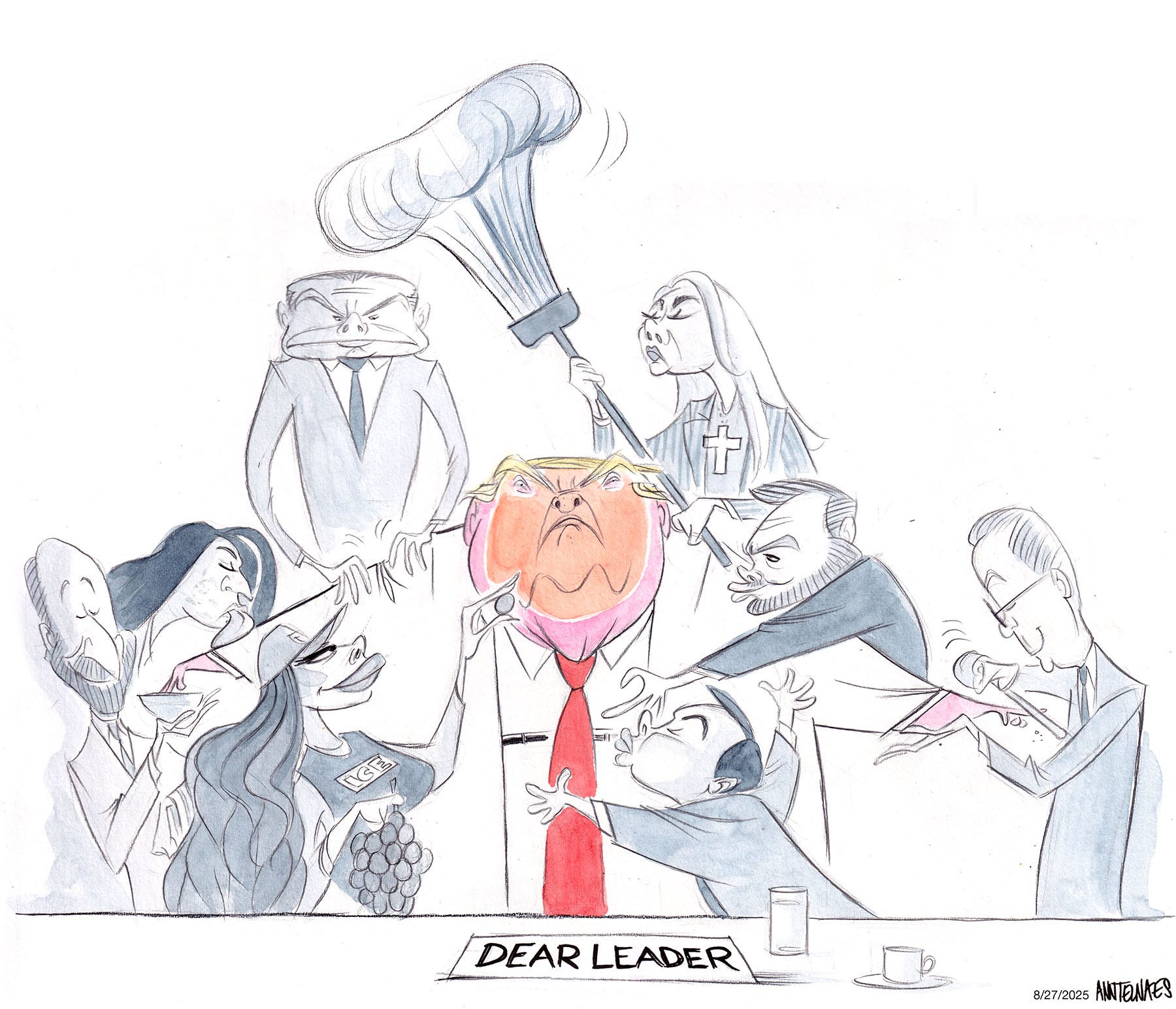
Trump’s loser by Ann Telnaes
Elon’s millions didn’t buy him the votes in Wisconsin Read on Substack

=========================
https://www.levernews.com/florida-is-going-medieval-on-labor-law/
Florida Is Going Medieval On Labor Law
Republican lawmakers in the Sunshine State are advancing a suite of bills making it easier for employers to exploit society’s most vulnerable.
Snippet (there’s much more, also about other subjects, on this page -A):
Make labor law feudal again. The Florida legislature is rapidly advancing a suite of bills allowing employers to underpay subminimum-wage workers — including children. One measure proposes undoing key child labor restrictions, like rules regulating maximum hours per week, banning overnight shifts, and guaranteeing teens get meal breaks. Another bill would permit employers to misclassify full-time workers as interns and apprentices to circumvent the state’s new minimum wage law. Both bills are part of the business lobby’s long war to decimate labor rights in the state; proponents are citing ongoing labor market disruptions caused in part by the Trump administration’s mass deportation program.
Florida didn’t want this. In 2020, a supermajority of Floridians voted to pass a ballot initiative to raise the state’s minimum wage from $8.56 to $15 an hour by 2026. But business interests have tried to stop that law from ever fully going into effect. Last year, the legislature passed a carve-out for minor league baseball players, and this year, the business community is coming back with a more sweeping overhaul. The new bill exempts interns, apprentices, and work-study programs from the new wage standards, despite the fact that a minimum wage is supposed to raise the floor for the lowest-paid segments of the labor force.
Internships forever. Critics of the legislation point out that the bill text does not define any criteria for what differentiates an employee from an intern or apprentice. Without clear guardrails, employers could use this exemption to underpay just about any entry-level position that requires some training. All they’d need to do is require the employee to sign a form waiving their right to the state minimum wage.
Thanks, Florida Man. In a committee hearing earlier this month, the bill’s sponsor, state Rep. Ryan Chamberlin (R-Belleview), acknowledged that retailers like Target may exploit these loopholes as written. “It’s certainly not intended for Target to be able to do that,” he said in response to a Democratic lawmaker’s concerns, without denying that it’s a possibility. Meanwhile, critics argue that the legislation is patently unconstitutional and suspect that it’s meant to push for a ruling from the state’s high court, which is stacked with loyalists of Gov. Ron DeSantis (R), who has opposed the minimum-wage law. With a favorable ruling, business groups could weaken the law and undermine a guaranteed state minimum wage. (snip)
======================
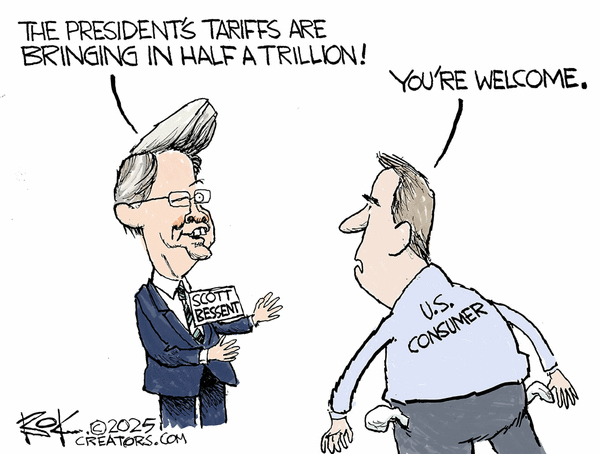
Trump Reveals Real Reason for His Extreme Tariffs
Donald Trump continues to bully one of the America’s longest allies.
Donald Trump just made the rationale for his tariff “Liberation Day” crystal clear: revenge.
In a post on Truth Social late Tuesday, the president said that the tariffs were his administration’s “fight” against Democrats’ “wild and flagrant push to not penalize Canada for the sale, into our Country, of large amounts of Fentanyl, by Tariffing the value of this horrible and deadly drug in order to make it more costly to distribute and buy.”
Approximately 0.2 percent of American fentanyl seizures occur at the Canadian border, according to federal statistics.
But Trump’s aggressive rhetoric and high levies on Canada have practically shattered the two neighbors’ long-standing allyship. On Thursday, Canadian Prime Minister Mark Carney announced that his country’s cozy relationship with the U.S. had come to an end, and that Canada would wean itself off American products and services “at speeds we haven’t seen in generations.”
Trump singled out four Republican senators in particular who have pushed back against his tariffs. “They are playing with the lives of the American people, and right into the hands of the Radical Left Democrats and Drug Cartels,” he said, referring to Mitch McConnell, Susan Collins, Lisa Murkowski, and Rand Paul.
“The Senate Bill is just a ploy of the Dems to show and expose the weakness of certain Republicans, namely these four, in that it is not going anywhere because the House will never approve it and I, as your President, will never sign it,” Trump said. “Why are they allowing Fentanyl to pour into our Country unchecked, and without penalty. What is wrong with them, other than suffering from Trump Derangement Syndrome, commonly known as TDS?”
Trump and his allies have frequently accused anyone that critiques their work of being mentally ill, effectively undermining the legitimacy of critical thought in the groupthink of his already sycophantic base.
“Who can want this to happen to our beautiful families, and why? To the people of the Great States of Kentucky, Alaska, and Maine, please contact these Senators and get them to FINALLY adhere to Republican Values and Ideals,” Trump said. “They have been extremely difficult to deal with and unbelievably disloyal to hardworking Majority Leader John Thune, and the Republican Party itself. MAKE AMERICA GREAT AGAIN!”
(I find it rich that Trump thinks those Senators have not adhered to Republican values and ideals, especially McConnell and Collins. Paul is in a world of his own, most decidedly a Libertarian world. Sheesh. -A.)
Some clips from The Majority report I liked.
So Who, Exactly, Is Being Punished Under This Government Edict?
I can’t think of a lot that a person can do about this. I started reading it hoping for an avenue for activism, then got caught up in the story, which is packed with info that we don’t get with stories about deportation flights. I’m sharing it because of the information. The information can help we the people’s kids who think they’re getting one job, only to find there’s another one, and it isn’t really civilian-type work. (And that is leaving the deportees aspect out of the picture, but …) The only thing I can think of to do that can eventually help is to take the info and share it with people during conversation, and such. This is another thing that, if people knew more about, they would not like it. -A.
Inside ICE Air: Flight Attendants on Deportation Planes Say Disaster Is “Only a Matter of Time”
by McKenzie Funk April 1, 2025, 6 a.m. EDT
ProPublica is a nonprofit newsroom that investigates abuses of power. Sign up to receive our biggest stories as soon as they’re published.
Reporting Highlights
- Unexpected Role: Flight attendants were told they would fly rock bands, sports teams and sun-seekers. Then Global Crossing Airlines started expanding into federal deportation flights.
- Human Struggles: Some flight attendants said they ignored orders not to interact with detainees. “I’d say ‘hola’ back,” said one flight attendant. “We’re not jerks.”
- Safety Concerns: Flight attendants received training in how to evacuate passengers but said they weren’t told how to usher out detainees whose hands and legs were bound by shackles.
(snip)
The deportation flight was in the air over Mexico when chaos erupted in the back of the plane, the flight attendant recalled. A little girl had collapsed. She had a high fever and was taking ragged, frantic breaths.
The flight attendant, a young woman who went by the nickname Lala, said she grabbed the plane’s emergency oxygen bottle and rushed past rows of migrants chained at the wrists and ankles to reach the girl and her parents.
By then, Lala was accustomed to the hard realities of working charter flights for Immigration and Customs Enforcement. She’d learned to obey instructions not to look the passengers in the eyes, not to greet them or ask about their well-being. But until the girl collapsed, Lala had managed to escape an emergency.
Lala worked for Global Crossing Airlines, the dominant player in the loose network of deportation contractors known as ICE Air. GlobalX, as the charter company is also called, is lately in the news. Two weeks ago, it helped the Trump administration fly hundreds of Venezuelans to El Salvador despite a federal court order blocking the deportations, triggering a showdown that experts fear could become a full-blown constitutional crisis.
In interviews with ProPublica, Lala and six other current and former GlobalX flight attendants provided a window into a part of the deportation process that is rarely seen and little understood. For migrants who have spent months or years trying to reach this country and live here, it is the last act, the final bit of America they may experience.

All but one of the flight attendants requested anonymity or asked that only a nickname be used, fearing retribution or black marks as they looked for new jobs in an insular industry.
Because ICE, GlobalX and other charter carriers did not respond to questions after being provided with detailed lists of this story’s findings, the flight attendants’ individual accounts are hard to verify. But their stories are consistent with one another. They are also generally consistent with what has been said about ICE Air in legal filings, news accounts, academic research and publicly released copies of the ICE Air Operations Handbook.
That morning over Mexico, Lala said, the girl’s oxygen saturation level was 70% — perilously low compared with a healthy person’s 95% or higher. Her temperature was 102.3 degrees. The flight had a nurse on contract who worked alongside its security guards. But beyond giving the girl Tylenol, the nurse left the situation in Lala’s hands, she recalled.
Lala broke the rule about talking to detainees. The parents told Lala their daughter had a history of asthma. The mom, who Lala said had epilepsy, seemed on the verge of her own medical crisis.
Lala placed the oxygen mask on the girl’s face. The nurse removed her socks to keep her from further overheating. Lala counted down the minutes, praying for the girl to keep breathing.
The stories shared by ICE Air flight attendants paint a different picture of deportations from the one presented to the public, especially under President Donald Trump. On social media, the White House has depicted a military operation carried out with ruthless efficiency, using Air Force C-17s, ICE agents in tactical vests and soldiers in camo.
The reality is that 85% of the administration’s “removal” flights — 254 flights as of March 21, according to the advocacy group Witness at the Border — have been on charter planes. Military flights have now all but ceased. While there are ICE officers and hired security guards on the charters, the crew members on board are civilians, ordinary people swept up in something most didn’t knowingly sign up for. (snip-MORE)
Idaho state Rep. Stephanie Mickelsen, R-Idaho Falls, has spoken up on behalf of migrant workers — a stand that attracted social media taunts and a call for Immigration and Customs Enforcement raids at her farms from a far-right political opponent.


Jon Ossoff