This one is especially funny!
Some Shorts For A.M. Fun
This one is especially funny!

This one is especially funny!
Scottie mentions restroom etiquette sometimes. Turns out, there’s an actual etiquette, as he says, and here’s a story about it!
The “buffer urinal” is more important than we realize.
By Evan Porter
There’s a theory that most men, and people in general, intuitively understand “urinal etiquette.” It’s the art and science of where to stand in relation to other men when using a public restroom. Stand too far away, and you risk coming across as standoffish or rude. Stand too close, and you’ll make the other person uncomfortable.
Most people prefer to have a “buffer” between themselves and strangers, and it’s not limited to urinals or public restroom stalls. When given the option, most of us will sit at least one seat away from the nearest stranger in a movie theater or auditorium. We’ll leave a bench or treadmill between ourselves and a fellow gym-goer.
The buffer may seem like common decency and consideration for the people around us, but there could be more to it than that, according to a decades-old research study.
In 1976, a team of researchers actually got the idea to test whether the proximity of a stranger had an effect on the way men urinated. Yes, really.
More specifically, they wanted to test what happens when someone invades your personal space. Do you just feel awkward or uncomfortable, or are there more measurable things happening in the body.

Objectively, the worst kind of urinal. Photo Credit: Photo credit: Wikimedia Commons
For the experiment, researchers began with a pilot study in a men’s public restroom. An observer stood by the sink, appearing to busy himself with washing and grooming, all while secretly keeping tabs on the men who entered. The published study takes it from there:
“When a potential subject entered the room and walked to a urinal, the observer recorded the selected urinal and the placement of the next nearest user. He also noted (with a chronographic wristwatch) and recorded the micturation delay (the time between when a subject unzipped his fly and when urination began) and the micturation persistence (the time between the onset and completion of urination). The onset an cessation of micturation were signaled by the sound of the stream of urine striking the water in the urinal.”
Ethical concerns about observing unsuspecting men in a restroom aside, the study found that none of the 48 subjects chose to stand directly next to another “user” at the urinal banks. The data also showed that men urinated longer the farther they were from the nearest person.
The study was repeated, but this time, confederates were involved. Volunteers were stationed at specific distances from unsuspecting bathroom users, while another observer hid in a nearby stall and used a “periscope” to get a clear sightline of the urine stream.
Once again, the data was extremely conclusive: men who stood directly next to a confederate while urinating took longer to begin and also urinated for longer overall.
“These findings provide objective evidence that personal space invasions produce physiological changes associated with arousal,” the authors noted in their abstract.
It was an important, if controversial, study in advancing the field of proxemics—the study of physical space in human nonverbal communication. Research like this unusual bathroom study has helped us understand “intimate distance,” a space very close to our bodies that we reserve for romantic partners, children, and close friends.
Research in the field has also mapped the “personal bubble,” or “personal distance,” typically reserved for family members and friends. However, when strangers invade this space—in a crowded elevator, a packed subway car, or by standing next to us at the urinal—that’s when things get really interesting.
Our bodies respond, and MIT Press notes that people often deal with an invasion of personal space by “psychologically removing themselves from the situation” by listening to music or staring blankly at a wall.
Now we know a little more about the physiological response behind this aversion, and it makes urinal etiquette make much more sense. It’s not just “machismo” or homophobia—it’s a way of avoiding a serious stress and anxiety trigger. Or, at the very least, a way to have a much more satisfying pee.
Orion Rummler
This story was originally reported by Orion Rummler of The 19th. Meet Orion and read more of their reporting on gender, politics and policy.
The largest medical association in the United States supports gender-affirming care — a stance it has reiterated in different ways over the last 10 years. But as Republicans press leading medical organizations on health care for transgender youth, the American Medical Association (AMA) is the latest group caught between political rhetoric and the complex realities of specialized care that few people receive.
As patients, families and doctors navigate this care in an increasingly confusing and hostile landscape, what medical groups say matters. But lately, what they’ve had to say — and how politicians interpret it — has only caused more uncertainty.
The AMA’s stance was already in question after a January meeting between leaders of major medical groups and Dr. Mehmet Oz, the head of the Centers for Medicare and Medicaid Services. After that meeting, which was first reported by The New York Times, one group in attendance — the American Society of Plastic Surgeons (ASPS) — muddied the waters about whether it had taken a more restrictive stance on gender-affirming care.
Questions soon followed for the AMA, the nation’s most prominent organization representing doctors.
Twenty Republican state attorneys general are pushing for the AMA to broadly oppose gender-affirming care for minors, in response to news coverage about their recommendations around youth surgeries. The attorneys suggest that the AMA may be violating state consumer protection laws by confusing, or even misleading, medical providers and patients about their stance. They mention wanting to “avoid a formal investigation” into the issue.
The attorneys, led by Steve Marshall in Alabama, wrote a letter in February asking whether the group recommends hormone therapy or puberty blockers to treat gender dysphoria in minors.
“If you agree that there is insufficient evidence to support using surgical interventions to treat gender dysphoria in minors — as your recent statement indicates — we do not understand how you can find that there is sufficient evidence to support using hormonal interventions to treat gender dysphoria in minors,” their letter reads.
This is an escalation of a familiar tactic, said Khadijah Silver, director of gender justice and health equity at Lawyers for Good Government. And if it works, it will be a major weapon in the political fight to delegitimize gender-affirming care, they said.
“If you can convince the public that they have shifted stance, that’s extremely powerful,” they said, referring to the AMA.
In some ways, that impact is already being felt.
In a recent congressional hearing on rising health care costs, the board of trustees chair for the American Medical Association was asked about how patients across the country are struggling to find doctors. Two hours into the hearing, he was also asked about gender-affirming care for trans youth — a topic that affects few Americans, but takes up a lot of political air.
Rep. Erin Houchin, a Republican from Indiana, asked why the medical group changed its position on surgeries for trans youth.
But the AMA maintains that it has not changed its position.
“In surgery and minors, our belief is that it should generally be deferred until adulthood. But, we respect the physician-patient-family relationship in determining that,” Dr. David H. Aizuss answered in response to the question from the congresswoman.
That exchange took only a few minutes out of a hearing that spanned the gamut of crises facing the U.S. health care system, like skyrocketing insurance premiums and a worsening physician shortage. But it represents a growing tension between Republicans and medical groups, as elected officials who oppose gender-affirming care push for major health care organizations to do the same.
The American Medical Association declined to comment on the attorneys general’s letter, which had asked for a response by March 25. In a broader statement, the medical group said it supports gender-affirming care.
“We support evidence-based treatment for medical care, including gender affirming care,” an AMA spokesperson said in an email. “Currently, the evidence for surgical intervention in minors is insufficient for us to make a definitive statement. In the absence of clear evidence, surgical interventions in minors should be generally deferred to adulthood. Treatment decisions should be made between the physician and the patient (and family) based on the best medical evidence and clinical judgment.”
That position aligns with the World Professional Association for Transgender Health (WPATH), an authority on medical care for trans people. WPATH recommends that patients generally wait until adulthood before seeking surgery. Trans youth rarely undergo surgery of any kind; of the small number performed on adolescents, the majority are mastectomies.
If an adolescent does need surgery, WPATH recommends they meet extensive criteria — including a full understanding of reproductive side effects, a year’s worth of hormone therapy, sustained gender incongruence, plus emotional and cognitive maturity.
The questions surrounding surgery come on the heels of the American Society of Plastic Surgeons’ response to the January meeting with Oz. In what the Times described as a “tense” meeting, Oz pressed leaders of organizations including the AMA and the ASPS on why they recommend gender-affirming care for trans youth. At that meeting, the surgeons group said it would be changing its position, per the Times.
Weeks after the meeting, ASPS released a nine-page statement saying that gender-affirming surgery should be delayed for minors until a patient is at least 19. The surgeons’ group cited insufficient evidence that benefits for surgery outweigh risks, and pointed to a controversial report created by the Trump administration to back its position.
The surgeons group noted that it still opposes criminalization of such medical care. The Trump administration celebrated the announcement.
“Today marks another victory for biological truth in the Trump administration,” said former Deputy Health and Human Services Secretary Jim O’Neill, in a press release. Oz, who has compared gender-affirming care for minors to lobotomies, applauded the American Society of Plastic Surgeons “for placing itself on the right side of history.”
In the following days, the surgeon’s group appeared to backtrack. The American Society of Plastic Surgeons reportedly told NPR that its position “does not include a blanket recommendation for surgery for minors.” The ASPS did not respond to a request for comment on this story.
The AMA has had its own trouble communicating its position. In a recent internal newsletter from the board chair, the association said that its policy on gender-affirming care has not changed at all; and that it requested a correction from The New York Times in response to the outlet’s coverage of its initial statement on youth surgeries. However, the Times says it has received no such requests.
This back-and-forth is taking place against an intense political backdrop: Six states have made it a felony for doctorsto provide gender-affirming care to trans youth. Hospitals across the country have shuttered gender clinics in response to pressure from the administration. As a result, some young patients are cut off in the middle of treatment and medical professionals are grappling with how the law impacts them.
And despite ample news coverage, gender-affirming care is still not widely understood.
Very few transgender youth seek and access surgeries. More rely on hormone therapy and puberty blockers to treat gender dysphoria, which is a medical condition that can cause significant distress for trans people.
Puberty blockers delay the hormones that cause kids to go through puberty, which can be an intense and emotionally fraught time for trans youth. Many families say this treatment is crucial for their child’s wellbeing and prevents distress caused by dysphoria. There are potential risks, like decreased bone density, which is monitored by medical providers. Some providers recommend weight-bearing exercise or diet optimization to boost calcium and vitamin D levels while on puberty blockers.
Hormone therapy, which involves taking testosterone or estrogen to cause physical changes that align one’s body with their gender identity, is another treatment that some trans youth receive to alleviate dysphoria. As with puberty blockers, clinics require a mental health assessment as well as parental or guardian consent for the treatment.
Multiple studies have found that access to these treatments decrease depression and anxiety for trans youth. Butthey are now banned in much of the country, after Republican politicians and conservative lobbying groups flooded statehouses with bills aiming to restrict the care for minors.
The Endocrine Society and the American Academy of Pediatrics are under federal investigation over their support for gender-affirming care. Both medical groups have sued, as the government seeks information to determine if they have made “false or unsubstantiated representations” regarding the care.
The attorneys’ general letter to the American Medical Association is leveling up that pressure on medical groups, Silver said.
“Because the care is so politicized, any association that stands up and asserts its support for physicians who provide the care, will be made an example of,” they said.
by Dahlia Adler · Apr 3, 2026 at 5:00 am
New month, new collection of queer romances, and this month we’re going heavy on historicals! Treat yourself to love throughout the ages with these sweet new reads.

Author: Meg Jones
Released: April 7, 2026 by Avon
Genre: Contemporary Romance, LGBTQIA, Romance
Series: Game, Set, and Match #3
A sizzling sapphic enemies-to-lovers romance between two rival tennis superstars, taking place during the US Open!
Nothing fades faster than a former prodigy—and Inés Costa is dangerously close to disappearing.
Once queen of the court, Inés is limping through qualifiers. And after losing her biggest sponsor to Chloe Murphy, the sport’s fiery new favorite, she and her bank account are running on fumes.
Chloe, known as much for her talent as her temper, is a top seed for the upcoming US Open. But thanks to broken rackets, code violations, and the inability to play well with others, her “favorite” status is slipping away.
However, when they are forced to share the same side of the court, and the world surprisingly doesn’t implode, Chloe makes an she’ll fund Inés’s journey to the US Open, but only if Inés agrees to be her hitting partner and teach her to keep a level head.
It’s strictly business, but somewhere between practice drills and tour stops, the line between rival and something more begins to blur.
As the summer burns toward Flushing Meadows, their sizzling tension catches fire. With a trophy in sight and emotions running high, will their romance double fault at set point?
The Game, Set and Match series gets its first f/f in this third book, bringing a heated rivalry to the tennis court. This one’s chock full of favorite tropes and is decidedly steamy, the perfect pick to tide you over until nonfictional players hit the US Open in a few months. (snip-MORE, plus ordering info, on the page)
The Bird’s The Word:

Empidonax minimus
Also Known As:
The Least Flycatcher is a small but fierce bird of North American forests, known for its fearlessness in confronting birds much larger than itself, including formidable foes like Blue Jays and even hawks. They often share habitat and compete with American Redstarts, a fly-catching warbler, which they exclude from the best habitat through repeated chases and attacks. Of course, Least Flycatchers defend their territories from their neighbors as well.
However, despite their intense territoriality, these flycatchers are widely known to form dense clusters of breeding territories, even in areas with plenty of suitable habitat. Interestingly, the males closest to the center of a cluster are the healthiest, and the first to find mates. Conversely, birds that don’t join a cluster usually do not mate at all that season. While other factors may contribute to this pattern, the main influence seems to be that it facilitates birds mating with their neighbors in addition to their social mate.
Least Flycatchers are socially monogamous, pairing with a single bird during the breeding season with whom they defend a territory and raise young. But these birds are also quite promiscuous. More often than not, the nest of a mated pair will have at least one nestling sired by another male. “Spreading the love” in this way benefits both males and females — females end up with more genetic diversity in their nests, while males don’t have all their eggs in one “basket,” in case a nest fails. This breeding system, where territories are clustered together, females seek matings outside of the pair, and paired males compete for each other’s mates, has been described as a “hidden lek.” In some ways, this system is quite similar to the communal display areas, or leks, where birds like Lesser Prairie-Chicken and Greater Sage-Grouse defend small arenas to display for females.
One big difference between a classic lek and the so-called “hidden lek” of Least Flycatchers is that both the male and female in a pair are looking to mate with other birds without their own mate knowing about it. Also, the displays are a bit less dramatic. Rather than elaborate plumages, dances, and bizarre methods of sound production, these drab males instead opt to sing the same monotonous two-note song several thousand times an hour.
Though fairly common in appropriate habitat, Least Flycatcher populations have been declining since the 1970s. There are now a little over half as many Least Flycatchers as there once were. As such, Partners in Flight lists them as a Common Bird in Steep Decline. More research is needed to better understand the causes of this decline, but factors affecting the structure and health of forests probably play an important role. (snip)

(A comic, and some shorts. I thought I had more comics!) Some current event related, some simple humor, some both. And dancing!
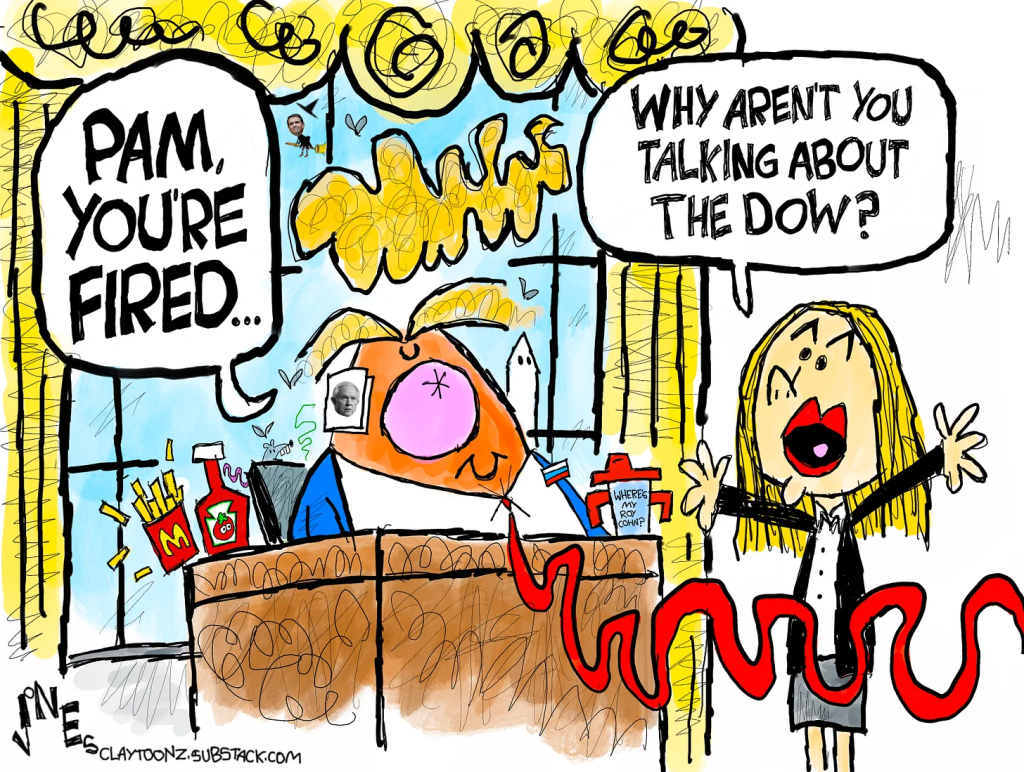
There were a lot of reasons to fire Pam Bondi as United States Attorney General, but Donald Trump picked a bad one.
Bondi was never qualified for the job, which was the second choice after Matt Gaetz, who would have been another ridiculous choice. Bondi made it clear after the 2020 election that she didn’t need evidence to make legal claims, as she declared that Donald Trump was cheated out of that race. She had been in his pocket ever since he bribed her in the 2000s not to investigate Trump University in Florida, when she was the state’s Attorney General.
After Bondi misled the country about her initial disclosures in the Jeffrey Epstein case, Congress responded by passing a law forcing the Justice Department to release its files on the pedophile and his allies. (snip-MORE; click on the title above)
They’re greedy and they’re dummies
Drumpf’s face looks like a mummy’s
The opposite of yummy
The Drumpfy Family
Don Junior loves his cocaine
And Eric is a no-brain
They’re syphillitic, insane
The Drumpfy Family
Chum
Numb
And dumb
So hide beneath the covers
And find yourself a lover
Don’t be a MAGA sucker
The Drumpfy Family!
(snip)
Over $84,000 Raised So Far For Tennessee Librarian Fired For Refusing To Remove LGBTQ-Themed Books
Nashville’s NBC affiliate reports:
The library director who was fired for refusing to relocate LGBTQ children’s books has garnered substantial community support, with people donating over $84,000 to help her as she navigates the loss of her job. A GoFundMe launched by a community member says that the fundraiser for Luanne James is going “directly toward supporting her family’s basic living expenses during this time.”
James was the director of the Rutherford County Library until the board voted to fire her last week. The termination came after she refused to move 132 children’s books to another section of the library because the LGBTQ themes were deemed inappropriate for children. James said that she “had no choice” but to refuse the board’s request to move the books. She said that she believes librarians are being politicized and that “is not what we signed up for.”
Read the full article.
Check out the protest crowd in the video below!
NBC News reports:
Defense Secretary Pete Hegseth has taken steps to block or delay promotions for more than a dozen Black and female senior officers across all four branches of the military, some of whom are seen as having been targeted because of their race, gender or perceived affiliation with Biden administration policies or officials, according to nine U.S. officials familiar with the process.
The process within the Army, the Air Force, the Navy and the Marines is structured to ensure the most qualified officers get promoted. Hegseth’s decision to intervene in the process has raised concerns among some officials within those military branches and the White House, the nine U.S. officials familiar with the situation said.
“There is not a single service that has been immune to this level of involvement by Hegseth,” one of the U.S. officials said. Two of the officials said there are concerns in the military and the White House specifically that Hegseth is blocking or stalling some qualified officers from receiving promotions through the ranks of general and admiral because of their race or gender as he targets diversity, equity and inclusion initiatives at the Pentagon.
Read the full article.
The Washington Post reports:
Defense Secretary Pete Hegseth has asked the Army’s top officer to step down and retire, defense officials said Thursday, an extraordinary move amid the war with Iran and the latest in a series of clashes between the Pentagon chief and the service’s senior leadership.
Gen. Randy George had been expected to hold the job of Army chief of staff for more than another year, until the fall of 2027, and complete what is typically a four-year assignment as a member of the Joint Chiefs of Staff. But Hegseth decided to go in another direction, representatives for the defense secretary said.
Two other Army generals were removed along with George, said two defense officials, who like some others spoke on the condition of anonymity to discuss the shake-up. They are Gen. David Hodne, who became the head of the service’s Training and Transformation Command in October, and Maj. Gen. William Green Jr., the chief of Army chaplains.
Read the full article. We can guess why the chief of Army chaplains has been removed.
Here’s one egregious example I just read about this morning in The Bulwark, concerning a Black, female major general. Not surprising. Still appalling.
“A few months earlier, Gen. George and [Army Secretary Dan] Driscoll had refused to accede to demands from Hegseth’s office to block the scheduled promotion of Maj. Gen. Antoinette R. Gant to take command of the Military District of Washington. The Washington District commander appears alongside the president at ceremonial functions in the D.C. area, for example at Arlington National Cemetery. Hegseth’s chief of staff reportedly told Driscoll that Trump would not want to stand next to a black female officer at military events.”
The article did not say whether Gant’s promotion ultimately went through.
Due to the Stephen Miller pogrom against anyone not white and the red states wanting to prove they are more maga than everyone else, but really it is just about how very unpopular Republican policies are that they are on a restrict voting to republicans only drive. I have been talking about how I would need a passport to vote.
Ron has been pushing for us to get passports and has been looking into it. One of the things he read was if you had a prior passport all the massive amount of information wouldn’t be needed. Ron told me he remembered I had a passport. I told him I had to have a red diplomatic passport due to the sensitive nature of my military job but I had to return it when I left the military.
He said Scottie you have an old blue passport. I said, Really?. Yes I remember seeing it he replied. The more he talked the more it jogged my memory and I did remember having a blue passport. I was not sure if I needed it to go to Germany or if it was issued after I turned in the red one. I had forgotten about all of this. But Ron is excellent at keeping our files and he remembered it. The thing that is a problem is that my passport has my prior to marriage name. But Ron says it is better to have this as the needed paperwork is not needed. I hope so. I am so tired these days. Ron is worried. Normally I jump out of bed at 3 or 4 and an charged up for the day. I am barely able to drag my self out of bed now at 5 and I am going to bed early.
Right now the cat screams at me to get up and feed him. I fell into a deep sleep last night and Ron got up and made his side of the bed and went out to the livingroom. Normally I hear Ron’s every move and wake up and if needed talk to him. But an hour later the cat was upset I was not up came to the bedroom and howled until I woke up. Then he got on the bed and purred. Ron claims he never heard him. But I got up and went to my office with the cat following me. I sat at my desk and Tupac jumped up on the desk on his towel and purred madly happy to have his desk time with me.
But this being so tired and going back to bed more often during the day and sleeping not just resting my back, is upsetting to me. I have been getting up early like 3 or 4 am and going to bed between 7 or 8 pm most of my life unless required to not do it. I would jump out of bed so energetic it would upset Ron and his sister laughed at how when she visited every time she got up I was already up. Now I am so tired Ron can get up and out of the bed get dressed and not wake me. When I do get up I feel I am dragging my body along. I have no energy to even think. Something has changed in my body and it scares me at how hard this shift has been. My doctor did not seem concerned about the blood results, saying since I have struggled with anemia before, it is likely I am facing it again making me tired. Plus there is the stress I am under. He did mention a screening for colon cancer and that asked if I struggled with depression. His nurse came in an asked me a bunch of questions resulting in the fact that I struggle with depression more than 2 days a week. He said he will have me check the results in 3 months and then he will go at it because by then my stress should be decreased. Hugs


