The short version is the company came out supporting the LGBTQ+ workers and community. The two fired workers went on the company intranet and made a point to question it and declare how they felt about the LGBTQ+ people. Lets just say they were not fans. So the company investigated and decided they would create a hostile work place. The first court agreed, but the appeals court said the employee lawsuit could go forward because the airline did not make an effort to accommodate the fired workers religious rights. So the fact that you are a Christian means you can treat LGBTQ+ co-workers like shit and disregard their very existence based on a mistaken understanding of what their god wants. Christian belief tRump’s an LGBTQ+ person’s right to exist equally with out discrimination. Hugs
An Alaska Airlines commercial airliner takes-off from Los Angeles International Airport in Los Angeles, California, U.S., November 6, 2025. REUTERS/Mike Blake/File Photo Purchase Licensing Rights
Flight attendants fired over intranet posts
Lower court said comments were not overtly religious, and dismissed case
But there was enough to let a jury decide, appeals court panel says
June 26 (Reuters) – A U.S. appeals court has revived a lawsuit claiming Alaska Airlines (ALKAIR.UL) engaged in religious discrimination by firing two flight attendants who criticized the company’s support for expanding legal protections for LGBTQ people.
A three-judge panel of the San Francisco-based 9th U.S. Circuit Court of Appeals said, opens new tab on Wednesday that there was enough proof that the airline was motivated by the workers’ Christian beliefs when it fired them to let a jury decide whether it broke the law.
The flight attendants in 2021 made separate posts on Alaska Airlines’ employee intranet critical of the company’s backing of the Equality Act, a bill in Congress to prohibit discrimination against gay and transgender people in employment, housing, public accommodations and other areas.
The posts were not overtly religious, leading a judge to dismiss the case last year. But Circuit Judge Daniel Bress, who was appointed by Republican President Donald Trump, as were the other judges on the panel, wrote for the 9th Circuit that the workers’ comments and the airline’s response to the posts were enough to show it may have been motivated by their religious beliefs.
“It did not matter whether [one of the plaintiffs] could support her post with chapter and verse from an authoritative religious text,” Bress wrote.
The plaintiffs also claim their union, the Association of Flight Attendants, discriminated against them and breached its legal duty to represent them by not fighting their termination.
The 9th Circuit on Wednesday revived those claims, and joined two other appeals courts in ruling that federal labor law does not preempt such claims against unions brought under state laws.
Alaska Airlines and the union did not immediately respond to requests for comment on Thursday.
The plaintiffs are represented by the First Liberty Institute, which says it is the largest legal organization in the country dedicated exclusively to defending religious liberty. Stephanie Taub, the group’s senior counsel, said the 9th Circuit ruling reinforces legal protections from religious discrimination.
“You cannot be fired because your employer does not like your religious beliefs,” she said.
According to court filings, after Alaska Airlines posted online about its support for the Equality Act, plaintiff Lacey Smith wrote in response: “As a company, do you think it’s possible to regulate morality?”
Another flight attendant, Marli Brown, made a separate, longer post claiming the Equality Act would infringe on women’s rights, enable sexual predators, and was “endangering the Church [and] encouraging suppression of religious freedom.”
Alaska Airlines deleted the posts and issued a statement in response, saying the company supported protecting LGBTQ people against discrimination and that “we also expect our employees to live by these same values.” Smith and Brown were then fired after an investigation for violating the airline’s anti-discrimination and harassment policy, court filings showed.
The women sued in 2022, accusing Alaska Airlines and the union of discriminating against them because of their Christian beliefs.
U.S. District Judge Barbara Rothstein in Seattle had dismissed the case, saying the firings were not discriminatory because the flight attendants’ posts were not religious in nature. She also said the federal Railway Labor Act, which regulates the rail and airline industries, preempted the plaintiffs’ claims that the union violated Washington and Oregon law.
The 9th Circuit reversed Rothstein’s order. Brown’s post specifically mentioned “the Church,” Bress wrote for the court, and the airline investigated her and Smith together. Both women also cited their religious beliefs in the course of the airline’s investigation, he said.
Bress was joined by Circuit Judge Kenneth Lee in his opinion. Circuit Judge Morgan Christen mostly agreed, but in a partial dissent said she would not have revived Smith’s discrimination claim.
“Alaska would have had to be clairvoyant to know that Smith considered the statement she posted on the company’s internal website to be an expression of her faith,” wrote Christen.
The case is Brown v. Alaska Airlines, 9th U.S. Circuit Court of Appeals, No. 24-3789.
For the plaintiffs: Stephanie Taub and others from First Liberty Institute; Andrew Gould of Holtzman Vogel Baran Torchinsky & Josefiak
For Alaska Airlines: Lauren Watts and others from Seyfarth Shaw
For the union: Benjamin Berger and others from Barnard Iglitzin & Lavitt
More Christian privilege and threats for those who are different or they don’t like. There is no hate like Christian love. And if you have listened to Dan McCallen the prohibitions against homosexuality these people like to claim are wrong. It is wrong because they do not understand the culture of the time the bible was written and what the original text / words were. They just want to hate and they think that if it comes from god then it is not their fault. Imagine hating so bad that just people wanting recognition for existing and for equality free from discrimination enrages you. This is why pride is still so desperately needed. As I read what he wrote again the anger, ignorance, and implied violence just because other people have different ways and feelings than he does. And the billerent stupidity makes me worry for the people around him and his children.. His view of being a man or manly is incredibly toxic. There is a video at the end of the post I did not include. Hugs
A controversial former San Francisco Giants player has gone crazy online in a lengthy homophobic rant against his ex-team’s Pride Night debacle. Aubrey Huff took to X on Wednesday morning, and he didn’t pull any punches when it came to his thoughts on general manager Buster Posey’s befuddled response to reporters’ questions on Tuesday.
“I can pretty much guarantee you I know exactly what Buster wants to say about having to answer irrelevant non-Baseball questions that pertain to the sexual preference within the LGBTQ fudge packing community,” Huff began.
“I’m not wearing this gay bulls–t. Queers don’t watch Baseball anyway. They watch The View, enjoy therapy, & fudge packing sessions. And anyone inside the LGBTQ community, or those who support them don’t like what I just said, then I say to you…. Go f–k yourselves, & eat a d–k. And I mean that in the most literal sense,” he said.
Has the state of Texas become a christian theocracy now? It seems every year they change the school curriculum to make it more white and more Christian. Itis clear that the Christian billionaire preacher who basically bought the state legislature and calls the shots has long wanted the state to be a White Christian Male paradise. These new changes basically make the state schools the same as the Jewish Orthodox schools in NY, where the students learn only the Torah but can hardly count to 20 and speak / write very little English. They are getting tax money to educate kids but they don’t. The kids graduate and can’t get jobs and are on state assistance. The new Texas standards emphasize white contributions and minimize any contributions from other races. They push religious stories over facts. This is just the forced religious indoctrination of children regardless of the religious beliefs of the parents. Notice there is no opt out on these religious texts, books, stories but parents much be told and can opt their child out of any lesson that mentions the LGBTQ+ or reading material containing information about it. If you are worried about the white washing race removing Christifying of public schools and the rewriting of history to change what really happened to make white people look better please give this article a read. below are a few quotes from the article. Hugs
The statewide reading list would require, among other literary works, that schools teach Bible material to children as young as 6 years old up to young adults preparing to receive their diplomas. That includes Christian stories about Adam and Eve, the eight Beatitudes and the Parable of the Prodigal Son.
On the contrary, Republicans eliminated a standard specifying that students should consider “the perspectives of groups whose voices are less represented in traditional historical accounts.” They added another requirement that introduces the biblical story of Moses alongside the Underground Railroad and Harriet Tubman — who was nicknamed “Moses” because, similar to the biblical prophet, she helped people escape slavery.
“Let me be very clear: Islam is not a religion,” state Sen. Bob Hall, R-Edgewood, testified before the education board Monday. “It is a totalitarian theocracy, not unlike totalitarian systems of communism, Nazism and globalism.”
Meanwhile, students, educators and progressive activists spoke out in opposition to the lack of racial, ethnic and gender inclusion in the debated books and lessons, as well as the state’s Christian focus over other religions.
The State Board of Education will hold a final vote Friday on incorporating more Christian stories into classrooms and deemphasizing race and cultural diversity in history lessons.
Certified elementary school librarian Sarah Pepin speaks at a State Board of Education meeting in Austin on June 22, 2026. Manoo Sirivelu/The Texas Tribune
Texas elementary and middle school students will likely see redesigned social studies and reading lessons that minimize racial, geographic and cultural diversity while emphasizing the Bible — but changes for high schoolers have suddenly hit a pause.
The Republican-led State Board of Education decided Thursday evening to allow final votes on a rewrite of Texas’ K-8 social studies lessons and a mandatory reading list for all public schools that includes Christian stories. Those votes are expected Friday.
However, the board delayed proposed changes to high school U.S. history, world history, geography and government.
For months, educators, Democrats and public education advocates criticized Texas’ social studies revamp as rushed. Conservative advocates and Republican board members insisted on pushing the process forward. But board chair Aaron Kinsey expressed doubts Thursday about having enough time to cut down the number of lessons packed into each course.
“This is a conundrum we’ve created of our own doing,” Democratic member Marisa B. Pérez-Díaz said. “And I’m very frustrated by it.”
Kinsey rejected an assertion from Pérez-Díaz that he rushed the process and said he was willing to continue working. But he also said board members made mistakes when they pushed through changes during late hours. For example, they eliminated a requirement that students learn about the American Revolution in high school U.S. history before reinserting it Thursday.
The elected board is on track to update what public school students must learn in reading and social studies. This week’s meetings ran as late as 2 a.m., as board members meticulously parsed through changes to lessons in each grade.
Along with Bible stories in reading, the social studies proposal features a dramatic transformation in how Texas schools have long administered lessons on history, geography, economics and government. It eliminates the current sixth-grade world cultures course, deemphasizes world history outside of European tradition and dedicates more focus to Texas and the United States.
Democrats suggested changes they hoped would make lessons more accurate and inclusive of historically underserved groups — most notably people of color — even if they ultimately did not favor the overall plan.
Republicans blamed cherry-picking over what students should learn for the delay.
“We wasted many hours late into the morning,” Republican member Brandon Hall said. “We have worn out and exhausted our staff on trifling amendments coming from people who had no intention of ever working with us or ever actually approving something they wanted to pass.”
Conservative leaders and activists champion the new lessons, which they view as “the final battle” in a push to rid Texas schools of instruction they say paints America in a negative light and trains students to hate the country.
Sociology classes, for example, currently require students to understand “the impact of race and ethnicity on society” and “analyze the varying treatment patterns of minority groups.” But that standard was eliminated in the newly proposed social studies plan.
If approved by the education board Friday, the K-8 social studies changes and the reading lists will take effect during the 2030-31 school year. The board will also decide whether to phase in the social studies changes or introduce them all at once.
Members could take up the high school courses at its next scheduled meeting in September, or the chair could schedule a special meeting before.
Reframing history
Educators criticized how the social studies proposal prioritizes memorization over critical thinking and simplification over accuracy. Historians called attention to factual errors, saying the new standards would set children up for failure post-graduation.
One lesson, for example, had described the forced relocation and imprisonment of Japanese families during World War II as one of the “contributions” to America’s military effort. Another proposal noted that high school students should know the significance of leaders in the Civil Rights Movement, specifying Thurgood Marshall, Barbara Jordan and Hector P. Garcia — but not Martin Luther King Jr.
The standards initially approved this week reflect slightly different suggestions, instead describing Japanese incarceration as one of the “changes” during the war and adding King to the list of Civil Rights leaders.
But Democratic board members said the minor tweaks will not fix what they see as a whitewashed social studies plan and a politically influenced approval process.
A panel of nine advisers guided the social studies overhaul, almost all of whom hold no Texas K-12 classroom experience and several of whom are either conservative activists or closely affiliated with them. Educators have described it as a major reversal of previous years when teachers led the way, while Democrats have said they do not feel fairly included in decision-making.
“Our voices are being left off constantly,” Democratic board member Tiffany Clark said.
Republicans clarified that advisers only provide recommendations. Elected members maintain final say in the social studies overhaul, they noted. The GOP members argued that it is Democrats’ own responsibility to ensure they are included in the rewrite.
“I, as well as several of my colleagues, have been in direct contact with our content advisers,” Republican member Audrey Young said. “I have been communicating through my content adviser this entire time.”
But some of the appointed experts also expressed frustrations. Yolanda Chávez Leyva, a historian at the University of Texas at El Paso helping guide the board, said she “didn’t feel that every adviser’s input was treated equally.”
Kate Rogers, a social studies adviser who previously led the Alamo Trust before publicly clashing with Lt. Gov. Dan Patrick, said the group remained professional but its recommendations did not represent all participants.
For instance, the advisory panel proposed changing a lesson that originally called on students to “identify domestic challenges for the United States following World War I related to racial violence and intolerance, including the resurgence of the Ku Klux Klan and the Tulsa Race Massacre.”
They instead suggested that students learn about the Klan’s “intolerance” of Catholics, Jews and immigrants but did not specify Black Americans. They also changed the “Tulsa Race Massacre” to the “Tulsa Race Riots.” During the 1921 massacre in Oklahoma, a white mob killed Black residents, destroyed their homes and looted their businesses after a Black teenager was falsely accused of trying to assault a white girl in an elevator.
The appointed group also removed standards that defined racial segregation as “keeping people apart based on the color of their skin” and specified that Africans endured slavery in the U.S. because of their race.
“I want to make it clear to the board members that we did not discuss every item on this document,” Rogers said. “Some of the changes were not reviewed by all of the content advisers.”
Board members adopted many changes proposed by the advisory group but reinserted several others, including how Nat Turner’s Rebellion “heightened sectional tensions and deepened disagreements over slavery” and how the expansion of slavery was the central cause of the Civil War. They also clarified that the Klan sought to intimidate and “limit the rights of African Americans in Texas during Reconstruction.”
Some members initiated changes that would expose students to more positive aspects of Black history, including Republican Keven Ellis’ suggestion that schools teach about Bessie Coleman, a Texan who became the first African American and Native American woman to obtain an international pilot’s license.
On the contrary, Republicans eliminated a standard specifying that students should consider “the perspectives of groups whose voices are less represented in traditional historical accounts.” They added another requirement that introduces the biblical story of Moses alongside the Underground Railroad and Harriet Tubman — who was nicknamed “Moses” because, similar to the biblical prophet, she helped people escape slavery.
Prior to debating high school social studies, a handful of Republicans on the elected board unsuccessfully attempted to block amendments from members who did not meet an earlier deadline to submit proposed changes.
If successful, the move effectively would have stopped Democrats from proposing on-the-spot tweaks, which was notable because the rule had not been enforced when the board discussed elementary and middle school lessons.
Reading lessons with Christian stories
Some of the nearly 500 speakers at this week’s meetings exchanged heated words about Christianity’s role in the development of the country, and at least one person with a Confederate flag was deemed out of order by the board chair and escorted from the room for verbally interrupting the meeting.
The statewide reading list would require, among other literary works, that schools teach Bible material to children as young as 6 years old up to young adults preparing to receive their diplomas. That includes Christian stories about Adam and Eve, the eight Beatitudes and the Parable of the Prodigal Son.
Republican leaders across the state often depict Islam as a violent religion they view as incompatible with their conservative Christian American values. During the board’s April meetings, the board eliminated a social studies standard that would have required students to learn about Muslim contributions to algebra and astronomy.
“Let me be very clear: Islam is not a religion,” state Sen. Bob Hall, R-Edgewood, testified before the education board Monday. “It is a totalitarian theocracy, not unlike totalitarian systems of communism, Nazism and globalism.”
Asked if he had ever visited a Muslim-majority country, the senatorHall responded no.
Elizabeth Jensen, who identified herself as a Texas school board trustee but did not specify the district, told the education panel that she believes “slavery was and still is fundamental to Sharia,” referring to the set of moral codes and principles that Muslims follow. Sharia does not have a uniform meaning, as Muslims interpret and act upon it differently.
Muslims have spent months denouncing such Islamophobia at State Board of Education meetings, calling it misinformation and harmful to the hundreds of thousands of Texans who practice the faith.
Meanwhile, students, educators and progressive activists spoke out in opposition to the lack of racial, ethnic and gender inclusion in the debated books and lessons, as well as the state’s Christian focus over other religions.
“These proposed standards actually defy the Constitution and highlight only one group of Americans as the founders who built this country to the exclusion of others — both in the past and in the present,” Ruth Nasrullah, a Muslim speaker, told the board members.
English teachers stressed during the meeting that many of the books on the proposed reading list do not align with what Texas requires them to teach, despite taking up most of roughly 36 weeks of instructional time in an academic year.
Before initial approval of the reading list, the board members — led by Republican Tom Maynard — debated whether they should prohibit teachers from assigning non-state-mandated books without the educators first posting them online for parental review. However, some expressed concerns about micromanaging teachers.
They also considered whether to grant charter schools flexibility in which grades they introduce the required readings, an attempt to appease charter leaders who said they wanted to assign more rigorous books to children in lower grades. But some members said doing so might create the opposite effect, allowing lower-performing campuses to lessen rigor for students in higher grades.
Neither of those passed, but board members have another opportunity to resurface suggestions before the final vote Friday.
Jaden Edison is the public education reporter for The Texas Tribune, where he previously worked as a reporting fellow in summer 2022. Before returning to the Tribune full time, he served as the justice…
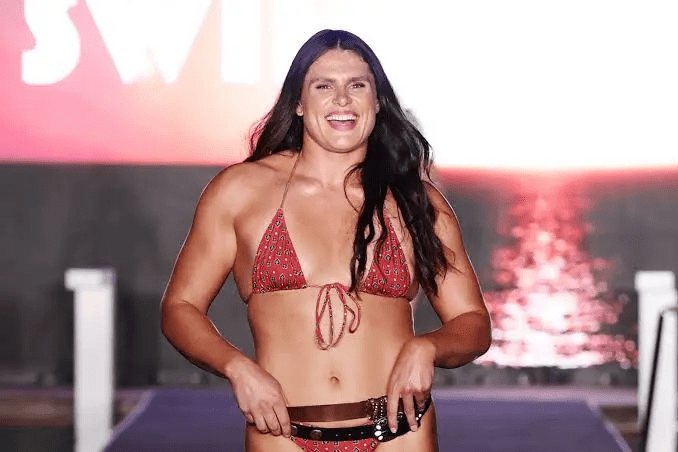
Scottie posted this meme yesterday and it prompted a further exploration than seemed easy in his list of images.
I think I’m going to shock some people here, maybe even get someone mad at me at this writing. I have to tell you all, I’m kinda a shy person. So, I’m not comfortable with some strange transgender person staring at my pecker when I pee.
I’m really just not comfortable with that. But, you know, I’m not comfortable with a strange man staring at my pecker when I’m trying to pee either. Nor am I comfortable with a strange woman staring at my pecker. In fact, I don’t flaunt my pecker about when I pee. And, I feel somehow disenfranchised because I don’t find the bathroom a place to flaunt my privates, yet the way some on the right talk about it there must be things going on in there that I’m not contributing to or enjoying. What am I doing different than those who are worried about this happening?
Some may also find this startling, but I heard that this person was found in the women’s bathroom. Many accused homophobes feel that people should not “pretend” to be a woman for the sole purpose of going into the women’s bathroom.
And, some uptight karens would say that the prevalence of this very person in a women’s bathroom is indicative of just how far things have come that “she” would feel comfortable going into a women’s bath. They say we should be shocked and outraged at Sports Illustrated for publishing these pictures.
And others would be wise to tell you that this is ILONA MAHER, a phenomenal women’s rugby star and arguably the best in the world. I would tell you that she is very strong, very aggressive, and very beautiful, and I would tell you that hassling Ms. Maher is surely contraindicated for a long life.
The uncomfortable facts are that sexual assaults perpetrated by trans people is extremely low. And, let’s consider just for a moment the great deal of bother a person needs to go through to transgender, and there are those who think it’s so they can go look at girls?! Further, the uncomfortable fact remains that 85%-90% of all sexual assaults are perpetrated by someone known by the victim — ie: not strangers, and often they are family members or close family friends and DO NOT happen in a public bathroom. And finally, a great many lgbtq folks actively avoid bathrooms, no matter how desperately they need relief, because they are all too often the victim of assault by other bathroom goers.
Personally, I’m not going into the bathroom to make friends, to admire others or to find comparisons to determine where I fall in the pissing contest of reactionary karens. I don’t care. We are all human, and like the kid’s book says, we all gotta poop.
Morgan Armstrong.Credit : Image provided by Horwitz Law
Morgan Armstrong, then 18, filed a lawsuit last year against Tennessee Christian Preparatory School after being suspended over a social media post in which she came out as gay
On June 22 of this year, a final judgment order was entered into court stating that a settlement was reached between both parties
They agreed that Armstrong’s suspension has been rescinded, and that the school will pay her $10,000
Over a year after a student sued a private Tennessee high school for suspending and prohibiting her from attending graduation after she came out as gay on social media, the school will now pay her $10,000 as part of a resolution to the case.
A final judgment order was entered into the Chancery Court for Bradley County, Tenn., on Monday, June 22, stating that a settlement was reached between Morgan Armstrong and Tennessee Christian Preparatory School.
Armstrong, then an 18-year-old graduating senior at the school, made the social media post on April 23, writing, “cats outta the bag,” according to a complaint obtained by PEOPLE and filed on May 19, 2025.
A screenshot of the post, which was included in the complaint, showed Armstrong and her girlfriend kissing and holding hands.
Armstrong defended the post in a May 29, 2025, interview with The Washington Post. “Everyone else gets to post their boyfriend or girlfriend. So just because I have a girlfriend and I’m a girl, why does that mean that I shouldn’t be able to?” she asked. “I love my girlfriend and I wanted to show it.”
Days after making the post, Armstrong was summoned to the administrator’s office and given a suspension letter, according to the complaint.
The suspension letter, which was included in the complaint, stated that Armstrong would not be allowed on campus or at any school events, including but not limited to graduation, which took place on May 10, 2025.
Although the school said that her diploma would be mailed to her on June 15, 2025, the complaint alleged that the school “explicitly threatened to sabotage Morgan’s college admissions process and to withhold Morgan’s diploma” if there was any “online slander” about the school or anybody associated with it.
Additionally, the school alleged in the letter that Morgan’s social media posting included “a disparaging remark reflecting the people at Tennessee Christian,” a claim that Armstrong disputes.
The complaint claimed that her suspension letter mentioned a private message that the senior sent to some of her friends that read: “go like and comment on my post guys bc if no one on my socials knew I was gay then they sure as hell do now so this is a big thing tbh, also I’m kinda scared about the facebook comments bc i have some ruthless trump supporting ‘jesus’ mfs on there.”
However, according to the complaint, that message did not refer to the school, but instead referred to some of Armstrong’s relatives — people who, according to Armstrong, “profess but do not practice Christian principles of love, acceptance, and compassion.”
The complaint alleged that the real reason why the school suspended her “was the fact that she had come out as gay” — and that even if she had violated the school’s social media policy, it would have been a first-time offense, and the maximum policy should have been a one-day in-school suspension.
Armstrong and her parents, who were named co-plaintiffs in the suit, sought to expunge Armstrong’s suspension record and disciplinary violation, allow her to take her final exams, forbid the school from withholding her diploma and prohibit the school from “sabotaging” Armstrong’s college admissions process.
In Monday’s final judgment order — which PEOPLE reviewed — both parties agreed that Armstrong’s suspension has been rescinded, even though they disagreed on the extent of her violation of Tennessee Christian Preparatory School’s policies.
The order also stated that the school had not spoken with other colleges or universities for the purpose of disparaging Armstrong, and agreed to be prohibited from making such remarks to the institutions.
The school will have to pay a $10,000 money judgment to Armstrong, the order read, and the lawsuit is now over.
In a statement shared with ABC affiliate WTVC, Tennessee Christian Preparatory School said: “Tennessee Christian and the Armstrong family disagree regarding the extent to which Morgan Armstrong violated school policies. Both parties acknowledge that this disagreement remains unresolved and have mutually agreed to move forward. No further comments will be made regarding this matter.”
Daniel Horwitz, an attorney for Armstrong and her family, said in a statement shared with PEOPLE, “School is a place where every student is entitled to feel welcome, accepted, and supported.”
Horwitz continued, “It is not a place where any administrator should feel comfortable disciplining or threatening kids for being gay. We were proud to represent Morgan and her family in this righteous lawsuit, and we are thrilled to have prevailed on their behalf. We hopeMorgan’s bravery will inspire others to stand up for themselves the way that she did.”
Tennessee Christian Preparatory School did not immediately respond to PEOPLE’s request for comment on Tuesday, June 23.
Emma Vigeland welcomes Ken Klippenstein, an independent journalist covering security and US politics at KlipNews, discussing the 15 anti-ICE activists indicted by the Justice Department.
Every autocracy has a central ideological mission. The current United States government wants to transform America from a multiracial democracy into a White Christian male-dominated ethnostate. This fanatical mission is increasingly influencing the administration’s policies, propaganda, and visuals produced by this United States government.
Their goal is to change who counts as an American, who can have leadership roles in government and society, who can vote, and who can walk the streets without fear of being imprisoned or deported.
This agenda of authoritarian transformation is the connective tissue binding the many news stories we see each day, whether it is the Trump administration deporting an estimated 17,500 immigrants to countries they have never visited, to White Christian Holy Warrior Pete Hegseth blocking promotions by female and Black Navy officers, to the wrecking of the Voting Rights Act.
Remember that Nazi salute given by Elon Musk at Trump’s Inauguration festivities, and that other Nazi salute given soon after by Steve Bannon at CPAC? They were not aberrations or provocations, but rather the opening shots of a race war now unfolding.
That war seeks to remove agency and mobility and rights and freedoms of non-Whites, while implementing schemes of population redesign, reducing the numbers of immigrants by disappearances, mass detentions, and deportations by government authorities.
MAGA is now a potent project of White race hegemony that feeds on several vectors: the long and tragic history of violence and legal and other effacements of Black people in America, the history of anti-immigrant xenophobia, and the example of authoritarian racial utopias that promoted some while cleansing society of others.
Foreign Policy, National Security Policy, and Elections
Transforming a multiracial and multifaith democracy into a White Christian ethnostate requires a holistic approach, and for months I have been tracking the attempts to achieve greater cohesion of government policy around this goal.
In a recent speech, Secretary of State Marco Rubio defended “Western civilization” as the shared identity of the United States and Europe and depicted mass migration as a threat to that civilization.
I have also examined how suppressing free and fair elections fits into this scheme.
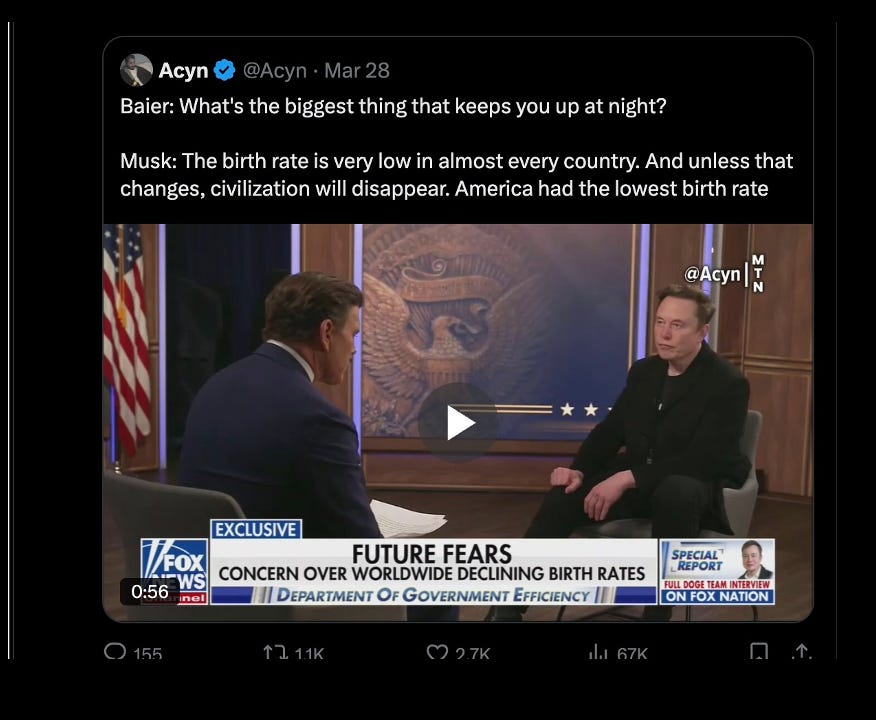
Here I add the tool of population reengineering, which is embraced by White House policy advisor Stephen Miller, Musk, and many other MAGA luminaries. A throughline of the far-right from Benito Mussolini to Musk is Great Replacement Theory, the idea that Whites are being outperformed demographically by non-Whites, necessitating measures to save “civilization” from “erasure” and Whites from annihilation.
The Fascists provided the template. “Cradles are empty and cemeteries are expanding,” Mussolini declared in 1927. “The entire White race, the Western race, could be submerged by other races of color that multiply with a rhythm unknown to our own.” In a speech that year, Il Duce cast himself in the role of a “clinician” who undertook “necessary hygienic actions” to defend Italian people from criminals, leftists and other political dissidents. “We remove these individuals from circulation just like a doctor does with an infected person,” he concluded chillingly.
A vast network of penal colonies, confinement zones, and prisons appeared to “quarantine” the “abnormal.” This “therapeutic” approach to governance, as official Giuseppe Bottai called it, was later applied to Italian Jews, and in Italian Ethiopia the regime experimented with apartheid-style racial segregation to stop the wrong kinds of babies from being conceived.
This idea of state action to protect White Christian civilization and the “natural family” –one man, one woman, and both white–continues among the far right today, as does the attachment to Great Replacement theory.
“I think there is a deliberate plan to erase everything that identifies us: culture, Nation, family are under attack,” stated Giorgia Meloni, a neo-Fascist, in March 2019. As Prime Minister, Meloni champions White motherhood as an antidote to population changes caused by non-White immigration.
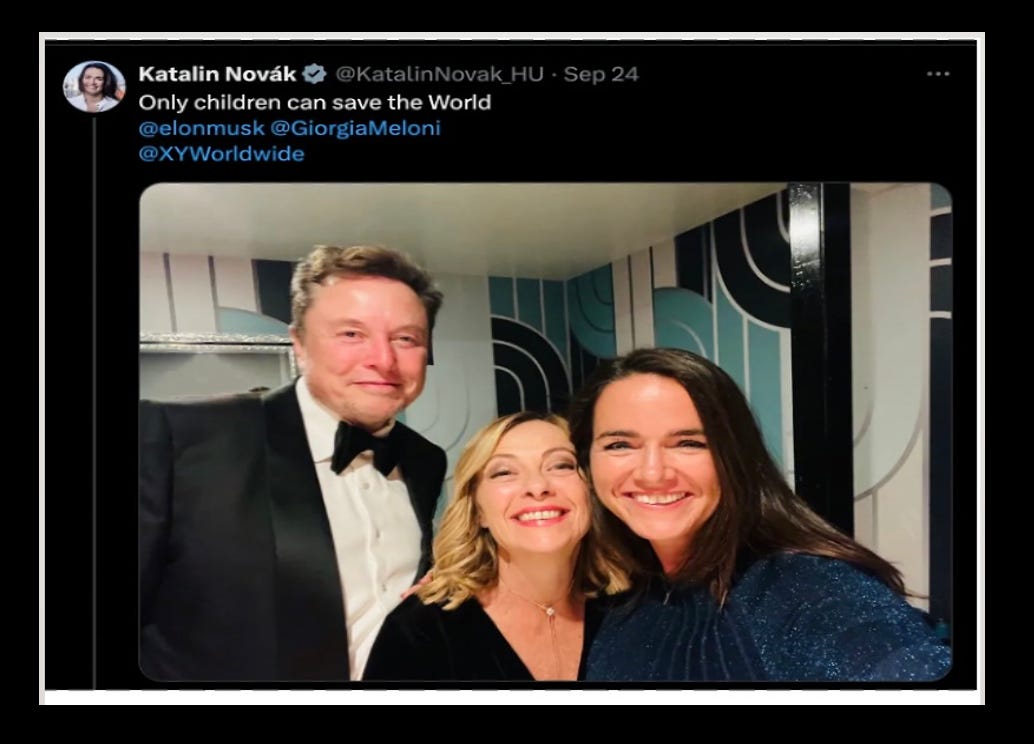
Having the right kinds of babies in the right numbers and keeping out undesirable races and births was a mainstay of the former Viktor Orban government. “Europe has become the continent of the empty crib,” said Hungarian Family Minister (and future President) Katalin Novak in 2019, echoing Mussolini. Novak had to resign from the presidency after she pardoned a pedophile, but she continues to advocate for “saving nations” from “a collapsing global birthrate,” this time through x-y, an organization she founded in 2024.
Musk, Meloni, and Novak at the launch of x-y.
X-y has been supported by Musk, who shares Novak’s preoccupation about Whites being replaced and civilization ending. A Washington Post investigation found that Musk posted 850 times in recent months on the topic of population and Whites being “a rapidly dying minority,” which triples his posting rate on these subjects in the previous 2 years.
An Optics of White Supremacy
We can expect X and other MAGA-friendly social media platforms to increase their messaging about a supposed race emergency, and we’ll likely see the Trump administration become more aggressive in its attempts to create an optics of White hegemony in government spaces.
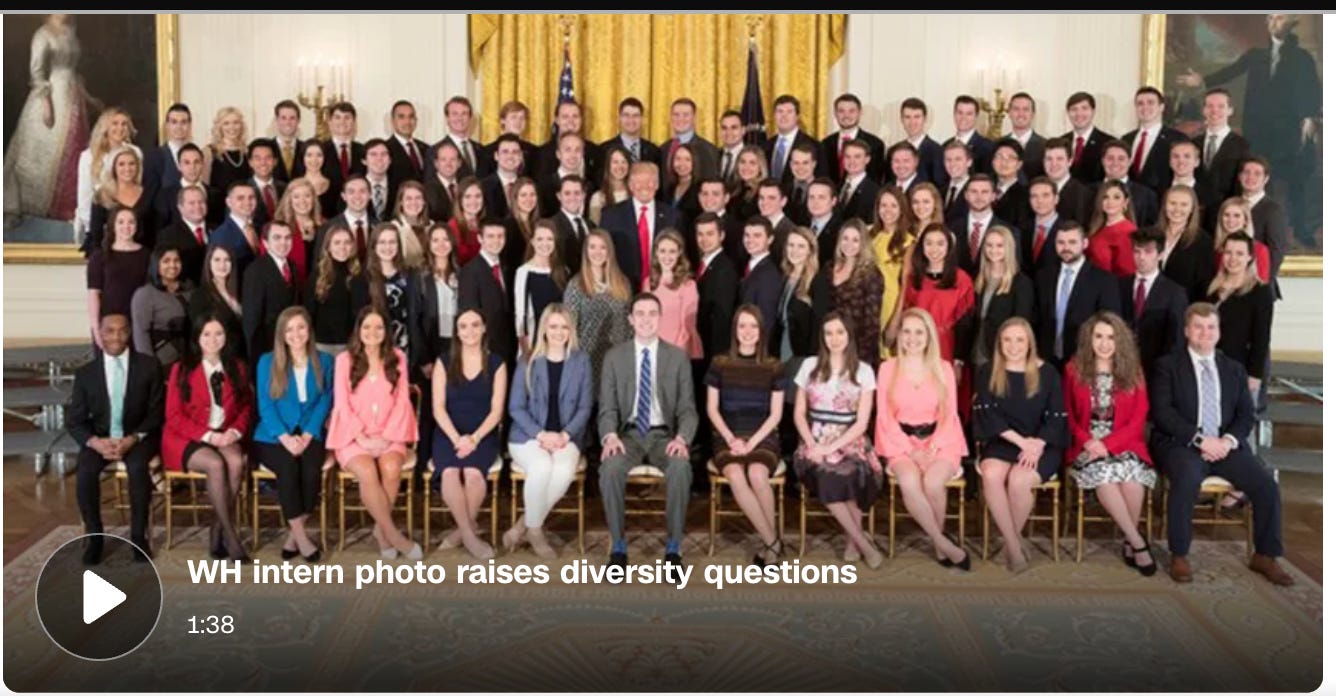
This idea of an all-White governing class was tested in Trump’s first term, as I warned in a 2018 CNN essay on White House interns.
There will also be a ramping up of removals of non-White immigrants from the public sphere, as the massive Amazon-style warehouses ICE is repurposing for people would indicate.
Our Identities Cannot Be Erased
This administration will never succeed in wrecking our multiracial and multifaith society, no matter how much damage it does to our democratic political system. It is who we are. Our identities cannot be taken away from us. And the attempts at mass disenfranchisement will backfire; a new civil rights movement is already starting.
In trying to create a homogeneous society and ban talk of diversity, this government is merely drawing attention to what makes the United States special, and the power of our roots, identities, and traditions. These will serve us well in the coming years as we pursue peaceful resistance to restore our democracy.
Under a single spotlight, a tall figure in a hooded robe strutted onto the stage, their back to the audience. After a suspenseful beat, three words in large bolded lettering lit up the screen behind them: “NATURE IS GAY.”
With a twirl to the crowd, Pattie Gonia unveiled their ginger-red hair and matching mustache, dancing in an earthy blue-and-green crop top and skirt barely covering their chiseled body. The crowd of over a thousand broke into roaring applause.A 2019 video of Bill Nye the Science Guy, pulled from his appearance on John Oliver’s “Last Week Tonight,” punctuated the dramatic reveal. “By the end of the century, if emissions keep rising, the average temperature on Earth could go up another 4 to 8 degrees,” Nye said. “What I’m saying is, the planet’s on fucking fire.”
These are just the first few seconds of environmental activist and drag queen Pattie Gonia’s “Save Her” tour, a one-of-a-kind show that calls for the protection of the dolls — and the planet. The drag queens and kings who created and star on the tour aim to counter the exclusion of their communities by promoting the inclusion of everyone.
For eight years, Pattie Gonia, who goes by Wyn Wiley out of drag, has amassed an impressive following of over 2 million people across their social channels and through their environmental activism on and off the stage. They’ve pushed boundaries, set records and earned accolades, including being featured as one of TIME’s most influential creators in 2025, named as one of National Geographic’s 33 “agents of change” and invited to speak at TED Talk. They have also raised millions of dollars for environmental and social justice non-profits, co-founded the environmental equity organization Outdoorist Oath and a job board to help the queer community and allies find work in the environmental sector.
Last year, Pattie Gonia completed a 100-mile trek from Point Reyes National Seashore to San Francisco’s Golden Gate Bridge in full drag — hair, heels and all — to raise $1 million for non-profit environmental and social justice organizations.
Pattie Gonia performs at the “Save Her! Environmental Drag Show” during Climate Week, Tuesday, Sept. 24, 2024, in Brooklyn, New York. (Alyssa Goodman/AP Photo)
Last month, they did it again, completing a five-day hike at Yosemite.
As show attendee and D.C. drag king Lionel Bitchie said, “She’s not one of the most followed drag queens for no reason.”
But they haven’t done all this work without ruffling a few orange-tinted feathers — and sparking division even among their own fans. During the 2024 presidential campaign season, they were targeted in a Trump campaign ad. Most recently, Pattie Gonia has been in the news for getting sued by the clothing brand Patagonia.
The lawsuit arose after Pattie Gonia filed a trademark application for exclusive rights to use the Pattie Gonia brand on commercial products and events, a move that Patagonia claims would compromise its brand identity. The drag queen responded on social media, posting that suing a climate activist is a “betrayal” of Patagonia’s core mission. Patagonia, for its part, acknowledged their shared goal of caring for the planet and the outdoors, but has held firm on the conditions to end the litigation.
Online, people in Pattie Gonia’s own fanbase have expressed conflict. While some view the lawsuit as harmful to the queer community and stopped using Patagonia’s products as a result, others disagree the clothing brand unfairly sued the drag artist.
Pattie Gonia said the timing of the lawsuit, filed on January 21, hits especially hard because it has come at a time when marginalized communities have been under fire. Several climate, gender and equity-related terms have been erased and banned from federal agencies. The Trump administration has rolled back key protections and visibility for LGBTQ+ communities, including limiting access to gender affirming care, removing mentions of LGBTQ+ history in national parks and banning transgender service members in the military. It also has slashed environmental safeguards for clean air and water, gutted funding for national parks and public lands, and expanded the use of polluting fossil fuel industries.
All the while, Pattie Gonia has embraced their own form of protest in the national “Save Her” tour, focusing it on climate activism and partnering with local drag queens at each of the tour’s stops, in more than 20 cities. At the 9:30 Club in Washington, D.C. — a historically inclusive space for Black performers steps from U Street’s former Black Broadway and a 20-minute drive from the White House — artists and attendees weren’t afraid to get political.
“A lot of time drag can be escapist, and not confronting the reality of dealing with fascism and climate decline, so I like drag that is a call to action and inspiring,” local drag artist and attendee Brooke N. Hymen said. “Pride month can be a celebration and it should be, but it should also be resistance against the forces that want to see us eliminated. And I feel like climate activism goes hand in hand with trans and queer activism.”
“Drag is political, so in a way this is like a rally,” Lionel Bitchie added.
One by one, each act gave their own climate-themed performance, with the majority of them stripping down to their “Fuck Donald Trump” pasties and underwear. Between acts, a parodied Smokey the Bear logo on stage read: “Only you can prevent fascist liars.”
Drag artists Brooke N. Hymen (left) and Lionel Bitchie (right) attended Pattie Gonia’s 9:30 Club show. “Drag is political, so in a way this is like a rally,” Bitchie said. (Jenae Barnes for The 19th)
“It’s a fantastic outlet for joy and rage all in one,” said attendee Kirby Callaway, who works in the environmental space. She said when she saw Pattie Gonia perform at a previous drag show, her “cheeks were hurting because I was smiling so much.”
“It’s so unique, [and] so much of the way that I interact with it in the real world is very doom and gloom,” Callaway said. “I don’t feel like a lot of places get to celebrate and find joy and laugh at these issues.”
Co-headliner and drag queen Sequoia (yes, like the tree) donned an upcycled outfit made of clothing relics from their closeted past and did a performance about the gender fluidity of plants and animals. The screen behind them displayed the words, “Nature is queer, and so am I.”
Going for a wildly humorous take on the issue, drag king Uncle Freak shuffled on stage to perform a striptease as a geriatric man, complete with a fake white mustache and a receding hairline that even NASA couldn’t find on the Hubble telescope. The environmental theme? How climate change worsens the effects of aging.
“Climate change accelerates biological aging in older adults by increasing vulnerability to extreme heat, dehydration and air pollution,” read the screen they pointed at with their cane on the stage.
But the show wasn’t all fun, games and nipple tassels. D.C. drag royalty King Molasses performed to Phil Collins’ ‘80’s hit “In the Air Tonight,” using the tune’s famous crescendo of intensity to parallel the “rising tension” of the climate crisis.
“In the Air felt very correct, in the sense of this urgency that we are now as a people finding ourselves in when it comes to saving the planet. By saving, I mean the impact of technology, of data centers, the climate skewing hotter, the ice caps melting, storms getting more severe,” the inaugural winner of the “King of Drag” reality TV show told The 19th. “There are so many things that are becoming more and more pressing at an alarming rate. And there will be a point where the consequences of our actions will be impossible to ignore.”
King Molasses performs to Phil Collins’ ‘80’s hit “In the Air Tonight.” (Maya Lopez)
Pattie Gonia came on and sang a heartfelt “bird song” about resilience and visibility in times of hardship. “No one can erase us, we’re here and we’re staying, we sing cause we made it, we made it through the night,” they sang as the crowd softened during the piano-accompanied tune and several people melted with tears and hugs.
Co-headliners Sequoia and Vera! joined Pattie at the climax of the show to perform a piece on social justice in front of the backdrop of an American flag. Written on each stripe, a different call to action: “Eat the rich. Protect the dolls. Free Palestine. Black lives still matter. No one is illegal on stolen land.”
Amid rampant erasure, censorship and oppression of the queer community and environmental advocates, the tour is more than a late-night rendezvous; it’s a rallying cry, Molasses said.
“The opportunity that this tour gives all of us artists is that drag allows us to play and show something that feels like entertainment,” Molasses said. “But if we can do it in a particular way, we are able to not only entertain but are able to call our community to action.”


 Certified elementary school librarian Sarah Pepin speaks at a State Board of Education meeting in Austin on June 22, 2026.




:max_bytes(150000):strip_icc():focal(664x255:666x257):format(webp)/Student-Banned-from-Graduation-at-Christian-School-After-Coming-Out-052925-b59993f838e54909ac4459183eb77e84.jpg)