The former transportation secretary described it as “the ugliest thing that has happened to me since my career in service began.”
Pete Buttigieg, former secretary of transportation, during the National Action Network 35th Anniversary Convention on April 10, 2026, in New York City.Adam Gray / Bloomberg via Getty Images
Former Transportation Secretary Pete Buttigieg said his family has been targeted in a “politically motivated hoax” after someone made what police characterized as a false report to Child Protective Services alleging he committed crimes against his children.
In a Substack post Friday, Buttigieg wrote that an anonymous caller reported to CPS that his 4-year-old twins he shares with his husband, Chasten, were “at risk.”
“The caller said that he had spoken to a woman who claimed to have met me at a conference several years ago in Alabama, where she said I told her that I had committed unspeakable violent crimes, and the caller believed my children were still at risk,” Buttigieg wrote.
Buttigieg, a prominent Democrat and potential 2028 presidential contender, likened the incident to “swatting” — when someone calls 911 to falsely report an immediate threat, often at a public figure’s home — “but with Child Protective Services instead of a SWAT team.”
As a result of the allegation, Buttigieg said a CPS worker told him he could not be around his children unsupervised for 24 hours while the allegation was investigated. He and his husband dropped the children off with their grandparents for the night, beginning what Buttigieg described as “among the darkest hours of my life.”
He said the children were also interviewed by CPS the following day.
The CPS worker assigned to the case did not find anything to substantiate the allegation, Buttigieg said, adding that he doesn’t know the identity of the person who made the accusation.
The police officer on the case “made clear that he believed this was politically motivated, and said it would not be referred to a prosecutor,” Buttigieg wrote. “Nothing in the forensic interview with the children, which was conducted by trained personnel, had led to concerns.”
In a statement provided to MS NOW on Friday afternoon, the Michigan State Police confirmed receiving an “anonymous report” in the case, adding that police and CPS workers determined it was false.
“False reports are dangerous and divert law enforcement officers and Child Protective Services workers from responding to legitimate emergencies and protecting vulnerable children and families,” the state police said.
In his Substack, Buttigieg characterized the incident as part of broader rise in political violence that leaders on both sides of the aisle face. He called it the worst thing he experienced in politics to date.
“Many times over the years, I have been denounced, yelled at, protested, threatened, and heckled,” Buttigieg wrote. “I’ve been through political attacks in office, death threats in public life, and rocket attacks in war. But this is the ugliest thing that has happened to me since my career in service began.”
“For twenty-four deeply distressing hours,” he continued, “we had no idea what I was accused of or what was about to happen. We could not understand someone abusing the system like this in order to hurt me and my family with an absurd and easily refuted allegation of a horrific crime.”
He also suggested homophobia may have motivated the incident, noting that it occurred during Pride month, which conservatives have long attacked , soon after he posted a photo of his family on Instagram to celebrate Father’s Day. Buttigieg has been subject to homophobic remarks from high-profile officials during his time in the public eye, including from former Vice President Mike Pence, who mocked his decision to take parental leave while serving as transportation secretary, and former co-chair of the Michigan Republican Party, Meshawn Maddock, who called him “a weak little girl” in 2022.
As Buttigieg noted on Substack, making a false report of felony child abuse is a crime under Michigan state law, punishable by a fine of up to four years in prison or a fine of up to $2,000, or both.
Buttigieg was slated to campaign in Tucson this Sunday for JoAnna Mendoza, a Democratic candidate for the state’s 6th Congressional District, but he has canceled the trip, Tucson.com reported.
Spokespeople for the Justice Department and the local prosecutor’s office representing the county where Buttigieg lives did not immediately respond to questions from MS NOW on Friday afternoon. The Michigan Attorney General’s Office declined to comment.
This is a very important news article. I hope everyone will read it. This is scary how a small mostly religious minority wants to erase an entire group of people from existence just for a made up moral certainty that they can’t accept that people different from them exist. They simply won’t accept that other people can feel differently than they do and they insist that they have the right to deny all rights to LGBTQ+ kids / people. I remember being a gay teenager hearing these same arguments about people like me in J high school. How gay kids shouldn’t be allowed in locker rooms as we may get excited by the other kids bodies and lose control and have sex with them right there in the locker room. It was a huge fight back then about gay teachers as the moral right felt they shouldn’t be teaching kids who might see being gay as normal. I remember the silly stupid republicans like Sam Nunn claiming no military person wanted to serve with or god forbid shower in the same room as a gay man. At the time I was gay and in the military and having more sex and great times even with straight guys. But the parent pushing the claim that their daughter had to change clothes in front of a trans kid went on right wing TV programs to promote the hate. The school denies that setup existed. Plus a lot of this is funded and pushed by religious hate groups with a lot of donated money behind them in an attempt to keep the country from progressing as their god is stuck with writings from 2,500 years ago and the majority of hate preachers seem to idolize the 1950s. I feel so sorry for the trans kids today. I remember what it was like for me as a gay kid in the public school system. I was not even out, just different but still I was attacked as a queer faggot. Why some people hate so deeply and want to act on it and even pass it on to others hopeing they will agree with them I can not understand. What happened to live and let live? I believe that if what someone else is doing doesn’t involve me, doesn’t harm me, then let that person be them. Qoutes from the article below. Oh and when did executive orders become laws? Did congress get dissolved, or are we now ruled by the whim or the racist bigot hater? Hugs
According to Liz Mikitarian, a retired kindergarten teacher and the founder of STOP Moms for Liberty, the coordinated efforts to undermine the rights of trans students in Illinois mimic a strategy playing out nationwide.
“You realize it’s so much bigger when you see all the communities around the country that have dealt with this exact same pattern,” Castro told Uncloseted Media and the Chicago Sun-Times.
Pat Green, who is still grappling with the bullying his son experienced, shares Lascano’s concerns. “From the time he was born, he had this light,” says Green. “When he was at his old school, it was just gone. … I’m really scared about the way things are right now. I remember the fear of wondering if I was going to lose my son. [These groups] are not protecting children. They are causing so much harm.”
Parents and advocates say coordinated complaints over transgender students are driving legal fees, security costs and emotional strain across Illinois school districts.
$360,000 and Counting: School Districts Are Spending Big Bucks to Fight Anti-Trans Lawsuits
Parents and advocates say coordinated complaints over transgender students are driving legal fees, security costs and emotional strain across Illinois school districts.
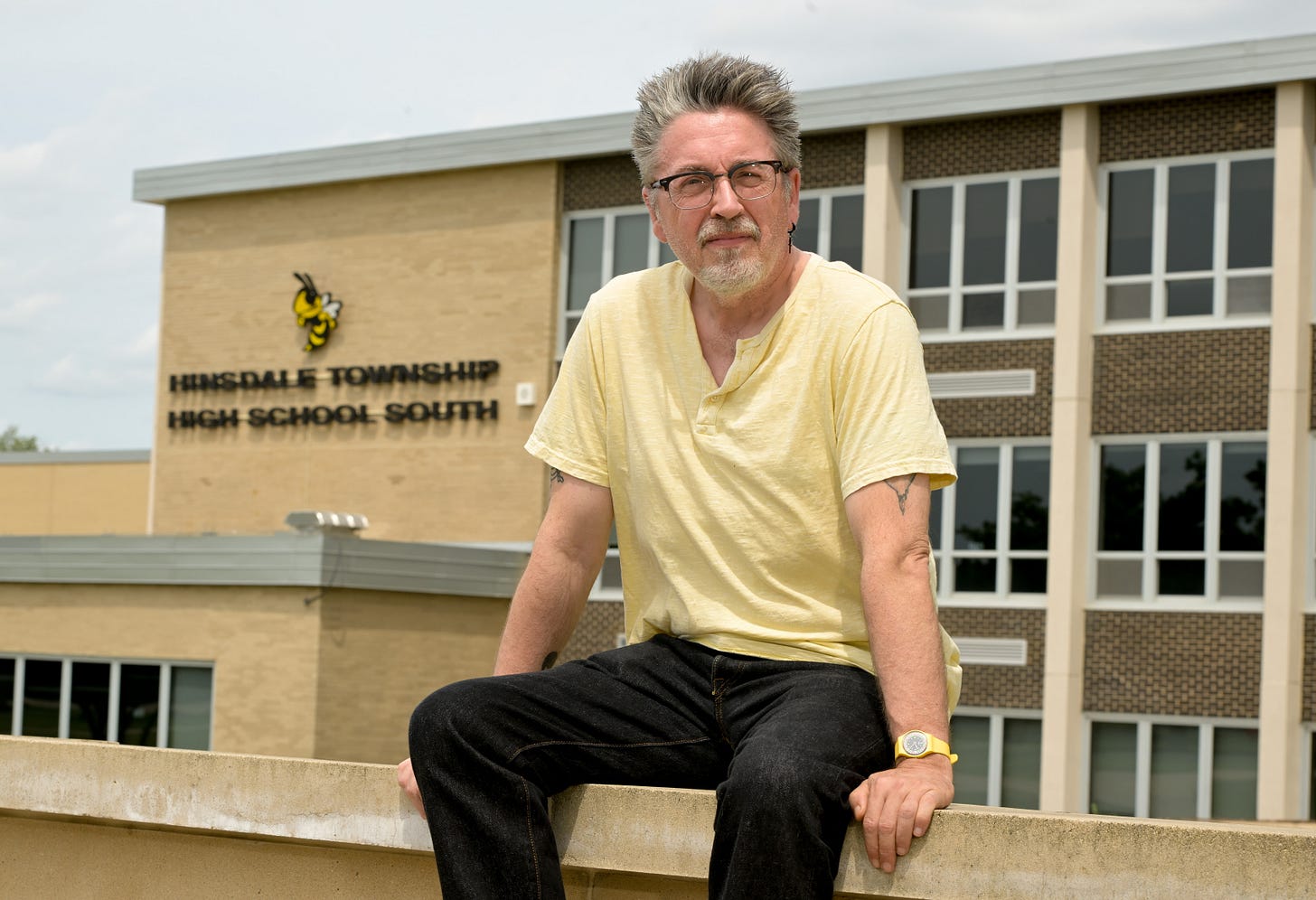
Pat Green sits in front of Hinsdale Township High School South, the school his son transferred to after getting bullied for being queer. Photo by Mark Black for the Chicago Sun-Times.
This story was produced in partnership with the Chicago Sun-Times, a nonprofit newspaper.
Editor’s note: This article includes mention of suicide and self-harm. If you are having thoughts of suicide or are concerned that someone you know may be, resources are available here.
As Pat Green took the stage at the Valley View 365U school board meeting on April 14, 2025, he recalled another night years earlier, when he picked up his 13-year-old son from the hospital. His son, who is trans and had recently come out as queer, had been shoved into a locker so hard that he needed four staples in his forehead.
“I hear the families of LGBTQI+ youth like mine,” Green tells the board. “And I just wanted to say thank you, and for God’s sake, don’t go backwards. … I almost lost the most precious gift God ever gave me.”
In the room with Green were also members of Awake Illinois, a Southern Poverty Law Center-designated hate and anti-government extremist group known for fighting against the rights of trans kids. They had filed a federal civil rights complaint against the district for allegedly violating Title IX by allowing transgender students access to bathrooms and locker rooms consistent with their genders.
When Green’s son, now 25, came out over a decade ago in eighth grade, he faced slurs daily and was told to use the faculty bathroom if he didn’t want to use the girls’ restroom.
“By the end of freshman year, the light my son used to have had turned into dread. Soon after came the cutting, the suicidal ideation, the grades slipping from honor student to barely passing,” Green told Uncloseted Media and the Chicago Sun-Times.
Pat Green and his son. Photo by Mark Black for the Chicago Sun-Times.
Despite Green’s emotional appeal to the school board, Awake Illinois founder Shannon Adcock told the board that “failure to address the Title IX violations will invite severe repercussions, including the termination of federal funding for noncompliant institutions, which would mean $20 million in this district’s case.”
Voices like Adcock’s prompted Green to start attending school board meetings. He noticed an increasing number of complaints and lawsuits from conservative parent groups targeting transgender-inclusive school policies in Illinois that were resulting in legal and financial strain for school districts.
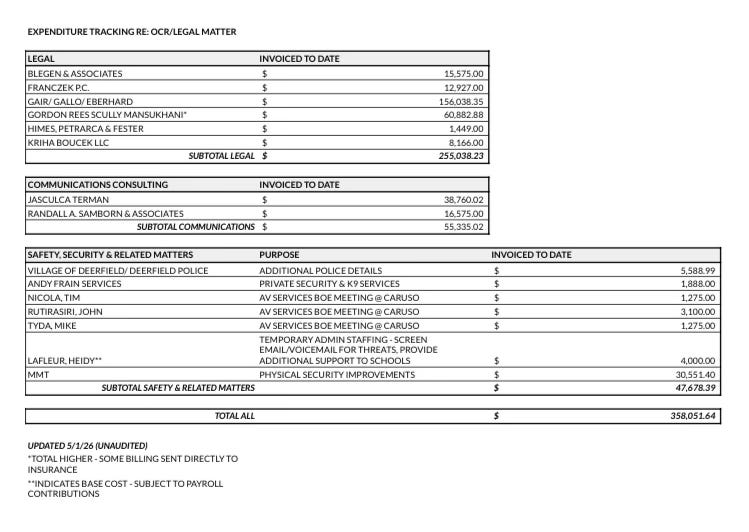
Documents obtained by Uncloseted Media and the Chicago Sun-Times under the Freedom of Information Act (FOIA) found that Deerfield School District 109 has paid nearly $360,000—the equivalent of four average teachers’ salaries—to fend off an ongoing lawsuit and pay for security costs spawned from complaints about trans-affirming bathroom and locker room policies.
A breakdown of costs Deerfield District 109 faces to fend off an ongoing lawsuit and pay for security costs spawned from complaints about trans-affirming bathroom and locker room policies, which was obtained via FOIA.
That amount is the equivalent of 37% of all federal funds the district received last year. It included more than $255,000 for legal defense, over $30,000 in school security upgrades and $4,000 for extra staff to screen threats.
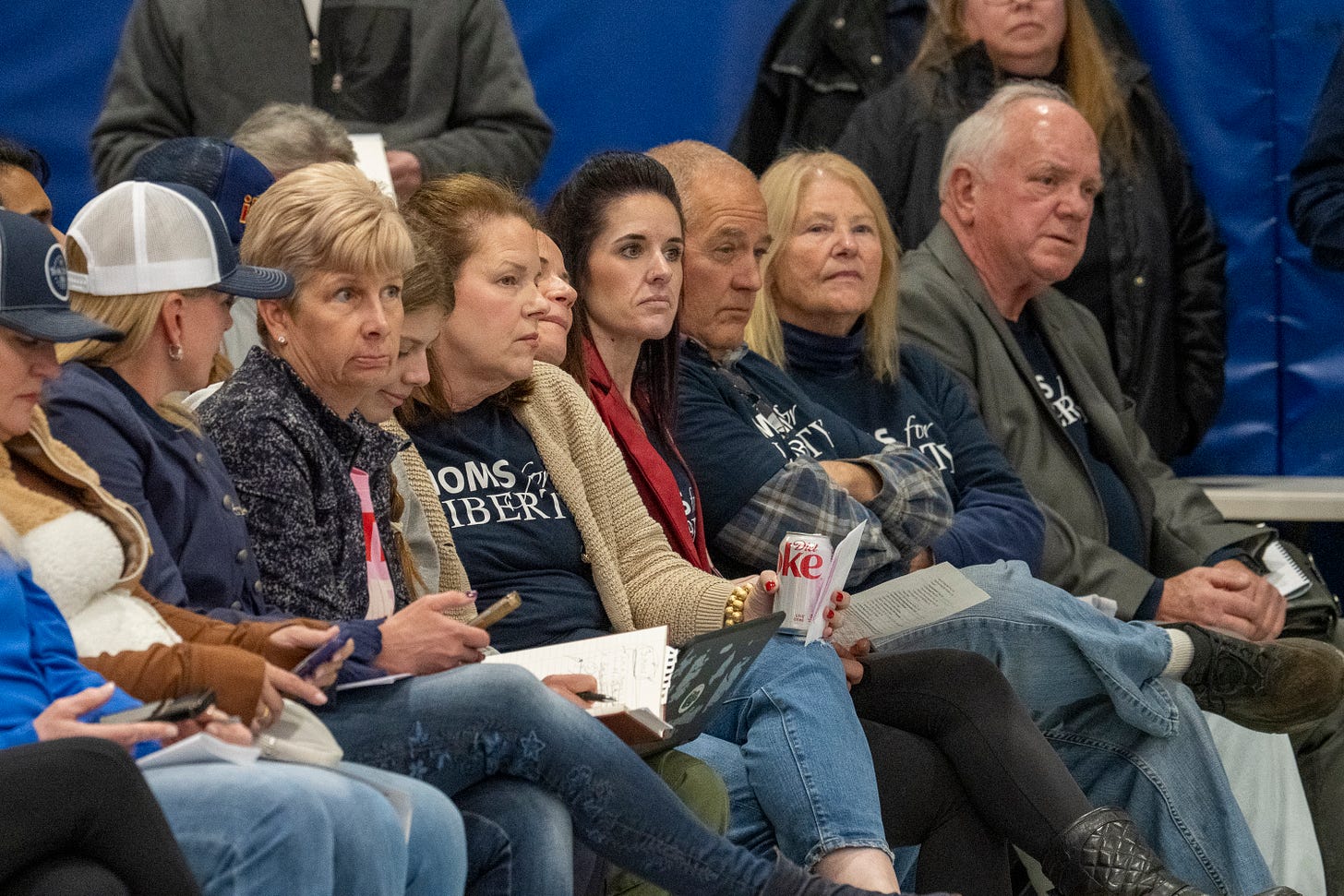
Moms for Liberty supporters attend a Deerfield District 109 board meeting at Caruso Middle School on April 10, 2025. Photo by Tyler Pasciak LaRiviere for the Chicago Sun-Times.
“When schools are forced to fight lawsuits over issues that aren’t a problem for the vast majority of people, it’s a waste of taxpayer dollars. Straight up monetarily, why are we spending so much time prosecuting and persecuting a minuscule part of the population? Why do you want your tax dollars doing that?” Allaina Humphreys, founder of Bolingbrook Pride, told Uncloseted Media and the Chicago Sun-Times.
While these suits are playing out across the state, school officials say they are following policies that align with the Illinois Human Rights Act, which state regulators and courts say require schools to allow transgender students to use facilities consistent with their gender identity. That interpretation was reinforced by the Illinois Human Rights Commission ruling in 2019 and subsequent state guidance issued in 2021.
But none of this is stopping parents like Adcock. “Federal law reigns supreme,” she said at a Naperville district meeting three months after filing the first of her complaints. “Only recently have trans cultists tried to contest [Title IX].” Adcock did not respond to requests for comment.
“I think the muddying of it comes from all of [Trump’s] executive orders,” says Humphreys. “This administration has used them … to dictate policy that it has no right to dictate. But that doesn’t mean people aren’t using it as a basis for legal action.”
Why Deerfield Had to Pay Nearly $360,000
Last spring, during a series of fiery school board meetings, Deerfield parent Nicole Georgas said her cisgender daughter refused to change for gym class after seeing a trans girl in the locker room. Georgas says administrators made her daughter change in front of them and the other student.
The school district denies the allegations and says they are committed to obeying state law.
Despite this, Georgas—who declined to comment for this story—filed a federal civil rights complaint in March 2025 with the Department of Justice. Conservative legal groups Defense of Freedom Institute for Policy Studies and Liberty Justice Center then cited Georgas’ story in complaints to the Department of Education.
America First Legal—a conservative legal group cofounded by Trump adviser Stephen Miller that has waged a litany of legal attacks against the LGBTQ community—then got in the mix. They urged the U.S. Department of Justice to investigate Deerfield Schools District employees, asking federal prosecutors to look at whether school administrators coordinated enforcement of district policy in a way that violated students’ rights. Though no charges are identified in the referral itself, the letter invokes federal civil rights criminal statutes, which can carry penalties ranging from fines and probation to multi-year prison sentences.
In the Deerfield referral and accompanying press materials, America First Legal repeatedly referred to the transgender student as a “male” or a “boy ‘identifying’ as a girl,” and described school policies recognizing students’ gender identities as “radical gender ideology” and “transgender madness.”
Following this, Georgas sued the district seeking an injunction, punitive damages and money for emotional distress. The U.S. Department of Education’s Office for Civil Rights repeated Georgas’ claim that students were “allegedly forced” to change in front of the transgender student, and cited previous Trump administration executive orders regarding gender.
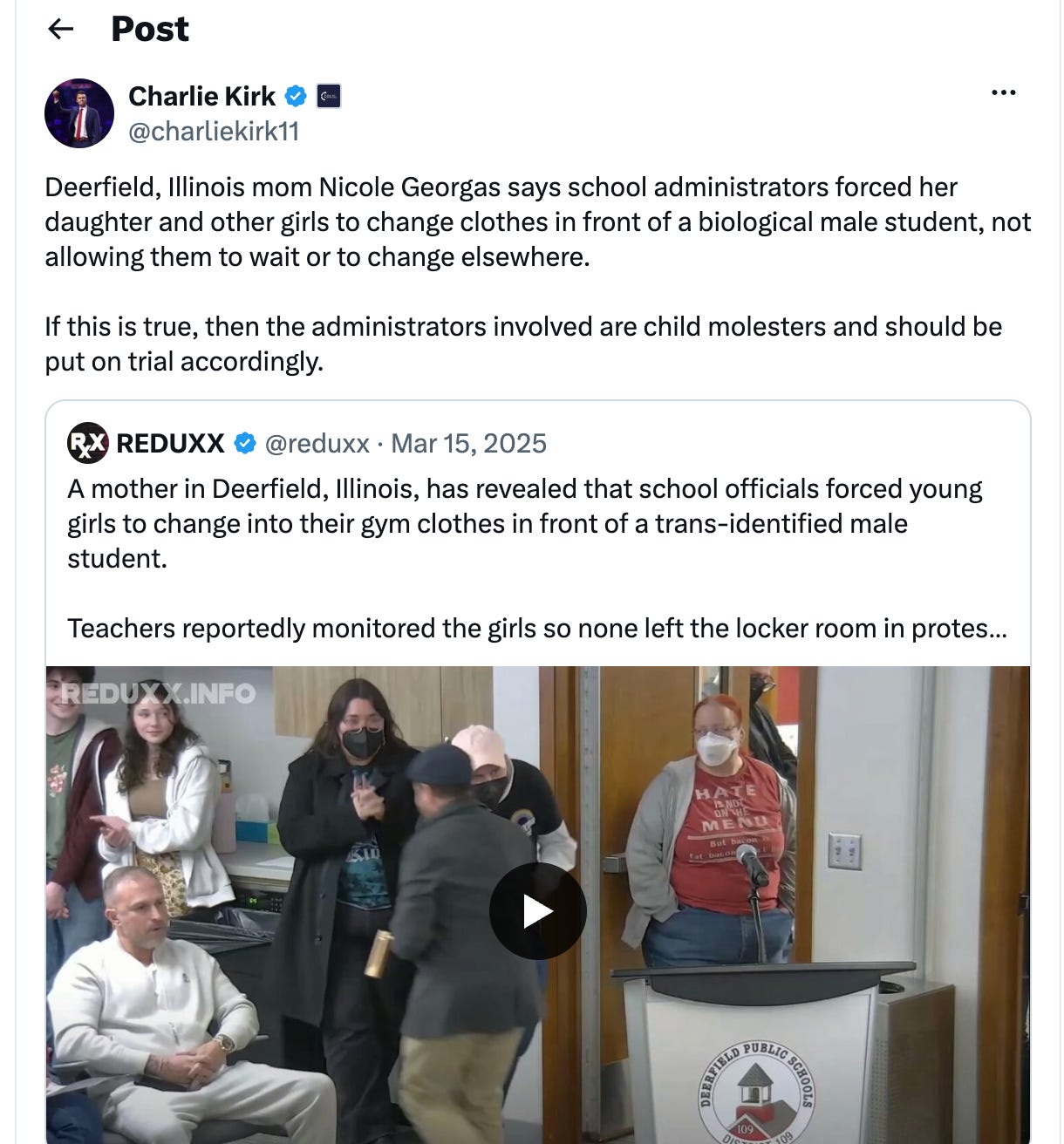
Georgas’ message gained even more attention when she appeared on Laura Ingraham’s and the late Charlie Kirk’s shows, where she used transphobic dog whistles to describe the trans student.
“They have continued to have the biological male student present in the locker room with the girls, and they are absolutely in violation with President Trump’s executive order,” Georgas said on Kirk’s show.
Shortly after her appearance on Fox News, a reporter asked White House Press Secretary Karoline Leavitt about Georgas’ case. “We are not going to tolerate such behavior by men pretending to be women. The president will continue to strongly stand for the rights of women and girls, not just in sports and on athletic fields, but also private spaces like locker rooms and bathrooms,” Leavitt told the reporter.
Georgas is moving to make her ongoing lawsuit a class action before her daughter graduates from middle school, which would void the case entirely.
Parallel Efforts Across the Country
According to Liz Mikitarian, a retired kindergarten teacher and the founder of STOP Moms for Liberty, the coordinated efforts to undermine the rights of trans students in Illinois mimic a strategy playing out nationwide.
“They feed these outlets that produce more hate,” Mikitarian told Uncloseted Media and the Chicago Sun-Times. “It’s a model of misinforming people and making them afraid of something, and that works, especially when it’s people’s children. … [But] it’s a grift and people are catching on.”
Financial Burdens
All of these complaints are costing significant time and money and frustrating many parents who see them as a waste of school resources.
Deerfield parent Elizabeth Castro attended the meetings in her child’s district last year and says it was shocking to look around the country and see the same “manufactured controversy.”
“You realize it’s so much bigger when you see all the communities around the country that have dealt with this exact same pattern,” Castro told Uncloseted Media and the Chicago Sun-Times.
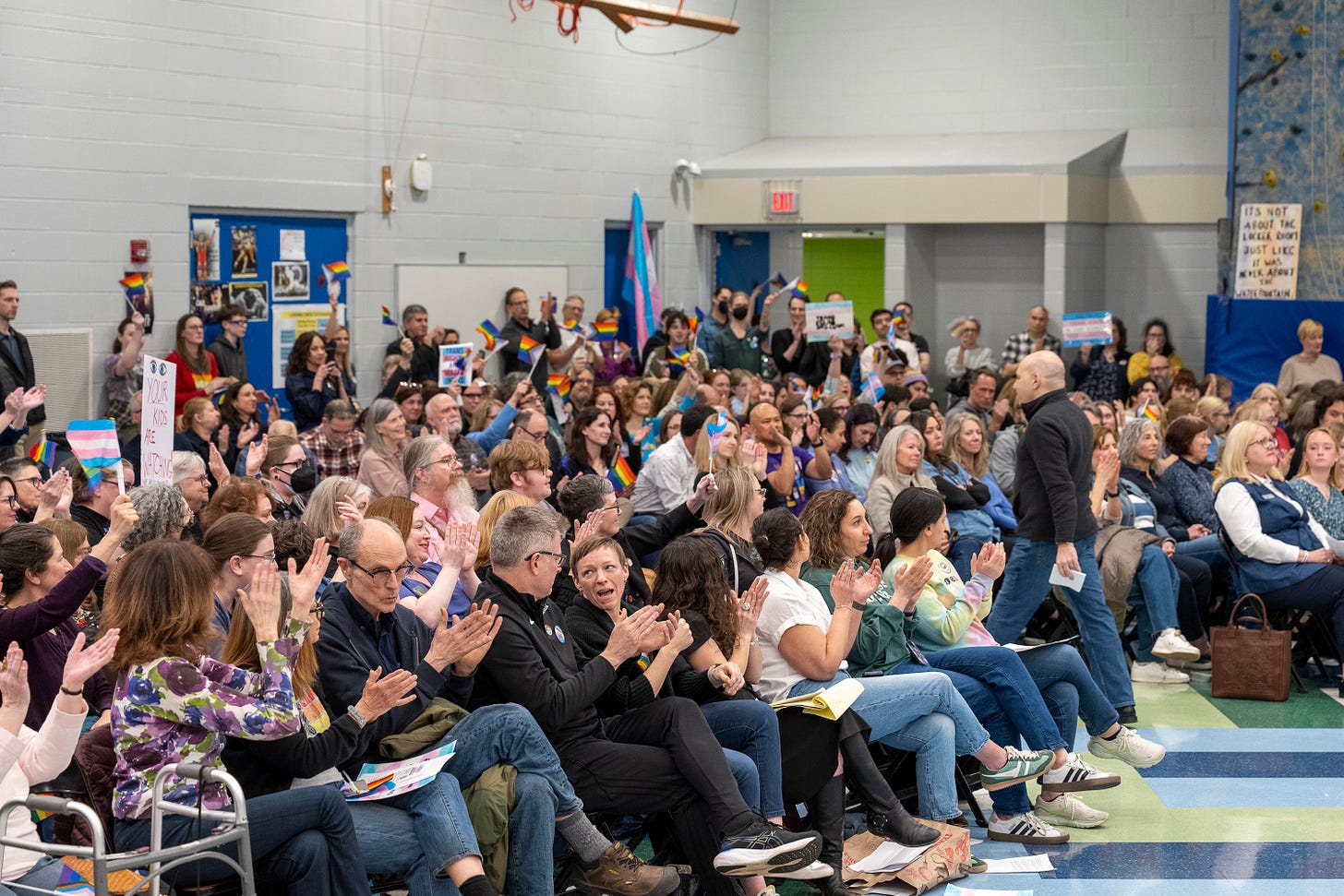
Hundreds of community members and trans-rights supporters applaud and cheer during a Deerfield District 109 board meeting at Caruso Middle School in Deerfield, IL, on April 10, 2025. Photo by Tyler Pasciak LaRiviere for the Chicago Sun-Times.
The Deerfield school district still hasn’t heard from the federal government, school officials say. And the Department of Education didn’t respond to a request for updates on the investigations.
“Schools should not be forced to divert hundreds of thousands of dollars away from classrooms, student services, mental health supports, accessibility accommodations and educational programming simply to defend their efforts to support vulnerable students,” Asher McMaher, the executive director of Trans Up Front IL, told Uncloseted Media and the Chicago Sun-Times. “These are vital public resources that should be invested in children, not spent responding to coordinated attacks on transgender youth and the institutions working to protect them.”
Policy Matters
Beyond the lost money and the chaos, the lawsuits and complaints have affected the trans kids who are at the center of these debates.
“The human cost is even greater than the financial one,” says McMaher. “These actions create fear, uncertainty and instability for transgender students and their families, many of whom are already navigating significant challenges. … The greatest tragedy is that these costs are entirely avoidable, yet they continue to grow as attacks on transgender youth are increasingly normalized and encouraged at the national level.”
According to Corey Lascano, LGBTQ coordinator for the Chicago Teachers Union, policies inform school culture, which is concerning especially when school is “the only place where [some trans youth] can feel safe to be themselves.”
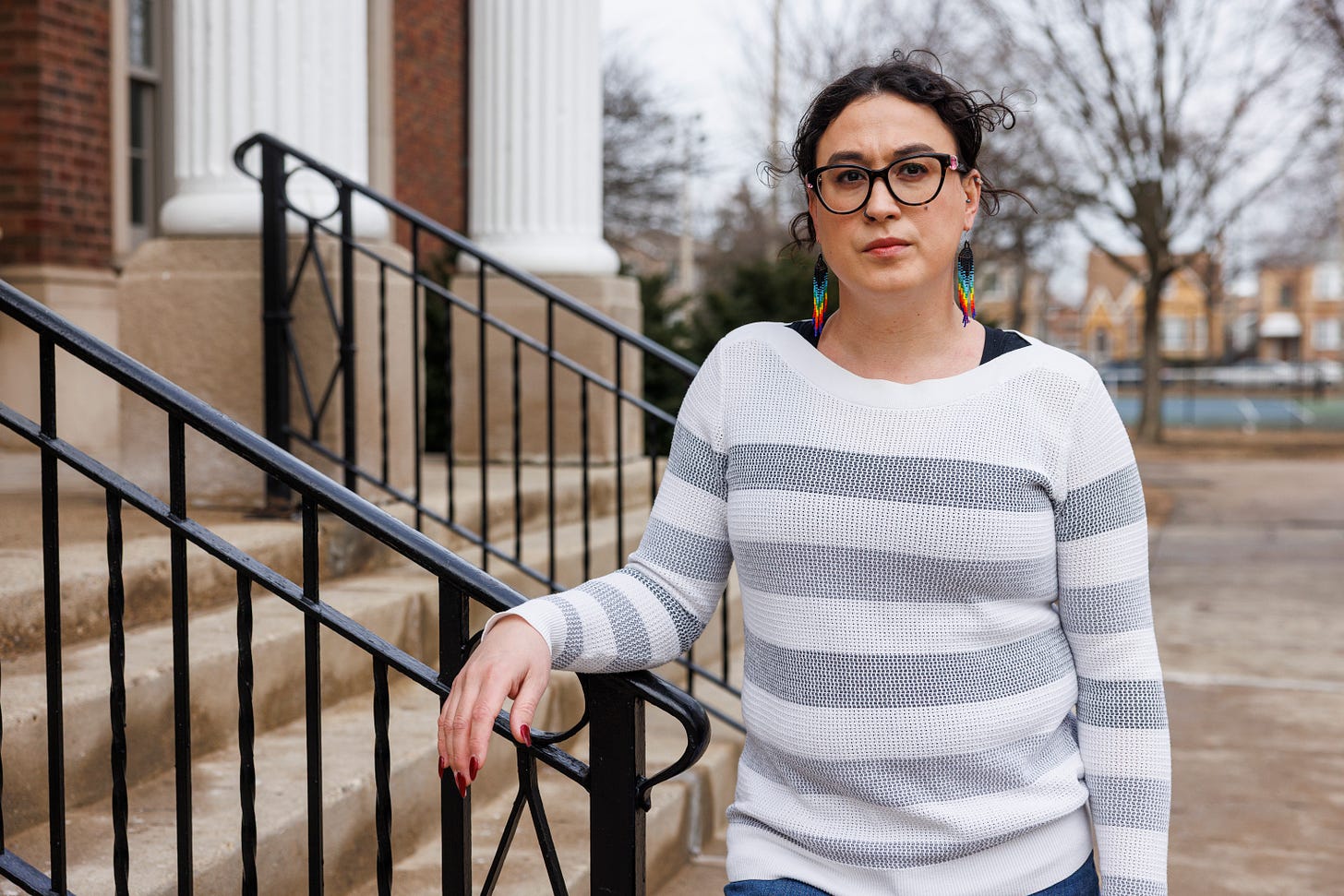
Corey Lascano, a board member with Trans Up Front IL. Photo by Anthony Vazquez for the Chicago Sun-Times.
Pat Green, who is still grappling with the bullying his son experienced, shares Lascano’s concerns. “From the time he was born, he had this light,” says Green. “When he was at his old school, it was just gone. … I’m really scared about the way things are right now. I remember the fear of wondering if I was going to lose my son. [These groups] are not protecting children. They are causing so much harm.”
If objective, nonpartisan, rigorous, LGBTQ-focused journalism is important to you, please consider making a tax-deductible donation in the U.S. through our 501(c)(3) fiscal sponsor, Resource Impact, by clicking this button:
The short version is the company came out supporting the LGBTQ+ workers and community. The two fired workers went on the company intranet and made a point to question it and declare how they felt about the LGBTQ+ people. Lets just say they were not fans. So the company investigated and decided they would create a hostile work place. The first court agreed, but the appeals court said the employee lawsuit could go forward because the airline did not make an effort to accommodate the fired workers religious rights. So the fact that you are a Christian means you can treat LGBTQ+ co-workers like shit and disregard their very existence based on a mistaken understanding of what their god wants. Christian belief tRump’s an LGBTQ+ person’s right to exist equally with out discrimination. Hugs
An Alaska Airlines commercial airliner takes-off from Los Angeles International Airport in Los Angeles, California, U.S., November 6, 2025. REUTERS/Mike Blake/File Photo Purchase Licensing Rights
Flight attendants fired over intranet posts
Lower court said comments were not overtly religious, and dismissed case
But there was enough to let a jury decide, appeals court panel says
June 26 (Reuters) – A U.S. appeals court has revived a lawsuit claiming Alaska Airlines (ALKAIR.UL) engaged in religious discrimination by firing two flight attendants who criticized the company’s support for expanding legal protections for LGBTQ people.
A three-judge panel of the San Francisco-based 9th U.S. Circuit Court of Appeals said, opens new tab on Wednesday that there was enough proof that the airline was motivated by the workers’ Christian beliefs when it fired them to let a jury decide whether it broke the law.
The flight attendants in 2021 made separate posts on Alaska Airlines’ employee intranet critical of the company’s backing of the Equality Act, a bill in Congress to prohibit discrimination against gay and transgender people in employment, housing, public accommodations and other areas.
The posts were not overtly religious, leading a judge to dismiss the case last year. But Circuit Judge Daniel Bress, who was appointed by Republican President Donald Trump, as were the other judges on the panel, wrote for the 9th Circuit that the workers’ comments and the airline’s response to the posts were enough to show it may have been motivated by their religious beliefs.
“It did not matter whether [one of the plaintiffs] could support her post with chapter and verse from an authoritative religious text,” Bress wrote.
The plaintiffs also claim their union, the Association of Flight Attendants, discriminated against them and breached its legal duty to represent them by not fighting their termination.
The 9th Circuit on Wednesday revived those claims, and joined two other appeals courts in ruling that federal labor law does not preempt such claims against unions brought under state laws.
Alaska Airlines and the union did not immediately respond to requests for comment on Thursday.
The plaintiffs are represented by the First Liberty Institute, which says it is the largest legal organization in the country dedicated exclusively to defending religious liberty. Stephanie Taub, the group’s senior counsel, said the 9th Circuit ruling reinforces legal protections from religious discrimination.
“You cannot be fired because your employer does not like your religious beliefs,” she said.
According to court filings, after Alaska Airlines posted online about its support for the Equality Act, plaintiff Lacey Smith wrote in response: “As a company, do you think it’s possible to regulate morality?”
Another flight attendant, Marli Brown, made a separate, longer post claiming the Equality Act would infringe on women’s rights, enable sexual predators, and was “endangering the Church [and] encouraging suppression of religious freedom.”
Alaska Airlines deleted the posts and issued a statement in response, saying the company supported protecting LGBTQ people against discrimination and that “we also expect our employees to live by these same values.” Smith and Brown were then fired after an investigation for violating the airline’s anti-discrimination and harassment policy, court filings showed.
The women sued in 2022, accusing Alaska Airlines and the union of discriminating against them because of their Christian beliefs.
U.S. District Judge Barbara Rothstein in Seattle had dismissed the case, saying the firings were not discriminatory because the flight attendants’ posts were not religious in nature. She also said the federal Railway Labor Act, which regulates the rail and airline industries, preempted the plaintiffs’ claims that the union violated Washington and Oregon law.
The 9th Circuit reversed Rothstein’s order. Brown’s post specifically mentioned “the Church,” Bress wrote for the court, and the airline investigated her and Smith together. Both women also cited their religious beliefs in the course of the airline’s investigation, he said.
Bress was joined by Circuit Judge Kenneth Lee in his opinion. Circuit Judge Morgan Christen mostly agreed, but in a partial dissent said she would not have revived Smith’s discrimination claim.
“Alaska would have had to be clairvoyant to know that Smith considered the statement she posted on the company’s internal website to be an expression of her faith,” wrote Christen.
The case is Brown v. Alaska Airlines, 9th U.S. Circuit Court of Appeals, No. 24-3789.
For the plaintiffs: Stephanie Taub and others from First Liberty Institute; Andrew Gould of Holtzman Vogel Baran Torchinsky & Josefiak
For Alaska Airlines: Lauren Watts and others from Seyfarth Shaw
For the union: Benjamin Berger and others from Barnard Iglitzin & Lavitt
A federal judge said a lawsuit challenging the Department of Justice’s creation of a $1.8 billion “anti-weaponization” fund will proceed.
Judge Leonie Brinkema cited the DOJ’s refusal to confirm in writing to her that the fund is dead.
Acting Attorney General Todd Blanche testified to a House committee on June 2 that the fund is not going forward. DOJ lawyers have pointed to that statement in arguing to Brinkema and another federal judge that it is sufficient to dismiss suits challenging the fund.
Acting U.S. Attorney General Todd Blanche speaks at a press conference at the Department of Justice on May 4, 2026 in Washington, DC.
Kevin Dietsch | Getty Images
A federal judge on Thursday said a lawsuit challenging the Department of Justice’s creation of a $1.8 billion “anti-weaponization” fund will proceed, citing the DOJ’s refusal to confirm in writing to her that the fund is dead, as the department has verbally said it is.
Brinkema said that acting Attorney General Todd Blanche’s refusal to rescind his May 18 memo that set up the structure of the fund, as well as his and President Donald Trump’s continued interest in compensating purported victims of DOJ overreach, “all support this conclusion” that the lawsuit is not moot.
The judge ordered the DOJ to file its answer to the lawsuit by July 17.
Blanche created the fund as part of a settlement of Trump’s $10 billion lawsuit against the Internal Revenue Service over a leak of his tax records. The fund, whose total possible disbursements would be $1.776 billion — in a nod to the year in which the Declaration of Independence was signed — was designed to provide redress to people who allegedly “suffered weaponization and lawfare.”
Critics called it a “slush fund” that would pay allies of Trump, including potentially hundreds of people convicted of crimes related to their involvement in the Jan. 6, 2021, attack on the U.S. Capitol.
Blanche testified to a House committee on June 2 that the fund is “not going forward, period,” after sharp criticism of it by Republican and Democratic lawmakers.
DOJ lawyers have pointed to that statement in arguing to Brinkema and another federal judge that it is sufficient to dismiss suits challenging the fund.
In a court filing this week, the DOJ said that written declarations that the fund is dead “are unnecessary,” and that Brinkema’s request that Blanche and Treasury Secretary Scott Bessent put in writing Blanche’s promise “implicates serious separation of powers concerns.”
But Brinkema, in her order Thursday, wrote, “That the defendants have refused to accord a genuine degree of trustworthiness to their representations about the Fund not going forward is particularly concerning because of the President’s consistent support for the Fund and Acting Attorney General Blanche’s acknowledgement that the Fund remains ‘important.’ ”
“Although Acting Attorney General Blanche reiterated several times during his testimony that the Fund was not going forward, when asked whether he would ‘issue a new memo in writing rescinding that May 18 memo,’ he replied, ‘I’m not committing to putting anything in writing. And I said it over and over again,’ ” Brinkema noted.
The plaintiffs in the lawsuit include Andrew Floyd, a former federal prosecutor who has said he was fired for prosecuting cases against Trump supporters who stormed the Capitol. The other plaintiffs are Jonathan Caravello, a professor at California State University Channel Islands, and the city of New Haven, Conn.
Has the state of Texas become a christian theocracy now? It seems every year they change the school curriculum to make it more white and more Christian. Itis clear that the Christian billionaire preacher who basically bought the state legislature and calls the shots has long wanted the state to be a White Christian Male paradise. These new changes basically make the state schools the same as the Jewish Orthodox schools in NY, where the students learn only the Torah but can hardly count to 20 and speak / write very little English. They are getting tax money to educate kids but they don’t. The kids graduate and can’t get jobs and are on state assistance. The new Texas standards emphasize white contributions and minimize any contributions from other races. They push religious stories over facts. This is just the forced religious indoctrination of children regardless of the religious beliefs of the parents. Notice there is no opt out on these religious texts, books, stories but parents much be told and can opt their child out of any lesson that mentions the LGBTQ+ or reading material containing information about it. If you are worried about the white washing race removing Christifying of public schools and the rewriting of history to change what really happened to make white people look better please give this article a read. below are a few quotes from the article. Hugs
The statewide reading list would require, among other literary works, that schools teach Bible material to children as young as 6 years old up to young adults preparing to receive their diplomas. That includes Christian stories about Adam and Eve, the eight Beatitudes and the Parable of the Prodigal Son.
On the contrary, Republicans eliminated a standard specifying that students should consider “the perspectives of groups whose voices are less represented in traditional historical accounts.” They added another requirement that introduces the biblical story of Moses alongside the Underground Railroad and Harriet Tubman — who was nicknamed “Moses” because, similar to the biblical prophet, she helped people escape slavery.
“Let me be very clear: Islam is not a religion,” state Sen. Bob Hall, R-Edgewood, testified before the education board Monday. “It is a totalitarian theocracy, not unlike totalitarian systems of communism, Nazism and globalism.”
Meanwhile, students, educators and progressive activists spoke out in opposition to the lack of racial, ethnic and gender inclusion in the debated books and lessons, as well as the state’s Christian focus over other religions.
The State Board of Education will hold a final vote Friday on incorporating more Christian stories into classrooms and deemphasizing race and cultural diversity in history lessons.
Certified elementary school librarian Sarah Pepin speaks at a State Board of Education meeting in Austin on June 22, 2026. Manoo Sirivelu/The Texas Tribune
Texas elementary and middle school students will likely see redesigned social studies and reading lessons that minimize racial, geographic and cultural diversity while emphasizing the Bible — but changes for high schoolers have suddenly hit a pause.
The Republican-led State Board of Education decided Thursday evening to allow final votes on a rewrite of Texas’ K-8 social studies lessons and a mandatory reading list for all public schools that includes Christian stories. Those votes are expected Friday.
However, the board delayed proposed changes to high school U.S. history, world history, geography and government.
For months, educators, Democrats and public education advocates criticized Texas’ social studies revamp as rushed. Conservative advocates and Republican board members insisted on pushing the process forward. But board chair Aaron Kinsey expressed doubts Thursday about having enough time to cut down the number of lessons packed into each course.
“This is a conundrum we’ve created of our own doing,” Democratic member Marisa B. Pérez-Díaz said. “And I’m very frustrated by it.”
Kinsey rejected an assertion from Pérez-Díaz that he rushed the process and said he was willing to continue working. But he also said board members made mistakes when they pushed through changes during late hours. For example, they eliminated a requirement that students learn about the American Revolution in high school U.S. history before reinserting it Thursday.
The elected board is on track to update what public school students must learn in reading and social studies. This week’s meetings ran as late as 2 a.m., as board members meticulously parsed through changes to lessons in each grade.
Along with Bible stories in reading, the social studies proposal features a dramatic transformation in how Texas schools have long administered lessons on history, geography, economics and government. It eliminates the current sixth-grade world cultures course, deemphasizes world history outside of European tradition and dedicates more focus to Texas and the United States.
Democrats suggested changes they hoped would make lessons more accurate and inclusive of historically underserved groups — most notably people of color — even if they ultimately did not favor the overall plan.
Republicans blamed cherry-picking over what students should learn for the delay.
“We wasted many hours late into the morning,” Republican member Brandon Hall said. “We have worn out and exhausted our staff on trifling amendments coming from people who had no intention of ever working with us or ever actually approving something they wanted to pass.”
Conservative leaders and activists champion the new lessons, which they view as “the final battle” in a push to rid Texas schools of instruction they say paints America in a negative light and trains students to hate the country.
Sociology classes, for example, currently require students to understand “the impact of race and ethnicity on society” and “analyze the varying treatment patterns of minority groups.” But that standard was eliminated in the newly proposed social studies plan.
If approved by the education board Friday, the K-8 social studies changes and the reading lists will take effect during the 2030-31 school year. The board will also decide whether to phase in the social studies changes or introduce them all at once.
Members could take up the high school courses at its next scheduled meeting in September, or the chair could schedule a special meeting before.
Reframing history
Educators criticized how the social studies proposal prioritizes memorization over critical thinking and simplification over accuracy. Historians called attention to factual errors, saying the new standards would set children up for failure post-graduation.
One lesson, for example, had described the forced relocation and imprisonment of Japanese families during World War II as one of the “contributions” to America’s military effort. Another proposal noted that high school students should know the significance of leaders in the Civil Rights Movement, specifying Thurgood Marshall, Barbara Jordan and Hector P. Garcia — but not Martin Luther King Jr.
The standards initially approved this week reflect slightly different suggestions, instead describing Japanese incarceration as one of the “changes” during the war and adding King to the list of Civil Rights leaders.
But Democratic board members said the minor tweaks will not fix what they see as a whitewashed social studies plan and a politically influenced approval process.
A panel of nine advisers guided the social studies overhaul, almost all of whom hold no Texas K-12 classroom experience and several of whom are either conservative activists or closely affiliated with them. Educators have described it as a major reversal of previous years when teachers led the way, while Democrats have said they do not feel fairly included in decision-making.
“Our voices are being left off constantly,” Democratic board member Tiffany Clark said.
Republicans clarified that advisers only provide recommendations. Elected members maintain final say in the social studies overhaul, they noted. The GOP members argued that it is Democrats’ own responsibility to ensure they are included in the rewrite.
“I, as well as several of my colleagues, have been in direct contact with our content advisers,” Republican member Audrey Young said. “I have been communicating through my content adviser this entire time.”
But some of the appointed experts also expressed frustrations. Yolanda Chávez Leyva, a historian at the University of Texas at El Paso helping guide the board, said she “didn’t feel that every adviser’s input was treated equally.”
Kate Rogers, a social studies adviser who previously led the Alamo Trust before publicly clashing with Lt. Gov. Dan Patrick, said the group remained professional but its recommendations did not represent all participants.
For instance, the advisory panel proposed changing a lesson that originally called on students to “identify domestic challenges for the United States following World War I related to racial violence and intolerance, including the resurgence of the Ku Klux Klan and the Tulsa Race Massacre.”
They instead suggested that students learn about the Klan’s “intolerance” of Catholics, Jews and immigrants but did not specify Black Americans. They also changed the “Tulsa Race Massacre” to the “Tulsa Race Riots.” During the 1921 massacre in Oklahoma, a white mob killed Black residents, destroyed their homes and looted their businesses after a Black teenager was falsely accused of trying to assault a white girl in an elevator.
The appointed group also removed standards that defined racial segregation as “keeping people apart based on the color of their skin” and specified that Africans endured slavery in the U.S. because of their race.
“I want to make it clear to the board members that we did not discuss every item on this document,” Rogers said. “Some of the changes were not reviewed by all of the content advisers.”
Board members adopted many changes proposed by the advisory group but reinserted several others, including how Nat Turner’s Rebellion “heightened sectional tensions and deepened disagreements over slavery” and how the expansion of slavery was the central cause of the Civil War. They also clarified that the Klan sought to intimidate and “limit the rights of African Americans in Texas during Reconstruction.”
Some members initiated changes that would expose students to more positive aspects of Black history, including Republican Keven Ellis’ suggestion that schools teach about Bessie Coleman, a Texan who became the first African American and Native American woman to obtain an international pilot’s license.
On the contrary, Republicans eliminated a standard specifying that students should consider “the perspectives of groups whose voices are less represented in traditional historical accounts.” They added another requirement that introduces the biblical story of Moses alongside the Underground Railroad and Harriet Tubman — who was nicknamed “Moses” because, similar to the biblical prophet, she helped people escape slavery.
Prior to debating high school social studies, a handful of Republicans on the elected board unsuccessfully attempted to block amendments from members who did not meet an earlier deadline to submit proposed changes.
If successful, the move effectively would have stopped Democrats from proposing on-the-spot tweaks, which was notable because the rule had not been enforced when the board discussed elementary and middle school lessons.
Reading lessons with Christian stories
Some of the nearly 500 speakers at this week’s meetings exchanged heated words about Christianity’s role in the development of the country, and at least one person with a Confederate flag was deemed out of order by the board chair and escorted from the room for verbally interrupting the meeting.
The statewide reading list would require, among other literary works, that schools teach Bible material to children as young as 6 years old up to young adults preparing to receive their diplomas. That includes Christian stories about Adam and Eve, the eight Beatitudes and the Parable of the Prodigal Son.
Republican leaders across the state often depict Islam as a violent religion they view as incompatible with their conservative Christian American values. During the board’s April meetings, the board eliminated a social studies standard that would have required students to learn about Muslim contributions to algebra and astronomy.
“Let me be very clear: Islam is not a religion,” state Sen. Bob Hall, R-Edgewood, testified before the education board Monday. “It is a totalitarian theocracy, not unlike totalitarian systems of communism, Nazism and globalism.”
Asked if he had ever visited a Muslim-majority country, the senatorHall responded no.
Elizabeth Jensen, who identified herself as a Texas school board trustee but did not specify the district, told the education panel that she believes “slavery was and still is fundamental to Sharia,” referring to the set of moral codes and principles that Muslims follow. Sharia does not have a uniform meaning, as Muslims interpret and act upon it differently.
Muslims have spent months denouncing such Islamophobia at State Board of Education meetings, calling it misinformation and harmful to the hundreds of thousands of Texans who practice the faith.
Meanwhile, students, educators and progressive activists spoke out in opposition to the lack of racial, ethnic and gender inclusion in the debated books and lessons, as well as the state’s Christian focus over other religions.
“These proposed standards actually defy the Constitution and highlight only one group of Americans as the founders who built this country to the exclusion of others — both in the past and in the present,” Ruth Nasrullah, a Muslim speaker, told the board members.
English teachers stressed during the meeting that many of the books on the proposed reading list do not align with what Texas requires them to teach, despite taking up most of roughly 36 weeks of instructional time in an academic year.
Before initial approval of the reading list, the board members — led by Republican Tom Maynard — debated whether they should prohibit teachers from assigning non-state-mandated books without the educators first posting them online for parental review. However, some expressed concerns about micromanaging teachers.
They also considered whether to grant charter schools flexibility in which grades they introduce the required readings, an attempt to appease charter leaders who said they wanted to assign more rigorous books to children in lower grades. But some members said doing so might create the opposite effect, allowing lower-performing campuses to lessen rigor for students in higher grades.
Neither of those passed, but board members have another opportunity to resurface suggestions before the final vote Friday.
Jaden Edison is the public education reporter for The Texas Tribune, where he previously worked as a reporting fellow in summer 2022. Before returning to the Tribune full time, he served as the justice…
Just remember this is pure pushing the Christian religion and denying that same money to public schools. And if you watch the video the church is hoping this is only a drop in the bucket they can get. Remember these churches don’t pay taxes, and they are not under state laws on what they teach. The don’t allow the general public who pay those taxes including the LGBTQ+. They discriminate against these and other groups due to religious beliefs, and they refuse the enrollment of the disabled because that cuts into their profit. This is a money-making scheme designed to suck public taxpayer money from public schools while not being required to serve all students or pay into the funds they want given to them. This is just an attempt to push religious schools while denying needed funds to public schools. These people want a Christian nationalist nation, and they demand the rest of us pay for it. They have no concern for the truth of history or anyone else’s beliefs; it is their god pushed at your money while you get no services or money for your local schools. Great video I hope you will watch. And I can tell you as an atheist in Florida I am against this hard drive desire of DeathSantis to force his religious views onto me and the children of this state. After all he helped his wife steal a huge amount of money meant for a charity to help sick people and use it for their gain. Hugs
Morgan Armstrong.Credit : Image provided by Horwitz Law
Morgan Armstrong, then 18, filed a lawsuit last year against Tennessee Christian Preparatory School after being suspended over a social media post in which she came out as gay
On June 22 of this year, a final judgment order was entered into court stating that a settlement was reached between both parties
They agreed that Armstrong’s suspension has been rescinded, and that the school will pay her $10,000
Over a year after a student sued a private Tennessee high school for suspending and prohibiting her from attending graduation after she came out as gay on social media, the school will now pay her $10,000 as part of a resolution to the case.
A final judgment order was entered into the Chancery Court for Bradley County, Tenn., on Monday, June 22, stating that a settlement was reached between Morgan Armstrong and Tennessee Christian Preparatory School.
Armstrong, then an 18-year-old graduating senior at the school, made the social media post on April 23, writing, “cats outta the bag,” according to a complaint obtained by PEOPLE and filed on May 19, 2025.
A screenshot of the post, which was included in the complaint, showed Armstrong and her girlfriend kissing and holding hands.
Armstrong defended the post in a May 29, 2025, interview with The Washington Post. “Everyone else gets to post their boyfriend or girlfriend. So just because I have a girlfriend and I’m a girl, why does that mean that I shouldn’t be able to?” she asked. “I love my girlfriend and I wanted to show it.”
Days after making the post, Armstrong was summoned to the administrator’s office and given a suspension letter, according to the complaint.
The suspension letter, which was included in the complaint, stated that Armstrong would not be allowed on campus or at any school events, including but not limited to graduation, which took place on May 10, 2025.
Although the school said that her diploma would be mailed to her on June 15, 2025, the complaint alleged that the school “explicitly threatened to sabotage Morgan’s college admissions process and to withhold Morgan’s diploma” if there was any “online slander” about the school or anybody associated with it.
Additionally, the school alleged in the letter that Morgan’s social media posting included “a disparaging remark reflecting the people at Tennessee Christian,” a claim that Armstrong disputes.
The complaint claimed that her suspension letter mentioned a private message that the senior sent to some of her friends that read: “go like and comment on my post guys bc if no one on my socials knew I was gay then they sure as hell do now so this is a big thing tbh, also I’m kinda scared about the facebook comments bc i have some ruthless trump supporting ‘jesus’ mfs on there.”
However, according to the complaint, that message did not refer to the school, but instead referred to some of Armstrong’s relatives — people who, according to Armstrong, “profess but do not practice Christian principles of love, acceptance, and compassion.”
The complaint alleged that the real reason why the school suspended her “was the fact that she had come out as gay” — and that even if she had violated the school’s social media policy, it would have been a first-time offense, and the maximum policy should have been a one-day in-school suspension.
Armstrong and her parents, who were named co-plaintiffs in the suit, sought to expunge Armstrong’s suspension record and disciplinary violation, allow her to take her final exams, forbid the school from withholding her diploma and prohibit the school from “sabotaging” Armstrong’s college admissions process.
In Monday’s final judgment order — which PEOPLE reviewed — both parties agreed that Armstrong’s suspension has been rescinded, even though they disagreed on the extent of her violation of Tennessee Christian Preparatory School’s policies.
The order also stated that the school had not spoken with other colleges or universities for the purpose of disparaging Armstrong, and agreed to be prohibited from making such remarks to the institutions.
The school will have to pay a $10,000 money judgment to Armstrong, the order read, and the lawsuit is now over.
In a statement shared with ABC affiliate WTVC, Tennessee Christian Preparatory School said: “Tennessee Christian and the Armstrong family disagree regarding the extent to which Morgan Armstrong violated school policies. Both parties acknowledge that this disagreement remains unresolved and have mutually agreed to move forward. No further comments will be made regarding this matter.”
Daniel Horwitz, an attorney for Armstrong and her family, said in a statement shared with PEOPLE, “School is a place where every student is entitled to feel welcome, accepted, and supported.”
Horwitz continued, “It is not a place where any administrator should feel comfortable disciplining or threatening kids for being gay. We were proud to represent Morgan and her family in this righteous lawsuit, and we are thrilled to have prevailed on their behalf. We hopeMorgan’s bravery will inspire others to stand up for themselves the way that she did.”
Tennessee Christian Preparatory School did not immediately respond to PEOPLE’s request for comment on Tuesday, June 23.
In the coming weeks, the United States plans to provide a welcome gift to white South Africans entering the United States as refugees. They will get an Android tablet, an American flag and copies of the Constitution and Declaration of Independence. They will also receive a packet of literature that provides a sanitized, Trump-approved view of American and South African history, one that criticizes racial equity and civil rights laws and promotes claims of discrimination against white people.
The welcome bags include a report commissioned by Mr. Trump during his first term that downplays the role of slavery in the country’s founding, and a children’s book accusing South Africa’s government of “favoring the Black population.” The gifts would be the latest step by the Trump administration to welcome the white minority in South Africa, even as the president maintains a ban on refugees fleeing from war and persecution everywhere else in the world.
New York Times reporters and authors of the new book “Regime Change: Inside the Imperial Presidency of Donald Trump,” Maggie Haberman and Jonathan Swan, sit down with Jon Stewart to discuss the surprising revelations they uncovered about the Trump administration, like the president being absent from the room when his own team discussed the Epstein files, as well as the motivation behind controversial moves like the tariff policy rollout and the Iran war. They also speak to how Trump controls the terms when reporters reach him on his cell phone and compare his first term to his second, which they describe as a story of hubris, built on gut feelings and belief from his cabinet that he is someone of destiny – because who else can survive four indictments and two assassination attempts to win the presidency a second time?

Pete Buttigieg, former secretary of transportation, during the National Action Network 35th Anniversary Convention on April 10, 2026, in New York City.Adam Gray / Bloomberg via Getty Images




 Certified elementary school librarian Sarah Pepin speaks at a State Board of Education meeting in Austin on June 22, 2026.
:max_bytes(150000):strip_icc():focal(664x255:666x257):format(webp)/Student-Banned-from-Graduation-at-Christian-School-After-Coming-Out-052925-b59993f838e54909ac4459183eb77e84.jpg)


