
Category: Food
“Before Trump’s efforts to make kids healthier, there was Michelle Obama”
Aug 13, 2025 Barbara Rodriguez
This story was originally reported by Barbara Rodriguez of The 19th. Meet Barbara and read more of their reporting on gender, politics and policy.
At an elementary school in Washington, D.C., the speaker at the podium wanted to talk about children’s health and the impact of childhood obesity.
“Our generation is facing so many devastating health problems because of how we live and how we eat — illnesses like diabetes and heart disease and cancer — that cause so much suffering and cost our economy billions,” the speaker said. “And today, we need to ask ourselves: Are we going to hand down these problems to our next generation? Or are we going to do what we’ve always done in this country and leave something better for our children and our grandchildren?”
Someone could mistake these words as being spoken in 2025 by a Trump administration official advocating to “Make America Healthy Again” — the catch-all agenda that has zeroed in on kids’ health and in particular, chronic disease and childhood obesity.
But the remarks were from then-first lady Michelle Obama, and the year was 2013.
Obama was promoting “Let’s Move!,” her initiative aimed at improving children’s nutrition at home and school and encouraging them to exercise more. The initiative is credited with making improvements to school lunch standards, creating more transparency in food labeling and bringing more awareness to childhood obesity.
But the first lady drew widespread partisan backlash for her efforts, as right-wing media personalities and Republicans vehemently criticized related regulation as government overreach. They have been more muted as the Trump administration, led in part by Health and Human Services Secretary Robert F. Kennedy Jr., now adopts similar messaging about children’s health.
“I do think that there’s a double standard going on, especially with RFK Jr.,” said Sydney Carr-Glenn, a political science professor at the College of the Holy Cross in Massachusetts who studies the intersectionality of race and gender for Black women in politics, including in the media. “People seem to be a little bit more accepting or a little bit more on board with this whole ‘Make America Healthy Again’ initiative.”
Last month, President Donald Trump announced he would revive the presidential fitness test, a once ubiquitous staple of school gym class. Just a few years ago, Let’s Move! offered programming to educators to encourage physical activity at school for at least 60 minutes each day.
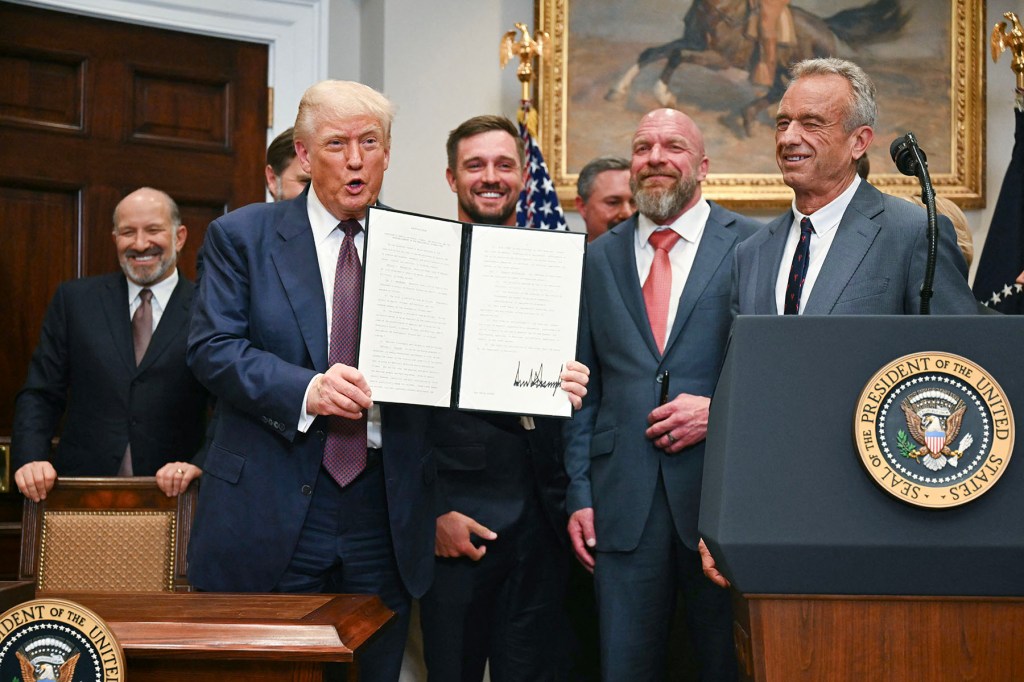
In some ways, Michelle Obama’s health policy efforts walked so MAHA could run. But you won’t find many Republicans acknowledging that.
“We live in such polarized times now that you would think the Trump administration would look at the things that Michelle Obama achieved and maybe try to build upon that,” said Sharon Wright Austin, a political science professor at the University of Florida. “But there is no collaboration. There are no coalitions. I’m sure if you were to say to Trump, ‘You’re doing the same thing that Michelle Obama originally started doing when Barack Obama was president,’ he would probably not only deny it, but he probably would be pretty offended.”
Obama’s motivation to launch Let’s Move!, the first lady explained, was rooted in her experience as a working mother trying to feed her kids nutritious food. The self-described “mom-in-chief” recognized that if she struggled with what to feed her children, other families with fewer resources might, too.
Within months of moving into the White House, the first lady started a vegetable garden to help teach children about locally grown food and to start a conversation about their health. She launched “Let’s Move” in early 2010, and her husband issued a directive to establish a task force on childhood obesity. Michelle Obama was present months later when the task force released a report assessing how to reduce childhood obesity within a generation. It included roughly 70 voluntary recommendations.

Zinga A. Fraser studies African American history and gender politics as an associate professor at Brooklyn College of the City University of New York. She noted that while Obama’s nutrition plans worked within a domesticated and gendered framework, her garden and health initiative was also part of a long history of Black women taking care of their communities through food sustainability.
“She understood what being a Black woman in that space looked like,” Fraser said of Obama’s role as first lady. “How she had to navigate and what it would be perceived as.”
Let’s Move! had several areas of focus: providing information to families about healthy food, improving the quality of food in schools, expanding access and affordability of healthy foods in communities, and increasing physical activity for children.
The first lady sought buy-in from key stakeholders early on. The American Beverage Association, a government lobbying group representing soft-drink makers, committed immediately to member companies voluntarily putting front-of-pack calorie labels on cans, bottles and vending machines within two years. Food service companies that operated in schools pledged to reduce the amount of fat, sugar and salt they put in kids’ meals over the next five years.
It’s the kind of voluntary industry action that Kennedy is touting 15 years later as he seeks voluntary commitments to remove certain dyes from the food supply and to switch the kind of oil that fast food chains use for cooking.
But the first lady was also politically savvy in broadening her initiative’s appeal to the general public. She danced on “The Ellen Degeneres Show” and did “mom dancing” on “The Tonight Show” with Jimmy Fallon. She released a “focus group” video with kids that featured comedian Will Ferrell. She shared a fitness video of herself working out. She appeared with members of the Miami Heat, including dunking a ball with LeBron James.
“She was strategic,” said Fraser, who is also director of the Shirley Chisholm Project on Brooklyn Women’s Activism. “She strategically used her positionality in many ways to move a needle, whether people saw it as influential or important at the time or not.”
It didn’t seem that Michelle Obama was entering controversial politics at first. She had settled on an area of public interest — children’s wellness — that was politically viable for a first lady, said Laurel Elder, a political science professor at Hartwick College in New York who has researched public opinion about presidential candidates and their spouses. There had already been a history of first ladies with projects like an anti-drug campaign and expanding literacy.
Elder noted that Obama was promoting a form of “new traditionalism” in the role of first lady.
“[The public] wants them to be traditional, but also the ‘new’ part is they really do have an expectation that the first lady should be out there and visible and should be leading campaigns in appropriate areas,” she said.
But as regulation policy emerged, so did the criticism. A child nutrition law passed at the end of 2010 included a phase-in of new federal school nutrition standards for milk, whole grains and sodium. The narrative that emerged was that the government was telling people what health choices to make.
“Your America is turning into a nanny state thanks to the Obama administration’s efforts to rein in the junk food industry,” said Sean Hannity on Fox News in 2010.
Glenn Beck, also on Fox News, described Michelle Obama’s efforts in 2010 as the beginning of efforts to police people for not eating healthier.
“You’re going to have to tax, you’re going to have to make it more and more difficult. But when those options don’t work, how do you get people to stop eating french fries, because french fries still beat carrots. What’s left? Well, now you have to start thinking about punishments — maybe a fine, maybe even jail. But it always starts with a nudge,” he said.
Even some Democrats criticized the Obama administration, arguing it didn’t go far enough to hold the food industry accountable to proposed changes.
In 2013, former Republican vice presidential candidate Sarah Palin sipped a large soda during an appearance at the Conservative Political Action Conference, known as CPAC. She was responding to a proposed ban of large sodas by then New York City Mayor Michael Bloomberg, but the stunt became part of a larger commentary on the government’s role in people’s health choices.
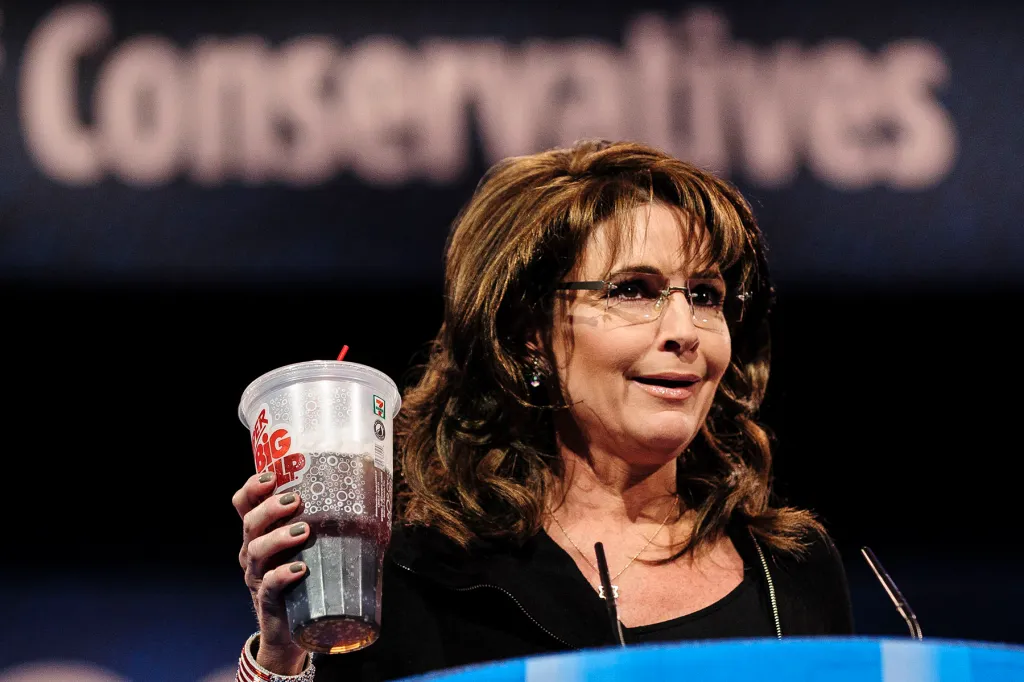
In 2014, Republicans in Congress sought exemptions to the 2010 school lunches law amid backing from a powerful school lunch industry group that expressed concern over implementation and costs. Michelle Obama pushed back in a New York Times op-ed. (In 2018 under the first Trump administration, the agriculture department sought to revert the new standards. It was challenged in court.)
A MAHA commission released a report this spring for addressing “the childhood chronic disease crisis.” Among its future policy focus will be poor diet, the “aggregation of environmental chemicals,” a lack of physical activity and chronic stress, and “overmedicalization.”
Kennedy told Fox News host Laura Ingraham earlier this year that while he didn’t want to take away “choice” from people, he believed in making changes to food assistance programs and school lunches. Several Republican-led states have recently begun restricting whether people on food assistance programs can buy processed foods and soda.
“We shouldn’t be subsidizing people to eat poison,” said Kennedy, who has separately started promoting that people should track their health metrics via “wearable” technology.
Kennedy’s MAHA initiative comes as the Trump administration cuts federal food assistance, key financial support for Medicaid and reduces environmental protections.
“You can’t cut benefits — Medicare, Medicaid, SNAP benefits, all of those things — to children and families and then still have an initiative where people are saying that they are about creating healthy environments for Americans,” Fraser said.
Natalia Mehlman Petrzela, a history professor at The New School in New York City, noted that when Beyoncé shot a related music video for the Let’s Move! initiative in 2011, she surrounded herself with young children dancing in a school cafeteria. It was common imagery for the first lady as well, as Michelle Obama swayed with kids to get them excited about nutrition and health. Trump’s recent announcement about the presidential fitness test featured former WWE wrestler and current Chief Content Officer Triple H doing a signature water spit at the White House.
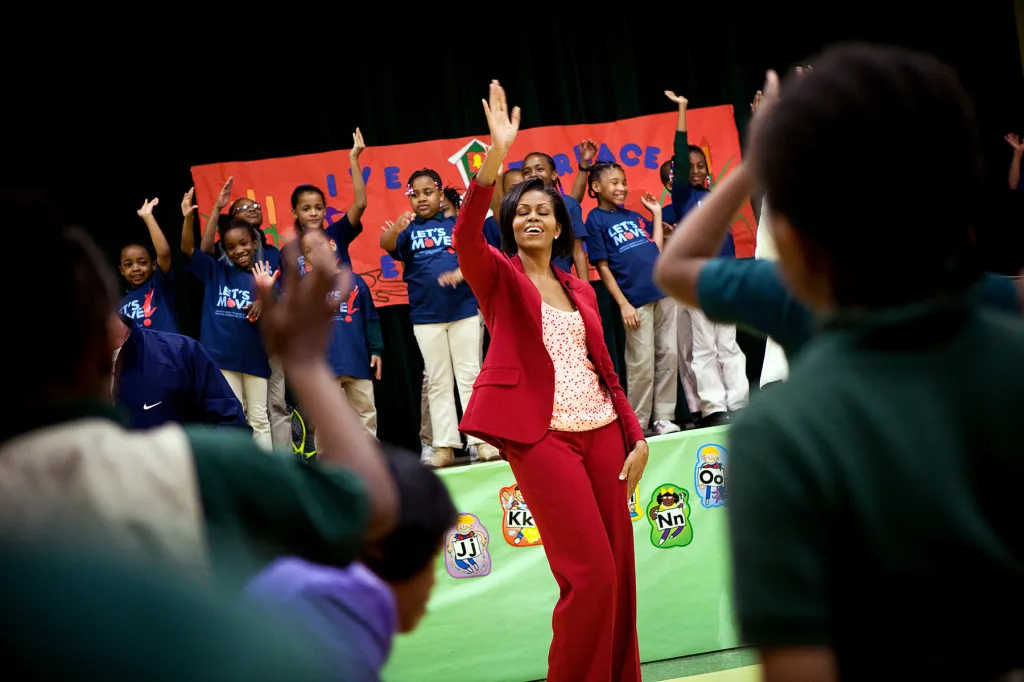
“To me, that arc kind of says a lot about what’s changed in our wellness and fitness environment,” said Petrzela, who is author of “Fit Nation: The Gains and Pains of America’s Exercise Obsession.” “That now there’s this highly individualistic, ‘strong man’ approach to things, and I think, even more interestingly, it’s tied to that anti-institutional critique, which used to be coded as really left, and in the intervening years, has become, almost completely seen as right wing.”
Austin at the University of Florida said that while Michelle Obama has never been an elected official, she held immense power in her role as first lady and left the White House with high polling. Austin believes the first lady balanced the political challenges of intersectional identities, and her mission to help children continues to resonate 15 years later — even though the messengers have changed.
“It just goes to show that as a Black woman, you’re never going to get the respect that you deserve,” she said.
Let’s talk about Trump’s DC move showing his golden age is gilded….
Why People Partied So Much in The 1980s, & More, in Peace & Justice History for 8/11
| August 11, 1894 Federal troops forced some 1,200 jobless workers across the Potomac River and out of Washington, D.C.  Jack London Led by an unemployed activist, “General” Charles “Hobo” Kelly, the jobless group’s “soldiers” included young journalist Jack London, known for writing about social issues, and miner/cowboy William ”Big Bill” Haywood who later organized western miners and the Industrial Workers of the World (IWW).  “Big Bill” Haywood Read about “Big Bill” |
| August 11, 1958 A drugstore chain in Wichita, Kansas, agreed to serve all its customers after weeks of sit-ins at Dockum’s lunch counter by local African-Americans who wanted an end to segregation. On this day, as several black Wichitans were sitting at the counter even though the store refused to serve them, a white man around 40 walked in and looked at them for several minutes. Then he looked at the store manager and said, simply, “Serve them. I’m losing too much money.” He was the owner, Robert Dockum. That day the lawyer for the local NAACP branch called the company and was told by the a vice president ”he had instructed all of his managers, clerks, etc., to serve all people without regard to race, creed or color,” statewide. This was the first success of the sit-in movement which soon spread to Oklahoma City and other towns in Kansas, but is often thought to have started in Greensboro, North Carolina, in 1960. |
August 11, 1984 Prior to his weekly radio address, unaware that the microphone was open and he was broadcasting, President Ronald Reagan joked, “My fellow Americans, I’m pleased to tell you today that I’ve signed legislation that will outlaw Russia forever. We begin bombing in five minutes.” Many Americans and others throughout the world were concerned about the President’s apparently flippant attitude towards nuclear war at a time of increasing tension between the two major nuclear powers. Among other things, the U.S. had begun a major strategic arms buildup, adding many thousands of additional nuclear warheads along with a broad range of new delivery systems: long-range bombers including 100 B-1B stealth bombers and MX (10-warhead) ICBMs, considered first-strike weapons; intermediate-range missiles to be deployed in Europe; 3000 cruise missiles; and Trident nuclear submarines with sea-launched cruise missiles. Additionally, Reagan had proposed building the space-based Strategic Defense Initiative of anti-ballistic missiles, a destabilizing influence on the nuclear balance. The Nuclear Arms Control Legacy of Ronald Reagan |
https://www.peacebuttons.info/E-News/peacehistoryaugust.htm#august11
Sounds Good

Four clips from The Majority Report. One on Gaza war crimes committed by Israel, one on ICE, one on tRump’s attacks on schools, and one on the jobs numbers.
VRA, 1st Electrocution, Hiroshima, & More In Peace & Justice History for 8/6
| August 6, 1890 At Auburn Prison in New York state, William Kemmler became the first person to be executed in the electric chair, developed by the Medico-Legal Society and Harold Brown, a colleague of Thomas Edison. William Kemmler received two applications of 1,300 volts of alternating current. The first lasted for only 17 seconds because a leather belt was about to fall off one of the second-hand Westinghouse generators. Kemmler was still alive. The second jolt lasted until the smell of burning flesh filled the room, about four minutes.  As soon as his charred body stopped smoldering, Kemmler was pronounced dead. ——————————————————————————- August 6th, 1945 – 8:15 AM ANNIVERSARY OF HIROSHIMA The United States dropped the first atomic bomb used in warfare on Hiroshima, Japan.  Hiroshima ruins An estimated 140,000 died from the immediate effects of this bomb and tens of thousands more died in subsequent years from burns and other injuries, and radiation-related illnesses. President Harry Truman ordered the use of the weapon in hopes of avoiding an invasion of Japan to end the war, and the presumed casualties likely to be suffered by invading American troops. The weapon, “Little Boy,” was delivered by a B-29 Superfortress nicknamed the Enola Gay, based on the island of Tinian, and piloted by Colonel Paul W. Tibbets. Voices of the Hibakusha, those injured in the bombings  <Hiroshima survivor <Hiroshima survivor Found watch stopped at the time of explosion>  Documents related to the decision to drop the atomic bomb On August 6, 1995, up to 50,000 people attended a memorial service commemorating Hiroshima Peace Day on the 50th anniversary of the first atomic bombing. —————————————————————————— August 6, 1957 Eleven activists from the Committee for Nonviolent Action (CNVA) were arrested attempting to enter the atomic testing grounds at Camp Mercury, Nevada, the first of what eventually became many thousands of arrests at the Nevada test site. —————————————————————————– August 6, 1965 The Voting Rights Act of 1965 was signed by President Johnson, making illegal century-old practices aimed at preventing African Americans from exercising their constitutional right to vote.  It created federal oversight of election laws in six Southern states (Alabama, Georgia, Louisiana, Mississippi, South Carolina, and Virginia) and in many counties of North Carolina where black voter turnout was very low. Black voter registration rates were as low as 7% in Mississippi prior to passage of the law; today voter registration rates are comparable for both blacks and whites in these states. The laws has been re-authorized by Congress four times. Introduction to the Voting Rights Act —————————————————————————— August 6, 1990  George Galloway The U.S. imposed trade sanctions on Iraq. As a result, the lack of much-needed medicines, water purification equipment and other items led to the death of many innocent Iraqis. According to British Member of Parliament George Galloway in his testimony to a committee of the U.S. Congress on May 17, 2005, these sanctions “ . . . killed one million Iraqis, most of them children, most of them died before they even knew that they were Iraqis, but they died for no other reason other than that they were Iraqis with the misfortune to be born at that time . . . .” When asked on U.S. television if she thought that the death of half a million Iraqi children (due to sanctions on Iraq) was a price worth paying, then U.S. Secretary of State Madeline Albright replied: “This is a very hard choice, but we think the price is worth it.” -60 Minutes (5/12/96) Were Sanctions Worth the Price? by Christopher Hayes ————————————————————————– August 6, 1998 Nearly 50,000 people attended a memorial service commemorating Hiroshima Peace Day on the 50th anniversary of the first atomic bombing which killed nearly 200,000 Japanese with a single weapon. The headlines when it happened ————————————————————————— August 6, 1998 Calling themselves the Minuteman III Plowshares, two peace activists, Daniel Sicken [pronounced seekin], 56, of Brattleboro, Vermont and Sachio Ko-Yin, 25, of Ridgewood, N.J entered silo N7 in Weld County [near Greeley] in Colorado operated by Warren AFB, Cheyenne, Wyoming. With hammers and their own blood, they symbolically disarmed structures on the launching pad of a Minuteman III nuclear missile silo.  Sachio Ko-Yin and Daniel Sicken Read about the Minuteman III Plowshares action |
https://www.peacebuttons.info/E-News/peacehistoryaugust.htm#august6
I Read This Substack Every Chance I Get; About Louisiana Culture, History, & Food, & Now Survival
This one’s about trouble for all coastal states, coming from Louisianans.
Louisiana Fights Against Becoming Another Not There No More Statistic by Jerileewei
Terrebonne Parish: Where the Rivers Meets the Sea Read on Substack
CCJC Audio Podcast Episode 00086, Season 2
“It’s not just the land we’re losing. It’s the stories. The way we talk. The smell of the air before a big storm.” — Emile Navarre
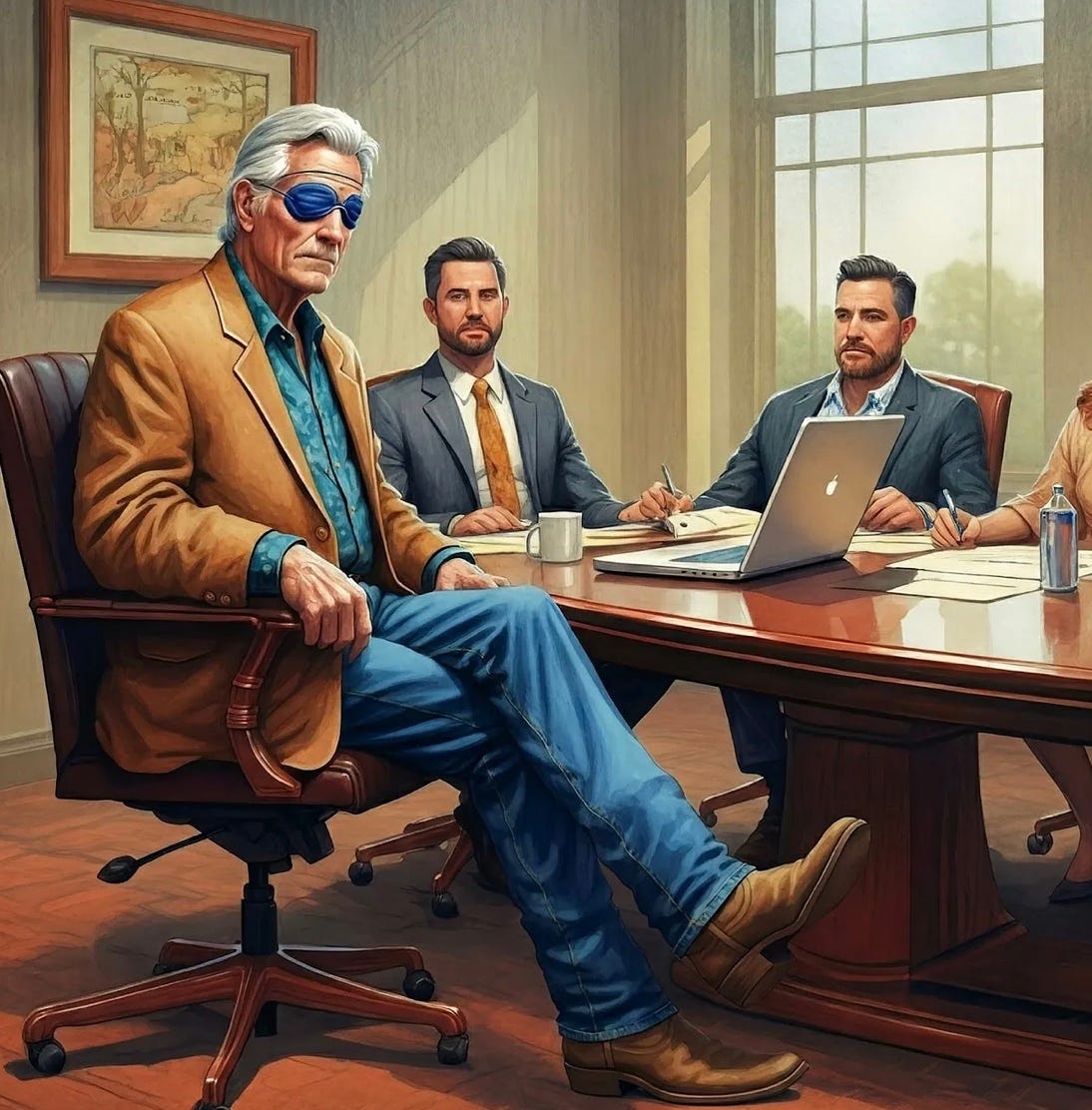
Back from his month long vacation in Chacahoula, Louisiana, Cajun Chronicle Podcast, Writer/Editor, Emile Navarre arrived for our first staff meeting armed with fresh material for a future episode, as soon as Marie Lirette, our Outreach Coordinator can reach out to potential experts on the topic of “Ain’t There No More” – a nation wide trending group talk everywhere these days, as our world changes in ways none of us could have imagined.
Here is his recount of his lifelong story telling to his family’s youngest children:

“Come closer, chérs,” he said, his voice a low rumble like the last Lafitte skiff shrimping boat of the day heading down the Bayou Lafourche over Galliano or Golden Meadow way. His cane bottom rocking chair seat creaked a steady rhythm against the worn Cedar floorboards as he said that.
The sun, a too warm blanket he could feel, but not see, was sinking somewhere behind the great oak in the yard he will always remember. He ran a hand over the cane of his chair, then rested it on the knee of a boy sitting on the steps below him. He lifted his walking stick and pointed off to the right side. “You see that big fence, hein?
“Or that levee your mamans and pépère have to climb to get home from work at the Bollinger Shipyard, just to get up to the house? We didn’t have such a thing when I was a boy. Back then, my feet knew every dip and bump in this land”.
“From our porch right down that oyster shell road to the bayou where the shrimp jumped so high, you’d swear you could catch them in your mouth, if you were quick.” A ripple of giggles ran through the children.
“Ah, oui,” he chuckled, “I lost a good tooth catching shrimp that way. But the land, it was different. We were like a river family. She’d bring us a big muddy hug every spring, and we’d be happy for it.”
“The floods, they were always a part of life. We’d move our things up high, sing songs, and wait for the water to go down. When it did, Mother Nature would leave behind a gift, a rich, dark mud that made our gardens burst with life. You could feel it in your toes, a soft, giving sponge of sandy soil that told you everything was going to be alright.”
He paused, and the laughter faded, replaced by the chirping of crickets.
“My pépère, he’d sit right here on the back porch with a fishing line tied to his toe, but in his mind, Gaia was always busy with the water. He’d talk about how the Lafourche river was a living thing, always moving, always changing. ‘She builds, and she takes away,‘ he’d say.”
“We knew that. A little bit here, a little bit there. It was a fair trade. But then came the men with the big ideas. They came from places where the land didn’t move so much. They told us we could stop the river’s big hugs. They said we could make a straight line and build high walls, so the water would stay in its place.”
Emile’s voice dropped to a conspiratorial whisper. “The young people, they thought it was wonderful. No more floods! No more moving furniture to the attic! But my pépère, he just shook his head. ‘You can’t trap a wild woman, not for long,’ he said. ‘She will find her way, and she will be angry for it.'”
“And she was,” he said, his hand now clutching his walking stick. “For years, the river was quiet, but our land, she was not. I can’t see it anymore with my eyes, but I felt it with my feet. The soil grew tired, no longer receiving her yearly gift.”
“The ground began to sag, and the bad marsh saltwater, it came closer in to say hello, not from a storm, but like a thief in the night, creeping up through the channels les Américains dug for the oil. They were for the big machines, the big money, but they were also a wound. A wound in the land that never healed.”
He turned his head toward the silent children, his milky blind blue eyes fixed on something only he could see. “Now, this levee you have, it protects you from the river, oui? But it holds the land in a box. It cannot breathe. The land is sick, and the ocean is hungry, taking a football field from our home every hour, the experts say.”
“I hear it in the wind now, not just the storms, but also in the sad whispers of the marsh, of the birds that have no place to land anymore. The land is leaving us, and we are left behind. We traded our river’s muddy hugs for a straight line and some high walls, and now we pay for it. Now, it’s not just the water that takes. It’s the land that gives itself away.”
The porch was silent, a stillness that was heavier than the humid air. The children looked at each other, not understanding all the words, but feeling the weight of them. One of the little girls, her braids tied with pink ribbons, quietly moved her hand to rest on the Emile’s knee as she headed inside for bed.
Emile smiled, his face creasing with a thousand invisible memories. Talking to the breeze, he raised his fist and threatened, “But you know what else my pépère said? He said, ‘As long as we tell the stories, the land is not truly gone.’ So listen, chérs, listen closely to my bedtime stories. Because now, it is your turn to remember.”

He had felt the last of the children’s light footsteps fade into the dusk, and the porch was still again except for his rocking chair. His head turned to the quiet rustling of the adults lingering on the porch. “You hear my stories, oui?” he said, his voice now lower, rougher.
“You too remember what I said about the river’s gift of mud? We didn’t know it, but we were like a family that had a big, generous table. Rivers brought food, and our land ate it. Every year, she’d get fat and happy. We thought we were so smart, so clever, when we built those high walls.”
“We told Gaia to stop eating for a while, believing for a while that she didn’t need the mud. ‘Don’t worry,’ we said, ‘We’ll protect you from the floods.’ But what we really did was put the food in a box and send it out to sea. Now, the land is starving. You cannot see it in a day, or a year. But that’s happening rapidly.”
“But I feel it in every part of my mind and body. Every year, she gets thinner, weaker. And like a sick old person who can’t stand anymore, Mother Earth’s starting to melt away. The medicine to save her is that very food we cut her off from. But the walls of levees and the canals the Corps of Engineers built? They are so high.”
“How will we get the food back to Louisiana’s coast before she’s gone entirely? That is the story my heart tells me now. And that is the story for you all to worry about. Time’s running out. I’m 75 years young this month. In another 75 years I won’t be here to see that my beloved Louisiane will be added to that dreaded list, “Ain’t Here No More.“
Cajun Chronicles Note: Sediment Starvation: The settlers’ levees and later government agencies built, while protecting their land from floods, also had an unintended consequence that would become a major factor in today’s coastal crisis. By containing the rivers, they prevented the natural flooding that would have deposited sediment into the wetlands.
This sediment was the building block of the delta. Without it, the land began to sink (subsidence) and slowly disappear. The settlers since the 1800s and later colonists were unaware of this long-term process and the vital role of the Mississippi’s and other rivers’ sediment in sustaining the land.
Water’s Takin’ Our Land, Gulf’s Hungry & She Ain’t Slowin’ Down
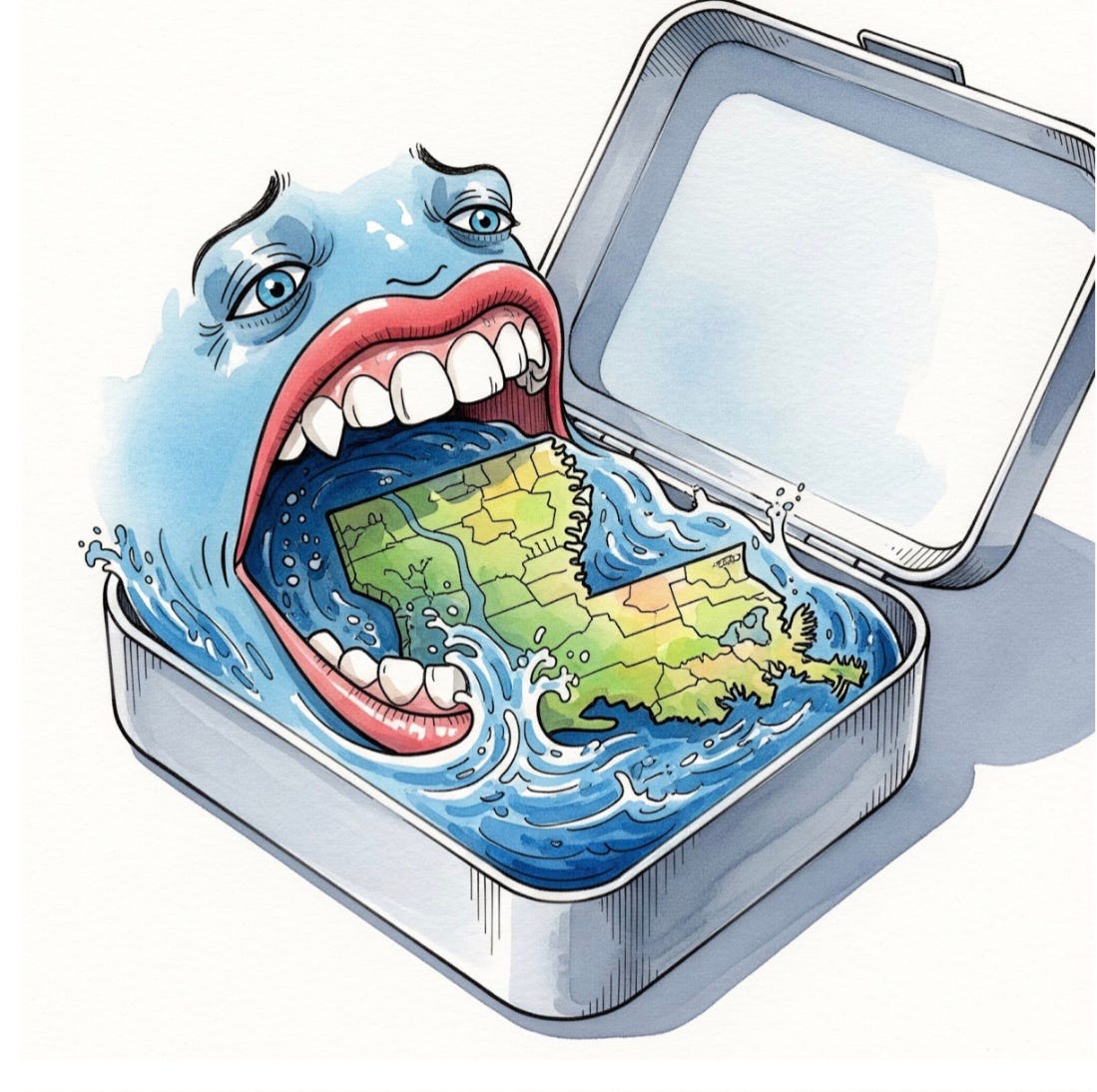
Louisiana has the highest coastal land loss rate in the United States. Since the 1930s, the state has lost about 2,000 square miles of land. This is a significant amount, roughly the size of the state of Delaware.
Without major intervention, the state of Louisiana is projected to lose an additional 700 to 1,000 square miles of land by the year 2050. This is an area roughly the size of the greater Washington D.C.-Baltimore area.
By the year 2100, the projections are even more dire, with some worst-case scenarios suggesting that up to 3,000 square miles of land could be lost. Some scientists have even warned that the entire remaining 5,800 square miles of Louisiana’s coastal wetlands in the Mississippi River delta could eventually disappear.
A Word of Wisdom:
Our fictional and non-fictional tales are inspired by real Louisiana and New Orleans history, but some details may have been spiced up for a good story. While we’ve respected the truth, a bit of creative license could have been used. Please note that all characters may be based on real people, but their identities in some cases have been Avatar masked for privacy. Others are fictional characters with connections to Louisiana.
As you read, remember history and real life is a complex mix of joy, sorrow, triumph, and tragedy. While we may have (or not) added a bit of fiction, the core message remains, the human spirit’s power to endure, adapt, and overcome.
© Jerilee Wei 2025 All Rights Reserved.
 Scottie's Playtime