Hi everyone. I really am so grateful for all of you and the support that you give me and others here. After I posted about the trigger event I think an important part got missed and today with all going on my wonderful husband offered to help me finish the dishes I was doing even though I knew he wanted to get on to other things. So I want to share this post with all of you.
I am happier than I can remember being in a long time.
For starters the triggering event was because Ron my husband who struggles to have the sexual desire I do was offering happily for us to … well have sex. But he was so wonderful with the way he handled it and when he got back up and made sure I was OK, he offered again. I said later.
Ron got home on the evening of the 2nd of March. Since then he has watched carefully to make sure I was not harming myself by taking on too much, instead softly forcing me to rest as he took over. On the personal side he has made it a daily routine and returned to the old normal of touching each other during the day and giving kisses and hugs. If he sees me struggling he intervenes right away.
But it goes both ways. Ron loves my cooking and with him home I have really been doing my best and in fact loving it. It gets to hurt so bad sitting in my desk chair and when we talk about what’s for supper and I provide a suggestion he asks if I would like to do it and I really want to. He does the chopping of vegetables and meats and I do the cooking / seasoning and set up the serving area.
Remember how I grew up. When I went out on my own I had no cooking skill at all. When Ron moved into my home I had eggs and hot dogs in the refrigerator. I simply had no clue how to make food. Ron first made food I fell in love with and started teaching me seasonings. I took to it like a fish to water and now he lets me take the lead on joint meal projects. And that is what the meals are, we work together on the idea and what we would like the outcome to be. He does any chopping because my eye sight is so bad and I have cut my self so badly at times. But then he lets me do my thing and comes to taste or add suggestions as I ask. He always does the cleanup as he understands how tired I am by then.
But it is more than meals. At night I struggle to sleep, and Tupac presses as hard to me as he can most of the time. Ron will reach out and touch me on the shoulder, arm, or back just to let me know he is there. If he knows or thinks I am struggling he will talk to me. If he knows I am awake he will ask if we can cuddle some more. I so love that but the issue there is Tupac. During the three months Ron was gone Tupac got very attached to me. He sleeps as close to me as he can get often laying his head on my folded arm. Ron says as long as I am able to sleep like that Tupac will stay asleep right there. If I shift he will move lower towards my belly and again push against me. If he doesn’t have paws touching me or himself he will lie with his head pointed at me and looking either up or down and his tail to Ron.
The few times I have moved him and set his stuff up so he was on the other side of us so Ron and I could cuddle he got very upset. So now I only do it if I have responded to his middle of the night need for food and while he is gone change the places of his sleep towels and blanket. He still doesn’t like it. The first night we did it in the morning Ron went to pet him and Tupac swatted at him.
I am sorry this is rambling, I guess I did not do a good job ordering my thoughts. I am just so happy which is an emotion I so rarely get to enjoy I wanted to share it all with everyone. Things seem so good, clear, wonderful, and grand, and Ron and I are more in tune with each other than we have been in a long time. They say absence makes the heart grow fonder. I don’t know, but the way he looks at me, the way his arms encircle me, and the way he gives me quick kisses are like it was half a decade ago and so wonderful. My body responds to him like in the old days and he enjoys it. That is new and I love it.
As for the bad events / the vortex. It has not been as bad since Ron has been home. I have had minor ones and have retreated to my “pink palace office” to cry quietly and try to deal. But the horrid nightmares reliving the events of my past have not happened since he came home. I have not needed to desperately cry out for help or in pain as I relive the things done to me. I know they will, but I also know he will be there. Listening and ready to help me face the demons and hurts that I will never totally make go away. I have noticed he is careful to not overload me mentally, emotionally, or physically. He will often tell me it is time for a break or that he would like to take over, or his favorite trick… I need a break do you mind if we rest for a while? I know he is doing it for me. But it still is grand. OK I don’t have a real ending here other than he just came into the office as I was writing this , leaned over me and gave me a kiss. I asked if he needed help with anything and his reply was not yet, I will let you know when. Maybe just possibly what they say about love is true, it can heal the wounds if you let it. Just know that now I am so very happy an emotion I have not felt in a long time. Hugs
A poor person calls in to explain how they have nothing and no way to live with all these cuts to social services. Horrific. The Democrats must promise to fix this and return the safety to the safety nets. Hugs
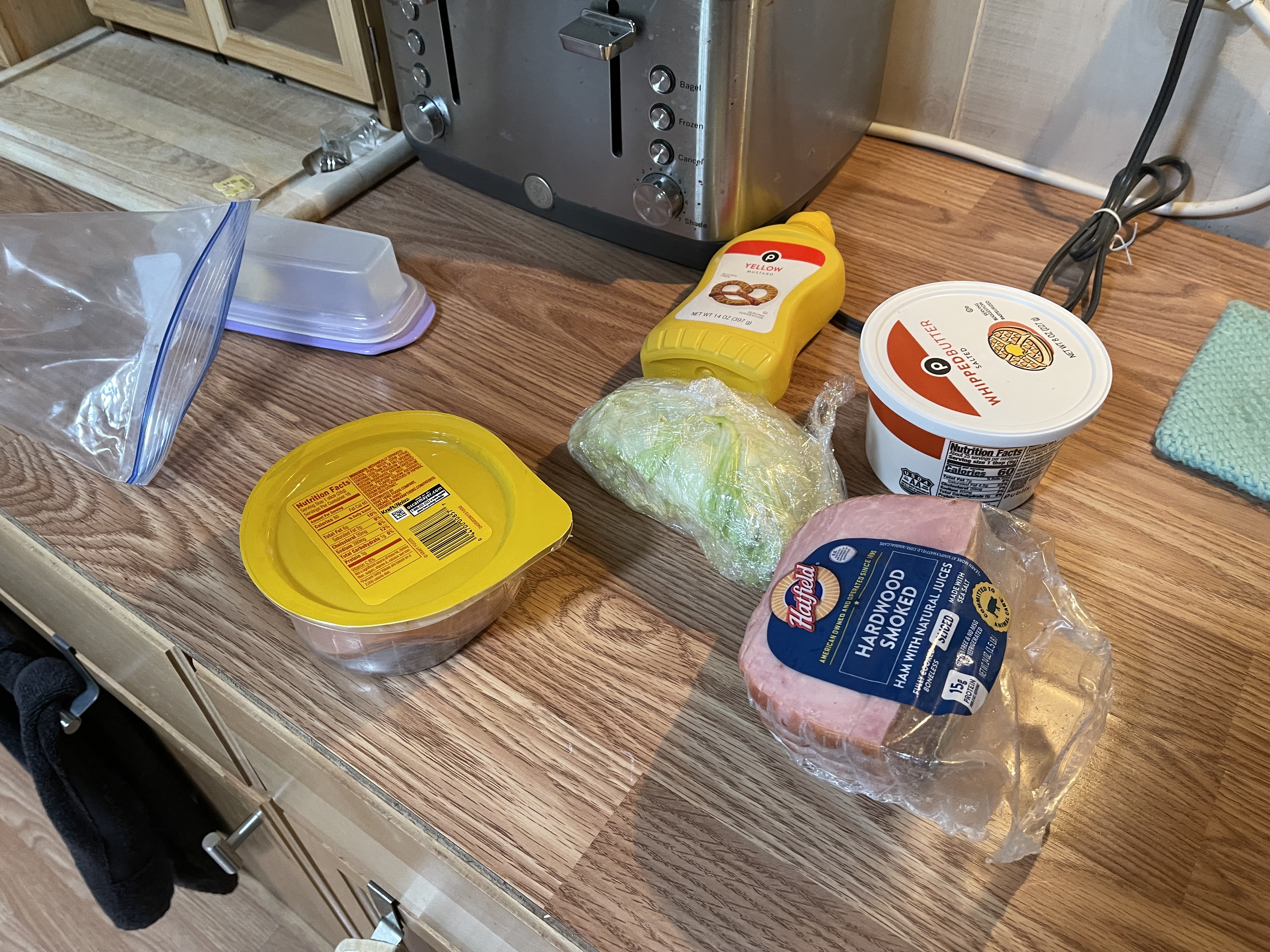
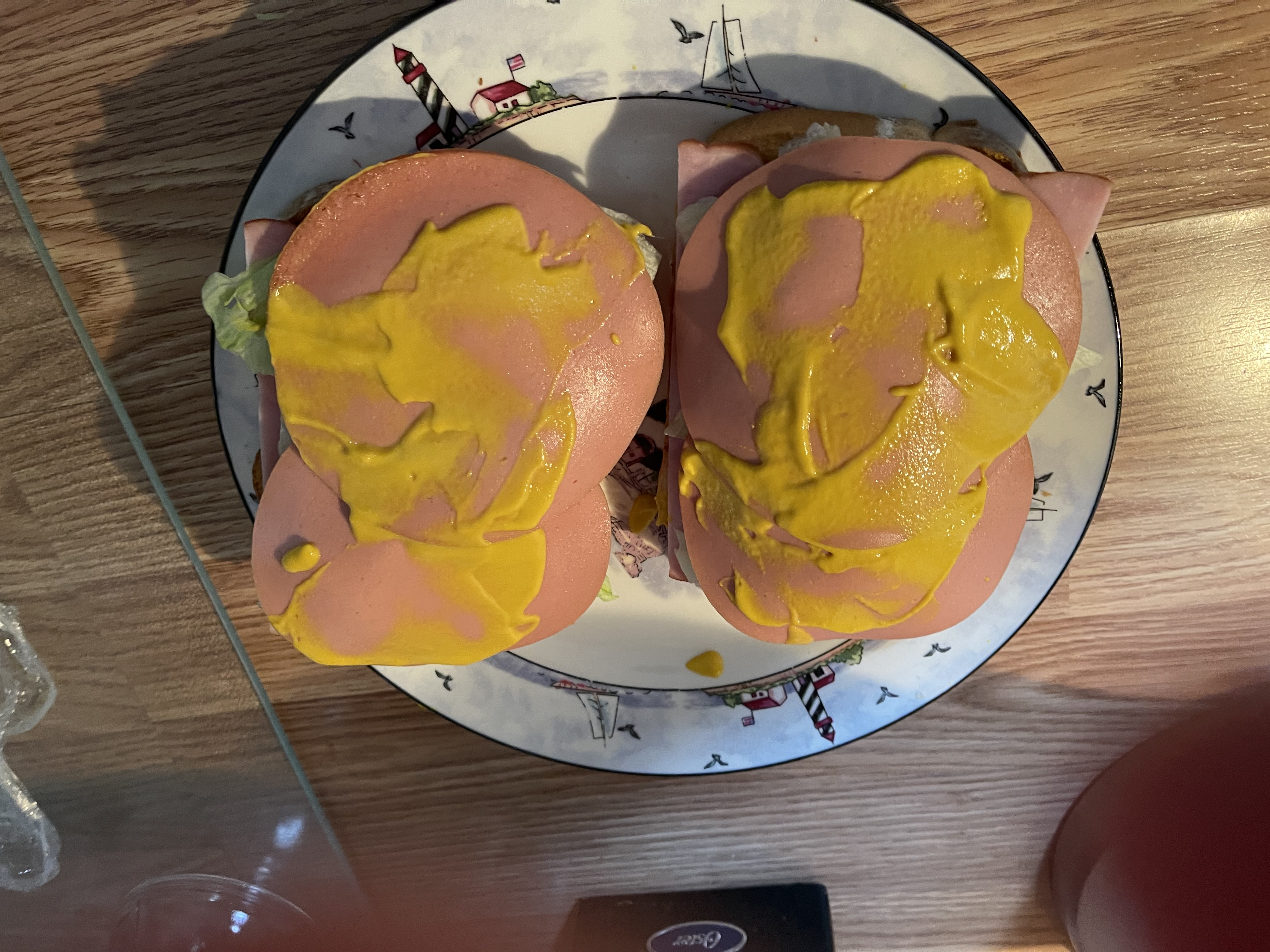
Here are the ingrediance I like in my sandwich tonight.
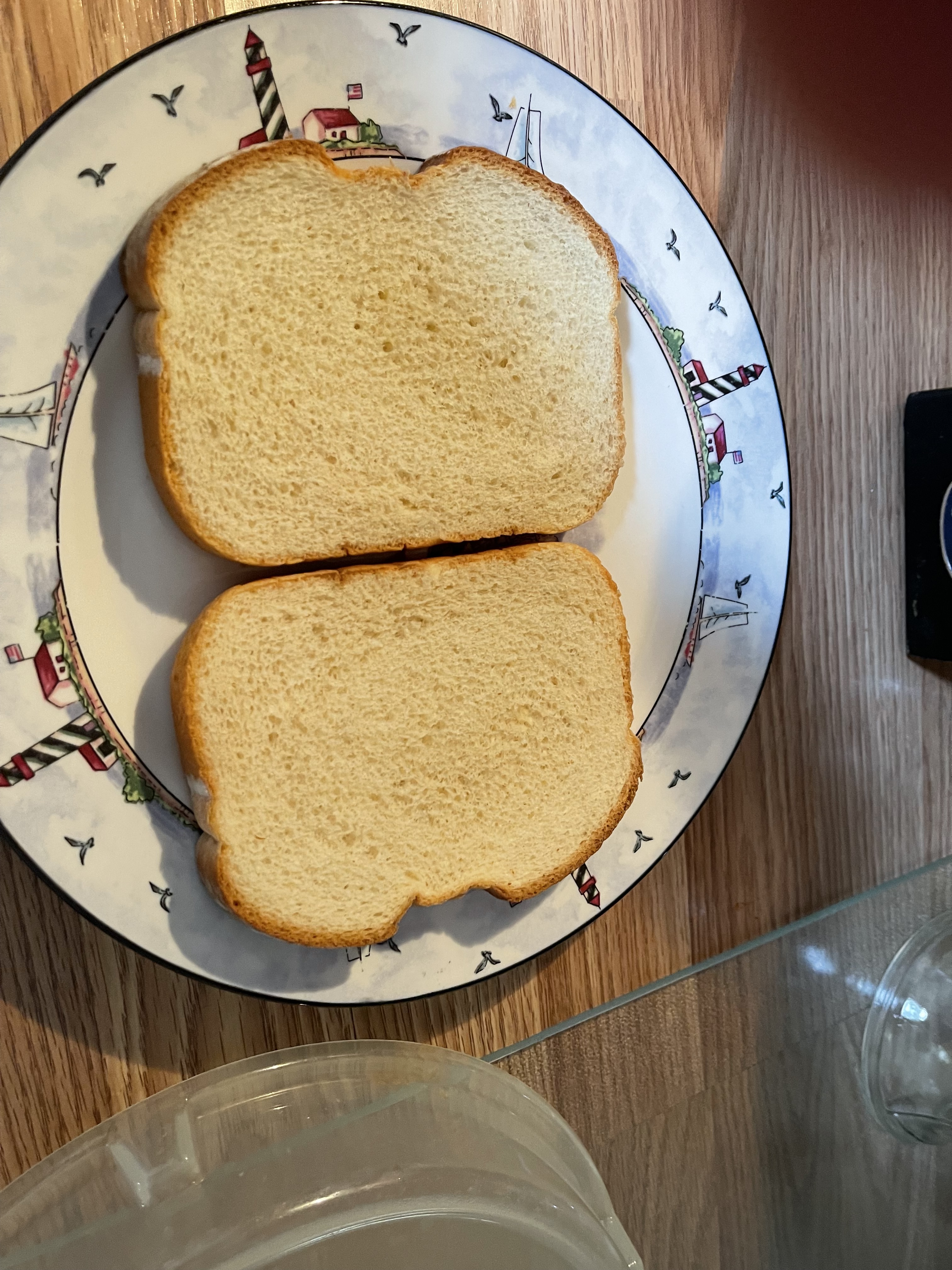
I start with heating the meats as I dislike cold foods. I then put the bread slices for two sandwiches on the plate and apply mustard to them.
Then the bread slices for the bottom which I put mustard on.
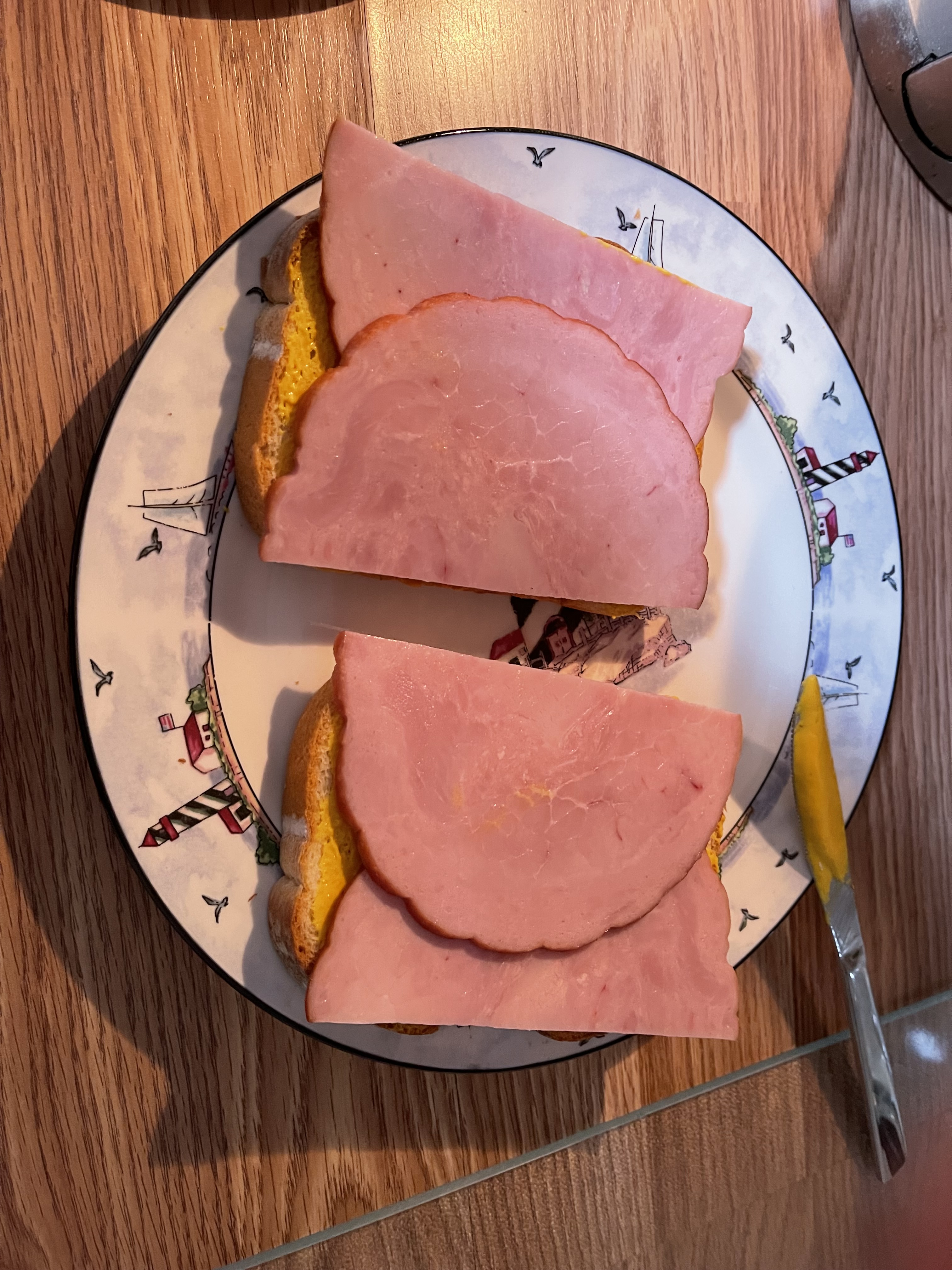
Then I add the first layer of meats.
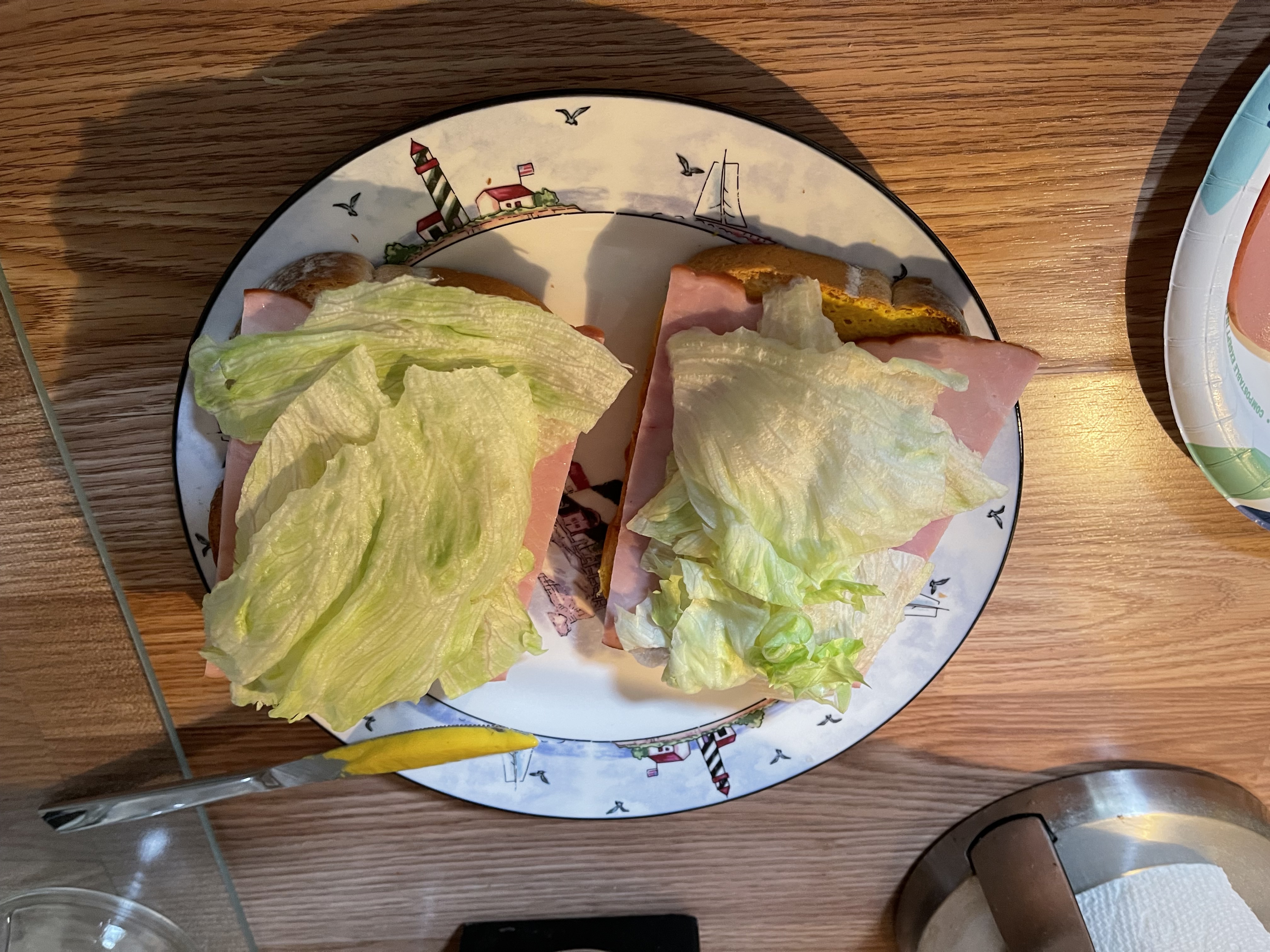
Then the lettuce, which gives it a crunch.
Then the other meats.
Then more mustard on the top of the last meats.
Then the last of the bread and the cutting of the sandwiches. I like my slice on an angle.
And that is my supper tonight. I doubt I will eat again. But at least I ate. Now I am exhausted but want to stay up. It is not yet 4 pm here but I was up at 2 am because of Tupac and then I couldn’t get back to sleep finally fell asleep at 5:30 but woke at 6 after a nightmare and knew I wouldn’t be going to sleep again that morning. Hugs
Donald Trump’s ICE is doing exactly what he wants. And now they are holding a political prisoner for nearly a year in an ICE detention camp simply because 33-year-old Leqaa Kordia dared to champion views the Trump regime opposes. This should concern all Americans especially given the recent warning from concentration camp expert Andrea Pitzer—who explained on my SiriusXM show that history tells the Trump regime building massive ICE detention camps will ultimately be used to imprison political prisoners.
That should not be a surprise to anyone who follows the history of fascist and other right wing regimes. Trump is following the fascist playbook, complete with his own secret police that has terrorized and even killed Americans who defy him. The most glaring example being the murder of Renee Good and Alex Pretti—who were then smeared by Trump officials as “domestic terrorists.”
Shockingly, we just learned that Trump’s ICE shot and killed another US citizen, 23 year old Ruben Ray Martinez, almost a year ago in March of 2025. However, Trump’s secret police covered up their involvement until recent media reports broke the story open. The details surrounding the murder of Martinez–who worked at Amazon–are simply unbelievable with ICE claiming that for some unknown reason this young man with no criminal record suddenly used his car to attack ICE officers.
Beyond that ICE has terrorized American citizens who dared film them—which they are legally entitled to—assaulted protesters and engaged in conduct consistent with an occupying army, not federal agents.
But it’s not ICE acting as a rogue agency—Trump wants them to do this. Trump—like Putin– wants to silence dissent as we’ve seen with his regime targeting all who oppose him from comedians like Jimmy Kimmel to seeking to criminally charge and imprison six Democratic members of Congress for warning members of the military to not follow illegal orders. A grand jury blocked that–at least for now.
That is why the case Leqaa Kordia demands far more attention given it’s a sneak preview of what we can expect from Trump for not just immigrants–but also U.S. citizens. Leqaa is a 33-year-old Palestinian woman with family in Gaza and the United States. Her mother is a US citizen living in Paterson, New Jersey—which is where Leqaa was staying and working as a waitress until she taken by ICE.
Leqaa Kordia
Kordia—who came to the US in 2016 on a student visa and was in the process of seeking permanent residence status via her mother –has no criminal record. The diminutive woman poses no threat to anyone. But to the Trump regime she is dangerous because she participated in peaceful protests advocating for Palestinian humanity. In the case, of Leqaa this issue is very personal in that she has lost nearly 200 relatives in Gaza.
But Leqaa’s case is not about Palestine—nor it is about Israel. Rather, it’s about freedom of speech—and the Trump’s regime targeting those who dare defy them.
How this case began was that in March of 2025, ICE informed Leqaa they wanted to speak to her. In response, she voluntarily appeared at the ICE office in Newark, New Jersey–where she was quickly arrested, thrown into an unmarked van and sent 1,500 miles away to the Prairieland Detention Facility in Texas far from her lawyer and family.
Since then, she has been detained in horrific conditions. As Leqaa detailed in a recent op-ed, the ICE facility she has been held in for nearly a year “is filthy, overcrowded and inhumane.” She slept in a plastic shell “surrounded by cockroaches and only a thin blanket.” And the food quality is so atrocious, it has caused her to vomit resulting in significant weight loss.
Worse, just a few weeks ago she experienced the first seizure of her life, collapsing to the floor. From there, ICE transported her to a hospital where her wrists and legs shackled to her bed for the three days. As she put it, “The entire time I was chained…I felt like an animal.” And simply to be cruel, ICE refused to tell her lawyers or family where she was or her medical condition.
None of this should be happening. As her lawyer Amal Thabateh explained to me, two different immigration judges ruled that Leqaa should be released on bond. But the Trump regime instead invoked a little used procedure to keep her in detention open ended.
To do that, serial liar DHS Secretary Kristi Noem smeared Leqaa as being a “terrorist” sympathizer for expressing concern for Palestinians in Gaza. They even claimed that releasing Leqaa—who again has no criminal record and was living with her US citizen mother in New Jersey–was somehow a threat to our nation. Of course, this is the same Noem who smeared with lies Renee Good and Alex Pretti as “terrorists” to justify their murders so we know she will say anything to defend the Trump regime’s crimes against humanity.
The idea Leqaa is a political prisoner is not just my view. Amnesty International lists her on their website demanding that the US government “release detained protester.” Her case is in the same section on the Amnesty website where they are calling for the release of dissidents in Russia, Belarus and other authoritarian regimes. This is where our nation is now viewed by human rights organizations.
Deeply alarming is that these ICE dentition centers are increasingly become death camps. At least 32 people died in ICE custody in 2025—the highest number in two decades. And in the past six weeks, six people have died in ICE custody including one man killed by ICE agents as they were restraining him. Will anyone be held accountable for this man’s death? That is like asking will anyone be held accountable for the death of Russian dissident Alexei Navalny killed in a Russian prison two years ago. We know that no one will be prosecuted because Russia is an authoritarian nation. As disturbing as it sounds, so is the United States under Trump.
But for those who refuse to submit to Trump and want to stand up for freedom of speech, I hope you will sign the Amnesty International petition calling for the US government to release Leqaa. Other ways to help this young woman include calling on your members of Congress to demand her release. You can also consider making a donation to her online fundraising page to help her and her family. Finally, you can follow Leqaa’s campaign for freedom on Instagram and amplify the updates.
As Andrea Pitzer repeatedly warned in our conversation on concentration camps, it does not end with people like Leqaa. It begins with people like Leqaa being held with in a camp for as long as the regime wants to keep her–in horrific conditions–simply because they want to silence her political views. They then continue until they reach people like us. But as the famous poem goes, by then it’s too late because when “they came for me…there was no one left to speak out.”
——
Below is my recent interview about Leqaa’s wrongful detention with her lawyer Amal Thabateh, who is with Creating Law Enforcement Accountability & Responsibility (CLEAR) Project and Laila El-Haddad, an award-winning Palestinian author, social activist, policy analyst and journalist.
The Dean’s Report by Dean Obeidallah is a reader-supported publication. To receive new posts and support my work, consider becoming a free or paid subscriber.
The international accompaniment movement teaches us that to sustain an emergency response to state violence, we must build durable, collective and supportive structures now.
Targeted state violence and rising fascism are being met with creative organizing by people in Minneapolis and across the country, from mass marches to neighborhood mutual aid to ICE watch foot patrols. These are all beautiful manifestations of resistance that have kept many people safe and demonstrated widespread repudiation of the Trump administration’s policies.
Yet as state-sanctioned violence becomes more coordinated, normalized and national in scope, we must continue adapting our response systems to shifting needs. Emergency response structures set up in moments of crisis can often lead to isolated, reactive decision making with responsibility falling on a few shoulders, creating the conditions for burnout, security failures, movement fragmentation and individual and organizational missteps or even collapse.
Here we can draw on some hard-earned lessons from our predecessors in the decades-long international accompaniment movement, who witness, stand with and provide security support for human rights defenders, communities and activists under attack by authoritarian regimes in Latin America.In response to sometimes devastating losses, accompaniment organizations developed a set of skills and strategies over many years for collaborative, sustainable decision making to respond to security incidents while under conditions of constant threat. We ourselves learned these skills in our many years of working with accompaniment organizations in Guatemala, Honduras and Colombia from 2008 to 2022.
We share here principles and practices from this legacy, which we hope organizations and networks, whether formal or informal, can use to develop emergency response structures that are sustainable, don’t overly burden a few individuals with the difficult decision making, actively build collective capacity and shared analysis, and support skill-building for more people in our movements.
What we present here are suggestions, and we invite you to adapt them to particular organizations and situations. They may take a bit more planning and preparation than may seem available in moments of urgency. But if we want to sustain our movements for what, unfortunately, is likely to be a long struggle, we must begin now to put durable, collective and supportive structures into practice.
1. No one person decides alone
Decision making in emergency security situations is emotionally and mentally taxing. Stress can narrow our literal and metaphorical fields of vision. And because the weight of a decision can be incredibly heavy to bear — especially if things go wrong — no one ever made a decision alone in the accompaniment organizations of which we were a part. We had clearly established protocols for which people, based on their roles in the organization, would come together for specific emergency response decisions.
For example, we established regional subcommittees based on where a security incident occurred. Each subcommittee was composed of a security lead, a representative from the advocacy team and on-the-ground volunteers, who worked together to assess, analyze and respond to emergency situations.
Applying this principle in a U.S. context, organizers of a publicly advertised protest could set a team of folks who gather at an office or a home to monitor social media and news reports for security incidents or threats, and be ready to make decisions about emergency response.
2. Prepare decision-making structures and roles beforehand
Emergency response or crisis moments are when people are most activated and are also the most likely to lead to organizational, interpersonal or movement conflict. This shouldn’t come as a surprise. After all, we are being subjected to situations of prolonged violence directed at ourselves and people we care for. We want to show up in the best way possible, yet often also feel frustration, impotence or rage.
In our accompaniment organizations, we mitigated stress and conflict (to the extent possible) by having clear processes and roles for decision making.
First, we frontloaded as many decisions as possible before an emergency, allowing us to focus on the situation at hand rather than spend time debating who would do what and delaying important support for the impacted individuals. Knowing who is going to be involved in emergency response reduces the need for conversation and shortens the response time.
The Peace Brigade International accompanies the Front of People in Defense of Land and Water in Amilcingo, Mexico. (Facebook/Peace Brigades International)
We have seen this play out in high-risk moments in our accompaniment work. For example, when we responded to nationwide protests that extended over months and saw daily murders of protesters by military and police forces, we set up a rotating decision-making group. Because roles and communication channels had already been agreed upon, colleagues didn’t have to debate who should verify information, call other allied organizations or set up our emergency response protocol. They could simply act.
Second, we made decisions in consensus. While clear decision-making structures are essential, that doesn’t necessarily mean they have to be hierarchical. We’ve found in our accompaniment work that decisions are easier to implement when everyone has a hand in shaping them. A consensus-based decision-making structure keeps any one person from carrying the whole mental load (see “No one person decides alone”) and lets us actually use the full brainpower in the room. We all come with different lived experiences, risk tolerances and ways of thinking, which means we’re bound to catch things others won’t and, luckily, vice versa.
This works best when folks talk it out together and create a clear timeline to decide. In the example above, if the group got stuck, they would start with a quick break to rest and regroup, and if that fails, go to a smaller predesignated subgroup — and, if even that doesn’t work, have a clear fallback decision-maker. Something else we’ve learned: Consensus tends to work better when we trust each other and each other’s criteria, so it helps to make the effort to get to know each other, grab a coffee or go for a walk before the emergencies happen.
3. Some participants in decision making should be offsite
It might seem logical that those directly involved in the emergency response should be onsite, able to see the situation firsthand and respond immediately. In fact, we learned in our accompaniment work that involving folks offsite as advisors or even decision makers can provide essential perspective, bring in crucial information and further spread the decision-making burden.
In one protest scenario, while tensions escalated on the ground, an off-site team a few blocks away tracked both police staging and local news sources and relayed that information back to organizers. This wider view allowed on-the-ground leadership to make informed choices without relying only on what was immediately visible.
4. Rotate the decision makers
Holding a decision-making role in an emergency situation is not easy; it means putting your body on high alert, navigating complex situations and grappling with violence directed at our communities. This, unsurprisingly, takes a toll on us over an extended period of time (more on this below).
Even if we believe we can hold this indefinitely, the reality is that, without moments to regulate our nervous systems, our bodies normalize the constant alertness, making it harder to activate when necessary and to properly analyze what is truly an emergency. We want our emergency decision makers to be well-rested, regulated and connected — for their wellbeing and ours, too.
That’s why we recommend that the decision makers in an emergency situation shift on an agreed-upon rotation. Depending on organizational structure, the best rotation might be every protest or event, or it might be a time period, like a week. This not only gives us a chance to skill up more folks in emergency response (always a benefit for our movements!), but it also gives us decision makers a chance to rest and recharge.
In the protest scenario previously mentioned, once things settled for the day, the people who had been making decisions rotated out. Some went home to sleep; others took quiet time away from phones and updates. A few days later, once they were rested enough to look at what they’d learned and what might need to change next time, they checked back in for the follow-up stage.
5. Institute Urgency Guides
Prolonged emergency situations make it harder over time to accurately recognize urgency. When everything feels critical, true emergencies can become blurred. Clear guidelines help mediate this by providing structure and clarity for decision making under sustained stress. In our accompaniment work, we used the following guidelines to categorize our responses:
On alert (prior to emergency): The situation seems to be escalating. We have seen a few signs indicating the risk level may be increasing (increased presence of armed actors, state or non-state, counter-protesters gathering, surveillance signs, suspected infiltration, etc.). Start to notify the security team (on and offsite) and start to implement increased security measures.
Immediate response (minutes to hours after): The emergency situation is active; the threat has not yet passed and there is potential for the situation to escalate or repeat. The physical and emotional well-being of impacted individuals is prioritized immediately.
Rapid (24 to 48 hours after): The specific situation has passed, but there is potential of it repeating in the near future. This could be because we will go to the same location in the next few days, or the event we are hosting will continue, or the aggressor is still nearby or indicating potential harm to our communities.
Follow-up (a few days to weeks after): The situation has passed. Here we focus on analysis and whether we need to adapt our organizational and movement strategy. This is also a great time to broaden the analysis by including allies in answering questions like: What was the aggressor’s desired impact? Have we seen this strategy used before? What are the increased security measures we may need to implement based on this situation?
We have used this for years in accompaniment spaces, allowing us to clearly mark stages in our response and who had to be involved. For example, when activists we were supporting suffered an assassination attempt, the attention moved from split-second decisions (immediate response) to checking in with impacted participants, ensuring medical attention, locating others who could be targeted next and finding safe houses, to adjusting security plans for the next day and watching for signs the situation might flare up again (rapid response). Later still, the group circled back to look at what had happened and what it meant going forward (follow up).
6. Establish ways to take care of yourself and your team before and after taking on decision-making roles.
When stepping into an emergency response decision-making role, it is essential to shore up your emotional resources before an emergency and repair your heart and mind afterward. This will look different for everyone, but all organizations and networks should dedicate time and space for everyone involved in emergency response to do this. You might employ the same tools for shoring up and for repairing: They could include a nice walk with your dog, tea with a close friend, reading a good book or taking a bath.
Whatever you need to rest and recharge, identify those activities and build them into your plans. We know this is hard, and to be clear, this level of care has not always been consistently present within accompaniment organizations; its absence often contributes to rapid turnover and diminished response capacity. Naming this matters. After more than a decade of collective work in emergency accompaniment, we have seen clearly that constant crisis response is not sustainable if people’s nervous systems are never given real opportunities to rest and regulate.
This is why we believe it is so important to speak directly about intentional, collective care practices not as an ideal, but as a necessary condition for the longevity and effectiveness of accompaniment and emergency response itself.
We don’t need to reinvent the wheel
These tools aren’t a panacea for the real risks presented by escalating state violence. They won’t stop all arrests, injuries, raids, deportations or assassinations. They won’t undo the harm already done or bring back the people we’ve lost. But the more we incorporate skillful emergency response tools into our repertoire, the more we can stay connected to one another under pressure, reduce preventable harm, and keep showing up again and again without burning out, fragmenting or turning on each other.
None of this work is new. We are drawing from the accumulated knowledge of mentors, organizers, human rights defenders, journalists, accompaniers, medics, lawyers and movement elders who have spent decades responding to fascist and authoritarian governments across regions and generations. From underground networks resisting military dictatorships, to civil rights organizers facing state-sanctioned terror, Indigenous land defenders, abolitionists, anti-colonial movements and transnational solidarity networks, people have long been building collective security, emergency response and care structures under conditions that mirror in many ways what we are facing now.
Luckily, this means we don’t have to reinvent the wheel. We just need to know how to look to the past, to other contexts and to each other for guidance and support. The more intentional we are,the better we’ll be able to keep up the struggle so that, one day soon, we will not just have survived fascism but defeated it.











 Scottie's Playtime