enjoy a couple of birdcams, with sound!
And see an albatross do a very cool thing-

enjoy a couple of birdcams, with sound!
And see an albatross do a very cool thing-

Oh! There are so many things that need to be done, so many of them about which we can do little but still all we can; however, today, I think it’s important that each of us gets outside as best we’re able. I think we should take a minute or two to simply appreciate our Earth, and take joy in its beauty and wonder as best we can; reconnect to it. I hope everyone who reads here is able to get at least a bit of time outside today (don’t get struck by lightning, or anything else unsafe!), and can just be with our planet and its inhabitants. There is peace to be found, which will build strength to continue. But, mostly, everything isn’t all about our battles. Hearing birdsong, watching squirrels frolic, and seeing butterflies flutter, is good for us.
Enjoy a video from Artemis II:


https://peacebuttons.info/orderpp-the-ecology-corner.htm#geac
then, well, the last story not at all.
Montana Supreme Court Rules Its Constitution Entirely Protects Trans Citizens In Landmark Ruling
On Monday, the Montana Supreme Court issued a landmark 5-2 ruling declaring that “transgender discrimination is, by its very nature, sex discrimination,” and that transgender people constitute a suspect class under the state’s equal protection clause. The ruling in Kalarchik v. State of Montana blocks a definition-of-sex law and related state policies that stripped all legal recognition from transgender people and barred them from obtaining accurate birth certificates and driver’s licenses. The decision rests on Montana’s constitution, whose Equal Protection and Individual Dignity clause has been repeatedly interpreted to protect transgender people—and which the court made clear provides far greater protection than the federal constitution. Justices have now issued the clearest declaration ever that transgender people in the state will have enhanced protections of their rights, grounding the ruling in equal protection, sex discrimination, and privacy—principles with broad applicability in a state that has become a major battleground for anti-trans legislation and resistance to it. (snip-MORE)
On Tuesday, the Colorado Supreme Court heard oral arguments over whether Children’s Hospital Colorado can be forced to resume gender-affirming care for transgender youth. The hospital was one of roughly 40 across the country that capitulated to Trump administration threats and shuttered their trans youth care programs. However, the hospital’s position has grown increasingly untenable, as hospitals in states like Minnesota and California have begun reversing course and as the Trump administration has suffered mounting losses in federal courts—including an Oregon ruling that vacated the very declaration the hospital cited as justification for halting care. Hearing arguments on Tuesday, several justices appeared skeptical of the hospital’s rationale, questioning whether Colorado’s civil rights protections for transgender people—among the strongest in the nation—can simply be overridden by federal threats that do not constitute law. (snip-MORE)
Apr 15, 2026 Candice Norwood
This story was originally reported by Candice Norwood of The 19th. Meet Candice and read more of their reporting on gender, politics and policy.
JJ had a five-year plan to turn his life around.
After being released from prison in 2022, he completed an 18-month job training program with the Los Angeles-based organization Homeboy Industries and began working as a cook for the group’s onsite cafe. He enrolled in two different community college programs to study business administration and culinary arts. He volunteered with groups to help other trans Latinx and formerly incarcerated people get back on their feet. By the time he reached the five-year anniversary of his release date, JJ hoped he would have saved enough to buy a house with his sister.
He also wanted to travel more, and last April, JJ went to Thailand with his mom, sister and a friend. It was his first time outside the United States since he and his parents entered the country without legal documentation when he was a toddler. They later obtained permanent resident status, and his sister was born in the United States.
“I always told myself, the moment I was able to come home, and if God permitted me to get my life together, that I would like to travel with my family,” JJ told The 19th. “Being able to give that to both my sister and my mom — even if I knew that this would be the end result, for me to get deported — I would do it all over again, just to see them happy.”
JJ, who asked for The 19th to withhold his last name for privacy, was not particularly concerned when returning to Los Angeles International Airport (LAX) and going through the standard post-flight motions. He waited in line for customs, showed his passport and green card, and got his fingerprints taken. But then, the customs officer made a phone call and escorted JJ away from his loved ones.
The weeks that followed felt like a different kind of prison: five days in LAX sleeping on the floor and living off of vending machine food, he said. Then it was five months in Eloy Detention Center in Arizona, where it came down to two options: JJ could do a “voluntary” departure to Mexico, or he could challenge his case in court and risk staying in the custody of Immigration and Customs Enforcement (ICE) indefinitely. The Department of Homeland Security did not respond to The 19th’s request for comment by the time of publication.
The choice was clear for JJ, he said, even if that meant returning to a country he hasn’t known since age 2. “I’ve been here since September, and I’m barely learning how to maneuver around. My Spanish is horrible,” he said recently from Mexico. “People notice that I’m not from here because of the way I speak.”
In the second Trump administration, people with JJ’s background — a formerly incarcerated trans immigrant — have three targets on their backs, and the power of the federal government aimed at them. Trump has repeatedly stated that ICE, under his administration, will detain and deport “the worst of the worst,” particularly people who have committed crimes. A combination of anti-trans, anti-immigrant and tough-on-crime messaging by the White House depicts a country under siege.
To carry out its mass deportation mission, the administration has ramped up partnerships with local law enforcement and correctional facilities that allow the federal government to take custody of people held in prisons who have already served their sentences. Even in states like California, which limit local law enforcement partnerships with ICE, federal law defines a broad list of criminal offenses that can make a noncitizen deportable, even if that person secured legal status like JJ.
The result is a system of “double punishment,” a prison-to-ICE pipeline that advocates told The 19th can be particularly detrimental for trans people.
We just see trauma compounded on trauma compounded on trauma.”Lynly Egyes
Trans migrants often face rejection from family, abuse, job insecurity or homelessness as a result of their identity, which increases their risk of criminalization, advocates say. In ICE custody, they may be denied health care access, face sexual violence and be deported to countries that are hostile to their identity. Even for those who attempt to rebuild their lives after serving prison terms, “ICE could use that years later to target them, pull them into immigration detention and have them deported,” said Lynly Egyes, the legal director at the Transgender Law Center.
“We just see trauma compounded on trauma compounded on trauma,” Egyes said. “When trans people are shuffled between systems such as prison into ICE custody, it completely strips them of any opportunity for freedom and connection with their loved ones and community.”
It took three attempts for Nataly Marinero to secure parole from the California Department of Corrections and Rehabilitation. It ultimately happened in 2023, and he was released after nearly 18 years of incarceration. The state’s parole approval rate was about 34 percent at the time.
During this process, the parole board assesses an incarcerated person’s behavior and activities while in custody and considers whether they will be a threat to the general public. The board considers a range of factors, including signs of remorse, past criminal history, age and plans for the future, according to the California department of corrections website. While in prison, Marinero took substance abuse courses, worked on getting his high school diploma, had a job as a clerk in the prison kitchen. He had not received a write up, an infraction in prison, in years, he said. Each of these factors help to build a stronger case for release.
Immediately after leaving prison, Marinero joined a reentry program in Los Angeles called A New Way of Life, where he received housing, a job and connections to other opportunities to help him transition to life outside.
Life felt good.
“Freedom — just to think about it makes me want to cry,” the 40-year-old told The 19th. “That’s the best thing that ever happened to me.”
Marinero, who came to the United States without authorization at 17, was aware that ICE had put a “hold” on him at the beginning of his incarceration more than a decade ago. ICE “holds” are requests asking jails or prisons to hold someone after incarceration so that they can be transferred to immigration custody.
“When you get to prison, your counselor would tell you when you have an ICE hold,” said Laura Hernandez, executive director of the California-based advocacy group Freedom for Immigrants.
“If you have an inkling that you may have an ICE hold, you tend to check every so often,” she added. “But sometimes ICE holds aren’t placed on anyone until right before they’re getting ready to be released. So people have to check like the entire time they’re inside.”
Whether the agency follows through on picking up immigrants with ICE holds on their accounts is largely a toss up. In Marinero’s case, he was allowed to be released from prison; he was allowed to join a reentry program and to live his life for two years without being arrested by ICE.
In January 2025, he received a call from a woman who said she was his parole officer. This struck Marinero as odd, because this was a different officer from the man he had previously spoken with. The woman demanded Marinero come to the front of his reentry home, he said. When he obeyed, ICE agents were waiting outside and took Marinero into custody.
His legal advocates at the California Coalition of Women Prisoners, who also serve trans people, moved quickly to assess whether Marinero could make an asylum claim as he was moved from an ICE holding facility to detention centers in California and Louisiana over the course of two months. Ultimately, his legal team was unable to file an asylum claim before his deportation. In April 2025, Marinero was placed in handcuffs and loaded onto a plane. He was back in El Salvador, a place he fled as a teenager and one of the most dangerous countries for trans people in Latin America.
Partnerships between federal immigration authorities, local law enforcement and state prisons have existed for three decades.
In 1996, fears about crime led to a wave of laws — including the 1994 crime bill — with more severe punishments and a historic expansion of law enforcement. President Bill Clinton signed into law two bills that created pathways to speed up the deportation of noncitizens with criminal records and broadened the list of crimes considered aggravated felonies. These crimes could range from murder and sexual assault to shoplifting and forgery. As a result, any noncitizens, including green card holders, with an aggravated felony record became eligible for deportation.
“It especially hit lawful permanent residents,” said Juliet Stumpf, the Edmund O. Belsheim professor of law chair at Lewis & Clark Law School, whose research centers on what’s referred to as “crimmigration.”
“We used to see lawful permanent residents as being able to remain in the country if they committed a crime,” she added. “But now, we’ve added a whole other level of penalty, for lawful permanent residents especially, because they’re the ones that are going to be most vulnerable to deportation based on those grounds.”
One of the 1996 laws also laid the groundwork for the 287(g) program, which can essentially turn local and state law enforcement into an arm of immigration enforcement. These 287(g) agreements fall into one of three categories, one being the “Jail Enforcement Model,” designed to identify noncitizens held in local jails or state prisons who can be transferred to immigration custody.
At the time of Trump’s first term, his administration ushered in a high — at that time — of about 150 active 287(g) agreements of all types. In the last 15 months, that figure has increased tenfold. As of April 10, ICE has signed 1,645 agreements across 39 states and two U.S. territories, according to data from the Department of Homeland Security. That dataset indicates that 10 percent of these agreements, 171 total, fall under the Jail Enforcement Model.
One contributor to this growth is likely financial incentives built into Trump’s expansive 2025 so-called One Big Beautiful tax bill, said Karen Pita Loor, director of the criminal law clinical program at Boston University.
“Historically, 287(g) agreements were not financially profitable for these counties, localities, whatever jurisdictions. They weren’t making them money,” Loor said. “The bill created really attractive financial incentives that make 287(g) agreements much more profitable.” These benefits to local law enforcement agencies can include salary reimbursements, $7,500 for equipment and $100,000 for new vehicles.
Some states, like California, where JJ and Marinero lived, have laws limiting collaborations between local and federal law enforcement. But even in those jurisdictions, the more forgiving immigration policies often do not extend to migrants with criminal records.
Prior to Trump’s return to office, JJ and Marinero, who served their prison time and were on a path to rehabilitation, might have gone unnoticed by ICE, advocates said.
Now, for Marinero, “I feel like going back to the same time when I was younger,” he said. “I can’t dress the way I want to dress. I can’t be who I want to be. It’s kind of killing my self-esteem.”
I just want to be free.”Nataly Marinero
Growing up in El Salvador, Marinero did not have a specific word to describe how he felt about his gender. He just knew that people called him a girl, but he felt like a boy and preferred loose fitting shirts and pants rather than dresses. Marinero’s religious family treated his self-expression like a curse that needed to be healed, he said. They told him he would go to hell if he didn’t change. People called him a “marimacha,” a slur for a lesbian or masculine girl. He was also repeatedly targeted for sexual violence.
“It was so bad that I wanted to try to kill myself so many times,” Marinero said. “I just want to be free.” When his uncle offered to connect him with a group who could get him into the United States, Marinero jumped at the chance.
Being back in El Salvador 23 years later, Marinero mostly works and stays at home. He doesn’t have friends, he said, though he recently found a boxing gym that is helping to relieve stress. In Mexico, JJ said he also keeps to himself and isn’t open with people about his trans identity. He said it helps that he “blends in” as a man and doesn’t get many questions or weird looks.
Next March will mark five years since JJ left prison. The five-year plan he mapped out for himself has changed quite a bit, but he hasn’t lost all hope.
“I feel like I just came out of being in prison all over again, and I have to start all over again,” he said. “Just getting back on my feet; that’s really my fifth-year goal now.”
It is Earth Month, and I’ve only posted a single acknowledgement of that, so far. Meanwhile, Ten Bears has us, with a full post of links regarding how things are, what needs to be done, and importantly, what we can still do.
Ollie has endeared himself to some house finches who come here to eat. He’s done this by chasing the squirrel off the feeder they prefer. He doesn’t realize he’s doing favors for the birds; he wants to play with the squirrel, especially zoomies. But, for 2 days in a row, I’ve watched house finches, in pairs, chase a squirrel back in Ollie’s direction by swooping the squirrel. They also are, so far, the only birds who don’t fly up away from this feeder when Ollie goes outside. Even the crows tend to fly into the trees until he comes back inside. So the house finches fascinate me this year. Anyway, here are these about more birds, and a bat, too.
Also Known As

The Yellow-winged Blackbird is a conspicuous species of the Southern Cone of South America, congregating in colonies in marshes during the breeding season, and forming larger flocks in wetlands, grasslands, and agricultural fields the rest of the year. These birds are also extremely vocal, giving a startling variety of calls, including sharp and percussive sounds, clear and musical whistles, and a range of other rattling, chirping, whining, whirring, and gargling vocalizations. Their song in particular makes use of virtuosic trills, robotic whistles, and mechanical whirring or buzzing sounds, coming across as half bird, half sci-fi robot. This iconic song is also the source of one of the Yellow-winged Blackbird’s nicknames, “trile,” and some authors propose it may also be the origin of the name of the country Chile! As if to make the most of their raucous acoustic capacity, the males of an entire colony will sometimes sing together in one big, cacophonous chorus.
In addition to nesting together in the same space, Yellow-winged Blackbirds also synchronize their nesting in time. Most of the females in a colony will lay within several days of each other. As a result, most of the nests in the colony will be on the same timeline, with eggs and nestlings developing at about the same time across the marsh. (snip)
Historic Oregon Bill Generating Conservation Funding Is Signed Into Law
Oregon will soon have a new, dedicated source of conservation funding to support the recovery of struggling bird and wildlife species across the state. House Bill 4134, dubbed 1.25% for Wildlife Bill, passed the Oregon State Senate in February and has now been signed into law by Governor Tina Kotek. American Bird Conservancy (ABC) strongly supported the 1.25% for Wildlife Bill, a proactive measure expected to raise up to $30 million annually for wildlife conservation in the state.
“This is monumental: Oregon has chosen to invest in its wildlife and its future with the passage of this historic law. Habitat restoration, recovery programs, and anti-poaching efforts are just a few of the programs that will be funded by this landmark legislation,” said Hardy Kern, ABC’s Director of Government Relations.
The Act will create a sustainable funding source dedicated to conserving imperiled species like the Marbled Murrelet, a seabird that nests in mature and old-growth forests in the state. Nest predation by jays and ravens contributes to the species’ declining population. Actions that could boost nesting success, such as campground cleanup efforts to reduce jay and raven numbers near sensitive nesting sites, are currently unfunded, but could benefit from the revenue generated by the newly signed law. (snip-MORE)
I did some reviews on the Cass report because it was supported by so many anti-trans bigots. Turns out there were so many lies and errors in the report that it became clear the purpose was to discredit the clinic and get it shut down. The report was driven by anti-trans people and even Cass herself was well known to be anti-trans. But what is so irksome is the lies still get told and circulated repeatedly even when they are pointed out. The idea of social contagion was found to be entirely made up by people desperate to keep their child from transitioning. The idea came from a website set up for parents that had kids transitioning and they hated it. The Cass report used lies from that site as if they were medical facts saying that parents were not told and children were being rushed to transition, when even the parents admitted they had all the information in writing that they had to sign and the biggest complaint was how long it took to get seen by the clinic with many kids going through puberty before they got gender affirming care. The idea of large amounts of detransitioners is totally made up as real studies have found it is less than 2% and the regret levels are well below any other medical procedure. I wish haters and bigots would understand if they have to make up stuff and lie to prove their point then they have no point to make. They just hate the idea of people not accepting they are the gender / sex assigned at birth and don’t want to accept new medical data. Hugs
(Personally, at this stage of my life, I’m thinking of tattooing DNR on my forehead and chest. There is no need to rescusitate me now. But, over the years, I’ve watched little to no progress on women’s cardiac treatment; they’re treated as if they’re hysterical, and also by using research on men’s cardiac. Frequently, women’s heart attacks don’t present the way men’s do. Even though women bother to learn about this so they know when to get help, they aren’t able to be treated properly because of lack of knowledge, and, as reported below, disbelieving the women. Anyway, here is this.)
If you’ve been watching The Pitt Season 2, you may have caught one of the most medically important scenes on television this year. (Alert: small spoiler from last week’s episode coming!)
A woman arrives at the ER by ambulance, clutching her chest, complaining of pain. Her EKG comes back looking normal. Doctors are puzzled. Then her heart stops.
Dr. Robby, played by Noah Wyle, figures out what happened: the paramedics placed her EKG leads too low on her chest, and far too low to get an accurate reading, missing her heart attack. Later, he confronts the paramedics directly. They felt uncomfortable moving her breasts to place the leads correctly. He turns to his staff and asks: “Shall we put it to a vote? Ladies in the room—show of hands—death with modesty, or life with brief nudity?”
The vote from the women is clear: they want to live.
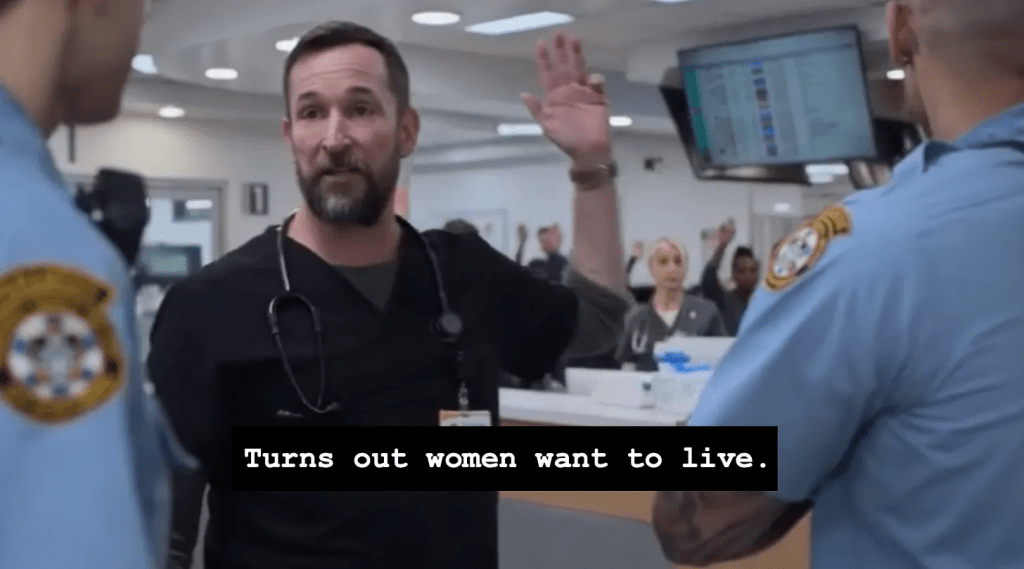
It’s a fictional scene (and in real life, public chastisement is certainly not the way to correct medical staff), but it highlights a very real problem we see every day.
If someone collapsed at a restaurant, would you start CPR? It turns out that for many people, the answer depends on the sex of the person who collapsed: women are less likely than men to receive CPR from a bystander (a nonmedical professional who is nearby) in public, and they are less likely to receive defibrillation (shocks that can restart the heart).
A Duke University study of more than 309,000 cardiac arrests found that women who had a cardiac arrest in public were 14% less likely to receive bystander CPR than men. This is true around the world, too.
And women are less likely to survive. Chest compressions and shocks in those first few minutes are critical, and bystander CPR can double to triple the chance of survival.
Researchers have asked the public why they think this happens, and the answers are striking:
While these fears may be common, actual cases of lawsuits against bystanders performing CPR are not—and Good Samaritan laws protect individuals genuinely trying to help in medical emergencies.
A 2020 review of CPR lawsuits in the U.S. found the vast majority of lawsuits were related to withholding CPR (not providing it). Lawsuits alleging harm from CPR were extremely rare (only 3 out of 170 cases), and all took place in medical facilities (not bystander CPR). The review found zero cases where a layperson was found liable for harm by providing CPR.
If someone is unresponsive and not breathing (or only gasping), start CPR. The basics are simple, and anyone can do it. Here’s a quick refresher:
(Note: this is for the general public, if you are health care provider, different guidance will apply.)
Women are less likely to receive CPR, less likely to be defibrillated, and less likely to survive cardiac arrest. The first few minutes after a cardiac arrest are the most critical, and CPR from someone like you significantly improves chance of survival. If someone isn’t responding and isn’t breathing, start chest compressions. Even if it’s a woman.
Love, KP
Thank you to Dr. Sarah Perman, emergency physician and cardiac arrest researcher, for reviewing this post!
Kristen Panthagani, MD, PhD, is completing a combined emergency medicine residency and research fellowship focusing on health literacy and communication. In her free time, she is a contributing writer for Your Local Epidemiologist and creator of the newsletters You Can Know Things and The Public Health Roundup. Views expressed belong to KP, not her employer.
Your Local Epidemiologist (YLE) is founded and operated by Dr. Katelyn Jetelina, MPH PhD—an epidemiologist, wife, and mom of two little girls. YLE reaches over 450,000 people in over 132 countries with one goal: “Translate” the ever-evolving public health science so that people will be well-equipped to make evidence-based decisions. This newsletter is free to everyone, thanks to the generous support of fellow YLE community members. (snip)
I was especially interested in the Justice Clarence Thomas comments, which I read, then became disinterested for reasons you’ll get if you read them. Lots of news of the day here.
A thin-skinned and prickly Defense Secretary Pete Hegseth went off on journalists in his press conference this morning, resorting to the classic “attack the messenger” defense to a unpopular war going poorly.
It’s not the first time Hegseth has succumbed to blaming a lack of patriotism among reporters for unfavorable headlines and critical reporting on a Middle East conflict ignited by the Trump administration. But today’s screed was striking for how it mixed the old worn-out reflexive questioning of the loyalty of reporters with biblical references that reflect Hegseth’s personal Christian nationalism:
“Sometimes it’s hard to figure out what side some of you are actually on,” Hegseth said. “It’s incredibly unpatriotic.”
In the decades since the Vietnam War, the Pentagon had haltingly moved away from the defensive crouch it often took in the face of criticism toward a more transparent and self-reflective public response to bad news. It was not always consistent and the backsliding was dramatic during periods of sustained setbacks, like in Iraq during the aughts, but the general trajectory was away from the kind of knee-jerk circle-the-wagons approach that Hegseth rolled out this morning.
Questioning the loyalty of journalists — or any regime critics — harkens to earlier dark eras of America history and to authoritarian regimes worldwide. But Hegseth’s diatribe came with a strong Christian twist, as he compared journalists to the Pharisees who rejected Jesus in the Bible:
“The Pharisees, the so-called and self-appointed elites of their time, they were there to witness, to write everything down, to record, but their hearts were hardened, even though they witnessed a literal miracle, it didn’t matter,” Hegseth said.
“They were only there to explain away the goodness in pursuit of their agenda. As the passage ends, the Pharisees went out and immediately held counsel against him, how to destroy him,” he continued.
“I sat there in church and I thought, our press are just like these Pharisees, not all of you, not all of you, but the legacy Trump-hating press, your politically motivated animus for President Trump nearly completely blinds you from the brilliance of our American warriors,” he added.
Hegseth — callow, reactive, driven by a warped theology of nationalism, and poorly grounded in history — personally represents a dramatic break from decades of training, education, and refining of a professional officers corps. In 15 months in office, Hegseth has done more to politicize the military than any secretary of defense in at least the last half century.
The accelerated pace of unlawful strikes against alleged drug-smuggling boats continued in the eastern Pacific, with the third such strike in the last three days. Three people were killed in the 51st strike of the U.S. campaign, bringing the death toll to at least 177 people.
Heather Cox Richardson draws a straight line from Lincoln’s assassination to Jan. 6 and the events of this week.
NBC News: “Anti-abortion advocates met with Justice Department officials Wednesday, just hours after the Trump administration fired prosecutors it accused of coordinating too closely with abortion-rights advocacy groups during the Biden administration.”
When all else fails and their election prospects look dire, Republicans fall back on various forms of racist appeals to solidify their base and wrong-foot Democrats. This year, top Texas Republicans have landed on Islamophobia as the racist appeal of choice. TPM’s Josh Kovensky reports on the ground from Grapevine, Texas, where he talks to right-wing activists who are back again to warning about Sharia law and portraying Muslims as an external threat to “real” Americans.
Too often, gullible national media outlets treat these racist effusions like an organic upwelling of nativism, rather than a calculated election year strategy. TPM, I’m proud to say, has never been suckered in.
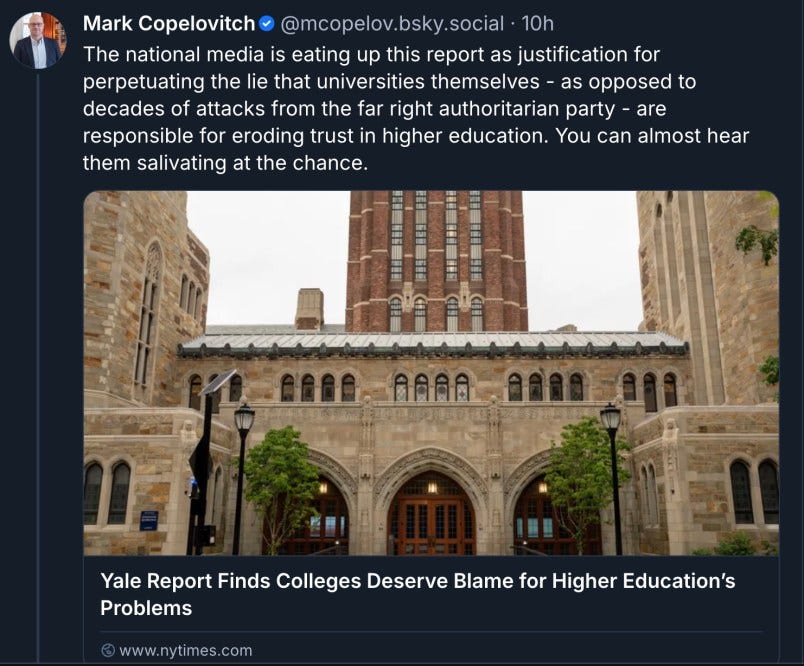
ProPublica offers a casebook study in the erosion of white-collar crime prosecutions under Trump II that includes the intervention of DOJ political appointees and the retention of a former Trump criminal defense attorney to outright kill one of the largest-ever cryptocurrency tax fraud cases.
“Hearing u/r in town. Wishing you would let me know. I could have made some excuses to get out and show u around. Please keep this private.”—Richard Chavez, father of Labor Secretary Lori Chavez-DeRemer, in a text to a young female staff member working for his daughter
Hot tips? Juicy scuttlebutt? Keen insights? Let me know. For sensitive information, use the encrypted methods here. (snip)

