ETTD, especially his economy. This is a story I’ve been wanting to post, but this and that come up, and it keeps getting buried in my Inbox. I actually got to it today, so I’m going ahead and posting it before it gets to be another month old.
When it comes to the queer bar in the wild, so many threats exist, and it’s only gotten worse in the past few years. Higher upfront costs combined with lower foot traffic have caused a nationwide problem for the service and food industries, which is exacerbated in queer spaces, which deal with smaller demographics than the average bar or restaurant. And of course, there’s the fact that many people, especially younger people, just don’t go out or have a third space anymore.
It’s hard to say whether anything can economy-proof the gay bar. In the past year alone, the U.S. has seen closures of long-running queer spaces, such as the Bay Area’s Ginger’s, which was open for 47 years, or Rochester, New York’s, Avenue Pub, which just inched past five decades of serving queers. New businesses aren’t exactly faring better, with bars such as Michigan’s General Wood Shop and Brooklyn’s Club Lambda having opened and closed within the span of just a couple years.
In some cases, a bar’s public frankness about its financial difficulties can prompt a community response that allows it to stay open. In the last few years, many struggling spaces have turned to sites such as GoFundMe to make ends meet, keep creditors at bay and continue to sling food, drink and community to its underserved patrons. (Efforts on the fundraising platform saved East Nashville’s Lipstick Lounge and Washington, D.C.’s As You Are.) And, of course, there are organizations such as the Lesbian Bar Project looking to not only document queer history, but keep these spaces vibrant. But just as important to fight for new and existing queer spaces is commemorating those that were lost, for a myriad of reasons, in the past year.
Club Lambda (Brooklyn)
After opening Lambda Lounge in Harlem, married couple Charles Hughes and Richard Solomon expanded their brand, and the creation of safe spaces for queer people of color, to Brooklyn with the opening of Club Lambda in Williamsburg in 2022.
“We saw that a lot of urban communities didn’t have a location that they could go to every night of the week,” Hughes told amNY in 2022. “Brooklyn didn’t have this, so we are opening Club Lambda.”
The club announced that it would close at the end of February in an Instagram post.
(snip-embedded Insta post on the page; I can’t grab it. Click the title above to go to the story page)
“The past 5 years have been nothing more than exciting as we have hosted some of the most iconic and memorable events New York has seen!” Club Lambda wrote in the post. “Servicing celebrities, socialites and many from all walks of life within the community has imprinted many memories for us to hold on to for years to come!!”
Upon announcement of its closure, many in the LGBTQ+ community, especially Black LGBTQ+ people, mourned the loss of a space owned by Black people that catered to a Black queer crowd.
Denver Sweet (Denver, Colorado)
After six years of operating in Downtown Denver, Denver Sweet closed its doors in July 2025, citing increased labor costs and less foot traffic in the bar, per the Denver Post. “This was an incredibly difficult decision to make, but we believe the time has come,” owners Randy Minten and Ken Maglasang said in a statement to the Post. “Creating and running Denver Sweet has been a dream come true for us — and saying goodbye is heartbreaking.”
(snip-Insta post)
Sweet celebrated its farewell with a bottomless mimosa lumberjack brunch featuring pancakes and unlimited mimosas, as well as performances from two local drag kings, per its final Instagram post. Not only did it feature an upstairs patio, it was, per the Post, one of the only bars in Denver that catered to the bear community.
Ginger’s (San Francisco)
Ginger’s closed permanently after a brief resurrection in 2024. The bar, which had previously closed, reopened for Pride 2024, per Eater San Francisco, but following financial hardship had to close permanently in late 2025, despite being the last LGBTQ+ bar in the city’s Financial District, per the San Francisco Chronicle.
Prior to its final closing, Ginger’s had operated in the Bay Area for 47 years. As with other closures, the owners cited dwindling bar traffic for the closure.
(snip-Insta post)
“The traffic to Ginger’s has not been consistently strong,” Future Bars Group, which operated Ginger’s, owner Brian Sheehy told SFGATE. “Without enough customer support, our staff don’t earn enough tips, and Ginger’s operates at a loss. We have struggled to get people into Ginger’s, despite the valiant efforts of our entire team and the great shows being put on by the performers.” Per SFGATE, Ginger’s first opened in 1978 by owner Don Rogers, who named the bar after actress Ginger Rogers due to their shared surname.
Eagle Houston (Houston)
When Eagle Houston closed this past summer, it took the Texas city’s residents by surprise. It had just hosted a spat of LGBTQ+ pride events in June before news of its close started to spread in local Facebook groups for the bear community, per the Houston Chronicle. What followed was mostly silence: neither the bar’s owner nor its social media pages responded to several requests for comment from the Chronicle. However, at the time of its closing, a notice to vacate had been posted on its front door, which had also been plastered with a sign noting various violations and boarded up with a solid wooden plank. The bar first opened in 1984.
Barracuda (New York City)
Open since 1995, Barracuda was known in New York City as a drag hotspot. (And if you were going to see a diva at Madison Square Garden, you’d walk a few blocks down to an afterparty most likely happening within.) Over three decades, the bar has seen the likes of Sherry Vine, Jackie Beat, Hedda Lettuce and others grace its stage.
“Thirty years is a very long time,” owner Bob Pontarelli said in a statement to Eater upon its closing. Pontarelli cited the opening of a condo project next door, and the accompanying construction, as the reason for the bar’s closure. “The damage from the construction has significantly affected the interior and overall operation of the bar.” The ongoing drilling meant there was “no way to anticipate the additional damage and risks that could arise in the future. It is impossible to conduct business as usual,” Pontarelli wrote.
This Is It! (Milwaukee)
When This Is It! closed its doors in 2025, it wasn’t just the shuttering of a Milwaukee queer staple. It was the closing of the oldest gay bar in the state of Wisconsin: This Is It! Had started operating in 1968. The bar announced its closure on its Facebook page on March 9, citing the COVID crisis as bringing a financial hardship from which the bar couldn’t recover, as well as an 8-month closure of the bar’s street and sidewalk in 2024.
“It’s with much sadness, but with so much love, we bid all of you farewell,” the bar wrote. “Take care of each other, and please continue to support local and queer-owned businesses.” Drag superstar Trixie Mattel even became a co-owner of the bar in 2021; at the time, she said that she bought it because she didn’t want to see it suffer the same fate as so many other queer havens post-COVID.
Under the announcement of the closing, many patrons were confused as to why the bar closed so suddenly, without a chance to either fundraise to keep the bar open or send it off with a farewell event.
Macri Park (Brooklyn)
New Yorkers were shocked to find out about the surprise closing of Brooklyn-based Macri Park in January without much notice. In an Instagram post in January, the bar had announced that it had already closed, giving bargoers nary a chance to celebrate or mourn the space.
(snip-Insta post)
Macri Park did not begin as a gay bar, first starting at a dive bar before ownership passed to the same person who owned nearby Metropolitan, per Greenpointers, in 2015. From then on, Macri became a gay bar with a new aesthetic. When the bar shared news of its closing on social, many local drag icons flew to its comment section to mourn.
“The doors may close,” wrote drag queen Bible Girl, “but i’m still in the walls.”
The Ruby Fruit (Los Angeles)
The Ruby Fruit, a lesbian wine bar located in Los Angeles’s Silver Lake neighborhood, announced in January 2025 that it would close its doors; though the bar had been struggling financially for some time, business paused and then dropped precipitously during and after the LA wildfires, per Eater. “When we’re talking about being vulnerable, the line is so thin between being able to carry on and not,” owner Mara Herbkersman told the outlet. “It became really clear after two days of being open that if we were to go on one more day, we would run the risk of not being able to pay our employees, a nonnegotiable for us.”
News of the bar’s closure sent shockwaves throughout the Los Angeles sapphic community as well as the queer internet. It also spawned considerable drama. After crowd-sourcing funds to stay open, the bar finally closed, per the Washington Blade, leaving some to wonder where the community aid it had asked for had gone. After its abrupt closing, former employees spoke candidly with the Blade about lingering and long-running financial affairs that predated the fires and alleged mistreatment at the bar. There was also some alleged clash over whether the bar was a “lesbian bar” versus a “sapphically-inclined” bar that was ultimately for everyone, per one employee who spoke to Eater.
Also, several trans and POC patrons reported feeling unwelcome in the space. “I don’t think they purposefully didn’t include them,” Sienna Deadrich, a former line cook at The Ruby Fruit told Eater. “But from the perspective of someone who is POC and trans, it was very clear that they didn’t include them.”
Avenue Pub (Rochester, NY)
Citing concerns both economic and safety-related, Avenue Pub in Rochester, New York, shut its doors after five decades in business. “You know, just the economic times right now. Monroe Avenue and the violence on the weekends,” owner Peter Mohr told WHEC. “It’s just, it’s making a very unsafe place for my consumers.”
(snip-Insta post)
Mohr elaborated in an Instagram post issued on its final day open. “If I had more resources to keep it going, I absolutely would,” Mohr wrote. “But the reality is that I’ve invested my life savings into these businesses — and I may never see that return.”
General Wood Shop (Grand Rapids, Michigan)
General Wood Shop got its name from the furniture store that used to occupy its space in the 1940s. When it opened in 2023, the bar was hoping to bring an LGBTQ+ space to Grand Rapids, Michigan. By the time it closed, it had succeeded.
(snip-Insta post)
“When we opened in July 2023, our dream was to create a place where everyone could feel welcome, safe, and celebrated,” the bar wrote on its social media post announcing its closure. “Together, we built more than a bar; we built a community we will always be proud of.” The bar did not give a reason for its closure on Instagram, nor did it offer one to local news affiliate WoodTV.
City Side Lounge and Kurt’s Place (Tampa)
In an extremely rare occurrence, two separate bars in the same space closed their doors within the same year. After City Side Lounge closed in March, Kurt’s Place opened up in the former venue in August, then finally announced its permanent closure in November, per Watermark Out News.
When City Side announced that it would close in February, local talent bemoaned the loss of the space, which was especially known as a haven for Tampa’s Latinx community. One DJ, DJ Manne, even posted that the bar’s Latin Night would continue in another venue.
Prior to its closure, the Facebook page associated with Kurt’s Place posted a notice from the building’s landlord stating that Kurt’s owed more than $30,000 in rent and past due fees.
March 25, 1807 Great Britain abolished international trade in slaves. Emancipation of slaves in the country, however, did not occur until 1834, and persisted as unpaid apprenticeship for the technically emancipated for years after that. The story of abolition in England
March 25, 1872 Toronto printers went on strike for a 9-hour workday and a 54-hour workweek—the first major strike in Canada. When the editor of the Globe newspaper had thirteen of them arrested, 10,000 turned out to support them. Later that year unions were made legal in Canada.
March 25, 1894 In the midst of a depression that had begun the previous year, a millionaire businessman from Massillon, Ohio, Jacob Coxey, organized a march of an “industrial army” from Ohio to Washington, D.C. Congress had done little in response to the economic crisis and Coxey advocated a range of solutions, many considered radical at the time, such as building roads and other public works (known as infrastructure today). Coxey’s Army passing through Mayland on their way to Washington. Coxey is seated behind the horses looking at the camera. “Coxey’s Army” gathered on the Capitol lawn but they were driven off and Coxey was arrested for trespassing when he tried to deliver his address to the crowd in violation of their first amendment rights “peacably to assemble, and to petition the Government for redress of grievances.”
March 25, 1911 The Triangle Shirt Waist Company, occupying the top floors of a ten-story building on New York’s lower east side, was consumed by fire. 147 people, mostly immigrant women and young girls working in sweatshop conditions, lost their lives. Approximately 50 died as they leapt from windows to the street; the others were burned or trampled to death, desperately trying to escape via stairway exits illegally locked to prevent “ the interruption of work.”Company owners were charged with seven counts of manslaughter—but were found not guilty.The incident was a turning point in labor law, especially concerning health and safety. For three days prior, the company, along with other warehouse owners, had grouped together to fight the Fire Commissioner’s order that fire sprinklers be installed. Protests in the wake of the Triangle Shirtwaist fire, button from the struggle Comprehensive collection of materials on the tragedy from Cornell University’s labor school
March 25, 1915 The Sisterhood of International Peace was founded in Melbourne, Australia, by Eleanor May Moore and Dr. Charles Strong.
March 25, 1965 Their numbers having swelled to 25,000, the Selma-to-Montgomery marchers arrived at the Alabama state capitol.Organized by the Southern Christian Leadership Conference (SCLC) and the Student Nonviolent Coordinating Committee (SNCC), the march was to bring attention to the denial of voting rights to black Americans in the state and elsewhere in the south. Twice the people had been turned back, denied the right to leave Selma peacefully. Martin Luther King Jr. and wife Coretta lead march into Montgomery, Alabama. Dr. King spoke to the crowd: “Yes, we are on the move and no wave of racism can stop us. (Yes, sir) We are on the move now. The burning of our churches will not deter us. (Yes, sir) The bombing of our homes will not dissuade us. (Yes, sir) We are on the move now. (Yes, sir) The beating and killing of our clergymen and young people will not divert us. We are on the move now.” The Federal Voting Rights Act was passed within two months. The Selma to Montgomery National Historic Trail
March 25, 1965 Viola Liuzzo Viola Gregg Liuzzo, a housewife and mother from Detroit, driving marchers back to Selma from Montgomery, was shot and killed by Ku Klux Klansmen from a passing car. She had driven down to Alabama to join the march after seeing on television the Bloody Sunday attacks at Selma’s Edmund Pettus Bridge earlier in the month. It was later learned that riding with the Klansmen was an FBI informant, Gary Rowe. More about Viola Liuzzo Viola Gregg Liuzzo
March 25, 1967 Reverend Martin Luther King, Jr. led an anti-war march for the first time in Chicago, opposing the Vietnam War by saying: “Our arrogance can be our doom. It can bring the curtains down on our national drama . . . Ultimately, a great nation is a compassionate nation The bombs in Vietnam explode at home—they destroy the dream and possibility for a decent America . . . .” Reverend King addresses rally at the end of the Chicago march photo: Jo Freeman
March 25, 1969 The newly wed John Lennon and Yoko Ono-Lennon began their seven-day “bed-in for peace” against the Vietnam War in the presidential suite of the the Amsterdam Hilton in The Netherlands. Their doors were open to the media from 10am to 10pm. They invited all to think about and talk about creating peace. “Yoko and I are quite willing to be the world’s clowns, if by so doing it will do some good”. The Wedding and “Ballad of John and Yoko”
March 25, 1972 30,000 participated in the Children’s March for Survival in Washington, D.C., sponsored by the National Welfare Rights Organization. They were supporting the Family Assistance Program, then pending in Congress (but never passed), which guaranteed a minimum income level for all families.
March 25, 1990 A new community, Segundo Montes, was started by campesinos in El Salvador who had lived for nine years as exiles in Honduras following the El Mozote Massacre, when 1000 civilians were killed by the U.S.-trained Salvadoran military. The town was named after a priest who had helped them in the Colomoncagua refugee camp on the border, and who was murdered along with four other Jesuit priests by the Salvadoran military.
Hi Everyone. Sorry for no posts except from my phone and later from my tablet which I have to carry a backup power supply and cord with me now to doctors appointments as my old pad has a battery life of less than 10 minutes. A new Ipad is not a priority for our money right now even the cheapest one. Ron needs heart surgery, Ron needs cataract surgery, I need both new glasses and cataract surgery, and the van still has an oil leak. Plus Kamyk has basicly given up and slipped into depression. He had an apartment open up that he needed first/ last / and security for which came to $900 a month. It was government-subsidized housing. But because he is in long term care now the nursing home took all his SSI, leaving him with no money. Plus he no longer gets physcial therapy so he is slowly losing the ability to walk again. His sister started a go fund me but he forbade her to tell me about it. He felt we had all done too much for him and did not want me or you people to think he was trying to milk us or be greedy.
In a way I am glad he did not tell me until it was too late because I worry that as he can’t walk well, doesn’t drive, and did not know how long it will take to get his SSI back, that he wouldn’t be able to care for himself and so would be homeless in two months. The nursing home he is in is really nice compared to the last one which was abusing him emotionally, physically, and even sexually because the nurses decided he needed Jesus in his life and he rejected that being forced on him. So they were going to abuse him until he relented and came to their Jesus. This one gives him his medications on time, changes his ostomy bag or helps him do it, and they have been nice / kind to him. I understand his frustrations having to share a room with another person and basicly having no privacy but… the US government / wealthy don’t care about people in a land where profit is king.
I got up at 4:20 to feed the cat who when he thinks he needs food howls to get one of us up. I decided to stay up and watch the recorded news that I did not get to watch yesterday. I was not well at all yesterday, highly stressed which has been the situation for a while. My doctors were clear and Ron reminded me that my body breaks down under stress, and I am to be under as little stress as possible. That is not possible and has not been for a while. When I woke yesterday it was already much later than normal for me. Ron said he could tell I was having a bad night, I was highly agitated. I had gotten up at 2 am with a huge contracture, a “cramp” in the large side muscle in the upper part of the leg. I managed to get out of bed but couldn’t straighten out my leg. I spent 30 minutes moving around the bed holding on to the dresser and the end of the bed, leaning over to put weight on the leg, then removing it. Eventally I got it to touch the floor and hold some weight so I limped to my office and got a cane, then went to the bathroom which was a critical need by then. Ron never woke up and was upset I did not wake him. Not much he could do that I did not know to do myself.
When I got up with Ron at 7 I still couldn’t move or use the leg which was being electrified from the knee down, I couldn’t bend the leg due to the muscle still hurting from the cramp. I was swinging the leg forward and walking “peg legged” with a cane. Ron realized something was wrong and had me take my blood pressure and pulse. My blood pressure was extremely high. My pulse was also far too high. So high he asked me to take another dose of my blood pressure and heart rate medications. Ron had me sitting and checking it every ten minutes. It was not coming down and the first news show I started watching made it worse. So as I as them recorded I went back to bed until noon.
The reason for so much stress is Ron. He had his new medication Saturday that opens the arteries so he was better Sunday, but all day friday and Saturday I had to watch him and deal with him. He was exstrememly forgetful, unable to work his computer, he would sit in his recliner and fall asleep even during a conversation. He has bad sleep apnea and so he has to have his CPAP machine anytime he goes to sleep. But even in the bed he was forgetting to put it on until reminded. I offered to move it out to his chair but he would promise not to fall asleep as he just wanted to watch a few things on TV, 2 minutes later he was asleep. I would make him go to bed and I stay there until he had his CPAP on. I don’t dare let him drive like this so I am doing all the driving and shopping now. I am doing the dishes so he doesn’t exsert himself and the last time he washed the dishes he put everything away in the worng drawers not even realizing he was doing it. So yesterday afternoon while he slept I did the dishes. He cooked a porkloin last night so I have a bunch of dishes to do when I get home. I did pick everything up and rinsed everything off / out so it should be easier than it could have been.
I have a doctor’s appointment this morning and I have to go with Ron as you can see to his new heart surgeon on Wednesday morning, which I have to look up and see where he is. I am tired people. I went to bed at 5 yesterday but kept getting up to check on Ron as he was in his recliner and I wanted to make sure he was not sleeping. Care of the cat has totally fallen to me now. I asked him if he could clean the cat litter box before he came to bed. He assured me he would so I went to bed. And he did not do it as he forgot. I did it when I woke up. Randy is sick after just having surgery, his parents are both sick / ill. Ron is teetering with the same thing that killed his brother-in-law. And I am worried and scared.
When I get the dishes done today I will try to get to the wonderful comments and reply to somethings Ali posted which I appreciate. Ali has really stepped up and is posting more to give everyone something on the blog to read and engage in. I can’t say how much I am grateful for that. Got to go. Hugs
Plus, AI is a subject of current event interest. (Lookin’ at autocorrect programs…)Meanwhile, I got a great deal of nerdy pleasure reading this, and I hope all who read, do as well!
A new exhibition at Yale Library explores the history of typos across five centuries. Visitors will see corrections that were listed inside copies of works by James Joyce, Upton Sinclair and Nicolaus Copernicus
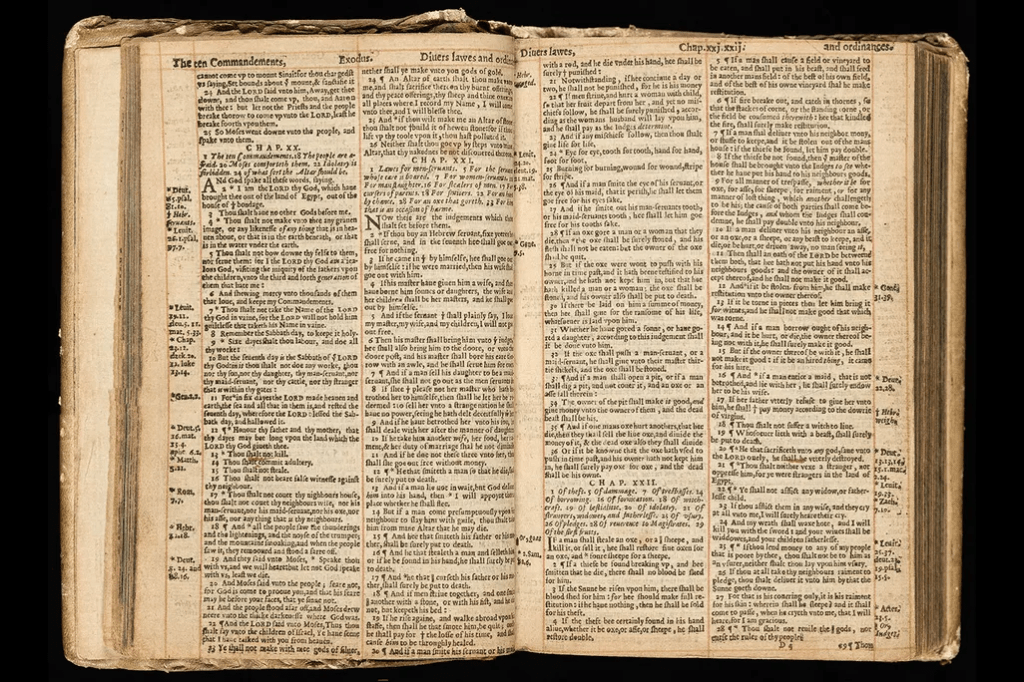
A 1631 copy of the Bible that includes the text “Thou shalt commit adultery.” Beinecke Rare Book and Manuscript Library
James Joyce wrote the manuscript of Ulysses with a steel pen over seven years. By his typists’ accounts, the Irish author’s penmanship was atrocious, and his revisions were overwhelming. When the book was published in 1922, it was full of mistakes. In a letter to his wife, he wrote, “The edition you have is full of printer’s errors.”
The following year, Joyce’s editors compiled a massive list of the book’s errors to be fixed in new editions. Joyce rejected some of the corrections, saying, “These are not misprints but beauties of my style hitherto undreamt of.” Even so, some future printings of the book came with a seven-page errata sheet listing more than 200 mistakes.
Errors like those in Ulysses are the subject of a new exhibition at Yale. “‘Beauties of My Style’: Errata and the Printed Mistake,” which opens at the university’s Sterling Memorial Library on March 30, examines the history of typos across five centuries.
“What we found was that errata sheets were not only spaces for corrections but also sites of humor, legal maneuvering and reinterpretation,” Rachel Churner, a visual studies scholar at the New School and the exhibition’s co-curator, tells Artnet’s Min Chen. “With this exhibition, we wanted to share ways in which even small corrections can reshape meaning and authority.”
According to a statement from the library, “errors committed” lists first appeared in the 15th century. Authors slipped these lists—containing typos, additions and apologies—into the backs of books after publication. The exhibition examines errata lists alongside their companion texts, examining themes of “censorship, misrepresentation, intervention and instability,” per the statement.
An errata slip from an early printing of James Joyce’s Ulysses Beinecke Rare Book and Manuscript Library
The exhibition spotlights around 30 artifacts from the collection of Yale’s Beinecke Rare Book and Manuscript Library. Items on display include “inaccurate maps, book corrections and religious texts with very grave typographic blunders,” reports Artnet.
In addition to the errata slip from Ulysses, visitors can see several other 20th-century examples, including a self-published copy of Upton Sinclair’s 100 Percent: The Story of a Patriot, in which he “mistakenly identified a founding member of the Communist Party of America as a government agent,” per Fine Books & Collections. Also on view is a fold-out errata from Allen Ginsberg’s 1968 Airplane Dreams. According to the statement, he included the error sheet as a “legal strategy for political resistance.”
Churner and her co-curator Geoff Kaplan, a graphic designer at the Yale School of Art, co-founded the publishing company No Place Press. As they researched errata at the Beinecke, they found “unexpected poetry,” Churner tells Artnet.
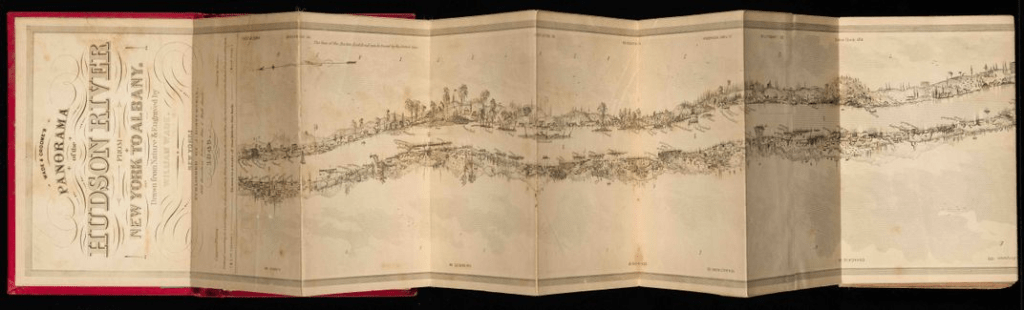
Wade & Croome’s Panorama of the Hudson River From New York to Albany, published in 1846, listed Fishkill Village’s population as 11,000 instead of 800. Beinecke Rare Book and Manuscript Library
The exhibition features an infamous 1631 edition of the Bible, which lists “Thou shalt commit adultery” as the Seventh Commandment. (The omission of the word “not” earned this edition the nickname “the Wicked Bible.”) By the time the mistake was discovered, 1,000 copies had been printed. The British king Charles I reprimanded the publishers, fined them £300 and stripped them of their printing license. In the centuries that followed, rumors circulated speculating that a rival printer had introduced the error. But as Chris Jones, a medieval studies scholar at the University of Canterbury in New Zealand, told the Guardian’s Eva Corlett in 2022, the more likely explanation is that the printers hadn’t wanted to spend money on copy editors.
Nearly all the Wicked Bibles were destroyed, and only about 20 known copies survive. In the copy on view at the Beinecke, someone fixed the error by hand, adding “not” to “Thou shalt commit adultery.”
In some cases, corrections have been used to influence public perception. During the Reformation in the 16th century, books were released describing “mistranslations” of Protestant and Catholic Bibles, “mobilizing the errata well beyond a list of typographic corrections,” Churner tells Artnet.
Plat Maps of Appanoose County, Iowa, 1986 Beinecke Rare Book and Manuscript Library
Many other errors, however, are simple mistakes. For example, the exhibition features a 1986 book of Iowa maps with a note correcting a mislabeled township. “Dear Sir, or Madam,” it reads, “We goofed in the Appanoose County Plat Book.”
The sexual abuse allegations against Chavez have rocked them. But their focus is still on protecting other women.
This story was originally reported by Chabeli Carrazana, Shefali Luthra and Marissa Martinez of The 19th. Meet Chabeli, Shefali and Marissa and read more of their reporting on gender, politics and policy.
Monica Ramirez has spent much of her life spotlighting the pervasiveness of sexual violence against women farmworkers. She, like many in that movement, considered civil rights leader Cesar Chavez an icon.
Since allegations came to light this week that Chavez sexually assaulted women and girls as young as 12 — including fellow movement leader Dolores Huerta — Ramirez and the larger farmworker community have been left reeling. Now, they’re trying to reconcile how this man who so many revered — whose name is on streets, schools and even a holiday — could perpetrate the violence that has plagued women farmworkers for decades.
The community has been “shaken to its foundation,” said Ramirez, the founder of Justice for Migrant Women, a civil rights organization focusing on farmworker and migrant women. She and other leaders are now trying to push forward the farmworker movement and continue the work that many women — not just Chavez — spearheaded.
Monica Ramirez, founder of Justice for Migrant Women, said the farmworker community has been “shaken to its foundation” by the allegations against Cesar Chavez. (Courtesy of Monica Ramirez)
“The farmworker movement is a leaderful movement, and women have always been part of that leadership,” Ramirez said. But their work has often been made invisible, sometimes by the very men who stood beside them in building worker power for Latinx people in the United States.
“In order to have a movement, in order to have a boycott, in order to organize any kind of action, it’s often women who are helping to organize the meetings, helping to bring their compañeras,” Ramirez said.
Chavez was one of the most revered figures in the Latinx civil rights movement. The labor leader cofounded what became the United Farm Workers union alongside Huerta, and was most known for a series of strikes and protests that grew unionization efforts across California. After Chavez’s death in 1993, he was posthumously awarded the Presidential Medal of Freedom, the nation’s highest civilian honor. In 2014, former President Barack Obama designated his birthday, March 31, as a federal holiday to celebrate his legacy, which many states had already marked.
Now, many of those celebrations are being canceled or renamed after a bombshell, yearslong investigation published by The New York Times Wednesday found evidence of a pervasive pattern of sexual abuse perpetrated by Chavez. Two women said Chavez sexually abused them for years as girls, when the organizer was in his 40s and had already become a powerful global figure. Ana Murguia said Chavez first assaulted her when she was 13; Debra Rojas was 12.
In the years following the abuse, both suffered from depression, panic attacks and substance abuse.
“I feel like he’s been a shadow over my life,” Rojas told the Times. “I want him to stop following me around. It’s time.”
Huerta, the renowned activist who coined the rallying cry, “Sí, se puede,” spoke at length about emotional and physical abuse from her longtime organizing partner — a disclosure she had never made publicly. She told the Times that he raped her in a secluded grape field in 1966, and had pressured her to have sex with him another time during a work trip in 1960. Both encounters resulted in children. Huerta concealed the pregnancies and arranged for the baby girls to be raised by others.
She was shaken upon hearing the allegations from other women, and told the Times she struggles to reconcile the man she knew and the one who assaulted her.
Labor leader and civil rights activist Dolores Huerta sits during an interview in San Francisco, Saturday, June 8, 2024. Huerta revealed she was raped by Cesar Chavez and pressured into sex during their years organizing together, disclosures she kept private for decades while building the farmworker movement. (Stephen Lam/San Francisco Chronicle/AP)
In a statement released Wednesday, Huerta said she carried her secret for 60 years because “building the movement and securing farmworker rights was my life’s work. The formation of a union was the only vehicle to accomplish and secure those rights and I wasn’t going to let Cesar or anyone else get in the way.”
She said she spoke up because she learned there were others coming forward.
“The farmworker movement has always been bigger and far more important than any one individual. Cesar’s actions do not diminish the permanent improvements achieved for farmworkers with the help of thousands of people,” she said. “We must continue to engage and support our community, which needs advocacy and activism now more than ever.”
Magaly Licolli knew exactly what Huerta was talking about in her statements about Chavez.
Licolli is the co-founder and executive director of Venceremos, an organization advocating for poultry workers in Arkansas, and she’s heard stories about sexual harassment and assault on women for years.
Before she started Venceremos, she was fired from another poultry worker organization after speaking up about multiple accusations of sexual harassment and assault against a well-known organizer.
“Women came forward and accused the organizer of sexually assaulting them or sexually harassing them. When I brought that to the board, they didn’t believe it,” Licolli said. “I had to stand with the women … I cannot do this work pretending I’m doing justice when I’m hiding injustice.”
Licolli felt that echoed this week.
“Women of color, we are not trusted on what we go through. We have to prove with pictures, with testimony, our own stories for our own stories to be validated,” she said. “I’m happy that now it’s something that people are talking about, and I’m happy that people are now reflecting about what is the role of women in the movement and when we have to be silenced toward that kind of injustice to protect the work that we do.”
Magaly Licolli, co-founder of Venceremos, pointed to a pattern in organizing spaces where women who report abuse are doubted, ignored or pushed out. (Courtesy of Magaly Licolli)
A growing share of farmworkers are women, according to the U.S. Department of Agriculture: about 26.4 percent in 2022, the most recent year for which data is available. Most are Latina.
A 2012 report by Human Rights Watch, an advocacy organization, found that women farmworkers are often at risk of sexual harassment or assault, with virtually every worker interviewed for the report saying they either had experienced harassment or assault or knew someone who had. Farmworkers work in mixed-gender settings, and they have limited worker protections But women typically lack avenues to report their experiences, the report’s authors wrote, in large part because of immigration status. As of 2022, most farmworkers were immigrants without U.S. citizenship.
“Sexual violence and harassment in the agricultural workplace are fostered by a severe imbalance of power between employers and supervisors and their low-wage, immigrant workers,” the report said.
A 2024 review published in the Journal of Agromedicine suggested that as many as 95 percent of women farmworkers in the United States have experienced workplace sexual harassment.
None of the women in the Times story spoke publicly until recently because of the shame and fear associated with reporting abuse against prominent organizers.
But over the past decade, after the growth of the #MeToo movement and the release of millions of Epstein files that have implicated numerous people in powerful positions, survivors have been more willing to speak up about their experiences.
Ramirez, who also founded the public awareness campaign known as the Bandana Project to raise awareness of sexual violence against farmworker women, said she now expects more women to come forward with their own stories. At an event Wednesday night shortly after the news broke, she said one woman came up to her to tell her how sexual assault was a problem in the fields where she worked as a teenager.
“Now that we understand clearly that this issue of sexual violence is an endemic problem in our society … the question we have to answer is: Knowing that, how serious are we going to get in our commitment to ending the problem?”
California lawmakers already plan to change the name of Cesar Chavez Day on March 31 to “Farmworkers Day,” and efforts are underway to remove his name from landmarks. But the real work to come will be about investing resources and support to improve the culture that has protected perpetrators in organizing spaces over victims.
Rep. Delia Ramirez, an Illinois Democrat who worked in organizing before entering politics, said it was “devastating” that the claims took so long to come out. She said when she became an executive director of a nonprofit at 21, she, too, had faced situations that in hindsight were not appropriate, and left the organization with a responsibility to create safer environments for other young women.
“Oftentimes women, especially women of color, we end up having to hold so many things for the sake of the movement, family, community,” Delia Ramirez told the 19th. “I don’t believe that there is one hero for our movements. Movements are led by a collective, and you can’t create some pedestal for one person, because humans will always fail you.”
Rep. Delia Ramirez said movements are led by a collective and warned against placing any one individual on a pedestal. (Allison Bailey/NurPhoto/AP)
Moving forward, Monica Ramirez said people will be watching how leaders in the farmworker movement respond to the allegations. Do they take a defensive posture or question the veracity of the survivors’ accounts? The revelations about Chavez come at a time when sexual misconduct by powerful men has been in the spotlight, all while the country grapples with a wave of immigration enforcement actions that are targeting Latinx people.
Licolli, the poultry organizer, said she has “never romanticized the immigrant community and the immigrant movement.” Sexual abuse happens in every movement and it doesn’t negate the work that’s been done to secure worker power, she said.
And for the farmworker women who are leading this work, it feels more urgent than ever that they continue leading.
Rosalinda Guillen, a farmworker and organizer in Washington state, leads Community to Community Development, an explicitly feminist and women-led organization — a perspective that she said lends itself to advocating for workers who are also parents, and that she said offers space for women farmworkers to assert their needs.
Guillen never met Chavez but was inspired to devote herself to organizing on behalf of farmworkers after his death. The news has been a “revision of everything that many of us know about the farmworker movement,” she said.
Her organization is removing images of Chavez from its office, Guillen said. “We revisited our values and principles in how we work together, reiterating there is no room for that,” she said, referring to sexual misconduct.
On Wednesday, while staff were still processing the reports, five farmworkers walked in. They had just lost their jobs.
Her staff switched gears, turning to figure out what those workers needed and how they could support them.
“They walked in reminding us this is the focus,” Guillen said. “This is why we’re here: To protect farmworkers.”
I haven’t made a Women’s History Month post in a while; it’s difficult to feel celebratory in the face of what both very bad men and women are doing in our names in the US these days. However, to make up for being remiss in re-recording history, please accept this post about Rose O’Neill. I first learned of her when my grandparents moved to Springfield, MO in 1970, and took us to her small museum at the small, then-non-commercial Shepherd Of The Hills area. (It was great back then!) I knew of Kewpies (I don’t care for the cutesiness, but they are art nonetheless,) but had no idea a woman created them, nor that she did so much art right in the area where we were then living. I began to be a fan, but sort of let it go as I got older. Below will be a PBS documentary that is excellent, and inspired me to make this post for March 21st. There is also some other info. Enjoy, and remember, we all have history, and it doesn’t go away just because someone makes it more difficult to find (yes, that is encouraging myself as well as readers who’ve made it this far!)
Here is a link with a snippet, about the museum now in Walnut Shade, MO. I bet all the things I remember will be there. Maybe I’ll make it over there and try again.It looks far less commercialized than Shepherd of the Hills last time I was there.
Bonniebrook is a historic home and museum located in Walnut Shade, Missouri, just a short drive from Branson. Our museum is dedicated to preserving the life and legacy of artist, writer, and activist Rose O’Neill, best known for her creation of the Kewpie dolls.
Bonniebrook Museum features Rose’s original drawings, paintings, and sculptures, artifacts from the O’Neill home, a large collection of Kewpies and other characters, the O’Neill family cemetery, and much more!
As one of the only art museums and historical homes in the Branson area, Bonniebrook is a must-see destination for those looking for things to do in Branson, Missouri and the surrounding areas. Come visit this well-preserved piece of history!
Mission Statement: Bonniebrook Historical Society (BHS) was founded in 1975. Its purpose is to collect, preserve, and make available for educational and historical purposes artifacts, documents, personal items, and any work or items directly relating to the history and life of Rose O’Neill. In addition, BHS accumulates research, materials that document, authenticate, explain, and provide detailed information about the character, personality, and accomplishments of the talented and generous Rose O’Neill.
Madrid traffic lights to promote gender equality and LGBT toleranceBen Vine
Thirty-nine percent of U.S. adults still believe homosexuality is “morally unacceptable,” according to a new report from the Pew Research Center published last week.
Pew researchers surveyed a representative sample of 3,605 adults in the U.S. last March, as part of a study about moral attitudes in 25 different countries, according to the report. Respondents were asked whether they believed certain behaviors — including homosexuality — were morally acceptable, unacceptable, or not a moral issue. (In U.S. surveys, the word “unacceptable” was changed to “wrong.”)
Within the U.S. sample, 39% viewed being gay as morally wrong. That placed the U.S. ninth among all countries surveyed by rate of anti-gay sentiment, between Israel (47%) and Hungary (34%). There was a slight net shift upward compared to Pew research from 2013, which found 37% of adults in the U.S. believed homosexuality was immoral.
Researchers did find significant differences in opinion between demographics, however. Sixty-two percent of U.S. women said it was acceptable or not a moral issue to be gay, compared to 56% of men. Disapproval also skewed older, with 43% of U.S. adults 40 years old or older saying homosexuality was unacceptable, compared to 33% of those aged 18-39. People with lower levels of formal education were also more likely to disapprove of all the behaviors surveyed, which included getting an abortion, gambling, and watching pornography.
The largest gaps in acceptance appeared to be based on religiosity. Fifty-eight percent of U.S. adults who said they pray daily disapproved of being gay, compared to just 24% of those who said they pray less often or not at all. That was especially true for Christians, who were “often among the most likely to consider each of the nine behaviors to be morally unacceptable,” researchers noted. In Nigeria, one of several African nations where U.S. evangelical groups have heavily influenced anti-gay laws and public opinion over the past two decades, 96% of respondents said being gay was immoral. (The most gay-accepting countries of the 25 surveyed were Germany and Sweden, where only 5% said homosexuality was unacceptable.)
The government wants to ban care nationwide, and hospitals are shutting down treatment. Parents just want it all to stop.
The Pew questions specifically asked respondents for their views on homosexuality, rather than the broader LGBTQ+ umbrella, and did not ask about transgender people. A Pew survey of LGBTQ+ adults in the U.S. last year found that most believed attitudes toward gay, lesbian, and bisexual people were becoming more positive, but that acceptance of trans people had declined.
The new Pew report also found that the U.S. was the only country where a minority of respondents (47%) viewed their neighbors as “very” or “somewhat” morally good. Democrats and left-leaning independents were more likely to view other citizens as morally bad, researchers noted, but that trend was also true for people outside the U.S. who did not support their country’s governing party. Overall, the U.S. is “in the middle of the pack” on most behaviors surveyed and was not uniquely judgmental, researchers noted, though U.S. respondents were generally less approving of extramarital affairs than most other countries and more positive about marijuana use than any country other than Canada.
Samantha Riedel is a writer and editor whose work on transgender culture and politics has previously appeared in VICE, Bitch Magazine, and The Establishment. She lives in Massachusetts, where she is presently at work on her first manuscript. … Read More
Today, I have Zoia Horn in mind especially, but it’s a really busy day in Peace & Justice History, with lots to inspire and motivate us, and most of that is below. (I wish we could put small images side by side, or else that I could figure out WP’s preferred method for that.)
March 16, 1190 The entire Jewish community of York, England, perished while observing Shabbat ha-Gadol, the last sabbath before Passover. Gathered together inside Clifford’s Tower, the keep of York’s medieval castle, for protection from the violent mob outside, many of the Jews took their own lives; others died in the flames they had lit, and those who finally surrendered were massacred and murdered. Clifford’s Tower This occurred just after the beginning of the Third Crusade. “Before attempting to revenge ourselves upon the Moslem unbelievers, let us first revenge ourselves upon the ‘killers of Christ’ living in our midst!”
March 16, 1827 The first newspaper owned and edited by and for African-Americans, Freedom’s Journal, was published in New York City. It appeared the same year slavery was abolished in New York state. two of the early founders of Freedom’s Journal
March 16, 1921 The War Resisters International was founded with sections set up in Great Britain, the Netherlands, Germany and Austria. By 1939 there were 54 WRI Sections in 24 countries, including the U.S.. WRI No More War demonstration in Berlin 1922 Their symbol: a broken gun.Their slogan: “The right to refuse to kill.” Their founding statement WRI today
March 16, 1968 U.S. troops in South Vietnam killed 504 Vietnamese civilians at My Lai, a pair of hamlets in the coastal lowlands of Quang Ngai Province. The victims were from 247 families, completely eliminating 24 of them, three generations with no survivors. Among the dead were 182 women, 17 of them pregnant, and 173 children, including 56 infants, and 60 older men. Young girls sheltering behind their mother during My Lai Lt. William L. Calley, Jr. commanded the men of Charlie Company, First Battalion, Americal Division, and was the only one tried out of 80 involved in what is called the My Lai Massacre. The Army, including a young Major Colin Powell, at first tried to cover it up and the media resisted reporting it. Some of Calley’s soldiers refused to participate, but only 24-year-old helicopter pilot Hugh Thompson and his crew stopped it by putting themselves between the villagers and the troops pursuing them.Chief My Lai prosecutor William Eckhardt described how Thompson responded to what he found when he put his helicopter down: “[Thompson] put his guns on Americans, said he would shoot them if they shot another Vietnamese, had his people wade in the ditch in gore to their knees, to their hips, took out children, took them to the hospital…flew back [to headquarters], standing in front of people, tears rolling down his cheeks, pounding on the table saying, ‘Notice, notice, notice’…then had the courage to testify time after time after time.” Lt. William L. Calley Some of Calley’s soldiers refused to participate, but only 24-year-old helicopter pilot Hugh Thompson and his crew stopped it by putting themselves between the villagers and the troops pursuing them. Warrant Officer Hugh Thompson Hugh Thompson’s story (An archived NYT piece that still wants a sign-in/up) More on My Lai 2015 article by Seymour Hersh who broke the original story:
March 16, 1972 Reference librarian Zoia Horn refused to testify against the Harrisburg Seven who were on trial for an alleged conspiracy to kidnap then-National Security Adviser Henry Kissinger. Five of the seven were current or former Catholic priests or nuns. Horn had been implicated by an ex-convict informer placed in the Bucknell University library by the FBI. Reference librarian Zoia Horn Though given immunity from self-incrimination, Zoia objected to the idea that libraries could become places of infiltration and spying. Charged with contempt of court, she was sent to jail for 20 days until a mistrial was declared.
Judith Krug, longtime director of the American Library Association’s Office of Intellectual Freedom, said that Horn was “the first librarian who spent time in jail for a value of our profession.”At the trial she asked to read a statement of explanation, but was led away in handcuffs before she had begun her third sentence: “Your Honor, it is because I respect the function of this court to protect the rights of the individual, that I must refuse to testify. I cannot in my conscience lend myself to this black charade. I love and respect this country too much to see a farce made of the tenets upon which it stands. To me it stands on freedom of thought—but government spying in homes, in libraries and universities inhibits and destroys this freedom. It stands on freedom of association—yet in this case gatherings of friends, picnics and parties have been given sinister implications, and made suspect. It stands on freedom of speech—yet general discussions have been interpreted by the government as advocacies of conspiracies.” Zoia Horn in the California Library Hall of Fame
March 16, 1988 Iraqi forces acting under orders from President Saddam Hussein attacked the Kurdish village of Halabja with a variety of poison gasses including mustard gas and the nerve agents sarin, tabun, and VX. About 5,000 non-combatant men, but mostly women and children, died from the chemical weapons.This was part of Saddam’s al-Anfal campaign, a slow genocide of the Kurds in Iraq. About 2000 villages were emptied and leveled as well as a dozen larger towns and cities, tens of thousands were killed. Kurdish father Omar Osman and his infant son, victims of Saddam Hussein’s poison gas attack on Halabja, Kurdistan (Iraq) The Human Rights Watch full report on the al-Anfal Campaign
March 16, 2003 Rachel Corrie, an American college student in Gaza to protest Israeli military and security operations, was killed when run over by a bulldozer while trying to stop Israeli troops from demolishing a Palestinian home. The 23-year-old from Olympia, Washington, was a member of International Solidarity Movement and was the first nonviolent western protester to die in the occupied territories. Remembering Rachel Corrie
March 16, 2003 Over 5000 coordinated candlelight vigils and demonstrations took place, in more than 125 countries, in an eleventh-hour protest against the U.S. invasion of Iraq.










 Scottie's Playtime