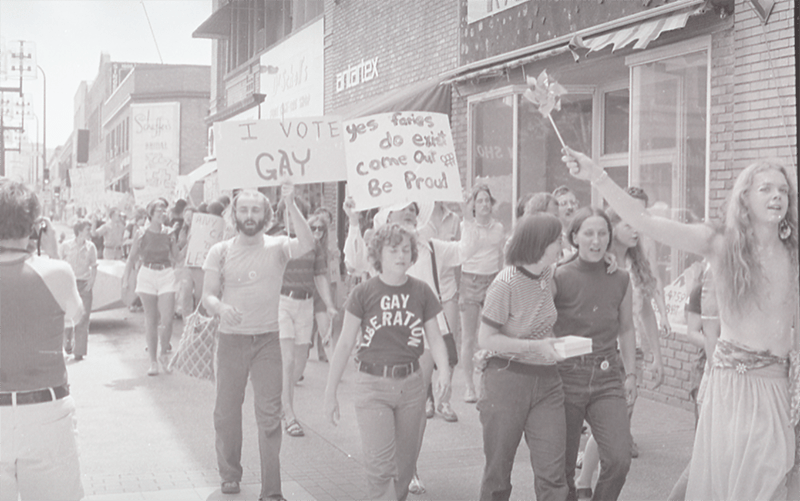
Tens of thousands defy Hungary’s ban on Pride in protest against Orbán

https://www.theguardian.com/world/2025/jun/28/tens-of-thousands-defy-hungarys-ban-on-pride-in-protest-against-orban

Crackdown on Pride is part of effort to curb democratic freedoms ahead of a hotly-contested election next year

Tens of thousands march against Hungary’s government for LGBT rights – video

Tens of thousands of people have taken to the streets of Budapest in defiance of the Hungarian government’s ban on Pride, heeding a call by the city’s mayor to “come calmly and boldly to stand together for freedom, dignity and equal rights”.

Jubilant crowds packed into the city’s streets on Saturday, waving Pride flags and signs that mocked the country’s prime minister, Viktor Orbán, as their peaceful procession inched forward at a snail’s pace.

Organisers estimated that a record number of people turned up, far outstripping the expected turnout of 35,000-40,000 people.

“We believe there are 180,000 to 200,000 people attending,” the president of Pride, Viktória Radványi told AFP. “It is hard to estimate because there have never been so many people at Budapest Pride.”

The mass demonstration against the government was a bittersweet marking of Budapest Pride’s 30th anniversary; while the turnout on Saturday was expected to reach record levels, it had come after the government had doubled down on its targeting of the country’s LGBTQ+ community.

Hungary Pride participants in the march cross the Elisabeth Bridge in Budapest, Hungary. Photograph: Rudolf Karancsi/AP

“We came because they tried to ban it,” said Timi, 49. The Hungarian national was marching with her daughter, Zsófi, 23, who had travelled from her home in Barcelona to join the rally.

After the ruling Fidesz party, led by the rightwing populist Orbán, fast-tracked a law that made it an offence to hold or attend events that involve the “depiction or promotion” of homosexuality to minors, many Hungarians vowed to show their disapproval by attending Pride for the first time.

Viki Márton was among those who had made good on the promise, turning up with her nine-year-old daughter.

The pair had come equipped with hats, water spray, and a swimsuit, more worried about heat than rightwing protesters. “I want her to see the reality,” said Márton. “And I’m so excited to be here!”

Tens of thousands of Hungarians took to the streets on Saturday, despite Orbán’s warning on Friday that those who attend or organise the march will face ‘legal consequences’. Photograph: János Kummer/Getty Images

Earlier this month, police announced they would follow the government’s orders and ban the march. The progressive mayor of Budapest, Gergely Karácsony, was swift to respond, saying that the march would instead go ahead as a separate municipal event, with Karácsony describing it as a way to circumvent the need for official authorisation.

On Saturday, the mayor reiterated why the city had decided to host the event, hinting at how the march had become a symbol of discontent against a government that has long faced criticism for weakening democratic institutions and gradually undermining the rule of law.

“The government is always fighting against an enemy against which they have to protect Hungarian people,” said Karácsony.

“This time, it is sexual minorities that are the target … we believe there should be no first and second class citizens, so we decided to stand by this event.”

Akos Horvath, 18, who had travelled two hours from his city in southern Hungary to take part in the march, described it as an event of “symbolic importance”.

Speaking to news agency AFP, he added: “It’s not just about representing gay people, but about standing up for the rights of the Hungarian people.”

The sentiment was echoed by fellow marcher Eszter Rein-Bódi. “This is about much more, not just about homosexuality,” Rein-Bódi told Reuters “This is the last moment to stand up for our rights.”

‘This is about much more, not just about homosexuality,’ one participant told Reuters. Photograph: Lisa Leutner/Reuters

Tens of thousands of Hungarians, including senior citizens and parents with their children, plus politicians and campaigners from 30 countries, took to the streets on Saturday, despite Orbán’s warning on Friday that those who attend or organise the march will face “legal consequences”.

The Hungarian prime minister sought to minimise concerns over violence, however, saying that Hungary was a “civilised country” and police would not “break it up … It cannot reach the level of physical abuse”.

Still, in a video posted to social media this week, the country’s justice minister, Bence Tuzson, warned the Budapest mayor that organising a banned event or encouraging people to attend is punishable by up to a year in prison.

Speaking to reporters on Friday, the mayor brushed off the threat and downplayed concerns that police would later impose heavy fines on attende s. “Police have only one task tomorrow: to guarantee the safety and security of those gathered at the event,” said Karácsony.

The potential for violence had been amplified after three groups with ties to the extreme right said they were planning counter-marches. As the Pride march got under way, local news site Telex reported that the route of the march had to be changed after one of these groups blocked off a bridge.

Analysts had described the government’s bid to crackdown on Pride as part of a wider effort to curb democratic freedoms ahead of a hotly contested national election next year.

Orbán is facing an unprecedented challenge from a former member of the Fidesz party’s elite, Péter Magyar, leading Pride organisers to suggest they are being scapegoated as Orbán scrambles to shore up support among conservative voters.

Orbán’s government had also prompted concerns across Hungary and beyond after it said it would use facial recognition software to identify people attending any banned events, potentially fining them up to €500 (£425).

Ahead of the march, as campaigners scrambled for clarity on whether or how this technology would be used, AFP reported that newly installed cameras had appeared on the lamp-posts that dotted the planned route.

The threat had been enough to rattle some. Elton, 30, a Brazilian living in Hungary wore a hat and sunglasses as he took part on Saturday, explaining that he had been worried about jeopardising his job and immigration status, but that his Hungarian boyfriend had persuaded him to attend.

“This is my second time at Pride, but the first time I feel insecure about it,” he said.

Orbán’s government had also prompted concerns across Hungary and beyond after it said it would use facial recognition software to identify people attending any banned events. Photograph: Lisa Leutner/Reuters

Mici, a 21-year-old Budapest resident, said she had attended Pride marches in the past but this time had weighed whether to join in after she was spooked by reports of the facial recognition system.

“At first, I was scared to come out because of the news, but I feel safe with so many people.”

She hoped that the massive turnout for the march would be enough to push the Orbán government to change its stance.

“I think the crowd that has come from across Europe, the record numbers, will make Hungarian people see that this cause is well-supported.”

https://x.com/VKJudit/status/1939019076061339781

https://x.com/LillianVikingDK/status/1939024057506169116

https://x.com/Euractiv/status/1938994845277921499

https://x.com/ThomasVLinge/status/1938995810491933090

She is correct, they don’t want to admit the LGBTQ+ exist and are doing their best to make it so we don’t to their kids. If they can convince their kids early that those people are bad before the kids learn their friends are LGBTQ+ they might turn out to be bigots as the parents want

image

BREAKING: The three liberal Supreme Court justices release a scathing dissent after the Republican-controlled judges issue an anti-LGBTQ ruling that “ushers in a new reality” that will deny children the “opportunity to practice living in our multicultural society.”

This is only the third time that Sonia Sotomayor has read her dissent from the bench, indicating strong disapproval…

“Exposing students to the ‘message’ that LGBTQ people exist, and that their loved ones may celebrate their marriages and life events, the majority says, is enough to trigger the most demanding form of judicial scrutiny,” Justice Sonia Sotomayor wrote, supported by justices Elena Kagan and Ketanji Brown Jackson.

The ruling was made in favor of a group of parents who want to opt their children out of elementary school lessons that include LGBTQ storybooks. The case will now go back to a lower court for final decision on whether schools must provide such an opt-out option.

Thanks to the Republican justices, school districts must now inform parents in advance of the books being read in class and allow them to pull their children if they choose. For underfunded schools, this additional burden will be too much to bear. It adds administrative costs and distracts teachers who are already struggling to teach overcrowded classrooms. Taken in tandem with the Trump administration’s efforts to completely eliminate the Department of Education, it’s a grim omen of things to come.

Crucially, the decision is a blatant handout to the religious radicals who helped put Donald Trump in power, which in turn tilted the court even more conservative. Such people want to pretend that LGBTQ people don’t even exist.

“Given the great diversity of religious beliefs in this country, countless interactions that occur every day in public schools might expose children to messages that conflict with a parent’s religious beliefs. If that is sufficient to trigger strict scrutiny, then little is not,” Sotomayor continued.

She predicted that the decision will cause “chaos for this Nation’s public schools.”

“Requiring schools to provide advance notice and the chance to opt out of every lesson plan or story time that might implicate a parent’s religious beliefs will impose impossible administrative burdens on schools,” she continued. “The harm will not be borne by educators alone: Children will suffer too. Classroom disruptions and absences may well inflict long-lasting harm on students’ learning and development.”

“Worse yet, the majority closes its eyes to the inevitable chilling effects of its ruling,” she went on. “Many school districts, and particularly the most resource strapped, cannot afford to engage in costly litigation over opt-out rights or to divert resources to tracking and managing student absences. Schools may instead censor their curricula, stripping material that risks generating religious objections.”

“The Court’s ruling, in effect, thus hands a subset of parents the right to veto curricular choices long left to locally elected school boards,” she added. “Because I cannot countenance the Court’s contortion of our precedent and the untold harms that will follow, I dissent.”

“The Inventor of the term ‘Transgender'”

Queer History 754: Virginia Prince – The Complicated Badass Who Gave Us Our Name by Wendy🏳️‍⚧️🏳️‍🌈🌈

The Inventor of the term “Transgender” Read on Substack

In the shadowy underground of mid-20th century America, where being anything other than a straight, cisgender conformist could land you in prison, a mental institution, or a shallow grave, Virginia Prince emerged like a goddamn hurricane wrapped in a dress. Born Charles Virginia Prince in 1912, she didn’t just challenge the rigid gender binary of her era—she fucking obliterated it, creating the conceptual framework and language that would eventually give birth to the modern transgender movement. But here’s the complicated shit: Virginia was also a product of her time, carrying baggage that would make her legacy as messy and contentious as it was revolutionary.

Virginia Prince & Transvestia - University of Victoria

Virginia Prince wasn’t just another cross-dresser hiding in the shadows of American respectability. She was a visionary who saw the possibility of living between genders at a time when society insisted only two existed, period. Her creation of the term “transgender” and her decades of activism laid the groundwork for every rights battle we fight today. But she was also a deeply flawed human being whose views on sexuality, surgery, and identity would later put her at odds with the very communities she helped create.

This is the story of a brilliant, frustrating, essential figure who gave us the language to describe ourselves while simultaneously trying to police how we used it. Virginia Prince: the complicated badass who launched a revolution she couldn’t fully control and gave birth to ideas that would outlive her prejudices.

The Making of a Revolutionary in Repressive Times

Growing up in the early 20th century as a child who felt a profound disconnect from assigned gender was like existing in a psychological prison where the guards spoke a language you couldn’t understand. Virginia’s early years were marked by the crushing realization that the gender role society demanded didn’t match the internal reality she experienced. But unlike many of her contemporaries who internalized this disconnect as shame or pathology, Virginia began to see it as evidence that society’s gender categories were bullshit.

The 1920s and 1930s were decades of supposed liberation and progress, but that freedom didn’t extend to people who challenged fundamental assumptions about gender and sexuality. Virginia came of age during an era when cross-dressing was criminalized, when psychological theories pathologized any deviation from gender norms, and when the mere suggestion that gender might be fluid could destroy careers, families, and lives.

Her early experiments with feminine expression required incredible courage and strategic thinking. This wasn’t just about putting on women’s clothes—it was about reimagining the entire concept of gender identity in a society that had no framework for understanding such complexity. Every time Virginia dressed as a woman, she was conducting a radical experiment in human possibility that challenged centuries of binary thinking.

The psychological toll of living this dual existence cannot be overstated. Virginia had to navigate professional life, family relationships, and social interactions while maintaining a secret that could have destroyed everything she had built. The constant vigilance required to maintain this double life would have broken weaker spirits, but it forged in Virginia a determination to create spaces where others wouldn’t have to endure such isolation.

The War Years: Finding Community in Darkness

World War II created unexpected opportunities for gender experimentation as social roles shifted and traditional structures loosened. Virginia’s service during the war exposed her to broader networks of people who challenged conventional gender expression, providing her first real sense of community around these issues.

The war also introduced Virginia to the underground networks of cross-dressers and gender-variant people who had been operating in secret for decades. These connections were crucial for her psychological survival and her future activism. For the first time, she realized she wasn’t alone in her experiences and that there were others who shared her vision of gender as something more complex than society acknowledged.

Her wartime experiences also revealed the arbitrary nature of gender roles when social necessity demanded flexibility. Women working in factories, men in traditionally feminine support roles, the blurring of boundaries that peacetime society rigidly enforced—all of this provided evidence that gender categories were social constructions rather than biological imperatives.

The psychological impact of finding community during this period was transformative for Virginia. The isolation and shame that had characterized her earlier years began to give way to a sense of purpose and possibility. She started to see her gender variance not as a personal pathology but as evidence of human diversity that deserved recognition and respect.

The Publishing Revolution: Creating Visibility

Virginia’s decision to publish “Transvestia” magazine in 1960 was an act of revolutionary courage that created the first sustained platform for transgender voices in American media. This wasn’t just a hobby publication—it was a lifeline for isolated individuals across the country who had never seen their experiences reflected in print.

The magazine provided more than just information; it created community among people who had been atomized by shame and secrecy. Readers could finally see that their experiences were shared, that their feelings were valid, and that there were others working to create understanding and acceptance. The psychological impact of this visibility cannot be overstated for people who had spent their lives believing they were alone and abnormal.

Virginia’s editorial approach was strategic and careful, emphasizing respectability and education rather than sensationalism or sexual content. She understood that changing public opinion required presenting transgender people as sympathetic figures rather than freaks or perverts. This respectability politics approach was both necessary for the times and limiting in ways that would later create tension within transgender communities.

The magazine also served as an educational tool for families, medical professionals, and allies who were struggling to understand transgender experiences. Virginia’s clear, rational explanations of gender variance helped combat the pathological narratives that dominated medical and psychological discourse of the era.

Coining “Transgender”: The Power of Language

Virginia’s creation of the term “transgender” in the 1960s represents one of the most significant contributions to LGBTQIA+ liberation in the 20th century. Before this linguistic innovation, people like her were forced to use medical terms like “transvestite” or “transsexual” that carried pathological connotations and didn’t capture the full range of gender-variant experiences.

The word “transgender” was revolutionary because it suggested that gender identity existed on a spectrum rather than in discrete categories. It implied that crossing gender boundaries was a legitimate form of human expression rather than a medical condition requiring treatment. This conceptual shift was crucial for moving transgender experiences from the realm of pathology to the realm of identity and civil rights.

Virginia’s linguistic innovation also provided a political tool that would prove essential for organizing and advocacy. Having a term that encompassed diverse gender experiences allowed for coalition building that wouldn’t have been possible using the more narrow medical terminology of the era. The word became a rallying cry that united people across different experiences of gender variance.

The psychological impact of this linguistic shift was profound for transgender people who finally had language to describe their experiences without resorting to pathological or derogatory terms. Language shapes thought, and Virginia’s creation of “transgender” literally gave people new ways to think about themselves and their possibilities.

The Philosophy of Gender: Virginia’s Complex Vision

Virginia’s understanding of gender was both revolutionary and limited by the constraints of her era. She rejected the binary categorization of male and female while simultaneously maintaining traditional ideas about gender roles and characteristics. This contradiction would later put her at odds with more radical transgender activists, but it was essential for gaining mainstream acceptance during conservative times.

Her concept of “femmephilia”—the love of femininity—suggested that attraction to feminine expression was natural and healthy rather than deviant or pathological. This idea challenged both psychiatric orthodoxy and social conventions that insisted masculinity and femininity were fixed, essential characteristics tied to biological sex.

Virginia’s insistence that transgender people could live full, authentic lives without medical intervention was radical for an era when medical gatekeeping dominated transgender experiences. She argued that social transition was sufficient for psychological well-being and that surgical intervention was unnecessary and potentially harmful.

However, her views on sexuality and transgender identity were more conservative and exclusionary. Virginia insisted that “true” transgender people were heterosexual and that homosexuality was a separate, unrelated phenomenon. This position would later be criticized as transphobic and homophobic, but it reflected strategic thinking about respectability politics in an era of extreme social conservatism.

Building Networks: The Organizational Genius

Virginia’s creation of transgender social networks and support groups represented a crucial step in community building that laid the foundation for later political organizing. Her “Tri-Ess” organization (Society for the Second Self) provided safe spaces for transgender people to gather, share experiences, and build relationships that sustained them through difficult times.

These gatherings were psychologically transformative for participants who had spent years or decades in isolation. Being able to present authentically in supportive environments provided relief from the constant stress of hiding their true selves. The social connections formed at these events often became lifelong friendships that provided ongoing support and validation.

Virginia’s organizational approach emphasized discretion and safety, recognizing that most transgender people of her era faced severe consequences if their identities were exposed. Her networks operated with careful attention to privacy and security that protected participants while still providing community and support.

The leadership skills Virginia developed through this organizing work would prove essential as the transgender rights movement gained momentum. Her ability to bring people together, facilitate discussions, and build consensus became a model for later activists who expanded on her foundation.

The Medical Establishment: Challenging Professional Authority

Virginia’s relationship with the medical establishment was complex and often contentious. While she worked with sympathetic doctors and researchers to advance understanding of transgender experiences, she also challenged medical authority in ways that were radical for her time.

Her rejection of the medical model that pathologized transgender identity put her at odds with professionals who insisted that gender variance was a mental illness requiring treatment. Virginia argued that transgender people were mentally healthy individuals whose distress came from social rejection rather than internal pathology.

This position was psychologically liberating for transgender people who had been told by medical professionals that they were sick, deviant, or delusional. Virginia’s insistence that transgender identity was a natural variation of human experience provided an alternative narrative that emphasized health and authenticity rather than illness and cure.

Her advocacy for informed consent and patient autonomy in transgender healthcare was decades ahead of its time. Virginia argued that transgender people should have the right to make their own decisions about their bodies and their treatment rather than being subjected to arbitrary medical gatekeeping.

International Impact: Spreading the Revolution

Virginia’s influence extended far beyond American borders as her publications and ideas spread to transgender communities around the world. Her magazines were smuggled into countries where transgender expression was even more severely criminalized, providing hope and information to isolated individuals globally.

Her correspondence with transgender people from different countries helped create an international network of support and advocacy that transcended national boundaries. These connections were crucial for sharing strategies, resources, and emotional support across diverse cultural contexts.

The conceptual framework Virginia developed for understanding transgender identity proved adaptable to different cultural contexts while maintaining its core emphasis on human dignity and self-determination. Her ideas influenced transgender organizing in Europe, Asia, and other regions where local activists adapted her strategies to their specific circumstances.

Her international visibility also helped establish transgender rights as a human rights issue rather than a local cultural phenomenon. By demonstrating that transgender people existed across all cultures and societies, Virginia’s work laid groundwork for later international human rights advocacy.

The Generational Divide: Evolution and Conflict

As younger transgender activists emerged in the 1970s and 1980s with more radical political agendas, Virginia’s conservative approach to respectability politics came under increasing criticism. Her emphasis on working within existing social structures clashed with activists who wanted to challenge those structures more directly.

The generational divide was particularly acute around issues of sexuality and medical transition. Younger activists rejected Virginia’s insistence that transgender people should be heterosexual and her opposition to surgical interventions. They argued that her gatekeeping was as harmful as medical gatekeeping in limiting transgender self-determination.

Virginia’s response to this criticism was often defensive and sometimes dismissive, reflecting her investment in approaches that had required enormous personal sacrifice to develop. She had spent decades building respectability and acceptance through careful strategic choices, and she feared that more radical approaches would undo that progress.

The psychological impact of this generational conflict was painful for Virginia, who saw her life’s work being criticized by the very communities she had helped create. However, this tension was also productive in pushing the transgender rights movement toward more inclusive and radical positions.

The Sexual Revolution: Changing Contexts

The sexual revolution of the 1960s and 1970s created new opportunities and challenges for transgender advocacy. Increased openness about sexuality and gender made transgender issues more visible but also more controversial as conservative backlash intensified.

Virginia’s conservative approach to sexuality became increasingly problematic as the broader LGBTQIA+ rights movement embraced more radical positions on sexual liberation. Her insistence that transgender identity was separate from sexuality clashed with emerging understanding of the interconnected nature of gender and sexual oppression.

The rise of gay liberation and feminist movements provided both allies and competitors for transgender advocacy. While these movements sometimes supported transgender rights, they also sometimes marginalized transgender concerns in favor of their own political priorities.

Virginia’s response to these changing contexts was mixed, as she struggled to maintain her strategic approach while adapting to new political realities. Her ability to evolve was limited by her deep investment in the respectability politics that had defined her earlier activism.

Legacy Complications: The Price of Pioneering

As Virginia aged, the contradictions in her legacy became more apparent and more problematic for younger transgender activists. Her groundbreaking contributions to transgender visibility and organizing were undeniable, but her conservative positions on sexuality and identity were increasingly seen as harmful and exclusionary.

Her opposition to transgender people who didn’t conform to her narrow definitions of legitimate transgender identity created gatekeeping that mirrored the medical gatekeeping she had originally challenged. This irony was particularly painful for transgender people who found themselves excluded from the very communities Virginia had helped create.

The psychological impact of Virginia’s gatekeeping was significant for transgender people who experienced rejection from someone who should have been an ally and advocate. Her insistence that only certain types of transgender experiences were valid reproduced the marginalization that many had hoped transgender communities would escape.

However, Virginia’s contributions to transgender liberation remained essential even as her limitations became more apparent. Her creation of language, community, and visibility provided the foundation for all subsequent transgender organizing, even when that organizing moved in directions she didn’t support.

The Final Years: Reflection and Resistance

Virginia’s later years were marked by increasing isolation from transgender communities that had moved beyond her conservative framework. While she continued to advocate for transgender rights, her influence waned as younger activists took leadership roles in the movement.

Her resistance to change reflected both personal investment in her lifelong approach and genuine concern about the directions of transgender advocacy. She worried that more radical positions would provoke backlash that would undo decades of progress toward social acceptance.

The psychological toll of this marginalization was significant for someone who had devoted her life to transgender advocacy. Watching the movement she had helped create evolve beyond her influence was both gratifying and painful as she grappled with the limitations of her own vision.

Despite these challenges, Virginia maintained her commitment to transgender advocacy until her death in 2009. Her persistence in the face of criticism demonstrated the same determination that had driven her pioneering work decades earlier.

Psychological Analysis: The Costs of Pioneering

From a psychological perspective, Virginia’s life illustrates both the tremendous strength required for pioneering social change and the personal costs of such leadership. Her ability to maintain authenticity while navigating extreme social hostility demonstrates remarkable resilience and strategic intelligence.

The psychological mechanisms Virginia developed for survival—careful boundary maintenance, strategic respectability, community building—became tools for broader transgender liberation even when they also created limitations and exclusions. Her survival strategies were both adaptive and restrictive, helping her navigate danger while also constraining her vision of possibility.

Her later conflicts with younger activists can be understood partly as trauma responses to decades of marginalization and partly as realistic concerns about the risks of more radical approaches. The psychological investment required to build acceptance through respectability politics made it difficult for her to embrace strategies that seemed to threaten that hard-won progress.

Virginia’s legacy demonstrates how pioneering figures often become both inspirational models and cautionary tales as movements evolve beyond their founding visions. Her contributions remain essential while her limitations serve as reminders of the ongoing need for growth and inclusion.

Social Impact: Transforming American Gender

Virginia’s influence on American understanding of gender extends far beyond transgender communities to broader social recognition of gender complexity and fluidity. Her visibility and advocacy helped plant seeds of change that would eventually blossom into mainstream acceptance of gender diversity.

Her creation of transgender terminology and concepts provided intellectual frameworks that influenced academic research, medical practice, and legal advocacy for decades. Scholars, activists, and professionals continue to build on foundations she established even when they disagree with her specific positions.

The social networks Virginia created became models for community organizing that influenced not just transgender advocacy but broader LGBTQIA+ organizing. Her emphasis on mutual support, education, and strategic communication became standard practices for social justice movements.

Her international influence helped establish transgender rights as a global human rights issue that transcended local cultural differences. The universal applicability of her core insights about human dignity and self-determination provided tools for advocates working in diverse cultural contexts.

The Philosophical Revolution: Expanding Human Possibility

Virginia’s fundamental contribution to human understanding was her demonstration that gender categories were social constructions rather than biological imperatives. This insight was philosophically revolutionary in its implications for human freedom and self-determination.

Her concept of transgender identity challenged not just gender binaries but broader assumptions about fixed identity categories. By showing that people could successfully live between or beyond conventional categories, she opened intellectual space for reimagining human possibility more broadly.

The philosophical framework Virginia developed for understanding gender variance influenced later thinking about sexuality, race, class, and other identity categories. Her insights about the constructed nature of social categories became foundational for intersectional analysis and identity politics.

Her emphasis on self-determination and personal autonomy in gender expression provided philosophical grounding for broader movements for individual freedom and authentic self-expression. These ideas continue to influence contemporary debates about identity, liberty, and human rights.

The Ongoing Revolution: Virginia’s Living Legacy

Despite the controversies surrounding her conservative positions, Virginia’s fundamental contributions to transgender liberation continue to shape contemporary activism and advocacy. Her linguistic innovations, organizational strategies, and philosophical insights remain relevant even as the movement has evolved beyond her original vision.

Current transgender rights advocates continue to grapple with the tensions Virginia identified between respectability politics and radical change, between strategic pragmatism and principled authenticity. Her example provides both inspiration and cautionary lessons for contemporary activists navigating similar challenges.

The institutional changes Virginia advocated for—medical reform, legal recognition, social acceptance—remain central to transgender rights agendas even as the specific approaches have evolved. Her strategic focus on concrete improvements in transgender people’s lives continues to guide effective advocacy.

Her international influence persists as transgender advocates around the world build on frameworks she established while adapting them to local circumstances. The universality of her core insights about human dignity continues to provide tools for global transgender liberation.

The Fucking Truth About What Virginia Achieved

Let’s cut through the academic bullshit and acknowledge what Virginia Prince actually accomplished. She took a world that insisted only two genders existed and forced it to confront the reality of human gender diversity. She created language, community, and visibility for people who had been erased from public consciousness and gave them tools to fight for recognition and rights.

Virginia’s creation of the term “transgender” alone represents one of the most significant contributions to LGBTQIA+ liberation in the 20th century. Without her linguistic innovation, we wouldn’t have the conceptual framework that makes contemporary transgender rights advocacy possible. She literally gave us the words we needed to describe ourselves and demand recognition.

Her decades of publishing, organizing, and advocacy laid the foundation for every transgender rights victory we’ve achieved since. The marriage equality, employment protections, healthcare access, and legal recognition that contemporary transgender people enjoy were built on groundwork Virginia established when such victories seemed impossible.

But here’s the complicated shit: Virginia was also a product of her time whose conservative positions on sexuality and identity created gatekeeping that excluded many people from the communities she helped create. Her respectability politics approach was necessary for survival in her era but became limiting as the movement evolved toward more inclusive and radical positions.

The psychological impact of Virginia’s work extends far beyond transgender communities to broader social understanding of gender complexity and human diversity. Every person who questions gender norms, challenges binary categories, or demands recognition for non-conforming identities owes something to the path Virginia blazed through hostile social terrain.

She wasn’t perfect—no pioneer is—but she was authentic in ways that transformed American culture. In an era when gender variance was criminalized and pathologized, Virginia’s insistence on dignity and self-determination was revolutionary. Her vision of transgender people as healthy, capable individuals rather than sick deviants provided alternative narratives that saved lives and changed minds.

Virginia Prince died in 2009, but her revolution continues every time someone uses the term “transgender,” every time a support group meets, every time an activist demands recognition rather than tolerance. Her legacy isn’t just in the organizations she founded or the publications she created, but in the transformed understanding of human possibility that makes contemporary gender diversity visible and valuable.

The fucking truth is this: Virginia didn’t just create the transgender rights movement—she created the conceptual foundation that makes all contemporary gender liberation possible. She took the notion that gender categories were fixed and immutable and torched it so thoroughly that even conservative backlash can’t restore the old certainties.

That’s the kind of revolutionary the world needed, transgender people deserved, and human progress required. Not because she was perfect, but because she was persistent. Not because she had all the answers, but because she asked the right questions. Not because she made everyone comfortable, but because she made it impossible to ignore transgender existence and dignity.

Virginia Prince: the complicated badass who gave us our fucking name and showed us that the only limits on human identity are the ones we accept. May her linguistic innovations keep evolving, her organizational strategies keep adapting, and her fundamental insight about human dignity keep expanding until every person can live authentically without apology or fear.

“Queer Representation in Pre-Code Hollywood

Before the establishment of the Hollywood Production Code in the 1930s, filmmakers deployed gender and sexuality stereotypes for glamour, humor, and drama alike.

By: Betsy Golden Kellem

With Pride month in full swing, it’s an ideal moment to look at historical queer representation, particularly in the early days of Hollywood cinema. The first few decades of the twentieth century were not only an active time for a growing medium, but also one in which crises of confidence, economy, masculinity, and culture changed how filmmakers presented queer characters and how (or if) audiences received them. Film professor David Lugowski summed up queer representation in early film neatly, writing that “[a]s cinema learned to talk, so did it also ‘speak’ about the gender roles so crucial to Hollywood film.”

Cinema moved from silent film into “talkies” in the late 1920s, with Al Jolson’s The Jazz Singer typically credited as the first feature to integrate sound and dialogue (it may, however, be a more complicated exercise to locate a true “first”). The late twenties also saw the onset in America of the Great Depression, and, at least as far as entertainment is concerned, many scholars link displays of sexuality and queerness in films in the late 1920s and early 1930s to a larger crisis in masculinity. Economic collapse, the story goes, leads to a broader crisis of identity and gender role. “In short,” Lugowski writes, “men found their gender status, linked to notions of ‘work’ and ‘value’ promulgated by capitalist structures and ideologies, in jeopardy.”

As film became more pervasive and culturally integrated under these circumstances, stereotypes started to be read as evidence that gender performance was equivalent to sexual orientation. Basic types in Hollywood films were clear. For men, queer types were usually either the “dithering, asexual ‘sissy,’” writes Lugowski, or “the more outrageous ‘pansy,’ an extremely effeminate boulevardier type sporting lipstick, rouge, a trim mustache and hairstyle, and an equally trim suit, incomplete without a boutonniere.” Lesbian representation favored masculine drag—tailored suits, hair cut short or slicked back, and sometimes male-coded accessories like a monocle or a cigar. “Objections arose,” Lugowski explains, “because she seemed to usurp male privilege; perhaps the pansy seemed to give it up.”

Prior to the 1930s, these stereotypes appear to have been commonly understood and deployed, for glamour, humor, and drama alike. Audiences may have responded variably—with titillation, acceptance, or shock, depending on the individual—but no one could say the film industry wasn’t inclusive of different relationship story arcs.

In a Code world, no film should risk lowering an audience’s moral standards nor should evil or immorality be presented except as a cautionary tale.

In Pandora’s Box (1929) Louise Brooks wooed a father and son as well as a countess in a tuxedo. Greta Garbo portrayed the title character Queen Christina in a 1933 film about the seventeenth-century Swedish monarch, widely assumed to have been queer. Garbo, along with Marlene Dietrich and other leading ladies such as Joan Crawford, Myrna Loy, and Barbara Stanwyck, were members of a private professional group of Hollywood women—all of them quietly bisexual or lesbian—known as the “Sewing Circle.” Palmy Days (1931) features not only a proud flower-wearing “pansy” character, but drag, donuts, and a sexy Busby Berkeley dance number.

These portrayals took on new weight and context with the passage of the Hollywood Production Code. The Code, a set of self-regulatory guidelines applied to film production, was begrudgingly accepted by film execs, writes Steven Vaughn. That industry figures would accept content restrictions seems strange, until you consider that it was a hold-your-nose solution preferable to either intrusive government regulation or control by investment banks or funders, who preferred their investments be as stable as possible. The Production Code of 1930 therefore came into being, heavily influenced by religious collaborators and proclaiming two linked truths: “Motion pictures are very important as Art,” and “The motion picture has special Moral obligations.” In a Code world, no film should risk lowering an audience’s moral standards nor should evil or immorality be presented except as a cautionary tale.

The Production Code embraced a list of “don’ts” and “be carefuls.” On the “don’ts” list, films were to eliminate blasphemy and profanity, depictions of drug use, miscegenation, and “any inference of sex perversion,” which implied homosexuality. “Be carefuls” enumerated in the 1956 version of the Code urged “the careful limits of good taste” around bedroom scenes, hangings, liquor, childbirth, and “third degree methods.”

The well-known English critic Anthony Slide explains that the Code particularly targeted queer representation in film.

Words such as ‘fairy,’ ‘nance,’ ‘pansy,’ and ‘sissy’ were banned from the screen vocabulary,” Slide writes. “Homosexuality, identified by the Production Code as ‘sex perversion,’ was outlawed: ‘No hint of sex perversion may be introduced into a screen story.’”

At first, to be honest, not much changed. Hollywood cinema remained as queer as ever, and during the harshest years of the Depression, the industry engaged in some of its most boundary-pushing and queer storytelling efforts.

“Not only does the number of incidents increase,” writes Lugowski,

but we also see more explicit references, longer scenes, and sometimes surprisingly substantial characters. Perhaps most important, the pansy and lesbian characters of the period remain, respectively, effeminate and mannish but become increasingly sexualized in 1933–34.

To wit: in 1934, Jack Warner (of Warner Brothers Studio) felt perfectly comfortable ignoring enforcer Joseph Breen’s firm letter and repeated phone calls about that year’s Wonder Bar. Starring Al Jolson and based on a Broadway musical of the same name, the film included a scene in which a tuxedo-clad man glides onto a busy dance floor and taps the shoulder of another man dancing with a blonde in finger waves and a white gown. He asks, “May I cut in?” The woman answers, “Why, certainly!” and reaches out her arms expectantly, at which point the two men embrace each other and whirl off down the dance floor. Jolson, from the bandstand, observes the exchange and quips, “Boys will be boys. Woo!

By the end of 1934, though, the Code was more than just a feel-good document for moralists. It was enabled with specific enforcement machinery in response to religious lobbying and the threat of significant industry opposition from the Catholic church.

[R]ather than risk possible state and federal censorship,” notes Chon Noriega, “as well as anticipated boycotts by the ten-million-member Catholic Legion of Decency, Hollywood studios proferred [sic] strict self-regulation, empowering the Hays Office—now under Joseph Breen—to enforce its four-year-old Production Code.”

Once the Production Code had teeth, filmmakers were restricted in what they could include in their work. If they violated Code standards, the Production Code Administration (PCA) could withhold its seal of approval, making distribution difficult. The possibility of appeal was slim to none, with a board of PCA directors making the call,  not fellow filmmakers. In 1947, with the Code not even fifteen years in effect, writer and censor Geoffrey Shurlock noted with some pleasure that

[d]uring the first thirteen years of PCA operation, no appeals have ever been taken as to disapproved scripts. The appeals as to finished pictures have averaged less than two each year, and in practically all cases, the PCA has been affirmed. Since the average annual production for the period 1935–46, inclusive, has been 519 features and 685 short subjects, this illustrates excellent producer co-operation.

Queer characters and storylines were less common, or circumscribed, until the Code weakened and ultimately fell in the 1960s (the success of boundary-pushing films like Some Like It Hot only helped in this regard). It remained true in film that villains, especially, were more likely to be accepted with queer coding. But a large number of films—more than perhaps one might expect—remain a testament to Hollywood’s longtime engagement with queer characters and themes. (snip)

PRIDE In An Anniversary & More, in Peace & Justice History for 6/28

June 28, 1916
A one-day strike by 50,000 German workers was organized to free Socialist anti-war leader Karl Liebknecht, charged with sedition for his criticism of the government and the war later known as World War I. He was the first ever to be expelled from the Reichstag, the German parliament, voted out for his opposition to Germany’s role in the war.
———————————————————————————————————
June 28, 1969
Patrons at the Stonewall Inn, a gay bar in New York City’s Greenwich Village, being subjected to routine anti-homosexual harassment by the New York City police raiding the bar, spontaneously fought back in an incident considered to be the birth of the gay rights movement.
Riot veteran and gay rights activist Craig Rodwell said: “A number of incidents were happening simultaneously. There was no one thing that happened or one person, there was just . . . a flash of group, of mass anger.”
About Craig Rodwel
A group of drag queens, who had been mourning the death earlier in the week of Judy Garland, mocked the police and threw things at them, and police were forced to retreat into the bar as the crowd of supporters grew; disturbances continued for days.
The bar is now on the National Register of Historic Places.


Stonewall and all it has inspired
—————————————————————————————————-
June 28, 1987

The Iranian Kurdish town of Sardasht was attacked by Iraqi aircraft with chemical weapons during the Iran-Iraq War. Saddam Hussein had started the war expecting an easy victory against the new Shiite Islamic republic, even though Iran had three times the population.

Victims of the mustard gas attack on Sarsasht, Iran
——————————————————————————————————-
June 28, 2005
Seen in New York City on June 28, 2005
   

https://www.peacebuttons.info/E-News/peacehistoryjune.htm#june28

Ohio’s GOP-backed budget keeps anti-LGBTQ provisions, Governor’s Merit Scholarship changes

https://ohiocapitaljournal.com/2025/06/26/ohios-gop-backed-budget-keeps-anti-lgbtq-provisions-governors-merit-scholarship-changes/

By:  – June 26, 2025 4:25 am

The final version of Ohio’s two-year state operating budget retains anti-LGBTQ provisions, requires Governor’s Merit Scholarship recipients pledge to remain in Ohio after graduation, and ties state funding to compliance with a new higher education law.

The budget now heads to Ohio Gov. Mike DeWine’s desk for his signature, which he must sign by June 30. He can line-item veto provisions in the budget.

Anti-LGBTQ provisions

A handful of anti-LGBTQ+ provisions are sprinkled throughout the budget, including a provision that would only recognize two sexes — male and female.

“Do we really have to make a law that says that men are men and women are women?” state Rep. Gary Click, R-Vickery, asked. “Do we really have to define that? We shouldn’t have to, but apparently we do.”

The budget would require public libraries to put books related to sexual orientation or gender identity in an area of the library that is out of sight for minors.

“If moms and dads want their kids to be indoctrinated within that, that’s up to the moms and dads, but we’re not going to put it in children’s faces in the children’s sections of the libraries,” Click said.

Ohio House Minority Leader Dani Isaacsohn, D-Cincinnati, called out the library provision.

“If you are one of the 20% of young people who identify as LGBTQ, you’re not going to be a hero in that story,” he said. “We have to have more books that show you as a leader, as a champion, as a hero.”

The budget would also ban Pride flags from being flown at public buildings and prohibit giving funds to youth homeless shelters that house transgender youth, even if they also serve youth who are not transgender.

“We are not hanging out the welcome mat for people from the LGBTQ community,” said Ohio Senate Minority Leader Nickie Antonio, D-Lakewood. “We should be a place where folks can just be who they are authentically and live and let live.”

Higher education provisions

The Governor’s Merit Scholarship awards the top 5% of each high school graduating class a $5,000 scholarship each year to attend an Ohio college or university.

Under the final version of the budget, scholarship recipients must sign a statement of commitment to live in Ohio for three years immediately after graduation starting in fiscal year 2027.

“If we want our young people to stay in Ohio, to start their careers in Ohio, to start a family in Ohio, we need to put our money where our mouth is, and we are doing that in this budget,” said Ohio House Finance Chair Brian Stewart, R-Ashville.

The Senate’s version of the budget would have required scholarship recipients sign a promissory note, but the final version of the budget instead requires students to sign a statement of commitment to live in Ohio for the first three years after graduating college.

“It was deemed (the promissory note) was a little bit heavy-handed and so we tried to roll that back,” Ohio Senate President Rob McColley, R-Napoleon said.

The budget allocates $47 million for fiscal year 2026 and $70 million in fiscal year 2027 for the Governor’s Merit Scholarship.

The Governor’s Merit Scholarship was enacted through the last state budget two years ago and 76% of the state’s 6,250 eligible students from the class of 2024 accepted the scholarship. Eighty-seven percent of Ohio students accepted the scholarship in its second year and 11 rural counties had a 100% acceptance rate.

The budget ties a portion of the State Share of Instruction to compliance with Senate Bill 1, a new higher education law banning diversity efforts, creates post-tenure reviews and an American civic literacy course, among other things.

The law affects Ohio’s public universities and community colleges and each university must submit a report showing compliance to the House and Senate higher education committees by March 1, according to the budget.

Housing provisions

The budget kept housing provisions the Senate added to the budget — $90 for the Residential Development Revolving Loan Program and $10 million for the Residential Economic Development District.

The Residential Development Revolving Loan Program supports new, single-family residential homes in rural areas of the state.

“If we want to grow our population, we have to have places for folks to live,” Stewart said. “This is going to be directed to small counties. We can’t be growing housing just in the three C’s, we need to be growing housing all across Ohio.”

Follow Capital Journal Reporter Megan Henry on Bluesky

“10 years after winning marriage equality, Jim Obergefell wants to aim higher”

Jun 26, 2025 Kate Sosin

This story was originally reported by Kate Sosin of The 19th. Meet Kate and read more of their reporting on gender, politics and policy.

It happened just a few weeks ago: Jim Obergefell was moving things in his office when he came across the ashes of his late husband, John Arthur, now 12 years gone. Arthur had last wishes for his ashes. Obergefell had yet to fulfill them.

“And it struck me that, oh, I am actually now mentally, emotionally ready to take care of John’s ashes,” Obergefell told The 19th. “It was the first time that I had that feeling so clearly and so strongly.” 

Obergefell, 58, is ready to move on. Not exactly from the love of his life or the history-making Supreme Court decision that came after Arthur died. But certainly from the insecurities straight America was grappling with a decade ago about same-sex unions. 

Obergefell is that Obergefell: the named plaintiff in the landmark lawsuit that extended marriage equality to every state in the nation in 2015. Ten years later, he celebrates that win and the many ways it rewrote his life. And in a time when LGBTQ+ rights are again under assault, he is looking to the future — of the queer rights movement and also his own. 

A journey to the Supreme Court

Obergefell’s journey to the Supreme Court was hardly destined. It began 12 years ago, on June 26, 2013, when the Supreme Court struck down the Defense of Marriage Act, a federal law that prohibited the government from recognizing same-sex marriages. 

Obergefell and Arthur had been together for 21 years at the time. The two had discussed getting married before. But they wanted it to be legal, and their home state of Ohio didn’t offer same-sex marriages. 

Arthur was gravely ill with ALS, a progressive neurodegenerative disease, and he barely left his home hospice bed. 

After the ruling, Obergefell leaned over to Arthur, hugged, then kissed him.

“Let’s get married,” he said. 

Arthur agreed. 

The logistics were not easy. Arthur was in no shape to travel, and the couple could not wed in Ohio. Obergefell researched and found that Maryland would let him get a marriage license even with only one of them present. But both would need to arrive in the state for the ceremony. 

When friends and family learned about their predicament, they pooled together money to charter a medical jet for Arthur. The two flew to Baltimore. Over the course of 45 minutes, they exchanged vows on the tarmac before flying home. 

“In the days that followed, we said the word ‘husband’ hundreds of times a day,” Obergefell said on the Decidedly Podcast in 2023. 

But just five days later, their joy was muted when civil rights attorney Al Gerhardstein informed them that because of Ohio’s ban on same-sex marriage, Arthur would be listed as single in death.

Arthur and Obergefell were angry. The couple sued the state of Ohio in federal district court and won. Three months later, Arthur died.

The following year, Obergefell, still in mourning, lost on appeal. But he refused to believe he might lose altogether. 

“I just kept going,” Obergefell said. “It was the right thing to do.”

On June 26, 2015, he won. For the country, the win was immensely practical. Many told Obergefell it gave them so much hope it saved their lives. For Obergefell, it meant a legacy for the man he loved. 

“I made promises to John to love, honor and protect him, and I was going to keep doing that,” he said. 

Jim walks down steps laughing beside a rainbow flag and a sign that says love wins".
In the decade since Jim Obergefell won his Supreme Court case that made same-sex marriage federally legal, hundreds of thousands of same-sex couples have married in the U.S. (Eric Gay/AP Photo)

Changing history

It’s difficult to overstate the impact of Obergefell’s case on the nation or the world. Since the 2015 ruling, the Williams Institute at the UCLA School of Law estimates, 591,000 queer couples have wed, generating an estimated $5.9 billion in wedding spending for state and local economies. 

It has also radically transformed Obergefell’s life. Introverted and unassuming, he has spent the last decade campaigning for LGBTQ+ rights. He helms Equality Vines, a wine company that donates its proceeds to advancing civil rights causes. 

It’s a position that makes him deeply proud if not a little fatigued. 

“I’m not tired of talking about it,” he said of the 10-year anniversary of the ruling. “I’m just physically tired from all of the interviews and the photographers and the speaking gigs and the events. Yes, I’m exhausted.” 

For 12 years, Obergefell has kept Arthur alive through retelling their story countless times in courtrooms and for the media. That exercise, of telling and retelling, helped Obergefell process his profound loss. 

But he has never recoupled. It wasn’t that Arthur didn’t want him to. In fact, Arthur told him regularly that he wanted him to find love again. He asked his friends and family to tell Obergefell that he wanted him to find love after he was gone.

“I know it was sincere, because he told me that he had other people tell me that,” Obergefell said. 

It isn’t about the pressure he feels as the face of marriage equality, he said, though part of him wonders what it would be like to date after making history. 

“I don’t know how to date,” he confessed. “I’m clueless when people flirt with me, and as much as I hate it, and I don’t go into any conversation or anything like this, but you know, there’s that part of me that sometimes wonders, you know, are they interested in me as a person, or are they interested in me as Jim Obergefell, named plaintiff?”

Obergefell’s name has become synonymous with marriage equality in the United States, an issue that has not always united the LGBTQ+ community. Some queer activists have argued that same-sex marriage was a misguided goal for the movement as queer youth continue to face high rates of homelessness and transgender people grapple with police violence and incarceration, among other issues.

More work to do

Obergefell, too, is worried that the needs of the community’s most vulnerable have gone unmet. He has watched horror-struck over the last five years as state legislatures have moved to restrict transgender rights.

“We need to fight for every marginalized community, because the queer community includes every marginalized community, and equality for one is pointless without equality for all,” he said. “I didn’t go to the Supreme Court just so White, cisgender, gay men like me could get married.”

Despite all of the setbacks in LGBTQ+ rights, and even threats to Obergefell’s game-changing victory, he is hopeful — and feels stronger than ever. People assume his case was difficult for him. It was, but the path was also obvious, to him and to Arthur. They loved each other. 

“If we weren’t willing to fight for each other and for what was right, then what’s the point?”

Lawrence v TX and More, in Peace & Justice History For 6/26

June 26, 1894

Mohandas Gandhi (center) as a young lawyer in Durban, South Africa in 1894
Mohandas Gandhi, a young Indian lawyer from Porbandar in Gujarat province, urged the Natal (a province in South Africa) India Congress to run a campaign of education and peaceful noncooperation to assert and protect their rights as ethnic Indians in South Africa. Within days of Gandhi’s arrival in South Africa the previous year, though he was a British subject and South Africa was under British rule, he had been thrown off a train, assaulted by a white coachman, denied hotel rooms, and pushed off a sidewalk because his skin color defined his status and limited his rights.
“Truly speaking, it was after I went to South Africa that I became what I am now.
My love for South Africa and my concern for her problems are no less than for India….”

– Mohandas Gandhi, 1949

“Gandhiji was a South African and his memory deserves to be cherished now and in post-apartheid South Africa. The Gandhian philosophy of peace, tolerance and non-violence began in South Africa as a powerful instrument of social change . . . This weapon was effectively used by India to liberate her people.”
– The Rev. Martin Luther King, Jr. [King used the same techniques to combat racism in the U.S.]

“We must never lose sight of the fact that the Gandhian philosophy may be a key to human survival in the twenty-first century.”
– Nelson Mandela, in his speech opening the Gandhi Hall in Lenasia, South Africa, September 1992 [source: anc.org.za] Mohandas Gandhi, 1949]

Also known as Mohandas Karamchand Gandhi was born on October 2, 1869, in Porbandar, India. He was known to the Indian people as Mahatma, meaning great-souled, a person revered for high-mindedness, wisdom and selflessness. Ghandiji adds a suffix to the last name to show respect.
He was also known as Bapu which means great father.
June 26, 1918
Pacifist and socialist organizer Eugene V. Debs was arrested for having given an anti-war speech in Canton, Ohio, ten days earlier. He was charged with “uttering words intended to cause insubordination and disloyalty within the American forces of the United States, to incite resistance to the war, and to promote the cause of Germany,” This last was despite his repeated and vehement criticism in the speech of Germany and its landed aristocracy, known as the Junkers.
“And that is war in a nutshell. The master class has always declared the wars; the subject class has always fought the battles.The master class has had all to gain and nothing to lose, while the subject class has had nothing to gain and all to lose — especially their lives.”
June 26, 1945
On the stage of San Francisco’s Veterans Auditorium (now known as the Herbst Theatre in the center of the War Memorial Veterans Building), delegates from 50 nations signed the United Nations Charter, establishing the world body as a means of saving “succeeding generations from the scourge of war.”

The U.S. Post Office issues a commemorative envelope.
The Germans had just surrendered to the Allied forces in April; the war in the Pacific continued.
Read the Preamble (included is full text of the Charter) 
Collection of photos from Founding of the UN – San Francisco Conference  (I love looking at these photos! -A.)
June 26, 1955

Flyer used to promote the Freedom Charter
The South African Freedom Charter was adopted at the Congress of the People at Kliptown near Johannesburg.
“We, the People of South Africa, declare for all our country and the world to know that South Africa belongs to all who live in it, black and white, and that no government can justly claim authority unless it is based on the will of all the people . . . .”
The Congress of the People in Kliptown 
Text of the Charter: 
June 26, 1963
President John F. Kennedy addressed 120,000 West Berliners and concluded his speech, “All free men, wherever they may live, are citizens of Berlin, and, therefore, as a free man, I take pride in the words: “Ich bin ein Berliner!” The East German government had stopped all travel and commerce between the Soviet-controlled and the American/British/French-controlled parts of the city in 1961. west.

John F. Kennedy, West Berlin, June 26, 1963
They then built a 166 km-long (103 miles) wall to separate the two Berlins and to stop emigration from east to west.
Watch the speech 
June 26, 2003
The U.S. Supreme Court found a Texas “anti-sodomy” law unconstitutional, overruling, and apologizing for, the 1986 Bowers v. Hardwick decision. The 6-3 decision in Lawrence v. Texas said that citizens have the “right to liberty under the Due Process Clause gives them the full right to engage in private conduct without government intervention.”
Text of the decision 

The good, bad, ugly and of course the stupid. 6-25-2025

5000+ Mexicans Form Record “Human Pride Flag”

Cops: Atlanta Teens Filmed Themselves Destroying Gay Bar’s Pride Flags, Hate Crime Charges Possible [VIDEO]

Riley Gaines: Defund States That Back Trans Athletes

Riley Gaines, who has turned a fifth place finish against non-trans swimmers into career with MAGA media.

Now let me see if I have this right. Riley Gaines finished 5th in a race with a trans athlete. And, if that trans athlete had NOT been in the race, Riley Gaines would still have finished in 5th place because the two swimmers were TIED for 5th. So, a trans athlete being in the race did not have any effect on Riley Gaines at all

Grenell Rages At “Hamilton” Creators Over Pride Event


Murkowski Floats Leaving Republican Party [VIDEO]


Cassidy Realizes Vax Advisory Panelists Are Crackpots


Fox Host: Israel Must Carry Out More Assassinations

US Intel: Bombing Only Set Back Iran For Months


Fox Host Furious About Ceasefire Announcement: “Adolf Hitler Wasn’t Thrown A Lifeline” At War’s End [AUDIO]

Sen. Katie Britt: “Trump Will Win The Nobel, No Doubt”


Trump Hints US May Leave NATO Mutual Defense Pact


Trump Admin Seeks To Deforest 59M Public Acres


Parliamentarian Nixes GOP Plot To Sell Public Lands

ICE Used National Guard Troops To Raid CA Weed Farm


Noem: Alligator Alcatraz Will Open “At Turbo Speed”


McConnell: Worried About Medicaid? “Get Over It”

Trump Challenges “Stupid AOC” To Cognitive Test

WH Claims DOGE Worker “Big Balls” Has Resigned

First of all, I would like proof of this man’s “big balls.”

Second, he is a national security disaster. From his Wikipedia page:

His maternal grandfather Valery Martynov was a KGB Lieutenant Colonel executed by the Soviet Union as a double agent. After his execution his widow moved with her children, including Coristine’s mother, to the United States.

Also from Wikipedia:

Bloomberg News reported that Coristine had been fired from his internship at cybersecurity firm Path Network in 2022 for allegedly leaking internal company information to a competitor. Following his dismissal, a large collection of internal Path documents and conversations was leaked online.

The apple may not fall too far from the tree in this instance.

Reuters published a story alleging that Coristine’s online content delivery network DiamondCDN had facilitated the work of the cybercriminal group EGodly. In 2023 Egodly thanked Coristine saying “We extend our gratitude to our valued partners DiamondCDN for generously providing us with their amazing DDoS protection and caching systems, which allow us to securely host and safeguard our website,” Egodly has claimed involvement in a number of crimes including email hacking, theft of cryptocurrency, and the harassment of a former FBI agent.

This guy would never have passed any sort of normal security clearance. That this story isn’t a massive front page scandal is an indictment of the times we live in.

Miscellaneous 6/24 Stuff On 6/25

The final story is posted in full because that’s how The 19th rolls. Enjoy! -A

Bombs Over Norway by Clay Jones

But his bucket came with a Peezy Prize Read on Substack

A Ukrainian lawmaker nominated Donald Trump for a Nobel Peace Prize, and has now withdrawn it, saying he had ‘lost any sort of faith and belief” in Trump and his ability to secure a ceasefire between Moscow and Kyiv. The mystery here is why ever had “faith” or “beliefe” in Donald Trump in the first place?

To believe in Donald Trump, you either have to be a cultist who does not live in reality, or have previously taken a tack hammer to the head.

The Ukrainian official, Oleksandr Merezhko, said Trump is “evading—he is dodging—the need to impose sanctions on Russia.” That’s because he’s Putin’s beyotch. Has Merezhko not been paying attention all these years?

Pakistan submitted a formal recommendation for Trump to receive the Nobel Peace Prize after saying his “decisive diplomatic intervention and pivotal leadership” stopped its recent military spat with India over Kashmir. Although India stated there was no need for external mediation on the Kashmir issue, playing down Trump’s role. Factor in that India’s leader is a Trump fan.

But now, just a day after recommending TACO for the Nobel Peace Prize, it’s condemning him for attacking Iran, saying the strikes “constituted a serious violation of international law” and the statute of the International Atomic Energy Agency. Pakistani Prime Minister Shehbaz Sharif, in a phone call Sunday with Iranian President Masoud Pezeshkian, expressed his concern that the bombings had targeted facilities that were under the safeguards of the IAEA.

Today, Georgia GOP Rep. Buddy Carter has formally nominated Trump for a Nobel Peace Prize, writing to the committee that it’s “in recognition of his extraordinary and historic role in brokering an end to the armed conflict between Israel and Iran.”

But, Buddy…you don’t negotiate peace by bombing somebody. Also, the peace deal isn’t working. Israel accused Iran of violating the deal, and Trump got upset, probably because further escalation would ruin his pretend chances of winning a Nobel Peace Prize. Also, you don’t win a Nobel Peace Prize by bombing a nation that’s never attacked you.

Trump said, “We basically — we have two countries that have been fighting so long and so hard that they don’t know what the fuck they’re doing.” Oh, and you do, TACO?

Buddy didn’t nominate Trump for the Nobel Peace Prize because he believes it would be deserved. Like Pakistan and the Ukrainian guy, Buddy is using the prize to kiss Trump’s ass. Pakistan and Ukraine both turned around and said Trump doesn’t deserve it, which they already knew. Maybe they should buy him planes. Buddy, I don’t know what you want from Trump, but can you buy him a plane?

Of course, Republicans are praising Trump for a peace deal with Israel and Iran, but why? There are no conditions or terms. Neither nation has given any concessions to the other. Has Iran agreed to abandon its nuclear program? No. Even if they did, why would it be more trustworthy than the deal Obama already made with Iran that Trump destroyed, which was working? Did Israel give Iran any concessions, like maybe abandoning its nuclear program that nobody wants to talk about?

Trump’s peace treaty is like the TEMU of peace treaties. It’s going to break just as soon as you start playing with it. (snip-MORE)

=============================

NATO Making Careful Preparations To Keep Baby Trump Entertained During Tomorrow’s Big Summit by Rebecca Schoenkopf

Wouldn’t want him to get bored or stomp out and demand to go home or anything! Read on Substack

This morning, Donald Trump was angry. One would imagine that after ending all wars forever with his flawless execution of the ceasefire between Israel and Iran, he just wanted to have a nice celebratory night, while SecDef Pete Hegseth drunked and belched around the White House residence in a sexy teddy singing “Nobel Peaaaaaaace Biiiiiiiiirthday, Missssteerrrrr [HIC!] Prezzzzdinint!”

Alas.

Instead it appears Israel and Iran stopped shooting long enough to let President Dumbass get on Truth Social and declare flawless victory, before they got right back to shooting at each other. It’s gotta be tough pretending to be the leader of the free world when none of the world, free or otherwise, has any respect for your leadership. (snip-MORE, and it is good!)

==================

Roe v Wade by Ann Telnaes

Overturned three years ago today Read on Substack

With Trump’s strikes on Iran and all the other shitstorms his administration has caused, the anniversary of American women losing their reproductive rights isn’t going to get a great deal of press. Here’s just one link to what abortion bans mean for women after the Supreme Court decision. There are plenty more.

============

Inside the queer pop-up parties you’ll never want to leave

Jun 18, 2025 Tara Pixley

This story was originally reported by Tara Pixley of The 19th. Meet Tara and read more of their reporting on gender, politics and policy.

Glitter sparkles across people and surfaces, rainbow-colored acrylic nails snap in time to the Afrobeat, and boisterous cheers egg on the occasional dance floor death drop. These are moments that make up spaces created for and by queer and trans people of color (QTPOC). From Los Angeles to Philadelphia, New York City to Atlanta, queer community organizers, DJs, musicians and artists are producing monthly pop-up events that attendees and organizers say are reimagining queer liberation through collective joy. 

Events range from underground warehouse raves like Hood Rave in Los Angeles to sunlit day parties and potlucks featuring patio yoga. Regardless of format, the trappings of queer life and culture are evident everywhere you look — necklaces made of popper bottles; chest harnesses as fashion; flags; fans; cheeky political statements across nails, hats and tees. The recognition of Black and Brown queer experiences is often apparent in event titles, like New York City’s notorious Papi Juice dance party and Los Angeles’ weekly Toxica event for sapphic Latine queers. 

These parties also frequently double as advocacy work, where they highlight mutual aid campaigns, promote queer causes and spread political awareness. In recent years, DJ shouts of “Free Palestine” are frequently met with affirmative cheers from dance floors dotted with keffiyehs and watermelon imagery. QTPOC parties are also changing the tunes of gay nightlife from the pop/EDM/disco variety to a musical mix of hip-hop, trap, house, reggaeton, soca and Afrobeats. 

“Everybody is able to see themselves in the music and feel safe here,” said Terri Flamer, who attended the Soulovely prom in Oakland, California, in May. “That’s probably the best thing about it, is you’re safe to be yourself, you can party, you meet people that don’t look like you and it’s all love.”

Queer dance parties also enable the ecstatic experience of group dance, which can be understood as its own form of activism. Maya Bhardwaj, a scholar studying the global influx of such parties in the last decade, called them queer utopias that center: “healing, mental health, ancestral faith practices, queer Black and Brown music and dance traditions, and spaces for activists and cultural workers to gather beyond mainstream bars and nightlife.” Mission statements from QTPOC dance party organizations often invoke terms like “affirmation,” “celebration” and “sustaining.“ 

While queer nightlife as a space of resistance isn’t new — it has its roots in AIDS activism of the ’80s — the intersectional community building and intention brought to crafting these spaces makes the current slate of QTPOC parties feel fresh. Often exclusionary White male gay spaces are frequently the only options for LGTBQ+ nightlife, and the pop-up event has become a go-to to address a lack of gatherings that feel welcoming to QTPOC folks.

There’s this sense of pain shared among QTBIPOC […] and therefore the joy that is experienced at these parties feels more necessary, more dire and more of a relief.”Nicole Prucha

Pop-up spaces provide “a feeling of safety in being able to trust that the people who are there have experienced or understand what it is like to be othered, in a sense apart from our sexuality,” said performance studies scholar Nicole Prucha about her experience attending Los Angeles QTPOC parties. As a queer Arab person who has often struggled to find places where she feels truly seen, Prucha said parties like Casual, Hot Pot and its sister event HabibiPot fill a vital need for queer people of color: “A place of refuge and queer world-building” at a time when LGBTQ+ rights are under attack.

The dance floor is reflected in Terri Flamer's sunglasses.
Terri Flamer attends Soulovely’s prom, held in the 14th season of Oakland’s QTPOC-centered monthly party. (Manuel Orbegozo for The 19th)

Event organizers are often working with limited resources amid challenging financial situations. Five queer BIPOC coordinators — Kike Ayorinde, Camryn Casey, Madi Dalton, dRi Guillén and Leslie Tellería — produce community-funded Lavender Evolutions (LE) events in D.C., and the ticket sales for each event contribute to the next event. In a collective statement, the organizers shared that they are largely unpaid but, “We do give core organizers small payments to cover things like gas, food during events, and the many hours of labor leading up to an event.” The LE organizers acknowledge that “money is a huge barrier and we could always use more of it, but for us, it’s more important that we have events that are financially accessible.” 

They keep ticket prices below $25 to achieve that aim but struggle with the financial load of creating these pop-up spaces. The organizers say they are often unable to meet the market rates of DJs and other collaborators due to tight budgets, while logistical support frequently comes from community members willing to volunteer their time to assist with check-in and ticketing. Another challenge they face is making their work in building queer community attractive to funders. “Grant makers don’t always understand the scope of the work that we do and why it’s so important, especially in this moment,” organizers said.

Despite the challenges, organizers said the work is worthwhile. “We do experience burnout but we rely heavily on the collective,” the organizers said. “More than anything, we prioritize people. For our core organizers, it’s a delicate balance because our time and energy is limited. We’re all balancing our full-time jobs, life and Lavender, but the love of community keeps us going.”

They need us, we need them. It’s not always about the bottom dollar, sometimes it’s about building community and the dollars come after.Sgt. Die Wies

The 19th sent photographers to queer pop-up parties and events in Oakland, Washington, D.C., and Atlanta to show these spaces of radical queer joy in action and highlight the work that queer organizers are doing to build QTPOC community across the country. 


OAKLAND

Soulovely has brought QTPOC-centered “cultural affairs” to the Bay Area for 14 years

A group of people hold onto each other in front of a sign saying Soulovely.
Many attendees of Soulovely’s prom said it was a first for them, providing queer and trans people of color (QTPOC) an opportunity to attend a prom in a safe and community-based setting. (Manuel Orbegozo for The 19th)

Soulovely is a beloved and long-lasting pillar of queer life in the Bay Area. Since 2011, its monthly events have served as a safe haven for a predominantly BIPOC queer community to celebrate their identities and bodies through music and dance. “I actually just found out that a loved one passed. So coming here was kind of like in honor of them as well, because they love to dance, I love to dance, we met out dancing — it brings people together,” said Mello-Jahlil Travis, who attended Soulovely in May.

A portrait of a woman wearing a white hat and dress.
Burlesque producer and performer Sgt. Die Wies attended the Soulovely queer prom on May 11 and says she thinks the space provides an opportunity to be “solution-based versus just focusing on the negativity. “ (Manuel Orbegozo for The 19th)

Attendees and organizers both are often quick to point out these spaces are not about excluding White, straight or otherwise non-QTPOC people. Rather they are about radical inclusion and belonging. Sgt. Die Wies, a burlesque producer and performer who attended the Soulovely queer prom in May, said that the party is all ages with a variety of ethnicities coming out to be together:“It’s beautiful to see because there’s so much division in the world right now.”

A person sits on a chair framed by a doorway.
Mello-Jahlil Travis (they/them) said the Soulovely Prom gave them an opportunity to have a different prom experience. “I’m stoked to be here amongst other beautiful queer people. It’s important to be able to see people who look like you be themselves and feel free. There’s not everywhere that I feel like I can have my nails painted and dress like this. It’s dope to be around people who can receive that.” (Manuel Orbegozo for The 19th)

While all are welcome, Jaycee Chang especially appreciates the way Soulovely centers queer and trans people of color. “It is both a space of joy and being a community but also, it’s a relatively politicized space where they’re very intentional about the artists that they bring in, the DJs, the themes,” Chang said.

And that can even extend to their families.

“One of the DJs who helped host HabibiPot [in Los Angeles], her mom was there to watch her first DJ set and she played Arab classics that my own mom had introduced me to,” Prucha said. “They’re both Palestinian, and her mom was there, standing on the tables with the rest of us, and she was crying because she was so happy that her daughter was there and had found community.”

A couple holds each other close for a portrait.
Tiara Reed (left) met her now-fiancée Chenelle Reed (right) at a Soulovely event and said “it’s so significant to have spaces where unapologetic joy and levity and freedom are welcome and everyone can just bask in it.” (Manuel Orbegozo for The 19th)

These spaces also provide opportunities for LGBTQ+ people to meet each other beyond dating apps. A 2020 Pew Research Center study reported that lesbian, gay and bisexual people were both more likely to use online dating and more likely to experience harassment through dating apps than their straight counterparts. 

Soulovely is always part of our story.”Chenelle Reed

Ahn Lee feels safe at Soulovely parties because harassment is far less likely. “I feel like no one’s gonna try to come at me in a way that doesn’t feel comfortable,” Lee said.

Several partygoers laugh and dance against a colorful mural backdrop.
Since 2011, Soulovely events have provided a safe haven for the queer BIPOC community in the Bay Area. (Manuel Orbegozo for The 19th)

And for others, like Tiara Reed and Chenelle Reed, Soulovely has become a character in their love story. Reflecting on the experience of meeting her now-fiancée, Tiara, at Soulovely and their future together, Chenelle said, “It’s going to be absolutely beautiful, because we have places like this … where you can connect and learn that anything is possible, family in all the ways is possible.”

A couple holds each other close and one kisses the cheek of the other.
Jaycee Chang (they/them, right) with their partner Ahn Lee (she/they, left), has been coming to Soulovely for over a decade. Chang said: “Even when the world is chaotic and there’s a lot of harm happening, we can come together as a community and create spaces that feel like refuge, like safety.” (Manuel Orbegozo for The 19th)

ATLANTA

Southern Fried Queer Pride builds QTPOC community through education and embodied healing

Grassroots collective Southern Fried Queer Pride (SFQP) — now in its 11th year — focuses its events toward “artivism” with a stated mission to fight narratives that confine Southern LGTBQ+ people to “stigma, statistics and struggle” instead aiming to uplift an “honest narrative of resilience, rich history and vibrance.” SFQP offers year-round programming, typically providing between 40 to 60 events that feature community education — like the upcoming trans health care workshop — as well as gallery shows, marches and dance parties, such as its June trans cabaret and open mic.

Two people hug each other against a backdrop of books and plants.
Maya Wiseman (left) and Magdalena (right) have both volunteered for SFQP for years and say organization offers a space of respite and community connection for them. (Piera Moore for The 19th)

Community organizer Maya Wiseman said the May 18 SFQP Community Potluck was an alcohol-free and masks-required event to further expand on their inclusiveness, which has become a hallmark of SFQP events. “Queer folks have been marginalized throughout time, but often queer folks, whether they know it or not, naturally end up creating safe spaces for everyone,” said Wiseman, who has worked with SFQP as a community organizer for six years. “We try to create spaces that say ‘come as you are,’ because we’re not having this at a club. If you want to come here in pajamas, in a tank top and shorts, it’s fine with us.”

Several people lay on yoga mats on the floor.
Southern Fried Queer Pride offered yoga at its May 18 community potluck in Atlanta. (Piera Moore for The 19th)

Atlanta’s queer community is very easy to navigate, and SFQP is a big reason why.”Magdalena


WASHINGTON, D.C.

Lavender Evolutions and Alphabet Soup make space for QTPOC joy at summer day parties

A group of people pose for the camera in swimwear.
Alphabet Soup Events uses a tiered ticket pricing system that recognizes the systemic financial issues queer and trans people of color face to increase racial diversity across its attendees. (Mariah Miranda for The 19th)

While not explicitly centering QTPOC, Alphabet Soup events, like the recent Daisy Dykes pool party, are “sapphic-focused” and find other ways to make their events inclusive and accessible for queer people of color. Tickets are available at different price tiers, with some lower-cost tickets allotted for BIPOC attendees. 

Closeup of a couple kissing on the dance floor.
A couple dances together at a pool party by Alphabet Soup Events. (Mariah Miranda for The 19th)

Adu Ogbagiorgis has witnessed a big shift in the racial makeup of Alphabet Soup parties after the organizer started this pricing practice, which they see as a welcome recognition that “Black queers have a different experience than White queers.” For Ogbagiorgis, this approach to ticketing shows they want people of color to come to the events. “So it’s really awesome to see that a lot of more predominantly White spaces are making space for Black queers,” they said.

Mackenzie Bolden said they can be themselves at Alphabet Soup events. “I feel like I can just embrace my skin, embrace my personality, embrace my queerness, embrace everything that is me. And that’s something I treasure and will never take for granted because of how often I don’t feel that way.”

A group of people surround two people shooting water guns at someone.
Lavender Evolution’s SWEAT party featured a wet t-shirt contest at on June 8 in D.C. (Mariah Miranda for The 19th)

Lavender Evolutions hosted a daytime beer garden pop-up called SWEAT on June 8 that featured a wet T-shirt contest, a water balloon toss and little cabanas filled with the sounds of multiple kikis. 

A person with blue hair fans themself while wearing a leather harness the same shade as their hair.
Ciara Bridges whips out their fan while attending Lavender Evolution’s SWEAT party in D.C. on June 8. (Mariah Miranda for The 19th)

Jojo Morinvil, who attended the SWEAT party, deeply values the way Lavender Evolutions has been intentional in their creation of space for queer BIPOC people to enjoy themselves. “They started out doing nature walks and book [clubs], then, as they grew, they really created safer spaces for folks to socialize, to get to know people and learn queer history, [along with] events where you can dance and party with your friends,” Morinvil said. 

Several people slow dance as the sun sets.
Couples and friends slow dance at Soulovely’s queer prom in Oakland on May 11. (Manuel Orbegozo for The 19th)

I truly believe that being whimsical will crush the patriarchy.”Sgt. Die Wies

Sgt. Die Wies points to the unabashed vibrance, love and joy experienced at parties like Soulovely as “things (that) are going to just crush the darkness. We’ve survived harder times than this. We’ve been bullied before. They ain’t got shit on us. There’s too many of us. There’s too much light and too much love and too much joy. We’ll be okay.”

Mariah Miranda, Piera Moore and Manuel Orbegozo contributed reporting.