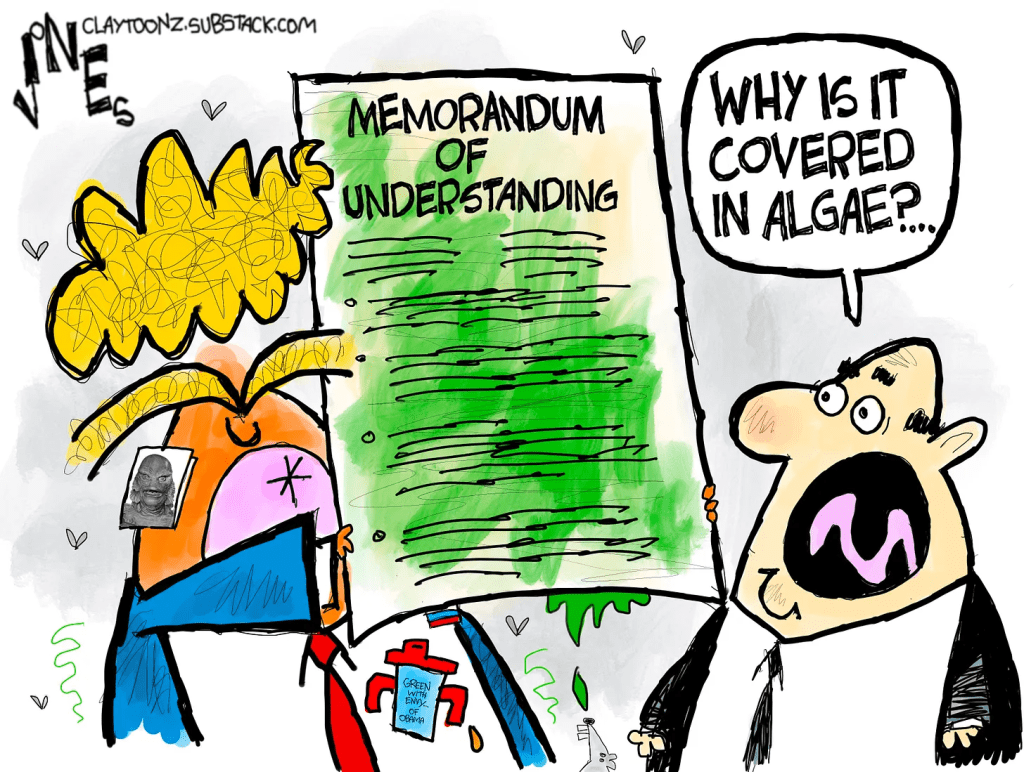
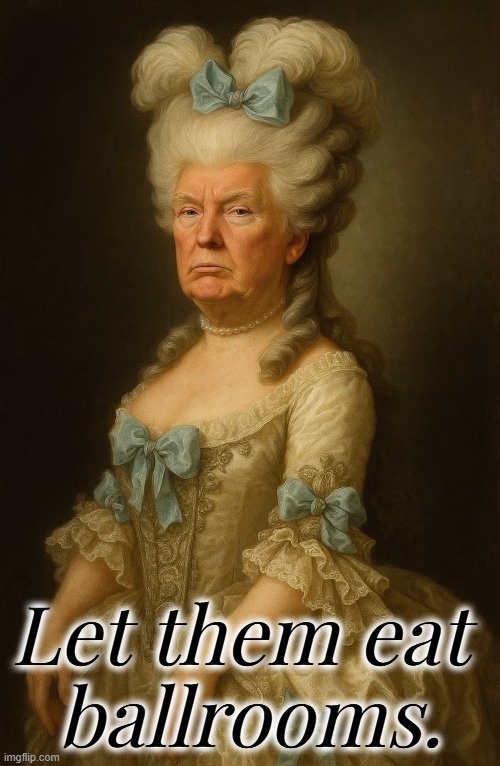
Trump’s failure with the Lincoln Memorial Reflecting Pool is a perfect example of how this regime operates.
He said he wants to beautify Washington DC, though the city is already beautiful. This is like when he came into office in 2017, and before the afternoon was over, he took credit for rebuilding the military. We were spending over $800 billion a year on our military before Donald Trump came into office, so trust me…. We already had a military. If anything, our military is weaker today because Donald Trump just wasted a lot of its armaments on his stupid chosen illegal war. It’s also being led by a chauvinistic, racist, white Christian nationalist with the brain of a moldy sponge.
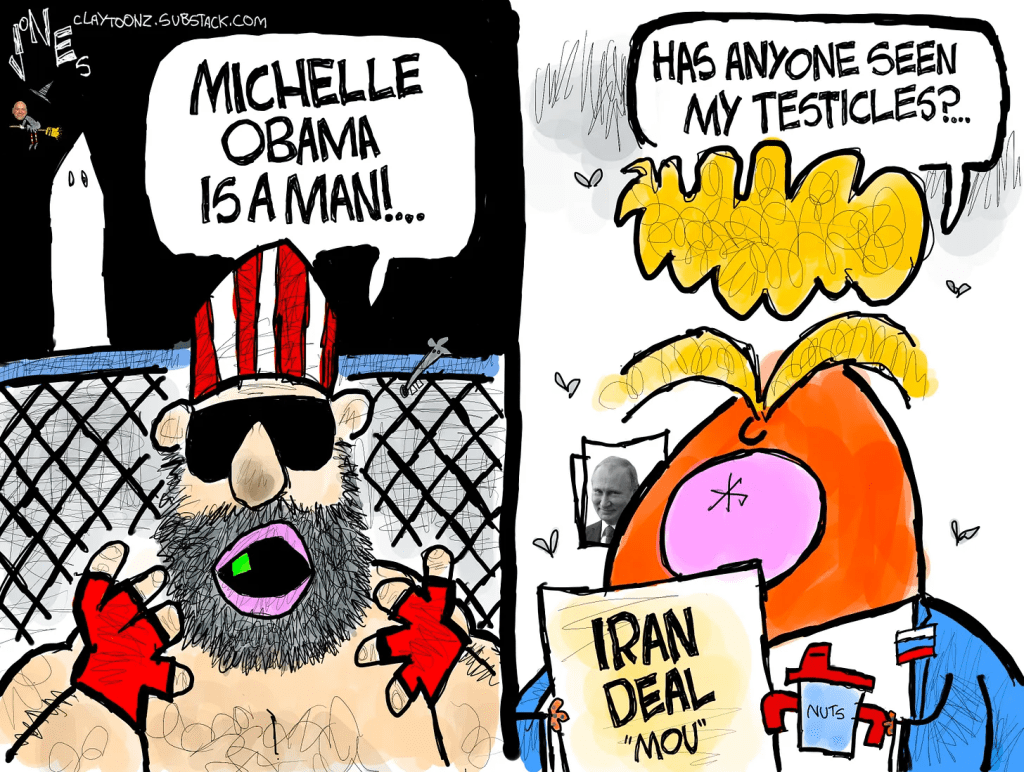
Back to the pool. Trump wanted to beautify it before July 4, when our nation celebrates its 250th birthday, not to be confused with June 14, which is Donald Trump’s birthday, which will now be commemorated every year by having shirtless men pummel each other in your backyard. (snip-MORE)
The UFC event at the White House last Sunday was not supposed to be political, even though it was held on Donald Trump’s birthday. But after winning his fight, UFC fighter Josh Hokit was being interviewed by podcaster and ring announcer, Joe Rogan, when he grinned and looked into the camera, and said, “And lastly, Michelle Obama is a man! Am I right, America?”
Of course, he is not right, and his racist and sexist conspiracy theory shouldn’t be given the dignity of a defense because it is just too ridiculous and stupid. But what Hokit did wasn’t just disrespectful to Michelle Obama and President Obama, but also to the White House, where he made the comment (hasn’t that place suffered enough during Trump 2.0?), and the country, as this was supposed to be for America’s 250th birthday.
The event itself was disrespectful enough to the White House and the Oval Office without Hokit’s hateful comment. (snip-MORE)
Sam and crew go over Graham Platner’s win and his interview with Mika Brzezinski Scarborough on Morning Joe. Amoung the jokes about her interview they go over his acceptance speech. I am personally satisfied he has answered all the questions. I love his line “… if you give me the chance I will be a senator for the people who cannot afford to buy a senator”. I am a progressive and a believer in DSA policies. Graham Platner is not the perfect person who is flawless and unlike many his flaws are out in the open, not hidden behind a facade of fake religious politeness. He is a populist. I am not looking for religious leaders in our lawmakers, I am not expecting someone who walked blamelessly through life, that they way only one person did and his name was Jesus. I am looking for someone whose policies help the lower incomes and the public at large, not the privileged few. I am looking for a congress and White House filled with people who do not think elected office is their golden ticket to personal wealth and authority over others. Real people screw up and those that ask and work for a second chance should be given a chance to show they deserve it. In my opinion Platner has and does shown he deserves his forgiveness. Plus people look at Graham’s past are not looking at Collin’s past or even Mika who started dating Joe when he was still married. To me a lot of these people going on about Platner’s past seem to hold him to a different standard than they themselves are held or republican canidates are held. Hugs.
Remember this is a Christian nationalist who wants to push his version of religion on everyone else. He has denied promotion to women and black people. He is a radical religious crusader, which I know because he has a crusader tattoo. Years of trying to make the US military of which I was one and my dog tags read pagan for religion more inclusive are being destroyed by an administration that is filled with people who are driven to promote and push a religious domination on the military and country. It has long been known that religious zealots infected the Air Force Academy and were pushing the evangelical version of the Christian religion. In Germany I had to spend an uncomfortable 8 months when a fundamentalist religious group in our unit decided that as it was an open secret in the unit I was one of the gay members of the unit that was more open about it they needed to save me from my sins. Every time I went to the chow hall one of them cornered me at a table and started to preach at me. Not talk to me, not to offer friendship, but to tell me all about hell and how horrible I was and that their god hated how I was and that I was in willful disobedience to their great deity. They could save me from their already determined fate if I just joined them and gave my life to their god instead of the heathen sin some demons had infected me with.
I got so damn frustrated with them. Then my friends who had started eating with me to drive them away came up with a plan. We created a religion based on greek mythogoly that we called the “House of Aphrodite”. We drew up a few tenets of the region, one of which was that it was a sex religion and to worship everyone needed to do so with each other nude. The last time they saw me at the chow hall and several of them tried to sit with me and my friends, my friends sprung the trap. They told the guys we would gladly go to their church meetings and pray with them but only if they went to one of our religious meetings first. They did not know we were religious they claimed but we assured them we were very devout. Thinking we were talking about a “liberal” church they readily agreed and then my friends sprung the trap. They told them about our religion The House Aphrodite and the tenets. My friends emphasized how we all worshiped in the nude and some rituals enacted required people to touch each other even on their sexual organs to honor the goddess. My friends played it up and I could hardly keep from laughing at the horrified looks on their faces. Needless to say they declined our invitation to join us in worship. But after that they never bothered me again. Hugs
Cesar Chavez, Eric Swalwell, Justin Fairfax, and the gender politics of keeping their dirty secrets.
News about powerful men committing violence against women has bombarded the United States in recent months.
On April 16, 2026, Virginia’s former Lieutenant Gov. Justin Fairfax killed his wife, Dr. Cerina Fairfax, and then himself inside their family home. The shocking news came days after Rep. Eric Swalwell, a Democrat from California, resigned from Congress following multiple sexual misconduct allegations.
A few weeks prior, in March 2026, an investigation about labor movement leader Cesar Chavez revealed a decades-long pattern of sexual abuse, including against another farmworker icon, Dolores Huerta.
All three of these powerful men had known patterns of alleged predatory sexual behavior. But their secret was protected—in some cases for decades—not only by other men, but also by some of the same women they’d hurt.
Somehow, no matter how much progress we think we’ve made, women keep being sacrificed—or sacrificing ourselves—for men’s accomplishments and legacy. Our lives and futures and mental health are even sacrificed on the altar of their potential political accomplishments and legacy.
The Al Franken effect
I’m a legal historian and commentator on sexism and gender-based violence. I’ve studied violence against women and the criminal trials that let male perpetrators off the hook. I’m also a woman who experiences sexual harassment so often that it has become a dull hum following me throughout my day.
This self-sacrifice seemingly stems from what seems to me to be a societal belief that the men who commit harm are more needed than the women who are harmed. Our ideas, organizing, and logistical labor—often dismissed as “secretarial” work—can’t compete with the fear of losing a single powerful man.
When the allegations against Swalwell first broke, some on the left rushed to defend him. Some on social media claimed it was a Republican smear job because he’s been opposed to Trump’s policies and was running to be the next governor of California.
Women often come forward with their stories when a man is running for political office because they feel that information is relevant to voters. Or, they may speak out because it’s difficult to see one’s abuser portrayed so incompletely in the news.
Yet some people cast doubt on the timing of the Swalwell accusations, suggesting people were out to get attention or take a “good man” down before he can further ascend in his career. On social media, posts compared the situation to Al Franken resigning from Congress in 2017 over sexual misconduct allegations.
Franken’s resignation is often treated as an example of #MeToo going “too far,” because some reporting suggests that the initial accusation against Franken may have been trumped up. But he was sexually inappropriate with women both before and after taking office. His resignation was important to live up to progressive values, and the left didn’t actually lose any political clout over it: Franken’s replacement, Tina Smith, has been a fantastic senator.
It’s relatively rare for members of Congress to resign after being accused of sexual misconduct. According to the National Women’s Defense League, 23 lawmakers with public accusations are running for reelection in 2026 in 16 states, including nine people running for Congress.
The group held a press conference on April 21, 2026, to discuss two new reports on sexual misconduct in Congress and state government. According to its research, 80 percent of candidates publicly accused get reelected.
Cesar Chavez’s legacy
The calculus for marginalized women to come forward about sexual assault is even tougher.
The first line of Dolores Huerta’s public statement about her abuse says she kept quiet for nearly 60 years because she “believed that exposing the truth would hurt the farmworker movement I have spent my entire life fighting for.”
I believe many women stay quiet when they think coming forward could hurt a movement—in this case, one Huerta helped to build. But they may tell their story if they’re worried not doing so could cause even more harm.
Her story details two incidents of sexual assault that resulted in two hidden pregnancies. She gave both children up for adoption.
Soon after the investigation broke, Chavez’s name was erased from monuments across the country. That’s not necessarily an indication of local leaders taking sexual violence seriously. In some places, it may just as well reflect a desire to erase Mexican American achievements and the progress of the United Farmworkers Union in securing rights for migrant laborers, some of the most marginalized workers in the country.
I say that because we have the perfect replacement for Chavez’s legacy in Huerta herself. It would be so easy to simply rename every street and monument after her, rather than simply erase commemorations of the movement.
Huerta was already forced to sacrifice so much by Chavez, must she now watch as her life’s work goes down with him, too?ire News Group is a reader-supported, independent nonprofit newsroom.
Jewish history
In my own Jewish community, there is a long history of pressuring victims of domestic violence and sexual assault to stay quiet—and not air their suffering outside the community.
Doing so would be an example of “lashon hara,” or evil speech or gossip. If we report our abuse to police, we are contributing to negative ideas about the Jewish men in our community. Some men in the Jewish community even claim that because of Jewish teachings and customs, Jewish men can’t ever actually abuse their wives, because domestic violence is a Christian affliction of gentile culture—that is, a non-Jewish problem.
This myth persists outside the Jewish community, and it can impact how Jewish women are treated in secular American courts.
My doctoral dissertation research covered a case of a Jewish woman in New York City murdered in 1875. Both suspects in her killing were Jewish men protected by the community. During the trial, the victim was used as a cudgel against her own people to prove that Jews were dangerous.
If she had survived and was given the choice to report the violence she faced would she have feared exposing a man from her community to the criminal justice system?
This concern is even more heightened for Black women. If their abusers are Black, they know that reporting them means increasing exposure to a racist criminal justice system.
Research also suggests Black women are less likely to be seen as victims by the dominant society and more likely to be blamed for harming men of their own community, or accused of trying to “take down a good man.” (Think back to how accusations against R. Kelly, Mike Tyson, Bill Cosby, and Clarence Thomas were greeted.)
As Aishah Simmons, Black feminist and activist, explains, many people “think that exposing and addressing intra-racial sexual violence against Black women divides the community … and we should only focus … on racism since that is the ‘real problem.’”
This community protection can feel even more important when the abuse comes from a so-called “good Black man,” as author Kaitlyn Greenidge wrote on April 19, 2026, of Cerina Fairfax’s killing. The promise of a Black middle class life with a politician husband like Justin Fairfax is supposed to guarantee a safe and protected life.
Cerina Fairfax stood by her husband even after two women accused him of sexually assaulting them; one alleged incident occurred back when he and his accuser were undergraduates at Duke University.
The accusations against Fairfax came to light during a crisis in Virginia politics when he was poised to possibly take over the governorship from the scandal-plagued Ralph Northam. Fairfax denied any misconduct and refused to resign. No criminal charges were filed. He ran for governor in 2021, and lost.
In this case, Democrats did lose leadership of the state. Before the sexual assault allegations, Fairfax was seen as a rising star in the Democratic Party. Had his accusers not gone public, he might have become the state’s next governor.
But it’s equally true that had he resigned in 2019, after they did, a new Lt. governor could have stepped in and potentially run successfully in 2021.
Sacrificing for the cause
It irks me that Fairfax ran for governor after being accused of sexual misconduct. It irks me that Swalwell did, too.
Swalwell’s name remains on the primary ballots in the California governor race, and that will hurt the Democrats’ chances to hold onto that post. It was Swalwell’s hubris and entitlement hurt his party—not the women who came forward to prevent him from accruing more power.
I wonder: How many young staffers left politics because Swalwell was allowed to prey on his subordinates? What progress could have been made in the labor movement if the women abused by Chavez had instead been in leadership roles? Would Cerina Fairfax still be alive if her husband had been prosecuted in 2019?
We’ll never know how the world would look if the well-being of the women in these cases had been prioritized over the careers of their abusers. What I know is that the harm done to us as women is more important than the potential of the men who hurt us. And I know that the goals of movements or political gains can no longer rest on our silence and our labor.
Yet the tRump administration trashed the government’s stance of fighting right wing violence or right wing extremist violent groups. It started with the republicans forcing Obama to remove a government study on right wing extremists. Now the current DOJ and FBI have removed all mention of right wing violence or violent actions instead claiming the violence is all being done and caused by Antifa. The government wants to make the public believe that the people who are against fascism are the real extremist threat to the public. Antifa is antifascism / antifascist. It has no headquarts or central organization it is just people who since the 1930s have pushed back against fascism and fascists. The tRump white supremacists want the public to believe violent groups like the Proud Boys, the Oath Keepers, Nazi groups, the 3 percenters, and other militia groups that joined in the insurrection riot on Jan 6th and are extreme white supremacists. The current people in charge love the way they can steal the money from the treasury and take away people’s rights, so they want to keep the hate groups that support them to be the good guys and anyone who tries to stop the destruction of democracy they hope to make the bad people. Hugs
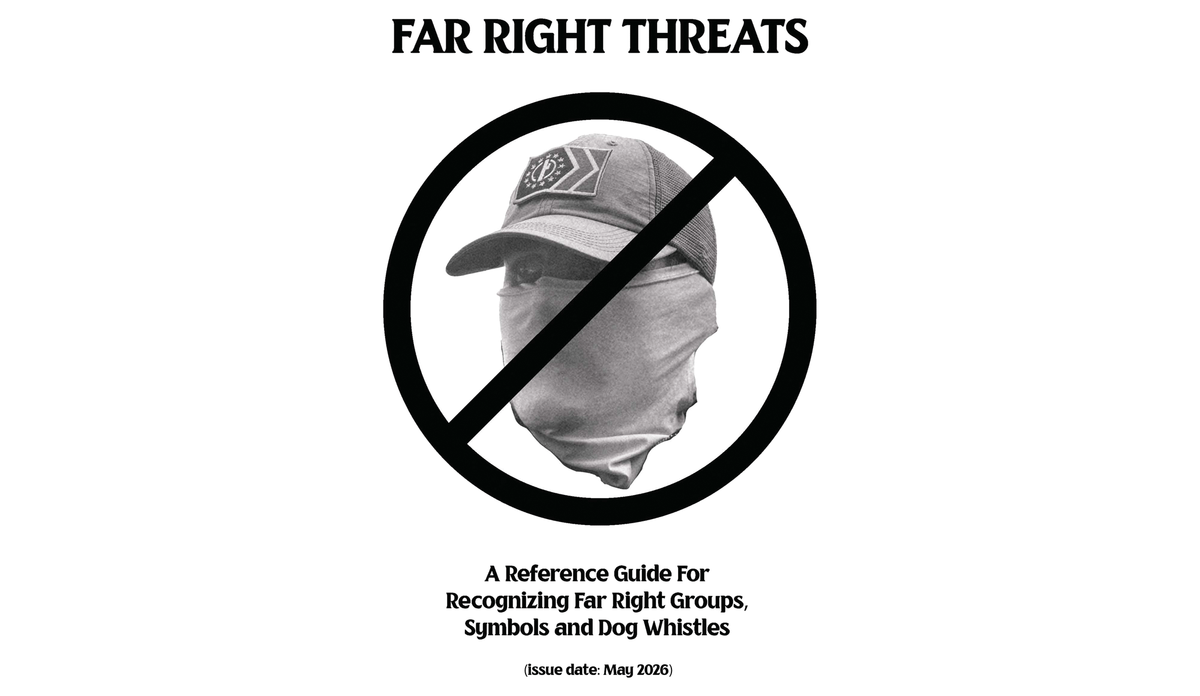
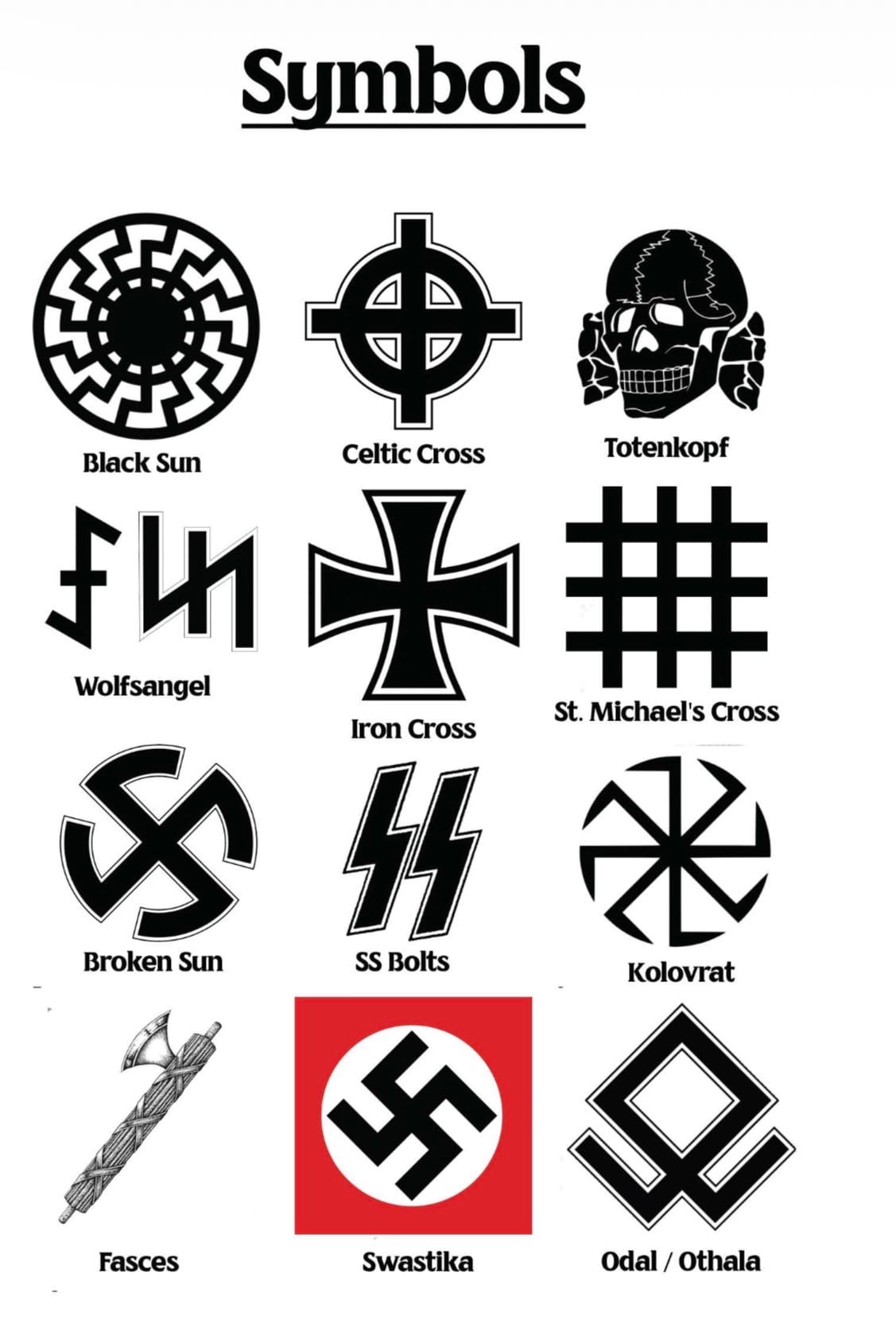
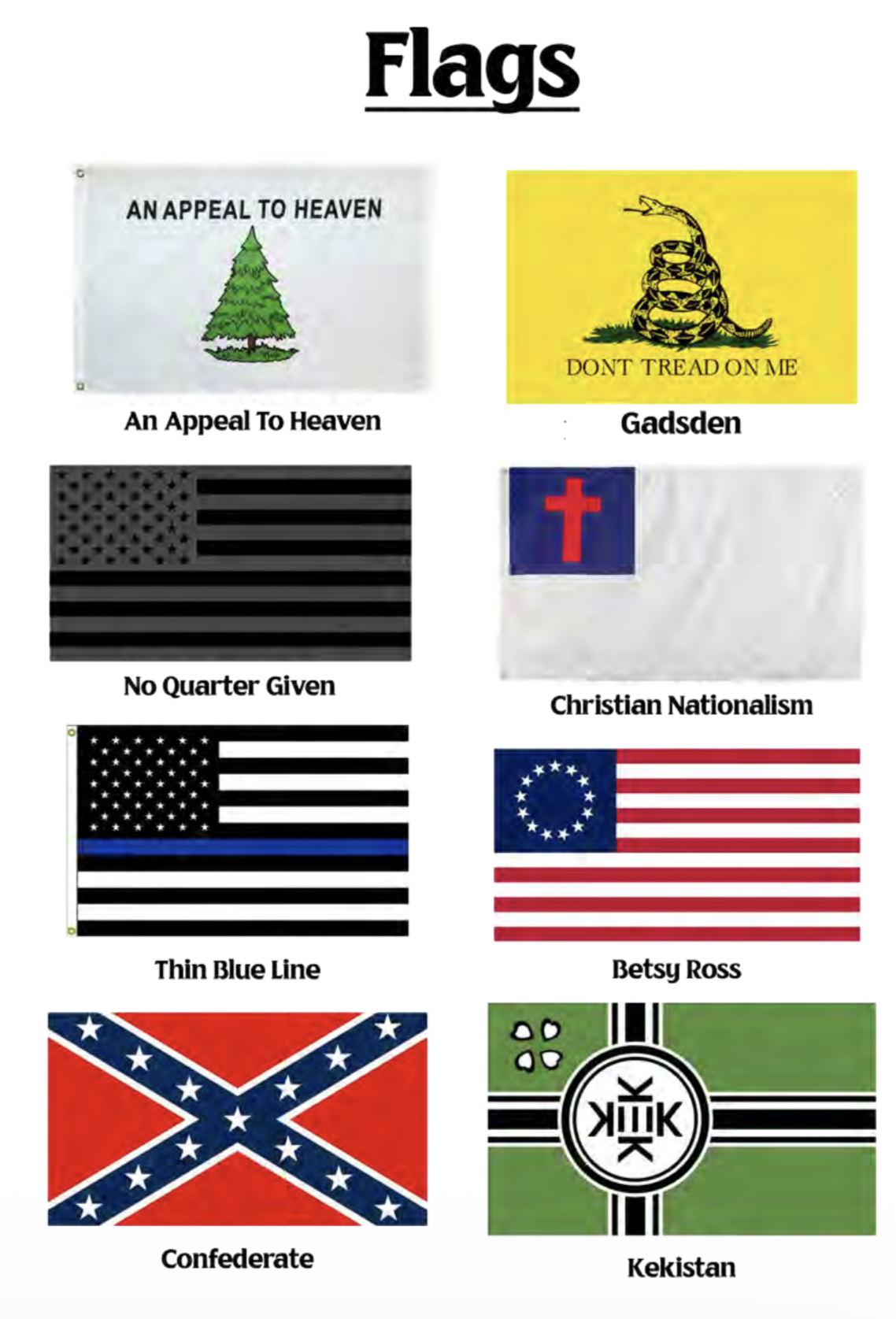
Disclaimer: WWFU typically redacts the imagery seen in this zine with an iron front or an X, and encourages others to do the same. This zine also contains slurs that we typically redact. For the sake of eduction and proper recognition, the following content is un-redacted.
A Reference Guide For Recognizing Far Right Groups, Symbols and Dog Whistles
Introduction
As of spring 2026, this zine serves as a reference guide to far-right symbols, dogwhistles, and groups, helping you recognize and understand them. The list focuses on the most active groups and the most commonly used phrases and symbols at this time.
Not all neo-Nazi and white supremacist groups openly brand themselves with swastikas or SS bolts. Recognizing their dogwhistles is essential to accurately identifying them as the community threats they are. Some groups and individuals deliberately project a public facing image of “patriotism” or opposition to “foreign wars” to appear more mainstream, while privately holding the same beliefs as more openly neo-Nazi organizations. Because some symbols are not exclusive to neo-Nazis, fascists, or white supremacists, it’s important to look for additional context clues and patterns of use.
Dogwhistles are coded messages communicated through words or phrases understood by a specific in-group, but not by outside observers. Neo-Nazis and white supremacists use dogwhistles to signal to one another while maintaining plausible deniability.
Phrases / Numbers
131: Anti Communist Action (ACA), the numbers referring to the letters of the alphabet.
Blue Lives Matter/All Lives Matter: These phrases are nothing more than a response to people saying “Black Live Matter” and as way to silence Black voices. Cops can always choose to take off their uniform, while Black people cannot take off their skin or escape the discrimination that comes with it. No one would go to an event to save the rainforests and say that all forests matter. If all lives matter, as racists love to say, then Black lives have to matter. All lives can’t matter until Black lives matter because they are the ones being targeted by police, racist attacks, and everyday discrimination.
TDOTR: The Day of the Rope, a fictional day from the book The Turner Diaries in which race traitors (women who marry non-white men, the press, politicians, LGBTQ people and more) are hanged from lampposts.
6MWE: “Six Million Wasn’t Enough” referring to the number of Jewish people murdered during the holocaust.
The Great Replacement Theory: White supremacist conspiracy theory that argues democratic and government officials are intentionally facilitating non-white immigration to replace the white population for political purposes. Similar phrases include “white genocide.”
It’s okay to be white: While no one is saying it’s not okay to be white, this phrase creates perceived victimhood and is a stepping stone to great replacement.
WPWW: White Pride World Wide
GTKRWN: Gas the Kikes, Race War Now
RAHOWA: Racial Holy War
RWDS: Right Wing Death Squad
Blood and Soil: A reference to race and nationality from Nazi Germany
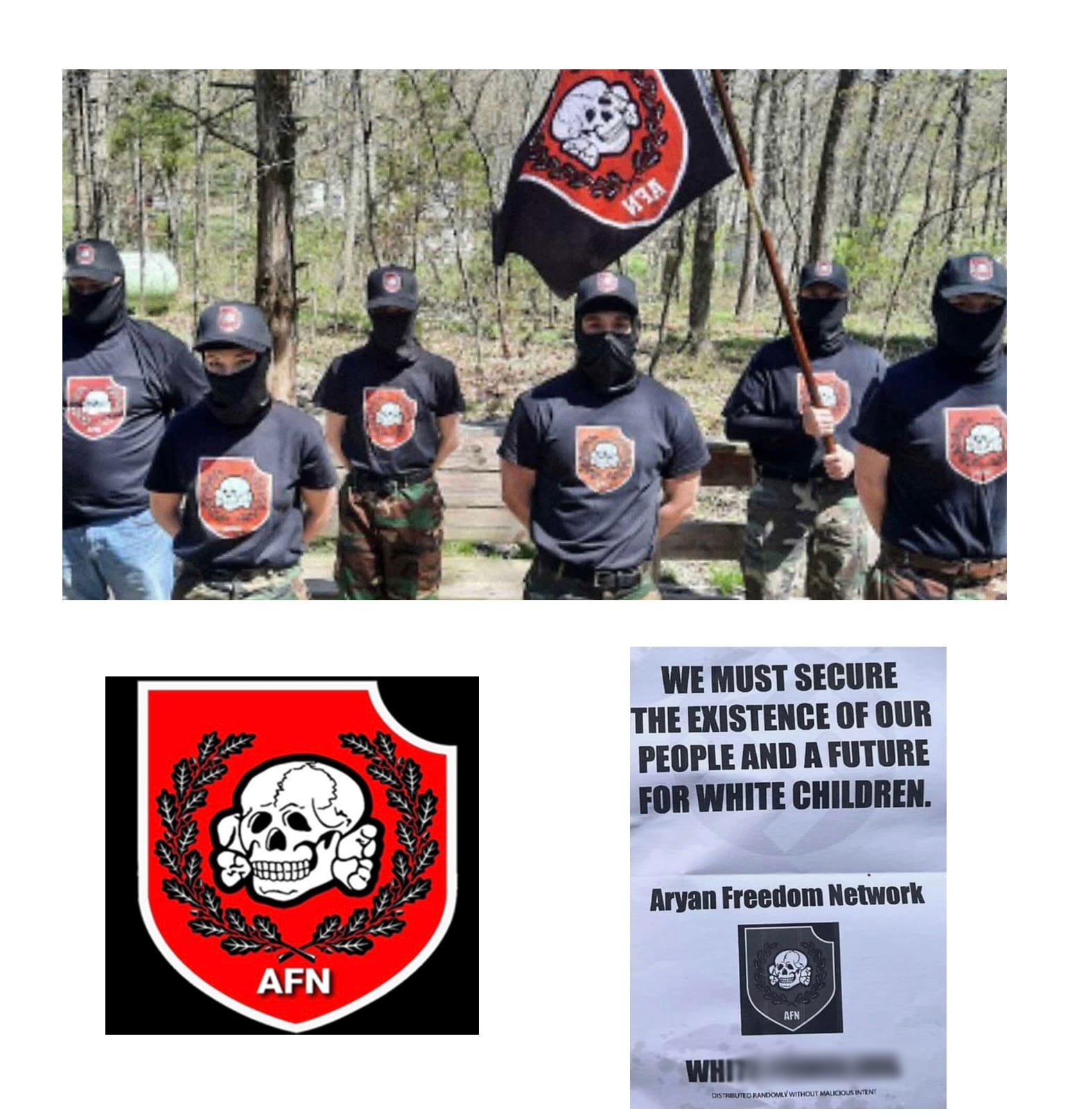
14: A reference to the 14 words “we must secure the existence of our people and a future for white children” coined by David Lane.
88: 8 Represents the 8th letter of the alphabet, HH or “Heil Hitler.” Variations include H8 and 83 “Heil Christ.” You will often see the numbers 14 and 88 together (1488 or 14/88).
WP: White Power. Also sometimes signified by an “okay” hand gesture.
Reclaim America: White supremacist slogan advocating for the “reclaiming” of America from immigrants (referencing the racist Great Replacement conspiracy theory).
We’ll Have Our Home Again: Popular phrase used by neo-nazis and white supremacists based on a song of the same title and similar to “reclaim America.”
Groups / Orgs
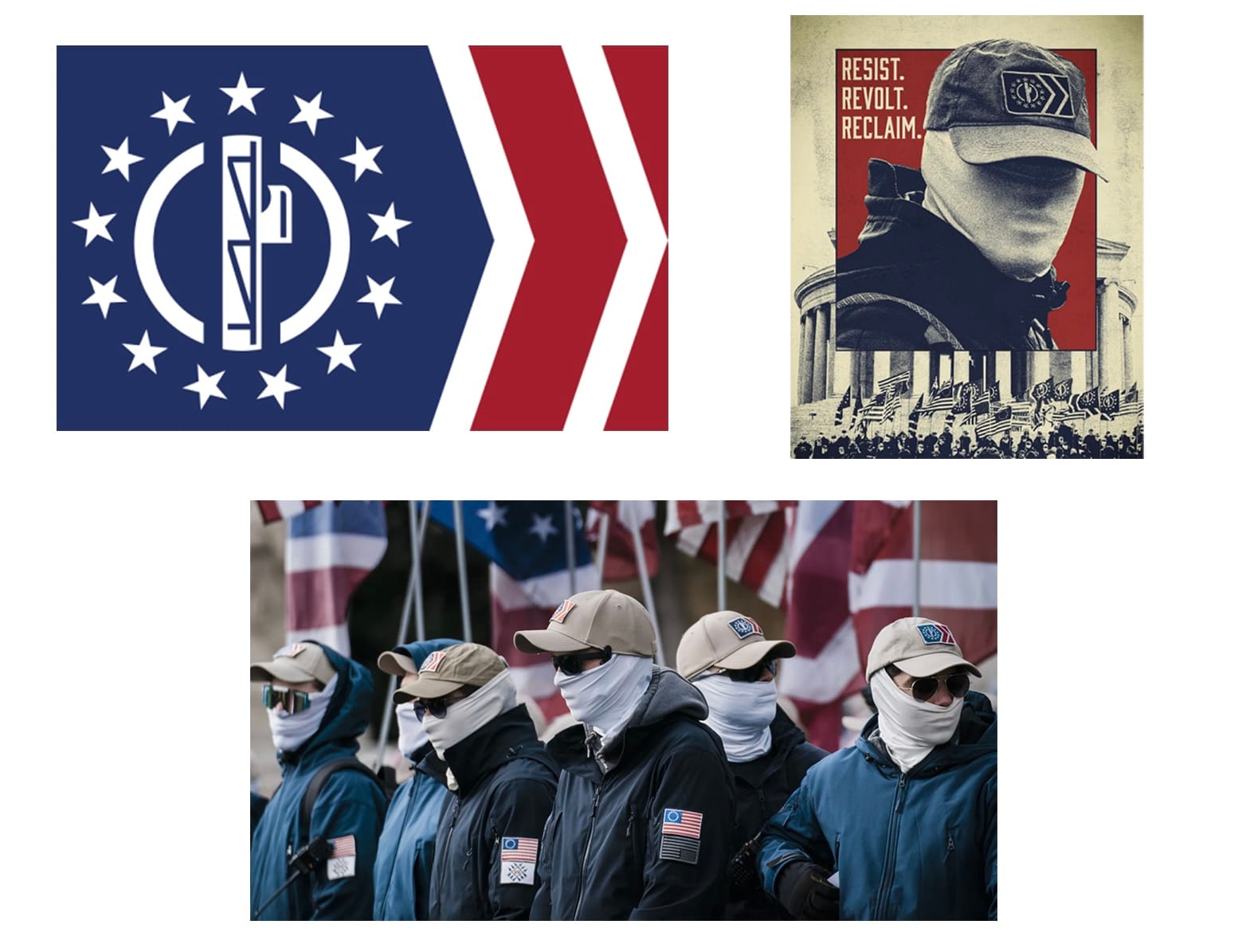
Patriot Front: A white nationalist group mostly focused on using patriotic imagery and rhetoric to spread propaganda and recruit. Founded by Thomas Rousseau, the group broke off from Vanguard America in 2017 after the deadly Charlottesville rally in Virginia. They care primarily about public image. Their style involves patriotic designs including red white and blue, fasces, khaki pants, and white masks with matching shirts, shields, the Confederate flag, the Betsy Ross flag, and the US flag. Despite their efforts to be palatable to a wider audience, outside of public view they espouse anti-semetic, pro-white and pro-nazi views. Patriot Front is currently one of the largest white nationalist groups in the US.
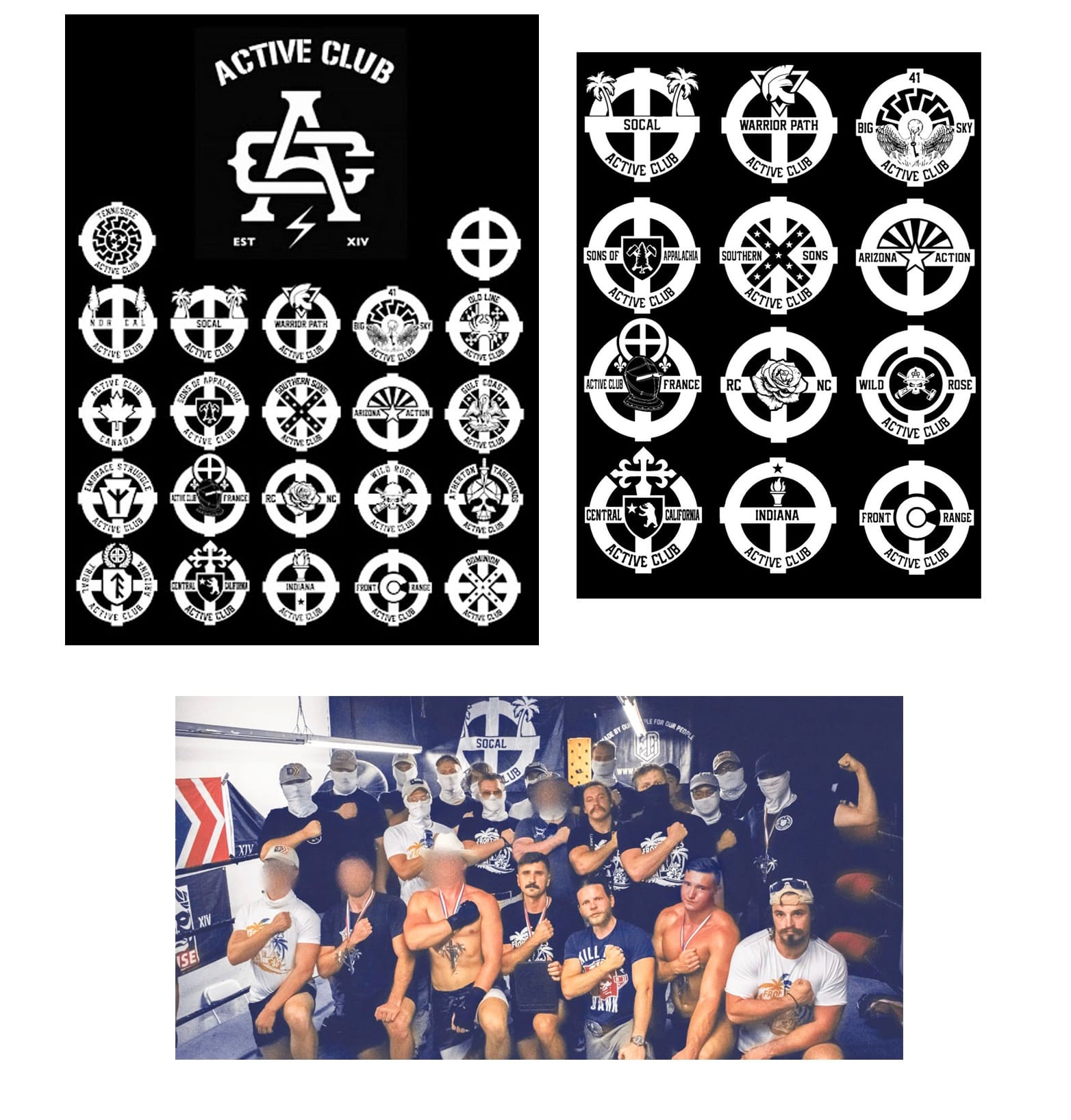
Active Clubs: Active Clubs are white supremacist fight clubs widespread across the US and throughout parts of Europe. They use the guise of fitness and training to try recruiting mostly younger white men into their clubs. Often members will march with other larger neo-nazi / white supremacist groups, and all chapters share the same logo of a Celtic Cross with text representative of their region. Many Active Clubs in the US are directly tied to Thomas Rousseau and Patriot Front.
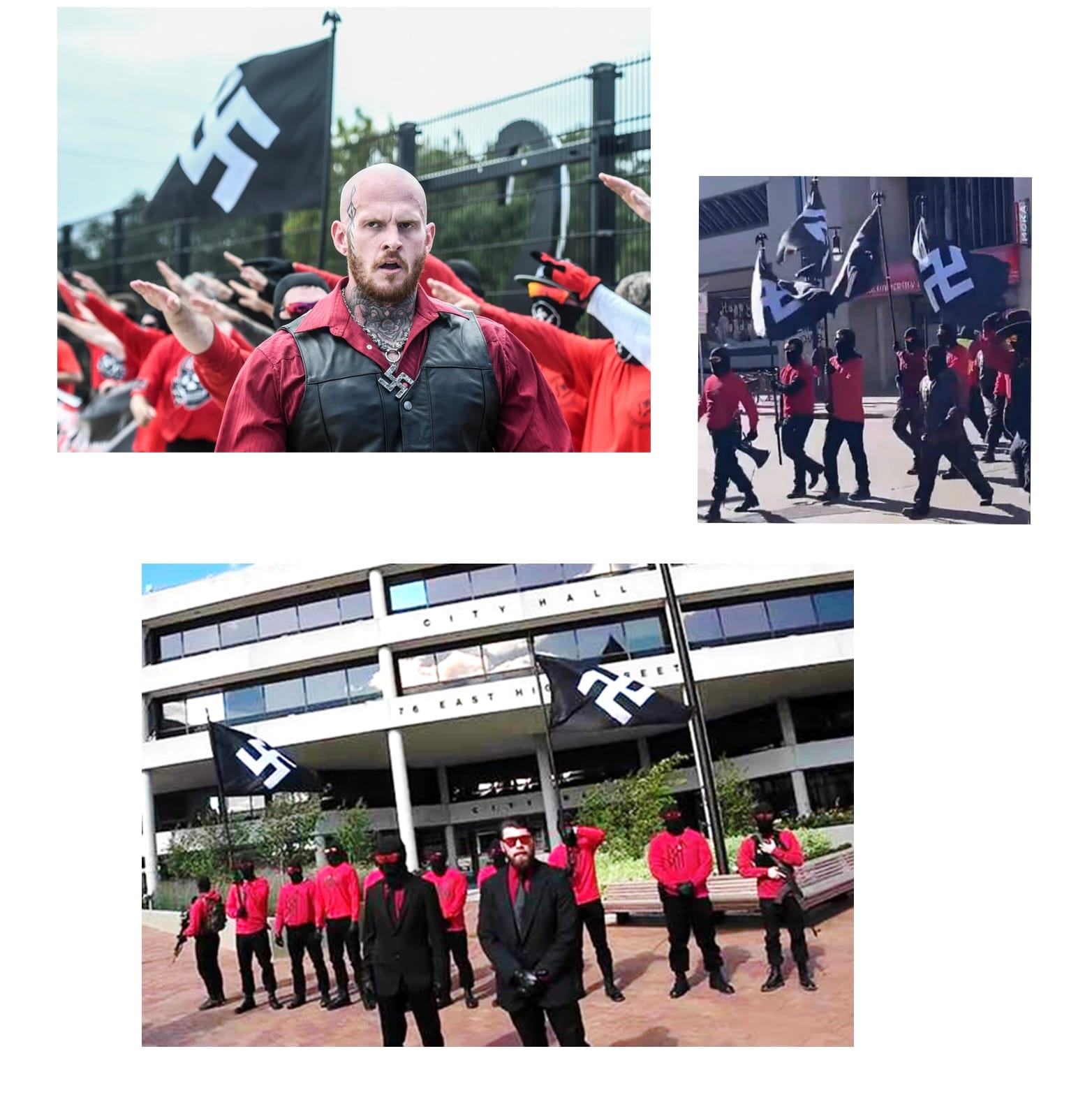
Blood Tribe: Blood Tribe is a neo-nazi group started by former marine Christopher Pohlhaus. They are known for being one of the most outward facing Nazi groups, holding semi-regular marches in cities across the US. They wear matching red and black outfits with black face coverings, and march with matching black and white swastika flags, and will loudly chant white supremacist and nazi slogans. Their goal is to instill a Fourth Reich in the US.
AFN: “Aryan Freedom Network” is a neo-nazi group present widespread across the US. The group has begun functioning as an umbrella organization, bringing in members from other groups like the Ku Klux Klan and outlaw bikers to function under their name. Outside of flyering neighborhoods with nazi propaganda, they operate mostly out of public view. They train often with firearms and make efforts to organize nationally across as many regions as possible.
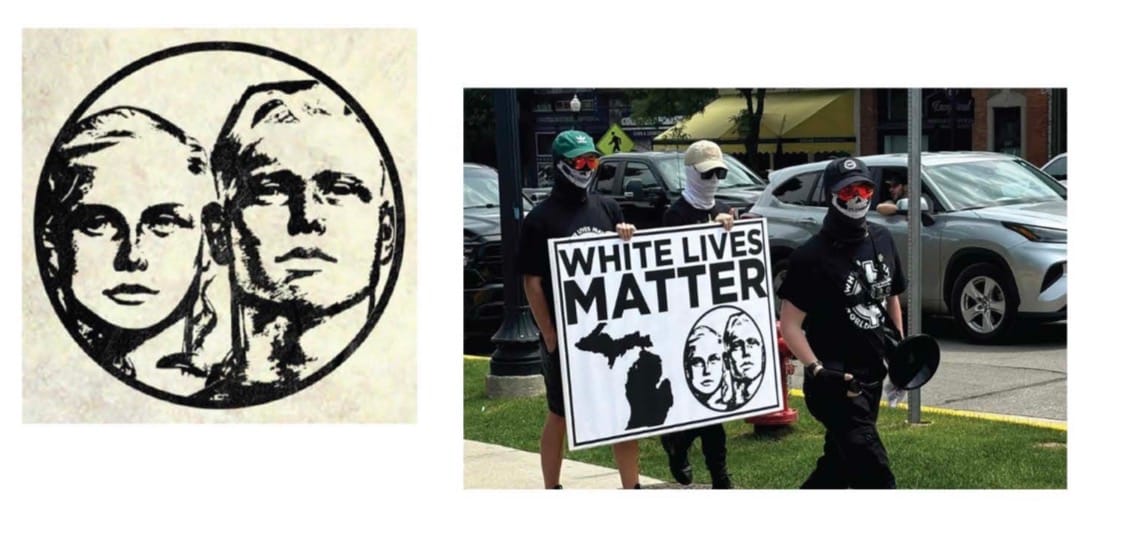
WLM: “White Lives Matter” is a white supremacist movement with chapters all around America and the globe, who focus their activism on low-risk tactics like stickers, flyers, and banners.
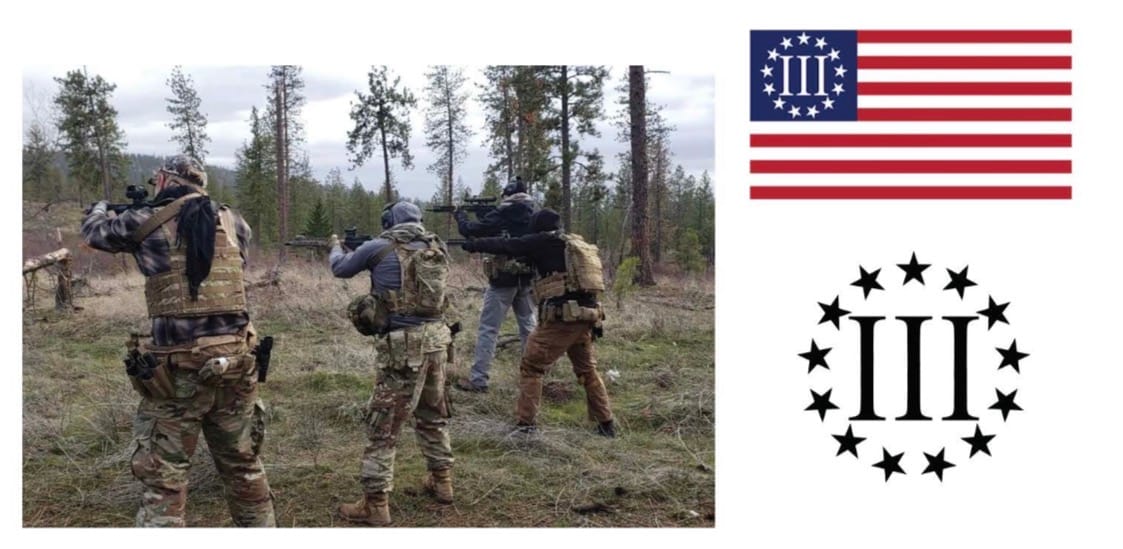
Three Percenters: This movement was created in 2008 with the false claim that only 3% of American forces fought the British in the revolutionary war, and therefore it would take only 3% of the population to overthrow the current US government. They are a far-right militia movement of anti-government extremists focused on gun ownership.
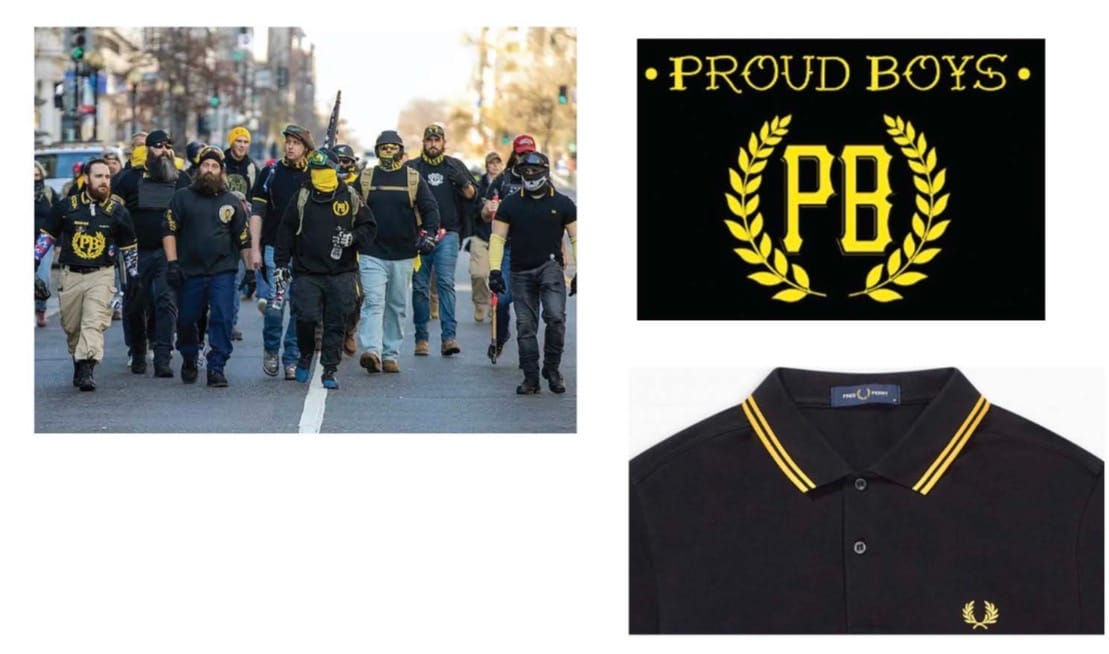
Proud Boys: A group of western chauvinists founded by Gavin McInnes in 2016. Although the Proud Boys aren’t explicitly white supremacist, their emphasis on the “western” values and culture is a thinly veiled substitute for “White” values and culture and is used to deflect accusations of racism. Their ideology can be considered a form of proto-fascism as it contains elements of ultra-nationalism, traditionalism, misogyny, and social Darwinism. Their membership has different levels and members are encouraged to participate in street brawls. Level 1 is to exclaim “I am a proud western chauvinist and I refuse to apologize for creating the modern world.” Level two is to recite 5 cereal brands while other members perform a “beat in.” Level 3 is to get a tattoo of “PROUD BOY,” and level 4 is to engage in violence for their cause, usually against LGBTQ or antifascists. They use the acronyms POYB (Proud of Your Boy) and FAFO (Fuck Around and Find Out) and can be spotted in black and yellow Fred Perry polo shirts, or other clothes with the black/yellow color combination. They also use the “okay” hand sign on a regular basis.
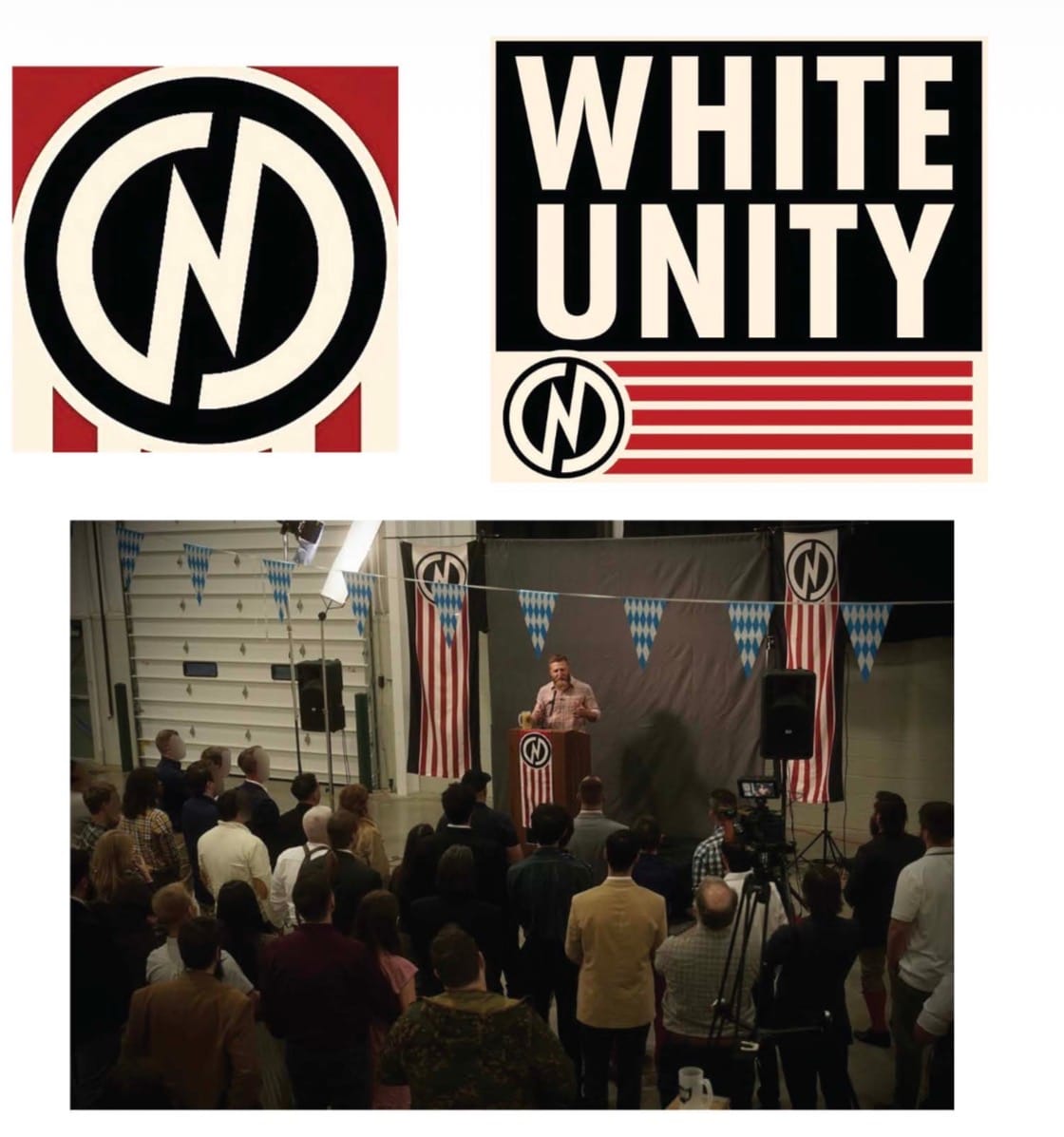
NOVA: “National Organization for Vital Action” is a white-supremacist organization with the goal of building a “nation within a nation” for whites only. They aim to connect as many neo-nazi and white-supremacist groups and individuals as possible in order to create a broad network of racists in America. Their public actions mostly consist of banner drops and stickers. In private, the group has expressed their willingness to use violence to achieve their end goals of a whites only nation.
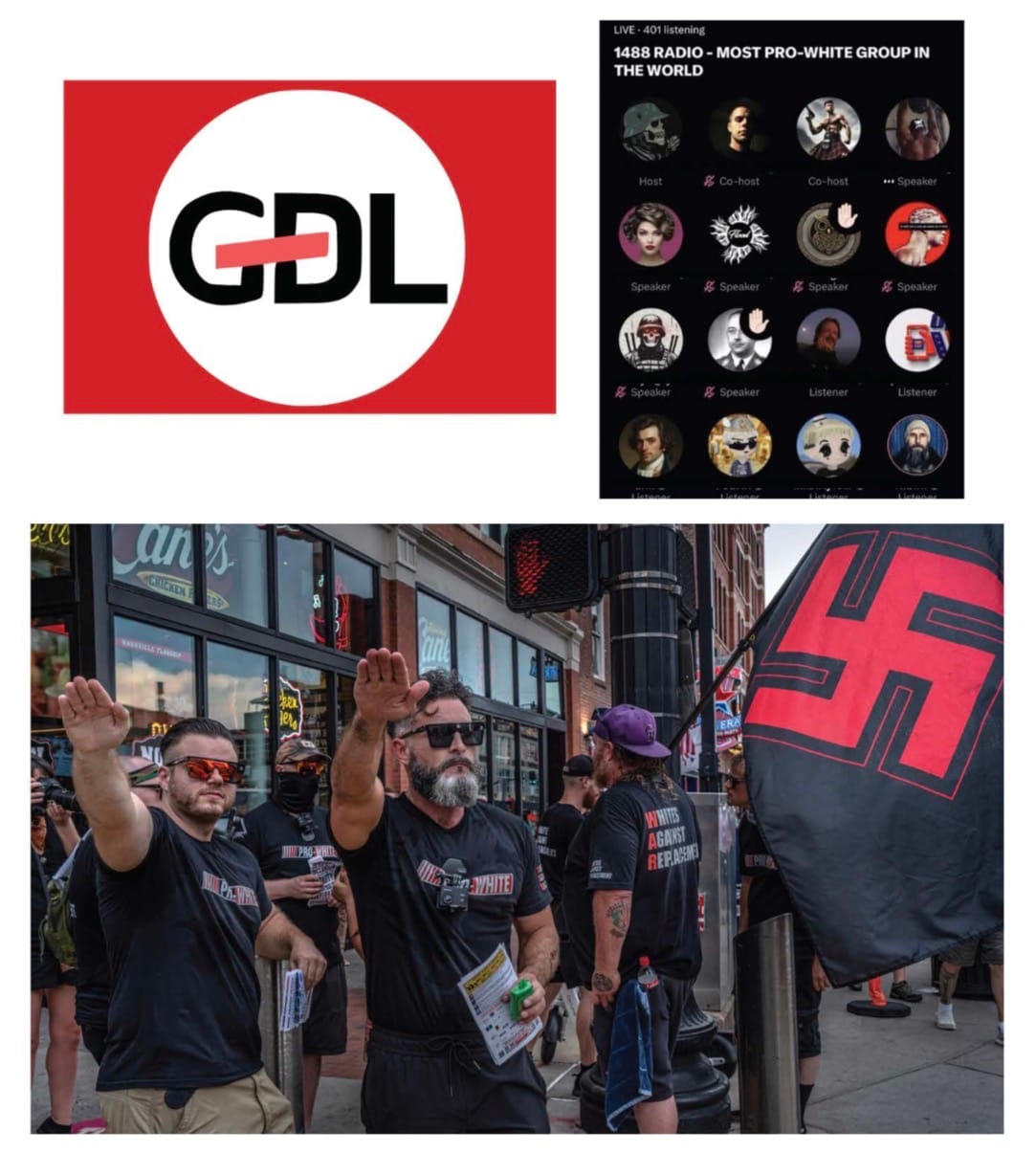
GDL: “Goyim Defense League”, founded by Jon Minadeo II, is a network of anti-semetic content creators who focus almost exclusively on anti-Jewish conspiracy theories and hatred. They primarily focus their efforts on online videos and live -streams, but are also active in-person, often flyering neighborhoods doing banner drops, harassing synagogues, and holding marches with swastika flags.
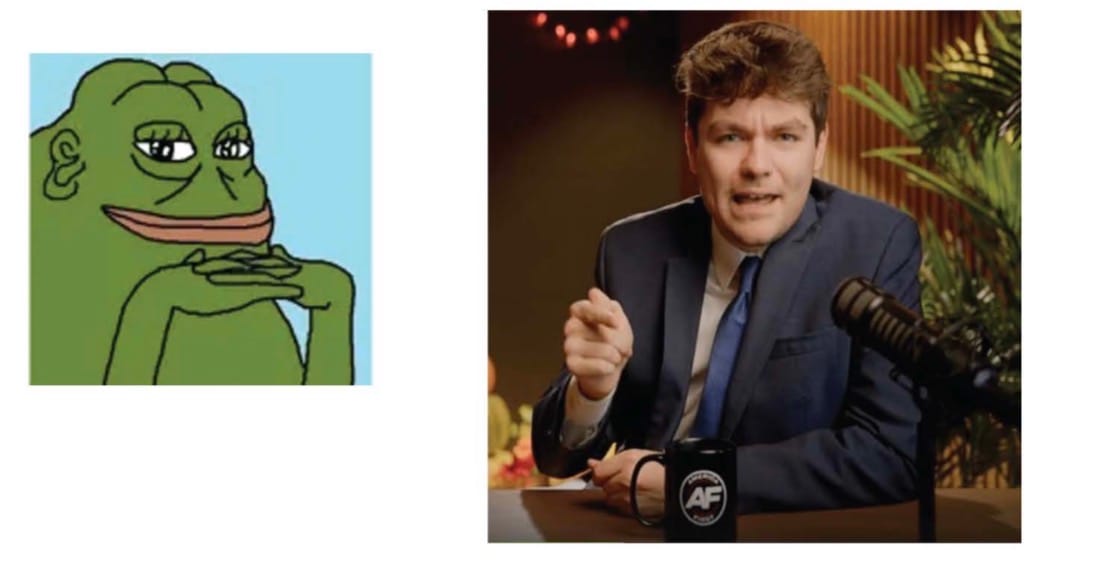
Groypers: “Groypers” are a term for followers of far-right, nazi influencer Nick Fuentes. Less of an organized group, it is a term given to adherents of the anti-immigrant, anti-semetic, and pro-white positions held by Nick Fuentes and pushed into the public. The primary function of Groypers is to push more “traditional conservatives” into a more radical, white supremacist sphere.
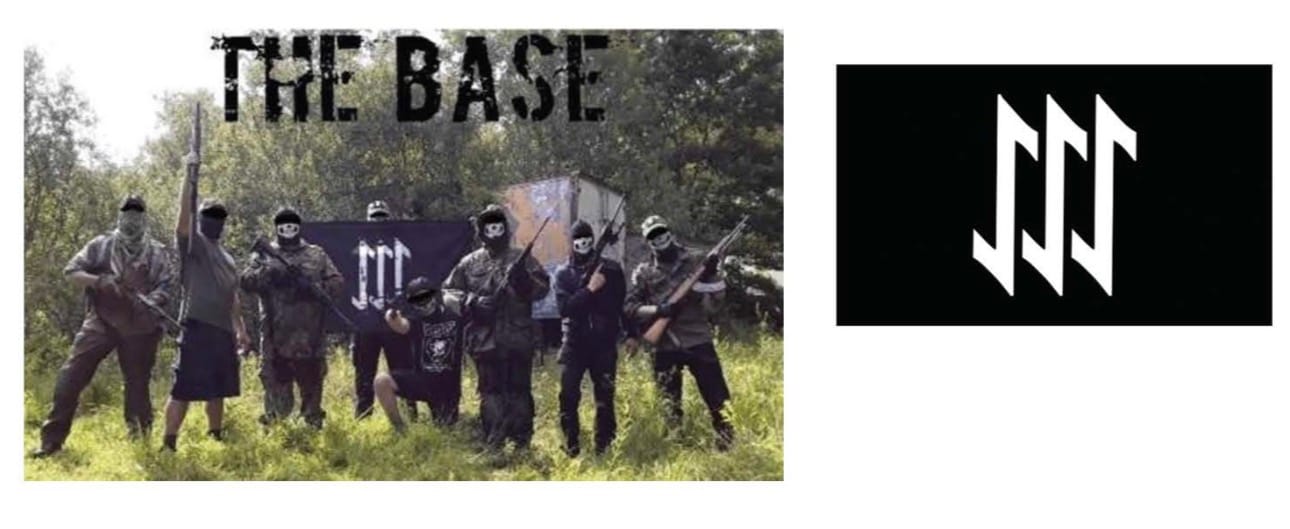
The Base: An accelerationist paramilitary nazi group formed by Rinaldo Nazzaro in 2018. They have similar aesthetics to Atomwaffen, but a different logo.
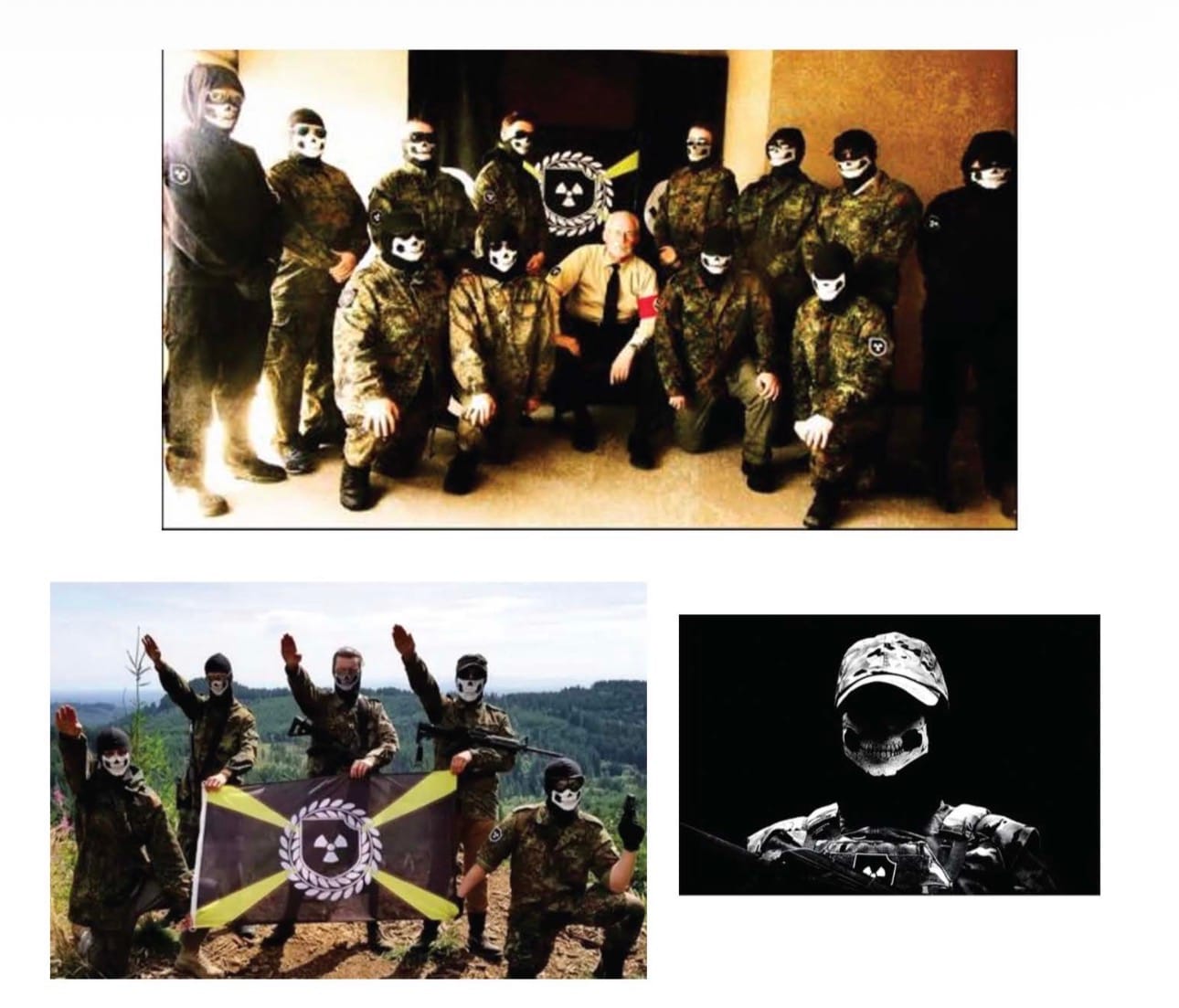
Atomwaffen Division: Also known as the National Socialist Order, Atomwaffen is an accelerationist (accelerating towards a race war in which they hope to overthrow the current government and society and replace it with a fascist order) nazi group responsible for several murders. After numerous arrests and infighting. the group dissolved, only recently attempting to reform in 2025, though failing to gain support. Responsible for popularizing the skull mask within neo-nazi groups, other symbols include the radioactive symbol and flecktarn (a German camo pattern similar to the “peas” pattern from WW2). Although now defunct, their influence remains significant.
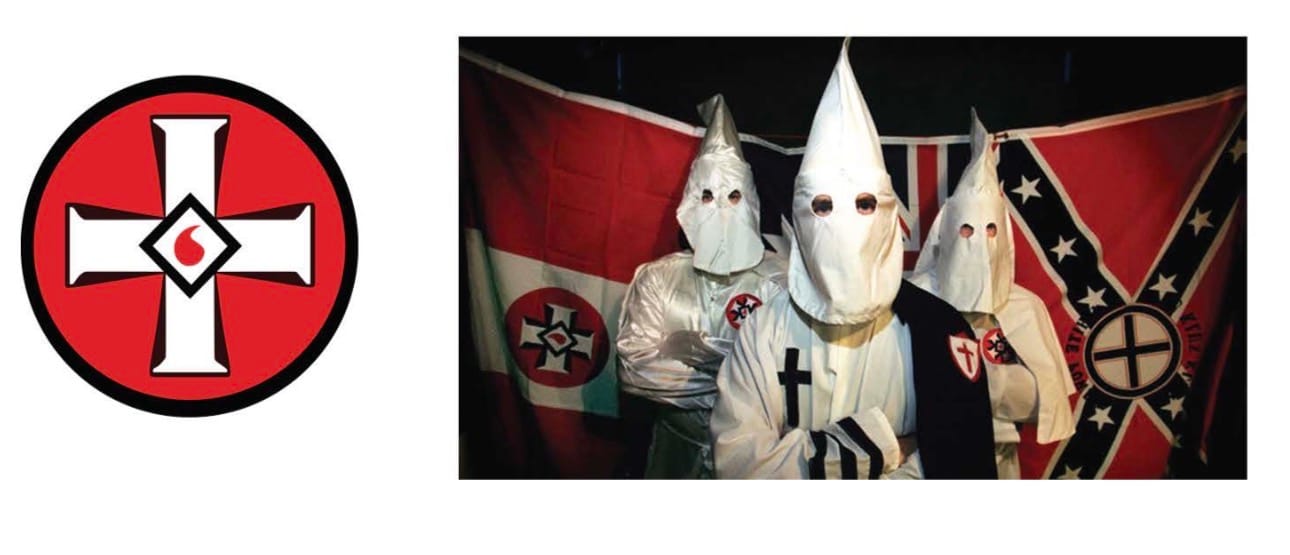
Ku Klux Klan: One of the longst running white supremacist organizations. They use the number 311 to represent 3 Ks, which is the 11th letter of the alphabet. Their iconic robes have become so recognizable they may no longer count as a dog whistle. They also use the blood drop cross and variations on the blood drop cross including just the blood drop, and the confederate flag.
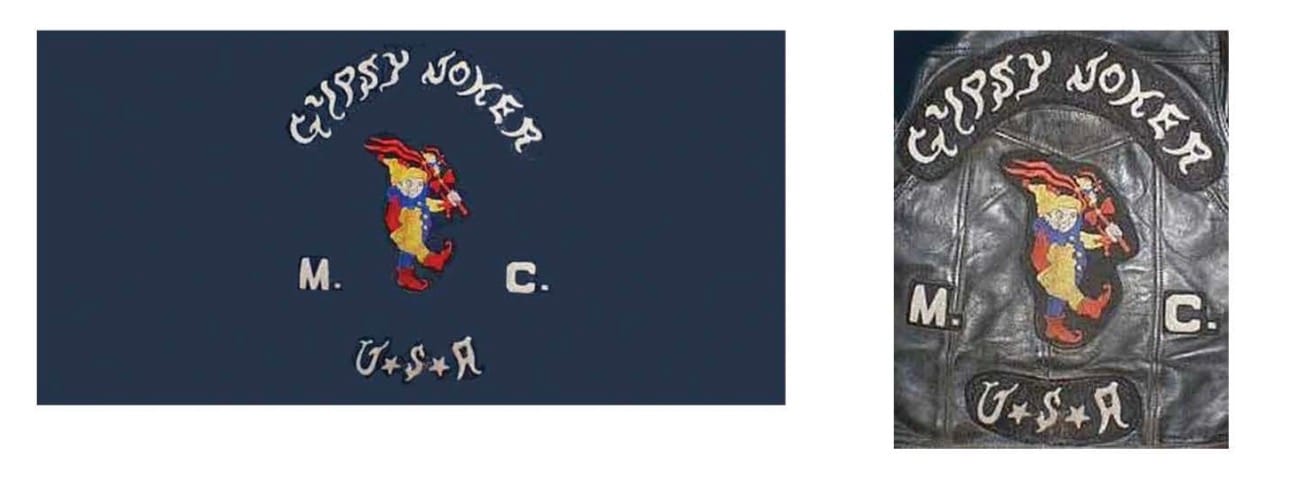
Gypsy Jokers: A one percenter motorcycle club with white supremacist sympathies who are known to traffic drugs and engage in low level organized crime and violence. They wear motorcycle gear adorned with nazi symbols and a back patch that says “Gypsy Jokers.” In recent years they have been known to associate with the Proud Boys.
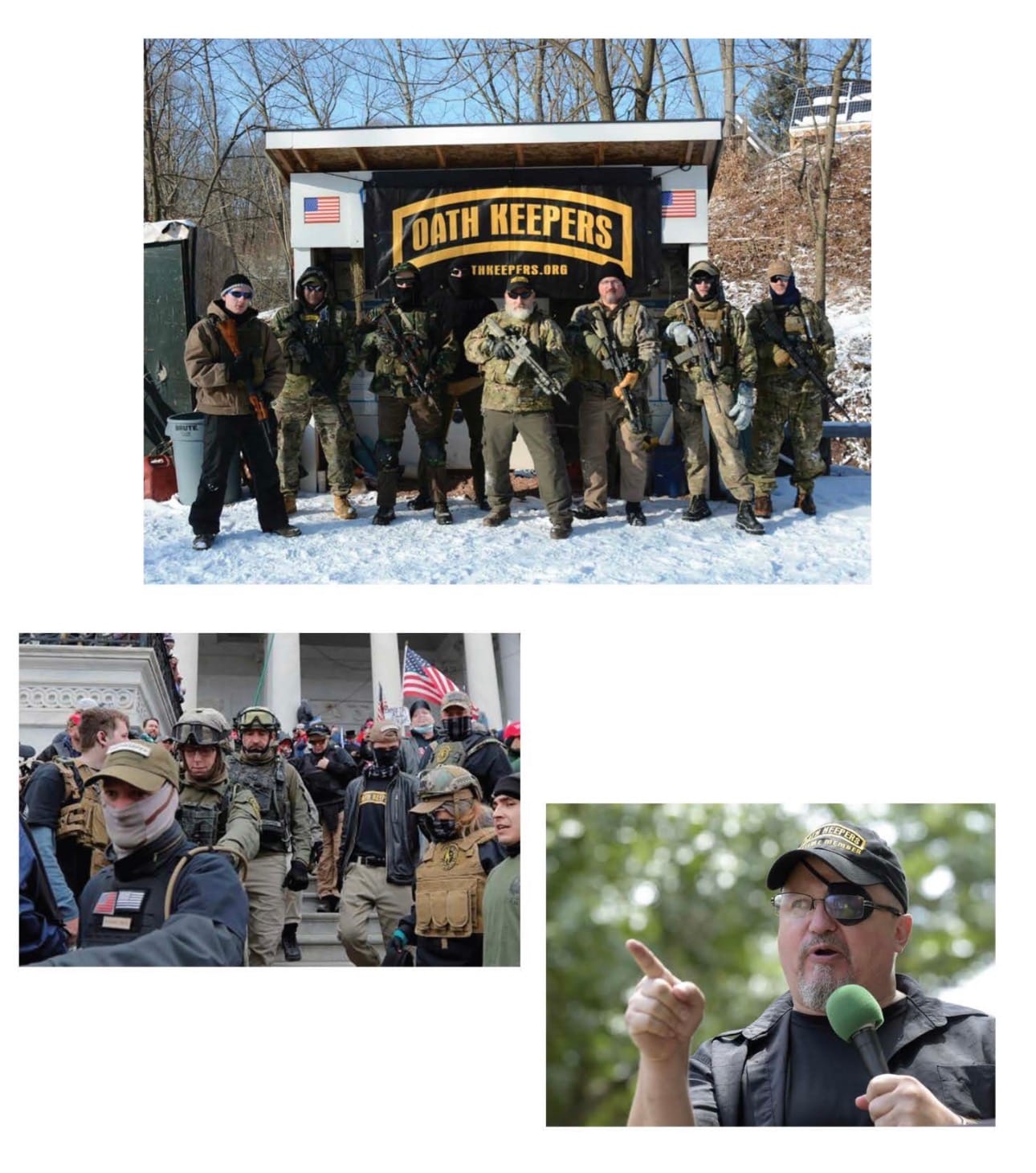
Oathkeepers: Far-right anti-government militia founded in 2009 by Stewart Rhodes. Oathkeepers played a key role in the January 6 insurrection at the US Capitol. Oathkeepers appeal directly to military and law enforcement personnel, encouraging them to keep their “oath” to defend the public from what they perceive as the new world order, by means of discipline and violence. They’re also associated with three percenters.
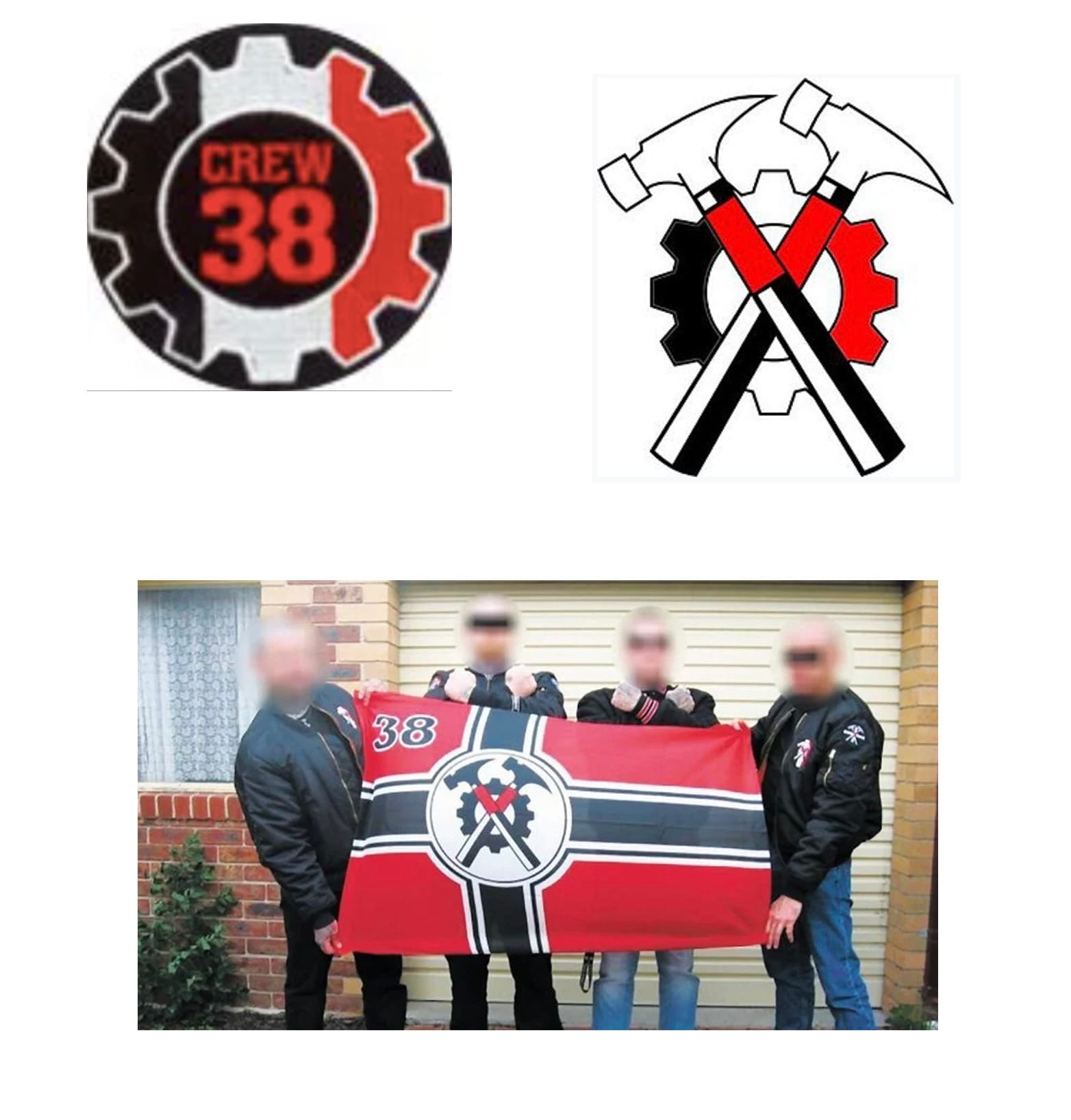
Hammerskins: A racist skinhead group, aka boneheads. The feeder group is known as Crew 38 (38 for “Crossed Hammers”). Hammerskins focus mostly on spreading racist music, but they also engage in street fighting and targeted attacks. Hammerskin Nation is considered one of the most violent racist skinhead groups in the US. They use a hand sign of crossed arms with fists to represent the crossed hammers.
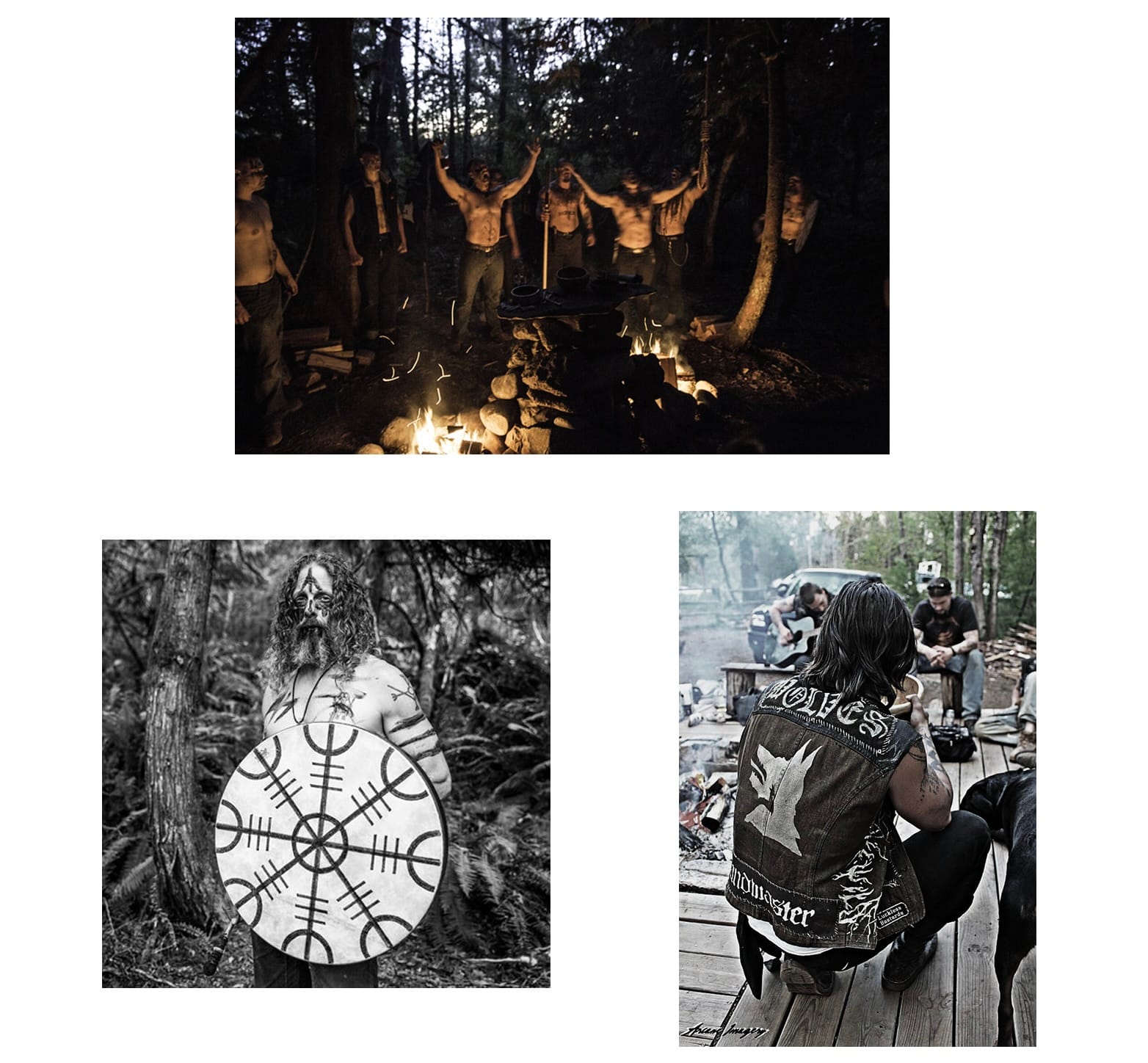
WoV: “Wolves of Vinland” is a group with heavy folkish influences that promotes white supremacy and misogyny, stressing Asatru or Paganism, including animal sacrifices and blood rituals in the woods. They have recently been partnering with Patriot Front and Active Clubs to hold fascist combat events. Their headquarters is in VA, but membership is not limited to that area. “Operation Werewolf” has been used as a recruiting tool and feeder group for WoV. They can be spotted with Celtic and Nordic imagery, runes, and wolf pack patches..
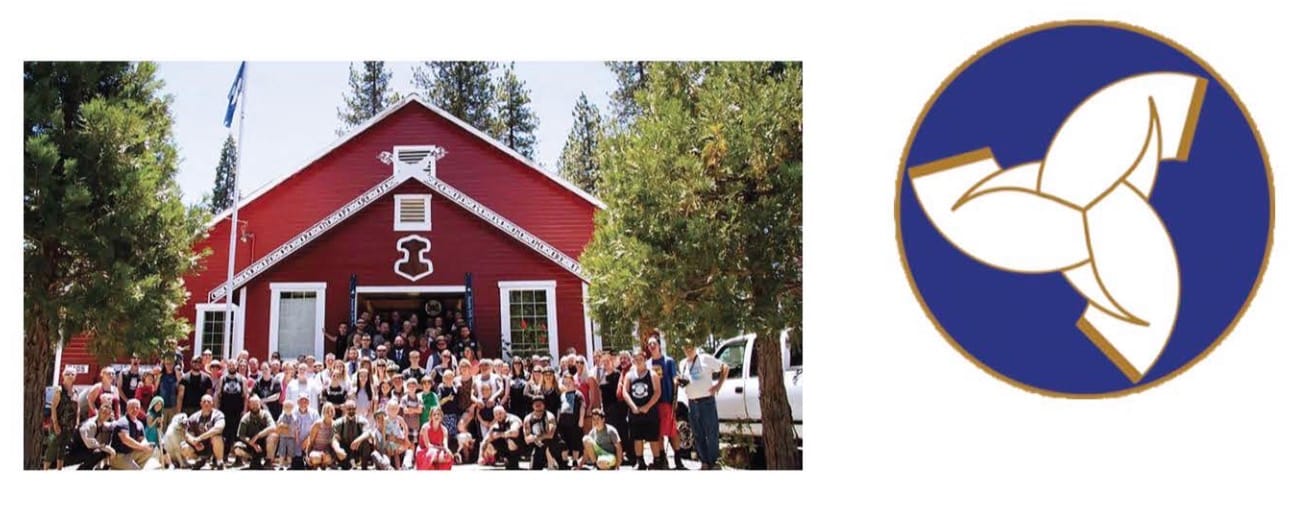
Asatru Folk Assembly: A norse pagan organization which advocates for pre-Christian European rituals and beliefs. The organization discourages “race-mixing” and promotes a whites-only vision of America, falsely claiming that white people were in North America first and were wiped out. Members of other neo-nazi groups such as Blood Tribe associate often with them.
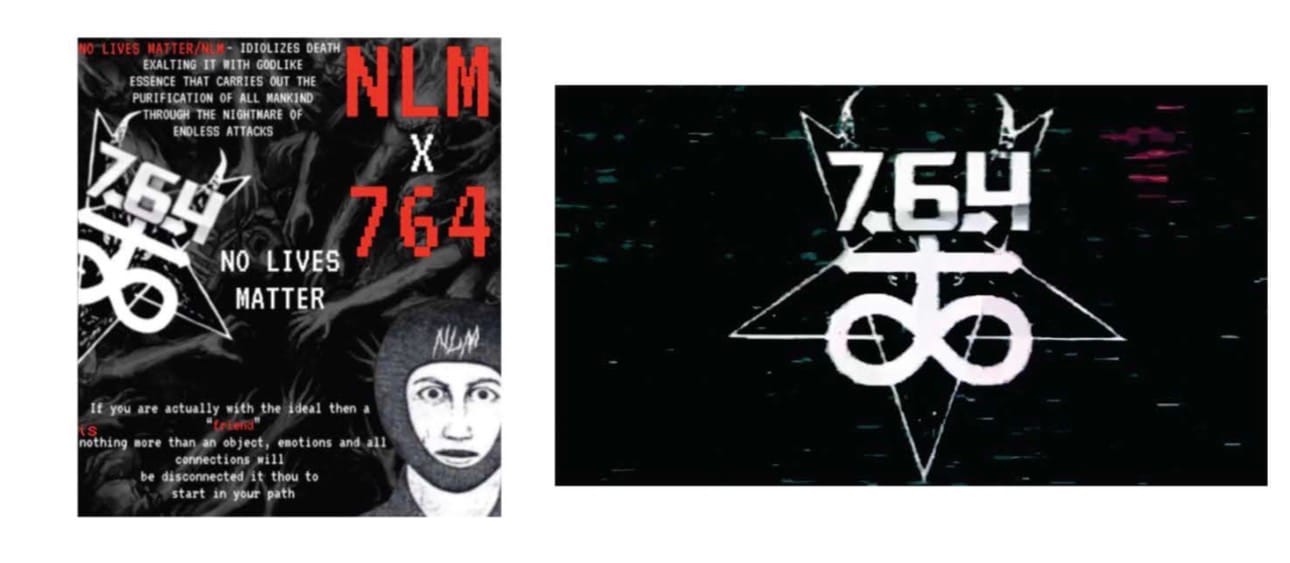
764 / No Lives Matter: 764 is an international, predatory network that espouses neo-nazi, satanic, nihilistic, and accelerationist beliefs. It targets and exploits children / young people and encourages them to commit mass acts of violence. Adherents have been responsible for acts such as murder, firebombings, and school shootings.
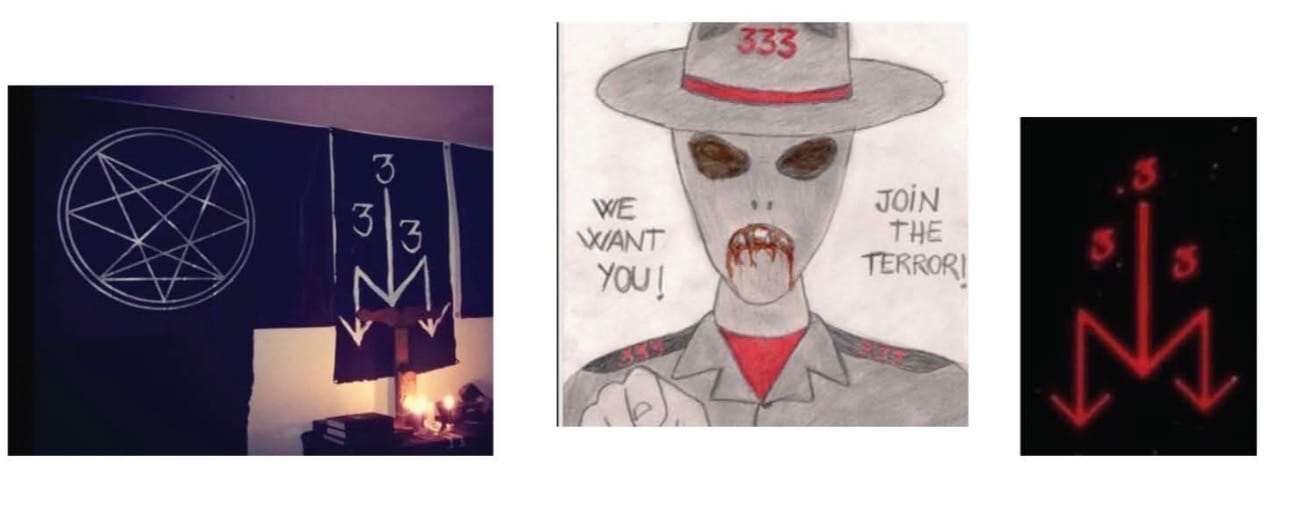
Tempel ov Blood / 09A: The Order of Nine Angles (09A), and it’s most violent chapter, The Tempel ov Blood (ToB), are satanic neo-Nazi cults that have had a significant influence on far-right accelerationist projects, like the now-defunct Atomwaffen. Suffice to say, 09A and ToB glorify nazism and violence, and are adept at radicalizing (and abusing) teenagers. Symbols include the seven-pt star inside a circle, a downward sort of pitchfork with 333 above it, and “Drill Sgt Grey” – a sinister space alien in a military outfit.
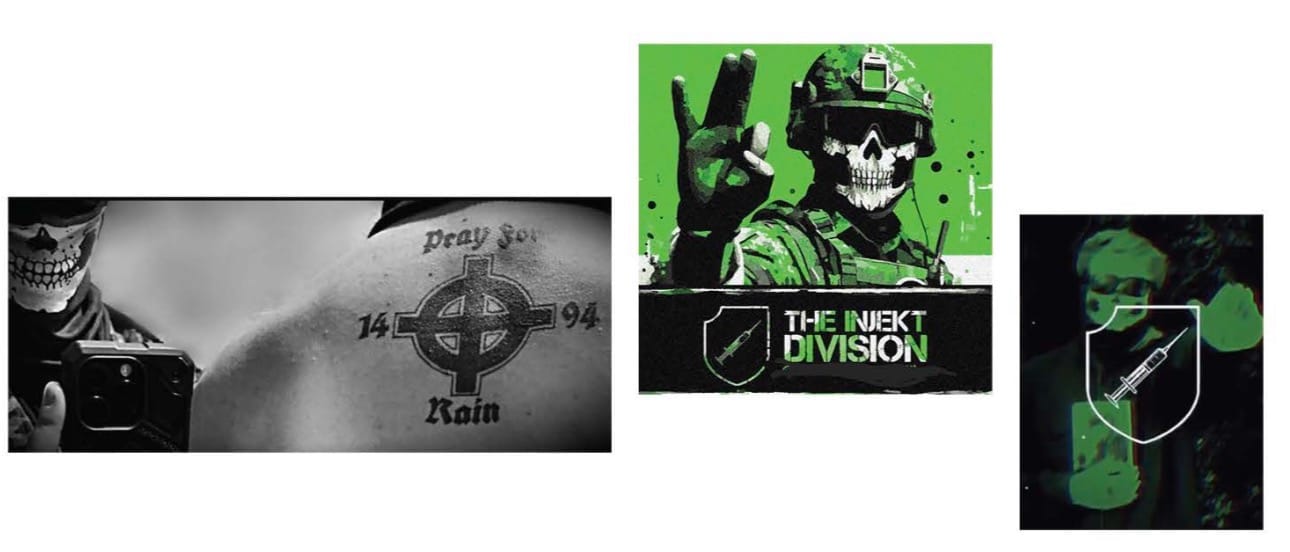
Injekt Division: An accelerationist nazi group that was formed by Coleman Blevins (aka Korb) in 2021. They are organized in decentralized cells, embracing a terror guerrilla ideology that looks to collapse the “System”. Their symbols include a syringe, 1494 and “Pray For Rain”.
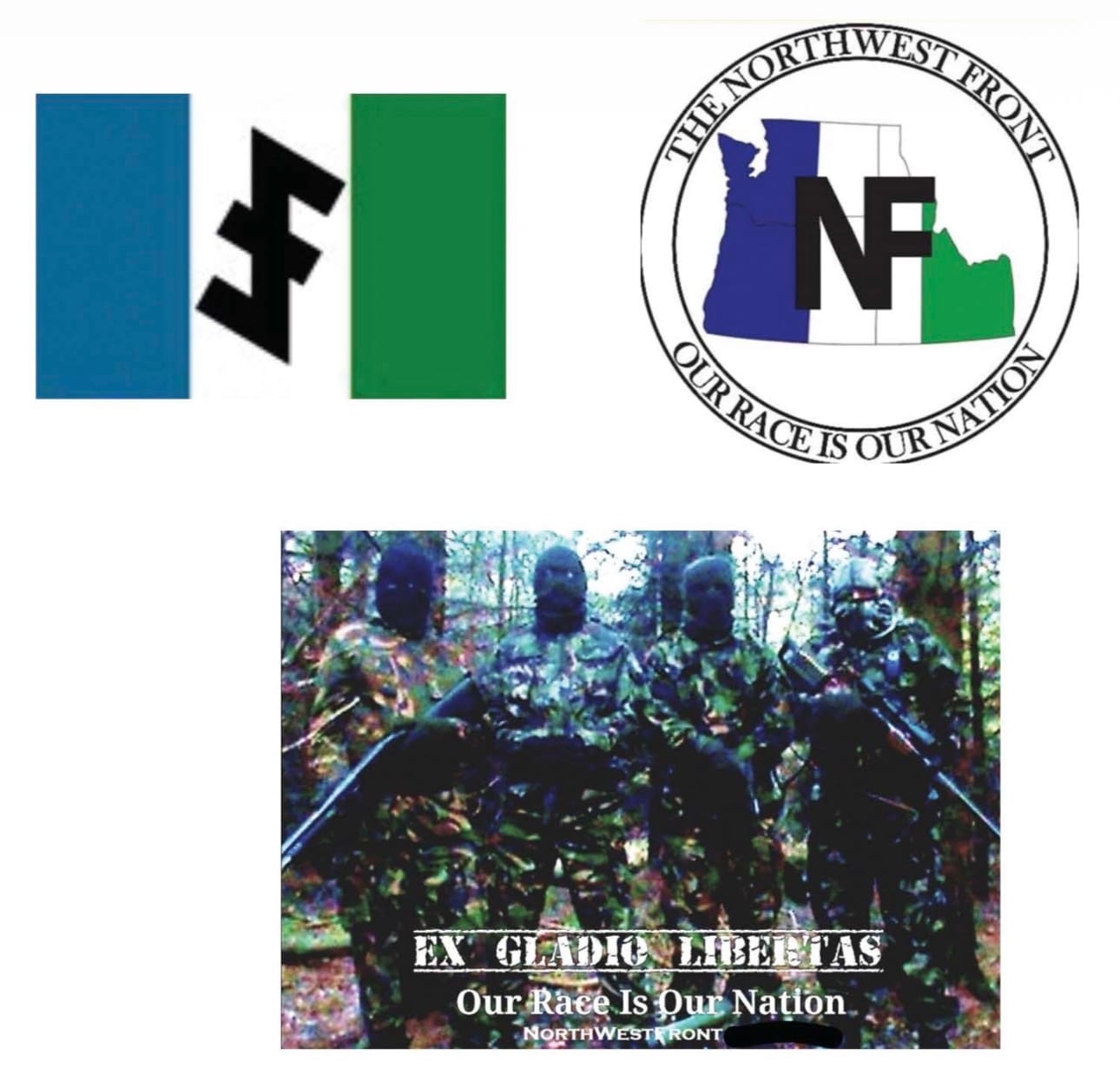
NWTI: “The Northwest Territorial Imperative” is a vision of a whites-only homeland in the Pacific NW. Proposed in the ’80s by Richard Butler of the Aryan Nations, it is an idea embraced by a wide variety of white supremacists, including secretive militant nazi groups dedicated to implementing the vision, such as Northwest Front (NF) or the Northwest Pioneer Association (NPA). NWTI is represented by an inverted Cascadian tri-color flag – having vertical stripes, rather than horizontal. Their flag sometimes includes a rune or swastika. Common associated phrases: “Come Home, White Man” and “Ex Gladio Libertas”.
Vinlanders Social Club: Vinlanders Social Club (VSC / Firm 22) is a violent neo-Nazi bonehead gang formed in 2003. It uses Firm 22 as a support crew of men and women; the men being prospects for full VSC membership. VSC / Firm 22 went into decline in the 2010s, but has been attempting to build itself back up through proximity to the active club movement, much like the Hammerskins. Its symbols include a black cross on a green flag, 22, 1422, an eagle holding brass knuckles, a red, white & blue shield patch with a laurel, or just a laurel.
TPUSA: “Turning Point USA” is an organization which targets high schoolers and college students with far-right propaganda, talking points, and literature. Founded by Charlie Kirk, and now led by his widowed wife Erika Kirk, the organization has chapters in schools across the US, and regularly sets up tents on college campuses in order to recruit and create content by means of filming bad-faith political “debates.” With a roster of speakers and frequent events, TPUSA regularly promotes popular anti-trans white nationalist talking points, white Christianity, and racial divisions. Using the public image of more traditional conservatism, they function as a pipeline to more fascist far-right ideologies.
References and Further Reading
For current / past antifascist articles, contact info for sharing tips, and other resources, you can visit:
An April 2 Washington County School Board meeting in Tennessee took an uncomfortable turn after high school student Hannah Campbell finished delivering her remarks. Seated with the board and directly next to the superintendent, Campbell confidently participated in a discussion with members after presenting research she had conducted on other schools.
The comment is not a baseless allegation. The interaction was caught on video. A few people in the room laughed, Campbell herself quickly brushed off the comment, and the meeting continued as scheduled. Any viewer watching the meeting in person or on YouTube could clearly see what happened.
To many, it was clear that a line had been crossed, and the mood in the room was tense afterward.
The board chair, Annette Buchanan, called an emergency meeting the following week, where members voted to censure Ervin—a public rebuke meant to show that they did not support his comments. But otherwise, as an elected official, Ervin would keep his position on the board.
For his part, Ervin issued a statement apologizing for the incident but insisting that he had not meant any harm.
“I understand why people are reacting the way they are. But that’s not the full conversation, not even close,” he wrote. “When I mentioned she was hot, I meant she was on a roll. It was nothing to do with her appearance.”
The board’s response was not good enough for Campbell, who was also unconvinced by the apology statement.
Student boldly appears at another board meeting to speak up for herself
Campbell refused to shrink or hide. Instead, she returned to a school board meeting on May 7 and confronted not just Ervin, but the entire board, in a courageous four-minute speech.
“I do not forgive you,” she said to Ervin, adding, “The failure to act on the board’s behalf was and is equivalent to his actions, and it has hurt me just as much. To watch the chairperson be so quick to bang her gavel, to control the public, yet not use it once to control her own peer was disgusting … I believe that you are all cowards.”
She sarcastically thanked the board at the end of her speech for showing her that she would do well not to trust adults and authority figures to stand up for her—that she would have to do it herself.
The student’s brave stand earned the support of the community
Campbell was wrong about one thing: There were others in the community who were willing to stand up for her.
One irate father vowed to raise enough money to oust every single board member should they fail to act. “Would you want your kid around that guy without a camera around? I wouldn’t,” he said.
Meanwhile, an online petition calling for Ervin’s removal from the board, along with Superintendent Jerry Boyd’s, has collected nearly 7,000 signatures.
Even more enraging to parents, students, and community members is the fact that Ervin has been accused of inappropriate conduct before. According to WCYB-TV, records show that in 2009, Ervin made a “lewd, juvenile gesture of a sexual nature” in front of students and teachers at a school. He was censured then and barred from school property unless accompanied.
Campbell’s willingness to use her voice may be the difference between a censure and something that makes a real difference for all the students who come before the board after her.
The federal government is escalating efforts to seek private medical data for children undergoing gender-affirming care, as at least one hospital faces the first known criminal probe of its kind.
Last week, NYU Langone Hospitals in New York City received a grand jury subpoena for information about young patients who received gender-affirming care at their facilities anytime in the past six years.
A grand jury subpoena indicates that a federal criminal investigation is underway. This would be a first in regards to gender-affirming care.
The subpoena came from the U.S. Attorney’s Office in the Northern District of Texas, part of the Justice Department. The office is also seeking the names of hospital employees involved in providing gender-affirming care. The government has previously sought medical records of transgender kids from other states, and so have Texas officials, but not like this.
Parents of trans youth under the age of 18 who have received care at NYU Langone got a notification from the hospital alerting them to the grand jury subpoena. According to that notification and to the hospital’s public statement, NYU Langone is one of several institutions that received a subpoena May 7. The hospital said it is still evaluating how it will respond to it.
New York law prevents the disclosure of medical records related to gender-affirming care and abortion except in limited circumstances and broadly prohibits law enforcement from cooperating with investigations into gender-affirming care. This sets up a potential legal fight over the subpoena.
Several legal battles are currently playing out in response to other attempts from the government to obtain trans kids’ medical records.
Eleven families just filed a class-action lawsuit to block the Justice Department from obtaining confidential information about young trans patients seeking gender-affirming care. The agency sent more than 20 subpoenas last summer to doctors and clinics involved in providing such care, with the intent to investigate “healthcare fraud, false statements, and more.” Both the Justice Department and the Federal Trade Commission (FTC) have sought to investigate gender-affirming care as medical fraud.
Multiple judges halted these DOJ subpoenas in their tracks, after hospitals fought back. A federal judge in Massachusetts called the agency’s investigations into gender-affirming care “motivated only by bad faith.” A judge in Colorado, who blocked a similar subpoena, said patient medical records must be protected from “improper disclosure.”
Separately, a federal judge this month temporarily blocked the FTC from investigating two medical groups that support gender-affirming care for transgender people. Those groups, the World Professional Association for Transgender Health (WPATH) and the Endocrine Society, were served civil investigative demands for years of internal records and financial information. Both groups sued.
Over the past year, hospitals in states like New York, where gender-affirming care is legally protected, have come under pressure by the federal government to halt care for trans youth. For patients, that care has been spotty: earlier this year, NYU Langone halted gender-affirming care for young patients, citing “the current regulatory environment” as a key reason. More than 40 hospitals across the country have done the same, per STAT News.
Gender-affirming care for trans youth primarily refers to hormone therapy and puberty blockers used to treat gender dysphoria, which is a medical condition that can cause significant distress. Very few transgender youth seek and access surgeries. Restricting gender-affirming care is a top priority of the Trump administration, which has proposed regulations to greatly restrict the care for youth and stated its opposition to trans identity as a whole.
In this interview Graham Platner responds to his detractors accusations against him. He discusses the tattoo and the Jewish times report that says he had talked about it while working at a bar during the time frame he was not working there. So there is not any credible evidence that he knew what the tattoo was. As he said why would he have danced with it in full display to his extended Jewish family? He makes sense. He understands that people may not like him because he is not polished as a politician. He also says he stumbles verbally and struggles to correct and improve himself. It was a hard hitting interview and Platner came off as very reasonable. Hugs
Now, in this must-watch interview, Mehdi Hasan speaks to Platner not just about his vision for a progressive “political revolution” in Washington DC but also about some of his controversies, including his social media and his tattoo that resembled a Nazi symbol.
A week before the US went to war with Iran, Pete Hegseth, the war secretary, invited the head of his church to lead prayers at the Pentagon. From his pulpit in Idaho, Doug Wilson, a 72-year-old ultraconservative pastor, preaches that homosexuality is a sin, women who dress immodestly are “sluts”, and Charles Darwin’s theory of evolution is the “silliest thing in the world”.
Despite Hegseth’s evangelising, Wilson says the Trump administration is far from morally pure. He says the president is “not someone I would call a godly Christian man”, and disagrees with Trump’s appointment of a gay man, Scott Bessent, as his Treasury secretary because homosexuality is not just a sin, it is “a bad one”.
Of all his gripes, however, Wilson is most indignant about the 1960s sexual revolution, a moral catastrophe that he condemns frequently in his blog posts, sermons and books. He thinks women should dress modestly. But what is modest dress? “Not what they’re doing now,” he says. “I could pick on yoga pants.” He continues: “Men know what they think of hookers, which is not very much. When you’re just giving it away to every slob on the bus who wants to look, you’re degrading the currency.”
Does that mean Wilson and his followers sympathise with the dress codes enforced by Shia clerics in Iran? “No, because wrapping them up in a bedsheet is another way of degrading them. It is possible to be modest and attractive — attractive without attracting. Bundling them up the way really conservative Muslims do is a different kind of degradation. Like you’re not a person. But for a woman to dress like a slut is a different kind of degradation. Both kinds of degradation play off of each other.”
Wilson appeared here last month when he called for criminalizing homosexuality and outlawing all LGBTQ events.
In March, Wilson declared that under his Christian nationalist theocracy, all non-Protestant public events – such a Catholic parades that venerate the Virgin Mary – would be banned.
Also in March, a separate pastor at Hegseth’s church prayed for God to kill Senate candidate James Talarico.
Pete Hegseth’s pastor: ‘Women who dress immodestly are sluts’
Sorry this is not as long as I normally do. Ron found me sleeping at my desk an d only gave me a few minutes to finish before he forced me to bed physically. Hugs
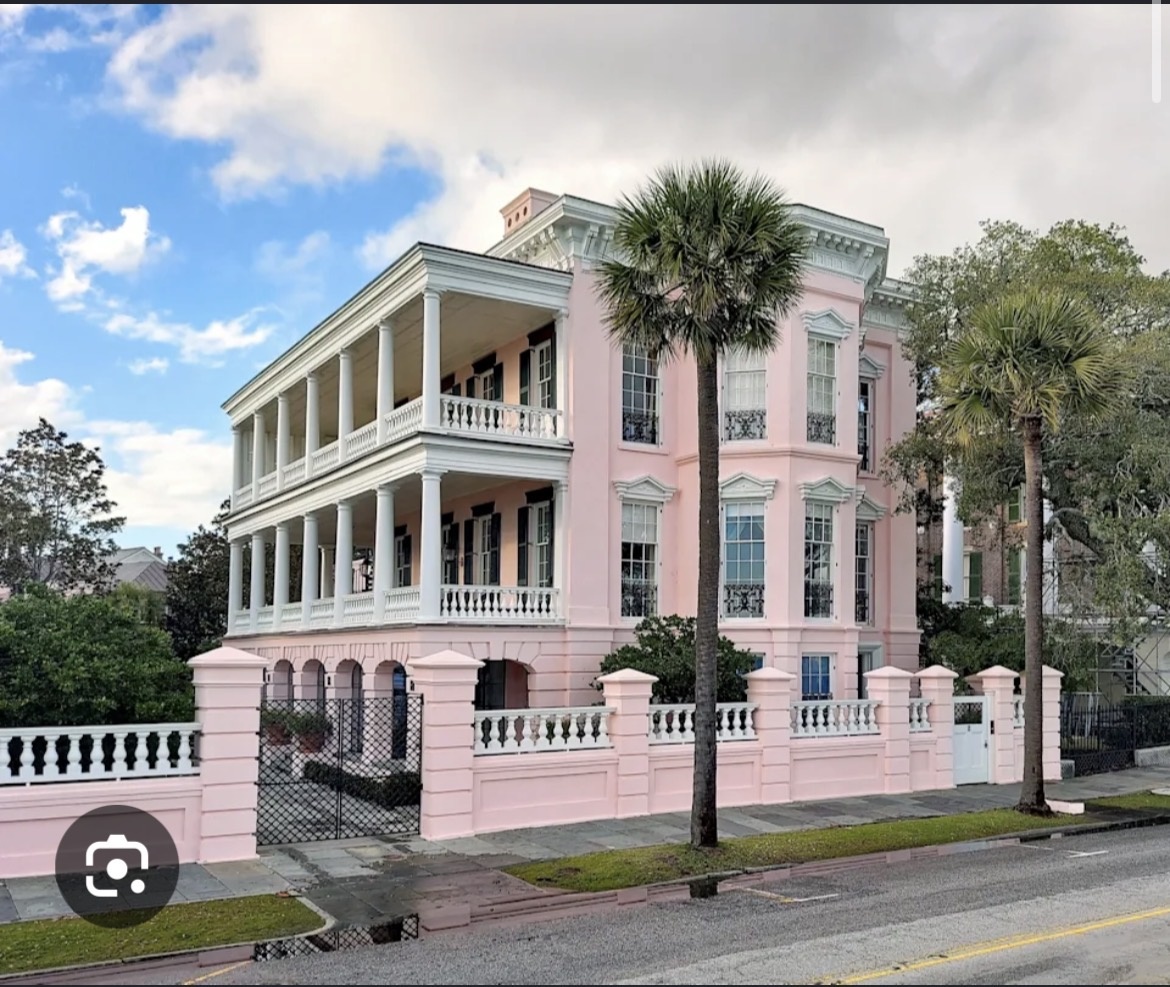
The house below was once owned by Scott Bessent the current Secretary of Treasury under tRump. I would love to own a home like this or at least be able to afford one like it. It is a famous home called the Pink House. Hugs
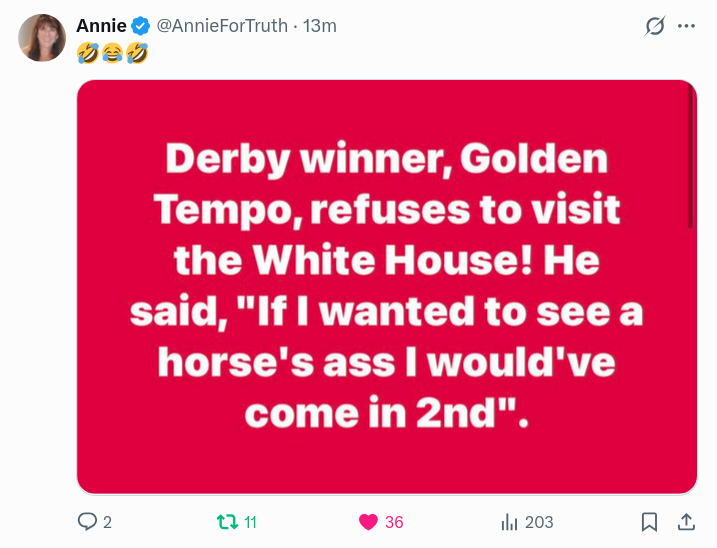
These are fake The first three were posted by tRump but the left is the one that has to turn down the rhetoric.
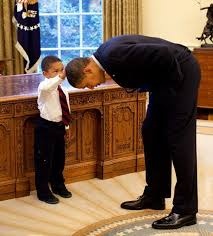
This is the real Obama bowing picture.
And this guy posted 86 46 during Bidens term and the post is still up. But Comey is on trial for threatening the cult leader and not Posobiec who did the same to Biden.
And this one is real. tRump suluted an enemy general from North Korea.
And this one is real also.
“The more likely prospect, they say, is that he becomes an independent who caucuses with the GOP, or simply casts his vote to ensure Thune remains majority leader. Ensuring control of the Senate could be especially critical should there be a Supreme Court vacancy http://www.politico.com/news/magazin…
NEW: A Republican U.S. Senate candidate said he's recruiting off-duty police officers to serve as poll watchers in Detroit for the 2026 midterms — and suggested they could flash their badges at voters.Intimidating voters is illegal. Interfering with someone's right to vote is a federal crime.
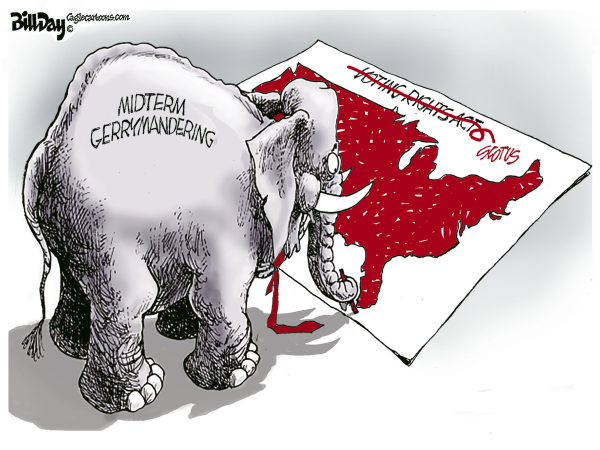
🚨BREAKING: Florida voters and pro-voting group Equal Ground Education Fund filed a lawsuit Monday challenging the GOP’s new congressional gerrymander, urging a court to block the map for violating the state constitution’s ban on partisan gerrymandering. http://www.democracydocket.com/news-alerts/…
Judge mulls contempt over DHS’ ‘patently false’ allegation in deportation caseThe Trump administration attacked a judge for releasing an accused murderer, but it withheld existence of the foreign warrant.www.politico.com/news/2026/05…
You see this press release from DHS about a federal judge? The agency pushed it out 5 days ago. Today, a DOJ attorney admitted to the judge that it “simply was not true.”(It’s also still online at DHS dot gov as of 540 pm Monday)1/
* SOUTH KOREA'S FOREIGN MINISTRY: FIRE AND EXPLOSION HAPPENED ON A KOREAN VESSEL IN STRAIT OF HORMUZ* SOUTH KOREA FOREIGN MINISTRY: CHECKING CAUSE OF FIRE AND DETAILS ON DAMAGE AT THE KOREAN VESSEL* SOUTH KOREA FOREIGN MINISTRY: TO CLOSELY COMMUNICATE WITH RELEVANT COUNTRIES@reuters.com
President Donald Trump threatened Iran, saying it will be 'blown off the face of the Earth' if it doesn't stop attacking ships in the Strait of Hormuz.
More Than 150 Wind Projects Stall as Pentagon Delays ReviewsThe delays, which companies say have worsened significantly in recent weeks, are the latest step in the Trump administration’s efforts to block wind power.www.nytimes.com/2026/05/04/c…