In the video below please notice the 8:17 mark how the little Nazi Bovino leads a large group of armed masked thugs into a crowd of people expecting and demanding they move aside for the gang thugs ICE rather than the ICE thugs respect the people. They are filming it and hoping that one person will refuse to move so they can attack them as a pack and use it to claim ICE needs more authority along with the military. This is pure little person bullied on the playground with his big brothers to back him up making all the other little kids move aside for him in fear. This is the country they want to create and so far they are getting it. Hugs
It’s the one-year anniversary of Donald Trump’s second administration this week. There’s not much to celebrate.
The oath Trump took on January 20, 2025: “I do solemnly swear (or affirm) that I will faithfully execute the Office of President of the United States, and will to the best of my ability, preserve, protect and defend the Constitution of the United States.” He added, “so help me God” at the end.
Tonight, about 1,500 active-duty soldiers, two infantry battalions of the Army’s 11th Airborne Division, are under prepare-to-deploy orders for possible action in Minnesota. This means Donald Trump is actively contemplating invoking the Insurrection Act. Absent that, deployment of active duty members of the military is prohibited by the Posse Comitatus Act. It bears repeating that the American military isn’t meant to be used for domestic law enforcement against American citizens, barring extraordinary circumstances that simply aren’t present here.
The 11th Airborne, nicknamed the “Arctic Angels,” specializes in operating in arctic conditions. That’s convenient for Minnesota, or perhaps for Maine, where there are persistent rumors Trump plans to surge ICE this week, with an eye to the state’s Somali immigrant community. Governor Janet Mills has said Maine officials have been unable to confirm whether the rumors are true, but she’s said she’s working with the cities of Portland and Lewiston, which have sizable immigrant communities, along with local law enforcement, to be ready. “Maine will not be intimidated,” the Governor said.
Trump seems to be on course to become the first President to direct the use of U.S. military forces against American citizens during peacetime. And he’s doing it in a situation where the “unrest” is mostly peaceful protests resulting from Trump’s efforts to inflame the city. The situation is hardly the kind of insurrection, domestic violence, or conspiracy the Act contemplates, but this is a presidency where the facts don’t matter. This week could become an extraordinary moment in American history.
What exactly does the 11th Airborne Division do? When they were activated in 2022, the General running the show told the troops, “I expect every soldier of this Division to be masters of their craft, of Arctic Warfare.” Arctic warfare—headed for the streets of Minneapolis.
According to their website, “The 11th Airborne Division executes expeditionary operations worldwide, conducts Multi-Domain Operations in the Indo-Pacific theater and the Arctic, and on order decisively defeats any adversary in extreme cold weather, mountainous and high-latitude environments through large scale combat operations.” They are ready to “deploy, fight and win decisively against any adversary.” Presumably, that includes the protestor in a giraffe costume ICE agents forced to the ground last week or the one dressed like a pickle. If the stakes weren’t so high, the whole thing would be ridiculous.
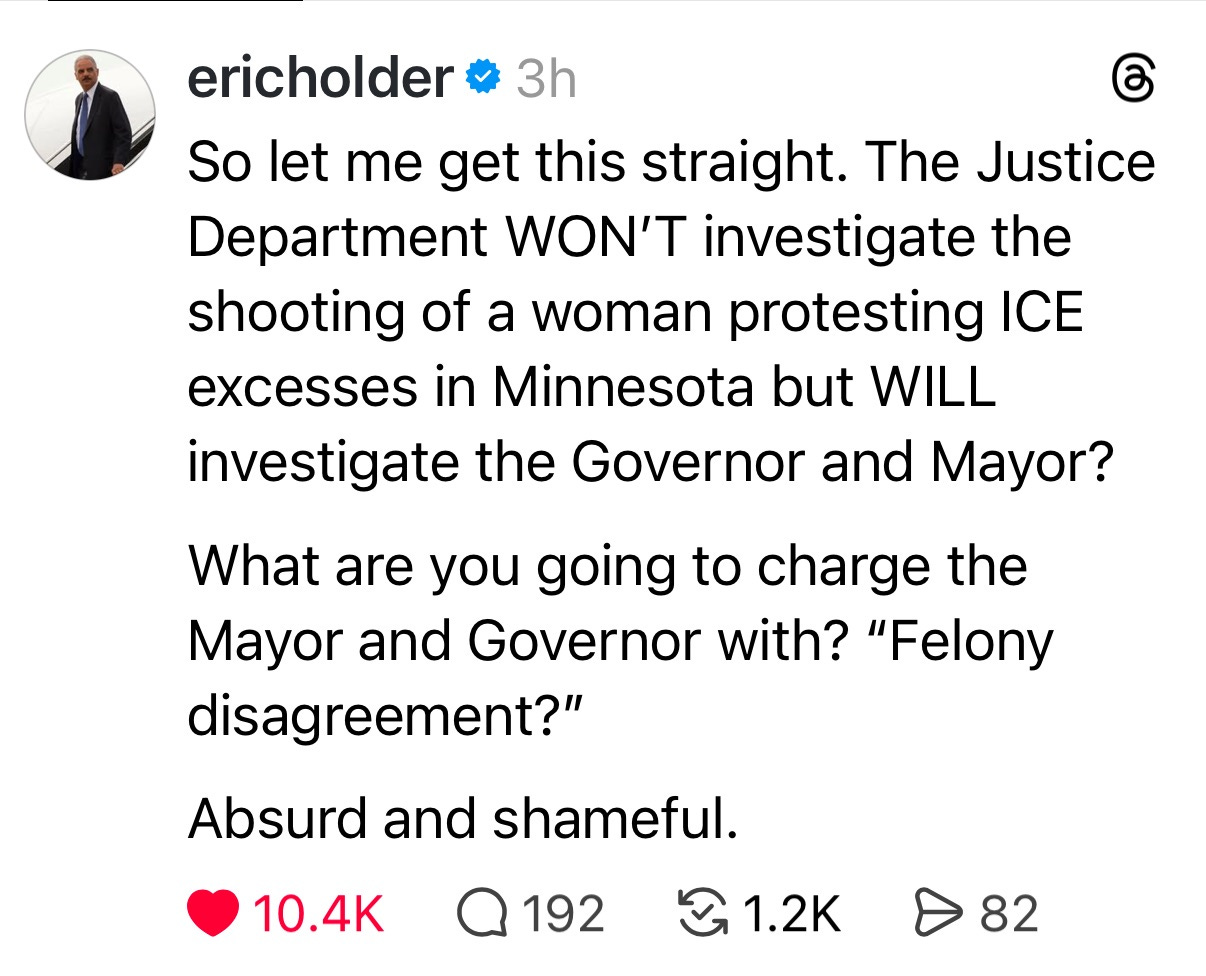
And to triple down on what it’s doing in Minnesota, the administration announced it’s investigating Minnesota Governor Tim Walz and Minneapolis Mayor Jacob Frey and plans to subpoena them. No word on specifics of potential charges or whether the subpoenas will be for documents or testimony. It’s hard to imagine what possible federal crimes the two have committed. Former Attorney General Eric Holder put it best—Holder quips, maybe “felony disagreement?”
DOJ is also investigating the partner of the Minneapolis woman an ICE agent shot and killed, apparently looking into whether Becca Good interfered with the agent. Videotape suggests he wasn’t impeded in any way by her comment that he should go out to lunch, moving without any obstruction to take three shots.
But DOJ is not investigating whether the ICE agent who killed her should be charged in connection with the shooting death of Renee Good. On Fox News Sunday, Deputy Attorney General Todd Blanche said, “No, we are not investigating.” Blanche characterized what happened as the agent “defending himself” and said, “we investigate when it’s appropriate to investigate,” claiming that wasn’t the case here. “The party told you to reject the evidence of your eyes and ears. It was their final, most essential command.” — George Orwell.
Officer-involved shootings are virtually always investigated, most of them by state agencies, which is where the majority of these incidents occur. But this case isn’t just a “shooting”; it’s a death, and possibly a homicide—a possibility that can’t be ruled out without investigation. There is also video evidence that a doctor who tried to treat Good, who was still alive when paramedics arrived 15 or more minutes later, was refused, which could lead to additional charges. This is the kind of case that demands a thorough, objective investigation.
Beyond that, Blanche’s claim that there are too many shootings every year to investigate—he says over 1,000—is as ludicrous as it is wrong. His argument is essentially that cops are shooting too many people to be bothered to investigate. If anything, high numbers would make investigation even more essential. While exact numbers aren’t available, a 2023 assessment by NBC suggested that between 2018 and 2022, 223 people were shot by officers working for or with the four primary federal law enforcement agencies, and that 151, or an average of 30 per year, were killed. Surely, Blanche can muster the resources to investigate 30 deaths in federal officer involved shootings a year—even if it means pulling a few FBI agents off of their work arresting school children and field workers who are in the country without legal immigration status, but hurting no one. In a moment where it would have shown good faith to conduct an investigation, the administration acted like it had something to hide, instead.
It should come as no surprise that recent polls show Trump slumping as he comes to the end of his first year. 58% of Americans call his first term a failure. A mere 37% say that Trump puts the good of the country above his personal gain. Only 32% believe he’s in touch with the problems ordinary Americans face in their daily lives. Perhaps most damning, “Fewer than half say that Trump has the stamina and sharpness to serve effectively, and just 35% call him someone they’re proud to have as president.”
Keep talking with the people around you! The truth still has a way of breaking through when we share it.
Other developments to expect this week:
On Tuesday, the plaintiffs’ response is due in the temporary protected status case we discussed in this post back on January 10. In Svitlana Doe v. Noem, Judge Talwani restricted the government’s efforts to end parole status for Colombians, Cubans, Ecuadorians, Guatemalans, Haitians, Hondurans, and Salvadorans with family reunification status. Once briefing is complete, she will decide whether to permanently enjoin the government from ending parole status for these individuals before the time set for it to expire.
On Wednesday, the Supreme Court will hear oral argument in the case of Fed Governor Lisa Cook, who Trump tried to remove. The Court has seemed less willing to let Trump run roughshod over federal appointees when it comes to the Fed than other agencies. It permitted Cook to remain in place during the litigation, in sharp contrast to how it has treated others, including FTC Commissioner Rebecca Slaughter, who Trump also ousted. Previously, Trump threatened to prosecute Cook for mortgage fraud, using the same flawed arguments that permeated the case brought in Virginia against New York AG Tish James and the investigations involving Senator Adam Schiff and Congressman Eric Swalwell. More recently, he has threatened Fed chair Jerome Powell with a meritless perjury prosecution. Whether the Court will weigh in on that pattern remains to be seen.
On Thursday, Jack Smith will testify on Capitol Hill, publicly this time, at 10 am. He will remain under restriction from a Florida Judge’s order that prevents him from discussing the details of his report on the Mar-a-Lago indictment.
Also this week, we’ll be on the lookout for developments in the arson at Beth Israel Jewish Synagogue in Jackson, Mississippi, that destroyed a significant portion of the temple, including its Torahs. Stephen Spencer Pittman has been charged by both state and federal prosecutors with hate crimes.
The local DA noted the historic nature of the temple:
“Beth Israel Congregation has endured violence in its history, including a 1967 Ku Klux Klan bombing during the civil-rights era, and this case arises amid a documented increase in attacks on houses of worship across the United States, including arson, vandalism, and other acts of target violence,” he said. “Such crimes are intended to intimidate entire religious communities. Violence directed at any place of worship, regardless of faith, will not be tolerated in Jackson, Mississippi.”
Pittman confessed to the attack after his arrest. He referred to the temple as “the synagogue of Satan,” language white nationalists frequently use to denigrate Jews. Jews make up just 2% of the population in the U.S. but are the targets of 69% of the hate crimes in this country, according to FBI statistics. It’s not clear whether the confession means he’ll be pleading guilty.
Finally, this week, just like last week, and the one before it, and the one before that, Trump’s Justice Department is still refusing to comply with the Epstein Files Transparency Act.
Minnesota is under occupation by federal agents from ICE and CBP, and they need your help.
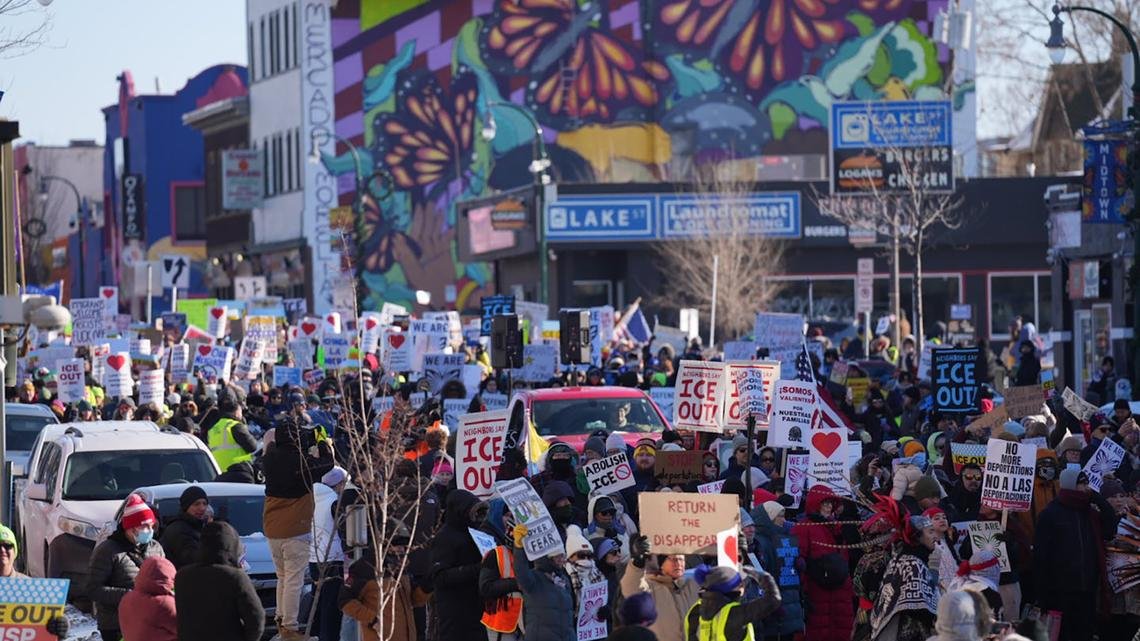
Not just Minneapolis, and not just people protesting. Across Minnesota, ICE continues to stop, harass, and detain people regardless of their citizenship status. Normal life in Minnesota has been interrupted, as schools have been forced to close or go virtual, as people live in fear of leaving their homes or going to work.
Minnesotans are organized and activated to respond to this violence. But they need our help.
This directory of places to donate to all comes from activists on the ground, plugged into the situation. Everything is vetted, with the exception of individual GoFundMes (not everyone is in our networks, and we don’t want to pick and choose who is worthy of help.)
If you don’t have resources to give, please amplify what you are hearing and seeing about Minnesota, across social media, but also to your networks, friends, and family offline.
Overwhelmed by the amount of listings here? Donate to the Immigrant Law Center of MN, who is providing assistance to hundreds of people with families detained by ICE, or the Immigrant Rapid Response Fund, a fund assembled by a coalition of Twin Cities Foundations committed to getting assistance out the door as quickly as possible.
Mutual Aid & Materials Purchasing
These funds are administered by neighbors helping their neighbors, not large organizations. This is one of the most direct ways to help and to get cash and resources into people’s hands quickly.
Diaper Fund
Rent Relief Funds
Mutual Aid Funds
Provide Food Support
Buy/Donate Materials
Crowdfunding Campaigns
We are only including campaigns which have not met their goals. To get a campaign added please email contact@standupforminnesota.com
Funds for Employees
For Individuals
Funds for Schools & Students
Funds for Communities
And there is so much more on the page. Please thoughtfully consider what you can do, including simply telling people about this when it comes up (or when you bring it up, maybe?) And thank you!
I just posted a video from Hasan Piker on the same topic. However some people prefer verified news sources instead of podcasters, so here is another discussion of the NYT frame by frame breakdown of the videos by the reporter and Anderson Cooper. Again showing that Ross’s torso is several feet from the car and he was in no danger until he murdered Renee Good. Hugs
Just like fundamentalist evangelical Christians maga thugs can not be reasoned with, they are on a mission from their god tRump to protect the goal of the cult. They act similar in that they attack anyone who displays a difference to their preconceived view of how things should be according to their religious leaders. They feel an intense desire, no need to destroy any dissent and make everyone conform, by force if necessary. So Renee good presents a threat to their view of how things should be. She doesn’t conform. She is not straight but is a lesbian. She did not immediately bow to the authority and whims of the cult leader, and she seems to support the rights of minorities which the cult feels is harmful to the white straight cis majority. So maga thugs attack without thinking in a pack as that is how they are trained as school yard bullies and they never grew out of it. Hugs
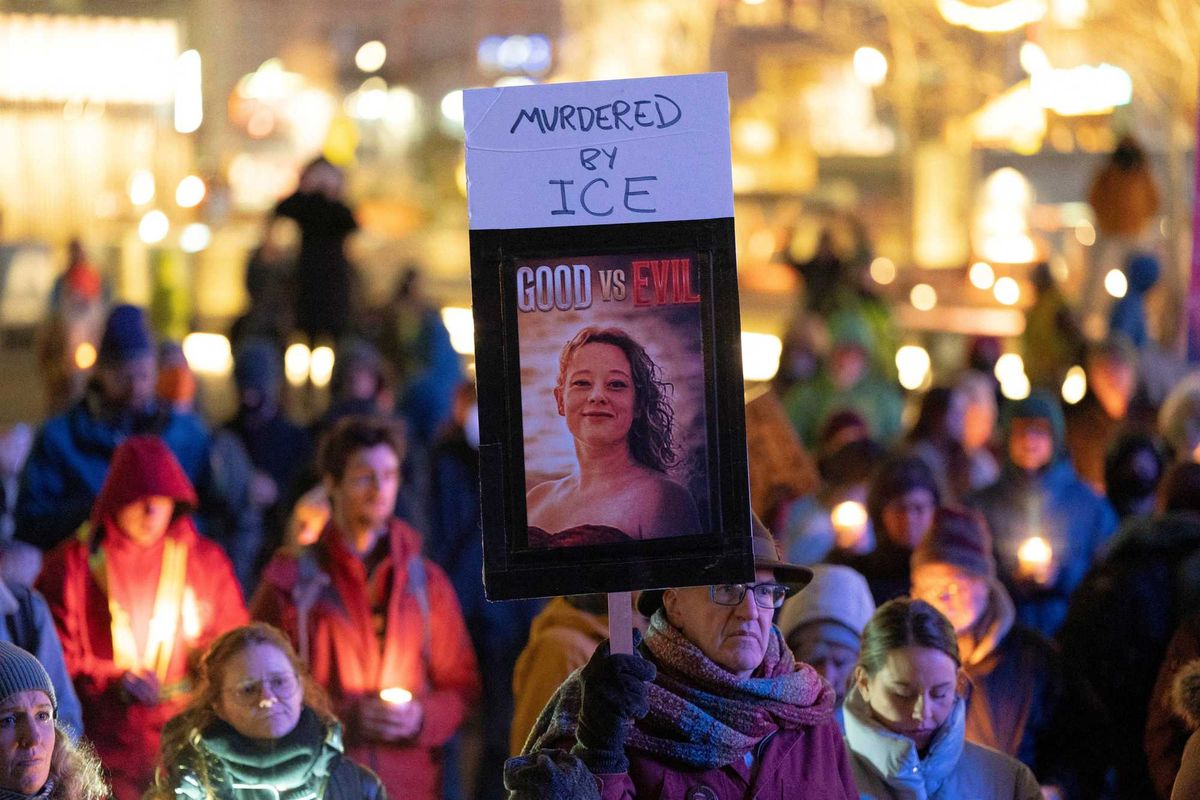
People gather during a vigil for Renee Nicole Good, who was shot and killed by an ICE agent, in Seattle, Washington, U.S., January 8, 2026. REUTERS/David Ryder
The tiny charter school where slain mother Renee Good sent her 6-year-old son has been forced to conduct classes online after receiving a slew of threats following her fatal shooting by an immigration officer.
The threats started pouring in to Southside Family Charter School after the New York Post reported on the school’s focus on social justice and right-wing social media accounts identified the school where Good had dropped off her son shortly before encountering the federal agent who shot and killed her, reported Sahan Journal.
“The attacks and threats to our school have been very hurtful, especially at this painful moment,” school officials told the Journal. “At the same time, we have received much support from our community. This moment has been painful but it has also brought us closer as a community.”
Southside Family Charter School, where Good served on the school board, was founded in the 1970s and became a charter school in 2006, but its enrollment dropped from 119 students last year to just 26 this year after it transitioned from a K-8 to a K-5 program.
“Staff and students prepare and eat meals together,” a school spokeswoman said. “Older students mentor younger students regularly and learn with them as well. Visiting artists and field trips are part of our curriculum.”
Conservative outlets and social media users seized on the school’s social justice curriculum after Good was killed, complaining that students learned about George Floyd’s police murder and staffers were urged to report ICE activity, and a sign notified immigration officers they were not permitted to enter the building without a judicial warrant.
“Our school is responding consistently with how most schools in the area are responding,” school leaders officials said.
Right-wing social media users claimed the school’s focus on social justice was evidence that Good was a domestic terrorist, as Trump administration officials have claimed to justify her killed by a federal agent.
“I’m calling for all federal funds to Minnesota’s Southside Family Charter School to be REVOKED,” Rep. Buddy Carter (R-GA) posted on Facebook. “This institution radicalizes students and pushes a left-wing agenda that demonizes ICE agents. The federal government should not subsidize anti-American education.”
A TikTok video viewed more than 100,000 times suggested Good was “trained to fight federal agents” by her son’s school, while others mocked her as “the epitome of the modern-day liberal white woman” and questioned her decision to enroll her son there.
The school eventually shut down its Facebook page and took down most of its online presence in response to the threats.
“At this time we would like to ask the community and members of the media to understand this is a very difficult and painful time for our school community and for Renee’s family,” school leaders said. “We would kindly ask everyone to respect our privacy and allow us the necessary time to grieve. We appreciate the community’s compassion, support, and understanding as we mourn together.”
ICE assaults a guy for videotaping them which is LEGAL Because they are gang thugs who don’t want their abuses recorded. Their goal is threefold. Remove the nonwhites, create fear and force instant obedience to mob gang rule, and cement a cult like government that supports their gang thug activity. These are the far right white supremacist Christian nationalist Militias that for decades have threatened their neighbors with violence, and now they are sanctioned by the government, given no restraints, and turned loose on the public. Notice they attack as a pack once the first one attacks the filming bystander because the gang thug couldn’t stand to have his authority challenged. I don’t know what to do to force democratic leadership to not vote for the last funding bill unless ICE is unmasked and restrained. Something has to be done before we end up as Iran with hundreds of thousands of protestors dead. Hugs
Discover the cosmos! Each day a different image or photograph of our fascinating universe is featured, along with a brief explanation written by a professional astronomer.
Explanation: Apollo 14’s Lunar Module Antares landed on the Moon on February 5, 1971. Toward the end of the stay astronaut Ed Mitchell snapped a series of photos of the lunar surface while looking out a window, assembled into this detailed mosaic by Apollo Lunar Surface Journal editor Eric Jones. The view looks across the Fra Mauro highlands to the northwest of the landing site after the Apollo 14 astronauts had completed their second and final walk on the Moon. Prominent in the foreground is their Modular Equipment Transporter, a two-wheeled, rickshaw-like device used to carry tools and samples. Near the horizon at top center is a 1.5 meter wide boulder dubbed Turtle rock. In the shallow crater below Turtle rock is the long white handle of a sampling instrument, thrown there javelin-style by Mitchell. Mitchell’s fellow moonwalker and first American in space, Alan Shepard, also used a makeshift six iron to hit two golf balls. One of Shepard’s golf balls is just visible as a white spot below Mitchell’s javelin.
The video below shows another shooting where the ICE thug fired into a car striking a person when he shifted his weapon to his other hand. The car was not moving and full of pepper spray. The man was not trying to drive. Yet ICE told a judge the man had weaponized his vehicle in an attempt to run over ICE thugs. The judge dismissed the case because ICE refused to hand over the body cam footage that showed what the ICE thug did and that DHS was lying. Again. Hugs
U.S. President Donald Trump has turned Greenland into a geopolitical hotspot with his demands to own it(Note: there is a video of this report on the page, if you prefer; click the title just above -A)
By EMMA BURROWS AP european security correspondent January 16, 2026, 12:17 AM
In their words: Greenlanders talk about Trump’s desire to own their Arctic island
(Snippet:)
NUUK, Greenland — U.S. President Donald Trump has turned the Arctic island of Greenland into a geopolitical hotspot with his demands to own it and suggestions that the U.S. could take it by force.
The island is a semiautonomous region of Denmark, and Denmark’s foreign minister said Wednesday after a meeting at the White House that a “fundamental disagreement” remains with Trump over the island.
The crisis is dominating the lives of Greenlanders and “people are not sleeping, children are afraid, and it just fills everything these days. And we can’t really understand it,” Naaja Nathanielsen, a Greenlandic minister said at a meeting with lawmakers in Britain’s Parliament this week.
Here’s a look at what Greenlanders think:
Trump has dismissed Denmark’s defenses in Greenland, suggesting it’s “two dog sleds.”
By saying that, Trump is “undermining us as a people,” Mari Laursen told AP. (snip-MORE)
==========
(It’s like another world inside my state, which is sorta nice. -A)
TOPEKA — Union leader Jake Lowen told the hundreds of workers who gathered Wednesday in the first floor rotunda of the Statehouse to look around and take in “the house that labor built.”
He referenced the stonemasons who cut every piece of limestone in the walls. The iron and steel workers who raised the dome, with the help of operating engineers who ran the hoists built by machinists. Plumbers, boilermakers and electricians brought light, heat and water.
Lowen, the executive secretary-treasurer of the Kansas State AFL-CIO, said some of the workers who started building the Statehouse, which took 37 years to construct, never saw it finished. At least seven gave their lives in the process, he said.
“The work was hard and the price was high, and yet they persevered,” he told the crowd that was gathered for an annual “solidarity day” labor rally.
He said the workers were building a Statehouse by day and a movement by night. In 1890, the year they raised the Statehouse dome, workers formed the Kansas State Federation of Labor, he said. (snip-MORE)
I’ve updated the web version of the post, but I wanted to send out an email update too so that readers on the ground in the Twin Cities are aware of the resource.
I’ll republish Governor Walz’s quote for emphasis:
“Tonight, I want to share another way you can help: Witness.
Help us establish a record of exactly what’s happening in our communities.
You have an absolute right to peacefully film ICE agents as they conduct their activities.
So carry your phone with you at all times.
And if you see ICE in your neighborhood, take out that phone and hit record.
Help us create a database of the atrocities against Minnesotans – not just to establish a record for posterity, but to bank evidence for future prosecution.”
If you are local to the Twin Cities, and feel safe and able, this is a concrete way in which you can help.
I think a lot of these TV people are missing one other reason tRump / Stephen Miller / Russell Vought is using an unrestrained ICE thug army loyal only to tRump is the midterms. He is sending them to blue cities and blue states. I fear he will use them to scare and intimidate people at voting polling stations in those same blue cities. Putting ICE in voting places to detain and keep from voting any non-white person or simply scare them from showing up. Also what about white people. Well they are assaulting, killing, and snatching white people now so … Hugs





 Scottie's Playtime