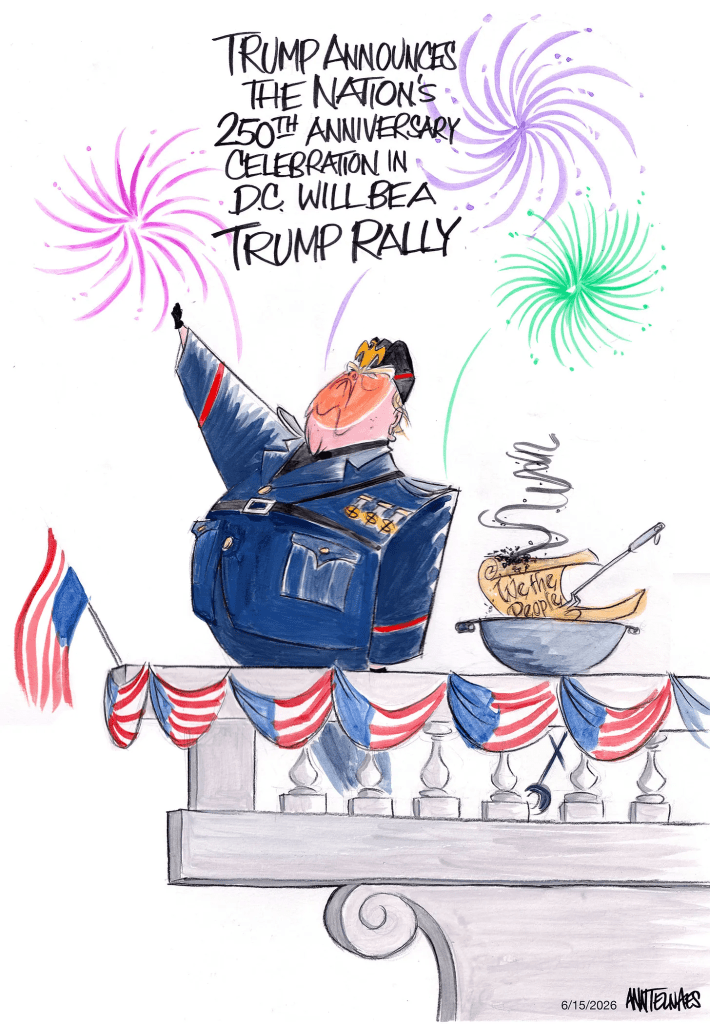
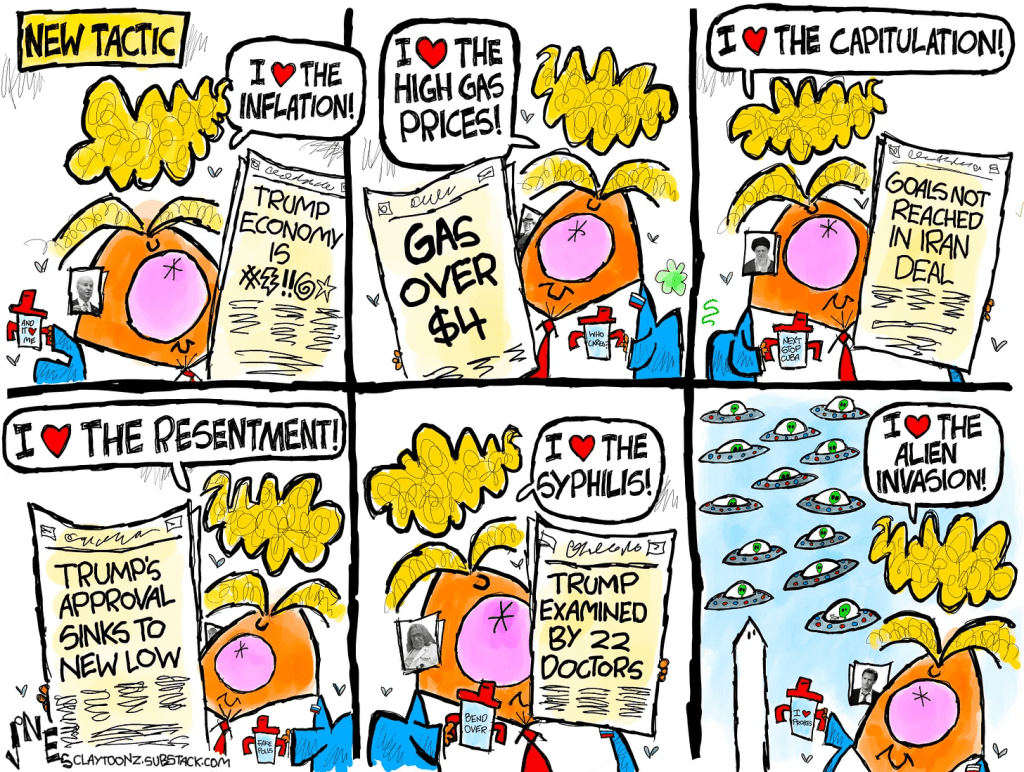
There are several this time! The titles are links, as usual, but for space consideration, I’m leaving Clay’s awesome commentary on his pages, and posting only toons this time. Go see what he has to say, though-it’s always good!
The stories of rebellion by enslaved peoples has been largely erased or occluded from history, and when these stories are told, they usually center men. In Cuba, however, two women became legends because of the leadership roles they took in rebellion. Carlota and Fermina were decisive, brave, and brutal. Both women were kidnapped from the Yoruba Nation and given the last name ‘Lucumí’, a word which refers to Afro-Cubans of Yoruba descent.
The Triunvirato sugar plantation was a fucking hellscape. By the 1840s, one third of Cuba’s population consisted of enslaved persons, almost all of whom worked in the sugar trade in some capacity. The 1840s saw Cuba utilizing steam-powered mails and railroads and engaging in massive deforestation as the economy became reliant on sugar. The Triunvirato Plantation was one of many that subjected enslaved people to a starvation diet and horrific working and living conditions.
We know very little about Carlota and Fermina. We do know, however, that on November 6, 1843, Carlota and others launched the Triunvirato Rebellion, the last in a series of uprisings across Cuba. Carlota used talking drums to communicate with other plantations, bringing the neighboring Acaná plantation, where Fermina was enslaved, as well as several others into the plan.
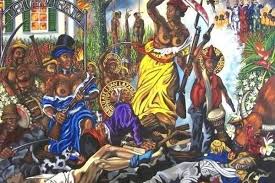
Carlota Leading the People (after Eugene Delacroix’s Liberty Leading the People by Lili Bernard, 2011
Fermina had recently escaped from Acaná and may have planned a June rebellion, but it didn’t happen. She was recaptured and shackled for months. Her tormentors released her from the shackles just a few days before the Triunvirato Rebellion, which she helped lead on the Acaná Plantation. In all, the enslaved people on five plantations rose up against their oppressors on or near November 6.
Here is a good overview of what we know about Carlota:
The series of rebellions that took place in 1843 (including uprisings in March and May, as well as a thwarted uprising in December) were collectively referred to as La Escalera. In response, slavers tortured and murdered so many people that 1844 became known as “The Year of the Lash”. Fermina was tortured and then killed by a firing squad. Carlota died at some point during the Trinuvirato Rebellion. Slavery in Cuba wasn’t abolished until 1886.
However, Carlota’s memory was preserved in oral legend. She became a famous symbol of resistance in Cuba. In 1975, when Cuba sent troops to support the People’s Movement for the Liberation of Angola (MPLA), they called the operation ‘Operation Carlota.’
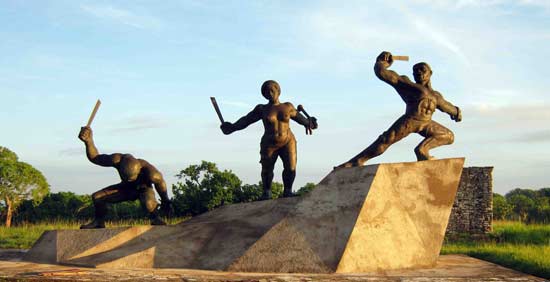
Monument to Carlota’s Rebellion, located at Triumvirato, erected in 1991
Writing about history is a messy business. For one thing, many historical figures, especially women, and most especially women of color, have been so systematically erased that the stories we still have of them are murky. This is certainly true of Carlota and Fermina. We don’t even know their real names – only the names their slavers forced them to bear. We know for sure that they existed, and everything else is a matter of sifting various stories together and trying to figure out where they overlap.
In this column, there is also the matter of who to choose as ‘Kickass.’ Carlota and Fermina were both said to have done terrible, violent things.
CW/TW
Their story can be seen as one in which brutality begets brutality, and it can also be seen as a human being refusing to break or to become passive with despair in the face of massive crushing forces. Carlota and Fermina were clever, resourceful, determined leaders. I only wish I knew their real names.
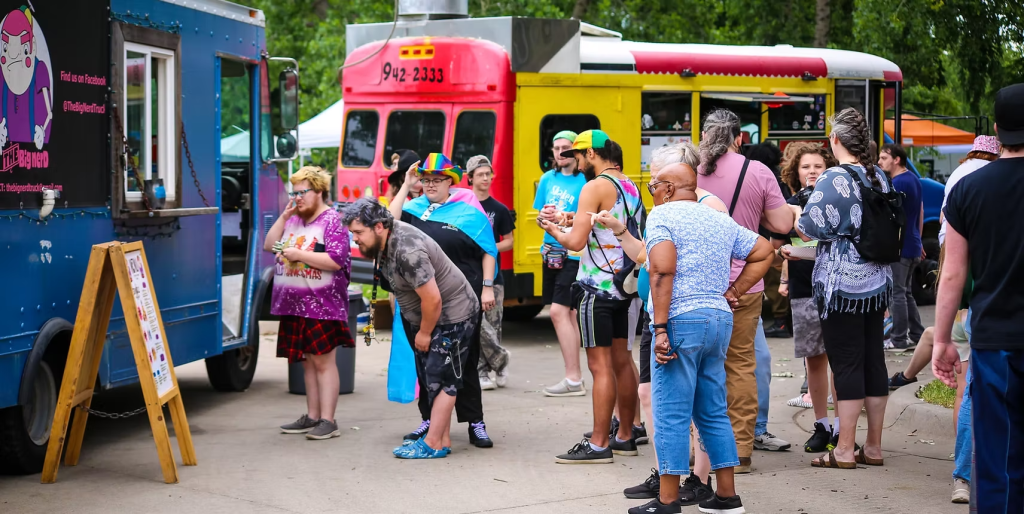
I think I posted about the Big Gay Market last year here on Scottie’s. It’s really cool, and it was Sunday 6/14 this year. It always makes me reminisce about, among other things, when I first came upon Scottie’s blog.
It was named “Scottie’s Toybox” at the time, with the same tagline, “Come See What I Share.” It sounded like Big Gay Fun to me, so I clicked through from MPS one time, and sure enough, there was a little big gay fun, a few resources for queer and other marginalized groups, and some issues on which people could take action if they cared to, along with a little general news. It was another time, it now seems. Anyway, Scottie transitioned to Playtime not as long a while back, I think due to Word Press anomalies, or something. I may not recall that correctly; I was a reader/sometime commenter, and it was nice. The Big Gay Market always reminds me of that, and I smile! 🏳🌈
Because of some election results and the associated removal of rights from, well, about everyone, but everyone isn’t as unsafe as those who are marginalized; and the scope of the blog has changed as well.
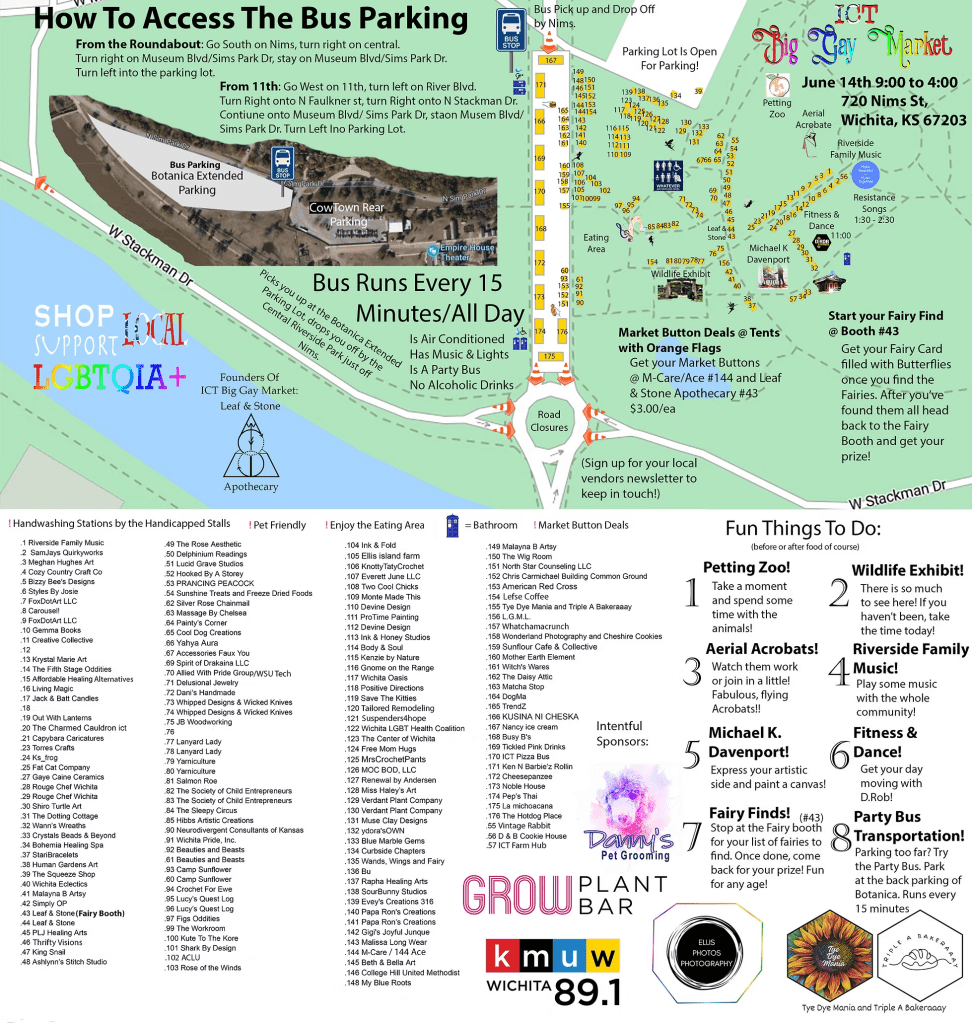
But on Big Gay Market day, I like to post about it. I bet everyone has a bright spot like this by them, and I know Scottie and I would like to know about those, too! Below is a report about, then the home page of Wichita’s Big Gay Market. Relax and enjoy!
A news report/interview from our local CBS affiliate.
(I dislike this channel, for its owner is an evil corporation and they’ve dumbed things down significantly, but as far as Google knows, they’re the only channel who has covered the Big Gay Market this year. For the record, I saw a short report on our local NBC affiliate at 5 PM, too, but can’t find it online Sunday evening. You can watch/listen on the page; it’s a short interview with the founder.)
WICHITA, Kan. (KWCH) – The 5th Annual ICT Big Gay Market returns Sunday, June 14, bringing a full day of vendors, food and family-friendly activities to Central Riverside Park. Organizer and founder James Boyd says the event is designed to feel like a “huge farmers market” that is welcoming to all ages and packed with things to see, taste, and shop, with nearly 150 vendors expected this year.
Admission is free, but attendees can choose to purchase a Market button. You do not need a button to attend, but some vendors will offer special discounts to button holders. Button proceeds go toward a $2,000 Trades Scholarship through WSU; once that goal is reached, remaining funds will help support next year’s market.
Event details
What: 5th Annual ICT Big Gay Market
When: 9:00 a.m. – 4:00 p.m. Sunday, June 14
Where: Central Riverside Park, 720 North Nims St., Wichita
Cost: Free to attend (optional Market button available)
Copyright 2026 KWCH. All rights reserved. To report a correction or typo, please email news@kwch.com
Central Riverside Park June 14th 9:am to 4:pm 720 North Nims st Wichita, KS 67203
Wether your looking for a day out and a meal, some shopping or chilling to local music this can be a fun time for everyone! Local creators from all around Wichita have come together to show support to our local LGBTQ community!
2026 has come so quickly it’s hard to believe we are celebrating our 5th season of ICT Big Gay Market!
Jeff & James put together a community scholarship that supports the futures of soon to be students at WSU TECH! Our goal is to help one person with a $2,000.00 boost to their passion. We all help out where we can, you can donate to this scholarship here:
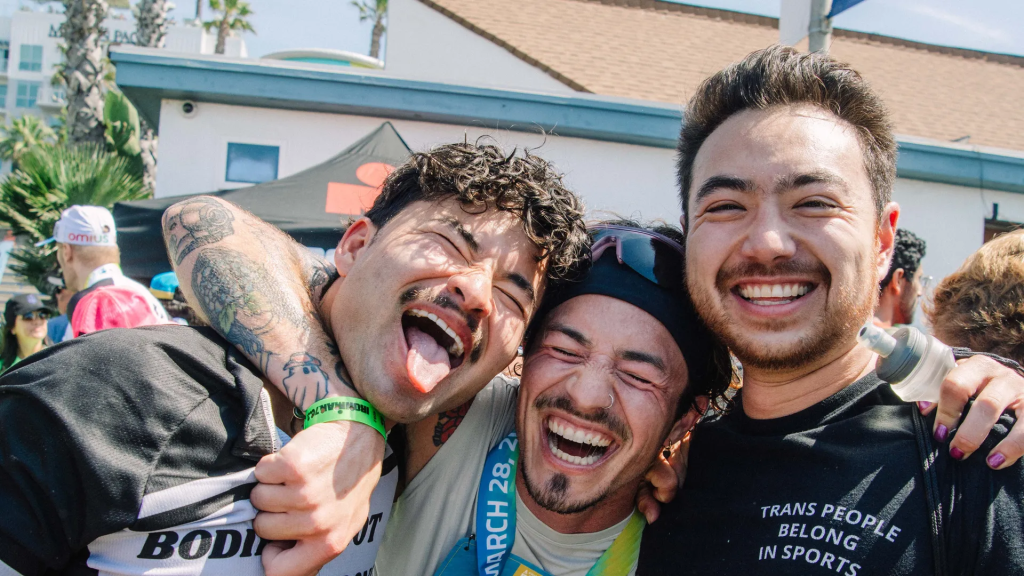
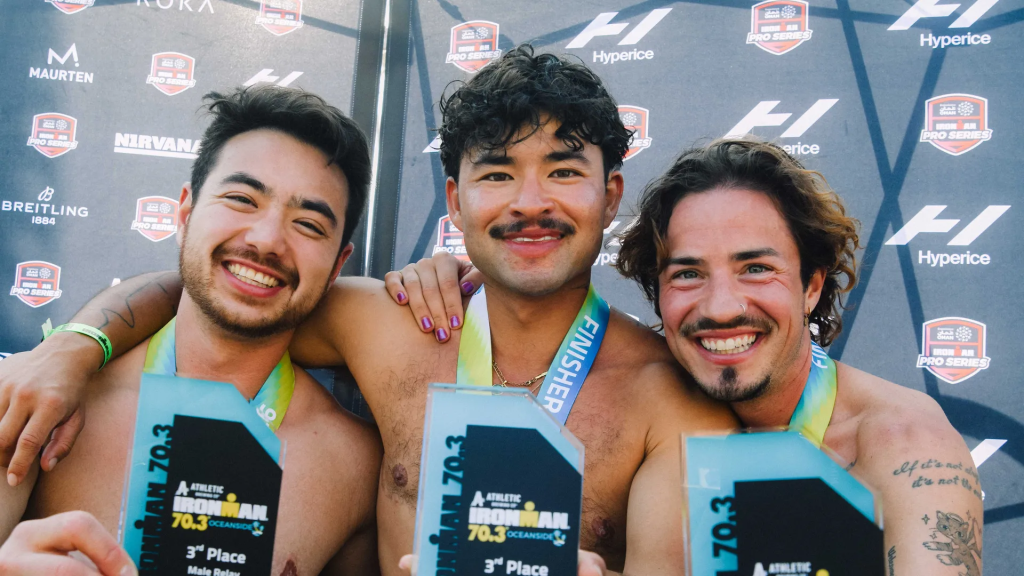
In March, the trio took third place at the 2026 Athletic Brewing Ironman 70.3 Oceanside competition, beating over 200 other teams.
Read Hiltz’s letter to the team below:
Schuyler, Chella, and Cal,
Congratulations on your podium finish at one of the toughest endurance events in the world! An Ironman podium is no joke. Beyond the months of training, sacrifice, and trust in your fellow teammates, a performance like that requires so much heart and grit. And it’s no surprise to me that you three embody those qualities so well.
Team Iron Transmasc represents so much to so many. Sometimes in sports, believing you can do something is supported by seeing someone else do it first. And when that someone looks like you, shares the same identity, pronouns, hairstyle, or top surgery scars, it can ignite a hope and fire to believe in yourself, and chase your dreams like never before.
As a nonbinary and endurance athlete myself, it was very special to see three out and proud transmasculine athletes execute a fantastic team effort and earn a podium performance together.
Thank you for your visibility and representation, and for inspiring me and so many others to believe that there’s a place for transmasculine people on podiums in endurance sports and beyond. — Nikki Hiltz
Congratulations are in order for Team Iron Transmasc, who won third place at the 2026 Athletic Brewing Ironman 70.3 Oceanside competition.
On Saturday, March 28, Team Iron Transmasc nabbed the third place spot in an ironman competition, a team sport that includes swimming, bike riding, and running. The team included champion trans swimmer Schuyler Bailar, deaf nonbinary cyclist Chella Man, and trans nonbinary marathoner Cal Calamia.
In an Instagram post celebrating their win, the trio wrote that they wanted to compete “without losing our love of the sport and synchronizing as friends.”
They continued, “In a world that is increasingly hostile toward trans people with an undue emphasis on athletics, we came together to showcase trans excellence, trans collaboration, and trans joy.”
The trio said they competed “for every person disenfranchised by transphobia, white supremacy, ableism, colonialism. For Palestinians, Iranians, Sudanese, Congolese. For every human’s right to exist exactly as we are, everywhere we are.”
The trio bested over 200 other teams to win their third place victory, per Out.
As part of the caption, the champions also pointed out that their victory took place just a few days after the IOC banned trans women from competition in female events.
“Sports are a human right of which so many people are deprived,” they wrote.
Bailar spoke further about trans participation in sports in an interview with Out given prior to the trio’s victory.
“One of the reasons that the recent IOC decision is so devastating is because it sends a message that sports are going to lead through discrimination, as opposed to being on a progressive way of moving humanity forwards, which is what they should be doing,” Bailar said.
Calamia told Out that the trio “kind of crushed it.” The running portion of the race was the third leg of the competition. Calamia said that, in their final moments, they passed a runner to nab a podium spot.
“There was a runner that was also competing in the relay that I passed at the very, very end of the whole thing, within the last 10 meters,” they said. “I had to close the deal. There was no part of me that would quit. And we got that spot on the men’s podium! It was amazing!”
Each competitor included a visual signifier of their trans identity on their uniform, Calamia mentioned. They had a trans flag on their running shorts, Schuyler had trans-colored goggles and Chella had a sign that said “bodies are not bans.”
Calamia said the trio have their eyes on future competitions, as well. “We’re already talking about what we’re going to do next,” they said. “We want to scale this up and get more trans athletes doing relays like this. We’re just excited to keep inspiring people and providing a counterweight to the other conversations about trans athletes.”
(You may listen to this, on the page linked above)
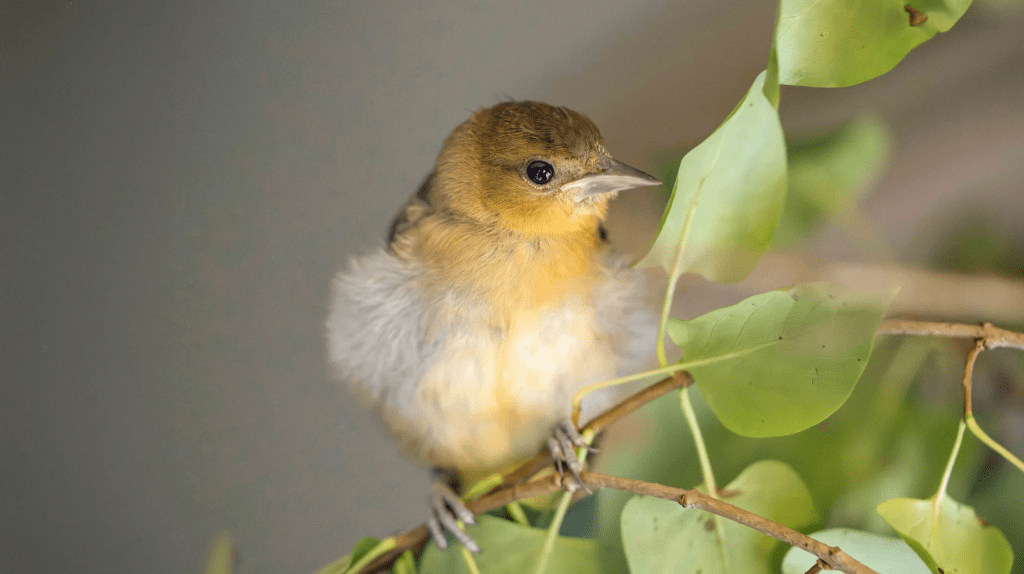
Sparky the Baltimore Oriole. Photo by Melissa Groo.
One early May, I watched a pair of Baltimore Orioles courting in my backyard. Before long, the female was weaving an intricate nest in the sugar maple outside my bedroom window. Three weeks later, the begging calls of chicks emanated from within.
As a self-professed “wildlife biographer,” I sought to photograph every stage of their story. I learned each oriole’s unique traits: the father’s dulcet chirrups as he patrolled his territory and the specific flight paths he took to the nest, the mother’s burnt-orange plumage as she moved surreptitiously through the trees, and her cryptic, leaf-like flutter down to the jelly feeder. I marveled at their tireless vigilance against marauding Blue Jays and squirrels and the dozens of daily forays they made to find insects for their nestlings.
One day, hearing a great ruckus, I rushed outside to find the parents flitting about a chick on the ground. She was injured and squawking piteously, likely captured by a predator and then released in the ensuing fray.
I scooped her up, pleading uselessly with the parents for forgiveness, and raced her to Cornell University’s wildlife hospital, not far from my home. She’d suffered puncture wounds and a ruptured air sac. After a stint in the hospital and then with a rehabilitator, she was transferred to me (a subpermittee under a wildlife rehabilitator’s license) in hopes of a release. But first, we needed to prove she could fly.
I named this tiny, spunky bird Sparky. (snip-MORE)
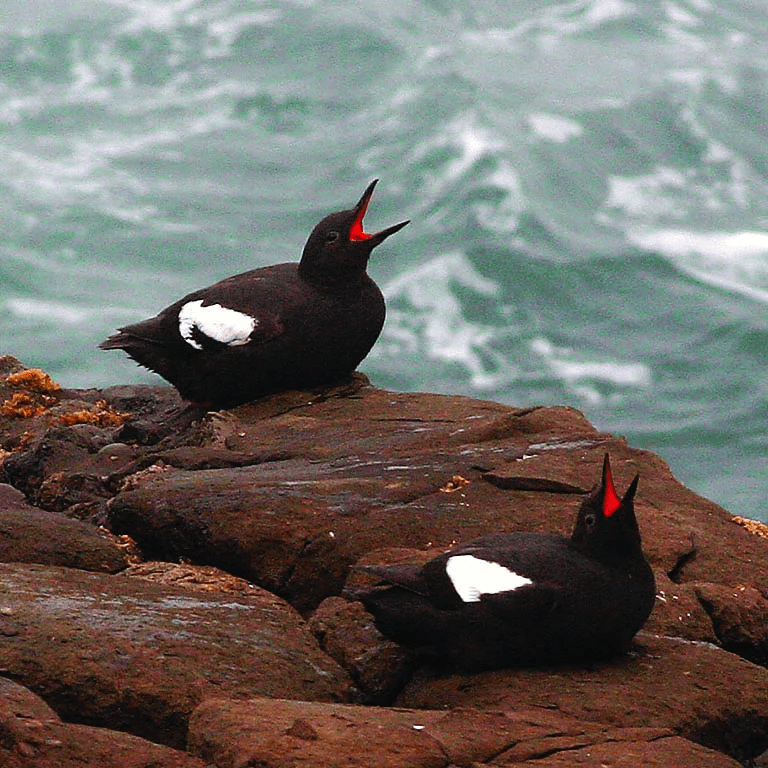
The Pigeon Guillemot is an attractive member of the auk family, a group of marine birds that also includes the puffins, murres, and auklets. The auks are largely known to forage on the open ocean, with some species diving to extraordinary depths for their food. The Pigeon Guillemot, however, forages in shallow waters near the shore and doesn’t usually dive deeper than about 100 feet. Nonetheless, they are graceful divers, “flying” underwater, their partially opened wings helping them maneuver and propelling them along. Like other auks, they use their feet as rudders.
Pigeon Guillemots are particularly fond of small fish and crustaceans, which they chase out from under rocks on the sea floor. But foraging among the nooks and crannies is not without its risks — the Pigeon Guillemot itself is food for other marine life, including the giant Pacific octopus!
Nesting colonies can be quite large, especially on small offshore islands with few predators. And Pigeon Guillemots dress quite elegantly for the occasion: During the breeding season, males and females sport velvety black plumage with a broad, white, vaguely V-shaped wing patch, all set off by their flashy, bright red feet. After the breeding season concludes, however, these birds molt to a mostly white and ashy black-and-gray plumage. (snip-MORE)
In the latest round of primary elections, voters in four states chose candidates for the November general elections, and something something national consequences, something something Donald Trump’s continued clammy grip on the Republican Party, yadda yadda. Primaries were held Tuesday in Maine, South Carolina, Nevada, and North Dakota. And in California, vote counting in last week’s primary for governor was complete enough that Republican Steve Hilton, a former Fox News host, secured the second spot in the at-large gubernatorial primary, so it’ll be him and Democrat Xavier Becerra facing each other in November. Funny how Democrats somehow only frauded up the LA mayor’s race, while the very same vote count process put Hilton on the ballot.
One might even think the cries of fraud were complete bullshit!
(snip-we know about Maine. Lets get Dems elected to our legislature!! Click through if you wish to read it, though.)
South Carolina: Nancy Mace Out, Lindsey Graham Persists Like A Bad Odor
In the Palmetto State, Rep. James Clyburn (D) easily won his primary and is likely to hold the seat, for an 18th term in the House. Clyburn benefited from the Republican-dominated state Lege’s decision to not join the rest of the former Confederacy in redrawing every last majority-Black congressional district out of existence this year.
But before you get carried away and accuse South Carolina Republicans of having a fit of decency or ethics, several top Goopers in the Lege said last month they opposed redistricting because early voting was already underway for this very primary. Still, that’s better than Louisiana,slightly, in the voting rights race to the bottom. For this year.
The really big outcome from South Carolina was that Rep. Nancy Mace, of the House Republican Batshit Awful Caucus, finished fifth — dead last — in the state’s gubernatorial primary. After this year, she’s both out of Congress and maybe even out of elected office forever, though here we note that the evil baddies in slasher flicks never seem to stay dead, either.
True to hateful bigoted form, Mace was an asshole right up to the final days of the primary, pandering to xenophobes by introducing a constitutional amendment that would ban naturalized citizens from serving in Congress, serving as federal judges, or serving in any position requiring Senate confirmation. She insisted that three of her Democratic colleagues in the House — Reps. Ilhan Omar (Minnesota), Shri Thanedar (Michigan), and Pramila Jayapal (Washington) — are “all making clear every single day their loyalty is not to America.” Jesus, what a vile person.
Trump’s endorsed GOP candidate in the governor’s primary, Lt. Gov. Pamela “not Nancy Mace” Evette, wasn’t able to get enough votes to secure the nomination outright, and will go up against state Attorney General Alan Wilson in a runoff on June 23. Mace endorsed Wilson, probably out of spite, although last year she had attacked Wilson, baselessly claiming he was protecting defendants accused of child sex abuse.
“Pamela Evette is NOT ENDORSED by DONALD TRUMP,” Mace wrote, incorrectly. “Do not believe her LIES.” Mace posted an AI-generated image of herself posing with Trump.
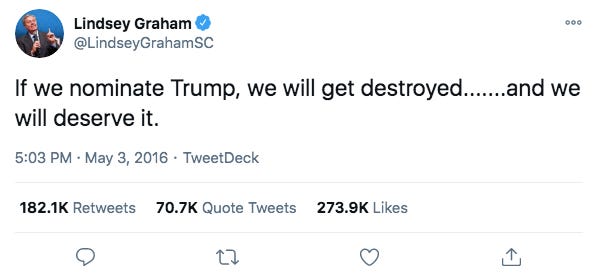
Oh, and speaking of assholes, Lindsey Graham easily fended off a primary challenge from self-funded business guy Mark Lynch, clearing the 50-percent threshold to avoid a runoff with 56 percent of the primary vote. Trump had unironically warned that it’d be a “DISASTER for the Republican Party” if Lynch won, which, hmmm, sounds vaguely familiar to something we heard a decade ago … what was that?