
Category: News / Information
Scott Pelley says Bari Weiss wanted 60 Minutes to say Renee Good was ‘driving toward officer’
https://www.theguardian.com/media/2026/jun/07/scott-pelley-bari-weiss-renee-good-report
Fired journalist accuses CBS News chief of interfering with report because it did not echo Trump’s view of the shooting
Scott Pelley was fired from CBS 60 Minutes last week. Photograph: Charles Sykes/AP
The fired 60 Minutes anchor Scott Pelley has accused editorial management at CBS of interfering with a broadcast segment on the killing of the Minneapolis protester Renee Good by an immigration officer in January.
The veteran broadcaster, who was recently dismissed from the show, said CBS News’s editor-in-chief, Bari Weiss, had sent an email to his supervisor requesting changes shortly before the airing of the segment in question.
In an interview with the New York Times published on Sunday, the 68-year-old Pelley accused Weiss of injecting “falsehoods and bias” into programming.
Pelley told the outlet: “Two of the things in the email include, ‘Can we make the protesters look more violent?’ Now, I’m paraphrasing. I don’t have the quote, but that’s what was communicated to me. And the other thing, Renee Good’s car. You need to describe her as driving toward the officer.”
Pelley maintained that was the direction contained in the email even though video of Good’s shooting did not support such a conclusion.
A CBS News spokesperson told the Times in response to Pelley’s statements that Weiss had made four points in an email exchange on the segment that had “no political motivation and were proposed solely to make the piece as strong, fair, and accurate as possible”.
“Not everything she raised made it into the final piece,” the statement added.
Pelley’s accusation comes amid turbulence at the flagship TV news show that has seen the 60 Minutes executive producer Tanya Simon replaced and several correspondents and producers leave over questions of editorial independence. Three of the show’s veterans – Lesley Stahl, Bill Whitaker and Jon Wertheim – are staying on.
The newly installed executive producer, Nick Bilton, a former Vanity Fair journalist and film-maker, told staff in a memo that “the foundation of 60 Minutes is journalistic independence.
“We will always pursue stories without fear or favor.”
Pelley’s accusations to the Times followed a heated exchange at a meeting on Monday in which he accused Weiss of “murdering” the show. He was fired soon after.
In his latest salvo, Pelley said he was concerned that Weiss “had zero television experience and had never managed a large global operation like CBS News”. He also called her lack of TV news experience “red flags to me”.
Pelley also said that Bilton’s mission to modernize the 58-year-old show ignored changes that were already in play.
“Of course we have to reach out to a younger and younger audience, but their argument about joining the internet age is just disingenuous,” Pelley said. “It’s almost as if Bari Weiss and Nick Bilton were sealed in a time capsule in 1990, and it just cracked open. They’ve just discovered the internet, and they’re running around telling everybody how important it is.”
Pelley’s accusations over the Minneapolis segment in part centered on what took place in the seconds before Good was shot by an immigration enforcement officer.
“On the video, you see the officer standing slightly off the front of the car,” Pelley told the Times. “You clearly see Ms Good’s wheels turned completely as far as they will go, away from the officer. But he shoots her in the head [and] kills her.”
Pelley also alluded to cellphone video from the officer’s vantage point that was publicly released and captured him calling Good a “fucking bitch”.
As Pelley put it, the officer said “something about her that I can’t repeat in polite company”.
Pelley said that 60 Minutes had “gone out of our way in our plan from the very beginning to show the protesters for the responsibility that they had … somehow that wasn’t enough for Ms Weiss”.
He added that video of the shooting showed that the officer wasn’t standing in front of the car and she wasn’t “driving toward him”. He argued that Weiss “wanted it described that way” because it echoed what Donald Trump said of the shooting in his capacity as president.
Asked to respond to Pelley’s claim that Weiss “was putting a thumb on the scale on behalf of the [Trump] administration”, CBS News said there was “no credible argument” to suggest she was doing that.
All Clay Jones This Morning
Lies and Hissy Fits
A black female journalist stands up to a bully
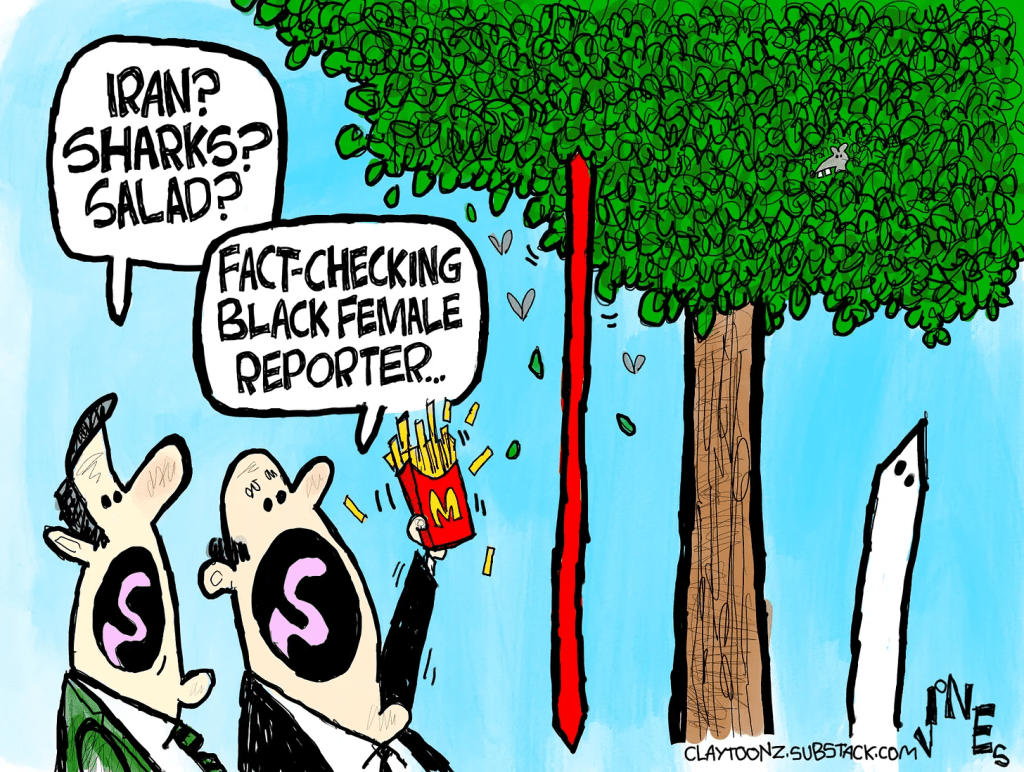
Donald Trump had an interview with a national news network, and he got fact-checked. Obviously, this network was not Fox News, because it would typically allow him to lie unabated.
It was a wide-ranging interview with NBC News’s Kristen Welker that aired Sunday on Meet the Press, and ended abruptly in a hissy fit on his part. Trump claimed that the California gubernatorial primary is “rigged” in favor of Democrats. Instead of letting his lie slide by, Welker pushed back and pointed out that there is no evidence to his claim. Welker was professional and tried to move the interview forward after calling out his lie, but Trump would not let it go.
Trump has a tradition of castigating black female journalists, and he continued it with Welker, saying, “You’re either crooked or you’re stupid,” before ending the interview in a tantrum. (snip-MORE)
Got A Basketball Trump
I think I can speak for all NBA fans, especially those in New York City, when I say to Donald Trump, stay away.
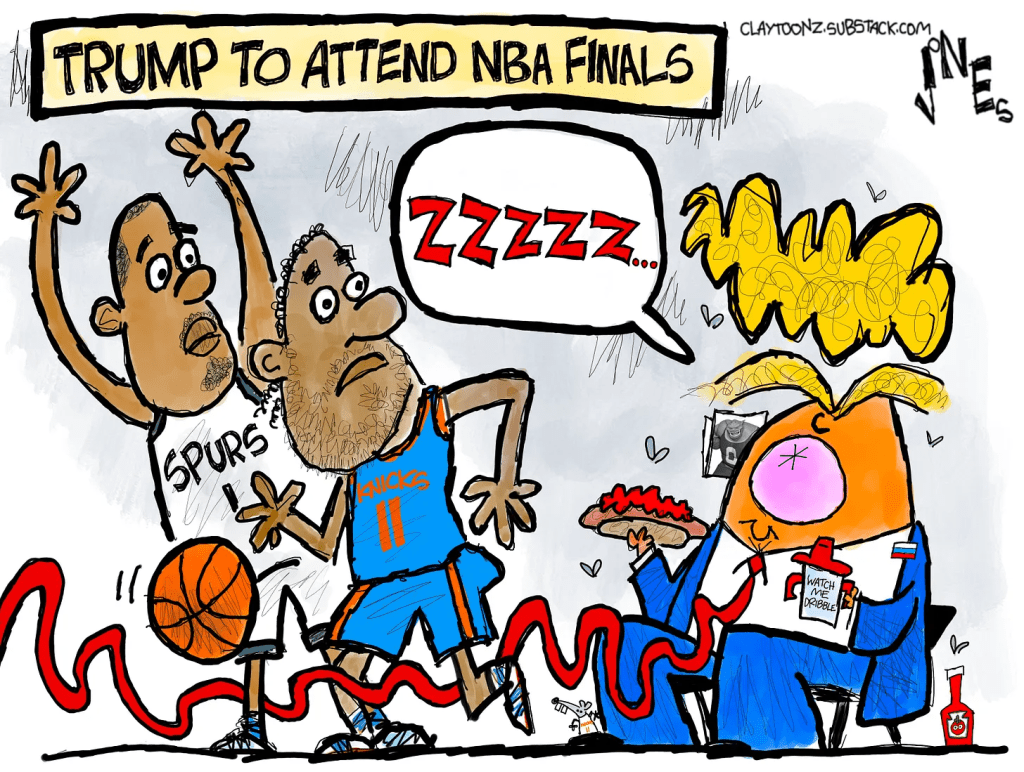
It seems that Donald Trump wants to take something else away from the people and make it all about himself. This time, it’s the NBA finals.
The New York Knicks lead in the finals, 2-0, after defeating the Spurs in the first two games in San Antonio. Now, the series is headed to New York City, where it will resume on Monday night. Not only will there be thousands upon thousands of rabid New York fans waiting for them, but also Donald Trump.
The Knicks haven’t won an NBA Finals series since 1973, and fans are worried that Donald Trump’s presence will jinx their current run, where they have not lost in the last 12 games. The Knicks swept the Cleveland Cavaliers and the Detroit Pistons on their way to meet the Spurs in the finals. The Spurs are supposed to be the better team, but no one has told the Knicks that yet.
Knicks owner James Dolan has invited Trump to attend Monday’s game at Madison Square Garden. Why would he do that? Is he stupid? (snip-MORE)
AI Versus Nepo Grifter Babies
Something needs to replace them

I considered taking the day off, but I have a hard time not working. I kind of sort of don’t know what to do with myself. So I drew something, but decided not to spend too much time on it.
I was thinking about artificial intelligence and how much I hate it. I really hate these people on social media who use AI to create cartoons. They suck. It annoys me that these people think that they are cartoonists. We all use AI, but I really hate that people are using it for their creative process. Lately, the word “slop” has been used with AI. I don’t know who was the first to use it that way, but it’s most appropriate. When it comes to art, there isn’t a lot of variety in styles with AI, which means that when you use it, it looks generic. I can usually tell when something has been created with AI. (snip-MORE)
What A Wonderful Thing!
Under Mamdani, New York will be the first to open a free childcare center for city workers
The center, called The Little Apple, could be a model for other cities exploring ways to make life more affordable for workers.
This story was originally reported by Chabeli Carrazana of The 19th. Meet Chabeli and read more of their reporting on gender, politics and policy.
Tucked in New York City Mayor Zohran Mamdani’s sprawling universal childcare plan is a little-talked-about milestone: In September, the city will open what appears to be the first free daycare for municipal workers in the country.
The center, called The Little Apple, is a pilot program that could prove to be a model for cities across the country that are childcare curious, but not ready to take the big universal swing.
Housed in a renovated space on the first floor of the David N. Dinkins Municipal Building in Manhattan, home base for more than 2,000 city workers, the Little Apple will offer free care to the kids of full-time staff. All workers in the Department of Citywide Administrative Services (DCAS), a city government support agency, can also take advantage of it regardless of their work location.
The center will be small — just 40 seats for children ages six weeks to 3 years old. To pay for it, the city budgeted about $1.5 million, or $35,000 per child.
“This is what Wall Street could call a good investment,” Mamdani said in a press conference announcing the new center. “We know that after housing, the cost of childcare is what is pushing working families out of this city.”
DCAS Commissioner Yume Kitasei told The 19th said the solution came about as a retention strategy, responding to the needs workers shared. In surveys, workers enthusiastically embraced the idea. One worker described access to free childcare as “life-changing.”
That’s probably not hyperbole. Childcare affordability is a national problem that has only grown more acute. Childcare costs an average of more than $13,000 annually nationwide; in New York for an infant at a center it’s closer to $21,000 on average. Paying for a daycare now vies with housing costs as the top constraint on family budgets, so much so that some parents have had to move or drop out of the workforce.
Cities, meanwhile, have been struggling to retain their workers since the pandemic. Benefits like childcare, which some cities and private companies have dabbled with, can help address the quality-of-life issues that are pushing workers out of jobs.
“This is a great time for us to sort of be thinking about: How can we make our jobs even more attractive to people and also retain the city workers that we have?” Kitasei said. “This is one piece of that puzzle.”
Kitasei added that a “healthy” number of staffers applied for The Little Apple and the department expects to fill its 40 childcare seats. Anyone who doesn’t get a spot will be put on a waitlist.
There is an appetite across the country for childcare solutions that could help bring down costs for certain workers, and cities are already taking on creative fixes.
Several already have childcare centers in municipal buildings or for city employees, including Boston, Los Angeles, Philadelphia and Grand Junction, Colorado, though none of them are free like New York’s. In Chattanooga, Tennessee, the county school district and a local childcare center known nationally for creating stable childcare models have partnered to provide childcare for the children of teachers inside unused classrooms in schools. Boone County, Missouri, is building a childcare center exclusively for children of first responders.
In the private sector, Google, General Mills and Siemens closed longstanding childcare centers they operated on their campuses in recent years, but efforts continue elsewhere. Patagonia has operated a childcare center at its California headquarters since the 1980s, a move it argues has lowered turnover from employees who use the site by 25 percent. Overstock.com also has an onsite childcare center at its Utah headquarters. Both are subsidized, not free.
“As cities in every region of the country compete with the private sector and other municipalities to attract and retain workers and elected officials, ensuring access to childcare offers an opportunity for local governments to build a representative workforce and invest in the future of their communities,” said Quincy Midthun, an outreach specialist with the Mayors Innovation Project at the High Road Strategy Center, a think tank focused on solutions to social problems.
The Little Apple, and New York City broadly, reflect a changing political tide when it comes to childcare.

The announcements of universal childcare in New York City and in New Mexico in the last year received an enormous amount of attention across the country. Both places took an idea that for many years was floated as a pipe dream — treating childcare similarly to public education — and turned it into reality. In New York, it’s one of the few issues that Mamdani, a Democratic socialist, and Gov. Kathy Hochul, a centrist Democrat, can agree on.
Voters are also hungry for more solutions: In poll after poll, they assert that spending money on childcare is a good investment.
Emmy Liss, who heads Mamdani’s childcare office, said childcare is at a “political tipping point.”
“We’re in this moment where folks across all political, socioeconomic, demographic spectrums recognize that childcare is essential, that childcare is something families are struggling to access, and know that the market economics of childcare don’t work without public investment,” Liss said. “We see recognition of that.”
With Little Apple, New York is testing what it looks like to commit to its promises of free care for all, but doing it first for its own employees.
“If we are asking folks to report to work in person in parts of the city where childcare is expensive, as it is all over the city, I think that we have to recognize that childcare is an important part of how we keep people in the workforce,” Liss said.
Mamdani and Hochul have been working to make childcare universally available to children in the city through a phased rollout set to conclude in four years. For 2-year olds, the mayor announced that 2,000 free seats will be available in the fall in four largely low-income areas of the city. Another 12,000 are planned for 2027. For 3-year-olds, about 2,000 new seats will be added in the fall, as well. The city has an existing universal childcare program for 4-year-olds.
Universal childcare as Mamdani envisions it will cover kids ages 6 weeks to 5 years with a price tag of about $6 billion annually, making it the most expensive pillar of his affordability agenda. Mamdani is expected to push to fund the program with a tax increase on the wealthy, a strategy Hochul has not been on board for, though the state is chipping in $4.5 billion. Mamdani has not yet unveiled what his universal childcare program would look like for infants and young toddlers.
How New York City’s program rolls out and its sustainability are being closely watched by proponents of universal care, who argue it’s also an anti-poverty measure.
“We know that other places are watching as we try different things out, including the work at the Little Apple,” Liss said.
In New York City, 21 percent of working parents experienced some kind of childcare hardship in 2024 that forced them to forgo care or use inadequate care, particularly families living in poverty, single mothers and Black parents, according to a recent report from Robin Hood, an anti-poverty organization, and Columbia University’s Center on Poverty and Social Policy.
An average of 3,400 2- and 3-year-olds were pushed into poverty between 2022 and 2024 specifically due to the cost of childcare, a separate report from the same organizations found. An estimated 4,100 2- and 3-year-olds would be lifted out of poverty each year if they had access to universal 2-K and 3-K education. That would reduce poverty for this age group by 9 percent.
Rebecca Bailin, the executive director of the parent organizing group New Yorkers United for Child Care, said the problem has reached such a fever pitch that thousands of parents started to organize around the issue in 2023 and helped push the agenda that was central to Mamdani’s election.
Bailin, who has a 1-year-old, said she can now depend on a 3-K program when her child turns 3 and likely a 2-K program, as well — a savings of about $100,000. The 2-K program Mamdani is rolling out will also be full-day care rather than partial-day care that wraps up around 2 p.m. like the existing 3-K program, addressing a top ask from parents.
“People are stoked,” Bailin said. “People feel like they can stay in the city.”
The Little Apple is a small part of the larger effort, but, “if we want to retain people, we have to do this,” Bailin said.
“This is something we want to see scaled. If city workers can’t afford to live here, that’s a real problem,” she continued. “This is really critical and we need this for everybody.”
ICE Detention Protests Heating Up | Wali Khan | TMR
This clip was with a reporter detailing the abuses in ICE detention facilities and the illegal actions of ICE agents and for profit prison staff. Profit over people as these ICE and prison staff do not see the detainees as humans like themselves. What is concerning is ICE is learning how to use existing laws to make the local law enforcement work against the will of the people. This young man wont admit he was attacked by ICE agents instead saying he thinks he hit a tree limb in the confusion but I showed Ron the video and he said the guy looks to him like he was hit repeatedly and hard in the head and possibly the body as well. When will we as a people see that these abuses are so very similar to the abuses suffered by the minorities in 1930s Geermany. Hugs
A Redux Post For PRIDE
Beware Anne Bonny… (redux post)
This Is One Fine Story!
Is there a pianist in the house? Audience member steps up to perform in La La Land in Sydney
Sterling Nasa had tickets to see Justin Hurwitz’s La La Land in Concert. When the keyboardist suddenly fell ill, he found himself on stage performing
La La Land is a much adored homage to Hollywood, where dreamers take chances and seize unexpected moments.
On Saturday night at the ICC’s Darling Harbour theatre, that idea became a reality for a 21-year-old university student who was thrust into the spotlight at a live performance of the movie’s score – and saved a concert from derailment.
Sterling Nasa was in the audience at La La Land in Concert, a touring production where the movie – which features Ryan Gosling and Emma Stone – is projected on to a screen while a live orchestra plays the musical score in synchronisation with the film.

The performance proceeded normally until the interval, which stretched out to 40 minutes. Then the film’s Oscar-winning composer and conductor, Justin Hurwitz, walked out alone to address the audience.
The orchestra’s keyboardist had suddenly fallen ill. Was there by any chance a pianist in the house? And one with exceptional sight-reading skills?
Speaking to Guardian Australia on Monday, Hurwitz revealed that behind the scenes, quiet panic had set in during that extended interval.
“Our first thought was, is there a string player who also knows keyboard? The answer was no.”
As the orchestra’s musicians frantically phoned local contacts, offers started rolling in of backup players who were 15 to 20 minutes away. But Hurwitz knew time had run out.
“I figured nobody’s as close as they say they are … so I just thought, well, we have 2,500 people in here …
“Yes, it was a gamble.
“That’s why I asked a few times. I wanted to make sure that somebody wasn’t just overly confident. I asked a couple of follow-up questions like, ‘Are you sure? Can you really sight-read? Can you play key signatures you’ve never played before?’”
Nasa, who plays piano and organ and is the bagpipes tutor at his old school, Scots College, hesitated when the call went out.
“I was a little bit tentative,” the University of Sydney politics and international studies student told ABC Radio on Monday morning. “I do owe a lot of the experience to my friend, Scarlett, who sort of … put my hand up for me. But I did end up finding the confidence and it was a very good decision to go down and volunteer myself.”
A longtime admirer of Hurwitz’s work, Nasa suddenly found himself sitting at an electric keyboard, staring at a complex score he had never rehearsed.
The ultimate test came during the performance of the John Legend piece Start a Fire, which features an intricate synthesiser solo designed to match the erratic hand movements of Gosling’s character on screen. It was the exact moment Hurwitz was most nervous about.
“The synth solo is really technical, and I thought, even a really high-level professional sight-reader would probably not be able to do it,” he said. “As it was coming up, I was thinking, ‘Oh no, how’s he going to be able to handle the solo?’”
Nasa told the ABC he was thinking the same thing.
“I saw it on the score and I thought, oh, I don’t know if I’m going to be able to sight-read that in one go,” he said.
Like Gosling’s jazz-pianist character Sebastian, the student had to decide whether to stay in the shadows or take a monumental leap of faith. With no time to overthink, he chose to trust his instincts.
“I took a little bit of a creative liberty and just decided to improvise, which I think ended up being a good choice.”
The gamble paid off, carrying the orchestra through the number – and earning Nasa a resounding ovation from the audience.
“He saw it coming up … and he just improvised,” Hurwitz said.
“That is a whole other skill on top of sight-reading. To be able to play a really cool solo in the right key, in the right scale, on the fly with no rehearsal – it was remarkable.”
The backstage debrief after the final bow was full of mutual disbelief.
“I just told him how blown away I was, and obviously how thankful I was,” Hurwitz said. “All of our heads were spinning a little bit because it was such a surreal moment.”
By Monday morning, the 21-year-old was experiencing a different kind of whirlwind, being ferried between breakfast television and radio studios to recount his sudden taste of showbiz fame.
Reflecting on the incredible turn of events, Nasa said it was an unforgettable privilege to play a soundtrack he had loved for years.
“It was quite a blessing to get to play a work that I’m in such admiration of,” he said.
While the production team is now scrambling to rehearse new keyboardists for the upcoming Melbourne and Brisbane legs of the tour, Nasa will be heading back to his regular university lectures.
But has the student missed his calling in life?
Hurwitz said that while the young Sydneysider certainly has the talent for a career in music, the choice is ultimately his to make.
“I don’t know what he’s most passionate about,” Hurwitz said. “Maybe he likes international relations a little more than music. But that’s what La La Land is about. You’ve got to do what you love the most.”
La La Land in Concert will play at the ICC Sydney on Monday, at the Brisbane Convention & Exhibition Centre on Wednesday and at the Hamer Hall in Melbourne from Friday 6 to 8 June.
Queer Lit 🏳🌈
How to Build Your Queer Summer Reading List
Jun 2, 2026, 8:30am
The founder of a popular New York City LGBTQ+ book clubs talks queer literature, book clubs, and what she’s reading this summer for Pride Month.

“It’s so important for everyone to be reading queer books by queer authors,” Joey Lobel said. Envato/Cage Rivera/Rewire News Group
In late 2022, Joey Lobel was frustrated.
An avid reader, Lobel, a 31-year-old butcher in Brooklyn, was struggling to find queer books that didn’t have sad endings.
“I went on a little spiral and I thought, I’m sure other people are feeling the same way,” she said.
So Lobel decided to make a queer book club page on the social networking website Meetup, hoping to build community around LGBTQ+ reads. She wasn’t sure if people would show up. But “worst case scenario,” she recalled thinking, “I’m sitting at a bar with a book, which is completely fine.”
But people did show up. And in the nearly four years since the Queer Book Club started, Lobel’s book club has become a staple in New York City’s LGBTQ+ community—with monthly meetups at the Brooklyn bar Young Ethel’s and an average of between 15 and 30 participants. The book club’s one-off events, like book swaps, are popular and see upward of 60 attendees.
As summer gets underway, Lobel spoke to Rewire News Group about the importance of LGBTQ+ literature, generating a top-notch list of reads for Pride Month, and building community through books.
The following conversation has been edited for length and clarity.
What makes a book queer?
A book is queer if it’s written for queer people by queer people. There are so many books out there that have zero queer characters, or one passing queer character. And to me, that’s not necessarily considered a queer book. But any book written for us, with us in mind, I want to read.
Do you have an all-time favorite queer book or queer character?
That’s so hard. My all-time favorite queer book is In The Dream House by Carmen Maria Machado. … I read a lot of books. And a lot of times, I sort of forget immediately. Like, you’re out of that world and you’re back in your world, and you forget what happened. But In the Dream House has always stuck with me.
Is queer literature for everyone?
I definitely believe queer literature is for everyone. You can learn from anyone. You can be entertained by anyone. And it’s important that we’re able to look at viewpoints other than our own. The amount of straight books that I’ve read in my life that I’ve enjoyed is vast. I just feel like it’s so important for everyone to be reading queer books by queer authors.
And to remind publishers that queer authors are authors people want to read.
There’s such a big audience out there. There are so many queer shows right now being canceled. There are such audiences for them, and they’re still being cancelled. We have to support queer media. And straight people have to support queer media. It’s enjoyable for everyone.
How do you approach building a queer summer reading list?
The reason I love the book club for figuring out what you’re going to read is that I’m always reading books that I would never choose on my own. If it was up to me, we’d be reading cute little rom-coms where everyone falls in love at the end. I love those, and there’s definitely space in my reading list for those—a big, big chunk of space.
I also like being able to read books that other people recommend to me. I look at a lot of Instagram recommendations.
There’s just so many books out there, it’s hard to choose. I also read so much more in the summer. So I try and hoard all of the books that I want to read until it gets warm. And then I’m outside just reading all day.
Speaking of, what are three books on your summer reading list?
I read this book previously, and I definitely want to reread it. It was incredible. It’s called Fracine’s Spectacular Crash and Burn by Renee Swindle. It’s so good. It’s about a young woman who loses her mom. And there’s a really interesting relationship dynamic in there with her mom who has passed, and with this young boy that she meets that she’s protecting, and someone that she starts dating. There’s so many layers to it that I want to reread it, because I know I’m going to get more of it the second time.
Right now, I’m reading Nevada by Imogen Binnie. That’s June’s book club pick. I’m halfway through, and it’s a really great book. It’s so different from the way that I see the world. From this character’s perspective, it’s a little darker and a little chaotic—more chaotic than I’m used to—which I think makes for an interesting dynamic to read about.
I also want to read Mac Crane’s new book, A Sharp Endless Need. Their last book, I Keep My Exoskeletons To Myself, was hauntingly beautiful—and not something I would gravitate toward because it’s not the rom-com, two girls falling in love. But we read it for book club and I was entranced. And that’s why I’m so glad that I get to read books that aren’t just my normal go-tos.
But one that is my normal go-to, which I haven’t read yet, is Puck by Samantha Allen. It’s been pitched to me as a Midsummer Night’s Dream spinoff with reality TV. And I’m already invested.
What advice do you have for people who are unsure about whether book clubs are for them?
There’s a lot of reasons why people might be a little nervous to join a book club. I was worried that I would have to always public speak, which is a little tough when you’re not feeling up to it. I was also worried that it would be tough finishing a book on a timeline—it does remind me a little bit of school, in that way. (Editor’s note: Lobel’s club has a rule that not finishing the monthly book is totally fine, so long as you’re “fine with spoilers.”)
But book clubs are very welcoming. You can just go in, and talk to people.
What’s the worst that can happen? You’re surrounded by other queer people who love books.
A Reason For PRIDE:
The Oral Histories of the AIDS Crisis
The voices of artists and activists illuminate the human experience behind the AIDS epidemic.
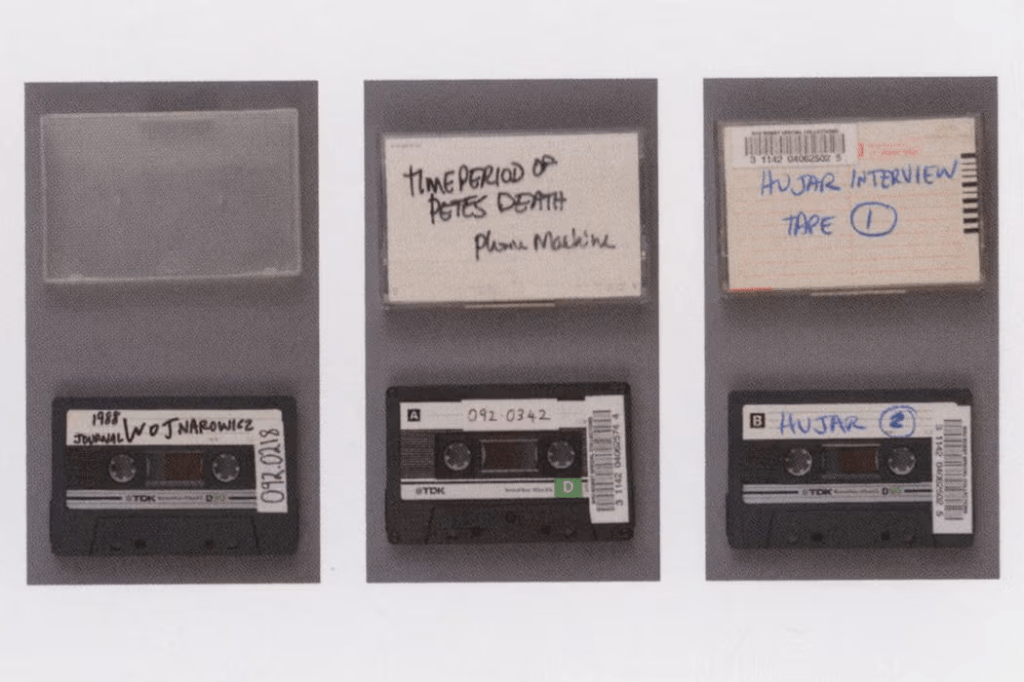
From a photograph of David Wojnarowicz’s audio cassette tapes, 1987-89 and undated in Voice=Survival, 2017 via JSTOR
By: Liz Tracey
When approaching recent historical events, where the scope of destruction and loss can be unfathomable in scale, oral history can bring both connection and immediacy through individual stories of loss, grief, rescue, or triumph that would otherwise disappear in the grand sweep of “Great Men and their Deeds.”
Scholar Indira Chowdhury describes the approach:
[T]he method enables the documentation of certain aspects of historical experience that are often missing from other kinds of historical sources. Oral historians not only interview and engage in conversation with living sources, they also find themselves challenged in a unique way—the historian is transformed into a protagonist in the dialogue. Oral history is perhaps the only field where the sources talk back to the historian, confronting, disputing, disrupting, and sometimes resisting the historian’s understanding of the past (Frisch 1990; Shopes 2012). Oral history works with the interviewee as a partner in dialogue and the verbal form historical truth can take is always co-constructed (Cook and Goodall 2013; Goodall and Cadzow 2009; Portelli 1991).
Some of the most effective (and affecting) projects using this approach concern communities that may be far outside of the audience’s experience, whether due to time, geography, or identity. Works like Shoah by Claude Lanzmann, Hard Times by Studs Terkel, and Boots of Leather, Slippers of Gold by Elizabeth Lapovsky Kennedy document their subjects through the voices of those who lived through specific moments and events that can be overwhelming or remain unknown without a more interpersonal method.
“Many of the best works about this disease have been produced by people at various stages of HIV infection.”
The history of the HIV/AIDS epidemic has recently become the subject of numerous oral history projects, where the stories of survivors, caregivers, activists, and health care professionals have been collected and made available online, traditionally published, and edited into documentaries.
One such collection, Visual Arts and the AIDS Epidemic, was begun in 2015 by the Smithsonian Archives of American Art after receiving a grant from The Keith Haring Foundation. Haring founded the foundation in 1989, a year before his death from HIV-related illness, to maintain his artistic and philanthropic legacy. The project interviewed forty artists about their lives, their work, and how the AIDS crisis intersected and permeated both.
The interviews in the Visual Arts and the AIDS Epidemic collection cover wide ranges of personal and creative history, ranging from insider gossip and “name-dropping” to theoretical discussions of method and art history. They benefit from interviewers who bring their own experience as artists, art scholars, and historians to the conversation, with questions and insights that make this collection a rich multifaceted history of AIDS, the arts, and activism.
In his 1990 article, journalist Richard Goldstein wrote about the deep relationship between art about AIDS and its creators. “One senses in much art about AIDS a sense of familiarity with its subject,” Goldstein writes,
as if the artist were immersed in dealing with the epidemic—as so many are. Many of the best works about this disease have been produced by people at various stages of HIV infection. Perhaps they have lost a lover, nursed a dear friend, or attended a dozen funerals at a young age, and feel themselves to be, in every sense, set apart by the experience. They are implicated. Their art signifies a collective trauma—mass death in the midst of life.
Reveal Digital, an initiative “to amplify important, long-overlooked voices of the twentieth century,” has made these histories, and more, available in their developing open access collection HIV, AIDS and the Arts.
Artists in The Early Years of the Epidemic
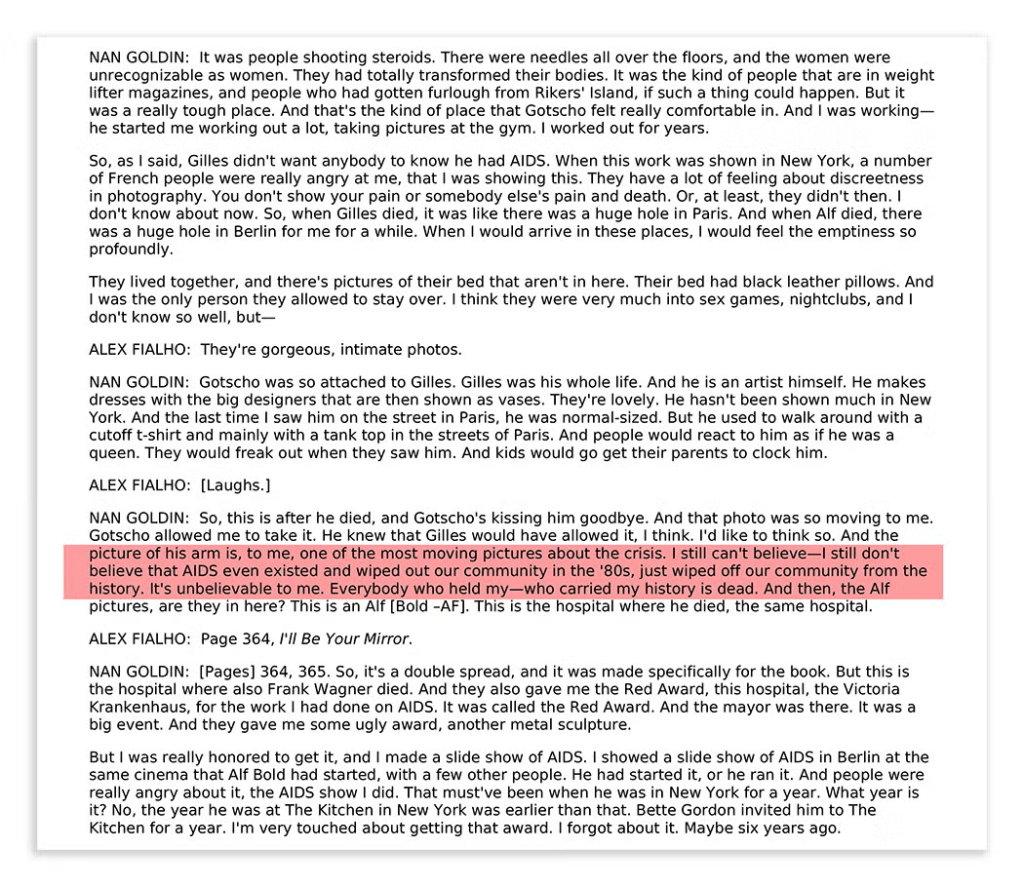
“I still can’t believe—I still don’t believe that AIDS even existed and wiped out our community in the ’80s, just wiped off our community from the history. It’s unbelievable to me. Everybody who held my—who carried my history is dead.” —Nan Goldin
The initial public responses by the US government to the first years of the epidemic were jokes at the expense of the ill at press conferences. President Reagan didn’t publicly say the word “AIDS” until 1985, four years after the first reported cases and two months after family friend Rock Hudson died of AIDS-related complications. That same year, Ryan White, a hemophiliac teenager with AIDS in Indiana, was prevented from returning to school after his diagnosis, and his family had to move after someone shot into their home.
One year later, William F. Buckley published a New York Times op-ed calling for HIV-positive people to be tattooed on the upper arm and buttocks to protect others (assuming that would protect both future sexual partners and intravenous drug users who might share needles). News reports about the disease largely focused on fear of contagion, the promiscuity and danger of gay men, and the threat of HIV to “normal” Americans.
Information about treatments for the many opportunistic infections that HIV made people vulnerable to was gathered in the early years by those under threat. Newsletters like “AIDS Treatment News” were photocopied and sold at LGBTQ bookstores, and buyers clubs imported potential treatments not yet approved by the Food and Drug Administration or available in the US. These groups and others, working with health care providers, had to become experts and educators at a time when US Congress was successfully prohibiting the use of funding from the Centers for Disease Control for education and prevention materials that would “promote or encourage, directly or indirectly, homosexual activities.”
In the interviews gathered in the Visual Arts and the AIDS Epidemic collection, artists describe how they first became aware of AIDS: from a loved one diagnosed after an illness; from hearing of a friend’s passing after not seeing them for a while; from a doctor telling them to stay with a partner because “there’s something going around”; or by learning of their own diagnosis. Friends were lost to the disease, and surviving family members denied the illness or sometimes actively excluded partners from funerals.
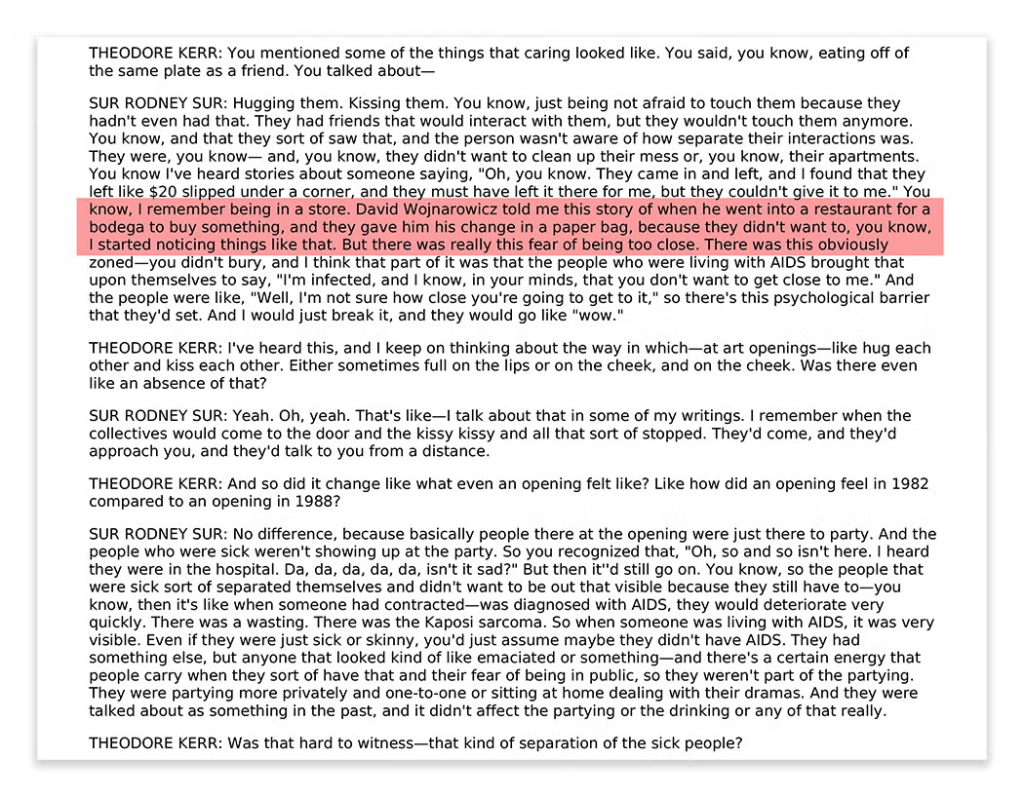
Sur Rodney (Sur), a New York City-based writer, gallery co-director, and archivist, relates that the late artist David Wojnarowicz would go to his local bodega in New York City where the clerks returned his change in a paper bag, out of fear. He describes his own anxieties when stepping in after a friend’s death to help save and archive their artworks and collections so they wouldn’t be destroyed (before there were nonprofit organizations to do so).
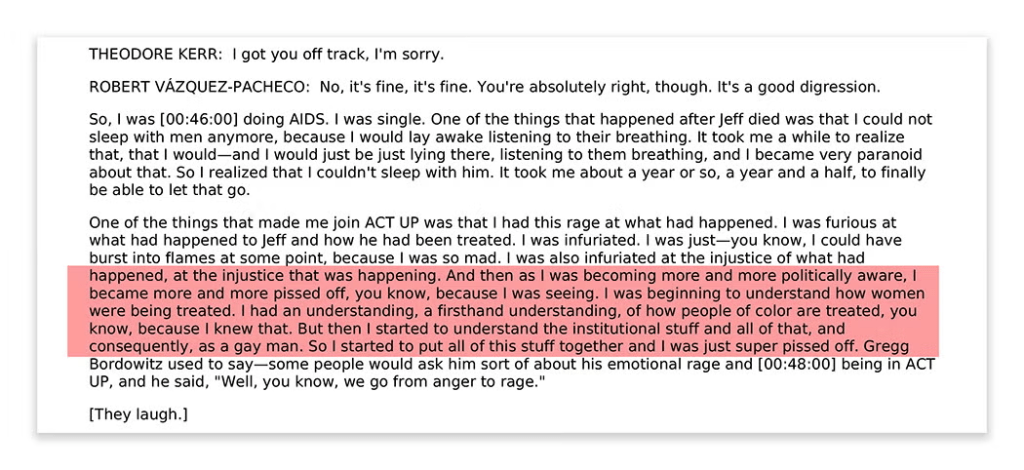
These personal experiences unfolded within the larger context of governmental indifference, active discrimination against people with the disease (or belonging to groups that were deemed “at risk”), and a growing consciousness of the political landscape of the epidemic. Robert Vasquez-Pacheco, a member of ACT UP and Gran Fury, recounts,
as I was becoming more and more politically aware, I became more and more pissed off, you know, because I was seeing. I was beginning to understand how women were being treated. I had an understanding, a firsthand understanding, of how people of color are treated, you know, because I knew that. But then I started to understand the institutional stuff and all of that, and consequently, as a gay man. So I started to put all of this stuff together and I was just super pissed off.
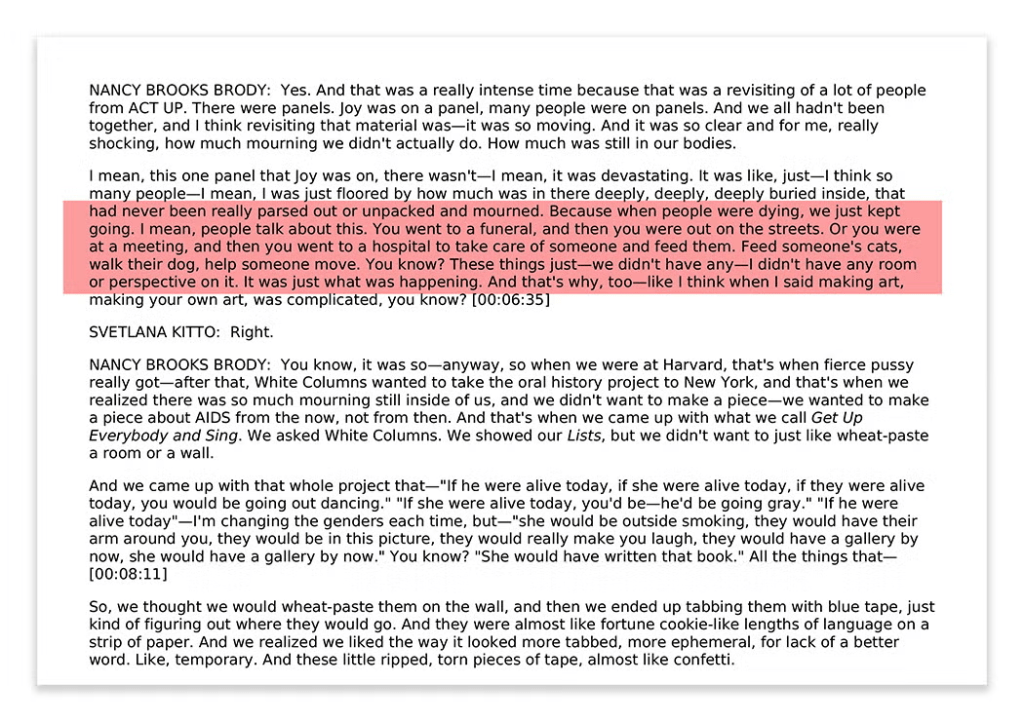
Some version of this process, repeated for many of the subjects, led people to activism, whether through art, volunteer work, protest, or sometimes all three. Nancy Brooks Brody (1962-2023), a visual artist and member of the fierce pussy collective, describes the progression in her interview.“Because when people were dying,” she explains,
we just kept going. […] You went to a funeral, and then you were out on the streets. Or you were at a meeting, and then you went to a hospital to take care of someone and feed them. Feed someone’s cats, walk their dog, help someone move. You know? These things just—we didn’t have any—I didn’t have any room or perspective on it. It was just what was happening.
The meetings she, and others, refer to were those of ACT UP New York (The AIDS Coalition to Unleash Power), which began in 1987 at a community meeting where Larry Kramer asked, “How long does it take before you get angry and fight back?” Kramer, a playwright and essayist who had been covering AIDS since the beginning through journalism, had co-founded the non-profit Gay Men’s Health Crisis in 1982. His play The Normal Heart, an impassioned call to action, spurred members of the audience to meet and subsequently take part in one of the most significant and effective activist movements of the twentieth century.
Creating Art in an Epidemic
The artistic works of those interviewed are diverse, both in media and approach: photographing people living with AIDS, using détournement to turn existing works into calls to action via graphic design, or using their body to confront audiences with the existence of the disease through performance. In some cases, their illness became an essential component of their art: John Dugdale, a former commercial photographer, began using nineteenth-century methods to capture and produce his work after HIV-related retinitis and a stroke left his sight significantly impaired. Ron Athey, one of the NEA Four, used his own HIV-positive body to create work exploring sex, trauma, and desire. The place of the artist within (or outside) a community could become a contentious issue, especially at a time when representation of people with AIDS was so fraught.
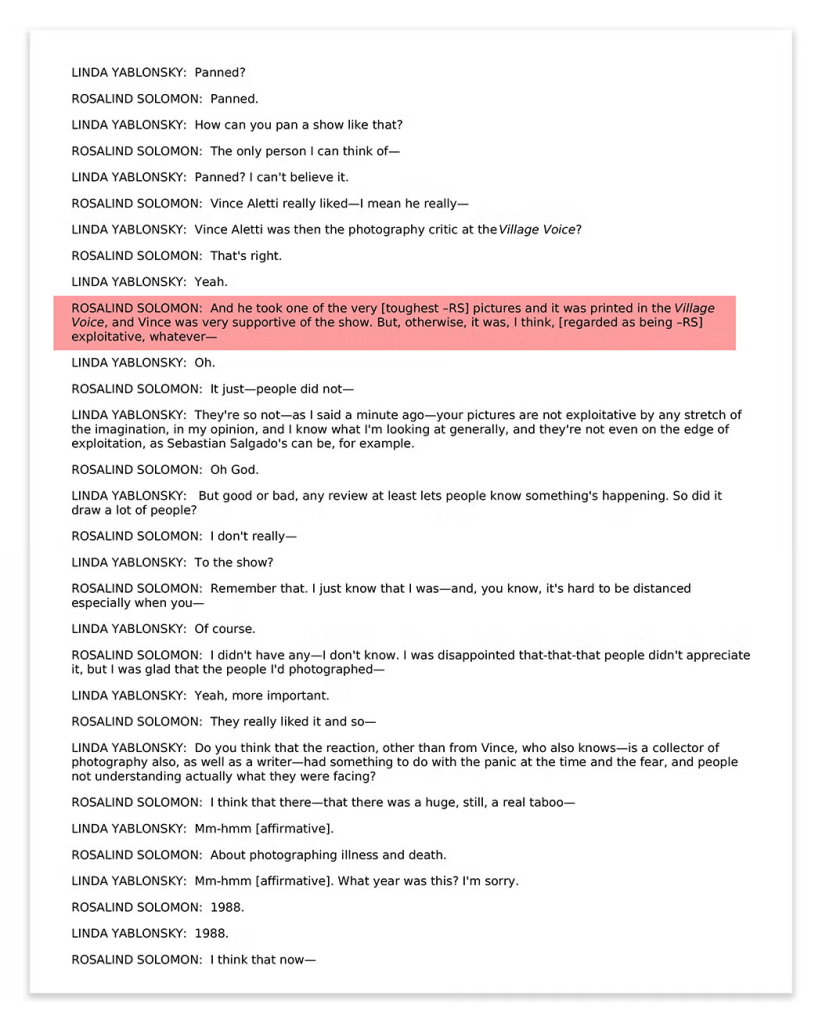
Rosalind Fox Solomon, whose 1988 show Portraits in the Time of AIDS featured photographs of the subject alone or with loved ones, some with visible lesions or in the hospital, relates that her project was critically panned and called “exploitative” at the time.
As another “outsider” to the communities she photographed, Nan Goldin reports that she encountered similar criticism for her exhibition The Ballad of Sexual Dependency, despite her immersion in the cultures she documented. In the book of the collected photographs, she writes, “I’m not crashing; this is my party. This is my family, my history.”
Some of the most vibrant, and now iconic, images of AIDS were created as (and for) protest: Silence = Death, the work of the Silence = Death Collective (and not ACT UP, as Avram Finkelstein relates in his interview) became the primary pictorial representation of ACT UP and a rallying slogan for the fight against the disease. Keith Haring did his own take on it for a poster, adding “Ignorance = Fear” to a “See No Evil, Hear No Evil, Speak No Evil” scene.
Collectives like Gran Fury and fierce pussy, which organized inside the ACT UP activist group, created posters for wheat-pasting that served as art, education, and calls to action around AIDS, homophobia, health care, and visibility. Whether newsprint works of text, guerrilla-installed bus station “ads,” or rolls of stickers of bloody hands announcing “One AIDS Death Every 10 Minutes,” the art of AIDS activism used any means available to communicate the urgency of the crisis.
The Visual Arts and the AIDS Epidemic collection demonstrates the power of oral history to preserve not just historical events, but what it felt like to live in the moment and survive it when so many people did not. Together with Reveal Digital’s HIV, AIDS, and the Arts archive, the collection ensures that these voices, experiences, and creative histories continue to be available to inform and educate future generations.
Have a correction or comment about this article?
Please contact us.

