Inadvertent Compliance

with the surveillance state.

How Citizen Surveillance Ate San Francisco

When a homeless man attacked a former city official, footage of the onslaught became a rallying cry. Then came another video, and another—and the story turned inside out.


Just when the
 people of San Francisco thought they’d seen every video—the sidewalk drug runners, the Louis Vuitton mob heisters, the men selling stolen laptops, the smash-and-grabbers snatching a camera from a Prius in traffic, the porch pirates porch pirates porch pirates into infinity, all indexed in the “Lawless San Francisco” section of the great internet video store—yes, just then: Stig Strombeck took out his cell phone camera on April 5 and hit Record.

It was around 7 pm, and Strombeck was on his way to his second job. He’d parked on Lombard Street. Not the famously crooked section up over the hill, but the wide gauntlet that jets toward the Golden Gate Bridge through the Marina district: the preppy hood of woo girls and boat guys and early-career Gavin Newsom and largely law-and-order Democrats. (“Everyone likes to shit on San Francisco, and San Franciscans like to shit on the Marina,” one resident told me. “It’s a victimless crime.”) But lately, even in the Marina, there was no escaping the rest of the city’s problems. The previous November, in a manicured playground just two blocks from where Strombeck was walking, a father said his 10-month-old baby had ingested fentanyl and had to be revived by Narcan—a San Francisco nadir that, to the presumable relief of civic boosters, hasn’t surfaced on film.

On the Lombard sidewalk, Strombeck pulled headphones from his ears and trained his camera on a disturbing scene playing out in the lot of a Shell gas station. Here’s the video: A bear of a middle-aged guy, 5’11”, 230 pounds, faces a rakish, apparently homeless man in his twenties who is wielding a 3-foot-long pole. The older bear of a guy holds his arms up like a boxer as the younger one jockeys with the pole, falls backward off a curb, then lithely spins back to his feet. The older guy blots his eyes and yells, “You’re going to jail, motherfucker.” The younger one, who wears a bright red stocking cap, whacks the bear of a guy across his face, sending him careening to the side. A male voice off camera says “Dude!”—the unmistakable Greek chorus of Wtf, this is insane. The younger guy looks toward the camera. The video stops.

⚠️ WARNING: GRAPHIC CONTENT
The following videos contain graphic content, which some readers may find disturbing.

Strombeck stowed his phone, but the action kept spilling into other frames. A daycare’s security cam showed the red-capped figure maniacally chasing the now bloodied man down the Lombard sidewalk before bashing him again. A neighbor pointed his camera down from his third-floor window as the younger guy strode below with the pole in one hand and what looks like the older man’s baseball cap in the other, pumping his arm, looking amped. Another video of the attacker that appears to be shot from a passing vehicle was uploaded to the crime-alert app Citizen, which pinged a software engineer sitting on his couch a few blocks away, who ventured over and filmed the crimson drips and Rorschach splotches of blood leading down the sidewalk. (Strombeck would later testify that by the end of the attack, the big guy was covered in “the most blood I’ve ever seen.”)

The following day, a Marina local named Joan wrote on Nextdoor that she was the mother of Don Carmignani, the man who’d been bludgeoned by the pole: “I want to thank all the neighbors that videoed what was happening & got involved to stop it. If they were not there my son would be dead!” Don was in the hospital, she wrote, with a skull fracture and a broken jaw. City politicians tweeted prayers and a call for more cops. Local news identified Carmignani as a former city fire commissioner, a lifelong San Franciscan and father of two. The assailant: 24-year-old Garret Doty, a recent arrival from Louisiana.

Reports said the attack kicked off when Carmignani asked some homeless people to move away from his elderly parents’ door, which they were blocking. In one TV newscast, a reporter mentions an allegation, from one of Doty’s companions, that Carmignani used “bear spray” during the altercation. The segment then cuts to a close-up interview of Doty’s homeless friend—a striking, red-bearded man named Nate Roye, speaking from under a filthy shearling hood—saying that Doty attacked because Carmignani had been “disrespectful.”

“Is that enough to beat him up?” the journalist asks, incredulously.

“Yeah, sometimes,” Roye replies, with a decisive nod.

San Franciscans know the larger drama that this episode advances, and you probably do too: Tech’s glittering citadel, fallen, with the footage to show it. Within some 40 hours of the Marina attack, in another swank part of the city, a widely admired tech executive named Bob Lee, the former CTO of Square and a founder of Cash App, had staggered past surveillance cameras while bleeding from several stab wounds and later died at the hospital. The two maulings—a beaten fire commissioner, a slain tech executive—upcycled to the national news, putting San Francisco under the national surveillance to which it’s become accustomed, with particularly lip-licking schadenfreude on the right. Here again was Newsom’s and Nancy Pelosi’s doom-looping dystopia, where remote-working techies and fleeing billionaires have ceded the city to IRL Grand Theft Auto.

Carmignani, his family, his attorney, and some witnesses provided images that flickered through the reports and social media: Strombeck’s video from the gas station. A laundromat’s street cam view of Doty grabbing the metal bar out of a trash bin and taking a practice swing. The daycare cam. In the neighborhood itself, the vigorous uptake of these images inspired a kind of hope. Marina residents—forever wary of being pegged as pearl-clutching Karens—thought they finally had their irrefutable proof of how clearly things had gotten out of hand. “Somebody got beat up. It was on camera multiple, multiple places,” one told me. “Like, the best evidence!”

But within days, the clarity crumbled. In the case of tech executive Bob Lee, police arrested not a person off the street but a tech entrepreneur whose sister had been hanging out with Lee. And in private, within the police department, the Carmignani attack was veering off narrative too. A police sergeant, sorting through the symphony of surveillance clips that captured the face-off, played the bodycam footage from a cop who had been interviewing Carmignani’s girlfriend after the attack. The officer asks whether she’d been inside when Carmignani went out to “confront” the guy. She says yes. Then from the ambulance, Carmignani interrupts her, barking a command through his broken jaw, seeming to thicken the plot:

“Don’t say nothing to nobody. Don’t say nothing to any cop, no one.”

In San Francisco there’s always another video. New York and London are known for being blanketed with government-run CCTV coverage, but surveillance here is different: It is as privatized as it is pervasive, a culture of Hitchcock’s Rear Window, at scale.

In the city where Nextdoor’s offices sit right in the gritty Tenderloin, sharing Ring cam footage of porch thieves is a bonding exercise between neighbors who’ve never met. All over town, local nonprofits oversee neighborhood-wide networks of cameras funded in part by donations from crypto entrepreneur Chris Larsen. (“That’s the winning formula,” Larsen told The New York Times in 2020. “Pure coverage.”) Platoons of Waymo self-driving cars circulate the streets like Pac-Man ghosts, gathering up videofeeds that cops snag for evidence. You can watch a resident’s live cam to see who’s on the corner of Hyde and Ellis, right now.

True-crime video has become San Francisco’s civic language, the common vocabulary of local TV news broadcasts, the acid punch line to a million social media posts. The feeds intensified during the pandemic, when commuterless streets erupted with synthetic opioid use and property crime. Since then, the city has found itself hobbled through successive breakdowns—a police shortage, a 34 percent office vacancy rate, a federal injunction severely limiting the city from clearing homeless camps. No one seems to be solving San Francisco’s problems, the feeling goes, so by God, people are going to film the dysfunction and post the footage.

A guy who goes by the handle JJ Smith is probably the most vivid personification of this drive. A longtime resident of the Tenderloin whose brother died of a fentanyl overdose in 2022, Smith—not his real name—films unhoused people as he tries to cajole them into considering treatment. Then he posts the footage on X, where he has about 19,000 followers.

In happier cases, he’ll document when people check into a program and come out clean on the other side. But much of Smith’s footage is far grimmer: coroners rolling sheet-draped corpses out of residential hotels; a cold open on a woman’s face as she OD’s on a sidewalk. Smith explains that he’s just given the woman Narcan, pulling you into morbid suspense combined with an awful feeling of Are we really supposed to be seeing this? Other times, Smith dispenses a tough love that edges into trolling, like the time he snatched away a coat draped over a woman’s head so he could scold her for smoking drugs next to a park where his kids play.

People shrug off statistics, Smith says, but “when you’re actually seeing it, it really gets to you.” Supporters credit him with recording a humanitarian crisis. Critics tweet at him, even chide him on camera: He’s exploiting people who have no privacy with footage they haven’t consented to. (Hey, he says, it’s a public sidewalk.)

Some of the discomfort with Smith, who says he knows many of the people he films, stems from the simple fact that, by now, he’s part of a social media bandwagon. Even presidential hopeful Ron DeSantis once stopped by the Tenderloin to shoot a video. Today, Smith is joined by other accounts like FriscoLive415 and Tenderloin Tube—a cadre that lives somewhere on the border between citizen journalists and dystopic paparazzi. Consider the live birth video. Last spring, a Twitter account that typically posts store-looting vids showed something else: an infant, just born and naked, on a Tenderloin sidewalk, its dazed mother trying to pick the baby up. The event is morally excruciating, but so is its existence here, on X, overlaid with the account’s watermark as the video travels the internet to 1.5 million views, churned into headlines like “Caught on Video: Homeless Woman Gives Birth in Broad Daylight on Tenderloin District Sidewalk.”

Masters Of War

https://www.youtube.com/post/UgkxcRbDnMs-OZRd4YLOay14vzCBEdbb1V7B

A Little Decent News

Montana Supreme Court Rules Its Constitution Entirely Protects Trans Citizens In Landmark Ruling

The ruling will have enormous impacts for transgender residents in the state.

Erin Reed

On Monday, the Montana Supreme Court issued a landmark 5-2 ruling declaring that “transgender discrimination is, by its very nature, sex discrimination,” and that transgender people constitute a suspect class under the state’s equal protection clause. The ruling in Kalarchik v. State of Montana blocks a definition-of-sex law and related state policies that stripped all legal recognition from transgender people and barred them from obtaining accurate birth certificates and driver’s licenses. The decision rests on Montana’s constitution, whose Equal Protection and Individual Dignity clause has been repeatedly interpreted to protect transgender people—and which the court made clear provides far greater protection than the federal constitution. Justices have now issued the clearest declaration ever that transgender people in the state will have enhanced protections of their rights, grounding the ruling in equal protection, sex discrimination, and privacy—principles with broad applicability in a state that has become a major battleground for anti-trans legislation and resistance to it. (snip-MORE)


Colorado Supreme Court May Force Children’s Hospital To Resume Trans Youth Care

Several justices seemed to support the families of trans youth on the question of whether to force Colorado Children’s Hospital to discontinue capitulating to the Trump administration.

Erin Reed

On Tuesday, the Colorado Supreme Court heard oral arguments over whether Children’s Hospital Colorado can be forced to resume gender-affirming care for transgender youth. The hospital was one of roughly 40 across the country that capitulated to Trump administration threats and shuttered their trans youth care programs. However, the hospital’s position has grown increasingly untenable, as hospitals in states like Minnesota and California have begun reversing course and as the Trump administration has suffered mounting losses in federal courts—including an Oregon ruling that vacated the very declaration the hospital cited as justification for halting care. Hearing arguments on Tuesday, several justices appeared skeptical of the hospital’s rationale, questioning whether Colorado’s civil rights protections for transgender people—among the strongest in the nation—can simply be overridden by federal threats that do not constitute law. (snip-MORE)


They served their prison time. Then came deportation.

Apr 15, 2026 Candice Norwood

This story was originally reported by Candice Norwood of The 19th. Meet Candice and read more of their reporting on gender, politics and policy.

JJ had a five-year plan to turn his life around. 

After being released from prison in 2022, he completed an 18-month job training program with the Los Angeles-based organization Homeboy Industries and began working as a cook for the group’s onsite cafe. He enrolled in two different community college programs to study business administration and culinary arts. He volunteered with groups to help other trans Latinx and formerly incarcerated people get back on their feet. By the time he reached the five-year anniversary of his release date, JJ hoped he would have saved enough to buy a house with his sister.

He also wanted to travel more, and last April, JJ went to Thailand with his mom, sister and a friend. It was his first time outside the United States since he and his parents entered the country without legal documentation when he was a toddler. They later obtained permanent resident status, and his sister was born in the United States.

“I always told myself, the moment I was able to come home, and if God permitted me to get my life together, that I would like to travel with my family,” JJ told The 19th. “Being able to give that to both my sister and my mom — even if I knew that this would be the end result, for me to get deported — I would do it all over again, just to see them happy.”

JJ, who asked for The 19th to withhold his last name for privacy, was not particularly concerned when returning to Los Angeles International Airport (LAX) and going through the standard post-flight motions. He waited in line for customs, showed his passport and green card, and got his fingerprints taken. But then, the customs officer made a phone call and escorted JJ away from his loved ones.

The weeks that followed felt like a different kind of prison: five days in LAX sleeping on the floor and living off of vending machine food, he said. Then it was five months in Eloy Detention Center in Arizona, where it came down to two options: JJ could do a “voluntary” departure to Mexico, or he could challenge his case in court and risk staying in the custody of Immigration and Customs Enforcement (ICE) indefinitely. The Department of Homeland Security did not respond to The 19th’s request for comment by the time of publication.

The choice was clear for JJ, he said, even if that meant returning to a country he hasn’t known since age 2. “I’ve been here since September, and I’m barely learning how to maneuver around. My Spanish is horrible,” he said recently from Mexico. “People notice that I’m not from here because of the way I speak.” 

In the second Trump administration, people with JJ’s background — a formerly incarcerated trans immigrant — have three targets on their backs, and the power of the federal government aimed at them. Trump has repeatedly stated that ICE, under his administration, will detain and deport “the worst of the worst,” particularly people who have committed crimes. A combination of anti-trans, anti-immigrant and tough-on-crime messaging by the White House depicts a country under siege. 

To carry out its mass deportation mission, the administration has ramped up partnerships with local law enforcement and correctional facilities that allow the federal government to take custody of people held in prisons who have already served their sentences. Even in states like California, which limit local law enforcement partnerships with ICE, federal law defines a broad list of criminal offenses that can make a noncitizen deportable, even if that person secured legal status like JJ.

The result is a system of “double punishment,” a prison-to-ICE pipeline that advocates told The 19th can be particularly detrimental for trans people. 

We just see trauma compounded on trauma compounded on trauma.”Lynly Egyes

Trans migrants often face rejection from family, abuse, job insecurity or homelessness as a result of their identity, which increases their risk of criminalization, advocates say. In ICE custody, they may be denied health care access, face sexual violence and be deported to countries that are hostile to their identity. Even for those who attempt to rebuild their lives after serving prison terms, “ICE could use that years later to target them, pull them into immigration detention and have them deported,” said Lynly Egyes, the legal director at the Transgender Law Center.

“We just see trauma compounded on trauma compounded on trauma,” Egyes said. “When trans people are shuffled between systems such as prison into ICE custody, it completely strips them of any opportunity for freedom and connection with their loved ones and community.”

It took three attempts for Nataly Marinero to secure parole from the California Department of Corrections and Rehabilitation. It ultimately happened in 2023, and he was released after nearly 18 years of incarceration. The state’s parole approval rate was about 34 percent at the time.

During this process, the parole board assesses an incarcerated person’s behavior and activities while in custody and considers whether they will be a threat to the general public. The board considers a range of factors, including signs of remorse, past criminal history, age and plans for the future, according to the California department of corrections website. While in prison, Marinero took substance abuse courses, worked on getting his high school diploma, had a job as a clerk in the prison kitchen. He had not received a write up, an infraction in prison, in years, he said. Each of these factors help to build a stronger case for release.

Immediately after leaving prison, Marinero joined a reentry program in Los Angeles called A New Way of Life, where he received housing, a job and connections to other opportunities to help him transition to life outside.

Life felt good.

“Freedom — just to think about it makes me want to cry,” the 40-year-old told The 19th. “That’s the best thing that ever happened to me.”

Marinero, who came to the United States without authorization at 17, was aware that ICE had put a “hold” on him at the beginning of his incarceration more than a decade ago. ICE “holds” are requests asking jails or prisons to hold someone after incarceration so that they can be transferred to immigration custody.

“When you get to prison, your counselor would tell you when you have an ICE hold,” said Laura Hernandez, executive director of the California-based advocacy group Freedom for Immigrants.

“If you have an inkling that you may have an ICE hold, you tend to check every so often,” she added. “But sometimes ICE holds aren’t placed on anyone until right before they’re getting ready to be released. So people have to check like the entire time they’re inside.”

Whether the agency follows through on picking up immigrants with ICE holds on their accounts is largely a toss up. In Marinero’s case, he was allowed to be released from prison; he was allowed to join a reentry program and to live his life for two years without being arrested by ICE.

In January 2025, he received a call from a woman who said she was his parole officer. This struck Marinero as odd, because this was a different officer from the man he had previously spoken with. The woman demanded Marinero come to the front of his reentry home, he said. When he obeyed, ICE agents were waiting outside and took Marinero into custody. 

His legal advocates at the California Coalition of Women Prisoners, who also serve trans people, moved quickly to assess whether Marinero could make an asylum claim as he was moved from an ICE holding facility to detention centers in California and Louisiana over the course of two months. Ultimately, his legal team was unable to file an asylum claim before his deportation. In April 2025, Marinero was placed in handcuffs and loaded onto a plane. He was back in El Salvador, a place he fled as a teenager and one of the most dangerous countries for trans people in Latin America.

Partnerships between federal immigration authorities, local law enforcement and state prisons have existed for three decades.

In 1996, fears about crime led to a wave of laws — including the 1994 crime bill — with more severe punishments and a historic expansion of law enforcement. President Bill Clinton signed into law two bills that created pathways to speed up the deportation of noncitizens with criminal records and broadened the list of crimes considered aggravated felonies. These crimes could range from murder and sexual assault to shoplifting and forgery. As a result, any noncitizens, including green card holders, with an aggravated felony record became eligible for deportation.

“It especially hit lawful permanent residents,” said Juliet Stumpf, the Edmund O. Belsheim professor of law chair at Lewis & Clark Law School, whose research centers on what’s referred to as “crimmigration.”

“We used to see lawful permanent residents as being able to remain in the country if they committed a crime,” she added. “But now, we’ve added a whole other level of penalty, for lawful permanent residents especially, because they’re the ones that are going to be most vulnerable to deportation based on those grounds.”

One of the 1996 laws also laid the groundwork for the 287(g) program, which can essentially turn local and state law enforcement into an arm of immigration enforcement. These 287(g) agreements fall into one of three categories, one being the “Jail Enforcement Model,” designed to identify noncitizens held in local jails or state prisons who can be transferred to immigration custody.

At the time of Trump’s first term, his administration ushered in a high — at that time — of about 150 active 287(g) agreements of all types. In the last 15 months, that figure has increased tenfold. As of April 10, ICE has signed 1,645 agreements across 39 states and two U.S. territories, according to data from the Department of Homeland Security. That dataset indicates that 10 percent of these agreements, 171 total, fall under the Jail Enforcement Model.

One contributor to this growth is likely financial incentives built into Trump’s expansive 2025 so-called One Big Beautiful tax bill, said Karen Pita Loor, director of the criminal law clinical program at Boston University.

“Historically, 287(g) agreements were not financially profitable for these counties, localities, whatever jurisdictions. They weren’t making them money,” Loor said. “The bill created really attractive financial incentives that make 287(g) agreements much more profitable.” These benefits to local law enforcement agencies can include salary reimbursements, $7,500 for equipment and $100,000 for new vehicles.

Some states, like California, where JJ and Marinero lived, have laws limiting collaborations between local and federal law enforcement. But even in those jurisdictions, the more forgiving immigration policies often do not extend to migrants with criminal records.

Prior to Trump’s return to office, JJ and Marinero, who served their prison time and were on a path to rehabilitation, might have gone unnoticed by ICE, advocates said.

Now, for Marinero, “I feel like going back to the same time when I was younger,” he said. “I can’t dress the way I want to dress. I can’t be who I want to be. It’s kind of killing my self-esteem.”

I just want to be free.”Nataly Marinero

Growing up in El Salvador, Marinero did not have a specific word to describe how he felt about his gender. He just knew that people called him a girl, but he felt like a boy and preferred loose fitting shirts and pants rather than dresses. Marinero’s religious family treated his self-expression like a curse that needed to be healed, he said. They told him he would go to hell if he didn’t change. People called him a “marimacha,” a slur for a lesbian or masculine girl. He was also repeatedly targeted for sexual violence.

“It was so bad that I wanted to try to kill myself so many times,” Marinero said. “I just want to be free.” When his uncle offered to connect him with a group who could get him into the United States, Marinero jumped at the chance.

Being back in El Salvador 23 years later, Marinero mostly works and stays at home. He doesn’t have friends, he said, though he recently found a boxing gym that is helping to relieve stress. In Mexico, JJ said he also keeps to himself and isn’t open with people about his trans identity. He said it helps that he “blends in” as a man and doesn’t get many questions or weird looks.

Next March will mark five years since JJ left prison. The five-year plan he mapped out for himself has changed quite a bit, but he hasn’t lost all hope. 

“I feel like I just came out of being in prison all over again, and I have to start all over again,” he said. “Just getting back on my feet; that’s really my fifth-year goal now.”

Some Toons From Clay Jones

Rocky Penis

At what point does Donald Trump say that he never knew RFK Junior?

Clay Jones

You know about RFK Jr. hiding the body of a dead bear cub in Central Park. You heard about him cutting off a whale’s head and tying it to the roof of his car. Now, get ready to hear about RFK Junior and the raccoon penis.

What?

Robert F. Kennedy Jr, the worst US health secretary in our nation’s history, once cut the penis off a road-killed raccoon on the side of I-684 while his children waited in his car. I don’t know if this was during his cocaine addiction. (snip-MORE)


Hate Tax

Why should the United Daughters of the Confederacy and other organizations celebrating racist traitors be tax-exempt anyway?

Clay Jones

On Monday, Virginia’s Governor, Abigail Spanberger, signed into law a bill that eliminates tax exemptions for organizations connected to the Confederacy. Most people were not aware that these organizations were exempt from paying taxes, or that they were even still around.

The bill, passed by the House and Senate in the General Assembly, specifically removes the Virginia division of the United Daughters of the Confederacy, the Stonewall Jackson Memorial, the Virginia division of the Sons of Confederate Veterans, and the Confederate Memorial Literary Society, along with other groups, from the state’s list of organizations that are exempt from state property taxes. (snip-MORE)


Arc de Butt

The Arc’s got back

Clay Jones

The Commission of Fine Arts is scheduled on Thursday to consider Donald Trump’s plan to build a 250-foot arch on the other side of the Potomac River from the Lincoln Memorial. This huge sculpture will be at the foot of Arlington National Cemetery. Unfortunately, the Commission of Fine Arts is stacked with Trump appointees.

The original plans for this monument were for it to be 76 feet tall to symbolize the year of America’s founding, which, in case you were educated in a red state, was in 1776. Soon after, Trump insisted that it be taller than the Arc de Triomphe in Paris (he must’ve been standing next to Emmanuel Macron at the urinals), which stands roughly 164 feet tall. Eventually, Trump decided that the arch should rise to 250 feet, to celebrate America’s 250 years, making it what is believed to be the tallest triumphal arch in any of the world’s capital cities. (snip-MORE)

Earth Month

Some Saturday Morning Fun

All About The Birds


The Yellow-winged Blackbird

Also Known As

  • Trile (Colloquial, Chile)
  • Alférez (Colloquial, Uruguay)
  • Varillero ala amarilla (Spanish)

About

The Yellow-winged Blackbird is a conspicuous species of the Southern Cone of South America, congregating in colonies in marshes during the breeding season, and forming larger flocks in wetlands, grasslands, and agricultural fields the rest of the year. These birds are also extremely vocal, giving a startling variety of calls, including sharp and percussive sounds, clear and musical whistles, and a range of other rattling, chirping, whining, whirring, and gargling vocalizations. Their song in particular makes use of virtuosic trills, robotic whistles, and mechanical whirring or buzzing sounds, coming across as half bird, half sci-fi robot. This iconic song is also the source of one of the Yellow-winged Blackbird’s nicknames, “trile,” and some authors propose it may also be the origin of the name of the country Chile! As if to make the most of their raucous acoustic capacity, the males of an entire colony will sometimes sing together in one big, cacophonous chorus.

In addition to nesting together in the same space, Yellow-winged Blackbirds also synchronize their nesting in time. Most of the females in a colony will lay within several days of each other. As a result, most of the nests in the colony will be on the same timeline, with eggs and nestlings developing at about the same time across the marsh. (snip)


Historic Oregon Bill Generating Conservation Funding Is Signed Into Law

Oregon will soon have a new, dedicated source of conservation funding to support the recovery of struggling bird and wildlife species across the state. House Bill 4134, dubbed 1.25% for Wildlife Bill, passed the Oregon State Senate in February and has now been signed into law by Governor Tina Kotek. American Bird Conservancy (ABC) strongly supported the 1.25% for Wildlife Bill, a proactive measure expected to raise up to $30 million annually for wildlife conservation in the state.

“This is monumental: Oregon has chosen to invest in its wildlife and its future with the passage of this historic law. Habitat restoration, recovery programs, and anti-poaching efforts are just a few of the programs that will be funded by this landmark legislation,” said Hardy Kern, ABC’s Director of Government Relations.

The Act will create a sustainable funding source dedicated to conserving imperiled species like the Marbled Murrelet, a seabird that nests in mature and old-growth forests in the state. Nest predation by jays and ravens contributes to the species’ declining population. Actions that could boost nesting success, such as campground cleanup efforts to reduce jay and raven numbers near sensitive nesting sites, are currently unfunded, but could benefit from the revenue generated by the newly signed law. (snip-MORE)


Some Peace & Justice History for 4/16 & 17:

April, 16, 1971
The Internal Revenue Service (IRS) estimated over 2,000 people openly refused to pay part or all of their income tax.
“If a thousand [people] were not to pay their tax bills this year, that would not be a violent and bloody measure, as it would be to pay them and enable the state to commit violence and shed innocent blood.”Henry David Thoreau on the Mexican War


National War Tax Resistance Coordinating Committee 
April 16, 2000
Between 10,000 and 20,000 activists blockaded meetings of the
World Bank and International Monetary Fund in Washington, D.C. Sitting down at intersections and locking arms to form human chains, the protesters were opposed to Bank and IMF policies that increased third-world indebtedness and did little to directly benefit the poor in those countries.


“The World Bank is subjugating our economic and social independence,” Vineeta Gupta, a doctor from the Punjab in India, said in a letter he delivered to World Bank President James Wolfensohn at his home. “It is time that we shut the bank down, and this boycott is a great start.”

War Tax Resistance

What is War Tax Resistance?

War tax resistance means refusing to pay some or all of the federal taxes that pay for war. While you can refuse income tax legally by lowering your taxable income, for many people war tax resistance involves civil disobedience.

In the U.S. war tax resisters refuse to pay some or all of their federal income tax and/or other taxes, like the federal excise tax on local telephone service. Income taxes and excise taxes are destined for the government’s general fund and about half of that money goes for military spending, including weapons of war and weapons of mass destruction.

People take many roads to war tax resistance. Most are motivated by a combination of reasons and actively work for peace in many other ways too. If you consider your motivations this will help you determine your method of resistance.

Refusing to pay federal income taxes is an act of civil disobedience with a long history in the U.S. America’s most well-known war tax resister was Henry David Thoreau, whose refusal to pay his poll tax because of the Mexican-American War earned him an night in jail and the experience that led him to write his influential essay, Civil Disobedience. While those of us who refuse to pay war taxes believe our refusal is just and imperative — and some of us cite international law to back up this belief — the government considers the refusal to pay these taxes to be illegal, and there are potential repercussions through the IRS collection system. For most of us who resist, the dire consequences of voluntarily paying for war are far worse that what the IRS and government can do to us. (snip-MORE)


April 17, 1959
22 were arrested in New York City for refusing to take shelter
during a civil defense drill.
April 17, 1960
Inspired by the Greensboro sit-in of four black college students at an all-white lunch counter, nearly 150 black students from nine states formed the Student Nonviolent Coordinating Committee (SNCC). Meeting in Raleigh, North Carolina, with Ella Baker, James Lawson and Martin Luther King, Jr., the founders set SNCC’s initial goals as overturning segregation in the South.

They also considered it important to give young blacks a stronger voice in the civil rights movement, as many had participated in sit-ins that had proliferated to dozens of cities over the previous three months.
At the Raleigh conference Guy Carawan sang a new version of “We Shall Overcome,” an adaptation of an old labor song. This song would become the national anthem of the civil rights movement.People joined hands and gently swayed in time singing “black and white together,” repeating over and over, “Deep in my heart, I do believe, we shall overcome some day.

What SNCC did to make change happen 
April 17, 1961

Cuban leader Fidel Castro during the Bay of Pigs invasion.
An army of 1500 anti-Castro Cuban exiles, mercenaries equipped and trained at a secret Guatemala base by the CIA, landed at Bahia de Cochinos (Bay of Pigs) in an attempt to “liberate” Cuba from Communist rule. Within three days, the invasion proved disastrous with nearly 1200 members of Brigade 2506 (who had been trained in the U.S.) taken prisoner. 

Known as Operation Zapata, it was conceived by Vice President Nixon, planned and approved by the Eisenhower administration, and executed shortly after President John Kennedy’s inauguration.

President Kennedy receives the Brigade 2506 flag in Miami
in 1962 and declares: “I promise to return this flag in a free Havana.”


Soviet General Secretary Nikita Kruschev sent a telegram to President Kennedy:
“Mr. President, I send you this message in an hour of alarm, fraught with danger for the peace of the whole world. Armed aggression has begun against Cuba. It is a secret to no one that the armed bands invading this country were trained, equipped and armed in the United States of America. The planes which are bombing Cuban cities belong to the United States of America, the bombs they are dropping are being supplied by the American Government . . . .”
What actually happened 
April 17, 1965

The first national demonstration against the Vietnam War took place in the nation’s capital. Students for a Democratic Society (SDS), the organizers, had expected about 2000 marchers; the actual count was 15,000–25,000. This was the largest anti-war protest ever to have been held in Washington, D.C. up to that time. The number of marchers approximately equaled the number of U.S. soldiers in Vietnam. Several hundred students in the protest broke away from the main march and conducted a brief sit-in at the U.S. Capitol’s door.
An exam prepared by SDS about the Vietnam War (answers available) 
April 17, 1965

Gay rights advocate Jack Nichols
The first demonstration promoting equal treatment of homosexuals, Jack Nichols, Barbara Gittings and others picketed in front of the White House.

There were no media present.

Read more (Go-it’s interesting!)
April 17, 1986
Reverend Jesse Jackson, future congresswoman Maxine Waters and others co-founded the Rainbow Coalition, initially intended as a progressive public-policy think tank within the Democratic Party.


Representative Maxine Waters, Harry Belafonte,
John Sweeney, President of the AFL-CIO,
Reverend Jesse Jackson, and Willie Nelson
August 6, 2005-Atlanta, Georgia.


Brief history of Rainbow Push Coalition
April 17, 1992
On Good Friday morning, about 50 people accompanied Fr. Carl Kabat and Carol Carson to Missile Silo Site N5 at Whiteman Air Force Base in Missouri, the same silo that Carl and other members of the Silo Pruning Hooks (see below) disarmed in 1984. They cut through a fence and, once inside, Carol used a sledgehammer on the concrete lid of the silo while Carl performed a rite of exorcism.
Eventually, the police arrived and arrested Carl and Carol. They were jailed and held until their court appearance. At that time, they made a preliminary agreement with federal prosecutors wherein they would plead “no contest” to trespass in exchange for the property destruction charge being dropped; they were sentenced to six and three months, respectively, in a halfway house.

Carl Kabat
A History of Direct Disarmament Actions 
About the Silo Pruning Hooks action 

It Still Makes A Difference

If your heart stopped right now, would a stranger save you? It depends on your sex.

Why women are less likely to receive CPR—and less likely to survive

Kristen Panthagani, MD, PhD

If you’ve been watching The Pitt Season 2, you may have caught one of the most medically important scenes on television this year. (Alert: small spoiler from last week’s episode coming!)

A woman arrives at the ER by ambulance, clutching her chest, complaining of pain. Her EKG comes back looking normal. Doctors are puzzled. Then her heart stops.

Dr. Robby, played by Noah Wyle, figures out what happened: the paramedics placed her EKG leads too low on her chest, and far too low to get an accurate reading, missing her heart attack. Later, he confronts the paramedics directly. They felt uncomfortable moving her breasts to place the leads correctly. He turns to his staff and asks: “Shall we put it to a vote? Ladies in the room—show of hands—death with modesty, or life with brief nudity?”

The vote from the women is clear: they want to live.

It’s a fictional scene (and in real life, public chastisement is certainly not the way to correct medical staff), but it highlights a very real problem we see every day.

Women are less likely to receive bystander CPR.

If someone collapsed at a restaurant, would you start CPR? It turns out that for many people, the answer depends on the sex of the person who collapsed: women are less likely than men to receive CPR from a bystander (a nonmedical professional who is nearby) in public, and they are less likely to receive defibrillation (shocks that can restart the heart).

A Duke University study of more than 309,000 cardiac arrests found that women who had a cardiac arrest in public were 14% less likely to receive bystander CPR than men. This is true around the world, too.

And women are less likely to survive. Chest compressions and shocks in those first few minutes are critical, and bystander CPR can double to triple the chance of survival.

Why are women less likely to receive CPR? The same reasons The Pitt depicted.

Researchers have asked the public why they think this happens, and the answers are striking:

  • Concerns about touching a woman’s chest to provide compressions.
  • Concerns about accusations of sexual assault.
  • Fear of causing injury to women, in part due to perceptions they are more frail.
  • Gender stereotypes that women are emotional or overreactive to symptoms.
  • Misperceptions that women are unlikely to experience true cardiac arrest.

While these fears may be common, actual cases of lawsuits against bystanders performing CPR are not—and Good Samaritan laws protect individuals genuinely trying to help in medical emergencies.

A 2020 review of CPR lawsuits in the U.S. found the vast majority of lawsuits were related to withholding CPR (not providing it). Lawsuits alleging harm from CPR were extremely rare (only 3 out of 170 cases), and all took place in medical facilities (not bystander CPR). The review found zero cases where a layperson was found liable for harm by providing CPR.

When should CPR be provided?

If someone is unresponsive and not breathing (or only gasping), start CPR. The basics are simple, and anyone can do it. Here’s a quick refresher:

  1. Call 911 immediately (or have someone else call while you start CPR).
  2. Push hard and fast in the center of the chest: press 2 inches deep to the beat of “Stayin’ Alive (or any other song with a beat of 100-120 per minute). Let the chest return to its normal position between each compression.
  3. Don’t stop until emergency services arrive. CPR is a WORKOUT. If you get tired (which is normal), try to switch out with someone.
  4. Use an automated external defibrillator (AED) as soon as one is available. Follow the voice prompts, it walks you through where to place the pads and when a shock is needed.

Common questions and misconceptions about CPR

(Note: this is for the general public, if you are health care provider, different guidance will apply.)

  • Do I need to check a pulse? Nope! It turns out most people are pretty bad at this. Instead, if someone is not responsive and not breathing (or only gasping), assume their heart has stopped and start compressions.
  • Do I need to provide rescue breaths (mouth-to-mouth)? If it’s a teen or adult, for most cases the answer is no. Chest compressions alone (“hands only CPR”) can be just as effective. While rescue breaths are important in cases of drowning, suspected overdose, and for children, in most other situations chest compressions alone is enough!
  • Do I need to remove clothing to start chest compressions? Nope! The priority is starting compressions as soon as possible. If you find something they are wearing is getting in the way, then don’t hesitate to remove it, but otherwise you can do compressions on top of clothing.
  • Do I need to remove clothing to use the defibrillator (AED)? Yes—the pads for a defibrillator should be placed directly on the skin. Place them where the stickers show they should go, and reposition or remove any clothing that is in the way. (This may include a bra!) Metal in bras is not an issue for shocks—you can leave it on as long as it’s not in the way of the pads.
  • What if we’re in public and other people might feel awkward from exposure of a woman’s chest? Do it anyway. Remember, the alternative is letting the woman die. Other people’s potential opinions or discomfort should not be weighed as more important than a woman’s life.
  • What if they appear frail and I might injure them? Start compressions anyway. You can’t get more injured than dead—which is what a cardiac arrest is. Broken ribs are common in CPR (for both male and female patients), but people can heal from those. They can’t heal from a heart that stops beating and isn’t restarted.
  • If I haven’t taken a CPR course, should I still provide CPR? Yes! Any chest compressions—even imperfect ones—are far better than no compressions. If you’d like to take a course, find one at redcross.org or heart.org.

Bottom line

Women are less likely to receive CPR, less likely to be defibrillated, and less likely to survive cardiac arrest. The first few minutes after a cardiac arrest are the most critical, and CPR from someone like you significantly improves chance of survival. If someone isn’t responding and isn’t breathing, start chest compressions. Even if it’s a woman.

Love, KP

Thank you to Dr. Sarah Perman, emergency physician and cardiac arrest researcher, for reviewing this post!


Kristen Panthagani, MD, PhD, is completing a combined emergency medicine residency and research fellowship focusing on health literacy and communication. In her free time, she is a contributing writer for Your Local Epidemiologist and creator of the newsletters You Can Know Things and The Public Health Roundup. Views expressed belong to KP, not her employer.

Your Local Epidemiologist (YLE) is founded and operated by Dr. Katelyn Jetelina, MPH PhD—an epidemiologist, wife, and mom of two little girls. YLE reaches over 450,000 people in over 132 countries with one goal: “Translate” the ever-evolving public health science so that people will be well-equipped to make evidence-based decisions. This newsletter is free to everyone, thanks to the generous support of fellow YLE community members. (snip)

Open Windows & Clay Jones

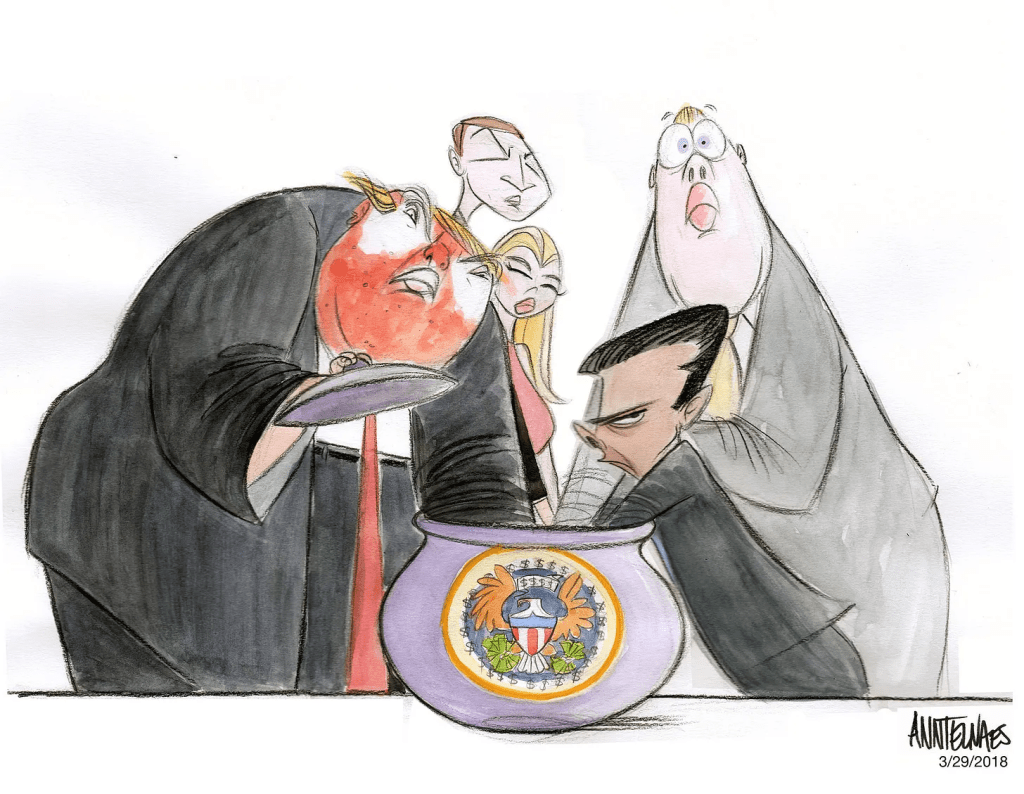
Trump’s DOJ is trying to throw out Jan. 6 convictions

This seditious president is using the Dept. of Justice to rewrite history and keep his Sturmabteilung available

Ann Telnaes

Jeanine Pirro, U.S. attorney for the District of Columbia and Trump toady signed motions to vacate convictions of Jan. 6 rioters including Stewart Rhodes, founder of Oath Keepers and Proud Boys leaders Ethan Nordean and Joseph Biggs.


Dr. MAGA

Dr. Fucknut will see you now

Clay Jones

As you will recall, Donald Trump attacked the pope, and then he posted an AI-generated image of himself as Jesus Christ healing the sick.

The New York Times described it: The image had showed Mr. Trump dressed in white and red robes, with the president’s hands emitting shining lights. His right hand was touching the forehead of a man lying on a bed in a hospital gown, evoking religious art that depicts Jesus healing the sick.

In the image posted on Sunday, the man in the bed is surrounded by figures looking up at Mr. Trump, including a medical worker with a stethoscope, a praying woman and a man in a camouflage uniform. The background of the image includes the Statue of Liberty, a building resembling the Lincoln Memorial, fighter jets, eagles, fireworks and a billowing American flag.
(snip-MORE, and it’s Hot!)