ICE Makes Huge Mistake In New York City, Jeffries Goes Full ‘Tough Guy’ During Liberal Message Discipline Failure, and Cuomo Experiences Personality Crisis Live On Air

This was the first report I watched on this. This one is longer because he tells the whole story and shows clips he took on his phone at the time. The mob was going to kill him after the IDF set the group up to be murdered at the hands of illegal settlers. The military told them to go to the spot where the settlers were hiding. Please watch to see the very illegal and horrific ways Israeli is treat people to simply drive them off of and steal their lands. Hugs
A 55-year-old Palestinian woman, Umm Saleh Abu Alia, was hospitalized after being brutally attacked by a masked Israeli settler in Turmus Ayya, West Bank. Captured on video by US journalist Jasper Nathaniel, the unprovoked assault shows the woman struck unconscious and hit again on the ground. Settlers continue to harass Palestinian farmers during the olive harvest, while the Israel Defense Forces claim to have intervened. This horrifying incident highlights escalating tensions and ongoing violence in the occupied West Bank.
In the occupied West Bank, armed Israeli settlers systematically attack Palestinian olive harvesters and farmers, burning trees and beating farmers. These assaults, often protected by Israeli forces, have caused severe injuries. Palestinians, joined by international activists, continue harvesting to avoid surrendering their land, despite the violence and threats aimed at driving them away. For them, this is a fight for their very livelihood and homeland.
| October 23, 1915 33,000 women marched in New York City demanding the right to vote. Known as the “banner parade” because of the multitude of flags and banners carried, it began at 2 o’clock in the afternoon and continued until long after dark, attracting a record-breaking crowd of spectators. Motor cars brought up the rear decorated with Chinese lanterns; once darkness fell, Fifth Avenue was a mass of moving colored lights.  The history of women’s suffrage in the U.S. |
| October 23, 1945 Jackie Robinson and pitcher John Wright were signed by Branch Rickey, president of the Brooklyn Dodgers Baseball Club, to play on a Dodger farm team, the Montreal Royals of the International League.Robinson became the first black baseball player to play on a major league team.  Jackie Robinson |
| October 23, 1947 The NAACP filed formal charges with the United Nations accusing the United States of racial discrimination. “An Appeal to the World,” edited by W.E.B. DuBois, was a factual study of the denial of the right to vote, and grievances against educational discrimination and lack of other social rights. This appeal spurred President Truman to create a civil rights commission. |
| October 23, 1956 The Hungarian revolution began with tens of thousands of people taking to the streets to demand an end to Soviet rule. More than 250,000 people, including students, workers, and soldiers, demonstrated in Budapest in support of the insurrection in Poland, demanding reforms in Hungary.  Hungarian students,1956  Hungarian revolution monument The day before, the students had produced a list of sixteen demands, including the removal of Soviet troops, the organization of multi-party democratic elections, and the restoration of freedom of speech. On the evening of the 23rd a large crowd pulled down the statue of Josef Stalin in Felvonulási Square. Hungary 1956 and the Political Revolution More |
| October 23, 1984 The Fact-Finding Board looking into the assassination of Filipino democratic leader Benigno Aquino confirmed that his death was the result of a military conspiracy, and indicted Chief-of-Staff General Fabian Ver, the first cousin of dictator Ferdinand Marcos. Marcos had blamed the chair of the Communist Party for the assassination, despite the fact that Aquino had been in the custody of the Aviation Security Command and surrounded by military personnel as he disembarked from the plane returning him to the Philippines. The chair of the Board, Corazon J. Agrava, was pressured into submitting a minority report clearing General Ver. He and the 25 other military officials charged were all acquitted. |
https://www.peacebuttons.info/E-News/peacehistoryoctober.htm#october23
by Nicole Foy
Democrats in the House and Senate announced plans for a wide-ranging investigation into immigration agents’ detention of citizens after a ProPublica story found that more than 170 Americans have been held by immigration officials this year.
Minority leaders of the House Oversight and Government Reform Committee and the Senate’s Permanent Subcommittee on Investigations said the joint investigation into the detention of U.S. citizens and other allegations of misconduct by immigration agents would include a hearing in Los Angeles.
“Over 170 U.S. Citizens are being arrested. Why? Because they look like me. Because they are of Latino origin. Or because they are suspected to not be a U.S. citizen, or because they are suspected of crimes they have not committed,” Rep. Robert Garcia of California, the ranking Democrat on the House committee, said during a Monday press conference in Los Angeles with Mayor Karen Bass.
Garcia said the investigators are demanding all records and documents showing how U.S. citizens are treated by immigration officials in Los Angeles and around the country. “We want to understand what they are doing in our neighborhoods, how it is being funded,” he said.
Our investigation found that at least 50 citizens have been detained based on questions about their citizenship as of Oct. 5. They were almost all Latino. Roughly 130 others have been detained after raids or protests on allegations of assaulting officers or interfering with arrests. Many of those cases have wilted under scrutiny.
We found Americans have been dragged, tackled, beaten, tased and shot by immigration agents. At least two dozen citizens have reported being held for at least a day without access to a phone or a lawyer.
Bass and Garcia said the mistreatment of citizens has come amid the arrests of immigrants reporting for check-ins and immigration court, and the administration’s repeated blocking of congressional attempts to visit and conduct oversight in federal detention facilities like the one in Los Angeles.
“It’s important that we say today that what is happening to undocumented residents is also happening to U.S. citizens, which means this can happen to anyone, to all of us, at any period of time,” Bass said.
Our article has also prompted members of Congress to write to the Department of Homeland Security.
In one letter sent on Monday to DHS Secretary Kristi Noem, Garcia and Sen. Richard Blumenthal, D-Conn., said citizens in cities like Los Angeles have borne the brunt of the administration’s aggressive immigration enforcement.
“The impact of these arrests has not been evenly distributed across the country, and cities like Chicago, Portland, Washington, D.C., and Los Angeles have been targeted,” Garcia and Blumenthal wrote. “Troublingly, the pattern of U.S. Citizen arrests coincides with an alarming increase in racial profiling — particularly of Latinos — which has been well documented in Los Angeles.”
DHS has not replied to previous letters.
Asked about the concerns from elected leaders, DHS spokesperson Tricia McLaughlin rejected claims that immigration agents have been engaging in racial profiling. She said in a statement to ProPublica that a temporary ruling by the Supreme Court in September had “vindicated” the administration “whether Mayor Bass or Rep. Garcia like it or not.”
“DHS enforces federal immigration law without fear, favor, or prejudice,” McLaughlin wrote. “Claims by the media, agitators, and sanctuary politicians like Mayor Bass and Rep. Garcia that ICE is targeting U.S. citizens, making unconstitutional arrests, and ‘trampling on civil liberties’ are FALSE.”
White House Deputy Press Secretary Abigail Jackson told ProPublica in an email that “unhinged rhetoric from activists and Democrat politicians” was responsible for an increase in assaults on ICE officers.
On social media, Deputy Chief of Staff Stephen Miller derided Bass’ press conference as “abject lies.”
“Violent leftists have been arrested and charged with illegally obstructing federal law enforcement, a felony,” Miller wrote Monday night on X. “Let that sink in: open borders Democrats have incited leftists to violently attack ICE.”
Of the cases we tracked through Oct. 5, we found nearly 50 instances where charges have never been filed or the cases were dismissed. Our count found at least eight citizens have pleaded guilty, mostly to misdemeanors, including for failing to follow orders. Others are still facing charges for more serious accusations, including for allegedly ramming an agent’s car. (The driver has pleaded not guilty.)
Our account did not count citizens arrested later, after some sort of judicial process, or those detained by local law enforcement or the National Guard. That included cases of some people charged with serious crimes, like throwing rocks or tossing a flare to start a fire.
Lead in protein powders. What you need to know by Katelyn Jetelina
The Dose Read on Substack
Happy Monday from Atlanta! I just tried to convince thousands at a public health conference that it’s time to reimagine systems—not just defend the status quo. I’m happy to report that tomatoes weren’t thrown my way. This is my fourth state in five days, and the highlight is actually seeing the seasons change and meeting a lot of you in person. I couldn’t be more excited to see my girls (and survive another round of the KPop Demon Hunters soundtrack).

This week’s Dose runs the gamut: from what’s really going on with lead in protein powders (and whether you should be worried), to a refreshing burst of leadership as 15 governors join forces to strengthen public health collaboration, to falsehoods swirling around mammograms. We’ll wrap with an infectious disease weather report and a quick note for dog owners on an FDA recall.
Let’s go!
Last week, Consumer Reports released an analysis revealing elevated lead levels in several popular protein powders and shakes. Google searches for “lead in protein powder” spiked 300%, and influencers lit up social media. Depending on which news source you read, it was either a five-alarm fire or no big deal.
So what’s actually going on? Lead is everywhere—soil, food, water, and air. Thankfully, overall exposure has dropped dramatically since the 1970s, and modern lab tests can now detect vanishingly small amounts (down to parts per billion). But detection does not necessarily equal danger.
How bad is bad? That’s where things get tricky because not everyone agrees:
Back to the report: of the 23 protein supplements they tested, two-thirds exceeded “Level of Concern.” One brand (Naked Nutrition Vegan Mass Gainer) hit nearly 16 times the limit. But because Consumer Reports used California’s exceptionally strict benchmark, those numbers sound scarier than they really are.
The average American already gets 5.3 mcg of lead daily from food and the environment. That’s another reason California’s cutoff doesn’t make much sense. Still, some products identified in the report could push intake close to the pregnancy (8.8 mcg) or adult (12.5 mcg) daily thresholds.
What this means for you: Don’t worry too much. While the FDA continues to reduce lead exposure through programs like Closer to Zero and the Total Diet Study (that is, if the funding continues), there are several things we can do in our own homes, especially for parents of kids and during pregnancy.
Big thanks to YLE’s Megan Maisano—Registered Dietitian Nutritionist— for writing this section.
Governors from 14 states and Guam announced the creation of the bipartisan Governors’ Public Health Alliance, which is a new effort to strengthen coordination and collaboration across state lines.
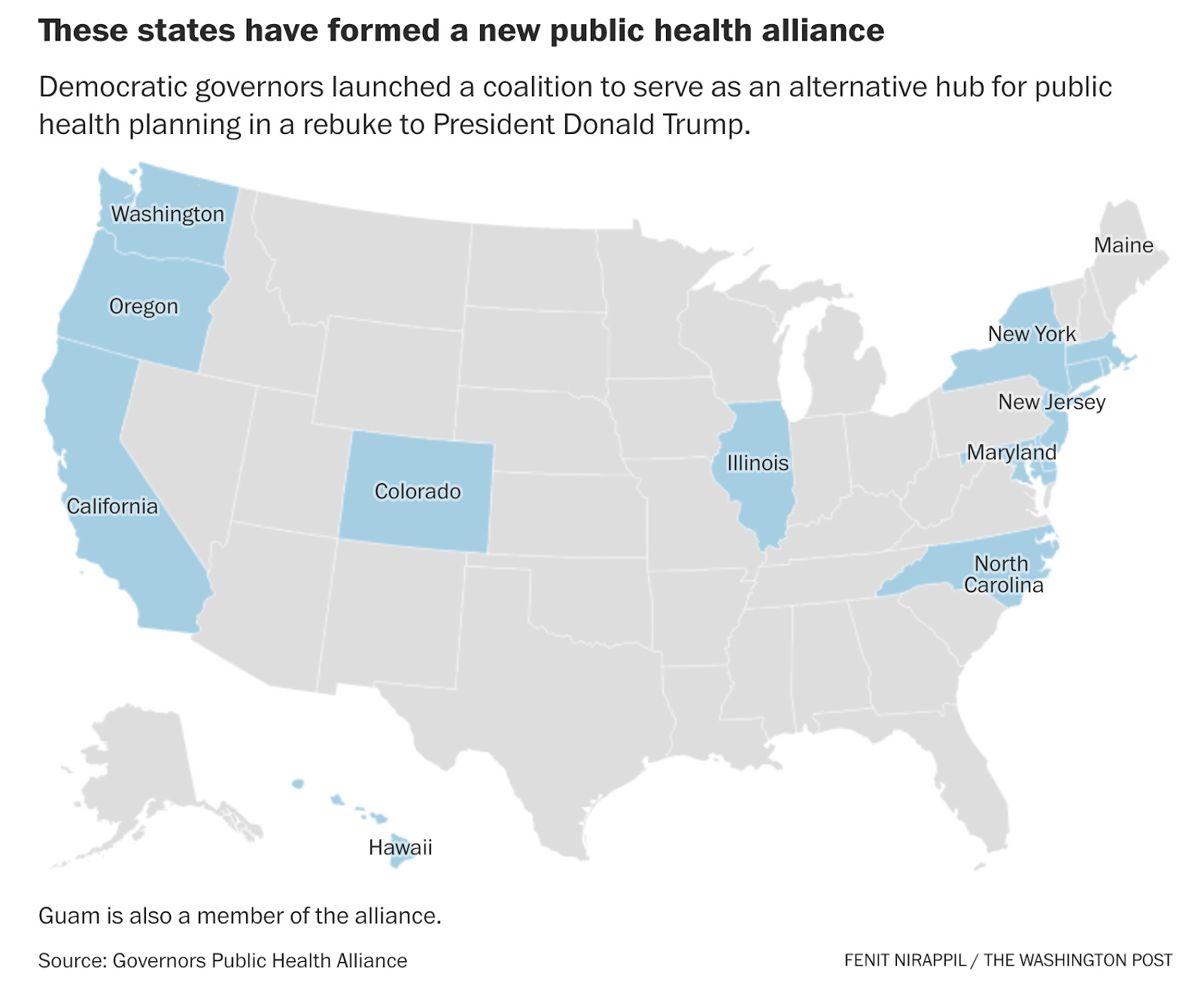
Why do we need this? In the U.S., authority over health rests with the states, not the federal government. Health (encompassing both health care and public health) is not only the highest budget item for a state but also the primary reason for state bankruptcy. In other words, governors hold enormous power over your health.
Today, though, federal support is shifting fast, funding is drying up, and states are being forced to get creative. States must decide whether to maintain their public health departments (due to funding cuts), how to continue purchasing vaccines (if the federal government stops recommending them), whether to negotiate drug prices (like insulin), and more. We saw a similar challenge during the pandemic with bulk purchasing of PPE.
In general, the more coordinating, collaborating, and innovative thinking, the better.
However, I’m growing increasingly concerned about the partisan gaps in public health. Although some Republicans are on the advisory board and the initiative was framed as bipartisan, no Republican-led states have joined. This worries me for my friends in red states, like Texas, but it also has implications for everyone, as diseases don’t care about borders.
What this means for you: If your state is included, you can rest assured your governor is talking to others, which is a helpful step toward innovative solutions. You could argue it was needed before this moment, too. Public health has been siloed for far too long.
Happy Breast Cancer Awareness month! Unfortunately, this month has driven some influencers to post false claims about the harms of mammograms. So let’s clear this up.
Breast cancer is the second leading cause of cancer death in women in the U.S., and accounts for 1 in 3 new cancers among women each year. (It affects men too, just at lower rates.) There is strong scientific consensus in support of routine mammograms to prevent breast cancer and detect it early:
There’s some critical nuance here:
What this means for you: The benefits of mammograms far outweigh the risks. The U.S. Preventive Task Force, the American College of Radiology, the American Society of Breast Surgeons, and the American College of Obstetricians and Gynecologists recommend routine mammograms starting at age 40 for women at average risk of breast cancer. If you have risk factors for breast cancer, dense breasts, or you’re 75 or older, talk to your doctor about your screening goals and plan. Don’t know your risk? Here’s one risk assessment tool.
For more, see YLE’s deep dive on breast cancer screening recommendations.
In the U.S., flu and RSV are still quiet. CDC data is still on pause because of the government shutdown, so we’re continuing to reference PopHive data. RSV activity is still low but growing in southern states, like Louisiana and Texas.
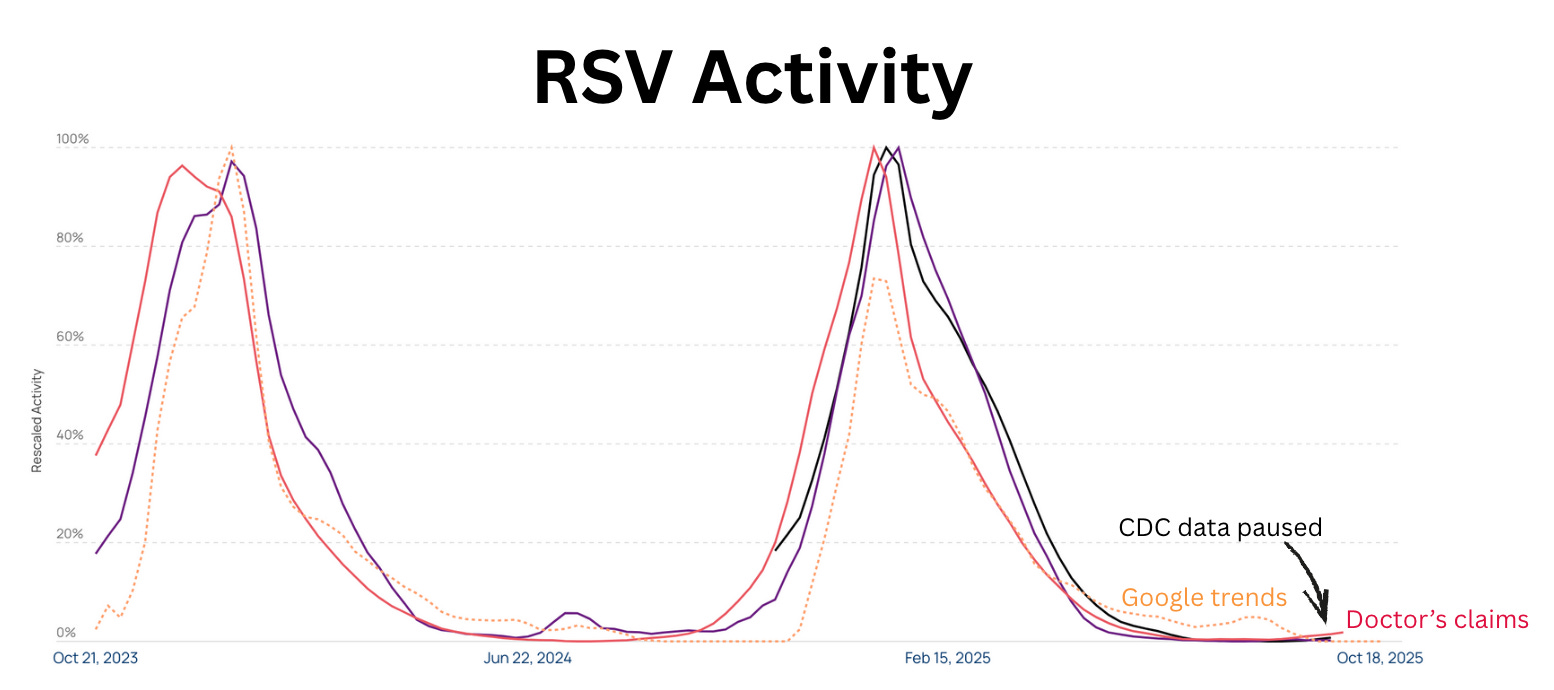
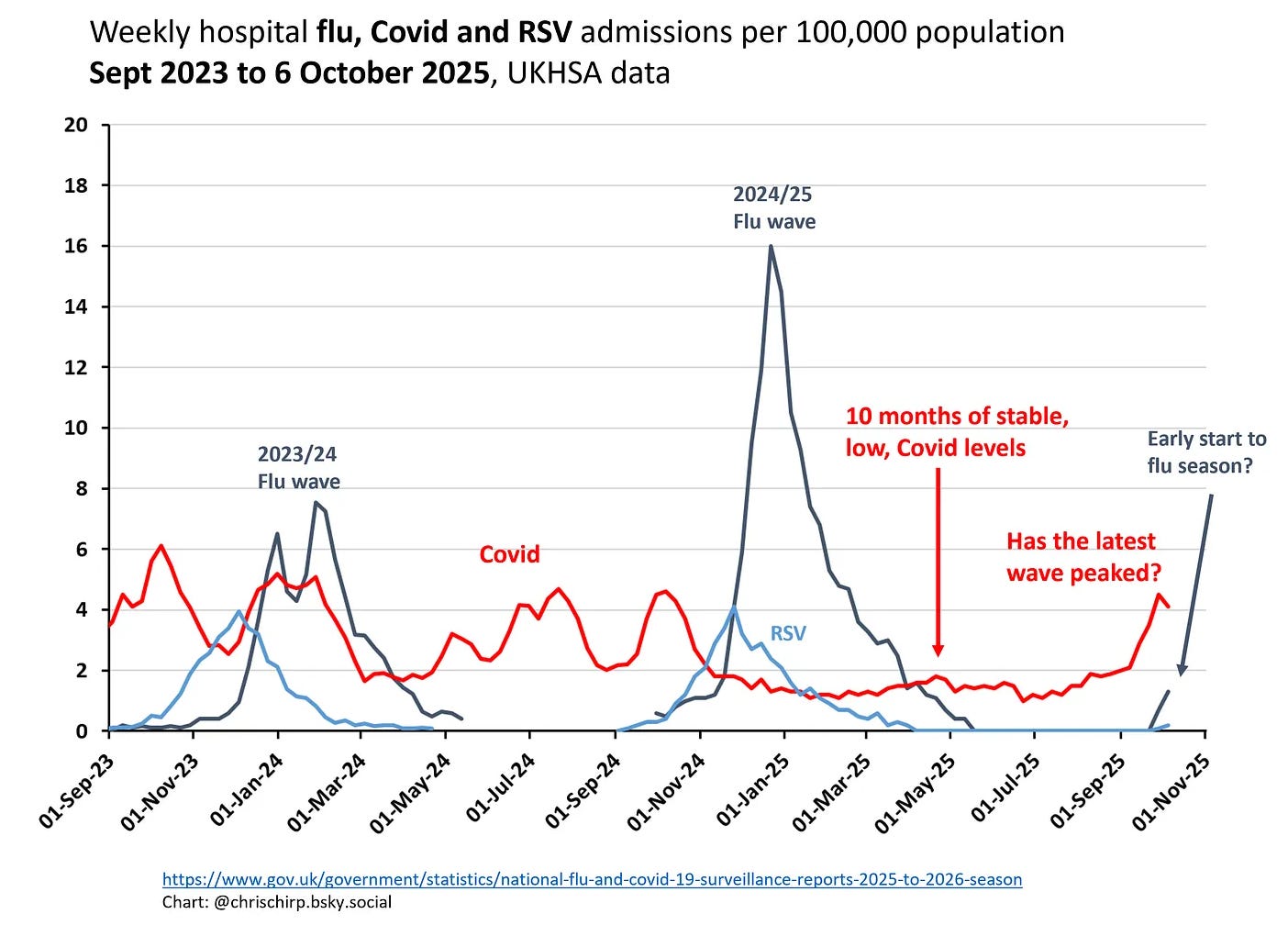
However, Covid-19 is having a moment in the U.K., with hospitalizations increasing exponentially after a 10-month lull. This isn’t driven by a dramatic variant, but rather by a lack of immunity building up over time. Flu might also be increasing, which suggests it’s coming soon (as expected) for the U.S.
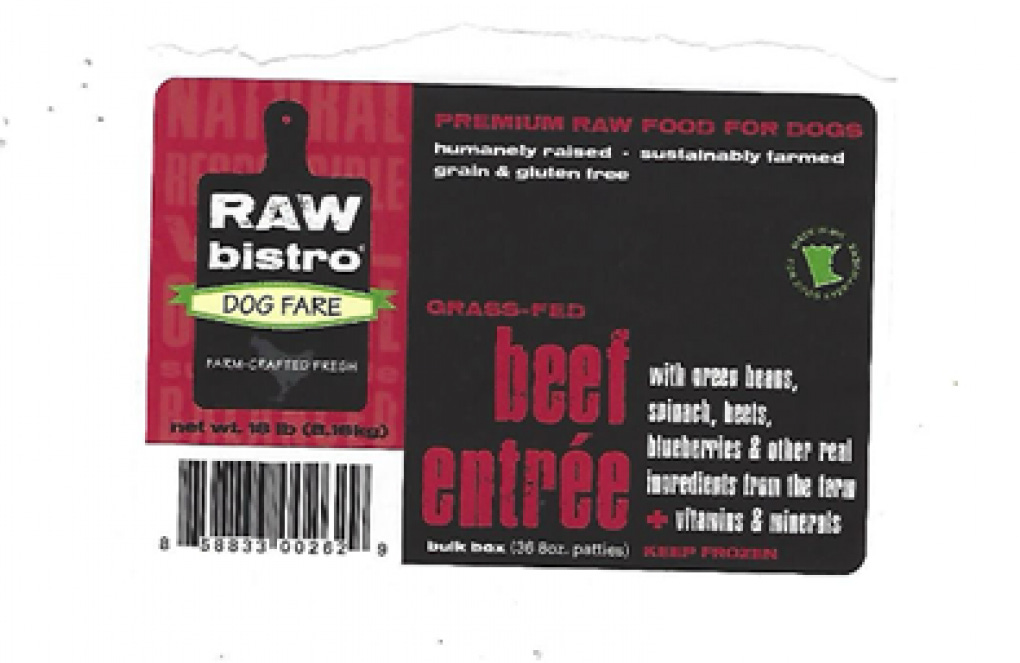
The FDA recalled Raw Bistro frozen beef dog food for possible Salmonella contamination. The recalled products were sold directly to consumers and to select distributors between Sept. 1 and Sept. 17 in California, Colorado, Illinois, and Minnesota.
Salmonella can make dogs sick, just like humans. Contaminated food can cause illness days later in dogs. And dog owners can get sick from handling contaminated food or dog bowls.
What this means for you: Check the lot numbers on your dog’s food, and toss it if they are included in the FDA recall notice. Sanitize bowls if they held contaminated food, wash your hands, and watch for warning signs in your dog: lethargy, vomiting, diarrhea, and loss of appetite. If you notice these signs, take your pet to the vet.
That’s it for this week! Share your fall leave pics in the comments below so that I can continue to live vicariously through you.
Love, YLE
Your Local Epidemiologist (YLE) is founded and operated by Dr. Katelyn Jetelina, MPH PhD—an epidemiologist, wife, and mom of two little girls. YLE is a public health newsletter that reaches over 400,000 people in more than 132 countries, with one goal: to translate the ever-evolving public health science so that people are well-equipped to make evidence-based decisions. This newsletter is free to everyone, thanks to the generous support of fellow YLE community members. To support the effort, subscribe or upgrade below:
Beverage alert, of course!
but not in this case.
October 21, 1837 Osceola painted by George Catlin, 1838 The U.S. Army, enforcing President Andrew Jackson’s 1830 Indian Removal Act, captured Seminole Indian leader Osceola (meaning “Black Drink”) by inviting him to a peace conference and then seizing him and nineteen others, though they had come under a flag of truce. Under the law, they and the others of the “Five Tribes” (Choctaws, Chickasaws, Creeks and Cherokees) were to be moved, by force if necessary, west of the Mississippi to Indian Territory (Arkansas and Oklahoma). The Seminole had moved to Florida (then under the control of Spain) from South Carolina and Georgia as they were forced from their ancestral lands, then forced further south into the Everglades where they settled. Read more about Osceola |
| October 21, 1967 In Washington, D.C., more than 100,000 demonstrators from all over the country surrounded the reflecting pool between the Washington and Lincoln monuments in a largely peaceful protest to end the Vietnam War.It was organized by “the Mobe,” the National Mobilization Committee to End the War in Vietnam. Some then marched on, encircled and attempted to storm the Pentagon in what some considered to be civil disobedience; 682 were arrested and dozens injured. This protest was paralleled by demonstrations in Japan and Western Europe, the most violent of which occurred outside the U.S. Embassy in London where 3,000 demonstrators attempted to storm the building. 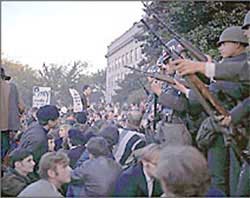 at the Pentagon Read two different accounts of the day with photographs: |
| October 21, 1983 In the first public action of the new Seattle Nonviolent Action Group (SNAG), 12 people blockaded the Boeing Cruise Missile plant in Kent, Washington; none were arrested. |
| October 21, 1994 In an “Agreed Framework” to “freeze” North Korea’s nuclear program, the United States and North Korea (Democratic Peoples’ Republic of Korea or DPRK) agreed over the next 10 years to construct two new proliferation-resistant light water-moderated nuclear power reactors (LWRs) in exchange for the shutdown of all their existing nuclear facilities. The DPRK also agreed to allow 8,000 spent nuclear reactor fuel elements to be removed to a third country; to remain a party to the Nuclear Non-Proliferation Treaty (NPT); and to allow inspections by the International Atomic Energy Agency. In the deal negotiated by Ambassador at Large Robert Gallucci, the U.S. agreed to normalize economic and diplomatic relations with Pyongyang and to provide formal assurances against the threat or use of nuclear weapons by the United States. The details of the agreement and what has followed Interview with Robert Gallucci, Dean, Walsh School of Foreign Service, Georgetown U. |
https://www.peacebuttons.info/E-News/peacehistoryoctober.htm#october21
 Scottie's Playtime