In February 2026, a rumor spread that Bo French, a Republican candidate for the Texas Railroad Commission, which regulates oil and gas, wanted to deport Native Americans — people indigenous to the U.S. Several social media posts made the claim, including on Facebook, where one user said French had called for the deportation of “third world savages” including Native Americans.
Some posts linked to a Feb. 10, 2026, article in Texas Monthly, which included a line that read, “One of French’s favorite phrases is ‘third world savages’—which he has applied to Afghan asylum seekers, Muslims, and even Native Americans, who he also wants deported.” It is true that French called for the deportation of Native Americans. He did so in an Oct. 10, 2025, post on X.
Read the full article. French, who is allied with two far-right Christian nationalist fracking billionaire pastors, last appeared here in November 2024 when he declared that Democrats are “retarded unmanly homos.” He appeared here in September 2024 when he lost a court battle to ban early voting on college campuses.
A former instructor for U.S. Immigration and Customs Enforcement on Monday accused the agency of dramatically slashing training standards for new officers and lying to Congress about it as the Trump administration seeks to rapidly expand its mass deportation operation.
Ryan Schwank, who resigned from his job at an ICE academy in Georgia last week, told congressional Democrats at a hearing that the agency eliminated 240 hours of “vital classes” from a mandatory 580-hour training program, including instruction about the legal boundaries for the use of force, how to safely handle firearms, and the proper way to detain and arrest immigrants.
“Law enforcement is a deadly serious biz. It is not a place for shortcuts,” Schwank said. “Deficient training can and will get people killed. … ICE is lying to Congress and the American people about the steps it is taking to ensure that 12,000 officers can faithfully uphold the Constitution and perform their jobs.”
Ryan Schwank, a former ICE academy instructor, testified in front of Congress today about constitutional violations.“At the academy, we took out the class that tells the officers that they have an oath to the Constitution.”
Former ICE agent: My first day training new cadets, I received secretive orders to teach them to violate the Constitution by entering homes without a warrant. I watched ICE cut classes that teach our legal system, firearms training, use of force, lawful arrests, and the limits of officers' authority
Former ICE trainer Ryan Schwank is telling Congress that agents are being trained to ignore the Constitution. "I swore an oath to uphold the Constitution when I joined ICE. I followed it when I resigned. The legally required training program at the ICE academy is deficient, defective, and broken."
Director Lyons looked me in the eyes and said ICE was receiving proper training.Now a whistleblower says officials are lying about how much training new recruits actually get.They’re cutting corners and covering up. We need real answers and accountability. http://www.cbsnews.com/news/ice-whi…
As Belle says tRump started a war and is blocking the funding for the very department in charged with securing the country against foreign threats until the all important trans people playing sports are banned. tRump is putting paid unmasked ICE agents in airports so why can’t they go unmasked on the streets of our towns and cities to stand around watching TSA agents work for free all because his feelings are hurt by trans people. She said something similar about FEMA but it all comes down to tRump using the scape goat of trans people and the Christian nationalists need to have a white male straight cis nation to live in even though those people are not representative of most of the nation nor of all Christians. But to not fund FEMA during horrific flooding and wildfires, to not fund DHS and TSA for security, to not fund the coast guard for our protection and assistance in local waters, and more just because he has a hard time understanding the truth that trans people exist and are normal members of society that deserve full unconditional civil rights and equality. Hugs
Hi Everyone. Sorry for no posts except from my phone and later from my tablet which I have to carry a backup power supply and cord with me now to doctors appointments as my old pad has a battery life of less than 10 minutes. A new Ipad is not a priority for our money right now even the cheapest one. Ron needs heart surgery, Ron needs cataract surgery, I need both new glasses and cataract surgery, and the van still has an oil leak. Plus Kamyk has basicly given up and slipped into depression. He had an apartment open up that he needed first/ last / and security for which came to $900 a month. It was government-subsidized housing. But because he is in long term care now the nursing home took all his SSI, leaving him with no money. Plus he no longer gets physcial therapy so he is slowly losing the ability to walk again. His sister started a go fund me but he forbade her to tell me about it. He felt we had all done too much for him and did not want me or you people to think he was trying to milk us or be greedy.
In a way I am glad he did not tell me until it was too late because I worry that as he can’t walk well, doesn’t drive, and did not know how long it will take to get his SSI back, that he wouldn’t be able to care for himself and so would be homeless in two months. The nursing home he is in is really nice compared to the last one which was abusing him emotionally, physically, and even sexually because the nurses decided he needed Jesus in his life and he rejected that being forced on him. So they were going to abuse him until he relented and came to their Jesus. This one gives him his medications on time, changes his ostomy bag or helps him do it, and they have been nice / kind to him. I understand his frustrations having to share a room with another person and basicly having no privacy but… the US government / wealthy don’t care about people in a land where profit is king.
I got up at 4:20 to feed the cat who when he thinks he needs food howls to get one of us up. I decided to stay up and watch the recorded news that I did not get to watch yesterday. I was not well at all yesterday, highly stressed which has been the situation for a while. My doctors were clear and Ron reminded me that my body breaks down under stress, and I am to be under as little stress as possible. That is not possible and has not been for a while. When I woke yesterday it was already much later than normal for me. Ron said he could tell I was having a bad night, I was highly agitated. I had gotten up at 2 am with a huge contracture, a “cramp” in the large side muscle in the upper part of the leg. I managed to get out of bed but couldn’t straighten out my leg. I spent 30 minutes moving around the bed holding on to the dresser and the end of the bed, leaning over to put weight on the leg, then removing it. Eventally I got it to touch the floor and hold some weight so I limped to my office and got a cane, then went to the bathroom which was a critical need by then. Ron never woke up and was upset I did not wake him. Not much he could do that I did not know to do myself.
When I got up with Ron at 7 I still couldn’t move or use the leg which was being electrified from the knee down, I couldn’t bend the leg due to the muscle still hurting from the cramp. I was swinging the leg forward and walking “peg legged” with a cane. Ron realized something was wrong and had me take my blood pressure and pulse. My blood pressure was extremely high. My pulse was also far too high. So high he asked me to take another dose of my blood pressure and heart rate medications. Ron had me sitting and checking it every ten minutes. It was not coming down and the first news show I started watching made it worse. So as I as them recorded I went back to bed until noon.
The reason for so much stress is Ron. He had his new medication Saturday that opens the arteries so he was better Sunday, but all day friday and Saturday I had to watch him and deal with him. He was exstrememly forgetful, unable to work his computer, he would sit in his recliner and fall asleep even during a conversation. He has bad sleep apnea and so he has to have his CPAP machine anytime he goes to sleep. But even in the bed he was forgetting to put it on until reminded. I offered to move it out to his chair but he would promise not to fall asleep as he just wanted to watch a few things on TV, 2 minutes later he was asleep. I would make him go to bed and I stay there until he had his CPAP on. I don’t dare let him drive like this so I am doing all the driving and shopping now. I am doing the dishes so he doesn’t exsert himself and the last time he washed the dishes he put everything away in the worng drawers not even realizing he was doing it. So yesterday afternoon while he slept I did the dishes. He cooked a porkloin last night so I have a bunch of dishes to do when I get home. I did pick everything up and rinsed everything off / out so it should be easier than it could have been.
I have a doctor’s appointment this morning and I have to go with Ron as you can see to his new heart surgeon on Wednesday morning, which I have to look up and see where he is. I am tired people. I went to bed at 5 yesterday but kept getting up to check on Ron as he was in his recliner and I wanted to make sure he was not sleeping. Care of the cat has totally fallen to me now. I asked him if he could clean the cat litter box before he came to bed. He assured me he would so I went to bed. And he did not do it as he forgot. I did it when I woke up. Randy is sick after just having surgery, his parents are both sick / ill. Ron is teetering with the same thing that killed his brother-in-law. And I am worried and scared.
When I get the dishes done today I will try to get to the wonderful comments and reply to somethings Ali posted which I appreciate. Ali has really stepped up and is posting more to give everyone something on the blog to read and engage in. I can’t say how much I am grateful for that. Got to go. Hugs
It’s another week full of legal proceedings. And a little politics, too.
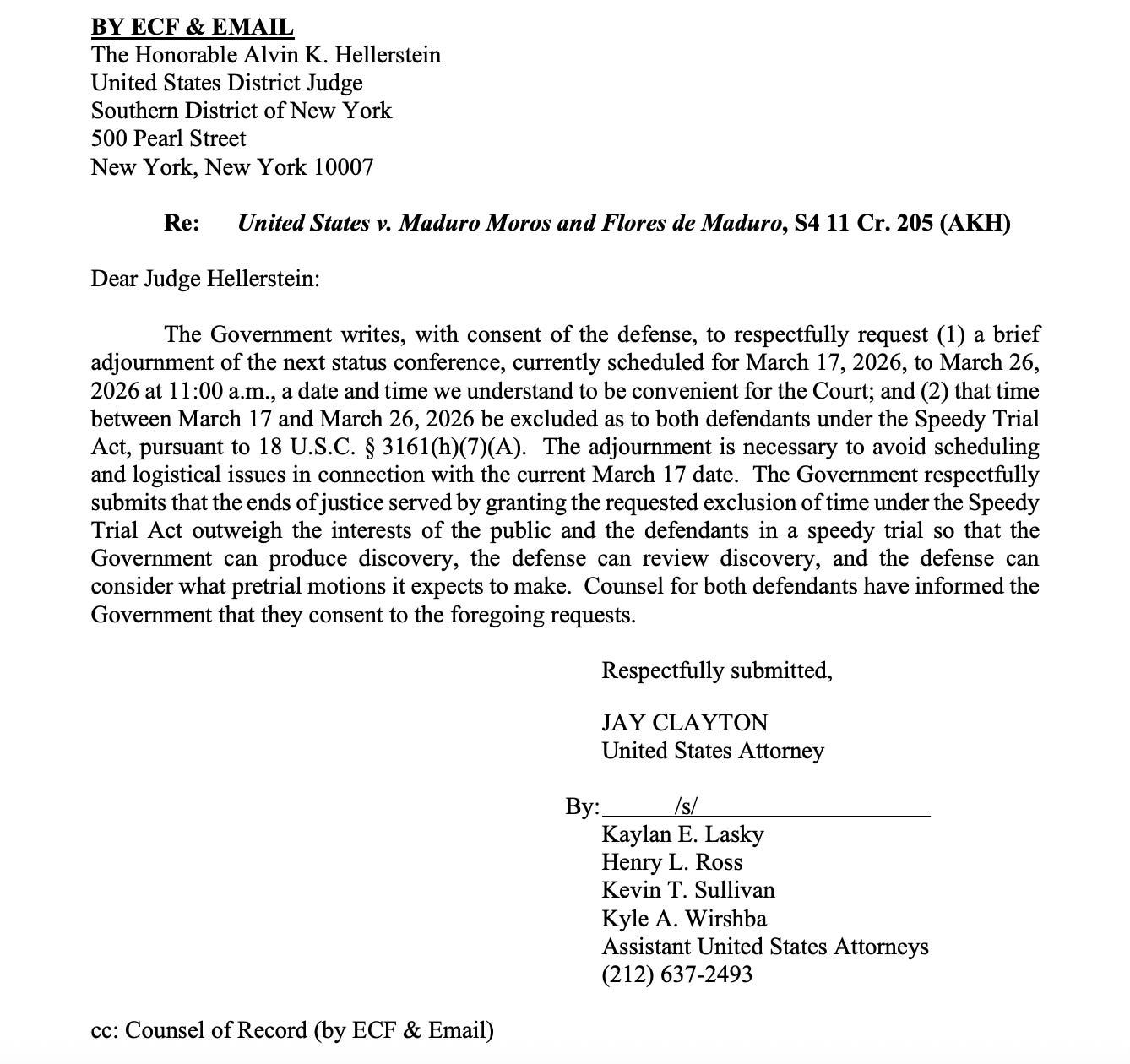
Tuesday: Maduro and Flores hearing
The U.S.-ousted Venezuelan leader Nicolás Maduro and his wife, Cilia Flores, were captured by U.S. forces on January 3 at their Caracas home. They were arrested pursuant to an indictment federal prosecutors had obtained and taken to the U.S. to face those charges. Both pled guilty and are currently detained pending trial. The superseding indictment can be found here. We discussed it at length here.
There was supposed to be a status conference on the case this Tuesday. But the government wrote the Judge, Alvin Hellerstein in the Southern District of New York, requesting a “brief continuance.” The stated reason was to permit discovery to proceed before the parties returned to court, a reasonable request given the likely amount of evidence the government will be turning over to the defense and the time it takes to review it with defendants who remain in custody.
But the government has been busy on the case already, opposing the defendants’ efforts to use Venezuelan government monies to fund their defense. Prosecutors say Maduro is not the legitimate leader of Venezuela and hasn’t been considered by the U.S. to be so for several years. Madura and Flores’ lawyers argue the laws and traditions of the country permit it to fund their defense. A Venezuelan official has said they are prepared to do so.
The defendants argue that their inability to access certain third-party funds to pay for their legal fees violates their Fifth and Sixth Amendment rights to due process and effective assistance of counsel. The parties have filed their briefs, and Judge Hellerstein is expected to consider the legal fees dispute during the March 26 hearing.
Tuesday: Illinois Primary
Illinois voters head to the polls Tuesday to choose their Democratic and Republican nominees for the open Senate seat being vacated by Dick Durbin, who is retiring after almost three decades. Two members of the House, Raja Krishnamoorthi and Robin Kelly, have thrown their hats into the ring, leaving their seats up for grabs. Three additional Illinois representatives are retiring: Danny Davis, Jan Schakowsky, and Jesus “Chuy” Garcia.
That means the Illinois delegation will look different, possibly younger, heading into 2027, and we will have new names to learn. Kamala Harris won the state with 54.8% of the vote in 2024, and it’s unlikely Democrats will lose any seats. In Kelly’s district, former representative Jesse Jackson Jr, who pled guilty to misusing campaign funds in 2013 and was sentenced to 30 months in prison (he served a little under two years), is trying to make a comeback, but he is one of 10 Democrats running for the seat. Jackson, who represented the district for over 20 years before going to prison, is up by double digits in two polls.
Everyone expects Governor JB Pritzker to handily win reelection. But as a potential 2028 presidential contender, there will be heavy scrutiny of how he handles himself during the campaign and how well he performs and leads the Democratic ticket. So there’s a lot to see here.
Under Illinois law, only poll workers and poll watchers can be at the polls on election day, and other people may not mill around outside as voters go about their business. Nonetheless, there have been concerns that ICE might show up to intimidate people. But DHS’s Assistant Secretary for Election Integrity, Heather Honey, issued a statement in late February, saying “Any suggestion that ICE is going to be present at polling places is simply disinformation.” She committed that there would “be no ICE presence at polling locations” during a call with voting officials from across the country.
That makes sense and I’m inclined to believe it. But only because doing it now would trigger legal challenges that would likely be decided against the administration. If they’re going to do this, we’ll likely see it for the first time when voters go to the polls in November.
Wednesday: Fulton County.
As you may recall from our earlier discussion, Judge J.P. Boulee sent the Justice Department and Fulton County to mediation in the case filed by the latter over the government’s seizure of voting records. Wednesday is the date by which the parties must let the Judge know whether they’ve been able to resolve the matter voluntarily. If mediation failed, it will be up to the Judge to decide whether the records are due to be returned, which they almost certainly are (the government gets to keep copies), but the administration could face some messy, revelatory testimony in court if the County goes into the unusual decision to have a U.S. Attorney from Missouri take over the matter, rather than the local U.S. Attorney.
The Rest of the Mess
Pam Bondi wants to deprive state bar associations of their ability to consider ethics challenges to federal prosecutors’ behavior.
DOJ has posted a proposed new regulation in the Federal Register that would prohibit state bars from proceeding while DOJ is conducting an internal review. Nothing in the rule would preclude DOJ from engaging in endless delay and short-circuiting state investigations.
In practice, state bar associations have routinely deferred to DOJ to conduct internal ethics proceedings before they act against a Justice Department lawyer. But that was under the old rules, where DOJ took ethics seriously. And as a practical matter, state bars, not Pam Bondi or Donald Trump, decide whether to give a specific lawyer a license to practice law in their state, so it’s difficult to see how the government has a legal leg to stand on here. It would be like Donald Trump deciding who can be a barber in Oklahoma or a cosmetologist in Arizona.
There is a 30-day comment period for the proposed regulations that will close on April 6. Comments will be public. Expect a wide variety of members of the legal profession to weigh in against the administration’s transparent effort to prevent state bar action against DOJ officials who are in ethical trouble. Congress made it clear in a law called the McDade Amendment that government attorneys “shall be subject to State laws and rules … governing attorneys in each State where such attorney engages in that attorney’s duties, to the same extent and in the same manner as other attorneys in that State.”The measure was passed in 1998 amid concerns about overzealous prosecutors. Pennsylvania Republican Representative Joseph McDade (R-PA) championed the measure after he was acquitted on bribery and racketeering charges.
The SAVE Act heads to the Senate for a vote this week.
We’ve been talking about it for months. This appears to be the week the Senate will vote on the SAVE Act. It has already passed in the House. In our conversation at Big Tent last week, Marc Elias opined it would not pass. The Senate would have to abandon the filibuster rule to get it across the finish line. That would be a last-ditch measure that Republican Senators have long argued against, but some seemed to waffle on the issue last week.
Trump tried to get Republican Senators to abandon the filibuster last November. He made that pitch with visiting Hungarian Prime Minister Viktor Orbán at his side. Orban heads what he has called an “illiberal democracy” in that country. It was quite an image.
The issue last year was the pending government shutdown. Trump called on Senate Republicans to scrap the filibuster rule and allow simple majority votes to prevail on that issue and for most other legislation. They declined, even though, or perhaps because, Trump promised his party that if they did, the GOP would “never lose the midterms and we will never lose a general election” for the foreseeable future. It will be interesting to see if that pitch reemerges this week as Trump tries to pass a measure designed to suppress Democratic votes in the upcoming election.
Senators on both sides of the aisle have long understood the power that honoring the filibuster gives both sides; it’s a form of mutually assured retention of power. But Texas Senator John Cornyn, long a proponent of the filibuster, put out an op ed in the New York Post arguing that the SAVE America Act is more important than it is.
“For many years, I believed that if the US Senate scrapped the filibuster, Texas and our nation would stand to lose more than we would gain … My fellow conservatives and I have proudly used the 60-vote threshold to protect the country from all sorts of bad ideas and dangerous policies. But when the reality on the ground changes, leaders must take stock and adapt…Today, Democrats are weaponizing the Senate’s rules to block the SAVE America Act, defund the Department of Homeland Security and hurt the American people — all to spite President Donald Trump.”
It was quite a reversal of long-held principles in service of Trump from the Texas Republican, who is facing an uphill battle to hold onto his Senate seat. He faced a primary challenge from Texas Attorney General Ken Paxton. Neither candidate reached the 50% threshold necessary for an outright win, so there will be a runoff, which is scheduled for May 26, although there have been whispers of a voluntary resolution. How we are about to find out if other Republican senators want to hold onto any of their institutional power or are willing to throw it away on Trump and a law that has strong arguments against its constitutionality.
Finally, Julie Le, the former government lawyer in Minneapolis who we met in this piece, when she begged a judge to hold her in contempt so she could get a good night’s sleep, has launched a Congressional campaign website. “This job sucks,” she told the judge. Now, it appears she might be looking for a new one, since she was ultimately removed after her outburst in court.
Sorry this article is so old. I have dozens more older than this in open tabs with the hope of one day being able to get what I think is important news out to those who may have missed it at the time. Here is the southern states patriarchy punishing women for not bringing forth a well formed offspring of a male who bred them. That is the way this reads to me. The woman means nothing, just the fetus, zygote, the failed issue of a man must be the fault of a woman. Think of this being promoted as prolife while they are willing to torture live females for a few cells in the human body that act parasitic. Remember no man is required to give any part of his body to another even his own dying child. Tht is the law. But a woman, a female is required to give her body over entirely and all actions of her life entirely to that male inserted parasitic entity that will drain her life force and can cause life long medical problems. It tells you exactly how these male law makers and their Christian supports see women. Hugs
Hundreds of US women charged with pregnancy-related crimes since fall of Roe
Study finds prosecutors targeting low-income women mainly in US south – and figure likely to be an undercount
Abortion rights supporters protest outside the supreme court in Washington in June last year. Photograph: Aashish Kiphayet/Middle East Images/AFP via Getty Images
In the first two years after the US supreme court overturned Roe v Wade, prosecutors in 16 states charged more than 400 people with pregnancy-related crimes, new research released on Tuesday found.
Of the 412 cases tracked by Pregnancy Justice, the vast majority took place in the US south, targeted low-income women and involved allegations that women broke laws against child abuse, endangerment or neglect, according to the research, which was compiled by the reproductive justice group. About 300 prosecutions took place in Alabama and Oklahoma. In 16 cases, law enforcement charged women with homicide.
Because there is no national database of US arrest or court records, the group believes the tally is likely to be an undercount. In a report released in September 2024, Pregnancy Justice said it had recorded 210 pregnancy-related prosecutions in the first year after Roe fell – the highest number ever recorded at that time. Pregnancy Justice is now devoting more resources to unearthing records of pregnancy-related prosecutions, so the group can’t say for sure whether these prosecutions are on the rise post-Roe or whether they are simply tracking them more closely.
Louisiana issues warrant for California doctor accused of mailing abortion pills
Read more
Nearly 400 of the cases included in the new report involved allegations of substance use during pregnancy. In an example described to the Guardian, after one woman gave birth, the hospital tested her umbilical cords for drugs. When the test came back positive for marijuana, the woman was arrested for felony child neglect, even though she had a medical marijuana card.
The laws used in most of these prosecutions, Pregnancy Justice pointed out, are typically meant to protect children, not fetuses. By prosecuting pregnant women under them, the group says, states are cementing the legal doctrine of “fetal personhood”, which seeks to grant embryos and fetuses full legal rights and protections – sometimes at the cost of the rights of the woman carrying them. Alabama and Oklahoma are both hubs for the growing fetal personhood movement.
“That is the ultimate goal of the anti-abortion movement,” said Dana Sussman, the senior vice-president at Pregnancy Justice, which scoured court and police records to find the cases. “It wasn’t just to overturn Roe. It is to establish full personhood, full rights for embryos and fetuses.”
Sussman said a number of women have faced criminal consequences for taking substances that were legal or prescribed to them. For that reason, Donald Trump’s claim last week that pregnant women who take Tylenol may give their children autism, raised alarms. Scientific research does not support this claim.
“It’s a perfect storm of all of the things that we work on: stigmatizing pregnant people for not being perfect pregnant people, blaming them for their perceived failures, and relying on misinformation and junk science to create a panic when there shouldn’t be one or isn’t one – while also increasing surveillance in the police state to monitor and potentially criminalize people when they don’t meet these impossible ideals,” Sussman said.
Only 31 of the cases documented by Pregnancy Justice included a stillbirth or miscarriage, while almost 300 of the cases led to a live birth.
A woman whose case was included in the Pregnancy Justice report reportedly didn’t realize she was pregnant until she started to feel intense pain in her stomach. The woman, a new immigrant to the US, suspected that she had food poisoning and decided to drive herself to the hospital.
Before she could get in the car, however, the woman started to give birth. She ultimately delivered what police records listed as a stillbirth. Pregnancy Justice did not factcheck the cases in the report and could not say whether the fetus was past 20 weeks of pregnancy, after which the term stillbirth is used. After police found the remains, the woman was charged with abuse of a corpse.
Abortion pill providers targeted by new Texas law refuse ‘anticipatory obedience’
Read more
The report indicates there are far more cases of miscarriage criminalization than have made national headlines. In one widely covered case in late 2023, police charged an Ohio woman with felony abuse of a corpse after she miscarried into a toilet. In another, earlier this year, a Georgia woman who had been found bleeding and unconscious after a miscarriage faced one count of concealing the death of another person, and one count of throwing away or abandonment of a dead body. The charges against both women were ultimately dropped.
Nine cases discovered by Pregnancy Justice involved allegations that women had considered abortions, such as ordering abortion pills or looking for information about abortion online. Only one woman in those cases was charged with violating a criminal abortion ban, likely because it is legal in most states to “self-manage” one’s own abortion. US abortion bans tend to penalize providers and people who help abortion patients, not the patients themselves.
In 2025, lawmakers in at least 12 states – including Alabama and Oklahoma – introduced legislation that would treat fetuses as people, which would leave women who have abortions vulnerable to being charged with homicide. In several of those states, that charge would carry the death penalty.
“What our work has proven is that, unfortunately, anything is possible when it comes to policing pregnancy,” Sussman said.
Amazing news! We were in the middle of of a zoom press conference about the Gas Suffocation aspect of the planned execution of Sonny Burton in Alabama on Thursday when a reporter put into the chat:
“Did you see that Governor Ivey just commuted Burton’s sentence?”
And with that, the news was broken. Governor Ivey heard YOUR messages, received YOUR petitions, read the articles YOU sent, heard YOU ringing her phone off the hook, heard us tolling our bell outside her house…. and she acted. Amen! THANK YOU!
Once again, this proves, sometimes, our united efforts work!
Congratulations to Sonny and his legal team, his family, and to all who had a hand in creating this moment!
Governor Ivey has declared that “All Life is Precious,” which is why we made sure to bring along our 4×10 foot banner to the 24-hour vigil we helped coordinate in front of her house a few weeks ago. The banner could not be missed from any street-facing window of the Governor’s mansion. We know with certainty that the Governor was there…. NOW we know that she heard our message!
The other good news is that now we don’t have to drive all the way to Alabama. In fact, we had planned to go to Texas fiirst to toll the bell outside the prison in Huntsville at the execution of Cedrick Ricks on Wednesday, which is still on. Without our planned return through Alabama, making such a long drive makes less sense.
As you know, everything we do to support local activists working to halt executions is another expense. It’s not just the costs of being on the road that we must cover, but also the overhead…
The four full time staff and our media consultant who do the behind-the-scenes work.
The costs of the tools and services we use to communicate our message to the world.
The price of existing as an organization that shows up to oppose every execution.
(snip-donation request. You can get there from the page of any of these links.)
Thank you. Yours in the Struggle,
–abe
PS: New execution dates are being set regularly. Click here to oppose every upcoming execution.
This caller is a well know immegration lawyer who calls in often. There has been a long running joke about the buttons on Sam’s shirts so ignore that part. The lawyer talks about what ICE is doing to help the detained people and he describes how horrific the conditions are. The goal is to make it so horrific these people will self-deport willingly. But the government is doing everything possible to hurt and harm the immigrants and detained people because of hate and bigotry of ICE and the white supremacists in the US government. Hugs
Her real crime was exercising her 1st amendment right to report negatively on ICE and the higher crime of doing it in spanish a language I would say most ICE couldn’t understand. She committed no crime and remember what DHS, Tom Lyons, Stephen Miller, and Bovino keep telling us they are only going after the worst of the worst criminals. Again look at my first sentence to see her worst of the worst crime. It is flat out racism and genocide of brown people in and name of creating a white ethnostate with an entrenched apartheid system. These people say they want people to come here legally but she is here legally. Hugs
A reporter for a Spanish-language news outlet in Tennessee who has been detained by U.S. Immigration and Customs Enforcement was not shown any warrant when she was arrested this week, according to court documents filed by her attorney.
Estefany Rodriguez Florez, a reporter for Nashville Noticias who has done stories critical of ICE, was arrested Wednesday during a traffic stop, according to documents filed in federal court in Nashville. Her lawyer called for her immediate release, but ICE has asked a judge to deny the request.
Rodriguez, a Colombian citizen, entered the U.S lawfully and has been living in the country for the past five years, court records filed by her lawyer show. She has a valid work permit, and she has applied for political asylum and legal status through her husband, who is a U.S. citizen.
Rodriguez has said she left Colombia after receiving death threats for her coverage of crime in the region, according to a statement from the National Association of Hispanic Journalists. The association said it “denounces immigration tactics that detain journalists and any efforts to interfere with news coverage of immigration enforcement.”
Rodriguez was with her husband in a marked Nashville Noticias vehicle when it was surrounded by several other vehicles and she was taken to a detention center, the news outlet said in a statement.
A court filing Friday by a lawyer for ICE said an arrest warrant had been issued for Rodriguez on Monday and her visa authorizing her to stay in the U.S. had expired. The filing said her arrest and detention “are not in violation of any laws or regulations.” ICE spokesperson Melissa Egan said Rodriguez was arrested during a “targeted enforcement operation” and she will remain in custody as her case proceeds through court.
Court documents filed by Rodriguez’s lawyer said that her attorney, Joel Coxander, spoke to an ICE agent who indicated that there was no arrest warrant for her at the time of her arrest. When she was arrested, Rodriguez was only shown an immigration document telling her to appear before ICE, according to the documents.
Rodriguez’s lawyer said in court documents that ICE had twice rescheduled a meeting with Rodriguez on her case, first because the office was closed during a winter storm and the second time because an agent couldn’t find her appointment in the system.
A new meeting was then set for March 17.
Rodriguez joined Nashville Noticias in 2022, covering social, family, health, police and immigration issues, the news outlet’s statement said.
“She needs to reunite with her young daughter and husband to continue her legal process within the framework permitted by law,” the statement said.
___
This story has been corrected to show the reporter’s second surname is Florez, not Flores as her attorneys initially said in a court filing.




 Congratulations to Sonny and his legal team, his family, and to all who had a hand in creating this moment!
 Scottie's Playtime