September 10, 1897 Nineteen unarmed striking coal miners were killed and 36 more wounded in Lattimer (near Hazleton), Pennsylvania, for refusing to disperse, by a posse organized by the Luzerne County sheriff. The strikers, most of whom were shot in the back, were originally brought in as strike-breakers, but later created their own union. The background and details
September 10, 1963 Twenty black students entered public schools in Birmingham, Tuskegee and Mobile, Alabama. The Governor George C. Wallace had ordered Alabama state troopers to stop the federal court-ordered integration of Alabama’s elementary and high schools. President John Kennedy responded by calling out the Alabama National Guard to protect the students and to see the order enforced. President Kennedy spoke that day at American University’s commencement, saying, “Peace need not be impractical, war not inevitable . . . There is not peace in many of our cities because there is not freedom.”
September 10, 1996 Sheryl Crow’s second album was banned from Wal-Mart stores because the song she co-wrote with Tad Wadhams, “Love Is A Good Thing” opens with “Watch out sister, watch out brother, Watch our children while they kill each other With a gun they bought at Wal-Mart discount stores….” Read more about this eventand an update
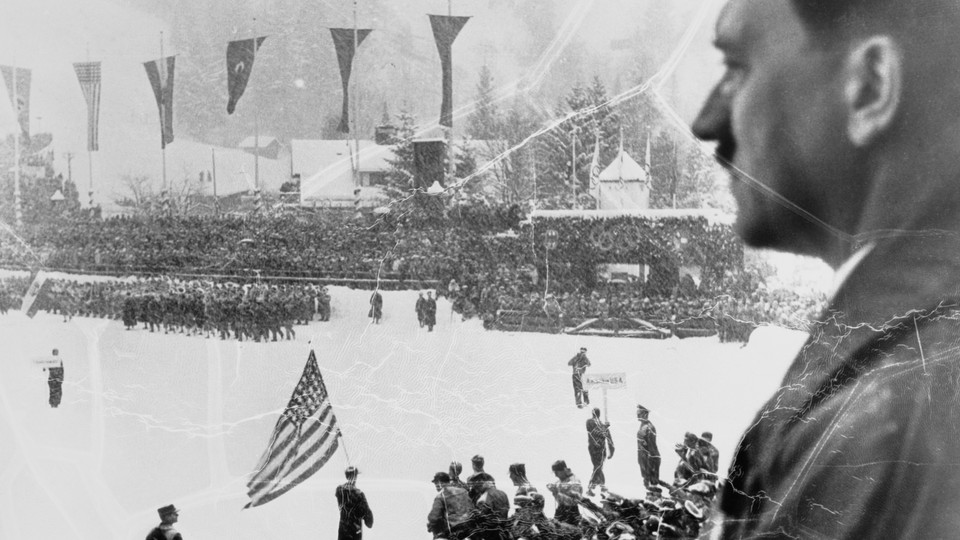
“The story we got about World War II is all wrong,” a guest told Tucker Carlson on his podcast two weeks ago. “I think that’s right,” replied Carlson. The guest, a Cornell chemistry professor named David Collum, then spelled out what he meant: “One can make the argument we should have sided with Hitler and fought Stalin.” Such sentiments might sound shocking to the uninitiated, but they are not to Carlson’s audience. In fact, the notion that the German dictator was unfairly maligned has become a running theme on Carlson’s show—and beyond.
Last September, Carlson interviewed a man named Darryl Cooper, whom he dubbed “the most important popular historian working in the United States today.” Cooper’s conception of honest history soon became clear: He suggested that British Prime Minister Winston Churchill might have been “the chief villain of the Second World War,” with Nazi Germany at best coming in second. The day after the episode aired, Cooper further downplayed Hitler’s genocidal ambitions, writing on social media that the German leader had sought peace with Europe and merely wanted “to reach an acceptable solution to the Jewish problem.” He did not explain why the Jews should have been considered a “problem” in the first place.
Enjoy a year of unlimited access to The Atlantic—including every story on our site and app, subscriber newsletters, and more.
“What is it about Hitler? Why is he the most evil?” the far-right podcaster Candace Owens asked in July 2024. “The first thing people would say is: ‘Well, an ethnic cleansing almost took place.’ And now I offer back: ‘You mean like we actually did to the Germans.’” A repeat guest on Carlson’s show, Owens defended him after his conversation with Cooper. “Many Americans are learning that WW2 history is not as black and white as we were taught and some details were purposefully omitted from our textbooks,” she wrote on X.
These Reich rehabilitators are not fringe figures. Carlson’s show ranks among the top podcasts in America. He spoke before President Donald Trump on the final night of the 2024 Republican National Convention, and his son serves as a deputy press secretary to Vice President J. D. Vance, who owes his office in part to Carlson’s advocacy. Owens has millions of followers on YouTube, Instagram, and X, and over the past six months, she has been interviewed by some of the nation’s most popular podcasters, including the comedian Theo Von and the ESPN personality Stephen A. Smith. Her output has attained sufficient notoriety that she is currently being sued by French President Emmanuel Macron and his wife, Brigitte, over her repeated claims that the French first lady was actually born a man. Cooper, the would-be World War II revisionist, publishes the top-selling history newsletter on the entire Substack platform.
Why does a potent portion of the American right seek to rehabilitate Hitler? The Nazi apologetics are partly an attention-seeking attempt at provocation—an effort to signal iconoclasm by transgressing one of society’s few remaining taboos. But there is more to the story than that. Carlson and his fellow travelers on the far right correctly identify the Second World War as a pivot point in America’s understanding of itself and its attitude toward its Jewish citizens. The country learned hard lessons from the Nazi Holocaust about the catastrophic consequences of conspiratorial prejudice. Today, a growing constituency on the right wants the nation to unlearn them.
Before World War II, the United States was a far more anti-Semitic place than it is now. Far from joining the conflict to rescue Europe’s Jews, the country was largely unsympathetic to their plight. In 1938, on the eve of the Holocaust, Gallup found that 54 percent of Americans believed that “the persecution of Jews in Europe has been partly their own fault,” and that another 11 percent thought it was “entirely” their fault. In other words, as the Nazis prepared to exterminate the Jews, most Americans blamed the victims.
The same week that the Kristallnacht pogrom left thousands of synagogues and Jewish businesses in ruins, 72 percent of Americans opposed allowing “a larger number of Jewish exiles from Germany to come to the United States to live.” Months later, 67 percent opposed a bill aimed at accepting child refugees from Germany; the idea never made it to a congressional vote. Many Americans worried, however illogically, that fleeing Jews might be German spies, a vanishingly rare occurrence. Those with suspicions included President Franklin D. Roosevelt, who suggested in 1940 that some refugees could be engaged in espionage under compulsion from the Nazis, “especially Jewish refugees.”
This climate of paranoia and hostility had deadly consequences. In 1939, the U.S. and Canada turned away the M.S. St. Louis, which carried nearly 1,000 Jewish refugees. The ship was forced to return to Europe, where hundreds of the passengers were captured and killed by the Germans. Restrained by public sentiment, Roosevelt not only kept the country’s refugee caps largely in place but also rejected pleas to bomb the Auschwitz concentration camp and the railway tracks that led to it. When the United States finally entered the war, it did so not out of any special sense of obligation to the Jews but to defend itself after the attack on Pearl Harbor.
That indifference to the Holocaust was immediately dispelled when the Allied Forces liberated several of the Nazi camps where millions of Jews had been murdered. Entering the gates of these sadistic sites, American service members came face-to-face with unspeakable Nazi atrocities—rotting piles of naked corpses, gas chambers, thousands of emaciated adults. Denial gave way to revulsion. “I thought of some of the stories I previously had read about Dachau and was glad of the chance to see for myself just to prove once and for all that what I had heard was propaganda,” Sergeant Horace Evers wrote to his family in May 1945. “But no it wasn’t propaganda at all … If anything some of the truth had been held back.”
Make your inbox more interesting with newsletters from your favorite Atlantic writers.
Dwight Eisenhower, the supreme commander of the Allied Forces in Europe and future U.S. president, personally went to Ohrdruf, a subcamp of Buchenwald and the first Nazi camp liberated by American troops. “I made the visit deliberately,” he cabled to Washington, “in order to be in position to give first-hand evidence of these things if ever, in the future, there develops a tendency to charge these allegations merely to ‘propaganda.’” Eisenhower then requested that members of Congress and prominent journalists be brought to the camps to see and document the horrors themselves. “I pray you to believe what I have said about Buchenwald,” the legendary CBS broadcaster Edward R. Murrow told his listeners after touring the camp. “I reported what I saw and heard, but only part of it. For most of it, I have no words.”
Two-thirds of Europe’s Jews had been murdered. American soldiers, drafted from across the United States, returned home bearing witness to what they had encountered. “Anti-Semitism was right there, it had been carried to the ultimate, and I knew that that was something we had to get rid of because I had experienced it,” Sergeant Leon Bass, a Black veteran whose segregated unit entered Buchenwald, later testified. In this way, the American people learned firsthand where rampant anti-Jewish prejudice led—and the country was transformed.
Americans began to understand themselves as the ones who’d defeated the Nazis and saved the Jews. Slowly but surely, anti-Semitism became un-American. But today, those lessons—like the people who learned them—are passing away, and a wave of propagandists with a very different agenda has arisen to fill the void they left behind.
Over the past few years, Tucker Carlson and his co-ideologues have begun insinuating anti-Semitic ideas into the public discourse. The former Fox News host has described Ben Shapiro, perhaps the most prominent American Jewish conservative, and those like him as foreign subversives who “don’t care about the country at all.” He has also promoted a lightly sanitized version of the white-supremacist “Great Replacement” theory that has inspired multiple anti-Semitic massacres on American soil. Candace Owens has accused Israel of involvement in the 9/11 attacks and the JFK assassination, and claimed that a Jewish pedophile cult controls the world. (Like many pushing such slanders, she has apparently discerned that replacingJews with Israel or Zionists grants age-old conspiracy theories new legitimacy.) In March, an influencer named Ian Carroll—who has a combined 3.8 million social-media followers, and whose work has been shared by Elon Musk—joined Joe Rogan, arguably the most popular podcaster in America, to expound without challenge about how a “giant group of Jewish billionaires is running a sex-trafficking operation targeting American politicians and business people.”
Before America entered World War II, reactionaries such as the famed aviator Charles Lindbergh and the Catholic radio firebrand Father Charles Coughlin inveighed against the country’s tiny Jewish population, accusing it of controlling America’s institutions and dragging the U.S. to war. “Their greatest danger to this country lies in their large ownership and influence in our motion pictures, our press, our radio and our government,” Lindbergh declared of American Jews in 1941. “Why is there persecution in Germany today?” asked Coughlin after Kristallnacht. “Jewish persecution only followed after Christians first were persecuted.” For these men and their millions of supporters, behind every perceived social and political problem lay a sinister Jewish culprit.
The 21st-century heirs of Lindbergh and Coughlin seek to turn back the clock to a time when such sentiments were seen by many as sensible rather than scandalous. These far-right figures have correctly ascertained that to change what is possible in American politics, they need to change how America talks about itself and its past. “The reason I keep focusing on this is probably the same reason you’re doing it,” Carlson told Darryl Cooper, the amateur Holocaust historian. “I think it’s central to the society we live in, the myths upon which it’s built. I think it’s also the cause of the destruction of Western civilization—these lies.”
Carlson couches his claims in layers of intellectual abstraction. Others are less coy. “Hitler burned down the trans clinics, arrested the Rothschild bankers, and gave free homes to families,” the former mixed martial artist Jake Shields told his 870,000 followers on X last week. “Does this sound like the most evil man who ever lived?” The post received 44,000 likes. (Shields has also denied that “a single Jew died in gas chambers.”) “Hitler was right about y’all,” said Myron Gaines, a manosphere podcaster with some 2 million followers across platforms, referring to Jews last year. “You guys come into a country, you push your pornography, you push your fuckin’ central banking, you push your degeneracy, you push the LGBT community, you push all this fuckin’ bullshit into a society, you destroy it from within.” These influencers are less respectable than Carlson, but their views are precisely the ones that more presentable propagandists like him are effectively working to mainstream. After Carlson’s guest last month suggested that the U.S. “should have sided with Hitler,” Shields reposted the clip.
Had Carlson and his cohort attempted their revisionism 20 years ago, they would have encountered a chorus of contradiction from real people who had experienced the history they sought to rewrite and know where its conspiratorial calumnies lead. But today, most of those people are dead, and a new generation is rising that never witnessed the Holocaust firsthand or heard about it from family and friends who did.
Late last year, David Shor, one of the Democratic Party’s top data scientists, surveyed some 130,000 voters about whether they had a “favorable” or “unfavorable” opinion of Jewish people. Hardly anyone over the age of 70 said their view was unfavorable. More than a quarter of those under 25 did. The question is not whether America’s self-understanding is changing; it’s how far that change will go—and what the consequences will be.
Yair Rosenberg is a staff writer at The Atlantic and the author of its newsletter Deep Shtetl, about the intersection of politics, culture, and religion.
Providing objective, nonpartisan, rigorous, original journalism that investigates America’s anti-LGBTQ landscape and elevates everyday American heroes. Expect two rigorously reported stories every weekend.
But how does Google’s algorithm decide which results show up? And how do these results influence LGBTQ kids, their parents and Americans at large who are searching for help?
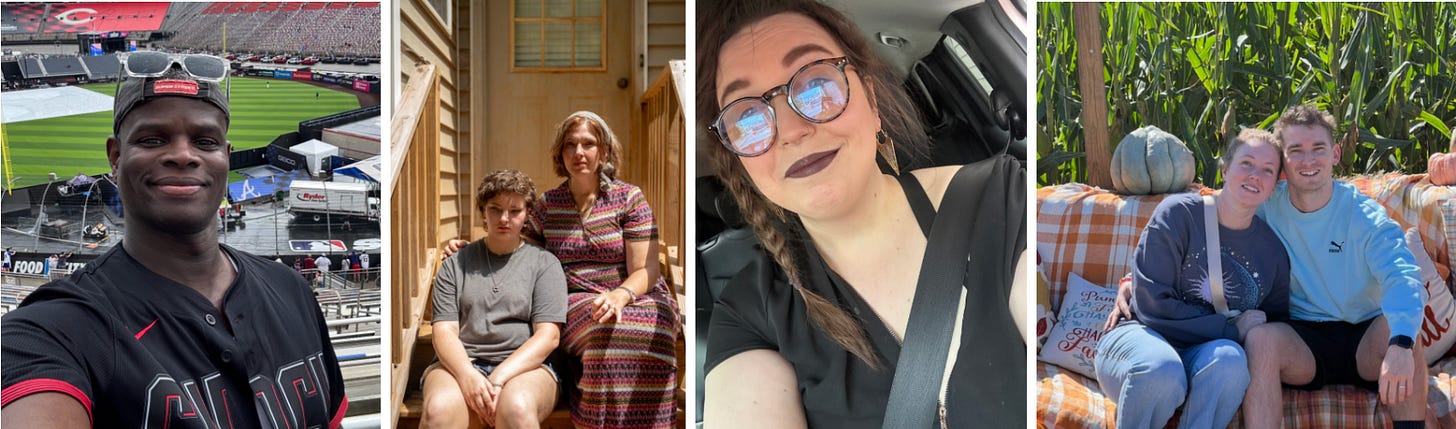
Uncloseted Media asked five Americans from around the country to Google five common queries related to LGBTQ identity, religion and parenting.
The results were alarming and raised an urgent question: With nearly 40% of LGBTQ youth seriously considering suicide just last year, what happens when a queer teen or the parent of a gay kid in crisis turns to Google?
Photos courtesy of participants Mark Just, Genna and Melanie Brown, April Samberg, Tommy O’Neil. Photo of Genna and Melanie by Kaoly Gutteriez.
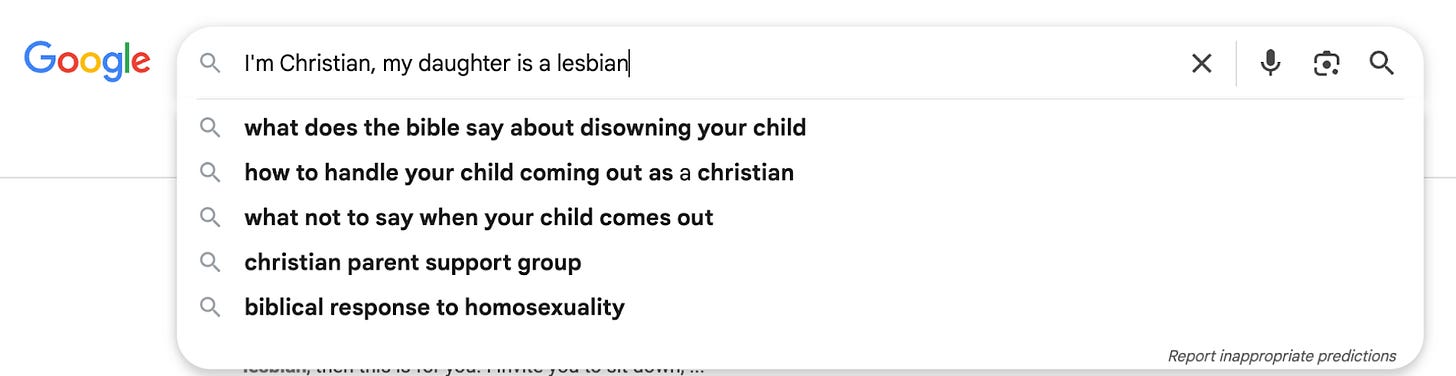
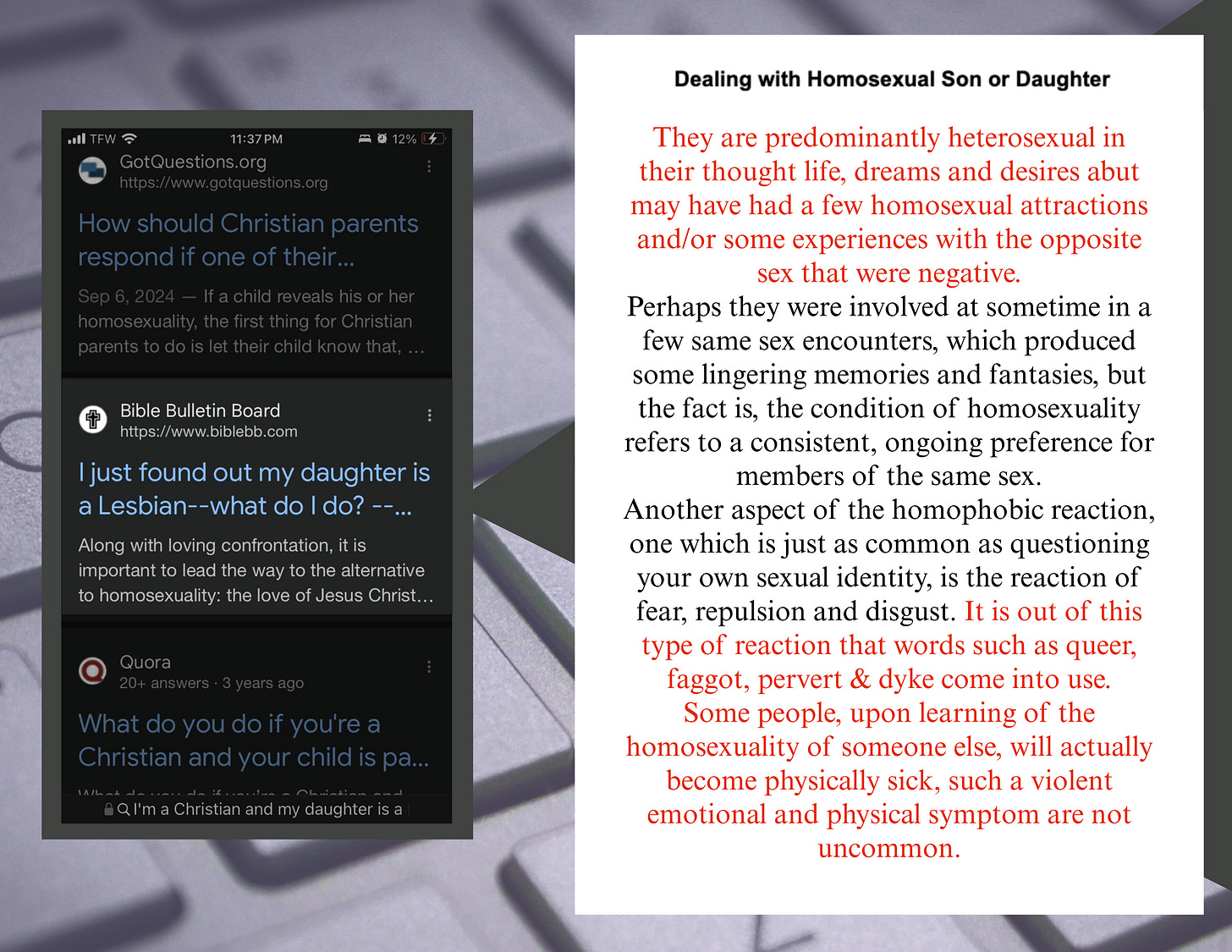
“I’m Christian, my daughter is a lesbian,” Melanie Brown, a Southern Baptist from High Point, North Carolina, types into Google.
When Brown presses enter, Bible Bulletin Board comes up as the third result, with the suggestion of “offering hope for change,” and “lead[ing] the way to the alternative to homosexuality.” It goes on to explain that “homosexuality is contrary to God’s Word. It is sin and as always results in sin’s destructive effects on the individual and on those close to them.”
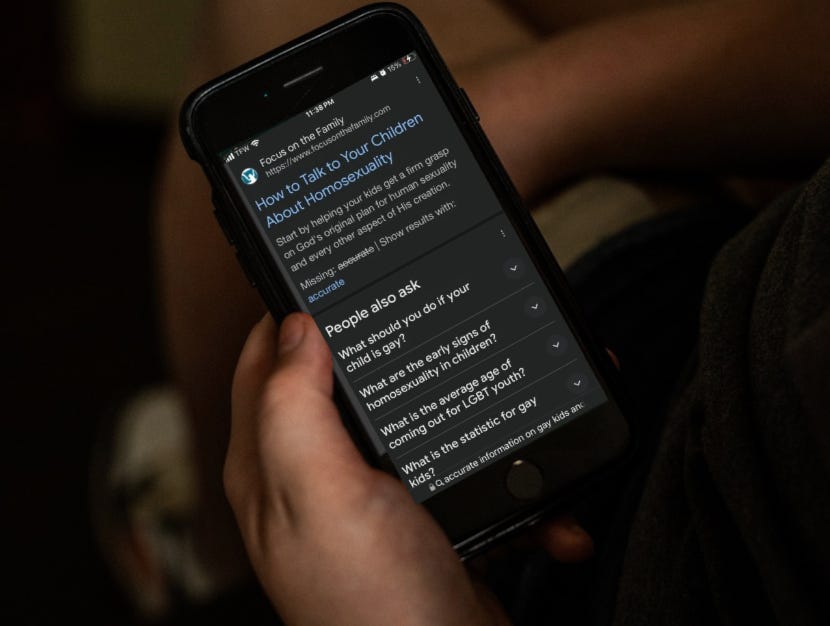
In the living room, Brown’s 15-year-old daughter Genna, with her dog on her lap, Googles “accurate information on gay kids and what to do.”
Focus on the Family (FOTF) is the first result. She clicks the link and lands on the platform of a hyper-religious organization known for promoting conversion therapy and labeling her sexuality as sinful.
The site, which presents itself as a reputable religious source, features a tab titled “Understanding Homosexuality” and a section under their resources for “Homosexuality.” It states: “[FOTF] is committed to upholding God’s design for the expression of human sexuality: a husband and wife in a marriage.”
It offers suggested reading on “redemption” from a gay lifestyle, along with 11 counseling resources aimed at changing sexual orientation, including The Alliance for Therapeutic Choice and Scientific Integrity, which guarantees “professional assistance … for persons who experience unwanted homosexual attractions.”
The language is intentionally padded, which means Genna and her mom—and many of the other millions of Christian parents of queer kids—may never know that Google led them to a Southern Poverty Law Center-designated anti-LGBTQ hate group. FOTF is known for its long-standing opposition to LGBTQ rights, for spreading anti-LGBTQ disinformation and for framing homosexuality and transgender identity as sinful and disordered.
Screenshot courtesy of Genna Brown. Photo by Kaoly Gutierrez.
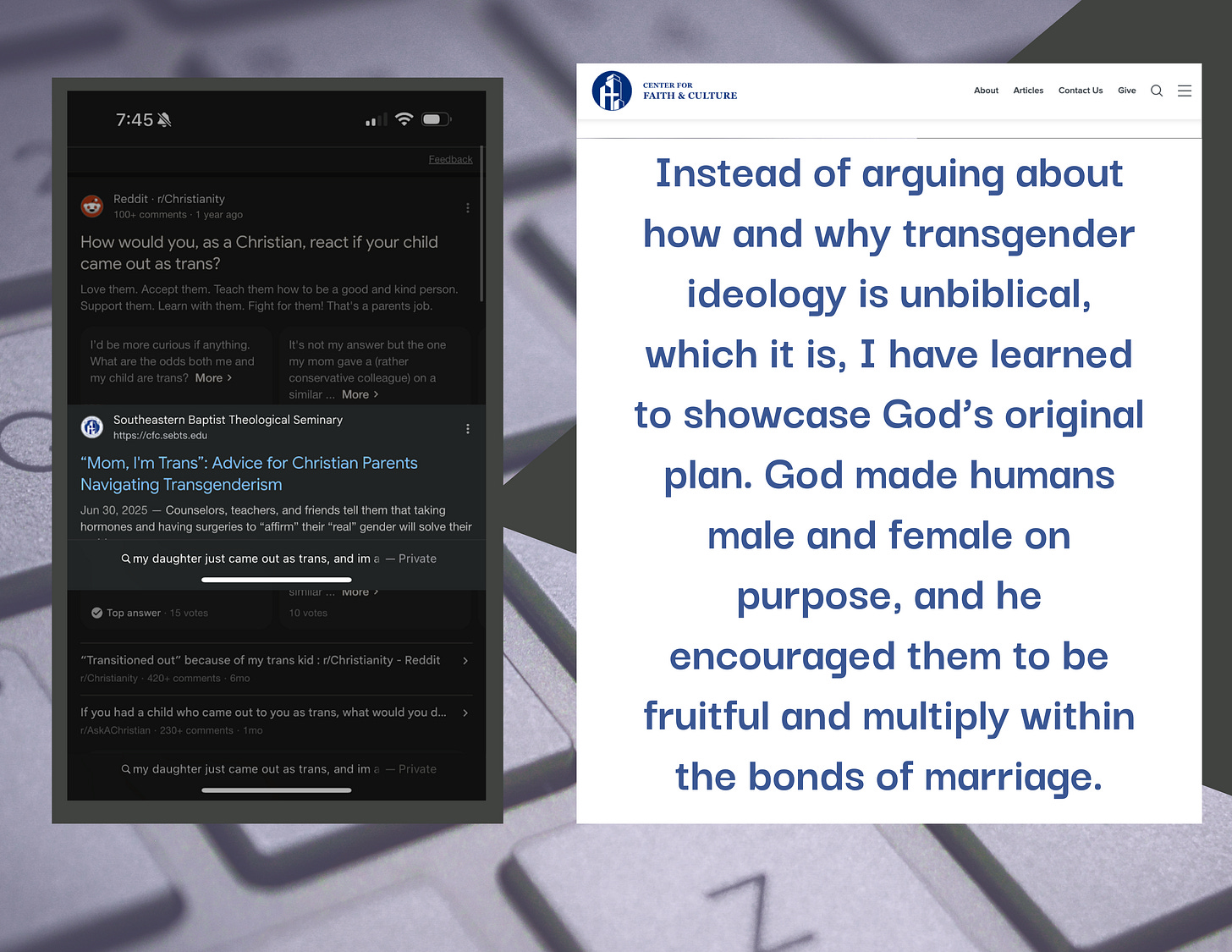
In South Boston, Virginia, Tommy O’Neil Googles, “My daughter just came out as trans and I’m a Christian.” As a father of two, he wants what’s best for his kids. According to Southeastern Baptist Theological Seminary, Google’s second result, O’Neil should recognize that God doesn’t make mistakes when assigning sex and give sympathy for those who are indoctrinated in the “transgender cult.”
Thousands of miles away in Anchorage, Alaska, 38-year-old bisexual woman April Samberg Googles, “I am bisexual and have a husband who is Christian, am I going to hell?”
The third result is once again an article by FOTF that tells April that “same-sex-attracted strugglers” and “transgender and homosexual lust and behavior are wrong.”
In Cincinnati, 44-year-old Mark Just Googles, “accurate information on homosexual kids and what to do.” FOTF is the top search result.
“I don’t feel good about it,” Just told Uncloseted Media. “It’s disturbing because if there are people out there who want to accept and understand their children or loved ones, this is what they’re being pointed to.”
“[I feel] fear for the queer kids with Christian parents who will be seeing that and thinking it’s good advice, and sorrow for the kids with parents who already have,” says Genna Brown, who was a “self-loathing, suicidal kid” who thought God would punish her for being gay before she came out to her now accepting parents. “It’s pretty awful that this is what’s being pushed for advice. This has no doubt harmed people.”
Uncloseted Media also asked folks in Taiwan, Lebanon, China, Hong Kong, Canada and India to Google similar queries. All of them had FOTF turn up as a top search result.
Subscribe
Why Does Google Allow This?
Google, like other search engines, compiles information and directs users to various websites by referencing the titles of web pages that it judges to be most reflective of what was searched.
“Google’s algorithm is notoriously a black box,” says Jesse Ringer, founder of Method and Metric, a search engine optimization (SEO) growth company. “That’s intentional to keep their competitive advantage.”
What we do know is that Google ranks search results by first crawling the web with an automated program called “spiders” to follow links from page to page and collect data.
It uses text matching to identify documents that it thinks are relevant to a query and then ranks them based on a combination of popularity, freshness, location and previous links clicked.
But for people searching for reliable information, its process can be problematic.
“Google doesn’t rank based on accuracy, but on popularity and query matching,” says Dirk Lewandowski, professor of information research and retrieval at the Hamburg University of Applied Sciences. “This is based on clicks and a network of how many other links are directed to this website. … Of course, users click what is shown in the first position. So we have kind of a rich get richer.”
How to Get a High Ranking
As websites with the highest rankings continue to receive more clicks, websites like FOTF can also employ other tactics to keep their prominent placement.
Backlinking—the process of having other web pages hyperlink back to your site—is one of the ways to maintain your high ranking.
“Backlinks are a big part of popularity. So the relationship between other websites linking to this source is a big part of Google’s algorithm,” says Ringer. “There are SEO businesses that build link farms so that the content of their clients can go higher. They create a network effect and they link to each other. It is not unreasonable to think that [FOTF] has hired either an SEO person or they’ve hired an external agency to contribute to that.”
According to Francesca Tripodi, assistant professor at the University of North Carolina School of Information and Library Science, ranking can also be gamed by matching keywords to content. Tripodi looked at the metadata of progressive and conservative companies and found that conservative content creators “are much better at doing this.”
“They are savvy at creating new sets of words and tagging their content with them,” she says. “That’s not something I’m seeing with progressive content creators.”
Tripodi says that not only does conservatism thrive online, it might be the only perspective returned.
Subscribe
“They are well-funded companies with large production budgets and effective digital marketing teams,” she wrote in a 2019 testimony about conservatism and Google searches. “This is why when you search for liberal phrases like ‘gender identity’ or ‘social justice’ the top returns … are conservative content creators.”
Google declined to speak on record with Uncloseted Media for this story.
In an email, a spokesperson said: “Like any search engine, Google indexes the content that’s available on the open web, relying on systems like keyword matching to surface relevant results. We are largely guided by local law when it comes to removing pages from search results.”
What If It’s Harmful or Illegal?
The United States notoriously protects harmful or misleading content—including anti-LGBTQ hate speech—under the First Amendment.
“The situation in [other countries] is a bit different than in America,” Lewandowski says. “For instance, Holocaust denial is illegal in Germany. So Google bans these sites, but they don’t ban them in the U.S.”
Section 230 of the U.S. law protects Americans’ freedom of expression online by implying that we should all be responsible for our own actions and statements on the internet. This law largely takes legal pressure off of Google.
And in 2003, an Oklahoma court ruled that Google’s rankings are subjective opinions and thus constitutionally protected.
Google’s policies for tamping down on harmful content “don’t apply to web results.” Thus, there is little moderation on the web pages that pop up for Americans who use the search engine.
The spokesperson for Google says that “[they] hold themselves to a high standard when it comes to legal requirements to remove pages from Google search results” and that “they don’t remove web results except for child sexual abuse, highly personal information, spam, site owner requests, and valid legal requests.”
But according to the company, “determining whether content is illegal is not always a determination that Google is equipped to make.”
Tripodi says this might be why groups like FOTF are still showing up, even though conversion therapy is illegal in 23 states. She says these groups may have found a loophole in Google’s policy by “tricking” the search engine into thinking they are providing “resources” and not simply a recommendation for conversion therapy.
Subscribe
What Can Google Do to Fix This?
“Google has a responsibility for what is coming up in their results because people trust [them],” says Lewandowski. “They think something is correct or accurate because it is number one in Google.”
Fifteen-year-old Genna Brown is one of the 85% of Americans who feel this way, according to a 2025 study.
“Isn’t the first result typically ranked most credible?” she says. “Because I typically trust the first result more.”
“It’s pretty concerning what comes up when you search for these things,” Ringer says. “There needs to be more done to educate the people who are doing the searches on understanding news and information.”
But vulnerable groups, like LGBTQ kids who are living in households where they are told they are going to hell and parents who are often confused and in crisis themselves, are being led by Google’s algorithm to believe that being queer is wrong.
“1000% yes, these results concern me,” says Genna Brown. “We’re talking about organizations that promote practices like conversion therapy, which is insane. … I wish there was some disclaimer. Like, ‘Google has determined this to be a subjective query. As such, we can’t verify the following results. Proceed with caution.’”
Tripodi says she thinks consumers are responsible for about 20% of the burden by researching and verifying the sources they learn from. But she agrees with Brown in that Google carries an ethical responsibility for the content it chooses to rank and promote.
“As a global corporation that gobbles up all other possibilities for information, Google has a responsibility to ensure that its content is accurate and not harmful,” Tripodi says. “[It’s their job] to ensure that the information that they surface is accurate and reliable because we know people trust that information.”
Uncloseted Media reached out to Focus on the Family, Southeastern Baptist Theological Seminary, and Bible Bulletin Board. They did not respond to our request for comment.
Additional reporting by Sophie Holland and Spencer Macnaughton.
If objective, nonpartisan, rigorous, LGBTQ-focused journalism is important to you, please consider making a tax-deductible donation through our fiscal sponsor, Resource Impact, by clicking this button:




 Scottie's Playtime