
Category: Questions
Lots Happening This Week; Joyce Vance Previews And Comments:
The Week Ahead
May 17, 2026
Coming this week:
Looks like the law firms win
Last week I flagged that oral argument was set in the D.C. Circuit for this past Thursday in the combined challenges filed by four law firms against Trump’s executive orders seeking to keep them from conducting much of their business. All four firms won in the lower courts. Based on the panel’s reception, they seem on track to do it again.
These cases are highly significant because they go to the heart of a major abuse of executive power: Trump’s insistence that he has the ability to put entities that oppose him out of business. Former Solicitor General for George W. Bush, Paul Clement, representing the firms, argued that Trump’s executive orders “run afoul of the better part of the Bill of Rights.” Not just one or two provisions, mind you, but “the better part.” He argued that they threaten the right to counsel, the separation of powers, and the rule of law.
Clement explained, “The executive orders here strike at the heart of the First Amendment and the ability of lawyers to zealously represent their clients. Lawyers cannot zealously represent their clients while walking on eggshells for fear of reprisals; thus, the executive orders strike at the heart of the rule of law and the zealous representation on which the judiciary and the adversary process depend.” That seems entirely clear. It could even be possible that firms might avoid representing certain clients—one of Trump’s early attacks was on Covington and Burling, a D.C. firm that gave advice to Jack Smith, the special counsel during the Biden administration who oversaw the two prosecutions of Donald Trump.
Clement also explained the headlock Trump had put firms in: “I either keep my security clearance, or I can sue the Trump administration, not both.” For many defense firms, the ability to obtain a security clearance is essential to doing certain types of work. Trump’s orders purported to remove those clearances for lawyers at firms that ran afoul of him. He also tried to suspend active government contracts and prevent attorneys who worked at the interdicted firms from entering government buildings, including federal courthouses. As we discussed here, it was always going to be a nonstarter because the orders, if permitted to go into effect, would allow a president to pick and choose which attorneys could continue to make a living and put ones he didn’t like out of business.
During argument, the panel seemed unpersuaded that the executive orders were discretionary national security decisions made by a president that aren’t subject to review by the courts. If the case makes its way to the Supreme Court, Trump will undoubtedly argue that the district judges who first considered the case were biased. Assuming Trump loses at the Court of Appeals, the Supreme Court could take the case on appeal, but is not obligated to. For instance, Judge Richard Leon, one of first district judges to consider a law firm executive order case, is also the judge who issued a preliminary injunction halting construction of Trump’s ballroom, finding that the president is the “steward” of the White House and not the “owner,” and that Trump had no statutory authority to proceed, absent authorization from Congress. So prepare yourself for meritless arguments about judicial bias if Trump suffers a loss here. There is no way of predicting how long it will take the court to rule, and the administration is enjoined from putting the orders into effect while the cases are being litigated.
Closing the loop on mifepristone
With only two justices, predictably, Thomas and Alito, writing in dissent, the Supreme Court has prevented Louisiana’s law, which would make mifepristone unavailable via telehealth, from going into effect while the litigation moves forward.
It’s not skeptical to question whether this happened because the Court is well aware of the risk of agitating voters in advance of the midterm elections.
Trump is hyperfocused on trying to salvage the November election despite his sinking performance in the polls.
We always knew that, backed into a corner, Trump would become ever more willing to damage democracy to save himself. It’s on.
NOTUS is reporting that meetings are being held, out of the public eye, between the White House, DOJ, DHS, and the Postal Service to try and interfere with the election. The goal seems to be building a national voter database that can then be used to determine who can and can’t vote—which is up to the individual states—and implement Trump’s order that the Post Office should interfere with mailing ballots.
The report in NOTUS included comments from an unidentified White House staffer speaking on background, who declined to acknowledge that the conversations were taking place, but did say that “it is standard process for administration officials to coordinate on implementing President Trump’s executive orders. We do not comment on private meetings that may or may not have happened.” That’s as good as a yes.
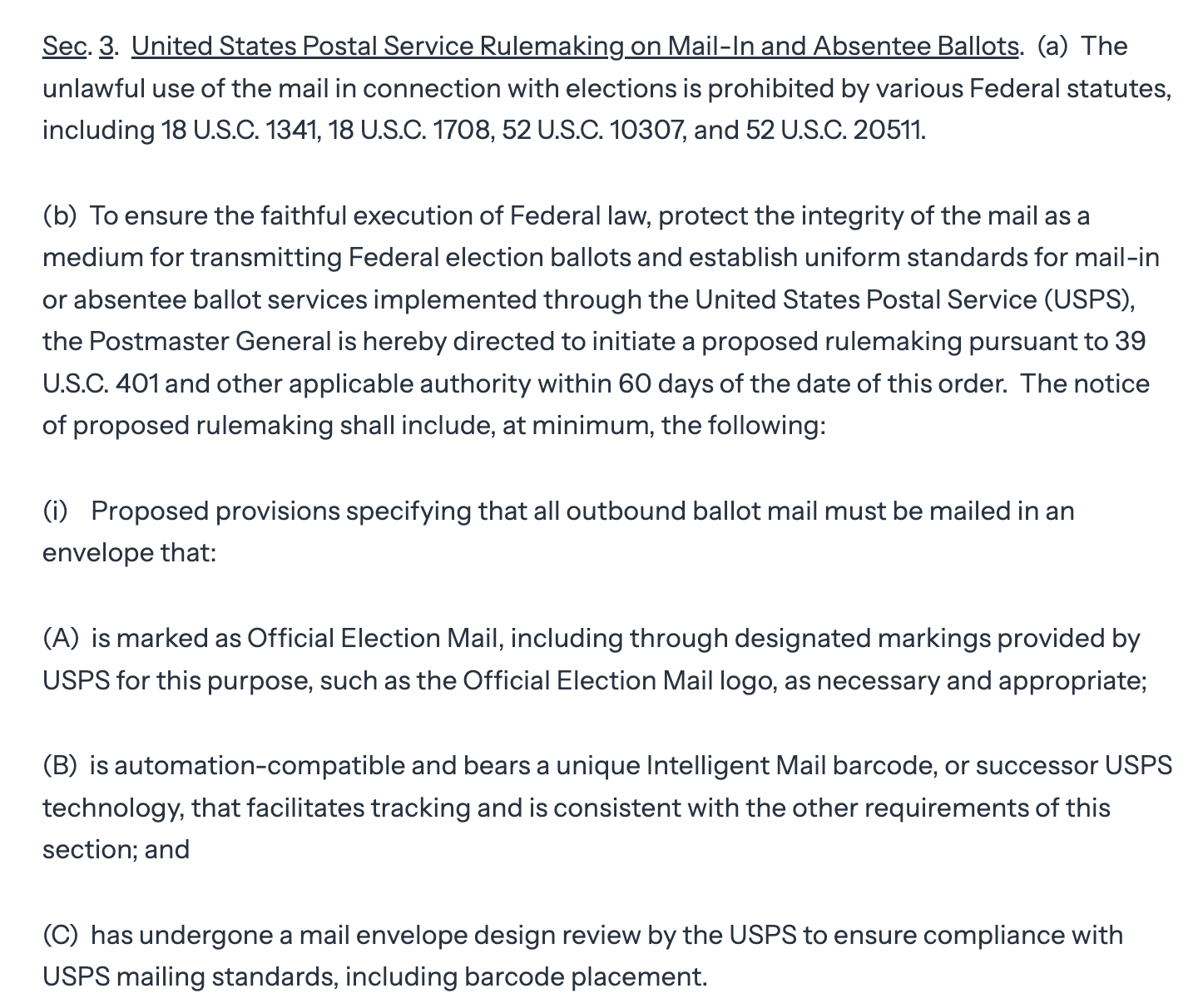
Trump’s executive order directing USPS to interfere in state-run elections is under challenge in court. At a hearing last week, DOJ argued that the court can’t act because the issue being raised is an “abstract legal question unless and until the Postal Service actually issues a rule that injures the plaintiffs and it does so only because it was directed to by the president — rather than, for example, as an exercise of the agency’s own independent judgment.” Judge Carl Nichols seemed inclined to buy that argument at one point in the hearing, asking how there could be irreparable injury, which he must find before he can enjoin the executive order, when no action has been taken as of yet. But at other points in the hearing, he pushed the government on the constitutionality of the president’s executive order.
We’ll watch carefully for a forthcoming ruling in this case, which will tell us a lot about whether the courts will entertain presidential interference in each state’s administration of its own election. But the White House is making its position clear.
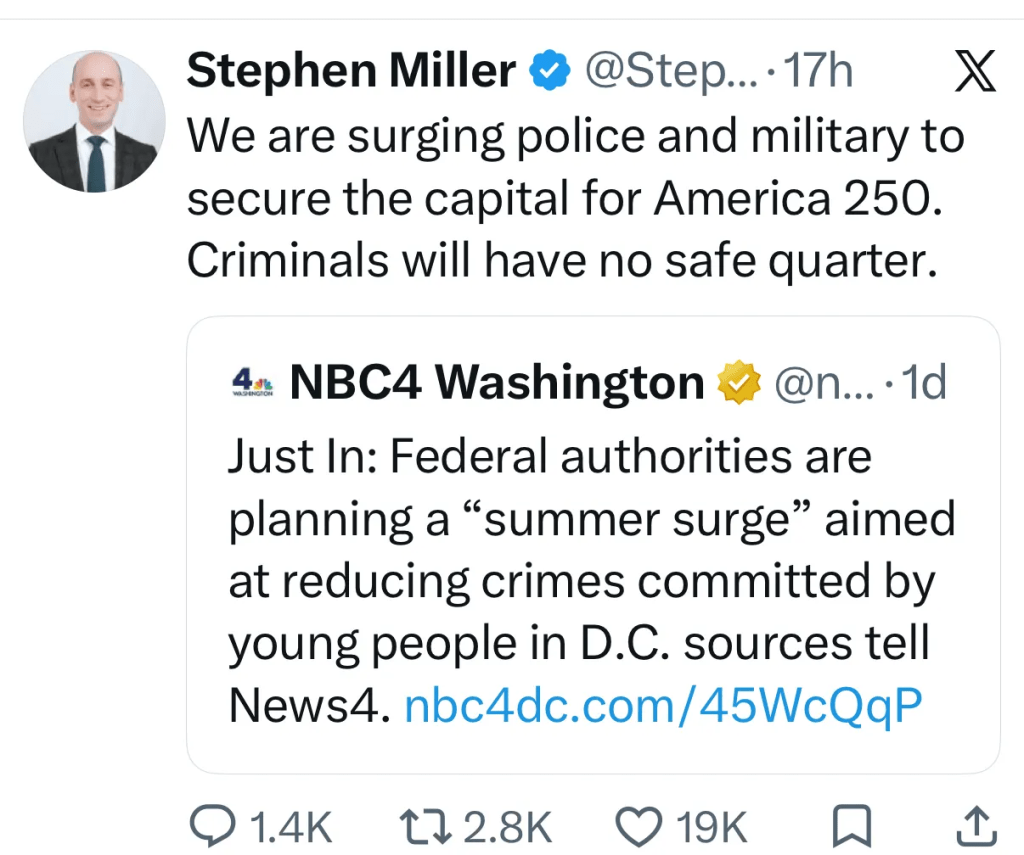
Stephen Miller, who it’s always worth noting is not a lawyer and doesn’t seem to appreciate what the Constitution says, seems to be continuing to look for a new way to militarize the country for reasons that don’t hold water in advance of the election. We’ll take up the issue of the illegality of sending federal troops or federal agents to the polls first breather we get.
Also …
On Wednesday, the state of Tennessee has a court date to defend itself against the NAACP’s allegations that it cannot, without violating state law, redraw its voting maps this late in the decade.
On Thursday, SCOTUS will be issuing more opinions.
By Friday, the Government has to produce discovery to the defendants in the Minnesota church protest case against Don Lemon and individual protestors who were indicted for violating the FACE Act. A judge ruled that heavily redacted discovery that prevents the defendants from identifying witnesses, including members of law enforcement, so they can prepare their cases violates the law. He has given the government until Friday to rectify its errors and “produce discovery consistent with its Rule 16(a) obligations, unredacted as to all victim and witness names, addresses, and telephone numbers; as well as fully unredacted as to law enforcement PII [personally identifiable information]” to every defendant who has agreed to abide by a protective order preventing its public dissemination. The government’s case has been widely viewed as likely violating the First Amendment from the outset.
Next up on the list of bad cabinet secretaries
Agriculture Secretary Brooke Rollins is being sued for violating employees’ right to be free from establishment of religion by the government. She’s been proselytizing in emails to the captive audience that is her workforce.
I recall once handling a case where a public employee was being subject to far less overt religious commentary, and the government agency immediately conceded error and fired the offender. This case is even more clear. Government employees are not disciples of Christ.
But don’t hold your breath for the president to fire her. This was a weekend characterized by a full-scale display of support for Christianity being promoted by the White House. The administration held a “Rededicate 250,” which many observers, both approvingly and disapprovingly, referred to as a Christian religious service featuring high-ranking government officials on the National Mall.

Rededicate 250 was “a White House-backed prayer festival dedicated to America’s Christian roots.” Trump gave a video speech. Speaker Mike Johnson, Secretary of Defense Pete Hegseth, and Secretary of State Marco Rubio were present, standing with evangelical leaders on the stage. Johnson told the crowd, “Our founders boldly proclaim that our rights do not derive from the government. They come from you, our Creator and Heavenly Father.”
Podcaster Brian Allen posted this snippet from MAGA radio host Eric Metaxas’ speech at the federally funded prayer event on the National Mall today: “It’s hard to believe that it would take two centuries for the Lord to raise up a great man to bring that ballroom finally to stand where it needs to stand. It’s extraordinary. We only had to wait two hundred years.”
As Allen put it, Metazas “told a crowd of thousands of Christians that God spent two centuries waiting to raise up Donald Trump — to build a ballroom.” The crowd responded by cheering.
The only way to overcome this sort of thing, a clear violation of the Constitution, is with a relentless commitment to telling the truth and sharing it widely. We know from Trump’s poll numbers that some of it is breaking through. The utter lunacy of the Christian God wanting a ballroom is something to ask people to stop, and instead of just following like sheep, spend a moment thinking about.
More Kleptocracy
Bloomberg is reporting that Trump’s disclosure forms for the first quarter of 2026 show that he made 3,600 Stock trades, and that they are worth as much as $750 Million (the reporting is done in bands, so it’s impossible to determine the exact amount from the forms). Former Undersecretary of State Rick Stengel pointed out that Bush and Clinton kept their assets in a blind trust and neither Obama nor Biden traded stocks or bonds while in office.
“3,700 trades,” Stengel tweeted, “is probably more than all the trades of all the presidents until now. And he is trading stocks that are affected by his decisions. A walking conflict of interest, at the least, and perhaps insider trading. Just as members of Congress should not be able to trade stocks, so too the president.” Stock trades aren’t official acts; they’re clearly personal ones. Stengel has certainly identified reasons that merit a closer look at these trades.
So, lots happening this week. We’ll be here through everything as we head into the Memorial Day weekend, trying to make it make sense. I’m grateful to all of you who spend part of your week here with me, thinking carefully about the law, democracy, and where we go from here. Thank you for being a part of Civil Discourse.
We’re in this together,
Joyce
“A Mother Of A Revolution” by Omar Thomas:
2 Pieces Regarding Transpeople’s Rights

I can’t get the entire article here; I think I used up all my NYFT freebies for life back in 2004. However, I got a blurb, and because it’s pertinent to our interests, I’m still posting the link for anyone who’d like to see the story. It’s surprising, as is the story after this one.
Kansas AG issues opinion exempting some state facilities from anti-trans bathroom law
By: Morgan Chilson
TOPEKA — A few spaces are exempt from Kansas’ new bathroom law that requires people to use the facilities in government buildings that match their sex assigned at birth, Attorney General Kris Kobach said in an opinion he released Wednesday.
Kobach’s opinion, which carries no legal authority, exempted some government spaces — such as skilled nursing rooms at the Kansas Office of Veterans’ Services — from complying with the bathroom law that went into effect in February.
He issued the opinion in response to an April letter from Justin Whitten, Gov. Laura Kelly’s chief counsel, who asked for clarification on defining “multiple-occupancy private spaces” and “facilities” as written in Senate Bill 244.
“This was a poorly written and ambiguous law, which is why the governor’s office sought an attorney general opinion,” said Olivia Taylor-Puckett, spokeswoman for Kelly. “The AG’s opinion provides new clarity on the more limited scope of SB 244 as inapplicable to places that are more ‘residential in character’ like a cabin or hospital room.”
The bill became law in February after passing through contentious legislative debate, including a veto from Kelly that was overturned. At the time, Kelly questioned vague language in the bill and how it would apply to some state facilities.
The law sets high fines for agencies that fail to comply and smaller fines escalating to class B misdemeanors for those who violate the law. Critics said the law doesn’t specifically address implementation, leaving agencies statewide struggling to determine what to do to comply.
In an April letter, Whitten asked Kobach to render an opinion on whether spaces like hospital rooms, prison cells and bedrooms in public buildings are considered “multiple-occupancy private spaces” under the law.
The letter asked for definition of “facilities,” and whether Kansas Department of Wildlife and Parks cabins throughout the state and Kansas Office of Veterans’ Services nursing facility rooms must adhere to the law.
“SB 244 makes no distinction based on a ‘facility’s’ purpose and instead focuses on the existence of a mere possibility of whether an individual may be in a state of undress in front of another individual,” Whitten’s letter said.
Arguments that the hospital is the “facility” rather than the patient room are “untenable,” he said. The hospital building would fit under the law’s definition of a public building, while the room would be the private space, Whitten said.
“If your answer relies on finding an ambiguity in Senate Bill 244 with the term ‘facilities,’ we ask that you work with the Legislature in the 2027 session to clarify this ambiguity,” he said.
Kobach’s opinion
Citing a dictionary definition of “facility” and saying that “in the absence of a contrary definition, words in a statute should be given their ‘ordinary, contemporary, common meaning,’ ” Kobach said neither the skilled nursing rooms or the Kansas Department of Wildlife and Parks rental cabins meet the definition of “facility,” which exempts them from the law.
Kobach said SB 244 listed examples of rooms the bill applies to.
“The debate surrounding SB 244 focused on the types of rooms listed in the statute — restrooms, locker rooms, changing rooms, and shower rooms — and the risks to safety and privacy when individuals of one biological sex use facilities designated for individuals of the opposite biological sex,” his opinion said.
Kobach said the Legislature’s intent didn’t include stopping a married couple from sharing a nursing home or assisted living facility room or to prevent people in those facilities from receiving guests of the opposite sex.
Prison cells, however, more closely match the type of facilities addressed in the law, Kobach said, which means multiple-occupancy cells must only be shared by prisoners of the same sex.
Taylor-Puckett said attorney general opinions are generally given “persuasive but not binding weight in a courtroom.” She recommended that individuals and entities should consult with their attorney with regard to any decisions about complying with SB 244.
‘Poorly drafted’
Harper Seldin, senior staff attorney for the American Civil Liberties Union, said he was glad to see some spaces exempted from the law but that the opinion reinforced what civil rights activists contended from the beginning: The vagueness of the law makes it difficult to enforce and understand.
“This uncertainty about whether people just living their lives are going to run afoul of this law, I think demonstrates both that the law was meant to terrorize and also that it’s poorly drafted,” he said.
Some Kansans and legislators objected to SB 244 being termed an “anti-trans” bill. But Seldin said the interpretation reinforces that it is a bill targeted at transgender and intersex people.
“These interpretations really continue to try to find ways to push transgender and intersex people out of public life, while making sure that people who aren’t transgender don’t feel any disruption whatsoever,” he said. “It does seem to very strongly suggest that this law was really targeted at transgender people and is not actually responsive to any concerns about safety or privacy.”
Seldin said any concerns about safety and privacy aren’t related to reality in Kansas.
Seldin is representing two Lawrence transgender men who are challenging the bathroom law in court, with the next hearing scheduled for Sept. 29 through Oct. 2. That will be an evidentiary hearing regarding the ACLU’s request for a temporary injunction of the law, Seldin said.
Supermassive Black Hole

NGC 1300: Barred Spiral Galaxy
Image Credit: NASAESA, Hubble Heritage
Explanation: Across the center of this spiral galaxy is a bar. And at the center of this bar is smaller spiral. And at the center of that spiral is a supermassive black hole. This all happens in the big, beautiful, barred spiral galaxy cataloged as NGC 1300, a galaxy that lies some 70 million light-years away toward the constellation of the river Eridanus. This Hubble Space Telescope composite view of the gorgeous island universe is one of the most detailed Hubble images ever made of a complete galaxy. NGC 1300 spans over 100,000 light-years and the Hubble image reveals striking details of the galaxy’s dominant central bar and majestic spiral arms. How the giant bar formed, how it remains, and how it affects star formation remains an active topic of research.
Jigsaw Universe: Astronomy Puzzle of the Day
Tomorrow’s picture: spiral unraveling
And any chance I get to listen to any Muse, I’m takin’ it; while I work the puzzle!
Clay Jones
Drunkie and the Blowfish
Why did Kash Patel snorkel around the Arizona?

When Kash Patel visited Hawaii last summer, he participated in what government officials described as a “VIP snorkel” around the USS Arizona, the battleship that sits at the bottom of Pearl Harbor as a memorial, in an outing coordinated by the military. The battleship sunk at the battle of Pearl Harbor by the Japanese Empire entombs more than 900 sailors and Marines.
The swim, revealed in government emails obtained by The Associated Press, comes to light amid criticism of Patel’s use of an FBI plane and his global travels, which have blurred professional responsibilities with leisure activities. Patel has chosen to live in Las Vegas for a reason.
When the Patel made the visit to Hawaii, the FBI took pains to note the director was not on vacation, highlighting his walking tour of the bureau’s Honolulu field office and meetings with local law enforcement. But what they left out was the swim. If Kash, who prefers to spell his first name as “Ka$h,” wasn’t doing anything wrong or suspicious, then why did they leave it out?
The USS Arizona is considered one of the most hallowed sites in the United States. With few exceptions, snorkeling and diving are off-limits around the battleship. Marine archaeologists and crews from the National Park Service make occasional dives at the memorial to survey the condition of the wreck. Other dives have been conducted to inter the remains of Arizona survivors who wanted to rest eternally with their former shipmates. (snip-MORE)
From U.S. Senator Alex Padilla:
WASHINGTON D.C. —Today, U.S. Senator Alex Padilla (D-Calif.), Ranking Member of the Senate Judiciary Immigration Subcommittee, Senate Democratic Whip Dick Durbin (D-Ill.), Ranking Member of the Senate Judiciary Committee and lead author of the Dream Act, and Senator Mark Kelly (D-Ariz.), joined immigration experts and advocates at a press conference and spotlight forum to highlight examples and implications of the growing threats to Dreamers, including Deferred Action for Childhood Arrivals (DACA) processing delays and detention and deportation concerns.
At the press conference, speakers highlighted examples of DACA recipients being unable to work and live safely in the United States due to the Trump Administration’s unjustified processing delays on their renewal applications, including a San Francisco-based DACA recipient who is at risk of losing her job. Held directly before the DACA spotlight forum, Padilla and his Democratic colleagues uplifted Dreamers’ stories and called attention to the devastating impact of unnecessary processing delays. Padilla emphasized the importance of passing the Dream Act and the urgent need for a permanent legislative fix that creates a pathway to citizenship to support our Dreamers who significantly contribute to our communities and economy.
“We hear cases of both DACA participants, and Dreamers more broadly, being detained and deported. Many DACA recipients just simply waiting for what used to be, and should be, a routine renewal of their status,” said Senator Padilla. “We’ve heard reports of the Justice Department’s handpicked panel of judges saying that DACA protections, ‘don’t actually protect dreamers from deportation.’ Why the change? This is the entire point of the DACA program – to recognize that young people who are contributing to our country and have no criminal record, who were brough here as children, should not be deported. They deserve protections.”
“Since the beginning of this year, my office alone has seen an increase in requests for help from hundreds of people dealing with delays in getting their renewals and bureaucratic chaos. Let me tell you about one woman named Ariel – a nurse in San Francisco who has lived in the United States since she was just two years old,” continued Padilla. “Ariel filed her renewal paperwork at the beginning of the year, 135 days before her expiration date. She followed every rule. She did everything she was supposed to do just like she always does, every two years like clockwork. But Ariel’s DACA status expired in April, and to this day her renewal status still hasn’t been processed. That’s not her fault! Yet she’s about to lose her job caring for sick people and the promotion she was working towards, because of the failures and cruelty of the Trump Administration. And here’s the thing that they don’t seem to understand in the gilded Oval Office: it’s not just Dreamers who are hurting because of these actions. It’s all of us.”
Following the press conference, Padilla and his Democratic colleagues participated in a spotlight forum on protecting Dreamers, hosted by Senator Durbin, to further highlight the contributions of DACA recipients and Dreamers in our communities, the threats that the Trump Administration has inflicted on DACA recipients, and the importance of a pathway to citizenship for Dreamers.
Padilla discussed the impacts of wrongful detention and deportation exercised by the Trump Administration, highlighting testimony from Maria de Jesus Estrada Juarez, a DACA recipient who was wrongfully detained at her green card interview and quickly deported, and who Padilla met with earlier this year. As countless stories of wrongful detention and deportation of DACA recipients under this Administration increase, Padilla emphasized the need for permanent protections and immigration reform.
“DACA is so much more than a work permit. It’s a promise. A promise to young people […] who proudly contribute so much to their families, their communities, and their countries,” said Senator Padilla. “A promise that if you come out of the shadows and you work hard and follow the rules, you will be protected. Because this is your home and you belong here. But tragically we’ve seen, in recent months, this administration doing everything they can to break that promise.”
Padilla further discussed the administration’s wrongful targeting of DACA recipients in its mass deportation campaign. In 2025, 261 DACA recipients were detained and at least 86 deported, despite having active DACA protections. DACA renewal processing times have skyrocketed; Padilla highlighted the growing number of Californians who have reached out to his office for assistance. Padilla emphasized the need for DACA and Dreamer protections from detention and deportation and criticized President Trump’s cruel attempt to cease DACA application processing.
Padilla has long championed permanent protections for Dreamers and DACA recipients and has been a leading voice in Congress for providing long-term undocumented immigrants with pathways to citizenship. In 2025, Padilla joined U.S. Senators Lisa Murkowski (R-Alaska) and Durbin in introducing the Dream Act of 2025 to provide permanent protections for Dreamers and DACA recipients. The legislation would allow noncitizens without lawful status who were brought to the United States as children and meet certain education, military service, or work requirements to earn lawful permanent residence and a pathway to citizenship. Padilla and his Democratic colleagues have joined immigration experts and advocates to renew their urgent call for the passage of the Dream Act to provide a permanent pathway to citizenship.
Earlier this year, Padilla and his Democratic colleagues demanded that former Department of Homeland Security Secretary Kristi Noem and U.S. Citizenship and Immigration Services (USCIS) Director Joseph Edlow reduce the severe delays in processing DACA renewal applications. In February, Padilla, Durbin, and Senator Kelly blasted DHS for wrongfully targeting and removing DACA recipients in a joint statement. Padilla has called attention to the increased risk of detention and deportation faced by DACA recipients when their renewal applications are not processed before their status expires. He emphasized that these long-term residents — who were brought to the country as children — have been working, studying, and living legally in the United States since 2012 and are vital members of American communities.
Padilla’s remarks at the press conference are available here.
Padilla’s remarks at the spotlight forum are available here.
###
Humanitarian Work With Quakers
I receive a couple of weekly emails from Friends Committee on National Legislation. I began working with them back when the US invaded Afghanistan. I’m copy-pasting today’s letter, which includes links for more info, and some even for taking a little action if someone cares to do it. Either way, it’s good to be informed.

| After a months-long political standoff over immigration enforcement funding, congressional Republicans continue to push forward a $72 billion proposal, without measures to hold these rogue agencies accountable. A ruling by the Senate parliamentarian Thursday set back the proposal for now. But we must continue the struggle against a blank check for more lawless, cruel enforcement. One of the most impactful ways we can push back is by lifting up stories of the toll of these policies on our communities. On Wednesday, a group of senators held a hearing spotlighting how immigrants brought to the U.S. as children are facing detention and deportation after being promised protections. Stephanie Villarreal shared a story about her husband Juan, a DACA recipient who has lived in the U.S. for more than 25 years. On Feb. 18, Juan was driving to deliver breast milk to their newborn baby in the neonatal intensive care unit. He never arrived. On his way, Juan was seized by ICE agents as Stephanie listened on the phone helplessly. He has been in detention ever since, separated from his wife, his baby, and his other children. “He did everything he was asked to,” Stephanie said. “But that didn’t matter.” We were also moved by the story of Deiver Henao, a nine-year-old boy held in ICE detention. “I don’t wanna be here anymore,” he said. “I want to be [in school] to be happy … I wish I could leave before the spelling bee.” Thankfully, Deiver and his family were released after his case received media attention. But many other children like him remain detained. These stories are not are exceptional: they are far too common. How we treat people like Juan and Deiver is a test of who are as a nation. We all deserve to be treated with dignity, love, and respect. It is up to us, as people of faith and conscience, to speak out against these heartbreaking injustices and demand better from our government. If ICE cruelty has impacted you or your community, we want to hear from you. “Congressional action depends on local, personal stories from the communities they represent,” FCNL’s Anika Forrest explained.“Let’s make sure that Congress can’t look away.” |
Elsewhere War Powers Resolution on Iran barely falls short Public pressure to end war on Iran is moving Congress. Just this week, we saw resolutions to end the war almost pass – falling only one vote short in the House and two votes short in the Senate. Public opposition to the war is bipartisan and fierce, and growing in Congress. Let’s keep up the momentum and get this over the finish line! As Trump visits China, cries for cooperation multiply President Trump visited China this week, meeting with Chinese President Xi Jinping, talking about trade, Taiwan, and other issues. FCNL joined a broad coalition of organizations in calling for a peaceful, cooperative relationship between China and the U.S.As our letter to Congress puts it, “At a time when so many domestic needs are going unmet, a confrontational posture toward China is costing untold billions.” Every dollar spent on war or preparing for war takes away from the desperate needs we have at home and abroad to build the world we seek. Members of Congress call on U.S. to stop Ecuador operations The U.S. military is supporting Ecuadorian forces to violently crack down on accused drug traffickers. Twenty members of Congress sent a letter to Secretary of Defense Pete Hegseth demanding that the U.S. stop and investigate serious accusations of human rights abuses: “The United States cannot continue to be complicit in abuses abroad. There must be accountability.” The path to abolishing the Selective Service Plans for automatic draft registration were announced about a month ago, fulfilling the mandate from 2025’s defense bill. Just yesterday, a bipartisan group of senators introduced legislation which would end the Selective Service entirely. FCNL’s Priya Moran explained what’s going on and what the future might hold, calling on Congress to “focus on preventing war, instead of maintaining a system designed to force young people to engage in it.” Call for Congress to act! In peace, Bryan Bowman Social Media and Communications Strategist Greg Williams Senior Communications Director |
From “The Root” Magazine
This is in regard to Kevin Hart’s roast show on Netflix. Over the past couple of years, I’ve read comments that Kevin Hart can be, um, problematic, by being, let’s say, careless how he speaks, or doesn’t call out others’s speech. I don’t go looking to see more about why, though, because it has read as celeb clickbait. I ran across this, and thought I’d share; it’s not celeb clickbait. So, if someone has watched or will watch Kevin Hart’s show, please let us know a counterpoint, or confirm!
Pastor Jamal Bryant Speaks Out Against Kevin Hart’s Netflix Special
Kevin Hart’s celebrity roast continues to garner more backlash and now, activist and Pastor Jamal Bryant is calling out the foul jokes!
If you haven’t pressed play on Kevin Hart’s Netflix roast yet, consider yourself warned. As more people check out Kevin Hart’s celebrity “G.O.A.T. Roast” that recently aired on Netflix, they are failing to find the humor due to the overwhelming amount of racist jokes that were lobbed across the stage from a myriad of white comics. And now, Pastor Jamal Bryant is calling Hart onto the carpet for letting it happen in the first place.
As we previously told you, the event was home to a plethora of shocking racial and stereotypical jokes targeted towards Hart and other Black comedians who were present. The “punchlines” were wide-ranging, from calling Hart a monkey, a slave, a crack baby, and burnt, to likening comedian Sheryl Underwood to a donkey and more. There was even an egregious George Floyd “joke” that was spoken, which soon prompted multiple members of his family to speak out in protest of it.
And all the while, Hart stood by laughing through it all, never once attempting to say when the jokes had gone too far.
Since then, fellow comedians like Michael Che and Lil Rel Howery have shared their two cents of disappointment with what took place. And now, Bryant is also airing out Hart and the other white comics for behaving the way they did.
Writing in a post to Threads, Bryant said of the event: “The Kevin Hart roast wasn’t comedy it was disrespect dressed as jokes. In this climate for it to go unchecked is to give consent.”
In the comment section, many couldn’t help but side with the New Birth Missionary Baptist Church leader and activist.
“I’ve watched Roasts before but this was outside of a roast, it went way over the line in racism period,” said one user.
“Yeah I missed the joke!!! To mock George Floyd was beyond racist! It was disgusting and when we laugh we allow them’ to think it’s ok!!!,” said another.
One other user agreed, adding: “We need to make it known that its unacceptable. I’m tired of Black ppl’s pain being the butt of jokes. I remember hugging my father so tightly after watching George Floyd’s unaliving. To know that the country we live in is ok with treating Black Men in such a manner will never sit right with me.”
Noted another person, “I think they went way too far! For the love of money !!”
The Government’s Fight Against Gender-Affirming Care Just Escalated
This story was originally reported by Orion Rummler of The 19th. Meet Orion and read more of their reporting on gender, politics and policy.
The federal government is escalating efforts to seek private medical data for children undergoing gender-affirming care, as at least one hospital faces the first known criminal probe of its kind.
Last week, NYU Langone Hospitals in New York City received a grand jury subpoena for information about young patients who received gender-affirming care at their facilities anytime in the past six years.
A grand jury subpoena indicates that a federal criminal investigation is underway. This would be a first in regards to gender-affirming care.
The subpoena came from the U.S. Attorney’s Office in the Northern District of Texas, part of the Justice Department. The office is also seeking the names of hospital employees involved in providing gender-affirming care. The government has previously sought medical records of transgender kids from other states, and so have Texas officials, but not like this.
Parents of trans youth under the age of 18 who have received care at NYU Langone got a notification from the hospital alerting them to the grand jury subpoena. According to that notification and to the hospital’s public statement, NYU Langone is one of several institutions that received a subpoena May 7. The hospital said it is still evaluating how it will respond to it.
New York law prevents the disclosure of medical records related to gender-affirming care and abortion except in limited circumstances and broadly prohibits law enforcement from cooperating with investigations into gender-affirming care. This sets up a potential legal fight over the subpoena.
Several legal battles are currently playing out in response to other attempts from the government to obtain trans kids’ medical records.
Eleven families just filed a class-action lawsuit to block the Justice Department from obtaining confidential information about young trans patients seeking gender-affirming care. The agency sent more than 20 subpoenas last summer to doctors and clinics involved in providing such care, with the intent to investigate “healthcare fraud, false statements, and more.” Both the Justice Department and the Federal Trade Commission (FTC) have sought to investigate gender-affirming care as medical fraud.
Multiple judges halted these DOJ subpoenas in their tracks, after hospitals fought back. A federal judge in Massachusetts called the agency’s investigations into gender-affirming care “motivated only by bad faith.” A judge in Colorado, who blocked a similar subpoena, said patient medical records must be protected from “improper disclosure.”
Separately, a federal judge this month temporarily blocked the FTC from investigating two medical groups that support gender-affirming care for transgender people. Those groups, the World Professional Association for Transgender Health (WPATH) and the Endocrine Society, were served civil investigative demands for years of internal records and financial information. Both groups sued.
Over the past year, hospitals in states like New York, where gender-affirming care is legally protected, have come under pressure by the federal government to halt care for trans youth. For patients, that care has been spotty: earlier this year, NYU Langone halted gender-affirming care for young patients, citing “the current regulatory environment” as a key reason. More than 40 hospitals across the country have done the same, per STAT News.
Gender-affirming care for trans youth primarily refers to hormone therapy and puberty blockers used to treat gender dysphoria, which is a medical condition that can cause significant distress. Very few transgender youth seek and access surgeries. Restricting gender-affirming care is a top priority of the Trump administration, which has proposed regulations to greatly restrict the care for youth and stated its opposition to trans identity as a whole.

