things that are just wrong about this; things to be said about him being full of BS; things to be said about him being full of himself; that he presents as if he is actually designing and building these; that he names them Optimus (from Optimus Prime, a hero in “Transformers”), and so on, and so on, and so on…
In a Tesla earnings call Wednesday, the world’s richest man pondered the future of his company’s Optimus robots—and his control over them.
Tesla might be an electric auto maker, but CEO Elon Musk has made clear that he thinks of it as much more: an innovator in artificial intelligence and software, a builder of world-shaking robots. He’s also argued that Tesla should be worth a lot more than it is today: up to $20 trillion, he posted in July, more than five times the current worth of Nvidia.
Musk has also made it clear that he wants to get paid, a lot. In November, Tesla shareholders will vote on the board’s proposal to pay the CEO a remarkable $1 trillion over the next decade. The deal would also increase Musk’s stake in Tesla from 13 percent to a quarter. But Musk would only get that big figure—and the extra control—if he hits a series of ambitious metrics, including 20 million vehicles delivered, 1 million robotaxis in commercial operation, and an $8.5 trillion valuation. And also, 1 million Optimus humanoid robots delivered.
On a call with investors on Wednesday, Musk locked on to that last point to make his most threatening argument for a gigantic payday yet. “My fundamental concern with regard to how much voting control I have at Tesla is, if I go ahead and build this enormous robot army, can I just be ousted at some point in the future?” he said. “If we build this robot army, do I have at least a strong influence over this robot army? Not control, but a strong influence … I don’t feel comfortable building that robot army unless I have a strong influence.”
Generally, Musk talks about Tesla’s Optimus project as more of a force for peace than war. He’s said that Optimus will upend the job market and free humanity from the drudgery of work. (“Working will be optional, like growing your own vegetables, instead of buying them from the store,” he posted this week.) Elsewhere on the investor call Wednesday, he said that Tesla’s robots would “actually create a world where there is no poverty, where everyone has access to the finest medical care.”
Optimus, he added, “will be an incredible surgeon, and imagine if everyone had access to an incredible surgeon.” For Tesla, Optimus will be “an infinite money glitch,” Musk said, arguing that everyone will want a humanoid robot who can do their work for them.
At Tesla events—and at the Tesla Diner in Los Angeles—Optimus robots are usually seen doing service work: serving drinks and popcorn, or entertaining visitors by dancing or playing rock, paper, scissors. (Optimus participants in a 2024 Tesla event were later acknowledged to be not fully autonomous, but remotely operated by humans.)
Whether Optimus chooses to do laundry or battle, Tesla’s vision of a robotic future still seems a ways away. On Wednesday’s call, Musk dwelled on the challenge of building humanoid hands and forearms, seeming to confirm earlier reporting that the features were proving especially hard for Tesla engineers to hack. And while Tesla set internal goals to produce 5,000 Optimus units this year, The Information reported this month that the company scaled down those production plans over the summer. On Wednesday, Musk said Tesla would have a “production-intent prototype” ready by February or March. Full-scale production, he said, would start at the end of next year.
Anthropic partnered with the US government to create a filter meant to block Claude from helping someone build a nuke. Experts are divided on whether its a necessary protection—or a protection at all.
At the end of August, the AI company Anthropicannounced that its chatbot Claude wouldn’t help anyone build a nuclear weapon. According to Anthropic, it had partnered with the Department of Energy (DOE) and the National Nuclear Security Administration (NNSA) to make sure Claude wouldn’t spill nuclear secrets.
The manufacture of nuclear weapons is both a precise science and a solved problem. A lot of the information about America’s most advanced nuclear weapons is Top Secret, but the original nuclear science is 80 years old. North Korea proved that a dedicated country with an interest in acquiring the bomb can do it, and it didn’t need a chatbot’s help.
How, exactly, did the US government work with an AI company to make sure a chatbot wasn’t spilling sensitive nuclear secrets? And also: Was there ever a danger of a chatbot helping someone build a nuke in the first place?
The answer to the first question is that it used Amazon. The answer to the second question is complicated.
Amazon Web Services (AWS) offers Top Secret cloud services to government clients where they can store sensitive and classified information. The DOE already had several of these servers when it started to work with Anthropic. (snip-MORE on the page. It’s good-read it!)
was privileged to deliver the opening keynote at this month’s FediForum, a conference for people building and supporting the open social web. My talk touched on what’s happening now, drew on my experiences building Elgg and Known and investing at Matter Ventures, and gave participants three important questions to ask themselves as they build platforms and serve communities.
Here’s the talk in its entirety, courtesy of FediForum. The transcript [is on the page.]
(Well, the Science and Art parts, anyway! This is originally a year-old story, republished by Cosmos today. I scouted around for some sort of an update, but didn’t find one. I still thought this is interesting, and at least now we know another area in which A.I. might be applied. I think that’s good to know, since A.I. does make mistakes, as noted below.)
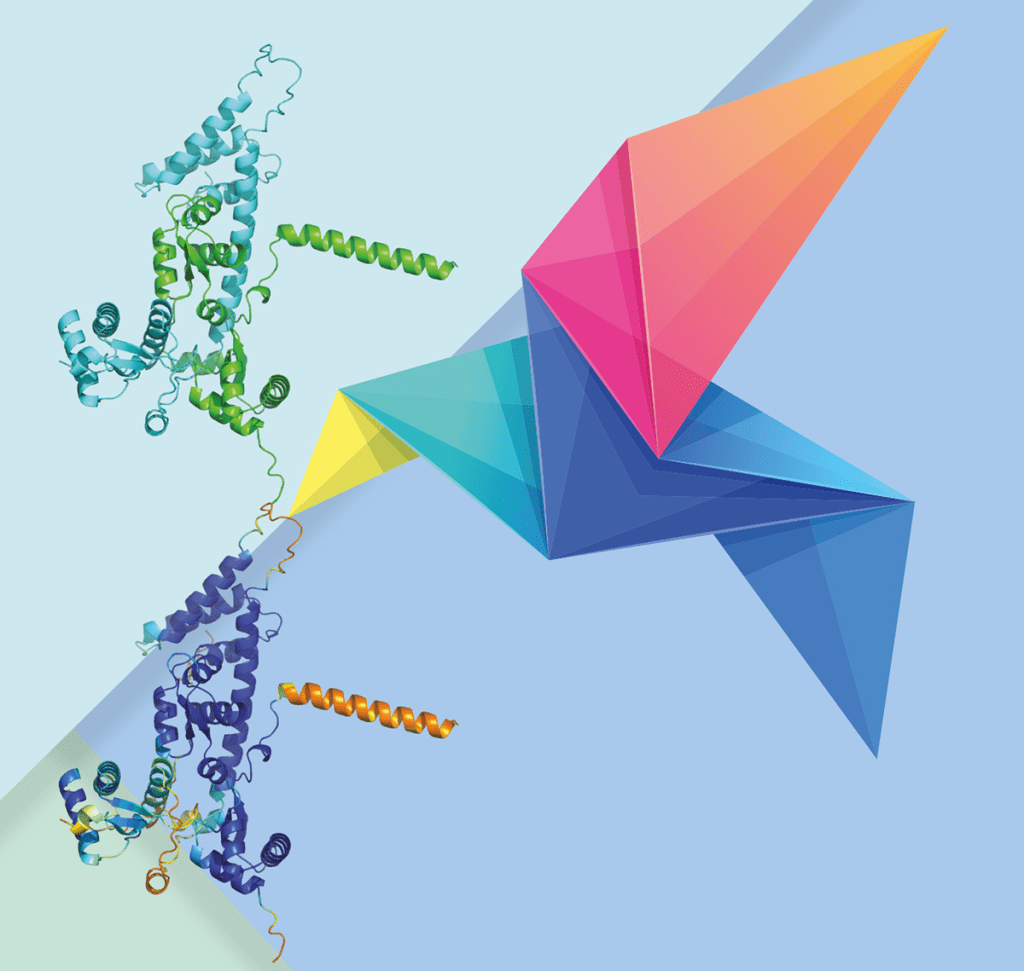
This artwork of an origami bird holds AlphaFold 3 predictions of a complex of two proteins (ScpA and ScpB) in its beak. The protein complex is important during cell division in bacteria. Top: ScpA is cyan and ScpB is green. Bottom: Confidence measures, where dark blue is very high confidence, light blue is confident, yellow is low confidence, and orange is very low confidence in the structural prediction. Credit: AlphaFold 3, Katie Michie.
A protein is made from of a chain of amino acids strung together like beads on a necklace. This chain spontaneously folds, like origami, into intricate pleats, folds, and loops through interactions between its amino acids. The resulting unique 3D structure largely determines its vital function within the lifeform. Solving the structure allows biologists to better understand how the protein works and design experiments to affect and modify it.
The smallest known protein, TAL, influences development of the fruit fly Drosophila melanogaster and has just 11 amino acids. The largest, Titin, is found in human muscle cells and is made up of roughly 35,000.
Proteins are far too tiny to inspect under a regular microscope. For decades researchers used complex experimental techniques, such as X-ray crystallography, nuclear magnetic resonance (NMR) spectroscopy, and cryogenic electron microscopy (cryo-EM) to solve their structures. It’s painstaking, time-consuming work that takes specialised skill and sometimes hundreds of thousands of dollars. And, as Kate Michie can attest, success is not always guaranteed.
“I spent four years trying to solve the crystal structure of a complex of two human proteins and got scooped. You know, I got nothing out of four years. I worked really hard at it, and it was a really difficult project. AlphaFold can calculate those in a few hours,” says Michie, who is chief scientist of the Structural Biology Facility at the Mark Wainwright Analytical Centre, of the University of New South Wales Sydney.
On 8 May 2024 Nature dropped a paper introducing the third and latest iteration of the artificial intelligence (AI) system AlphaFold, which predicts the 3D structure of proteins from their amino acid sequences. Google DeepMind and Isomorphic Labs, both subsidiaries of Alphabet, co-developed the new model. They say AlphaFold 3 (AF3) is “a revolutionary model that can predict the structure and interactions of all life’s molecules with unprecedented accuracy”. But, while AF3 has generated significant interest since its release, it has simultaneously sparked criticism among those in the scientific community.
Let’s take a closer look at how AI is changing the world of structural biology.
A revolution in protein structure
AF3’s predecessor, AlphaFold 2, was released as open source code in July 2021 and immediately changed the game in structural biology.
“I contacted the high-performance computation people and said, ‘we really need to get this piece of code running’. And then I asked my colleague, ‘Do you have any structures that you never submitted to the Protein Data Bank?’” says Michie.
The Protein Data Bank (PDB) is the global archive of all the experimentally solved structures for large biological molecules. As of June 2024, its estimated to include more than 220,000 proteins, which sounds like a lot until you consider the number of proteins we know of exceeds 200 million.
“My colleague sent me a sequence of a small protein he never submitted to the PDB, I ran it, and I just sent him the result. His email response to me was: ‘My mind is blown!’ And he said, ‘I immediately thought someone else must have solved the structure.’”
But they hadn’t, AF2 had accurately predicted the 3D structure of the protein from its amino acid sequence alone. What had taken years to describe experimentally had been done in just a few hours.
AF2 is a deep learning algorithm. In the world of AI that means it simulates the neural networks found in human brains. First, it takes the protein sequence of interest and searches several databases for similar proteins. By comparing these sequences, it can identify areas of similarity and difference to understand how the protein has changed across evolution.
For instance, if two amino acids are in close contact in 3D space then a mutation in one will usually be accompanied by a mutation in the other (to conserve the structure of the protein). But if they are far apart then they tend to evolve independently from each other. Using this to work out the relative positions of the amino acids, AF2 then takes its training on PDB structural data and iteratively constructs a 3D model of the protein’s structure with relatively high accuracy.
Scientists can take advantage of that predicted structure to accelerate their science by doing smarter, more strategic experiments in the laboratory right off the bat. “I’ve done work with some scientists working with immune complexes, and the models coming out of AlphaFold enable them to really trim down the number of animal experiments they do,” says Michie. “So instead of making say 20 CRISPR mice, they only might make two.”
As seen in AlphaFold 3, a structural prediction of Fos and Jun transcription factors with the DNA sequence they bind. The top panel shows the model and confidence data, and the green chart shows the high confidence of them binding to each other. Credit: AlphaFold 3, Katie Michie.
Crystal clues
An accurate AlphaFold structure can also be the crucial missing piece of the puzzle that allows researchers to experimentally solve the structure using X-ray crystallography.
“One of my other colleagues is virologist and he’d been working on a protein that had eluded structural elucidation for 20–30 years. It was from the world’s first known retrovirus,” says Michie.
“The trick of crystallography is you need to know two components of the maths to solve them,” she continues. The diffraction data provided by X-ray crystallography gives you one of those components, but you don’t have the other: the phase.
Traditional methods of obtaining phase information had proved unsuccessful, until Michie suggested using AlphaFold instead.
“Immediately the structure came out. AlphaFold helped him get the crystals but then actually enabled him to phase the structure. It told us that the Alpha Fold model was very good, but it also fixed up this problem in structural biology.”
To Michie, AlphaFold represents a massive step forward: “it’s genuinely the biggest scientific advance in my career”.
“The Alpha Fold model was very good, but it also fixed up this problem in structural biology.”
Predicting the structures of life’s molecules
Proteins don’t exist in a vacuum. They move around, bind to and modify each other, and even form large, complicated complexes.
Peter Czabotar, joint head of the Structural Biology Division at WEHI, the oldest medical research institute in Australia, says one of the early limitations of AF2 was you could only ever get structural predictions of one protein, alone. “Often what you’re interested in is how different proteins will interact with each other. For example, we work on proteins that are involved with cell death and the interactions between those proteins will dictate whether a cell will live or die.”
The gap has since been bridged by other research groups adapting and building upon AF2’s open source code, and with the AlphaFold-Multimer extension in October 2021.
The newest version, AF3, extends upon this capability by predicting interactions of multiple proteins, and nucleic acids (DNA and RNA). It can predict the impact of ions and post-translational modifications – the addition of chemical groups to amino acids – on these molecular systems too. AF3 can also be used to predict how a selection of small molecules called ligands bind to proteins, though this is restricted to ligands that have high-quality experimental data available in the PDB.
“But where the real power is, something that we do a lot of, is in the drug discovery world,” says Czabotar. “And it is extremely powerful for that, potentially, but they haven’t enabled that in the way that it’s released. We’ve done drug discovery against cell death proteins, for example. I can’t take one of the drugs that we’ve worked with and see how it interacts with my target protein, I can only use the [ligands] that they’ve enabled us to use.”
That capability to predict the structure of novel drug molecules interacting with target proteins seems to be restricted to Isomorphic Labs, which was launched in 2021 to pursue commercial drug discovery.
AF3 uses a very different approach for this new suit of predictions: generative AI. After processing the sequence inputs, it assembles its predictions using a diffusion network, the likes of which power AI image generators. According to Isomorphic Labs’ website: “the diffusion process starts with a cloud of atoms, and over many steps converges on its final, most accurate molecular structure”. Diffusion has been applied to protein structure prediction before, for example, in the seminal RoseTTAFold diffusion (RFdiffusion) by the Baker Laboratory at the Institute for Protein Design, the University of Washington.
But generative AI is not without its limitations. AF3 will occasionally produce structures with overlapping atoms (this is physically impossible) or replace a detail of the structure with its mirror image (chemically impossible). As a generative model, it is also prone to hallucinations in which it invents plausible-looking structures – particularly in disordered regions of the protein that lack a stable 3D structure – similarly to how a text to image AI struggles to create realistic-looking hands. In-built confidence measures help to identify when AF3 isn’t so sure about its structural prediction, but ultimately it takes a scientist with understanding of the underlying structural biology to come along and identify what’s gone wrong, and why.
“It’s very, very powerful. But it doesn’t exclude the need to necessarily confirm things experimentally. Whether that is by solving structures themselves or by, for example, testing the structures in some way in an experiment,” says Czabotar.
Concerns about code
In a major departure from AF2, access to the newest iteration of AlphaFold is limited to a web server and for non-commercial research only. “We have various structure-based drug discovery projects and some of them are purely academic, as students, PhDs and honours projects. But we also have had commercial partnerships, because that’s a way to push your discoveries into a clinical setting,” says Czabotar. “So generally, anything that is going to make an impact is done by an academic lab in a commercial partnership. Now, I guess it puts us in a bit of an awkward situation. Even if we could look at our compounds bound to the target [protein], there’s some projects where we won’t be able to do it because, you know, we’ve ticked a box.”
AF3’s accompanying Nature paper was also published without the source code, but with a ‘pseudocode’ instead – a detailed description of what the code can do and how it works. This prompted an open letter to the Editors of Nature, published 16 May and endorsed by more than 1,000 scientists as of June.
The letter raised concerns that “the absence of available code compromises peer review” and that the pseudocode released would “require months of effort to turn into workable code that approximates the performance, wasting valuable time and resources”. Access to the web server was also initially capped at 10 predictions per day, which the letter stated, “restricts the scientific community’s capacity to verify the broad claims of the findings or apply the predictions on a large scale”.
The sentiments appear to have hit home. Shortly after the letter’s release, DeepMind’s Vice President of research, Pushmeet Kohli announced via X that they would double the daily job limit to 20 and are “working on releasing the AF3 model (incl weights) for academic use … within 6 months”.
On 22 May Nature responded in an editorial, stating its reasoning for publishing the paper without code: “the private sector funds most global research and development, and many of the results of such work are not published in peer-reviewed journals. We at Nature think it’s important that journals engage with the private sector and work with its scientists so they can submit their research for peer review and publication.”
In the meantime, other researchers won’t be sitting idly by until the code release at the end of 2024. Already, multiple teams are racing to develop their own open source versions of AlphaFold 3, without any strings attached.
October 10, 1699 The Spanish issued a royal decree which stated that every African-American who came to St. Augustine, Florida, and adopted Catholicism would be free and protected from the English.
October 10, 1963 The Limited Test Ban Treaty—banning nuclear tests in the oceans, in the atmosphere, and in outer space—went into effect. The nuclear powers of the time—the United States, Great Britain, and the Soviet Union—had signed the treaty earlier in the year. In 1957, Nobel Prize-winner (Chemistry) Linus Pauling drafted the Scientists’ Bomb-Test Appeal with two colleagues, Barry Commoner and Ted Condon, eventually gaining the support of 11,000 scientists from 49 countries for an end to the testing of nuclear weapons. These included Bertrand Russell, Albert Einstein, and Albert Schweitzer. Linus Pauling Pauling then took the resolution to Dag Hammarskjöld, then Secretary-General of the United Nations, and sent copies to both President John F. Kennedy and Soviet Premier Nikita Kruschev. The final treaty had many similarities to Pauling’s draft. It went into effect the same day as the announcement of Pauling’s second Nobel Prize, this time for Peace.
October 10, 1967 The Outer Space Treaty (Treaty on Principles Governing the Activities of States in the Exploration and Use of Outer Space, Including the Moon and Other Celestial Bodies) demilitarizing outer space went into force.It sought to avoid “a new form of colonial competition” as in the Antarctic Treaty, and the possible damage that self-seeking exploitation might cause. Discussions on banning weapons of mass destruction in orbit had begun among the major powers ten years earlier. 1949 painting by Frank Tinsley of the infamous “Military Space Platform” proposed by then Secretary of Defense James Forrestal in the December 1948 military budget. The text of the treaty Read more
October 10, 1986 Elliott Abrams, then assistant secretary of state for inter-American affairs, testified before the Senate Foreign Relations Committee (in closed executive session) that he did not know that Marine Lt. Col. Oliver North, a White House employee in the Reagan administration, was directing illegal arms sales to Iran and diverting the proceeds to assist the Nicaraguan contras. Abrams pled guilty in 1991 to withholding information on the Iran-contra affair during that congressional testimony, but was pardoned by President George H.W. Bush. Elliott Abrams Presidents George W. Bush & George H.W. Bush Oliver North Read more about the pardons
October 10, 1987 Thirty thousand Germans demonstrated against construction of a large-scale nuclear reprocessing installation at Wackersdorf in mostly rural northern Bavaria.
October 10, 2002 The House voted 296-133 to pass the “Joint Resolution to Authorize the Use of United States Armed Forces Against Iraq,” giving President George W. Bush broad authority to use military force against Iraqi leader Saddam Hussein, with or without U.N. support.
This is a doctor who served in Gaz and explains how horrible it is with Israeli soldiers shooting children as sport. He talks of dealing with children with their intestines hanging out and they have to operate with out pain killers. Please watch to see how horrific Israel is being at this point.
Sorry I have not been posting much. Really struggling right now. Hugs
Dr. Mohammed Mustafa joins us to discuss the horrors he has witnessed while volunteering at hospitals in Gaza. Here is a link to the fundraiser for a children’s hospital in Gaza. Live-streamed on September 23, 2025.
Jimmy Kimmel has been returned to air after Trump’s attacks on free speech, and the men of MAGA crash Grindr in Arizona during the Charlie Kirk memorial.




 Scottie's Playtime