This caller is a well know immegration lawyer who calls in often. There has been a long running joke about the buttons on Sam’s shirts so ignore that part. The lawyer talks about what ICE is doing to help the detained people and he describes how horrific the conditions are. The goal is to make it so horrific these people will self-deport willingly. But the government is doing everything possible to hurt and harm the immigrants and detained people because of hate and bigotry of ICE and the white supremacists in the US government. Hugs
President Donald Trump has long treated reality like something that can be bent to his will — declare that everything is under control, insist the operation is flawless and expect the people around him to project the same confidence whether the facts cooperate or not.
But as the war in the Middle East continues to spiral outward, the White House is once again finding that projecting strength and actually convincing people things are under control are two very different things.
President Donald Trump speaks during a roundtable discussion on college sports in the East Room of the White House on March 06, 2026 in Washington, DC. (Photo by Anna Moneymaker/Getty Images)
The latest flashpoint erupted after the White House posted a pair of bizarre, Hollywood-style propaganda videos celebrating U.S. missile strikes on Iran — a move critics say only reinforced the growing perception that the administration is treating a deadly war like a movie trailer or video game.
The posts immediately set off fierce backlash online. One video stitched together scenes from blockbuster action films with real footage of U.S. strikes on Tehran, while another blended clips from a video game.
The first video, posted to the White House’s X account on Wednesday, March 4, opens with a clip from Call of Duty before cutting to footage of military aircraft taking off and real U.S. airstrikes on Iran. Upbeat music plays beneath the one-minute-and-five-second montage captioned, “Courtesy of the Red, White & Blue.”
Critics say the second video, posted Thursday, March 5, is even more disturbing.
The 42-second montage opens with a scene from Iron Man in which AI assistant J.A.R.V.I.S. tells Tony Stark, played by Robert Downey Jr., “Wake up. Daddy’s home,” before cutting to action-heavy clips from films including “Gladiator”, “Braveheart”, “Top Gun” and “Superman” — all interspersed with real footage of the U.S. attack on Tehran.
Another moment features a line from the television series “Better Call Saul”, when the character Saul Goodman declares, “You can’t conceive what I’m capable of.”
The video is captioned “JUSTICE THE AMERICAN WAY” and ends with a deep, ominous voice declaring, “Flawless victory.”
Some of the footage of the U.S. airstrikes appears to have been pulled directly from posts on U.S. Central Command’s own X account.
But instead of projecting strength or confidence, the videos quickly ignited outrage online — reinforcing the criticism that Trump’s team appears more interested in staging a cinematic show of force than explaining a coherent strategy for a rapidly escalating conflict.
French TV host Alex Taylor in post on X called it, “Quite simply one of the most disgusting things I’ve ever seen on here.”
“Whatever you think of the awful Iranian régime, the White House treating bombing raids like a cheap video game is gut-wrenchingly shocking America, your country is going to hell,” he declared.
Yahoo readers were similarly “disgusted” by the first post on Wednesday likening war to a video game.
“Just imagine if Obama or Bush or for that matter any other president had spliced together a propaganda video like this?? The GOPed would impeach within minutes of its release,” one reader pointed out.
Trump’s White House is known for posting both vulgar and offensive videos. In October after millions took to the streets in cities across the country for the “No Kings” protests, Trump posted a gross video of himself flying a fighter jet and dumping feces on demonstrators.
Others argued the videos trivialized the human cost of war and only reinforced the growing accusation that there are no adults in the room running the administration.
“RIDICULOUS VIDEO! Real people are dying IRL. Don’t make it like you just reset and no one’s has died.”
“CHILDISHLY INAPPROPRIATE, THOUGHTLESS, JUVENILE, SADISTIC, MEAN, IMMORAL AND SAD! WAR IS NOT A GAME OR A MOVIE,” one user wrote. “There are men, women and children being killed, maimed and left homeless because of the cruel leadership in America and Israel.”
“It is all a game with these creeps,” another commenter wrote. “Fantasy is their truth — men who know nothing about war using sci-fi and movies to sell their real killing.”
Some observers also pointed out the bizarre irony in the White House’s choice of film clips with one X user providing a full breakdown.
“Dumb f***ers didn’t understand any one of these movie plot lines?! That tracks.”
The backlash is unfolding as the war launched by the United States and Israel continues to escalate across the region.
In less than a week, since Trump, along with Israel, launched airstrikes on Iran on Saturday, Feb. 28, six American service members have been killed in an Iranian drone attack on a port in Kuwait.
Iran’s Red Crescent says the death toll in Trump’s bombing campaign inside Iran has reached at least 1,000, according to PBS.
Meanwhile, Trump and his allies have offered shifting explanations for the purpose of the operation.
The president initially suggested the campaign was about regime change in Tehran before later saying it was about preventing Iran from developing a nuclear weapon.
Defense Secretary Pete Hegseth has framed the operation as an effort to “protect Americans” and destroy Iranian ballistic missile capabilities.
But critics say the administration’s messaging has been anything but clear — feeding the rumor spreading online that the White House may not have a coherent plan for how the conflict ends.
Meanwhile, Iran is signaling it has no intention of backing down.
In an interview with NBC News, Iranian Foreign Minister Abbas Araghchi struck a defiant tone when asked whether Tehran feared a potential U.S. ground invasion.
“No, we are waiting for them,” Araghchi said. “Because we are confident that we can confront them — and that would be a big disaster for them.”
This report is terrifying. This country doesn’t have money to feed or give healthcare to the people, but we can spend billions arming and militarizing a secret masked unrestrained force with the power to detain, restrain, and kill the public with no consequence. The report explains how in other cases these groups take on a power and lawlessness of their own. They are the Taliban of the US. How soon until they show up with military vehicles not just in our cities but at our places to vote? What do ICE and border patrol need with high powered rifles, military armaments, and ar-15 style weapons for anyway, they are arresting the easy low hanging fruit from court rooms and hearings, school teachers, and kids. Plus remember they have ramped up public survaence, facial recognition, and databases on everyone. Hugs
In addition to staffing up at a furious rate, ICE and CPB are acquiring a vast cache of weapons from private contractors, new data reveals. This will not end well—or anytime soon.
The “forever wars” abroad and the global war on terror after the September 11 attacks left behind a long trail of failure, disillusionment, and death—but they also funneled huge sums of taxpayer money to companies that supplied the equipment that made all that destruction possible. That resulted in windfalls for GOP-connected companies, and fueled a massive public-private bureaucracy that grew harder to rein in as it metastasized to monstrous proportions.
Something like this is happening again in a different theater of operations: Donald Trump’s campaign of violent mass deportations. It’s becoming its own forever war: It could drag on for years or decades without success. It’s producing misguided military occupations of restive local populations. It has launched a huge arms buildup. And it also has what might be termed its very own war profiteers.
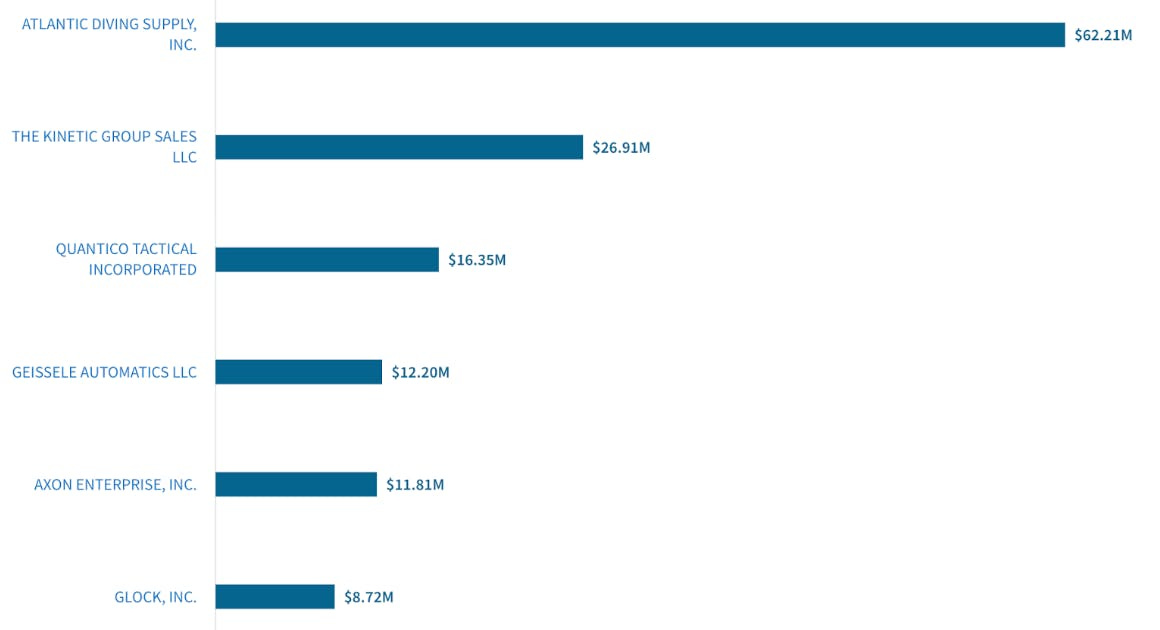
To wit: A handful of private companies that manufacture weaponry and ammunition have already inked very lucrative contracts with the Department of Homeland Security, which will provide it with enormous stockpiles of military-style equipment, some to the tune of tens of millions of dollars, according to data from Senator Adam Schiff’s office, which is probing DHS contracts.
The pileup of all that equipment hints at a major long-term problem. Just as we saw in the long aftermath of September 11, this new and evolving MAGA terror bureaucracy will expand in grotesque ways. It too will grow less constrained as it amasses more troops—and more firepower.
A harrowing glimpse of this future lies in a new report by Schiff that has gotten surprisingly little notice: It finds that Immigration and Customs Enforcement and Customs and Border Protection have formally approved contracts for at least a whopping $144 million in weapons, ammunition, and other accessories during Trump’s first year. The analysis—based on government contracting data—documents at least a fourfold increase for ICE and a doubling for CBP, relative to 2024, concluding that this will “build a heavily-armed domestic police force.”
It’s eye-opening stuff. One ICE contract is with Geissele Automatics for millions of dollars’ worth of “precision long guns and accessories” to support “armed agents” and other ICE operations, Schiff’s report says. This involves an unknown number of Geissele Border Patrol rifles, the report notes, describing this weapon as an “AR-style rifle with military specifications.” CBP contracted for millions of dollars more in rifles, as well.
ICE and CBP also contracted with Glock for millions of dollars in handguns and accessories, the report says. Taking all these contracts together, the report starkly concludes: “ICE and CBP have together placed orders to purchase thousands of new high-powered lethal weapons at taxpayer expense.”
There’s still more. The report documents ICE and CBP contracts totaling more than $30 million in ammunition and more than $25 million in contracts for the “non-lethal” weapons. That’s not a reassuring description: They include Tasers, pepper spray, and tear gas canisters.
In short, we’re looking at a massive stockpiling of weapons that will be in ICE’s and CBP’s possession for years to come. And someone is supplying all that equipment.
At my request, Schiff’s office analyzed the contracting data it collected to determine which companies are the top ICE and CBP contractors. Here are the results, per a chart provided by Schiff’s staff:
These particular contracts are mostly for small arms (including AR-style rifles), ordnance, ammunition, and related accessories like gun sights and suppressors, Schiff’s office says. A subcategory includes pepper spray, Tasers, tear gas, and other “non-lethal” weaponry.
“These contracts expose how DHS has set in motion a massive surge in spending to put even more dangerous weapons in ICE and CBP’s arsenal,” Schiff told me in an emailed statement. “This misuse of taxpayer dollars to maximally arm federal immigration agents, including those with questionable vetting and insufficient training, must end.”
In a sense, we’re seeing yet more cancerous growth of the post-September 11 national security bureaucracy, but with a more intensified inward focus. DHS, which was created after September 11, has long had a domestic anti-terror component. But now Trump has supercharged its role as a mass immigrant-expulsion operation that is unleashing violence toward U.S. citizens—and even killing them—while operating with near-total impunity among American populations, which Trump officials openly describe as a good thing.
“It’s the transformation of DHS from an entity that protected the homeland from external threats to one increasingly policing American society,” Donald Moynihan, author of an excellent Substack on state capacity, tells me. With this ramped-up stockpiling, Moynihan says, the endgame will be “filling those warehouses with people and using those guns and that technology to control American cities.”
The war on terror also teaches us that expanding bureaucracies like these only grow harder to control over time. “Trump is building up a well-funded, poorly trained paramilitary force that could easily take on a life of its own,” says Georgetown national security law expert Rosa Brooks. “Once you have a massive moneymaking machine ginned up, it’s hard to reverse course and turn off the spigot.”
The folly and waste of the forever wars, we are endlessly told, enabled Trump to successfully campaign against elites who foolishly sank unlimited blood and treasure into misguided imperial adventures abroad. Yet Trump’s mass deportations constitute their own forever war.
This is not meant glibly: Measured in political years, Trump’s mass expulsions actually will seemingly go on forever. Deporting an estimated 14 million people, if it continues at current rates, will take longer than this Trump term followed by two terms of President JD Vance. The scaled-up prison camps, if they materialize, will seemingly have to be packed for years, constituting an ever-expanding immigrant carceral state.
Meanwhile, just like the forever wars, this fiasco is also birthing its own captive constituencies and internal political momentum. This includes everyone from the private contractors supplying it to the large population of MAGA-adjacent young (and not so young) men signing up for ICE, which writer John Ganz describes as “an employment program for the Trumpenproletarian mob.”
Any entity this hypermaterialized—especially one simultaneously aimed at immigrants—will inevitably attract white nationalists and evolve into a political paramilitary force in thrall to ideologically aligned leaders, as Substacker Brian Beutler explains. This is borne out in ICE recruitment messaging, which explicitly seeks to get recruits invested in the mission of achieving national rejuvenation by employing cleansing ethno-nationalist violence.
The stockpiling of weapons underscores the point unnervingly. Now that Trump is feinting toward winding down in Minneapolis, what will be done with all that ideologically fired-up ICE manpower—and all that heavy weaponry? Even a relatively benign answer is alarming. It means more operations like the one in Minneapolis, but packaged with a sheen of new constraints that will simply be shrugged off by the force of this machine’s internal momentum—with more horrors awaiting us.
This is a quagmire for Trump, even if he doesn’t know it. Appropriately enough, it has also been created by unprincipled elite folly—only MAGA elites support it, while the American people verymuchdo not. Trump’s approval on immigration, once a foundational political strength, has deteriorated rapidly at moments when ICE dominates our attention. If his forever war continues in its current form—with its bureaucracy metastasizing in unpredictable directions—it will further cripple his presidency. And it’s darkly fitting that it may take down the presidential ambitions of Vance, also a self-proclaimed critic of forever war follies, along with him.
First the judges started questioning the truth of government officials and attorneys. Then the judges accused the DOJ / ICE of ignoring court rulings and orders. Now in this case Bondi’s posts clearly violate a judges orders and the constant posting on social media is designed to color or bias the public and potential jurors. The coruptin of this administration if beyoung anything we have ever seen in the US. I just read that Kash Patel has ordered the elete tatical teams around the country to rotate providing complete security and transportation. Not the regular FBI but the strategic elite teams. Hugs
“The government failed to respect Ms. Flores’s dignity and privacy, exposed her to a risk of doxxing, and generally thumbed its nose at the notion that defendants are innocent until proven guilty. The post also directly violated a court order sealing the case,” the judge wrote. “Notwithstanding, the government now seeks an accommodation from the Court that it blatantly failed to give Ms. Flores and her codefendants.”
The attorney general’s posts included names and photographs of the defendants.
Attorney General Pam Bondi’s posts made the government’s request for court-ordered discretion for its agents “eyebrow-raising, to say the least,” one judge wrote. | Allison Robbert/AP
Two federal judges have raised concerns about Attorney General Pam Bondi’s use of social media to publicize a wave of arrests last month of people charged with interfering with federal officers during an immigration enforcement surge in Minnesota.
In an order earlier this week, Magistrate Judge Dulce Foster said Bondi’s posts on X including the names and, in many instances, photographs of the defendants shortly after their arrests “violated a court order” placing those cases under seal.
Foster leveled the criticism in connection with the prosecution of Nitzana Flores, a South Haven, Minnesota, resident accused of assaulting two Border Patrol officers during a scuffle last month in Minneapolis surrounding the arrest of another person for allegedly ramming a government vehicle.
The judge said Bondi’s posting of the names and arrest photos undercut prosecutors’ request for an order to prohibit defense attorneys from publicly disclosing personal information about immigration agents involved in the case against Flores. The requested order would also prohibit any defense counsel from sharing that information with their client.
Foster said Bondi’s social media posts made the government’s request for court-ordered discretion for its agents “eyebrow-raising, to say the least.”
“The government failed to respect Ms. Flores’s dignity and privacy, exposed her to a risk of doxxing, and generally thumbed its nose at the notion that defendants are innocent until proven guilty. The post also directly violated a court order sealing the case,” the judge wrote. “Notwithstanding, the government now seeks an accommodation from the Court that it blatantly failed to give Ms. Flores and her codefendants.”
Foster modified the government’s proposal by broadening it to cover any party, victim or witness, while narrowing it to details such as phone numbers, residential addresses, email addresses and dates of birth. The judge also declined to restrict what evidence Flores can see and declined to prohibit disclosure of identities, which would include names and photographs.
At a hearing in a separate Minneapolis case last week, another magistrate judge, Shannon Elkins, directed prosecutors to “address whether the public posting of photographs violated the Court’s sealing order.” The government missed a deadline Tuesday to respond. Elkins later agreed to extend the deadline until Monday.
Justice Department spokespeople did not respond to requests for comment, but there are signs that Bondi got the magistrates’ messages.
On Friday, Bondi was careful not to jump the gun when announcing a new, massive wave of arrests in connection with a disruptive immigration-related protest at a St. Paul church last month. The new indictment Bondi announced added 30 defendants to the nine people already charged, who include former CNN anchor Don Lemon.
“YOU CANNOT ATTACK A HOUSE OF WORSHIP,” Bondi wrote in an X post that went up within a minute of the indictment being unsealed in the court’s online docket. “If you do so, you cannot hide from us — we will find you, arrest you, and prosecute you. This Department of Justice STANDS for Christians and all Americans of faith.”
While booking photos or mugshots are public in many states, the federal government has traditionally cited privacy concerns to resist making them public in federal criminal cases. In 2012, the Obama administration instituted a nationwide Justice Department policy to refuse release of such photos, except where necessary to track down a fugitive or for investigative reasons.
That policy appears to have been abandoned after President Donald Trump returned to office last year. The Justice Department has for decades routinely publicized the names, ages and hometowns of people arrested by including that information in press releases.
I feel our national security has been deeply harmed by the tRump adminsitration. I posted for tomorrow how Ukraine started making big gains against Russia’s invasion once they and foreign countries stopped sharing the war intel with the US. Seems clear everything Ukraine was sharing with the US went right to Putin. tRump’s amistration has given military secrets and tech to enemy countries just for their personal profit. And the worst of the stuff they hide. Horrific and I wonder with the military purges if the US can actually recover in the next decade. Hugs
Reddit, Meta, and Google voluntarily “complied with some of the requests” for identifying details of users critical of Immigration and Customs Enforcement (ICE) sent as part of a recent wave of administrative subpoenas the Department of Homeland Security has been distributing to Big Tech the past few months, according to an anonymously sourced New York Times report.
Those three companies, plus Discord, have received “hundreds” of such requests that have come from DHS recently. Meta, it should be noted, is the parent company of Instagram, Facebook, and WhatsApp.
Administrative subpoenas used for this purpose represent an escalation. This tool, which comes not from a judge but from DHS itself, was formerly reserved for situations like child abductions, according to the Times.
The users were targeted because their posts “criticized ICE or pointed to the locations of ICE agents,” the Times says.
A Google spokesperson replied to the Times with a statement, saying “When we receive a subpoena, our review process is designed to protect user privacy while meeting our legal obligations,” and “We inform users when their accounts have been subpoenaed, unless under legal order not to or in an exceptional circumstance. We review every legal demand and push back against those that are overbroad.”
Gizmodo requested comment from Meta, Discord, and Reddit. We will update if we hear back.
According to the Times, one or multiple of the relevant companies have stated that they notify users of these requests from DHS, and give them a 14-day window to “fight the subpoena in court” before complying.
Amazon has also been accused of at least some degree of participation with ICE’s ongoing mass deportation efforts. In October, Amazon-owned Ring announced a partnership with Flock that would loop the AI-powered network into the content coming from users’ doorbell cameras. According to a 404 Media investigation, that network feeds information to law enforcement agencies at the local and federal levels, allowing for reasonable concern that ICE has access to all that footage.
Protesters have launched an effort called “Resist and Unsubscribe” targeting ten tech companies they perceive as exceptionally supportive of ICE. That list includes Meta, Google, and Amazon, but not Reddit.



 Scottie's Playtime