Markwayne Mullin! (And I know the consequences of this could be somewhat worse than so far, because he’s yet more natively stupid. But at the moment, LMAO!)
Trump says he’s replacing Homeland Security Secretary Noem with GOP Sen. Markwayne Mullin
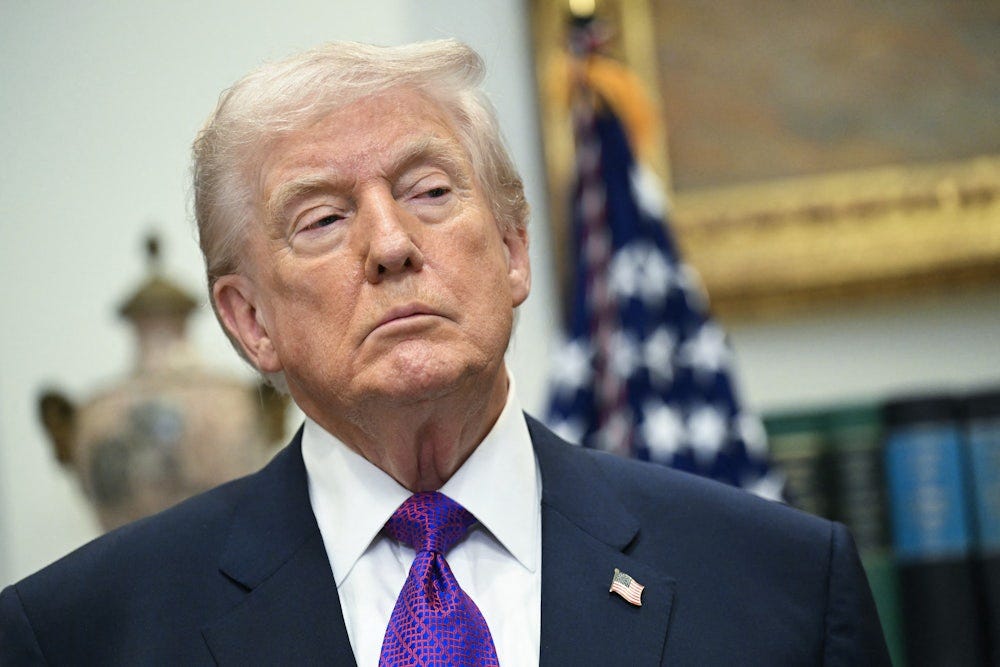
WASHINGTON (AP) — President Donald Trump said he’s replacing his embattled Homeland Security Secretary Kristi Noem and will nominate in her place Oklahoma Republican Sen. Markwayne Mullin.
Trump made the announcement on social media on Thursday, two days after Noem faced a grilling on Capitol Hill from GOP members as well as Democrats.
Trump says he’ll make Noem a “Special Envoy for The Shield of the Americas,” a new security initiative that he said would focus on the Western Hemisphere. (snip-fluffy stuff we already know.)
Mullin would need to be confirmed by the Senate, but under a federal law governing executive branch vacancies, he would be allowed to serve as an acting Homeland Security secretary as long as his nomination is formally pending.
This report is terrifying. This country doesn’t have money to feed or give healthcare to the people, but we can spend billions arming and militarizing a secret masked unrestrained force with the power to detain, restrain, and kill the public with no consequence. The report explains how in other cases these groups take on a power and lawlessness of their own. They are the Taliban of the US. How soon until they show up with military vehicles not just in our cities but at our places to vote? What do ICE and border patrol need with high powered rifles, military armaments, and ar-15 style weapons for anyway, they are arresting the easy low hanging fruit from court rooms and hearings, school teachers, and kids. Plus remember they have ramped up public survaence, facial recognition, and databases on everyone. Hugs
In addition to staffing up at a furious rate, ICE and CPB are acquiring a vast cache of weapons from private contractors, new data reveals. This will not end well—or anytime soon.
The “forever wars” abroad and the global war on terror after the September 11 attacks left behind a long trail of failure, disillusionment, and death—but they also funneled huge sums of taxpayer money to companies that supplied the equipment that made all that destruction possible. That resulted in windfalls for GOP-connected companies, and fueled a massive public-private bureaucracy that grew harder to rein in as it metastasized to monstrous proportions.
Something like this is happening again in a different theater of operations: Donald Trump’s campaign of violent mass deportations. It’s becoming its own forever war: It could drag on for years or decades without success. It’s producing misguided military occupations of restive local populations. It has launched a huge arms buildup. And it also has what might be termed its very own war profiteers.
To wit: A handful of private companies that manufacture weaponry and ammunition have already inked very lucrative contracts with the Department of Homeland Security, which will provide it with enormous stockpiles of military-style equipment, some to the tune of tens of millions of dollars, according to data from Senator Adam Schiff’s office, which is probing DHS contracts.
The pileup of all that equipment hints at a major long-term problem. Just as we saw in the long aftermath of September 11, this new and evolving MAGA terror bureaucracy will expand in grotesque ways. It too will grow less constrained as it amasses more troops—and more firepower.
A harrowing glimpse of this future lies in a new report by Schiff that has gotten surprisingly little notice: It finds that Immigration and Customs Enforcement and Customs and Border Protection have formally approved contracts for at least a whopping $144 million in weapons, ammunition, and other accessories during Trump’s first year. The analysis—based on government contracting data—documents at least a fourfold increase for ICE and a doubling for CBP, relative to 2024, concluding that this will “build a heavily-armed domestic police force.”
It’s eye-opening stuff. One ICE contract is with Geissele Automatics for millions of dollars’ worth of “precision long guns and accessories” to support “armed agents” and other ICE operations, Schiff’s report says. This involves an unknown number of Geissele Border Patrol rifles, the report notes, describing this weapon as an “AR-style rifle with military specifications.” CBP contracted for millions of dollars more in rifles, as well.
ICE and CBP also contracted with Glock for millions of dollars in handguns and accessories, the report says. Taking all these contracts together, the report starkly concludes: “ICE and CBP have together placed orders to purchase thousands of new high-powered lethal weapons at taxpayer expense.”
There’s still more. The report documents ICE and CBP contracts totaling more than $30 million in ammunition and more than $25 million in contracts for the “non-lethal” weapons. That’s not a reassuring description: They include Tasers, pepper spray, and tear gas canisters.
In short, we’re looking at a massive stockpiling of weapons that will be in ICE’s and CBP’s possession for years to come. And someone is supplying all that equipment.
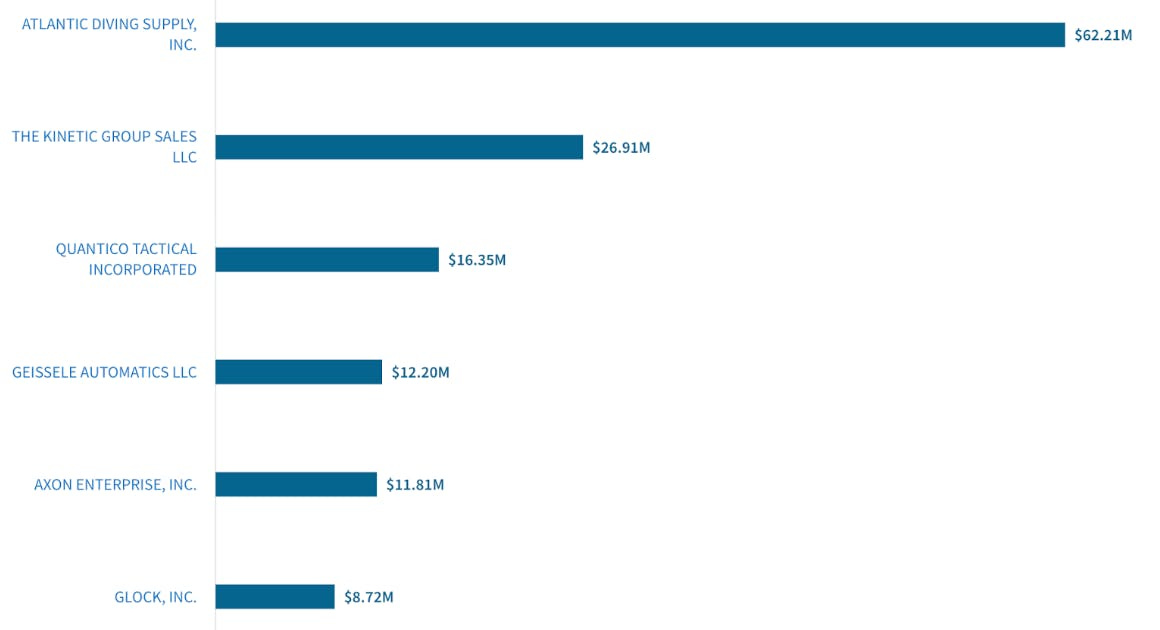
At my request, Schiff’s office analyzed the contracting data it collected to determine which companies are the top ICE and CBP contractors. Here are the results, per a chart provided by Schiff’s staff:
These particular contracts are mostly for small arms (including AR-style rifles), ordnance, ammunition, and related accessories like gun sights and suppressors, Schiff’s office says. A subcategory includes pepper spray, Tasers, tear gas, and other “non-lethal” weaponry.
“These contracts expose how DHS has set in motion a massive surge in spending to put even more dangerous weapons in ICE and CBP’s arsenal,” Schiff told me in an emailed statement. “This misuse of taxpayer dollars to maximally arm federal immigration agents, including those with questionable vetting and insufficient training, must end.”
In a sense, we’re seeing yet more cancerous growth of the post-September 11 national security bureaucracy, but with a more intensified inward focus. DHS, which was created after September 11, has long had a domestic anti-terror component. But now Trump has supercharged its role as a mass immigrant-expulsion operation that is unleashing violence toward U.S. citizens—and even killing them—while operating with near-total impunity among American populations, which Trump officials openly describe as a good thing.
“It’s the transformation of DHS from an entity that protected the homeland from external threats to one increasingly policing American society,” Donald Moynihan, author of an excellent Substack on state capacity, tells me. With this ramped-up stockpiling, Moynihan says, the endgame will be “filling those warehouses with people and using those guns and that technology to control American cities.”
The war on terror also teaches us that expanding bureaucracies like these only grow harder to control over time. “Trump is building up a well-funded, poorly trained paramilitary force that could easily take on a life of its own,” says Georgetown national security law expert Rosa Brooks. “Once you have a massive moneymaking machine ginned up, it’s hard to reverse course and turn off the spigot.”
The folly and waste of the forever wars, we are endlessly told, enabled Trump to successfully campaign against elites who foolishly sank unlimited blood and treasure into misguided imperial adventures abroad. Yet Trump’s mass deportations constitute their own forever war.
This is not meant glibly: Measured in political years, Trump’s mass expulsions actually will seemingly go on forever. Deporting an estimated 14 million people, if it continues at current rates, will take longer than this Trump term followed by two terms of President JD Vance. The scaled-up prison camps, if they materialize, will seemingly have to be packed for years, constituting an ever-expanding immigrant carceral state.
Meanwhile, just like the forever wars, this fiasco is also birthing its own captive constituencies and internal political momentum. This includes everyone from the private contractors supplying it to the large population of MAGA-adjacent young (and not so young) men signing up for ICE, which writer John Ganz describes as “an employment program for the Trumpenproletarian mob.”
Any entity this hypermaterialized—especially one simultaneously aimed at immigrants—will inevitably attract white nationalists and evolve into a political paramilitary force in thrall to ideologically aligned leaders, as Substacker Brian Beutler explains. This is borne out in ICE recruitment messaging, which explicitly seeks to get recruits invested in the mission of achieving national rejuvenation by employing cleansing ethno-nationalist violence.
The stockpiling of weapons underscores the point unnervingly. Now that Trump is feinting toward winding down in Minneapolis, what will be done with all that ideologically fired-up ICE manpower—and all that heavy weaponry? Even a relatively benign answer is alarming. It means more operations like the one in Minneapolis, but packaged with a sheen of new constraints that will simply be shrugged off by the force of this machine’s internal momentum—with more horrors awaiting us.
This is a quagmire for Trump, even if he doesn’t know it. Appropriately enough, it has also been created by unprincipled elite folly—only MAGA elites support it, while the American people verymuchdo not. Trump’s approval on immigration, once a foundational political strength, has deteriorated rapidly at moments when ICE dominates our attention. If his forever war continues in its current form—with its bureaucracy metastasizing in unpredictable directions—it will further cripple his presidency. And it’s darkly fitting that it may take down the presidential ambitions of Vance, also a self-proclaimed critic of forever war follies, along with him.
Spain, US jointly operate military bases in Moron, Rota
US tankers head to Germany, France from Spanish bases, maps show
Spain says its bases will not be used for Iran attacks
MADRID, March 2 (Reuters) – Fifteen U.S. aircraft have left the Rota and Moron military bases in southern Spain since the U.S. and Israel launched weekend attacks on Iran, maps by flight tracking website FlightRadar24 showed on Monday.
Foreign Minister Jose Manuel Albares said Spain would not allow its military bases, which are jointly operated by the U.S. and Spain but under Spanish sovereignty, to be used for attacks on Iran, which Spain has condemned.
First the judges started questioning the truth of government officials and attorneys. Then the judges accused the DOJ / ICE of ignoring court rulings and orders. Now in this case Bondi’s posts clearly violate a judges orders and the constant posting on social media is designed to color or bias the public and potential jurors. The coruptin of this administration if beyoung anything we have ever seen in the US. I just read that Kash Patel has ordered the elete tatical teams around the country to rotate providing complete security and transportation. Not the regular FBI but the strategic elite teams. Hugs
“The government failed to respect Ms. Flores’s dignity and privacy, exposed her to a risk of doxxing, and generally thumbed its nose at the notion that defendants are innocent until proven guilty. The post also directly violated a court order sealing the case,” the judge wrote. “Notwithstanding, the government now seeks an accommodation from the Court that it blatantly failed to give Ms. Flores and her codefendants.”
The attorney general’s posts included names and photographs of the defendants.
Attorney General Pam Bondi’s posts made the government’s request for court-ordered discretion for its agents “eyebrow-raising, to say the least,” one judge wrote. | Allison Robbert/AP
Two federal judges have raised concerns about Attorney General Pam Bondi’s use of social media to publicize a wave of arrests last month of people charged with interfering with federal officers during an immigration enforcement surge in Minnesota.
In an order earlier this week, Magistrate Judge Dulce Foster said Bondi’s posts on X including the names and, in many instances, photographs of the defendants shortly after their arrests “violated a court order” placing those cases under seal.
Foster leveled the criticism in connection with the prosecution of Nitzana Flores, a South Haven, Minnesota, resident accused of assaulting two Border Patrol officers during a scuffle last month in Minneapolis surrounding the arrest of another person for allegedly ramming a government vehicle.
The judge said Bondi’s posting of the names and arrest photos undercut prosecutors’ request for an order to prohibit defense attorneys from publicly disclosing personal information about immigration agents involved in the case against Flores. The requested order would also prohibit any defense counsel from sharing that information with their client.
Foster said Bondi’s social media posts made the government’s request for court-ordered discretion for its agents “eyebrow-raising, to say the least.”
“The government failed to respect Ms. Flores’s dignity and privacy, exposed her to a risk of doxxing, and generally thumbed its nose at the notion that defendants are innocent until proven guilty. The post also directly violated a court order sealing the case,” the judge wrote. “Notwithstanding, the government now seeks an accommodation from the Court that it blatantly failed to give Ms. Flores and her codefendants.”
Foster modified the government’s proposal by broadening it to cover any party, victim or witness, while narrowing it to details such as phone numbers, residential addresses, email addresses and dates of birth. The judge also declined to restrict what evidence Flores can see and declined to prohibit disclosure of identities, which would include names and photographs.
At a hearing in a separate Minneapolis case last week, another magistrate judge, Shannon Elkins, directed prosecutors to “address whether the public posting of photographs violated the Court’s sealing order.” The government missed a deadline Tuesday to respond. Elkins later agreed to extend the deadline until Monday.
Justice Department spokespeople did not respond to requests for comment, but there are signs that Bondi got the magistrates’ messages.
On Friday, Bondi was careful not to jump the gun when announcing a new, massive wave of arrests in connection with a disruptive immigration-related protest at a St. Paul church last month. The new indictment Bondi announced added 30 defendants to the nine people already charged, who include former CNN anchor Don Lemon.
“YOU CANNOT ATTACK A HOUSE OF WORSHIP,” Bondi wrote in an X post that went up within a minute of the indictment being unsealed in the court’s online docket. “If you do so, you cannot hide from us — we will find you, arrest you, and prosecute you. This Department of Justice STANDS for Christians and all Americans of faith.”
While booking photos or mugshots are public in many states, the federal government has traditionally cited privacy concerns to resist making them public in federal criminal cases. In 2012, the Obama administration instituted a nationwide Justice Department policy to refuse release of such photos, except where necessary to track down a fugitive or for investigative reasons.
That policy appears to have been abandoned after President Donald Trump returned to office last year. The Justice Department has for decades routinely publicized the names, ages and hometowns of people arrested by including that information in press releases.
“Then” (here, below “Now”) is also linked in today’s Peace & Justice newsletter. I’m posting from The Guardian so I can get the Then, and the Now from one tab because I’m lazy, I guess. I prefer to say “efficient, though.
US urges citizens to immediately depart over a dozen Middle Eastern countries
The US state department has urged Americans to immediately depart more than a dozen Middle Eastern countries amid US-Israeli strikes against Iran.
US citizens were urged to depart using commercial means from Bahrain, Egypt, Iran, Iraq, Israel, the [occupied] West Bank and Gaza, Jordan, Kuwait, Lebanon, Oman, Qatar, Saudi Arabia, Syria, United Arab Emirates and Yemen, according to Mora Namdar, the department’s assistant secretary for consular affairs.
Hundreds of thousands of travellers are currently stranded in the Gulf states, as the airspace over some of the world’s busiest international airports, including Dubai and Abu Dhabi, closed over the weekend.
The US Senate’s Democratic minority leader ChuckSchumer said a briefing from Trump administration officials about the US war with Iran“raised many more questions than it answered”.
“Look, a whole lot of questions were asked. I found their answers completely and totally insufficient,” Schumer told reporters as he exited the meeting. He departed without taking questions.
US secretary of state Marco Rubio as well as CIA director John Ratcliffe are among those briefing Congress leaders in a classified facility in the Capitol.
A reminder that you can follow our US politics live blog for more US-focused reaction and developments:
Thousands join ‘day of rage’ across the Middle East
This article is more than 15 years old
In Iraq, six killed as frustration erupts over corruption Yemen holds its biggest pro-democracy rally Egyptians demand accelerated reforms
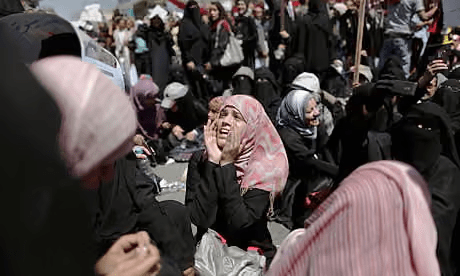
In Yemen’s capital, Sana’a, an anti-government protester chants slogans demanding the resignation of President Ali Abdullah Saleh. The president ordered security services to protect protesters. Photograph: Muhammed Muheisen/AP
Protests erupted in cities across the Middle East and North Africa. At least six people were reported killed and dozens injured in Iraq; thousands took to the streets in the Yemeni capital, Sana’a; and Egyptians gathered in Cairo’s Tahrir Square to demand an accelerated reform programme.
Iraq
Anger over corruption and abysmal basic services erupted in a “day of rage”, with the most serious clashes in Mosul and Hawija, in the north, and Basra in the south. At least six people were killed – three in Mosul and three in Hawija – and 75 injured in clashes with security services as protesters tried to attack government buildings.
Thousands of people made their way to the city’s Tahrir Square, but soldiers had closed it off with razor wire, using percussion grenades and firing in the air in an attempt to disperse crowds.
Lina Ali, 27, told Reuters: “The education system is bad. The health system is also bad. Services are going from bad to worse.” Protesters complained of high unemployment, a shortage of drinking water and frequent power cuts.
In Basra, the city’s governor, Shaltagh Abboud, said he would resign after 18 people were wounded in skirmishes between the 4,000 protesters and state security. A curfew was imposed until 6am tomorrow. There were also clashes in Falluja and Nassiriya.
Nouri al-Maliki, the prime minister, warned demonstrators they would become victims of al-Qaida and pro-Saddam violence.
Muntadar al-Zaidi, the Iraqi journalist who threw his shoes at George Bush, was arrested in Baghdad after travelling from Beirut to take part in the Day of Rage.
Yemen
Tens of thousands of protesters in Sana’a called for an end to the 32-year reign of President Ali Abdullah Saleh. It was the biggest pro-democracy rally in Yemen’s recent history. But small, yet violent, protests have been taking place across the country since Egypt’s Hosni Mubarak resigned two weeks ago.
Local media reported 30,000 anti-government demonstrators in Sana’a and more than 100,000 nationwide. Students, tribesmen, opposition activists and young professionals flooded the streets around Sana’a University, where protesters have been camped out since Sunday. “The people want the regime to fall,” they shouted, rising from their knees after a Friday prayer to mourn the deaths of two men shot dead on Tuesday by pro-Saleh supporters. The protest was peaceful, though at times tense. Protesters want better living conditions as well as political reform.
One banner read simply: “Look at the gap between the rich and poor.”
Riot police who tried to seize an anti-government protester had to fire in the air to dispel angry students demanding his release.
A few miles away, state media were out in force to film 10,000 middle-aged men, many carrying batons, marching up and down the streets yelling: “Saleh means stability.” These government loyalists, including impoverished tribesmen bussed in from far away, have been in Sana’a’s Tahrir Square for more than a month, holding rallies for which they have been given food, drink, and the placards, and accommodated in giant beige marquees. Anti-government protesters claim the loyalists are balataj, hired thugs, but Yemeni authorities deny any connection with the armed men.
Saleh has told his security forces to protect both sets of demonstrators and prevent any further clashes between them.
Egypt
Activists returned to Tahrir Square in their thousands to demand a faster pace to reforms. They want a new cabinet to replace one that includes many figures from the Mubarak regime. According to Al Jazeera they singled out the prime minister, Ahmed Shafik, who, they said, was hand-picked by Mubarak; and they want the former president, believed to be holed up in his Sharm el-Sheikh villa, to be put on trial and held accountable for his 31 years of rule,. They also want political prisoners released.
The ruling military council has promised elections within six months. “We do not want Shafik any more, even if they shoot us with bullets,” activists chanted. “Revolution until victory, revolution against Shafik and the palace.”
Tunisia
In the centre of Tunis, tens of thousands demanded the resignation of the prime minister, Mohamed Ghannouchi, seen as an ally of the ousted president. The uprising that forced former president Zine al-Abidine Ben Ali to flee on 14 January after 23 years in power was the catalyst for regional revolt. “Shame on the government!” and “Ghannouchi step down,” they shouted. Witnesses said it was the biggest protest since Ben Ali’s departure, when demonstrations were banned. Activists also protested against the bloody crackdown by forces loyal to Libya’s Muammar Gaddafi. Thousands of Libyans have fled to Tunisia.
Jordan
In the capital, Amman, 5,000 protested, demanding political reform. “Reform has become a necessity that cannot wait,” said Sheikh Hamza Mansour, the head of the Islamic Action Front, the country’s largest opposition group, at a rally. “It’s the demand of all Jordanians,” he added. Protestors chanted: “The people want to reform the regime”, “we want a fair electoral law”, and “people want an elected government”.
Bahrain
There were tens of thousands of anti-government protesters in Manama, adding to pressure for sweeping democratic change during two weeks of demonstrations in the strategic Gulf island kingdom. At least two marches converged on Manama’s landmark Pearl Square, the focal point of the uprising – the largest show of opposition strength so far.
Security forces made no immediate attempt to halt the marchers in an apparent sign that Bahrain’s rulers do not want to risk more bloodshed and denunciations from their Western allies.
Bahrain is the first Gulf state to be thrown into turmoil by the Arab world’s wave of change. The government had declared Friday a day of mourning for the seven people killed in clashes since 14 February.
Many protesters waved Bahrain’s red-and-white flag, chanting: “No dialogue before the government is dissolved,” and “For Bahrain’s future, we are not afraid to be killed.”
One procession split into separate groups of men and black-robed women, passing skyscrapers adorned with images of the nation’s ruling family.
Some demonstrators called on the US to do more to support their cause. “These people are fighting for freedom,” said Hussain Isa al-Saffar, 25. “The US … should be supporting freedom here.”
The White House said the national security adviser, Tom Donilon, spoke with Bahrain’s crown prince, Salman bin Hamad bin Isa Al Khalifa, on Thursday stating the US’s support for reforms through dialogue with opposition groups. The US chairman of the joint chiefs of staff, Admiral Mike Mullen, also held talks with Bahraini leaders Thursday.
In Pearl Square, a massive Bahraini flag was hoisted along with the phrase “martyrs’ square” in Arabic, a reference to those killed by security forces. Graphic photos of the dead were posted in the square, and a noose was fashioned around a portrait of Bahrain’s prime minister.
Palestine
The Palestinian Authority (PA) had authorised a Day of Rage to protest against the US veto of a UN security council resolution condemning Israeli settlements, but that was called off without explanation.
An unofficial protest on Thursday in Ramallah, the main city in the West Bank, demanded unity between the two main factions, Fatah and Hamas, as well as “liberation”.
Analysts say the Fatah-dominated PA and Gaza’s Hamas government are nervously watching uprisings elsewhere in the region. Palestinians in both Gaza and the West Bank complain of repression.


 Scottie's Playtime