I’m going to put it all in here (and it’s really long for a post,) though I don’t generally like just taking people’s hard work. But there are misinterpretations of who/what is not rightwing, and this helps, even though it’s a few years old. It’s getting more important to know, because there is so very much out there now, trying for views and clicks and whatever.Jeff Sharlet knows whereof he speaks; he brought to light The Family back in the late 90s early 2000s.
How to name the rude currents eroding the Left, those which have claimed the hearts, minds and Substacks of so many former friends and fellow travelers? There are the journalist-provocateurs and the readers who have followed them rightward, the Trumpers-come-lately marching on to Glenn Greenwald’s Rumble or vanishing into Max Blumenthal’s Grayzone. There are those not quite yet there, such as Ana Kasparian of The Young Turks, currently mourning the leftism she now believes “gaslit” her about a “crime wave” it refuses to admit. “I’m going through something very real and very sincere,” she told a “disaffected Democrats” podcast in July, “and it’s uncomfortable.” It is, indeed.
Consider the dislocation that flickers across the face of journalist Matt Taibbi in a TV interview this summer for the conspiracist, right-wing Epoch Times. Acclaimed by the Left during Occupy Wall Street as a scourge of corporate power, Taibbi is best known for his years at Rolling Stone. When the day eventually comes, the “vampire squid relentlessly jamming its blood funnel into anything that smells like money”— Taibbi’s unforgettable embodiment of Goldman Sachs in a 2010 article—will haunt his obituary.
While Taibbi insists his politics haven’t changed — an oddly conservative way to insist one hasn’t become conservative — his surroundings certainly have. Wearing a velvety brown jacket, jeans and his default smirk, he sat for his Epoch Times interview amid the libertarian FreedomFest conference. This year, in addition to Taibbi, it featured as speakers presidential candidates RFK Jr. (an Independent) and Vivek Ramaswamy (a Republican), along with former candidate Tulsi Gabbard (now a former Democrat, too), united in their contempt for “wokeness.” Epoch Times’ Jan Jekielek anointed Taibbi an “American Thought Leader” for Taibbi’s critique of a timid, consensus-driven press that, he says, is reminiscent of the Soviet Union.
As Taibbi charges that the media is unwilling “to raise questions about things that have been ‘decided,’” Jekielek’s eyes light up. It reminds him of his own experience bucking consensus, he says, when, as a university student, he realized the core tenet of evolutionary science “simply was untrue.” Gulp. In the midst of nodding along, Taibbi’s normally expressive, still-boyish face seems to freeze, his fingers to tense on his knee. It’s a moment recognizable from countless movies. Imagine the record scratch, the freeze frame, the familiar Hollywood voiceover: “You’re probably wondering how I got here.”
Taibbi’s far from the first. Consider the case of David Horowitz, once a founding sponsor of this magazine, more recently author of Blitz: Trump Will Smash the Left and Win. Or, after him, Christopher Hitchens, whose knowledge of Iraqi Ba’athism led him, after 9/11, to align first with U.S. neoconservatives and ultimately with the very kind of religious nationalists he’d so long derided. We might mark 9/11 as a moment when many who believed they were for peace gave in to the notion that it can only be won through war. Post-October 7 may prove another such moment.
But the present left-to-right acceleration began in earnest with the onset of the Trump years, in 2017.
There are the intellectuals-in-exile, the scholars whose once contained complaints about free speech or diversity initiatives metastasized into a broad contrarianism that found new patrons. There are the not-so-funny-anymore, the comedians once known for their left politics — Chappelle and Roseanne and Russell Brand — pulled rightward by “jokes” about trans people, pandemic panics and pedophiles. There’s the “new New Right’s” very own Kennedy — Robert F., Jr., of the bulging biceps. RFK Jr. may seem, with his campaign pushups, little more than a joke to young leftists, but his history as a champion of intersectional environmentalism is long: as a leader of activist organizations, a lawyer for poor communities of color and a host for the defunct progressive radio network Air America. But in recent years, he’s been having second thoughts: We all know about Bobby and the vaxx, but did you know he’s recently “learned” we must seal the Southern border to protect our food supply from a “tsunami” of “defecating” migrants, shitting on our greens?
These left-to-right sliders (or at least left-ish-to-right) — themselves migrants across the political divide — find themselves in strange constellation with those they might once have disdained. Pop feminist icon Naomi Wolf now conferences with hard-right student organizer Charlie Kirk over the prospect of “capital punishment” for Joe Biden and Kamala Harris. YouTuber Jimmy Dore, another once-left comedian who lost hold of the joke, now marvels over his meeting of the minds with Tucker Carlson: “We should do a show together!” Call it The Horseshoe Hour.
Except “horseshoe theory,” which imagines a political spectrum bending to meet at its extremes, doesn’t describe this drift. It goes in one direction.
It’s easy to dismiss many of these high-profile defectors as crackpots or spotlight-seekers, as never truly serious in their political principles or as plain grifters. Because of course there is money to be made by saying, “Once I was blind, but now I see.” It permits the Steve Bannons of the world to affirm their political faith not as an argument, but just the truth. But, in some ways, the peculiarities of the celebrity drifters are beside the point.
The point is who they bring along.
Over the past seven years, they — the intellectuals, the comedians, their fans, the growing cohort of voters now leaning toward RFK Jr. (22% in one November poll) — have taken “red pills” a la The Matrix, tumbled down rabbit holes in the Wonderland sense. In moments of great flux — the 1960s from which Horowitz fled, the post-9/11 years, the current clusterfuck of crises so vast and interconnected that they might more simply be called our condition — such portals, from one reality to another, are plentiful. And currently they’re mostly riddling the Left as fascism gathers force, drawing together tendencies that didn’t previously align. There’s the rabbit hole of a Manichaean anti-imperialism, in which the enemy of my enemy is my friend, and the twisting logic by which some come to believe first in Vladimir Putin and then in the self-declared “illiberal democracy” of Hungary’s Viktor Orbán. There’s the gender confusion of “trans-exclusionary radical feminists,” who begin with a defense of women’s-only spaces and then fall, like J.K. Rowling, into alliances with the Christian Right. There’s the race vs. class debate, and the declaration that identity is just a distraction. There’s #MeToo, and the backlash of those who can’t let go of fallen heroes. There are genuine critiques of the concept of “white fragility” that collapse into white fragility, no quotation marks.
Matt Taibbi’s own slide began in 2017, after the release of his book about the police killing of Eric Garner, I Can’t Breathe, was derailed by the resurrection of his misogynistic exploits as a young expat reporter in post-Soviet Moscow. Taibbi’s apologies didn’t quell the criticism. Then he started talking about “cancel culture”; then liberal media bias; then, late in 2022, he made himself the mouthpiece for Elon Musk’s Twitter Files project. In March, he found himself in a congressional hearing, nodding along as Rep. Jim Jordan (R-Ohio) described Democrats as a McCarthyite mob. In November, Taibbi and two other Twitter Files reporters received a $100,000 award from a program of the Young America’s Foundation, long a bridge between establishment conservatives and each generation’s shoutiest right-wing youth.
In similar fashion, Naomi Wolf ’s path from a liberal third-wave feminist writer of “big ideas” books to a regular guest on Steve Bannon’s War Room and Fox News began— or perhaps sped up — with a career humiliation. As Naomi Klein recounts in her recent book Doppelganger: A Trip Into the Mirror World, the premise of Wolf’s 2019 book Outrages collapsed on live air over a misunderstanding of an archaic legal term. By 2021, Wolf had emerged as a key purveyor of Covid-19 conspiracy theories, warning that “vaccine passports equal slavery forever.”
“We’re seeing people turn right for a number of different reasons,” argues journalist Eoin Higgins, author of a forthcoming book on formerly left-wing journalists who’ve aligned with reactionary tech billionaires. “There are financial incentives, there are attention incentives, there are culture war differences as people are becoming more conservative on culture; there’s a sense of being betrayed by progressives and the Left. There are so many different reasons that reducing this to people going too far [left] and going to the Right is an oversimplification.”
Maybe there’s a kind of gravity to the slide, the black hole of fascism sucking toward it all the loose particles of those whose commitments were never complex or whose convictions were snapped by despair. And the accusation that arises with almost every left-to-right slider, that they’re sell-outs, just doing it for the money? Yes, some are. Yes, and—because even when it starts that way, the transaction is transformational.
In the wake of Bernie Sanders’ loss in the 2020 presidential election, a small collection of leftists reconstituted themselves as “post-left,” still opposed to capitalism but scornful of “identitarian politics” and so disgusted with the liberal-left — from Democrats to the Democratic Socialists of America — that they saw little issue allying with the Right.
UnHerd, a U.K.-based “heterodox” opinion website founded by a Brexit supporter, covered the movement in a piece titled “Twilight of the American Left.” To the post-left, explained contributor Park MacDougald, the real U.S. ruling class is a Democratic oligarchy that uses the threat of creeping fascism and white nationalism to consolidate power, and deploys “‘identity politics,’ ‘antiracism,’ ‘intersectionality’ and other pillars of the progressive culture war” as “mystifications whose function is to demoralize and divide the proletariat.” Leftists, in this view, merely serve as that regime’s “unwitting dupes.”
But distinct from other “class-first” leftists, the post-left didn’t believe a real Left remained at all. Hence the double-edged title of the now defunct podcast What’s Left?, cohosted by Australian social media personality Aimee Terese, a former Sanders supporter who sought to “[heighten] the contradictions between left-liberal-identitarians and materialists” and who spent much of 2020 attacking progressive movements. After the primaries, the podcast gave voice to disillusioned Sanders supporters who railed against Sanders and other leftists for “sheep-dogging” people into the Democratic Party. Terese’s posts were shared by the likes of Mike Pompeo and Donald Trump Jr. The podcast began interviewing a range of right-wing leaders: “postliberal” scholars such as Harvard’s Adrian Vermeule, right-populists like hillbilly elegist J.D. Vance and former Mitt Romney campaign staffer Oren Cass, who recast himself as a champion of, as his book puts it, The Once and Future Worker.
But Terese went further than her guests, embracing some of the most vicious far-right rhetoric online: “demographic replacement” conspiracy theories, calls to “trust the (race) science” or for the homeless to be “warehoused.” These days, Terese cohosts a new podcast with friends from the ever-more-reactionary Independent Women’s Forum and The Federalist. She’s posted praise for the Confederacy, as well as a swastika, even as she aligns slightly more with Israel because her self-declared Islamophobia comes first. Such is the ouroboros of fascist contrarianism, the snake that bites its own tail.
It’s no insult to use the F-word with regard to such beliefs. Terese herself calls fascism “the necessary corrective called forth by the existence of insane communists.” It’s an unwitting rephrasing of the Italian novelist Ignazio Silone’s famous description of fascism as a “counter-revolution against a revolution that never took place.”
And yet the internet makes it possible for left-to-righters to believe that revolution has taken place. Such is the illusion cast by, say, Libs of TikTok, which scours social media for foolish statements — they do exist — to decontextualize and amplify. If you silo yourself in that rabbit hole, it’s easy to believe the most caricatured expressions of “wokeness” are overrunning our schools. It is a “very online” thing. But it isn’t only online. Schools targeted by Libs of TikTok have become subject to bomb threats — so far, fake ones, but resulting in very real closures. In their book Meme Wars, Joan Donovan, Emily Dreyfuss and Brian Friedberg describe a “wires to weeds” cycle that is its own kind of ouroboros: “Someone makes an appeal online (wires) that leads to a real-life event (weeds), and at this event … spectacle breaks out, which leads to media attention, which leads to conversation and action online (wires), which leads to a new event in the real world (weeds),” and so on. And each spectacle further cements a new underlying ideology.
In Manhattan, that sort of spectacle — call it the “cool factor” of bigoted rebellion — has been on display in real life in the widely chronicled, scene-y subculture of Dimes Square, where a group of mostly young, often arty people began to converge in 2020, in bars and pandemic-discounted lofts, eager to party despite Covid restrictions. Inspired by transgressing one boundary, they made a movement out of transgressing others. Reporters contrasted the young “downtown scene” as the inverse of earnest leftist politics, now recast as middle-aged moralism. One of the scene’s patron saints, playwright Matthew Gasda, said the combination of “repressive Covid governance following years of Trump-era moral panics” had “produced a moment of ideological uncertainty and openness” in which some leftists found common cause with conservatives and used “strategic irony” to counter what they viewed as a scolding, “woke” Left. Some declared the police killings that inspired the Black Lives Matter movement a racial “psy-op.” Slurs — “retard” is ubiquitous, along with anti-queer terms and even the N-word — became a marker of “heterodox” thinking.
Anna Khachiyan and Dasha Nekrasova, the glamorous (their word) cohosts of the podcast Red Scare, which had formerly espoused a quasi-socialist politics, became the scene’s queen tastemakers. They were beautiful, they came from Moscow and Minsk, they read difficult books and rolled their eyes and talked about far-right “race realists” like Steve Sailer, author of an anti-Obama book called America’s Half-Blood Prince.
In theory, artists shocking the bourgeoisie is an old story. “This sort of thing has been seen before,” says John Ganz, author of a forthcoming book on political volatility in the early 1990s. “A certain cultural elite thinking the transgression and vulgarity of fascism or right-wing populism is amusing and upsets all the right people. When Celine published his crazy antisemitic rant in the ’30s, lots of French intellectuals thought he must be being ironic: ‘This is such a wonderful provocation of middle-class sensibilities and hypocrisy.’” But, Ganz continues, “The problem is they also have to keep coming up with stuff to be provocative.”
In a 2017 article, political scientist Joseph E. Lowndes tells a cautionary tale about Telos, a once-Marxist journal founded in the 1960s that, by the 1990s, had become home to far-right thinkers who provided the intellectual backbone for the alt-right. Frustrated by their sense that all forms of dissent were co-opted and neutralized by capitalism, Telos’ editors had searched farther and farther afield for movements that truly challenged social norms. Much of what they found was on the nationalist, racist Right.
It was an instructive story for the Trumpocene, Lowndes writes: “Globally, there are two major responses to this era of vast inequality, or two off ramps from neoliberalism: one left, one right.” The right-wing response, he continues, is ascendant worldwide, transforming populist promises into nationalist policies. Meanwhile, too much of the Left is making the dangerous gamble that it can build power by avoiding issues “that divide the working class.” That path, Lowndes warns, leads not to socialism, but “toward a politics that will be played out entirely on the landscape that the fascists are trying to create.”
They have the money to do so, some of it from sources associated with venture capitalist Peter Thiel, whose strategic far-right funding has included the Senate campaigns of Arizona’s Blake Masters and Ohio’s J.D. Vance, an anti-immigration Super PAC and a contrarian Dimes Square film festival.
After 2016, right-wing intellectuals, flush with patronage, set about to retcon a theory of Trumpism. What was the movement that had just upended U.S. politics? Ideas came from the new New Right — critics of the political theory of liberalism — for both letting boundless social liberty undermine the country’s social foundation and for letting free markets immiserate the working and middle classes. They proposed a “realignment,” combining more generous economic policies with stricter social conservatism — a call since repackaged for mass consumption as Republicans try to rebrand as the party of the “multiracial working class.”
In October 2022, Ohio’s Franciscan University of Steubenville, perhaps the most conservative Catholic college in the country, hosted a conference lauding FDR and Amazon union leader Christian Smalls. It was an academic affair, but Vance interrupted his Senate campaign to deliver its closing address.
The conference was organized by Sohrab Ahmari, an Iranian-American immigrant who converted to Catholicism on his way to becoming one of the most public faces of this realignment, as cofounder of the “heterodox” journal Compact. Launched in 2022, Compact’s mission was to prosecute “a two-front war against the Left and the Right” by promoting “a strong social-democratic state that defends community — local and national, familial and religious — against a libertine left and a libertarian right.” The premise, Ahmari told one of us last year, was building a coalition that could agree to disagree on abortion and LGBTQ rights, but whose consensus on a social welfare state would “lower the temperature” of the culture wars.
What Compact’s project has looked like in concrete terms is eclectic: a blend of articles about labor and corporate monopoly alongside self-described “neoreactionaries,” anti-“woke” leftists who view corporate diversity statements as a smokescreen for capital, anti-immigration social democrats, anti-“gender ideology” feminists — and all that wrapped around Trump endorsements.
Online, leftists lampooned the interrelated post-left and new New Right projects. That the post-left was nothing more than “an internet clique waiting on a check”— perhaps from someone like Thiel. Or that Compact existed “to expand GOP agitprop production by .04% into a new microniche.” Or that the “New Right working class realignment” came with the disclaimer: “PRODUCT INTENDED FOR AESTHETIC/ENTERTAINMENT PURPOSES ONLY & NOT LIABLE FOR POLICY OUTCOMES.”
But aesthetics aren’t nothing and the blurring of political boundaries lends space for full-fledged fascists to develop crossover appeal. In 2022, Compact warmly profiled the hashtag movement #MAGACommunism, which derides leftists for “demonizing MAGA supporters as inherently racist, xenophobic, and so on,” arguing that they should instead be seen as “the only mass working-class and antiestablishment movement that currently exists in America.” What do such figures mean by “working class”? “Racists,” says one prominent #MAGACommunist, Jackson Hinkle, “hate me because I’m white.” He has 2 million Twitter followers. This October, numerous leftists warned that Hinkle was among the far-right actors opportunistically promoting the Palestinian cause to further their reach — he gained roughly 1.6 million of his followers in the first weeks of the war — and achieve their own, deeply different goals.
In mid-2022, just months after Compact launched, its main leftist founding editor, Edwin Aponte, was gone from the project. Later that year, he spoke with one of us, for a report at Salon, about why he’d joined in the first place.
“Why would this even be attractive to me?” he asked. He’s a Marxist; he sees culture as secondary to material conditions. Sanders’ first campaign had struck him as a mass movement coming around to his point of view. “And it all fell apart. … Famous stuff on the Left: To lose your mind after the failure of your movement.”
In the shifting aftermath, Aponte gravitated toward “right-leaning, right-curious leftists and Marxists” who echoed his thinking that “the cultural things actually don’t matter.” He felt he’d been isolated on the Left for his views and believed the same was true on the Right for Compact’s other founding editors, Ahmari and Matthew Schmitz.
Compact’s founders, Aponte said, pitched the project to him as one that sought “a strong, centralized and generous social democracy” and told him they weren’t interested in “relitigating settled issues” like abortion. (Ahmari and Schmitz insisted to Salon, in 2022, that their agreement “wasn’t to preclude articles about abortion, but to refract abortion — and all other cultural issues — through a material lens.”) After a draft of the Dobbs decision overturning Roe v. Wade was leaked that spring, Compact published what Aponte saw as a “triumphalist” proposal by a right-wing nationalist critic of neoliberalism: “One country can help us cut through the noise,” declared the author, thinking not of the abortion debate, now settled in his mind, but of next steps. “When Hungary set out to reverse its catastrophic population declines, it picked one goal that has enabled the rest: promoting marriage.”
Record scratch; freeze frame; voiceover: What, wondered Aponte, am I doing here?
Aponte realized the desire he shared with his right-wing co-editors for a social democratic state derived, for them, from a very different dream of the order that would result. Yes, like much of the postliberal new New Right, they saw the benefits of economic policy made with the working class in mind. “But more importantly,” Aponte suddenly understood, for his new comrades it was all “a way to forcefully apply their moral and cultural ideas”: “It’s a moral authoritarianism as centrally informing what the state would be. And everything flows from there.”
Back then, Aponte feared what would happen if politicians who shared those beliefs, such as Blake Masters or J.D. Vance, won their Senate races — as Vance did. He could see these ideas were spreading, in weird directions, among postleftists, people who used to tweet about how “identity politics” were a diversion from materialist concerns. “The next thing you know, they turn into actual racists, transphobes and homophobes. I’ve seen it. It’s real.”
The truth of it all, he says, isn’t in this theory or that. “People go where people accept them, or are nice to them, and away from people who are mean to them.” It wasn’t always coherent, but it didn’t have to be. “Historically speaking, authoritarian reactionary movements have been the result of, or have gained support and energy from, such incoherence and such contradictions,” Aponte said. “So, some dark shit is happening, and it sucks because I feel like I’ve had a hand in that.”
Since then, Aponte’s realization is finding echoes. On X (formerly Twitter) in September, a Dimes Square habitué wrote, “It is certainly not the case that everyone who participated in this scene to get clout for their lit mag is a ‘fascist’ or should be ‘canceled.’ However — it is also the case that simultaneously it is becoming the soil and recruiting ground for an actual 1930s style far-right movement that is organized and funded by venture capital.” The anonymous poster claimed that several prime movers now “explicitly endorse and advocate mass genocide.” A classic Page Six blind item, made over as murderous: “Everyone who is in the scene knows this at this point — presumably soon it will be public knowledge.”
That same month, Compact’s Schmitz tweeted his dismay that the post-left converts to the “dissident right” had “simply inverted the leftist frame,” swapping supposed “misandry” for misogyny and embracing “an increasingly open politics of white identity.”
“Fascists have been pushing red-brown politics for generations — sometimes openly, sometimes by repackaging their ideas to sound leftist,” writes Matthew Lyons, author of Insurgent Supremacists: The U.S. Far Right’s Challenge to State and Empire. The forerunners of fascism emerged from France in the late 19th century, when a movement arose combining anti-Marxists, Catholic traditionalists and disaffected leftists who’d grown pessimistic about democracy. The tendency has been overstated at times, but it’s rippled through Left movements since, from strange marriages of convenience within the Weimar Republic to Trotskyite-turned-fascist Lyndon LaRouche leaching off Left support from countless causes.
Today, Grayzone, the megasite created by once-leftist journalist Max Blumenthal, supports Putin’s authoritarian Russia and its international alliances, notably including Syrian president Bashar al-Assad, on putatively anti-imperialist grounds. But any far-left and far-right alliance against imperialism and globalization rests on shaky ground. While the Left sees globalization as entrenching inequality, argues economist Simon Choat, Trumpish anti-globalization is primarily concerned with the erosion of “supposedly traditional and homogeneous cultural and ethnic communities.” The Left critique calls for freedom of movement for people as well as capital; the Right seeks to reverse it through new forms of nationalism and xenophobia. Not to mention that “globalist,” in the Right’s usage, is an antisemitic dog-whistle.
This isn’t horseshoe theory. If there’s a commonality between far Left and far Right, says Lyons, it’s a common opposition to the status quo — but one that’s based on fundamentally different reasons. “And there are many more commonalities between the far Right and center in terms of investment in hierarchies and inequalities, which are not reflected in horseshoe theory.”
“It’s not the Left going to an extreme,” says Lowndes. “It’s choosing one element of left politics and abandoning all of its other historic principles.”
The publication of Naomi Klein’s Doppelganger has popularized an alternative interpretation: diagonalism, a theory developed by historian Quinn Slobodian and political theorist William Callison to describe 2020 Germany, where a coalition of primarily small business owners and apolitical “lifestyle leftists” joined to protest pandemic restrictions.
Diagonalism, argue Slobodian and Callison, functions like a post-Covid version of “digitally mediated” movements such as Brexit. It rejects conventional labels of left and right, even as it borrows elements from both, sharing “a conviction that all power is conspiracy.” It’s often marked by “a dedication to disruptive decentralization, a desire for distributed knowledge and thus distributed power, and a susceptibility to right-wing radicalization.”
The people who comprise diagonalist movements come in various forms: movement hustlers gamifying politics; left-to-right ideologues who claim they didn’t leave the Left, the Left left them; and far-right esoterics. It has drawn wellness enthusiasts as well as neo-Nazis, and has praised QAnon. Unlike a horseshoe, the diagonalist path draws from not just the Left but also the center and the greater hinterlands, where everyday people hadn’t previously thought much about politics at all.
But even for those with deeper political commitments, Callison told the podcast Conspirituality, “these left-to-right travelers tend to do something sort of sleight of hand, where they begin to put civil freedom above social justice. What should remain for them is a belief in the need for redistributive equality, or some kind of end state where economic inequality has been ameliorated somehow. But that seems to fade deep into the background, instead replaced by a kind of obsession with matters of speech and platforming.”
Diagonalist politics aren’t ending with Covid. They’re already transferring onto issues such as environmental protections. The “medical freedom” of the body becomes the corporate freedom of capitalism. RFK Jr., a former Riverkeeper, now calls himself a “radical free marketeer.” In his campaign, he told a podcast, “Climate has become a crisis like Covid that the Davos groups and other totalitarian elements in our society have used as a pretext for clamping down totalitarian controls.” It’d be just cynical if it wasn’t so sad: the retreat to 20th-century Cold War rhetoric in the face of a 21st-century totalizing threat, the ultimate denial of the passage of time, a morbid symptom of fascism’s growing attraction.
n October, Matthew Gasda, the playwright whose Dimes Square helped solidify the movement, wrote in Compact about his own regrets. The scene had once struck him as having “a nondenominational interest in questioning the way things worked.” He’d found it thrilling that “old political boundaries were temporarily porous and fluid.” But something had changed. “Edgelords” who’d once used “strategic irony” to challenge the status quo “began to believe their own rhetoric.”
This change is not entirely surprising — think of the white power “OK” symbol’s origins as a “joke” with which to “own” earnest “libs.” But how was Gasda to have known? He was just an artist. But then “new ideological silos were constructed” and now “significant downtown figures soft-peddle eugenics; others glamorize revolutionary terrorism; others worship political strongmen.” Gasda began to fear that, as he told a Compact podcast, “Memetic violence is going to produce real violence.” The podcast host noted that within online dissident right circles, cheering Kyle Rittenhouse — who killed two people during a Black Lives Matter protest in 2020 — had become a litmus test. “Certain masks seem to be coming off,” Gasda said.
In 2022, Red Scare’s Anna Khachiyan promoted “based literary publication” The Asylum, one of a new crop of “dissident right” journals. Alongside an extended interview with her ran a celebration of Rittenhouse — as an exemplar of “an heroic ethos that is manifested through action” — and an exploration of whether the blood libel, the centuries-old conspiracy theory that Jews ritually murder Christian children, might actually be true.
This fall, Nekrasova posted a picture of herself reading a book on “selective breeding” by Costin Alamariu — a Yale Ph.D. and the man behind far-right internet personality Bronze Age Pervert, who’s developed a following among right-wing political staffers for his advocacy of an Aryan warrior state.
Where does it end? Ask Oliver Bateman, a journalist who grew up in a conservative community, moved left and then post-left, for a time cohosting the What’s Left? podcast with Aimee Terese. By 2021, says Bateman, much of the post-left camp began acknowledging they were no longer on the Left at all. The breaking points centered around the racial justice protests following the murder of George Floyd and pandemic shutdowns. In time, says Bateman, even the fig leaf of leftist economic politics fell away. Post-leftists, now rebranded as the dissident right, began arguing against unions. “Labor pimps,” declared Terese. By the time the podcast ended in 2022, Terese was defending Alex Jones as he faced a defamation lawsuit over his claims that the Sandy Hook mass school shooting was a “false flag.”
Today, says Bateman, there’s no line between post-left and plain-old Right. “It’s just all this goofy soup, and the people that got off the crazy train are just”— like himself — “leftover Democrats.”
As for the rest?
“This is all building toward a new push for people knowing their place,” says Bateman. “They’re fighting all the same battles the Right fought in the ’80s, ’70s, ’60s: relitigating civil rights, gays, race in America, race and IQ. It’s this train that only goes in one direction, unless you have any sense of what the map looks like. Some of these podcasts are meme-ing George Wallace back into the discourse. They’re relitigating Germany in the ’30s. Everything is in play. You can only be ironic for so long — you can only post so many George Wallace memes — before you start thinking that two sets of water fountains aren’t a bad idea.”
It’s easy to feel contempt for such people. It’s more honest to acknowledge our losses. We may say, “They were never really Left” — Tulsi Gabbard’s connection to Hindu nationalism is a prime example — or, “Good riddance, we’re better off without them.” But are we?
What they’ve become, yes. But was any movement ever made stronger by subtraction?
Meanwhile, the Right knows the power of addition. For Steve Bannon, his new War Room regular Naomi Wolf is just one more wedge he can use to peel pandemic-aggrieved suburban “wellness moms” away from the Democratic Party, just as he’s pulled the “white working class” toward Trump.
For every Wolf, for every Taibbi, there are so many everyday people following them rightward. Not selling out but breaking up, sometimes cracking up, giving into knowingness and the elation of “seeing through” the con— of Covid, or pronouns, or “the Russia hoax” or “Trump Derangement Syndrome.”
We, the authors of this article, each count such losses in our own lives, and maybe you do, too: friends you struggle to hold onto despite their growing allegiance to terrifying ideas, and friends you give up on, and friends who have given up on you and the hope you shared together.
Hope, after all, is earnest, and earnest can be embarrassing, especially now as the odds seem to lengthen. But as media critic Jay Rosen puts it, what matters more than odds are stakes. We, the authors of this article — such an earnest phrase — have spent much of the past 20 years documenting the mutations of the Right in the United States and around the world. We’ve taken courage from the fault lines such close examination reveals: that there is no singular Right, but many, so often squalling, like the GOP House conference that just spent a month searching for a speaker.
But in this age of Trump, his presence and his shadow, we’ve witnessed more right-wing factions converging than splitting, putting aside differences and adopting new and ugly dreams. They, of course, do not see the dreams as ugly, but beautiful. Utopian, even, with MAGA as merely prelude to what the intellectuals among them sometimes refer to as “sovereignty,” “greatness” or “the common good”: sweet-sounding phrases that find their purest expression in the image of the gallows erected outside the Capitol on Jan. 6, 2021. The greater the spectacle, the stronger its gravity. That’s what makes fascism so scary when it genuinely flares. It consumes. It grows.
JEFF SHARLET’S most recent book is The Undertow: Scenes from a Slow Civil War. He is the Frederick Sessions Beebe ’35 Professor in the Art of Writing at Dartmouth College.
This report is terrifying. This country doesn’t have money to feed or give healthcare to the people, but we can spend billions arming and militarizing a secret masked unrestrained force with the power to detain, restrain, and kill the public with no consequence. The report explains how in other cases these groups take on a power and lawlessness of their own. They are the Taliban of the US. How soon until they show up with military vehicles not just in our cities but at our places to vote? What do ICE and border patrol need with high powered rifles, military armaments, and ar-15 style weapons for anyway, they are arresting the easy low hanging fruit from court rooms and hearings, school teachers, and kids. Plus remember they have ramped up public survaence, facial recognition, and databases on everyone. Hugs
In addition to staffing up at a furious rate, ICE and CPB are acquiring a vast cache of weapons from private contractors, new data reveals. This will not end well—or anytime soon.
The “forever wars” abroad and the global war on terror after the September 11 attacks left behind a long trail of failure, disillusionment, and death—but they also funneled huge sums of taxpayer money to companies that supplied the equipment that made all that destruction possible. That resulted in windfalls for GOP-connected companies, and fueled a massive public-private bureaucracy that grew harder to rein in as it metastasized to monstrous proportions.
Something like this is happening again in a different theater of operations: Donald Trump’s campaign of violent mass deportations. It’s becoming its own forever war: It could drag on for years or decades without success. It’s producing misguided military occupations of restive local populations. It has launched a huge arms buildup. And it also has what might be termed its very own war profiteers.
To wit: A handful of private companies that manufacture weaponry and ammunition have already inked very lucrative contracts with the Department of Homeland Security, which will provide it with enormous stockpiles of military-style equipment, some to the tune of tens of millions of dollars, according to data from Senator Adam Schiff’s office, which is probing DHS contracts.
The pileup of all that equipment hints at a major long-term problem. Just as we saw in the long aftermath of September 11, this new and evolving MAGA terror bureaucracy will expand in grotesque ways. It too will grow less constrained as it amasses more troops—and more firepower.
A harrowing glimpse of this future lies in a new report by Schiff that has gotten surprisingly little notice: It finds that Immigration and Customs Enforcement and Customs and Border Protection have formally approved contracts for at least a whopping $144 million in weapons, ammunition, and other accessories during Trump’s first year. The analysis—based on government contracting data—documents at least a fourfold increase for ICE and a doubling for CBP, relative to 2024, concluding that this will “build a heavily-armed domestic police force.”
It’s eye-opening stuff. One ICE contract is with Geissele Automatics for millions of dollars’ worth of “precision long guns and accessories” to support “armed agents” and other ICE operations, Schiff’s report says. This involves an unknown number of Geissele Border Patrol rifles, the report notes, describing this weapon as an “AR-style rifle with military specifications.” CBP contracted for millions of dollars more in rifles, as well.
ICE and CBP also contracted with Glock for millions of dollars in handguns and accessories, the report says. Taking all these contracts together, the report starkly concludes: “ICE and CBP have together placed orders to purchase thousands of new high-powered lethal weapons at taxpayer expense.”
There’s still more. The report documents ICE and CBP contracts totaling more than $30 million in ammunition and more than $25 million in contracts for the “non-lethal” weapons. That’s not a reassuring description: They include Tasers, pepper spray, and tear gas canisters.
In short, we’re looking at a massive stockpiling of weapons that will be in ICE’s and CBP’s possession for years to come. And someone is supplying all that equipment.
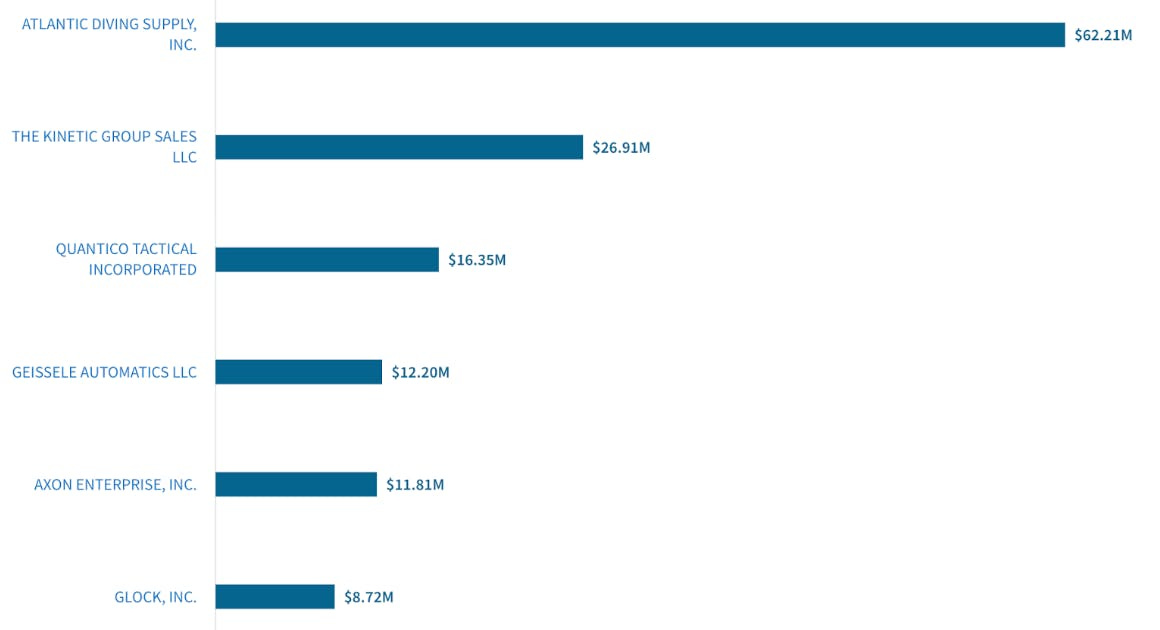
At my request, Schiff’s office analyzed the contracting data it collected to determine which companies are the top ICE and CBP contractors. Here are the results, per a chart provided by Schiff’s staff:
These particular contracts are mostly for small arms (including AR-style rifles), ordnance, ammunition, and related accessories like gun sights and suppressors, Schiff’s office says. A subcategory includes pepper spray, Tasers, tear gas, and other “non-lethal” weaponry.
“These contracts expose how DHS has set in motion a massive surge in spending to put even more dangerous weapons in ICE and CBP’s arsenal,” Schiff told me in an emailed statement. “This misuse of taxpayer dollars to maximally arm federal immigration agents, including those with questionable vetting and insufficient training, must end.”
In a sense, we’re seeing yet more cancerous growth of the post-September 11 national security bureaucracy, but with a more intensified inward focus. DHS, which was created after September 11, has long had a domestic anti-terror component. But now Trump has supercharged its role as a mass immigrant-expulsion operation that is unleashing violence toward U.S. citizens—and even killing them—while operating with near-total impunity among American populations, which Trump officials openly describe as a good thing.
“It’s the transformation of DHS from an entity that protected the homeland from external threats to one increasingly policing American society,” Donald Moynihan, author of an excellent Substack on state capacity, tells me. With this ramped-up stockpiling, Moynihan says, the endgame will be “filling those warehouses with people and using those guns and that technology to control American cities.”
The war on terror also teaches us that expanding bureaucracies like these only grow harder to control over time. “Trump is building up a well-funded, poorly trained paramilitary force that could easily take on a life of its own,” says Georgetown national security law expert Rosa Brooks. “Once you have a massive moneymaking machine ginned up, it’s hard to reverse course and turn off the spigot.”
The folly and waste of the forever wars, we are endlessly told, enabled Trump to successfully campaign against elites who foolishly sank unlimited blood and treasure into misguided imperial adventures abroad. Yet Trump’s mass deportations constitute their own forever war.
This is not meant glibly: Measured in political years, Trump’s mass expulsions actually will seemingly go on forever. Deporting an estimated 14 million people, if it continues at current rates, will take longer than this Trump term followed by two terms of President JD Vance. The scaled-up prison camps, if they materialize, will seemingly have to be packed for years, constituting an ever-expanding immigrant carceral state.
Meanwhile, just like the forever wars, this fiasco is also birthing its own captive constituencies and internal political momentum. This includes everyone from the private contractors supplying it to the large population of MAGA-adjacent young (and not so young) men signing up for ICE, which writer John Ganz describes as “an employment program for the Trumpenproletarian mob.”
Any entity this hypermaterialized—especially one simultaneously aimed at immigrants—will inevitably attract white nationalists and evolve into a political paramilitary force in thrall to ideologically aligned leaders, as Substacker Brian Beutler explains. This is borne out in ICE recruitment messaging, which explicitly seeks to get recruits invested in the mission of achieving national rejuvenation by employing cleansing ethno-nationalist violence.
The stockpiling of weapons underscores the point unnervingly. Now that Trump is feinting toward winding down in Minneapolis, what will be done with all that ideologically fired-up ICE manpower—and all that heavy weaponry? Even a relatively benign answer is alarming. It means more operations like the one in Minneapolis, but packaged with a sheen of new constraints that will simply be shrugged off by the force of this machine’s internal momentum—with more horrors awaiting us.
This is a quagmire for Trump, even if he doesn’t know it. Appropriately enough, it has also been created by unprincipled elite folly—only MAGA elites support it, while the American people verymuchdo not. Trump’s approval on immigration, once a foundational political strength, has deteriorated rapidly at moments when ICE dominates our attention. If his forever war continues in its current form—with its bureaucracy metastasizing in unpredictable directions—it will further cripple his presidency. And it’s darkly fitting that it may take down the presidential ambitions of Vance, also a self-proclaimed critic of forever war follies, along with him.
Again Christian fundamentlist rehtoric and constant attacks on LGBTQ+ people by religious leaders lead to the gullible doing actions like this. He knew demons would be there and he needed to be the hero and slay the evil man living in a way that made his god un happy. Every church leader who preaches hate against other communities should be held responsible for the actions of those who listen to their ridiculous, hateful claims and then act on them. Hugs
McGee told detectives they met on Grindr, and that he went to his apartment because he knew “demons would be there,” according to court documents. He also told detectives he intended to “slay” and “get rid of” the victim.
Investigators discovered that McGee planned the attack ahead of time, and including searching the internet for violently homophobic material, purchasing the weapon and searching for how to get away with murder, as well as how to dispose of a body.
Daniel McGee, 26, was sentenced to just over 12 years in prison, along with five years of supervised release.
“The right to live safely in one’s community is a fundamental civil right. The District of Oregon remains committed to combating hate crimes and protecting that right for all,” said U.S. Attorney for the District of Oregon Scott E. Bradford. “While no conviction can undo the harm caused, we hope this sentence will bring some measure of justice to the victim and our community.”
“Hate crimes impact not just individuals, but entire communities,” added FBI Portland Special Agent in Charge Matt Torres. “The FBI works together with our partners to prevent hate crimes from impacting our communities, and every attack on someone because of who and what they are deserves to be acted on by the full extent of the law.”
McGee made national news in 2021 when he was charged with attacking a man he met on Grindr, a dating app for gay men.
In court documents, prosecutors said he used the screen name “str8 curious” and arranged to meet the man at his apartment. He said he had just turned 18 and wasn’t ready to kiss yet, but wanted to make sure they would be alone.
But when McGee arrived at the apartment, he attacked the man. He struck the victim over the head repeatedly using a small wooden club known as a tire thumper. Multiple callers told emergency dispatchers they could hear someone screaming for help.
When police arrived, they found both men inside the victim’s apartment. The victim had life-threatening injuries, including multiple lacerations to the sides and back of his head, and a large portion of his scalp was missing.
McGee told detectives they met on Grindr, and that he went to his apartment because he knew “demons would be there,” according to court documents. He also told detectives he intended to “slay” and “get rid of” the victim.
Investigators discovered that McGee planned the attack ahead of time, and including searching the internet for violently homophobic material, purchasing the weapon and searching for how to get away with murder, as well as how to dispose of a body.
In November 2021, McGee was charged with a federal hate crime involving an attempt to kill. He pleaded guilty in federal court in Nov. 2025.
“Then” (here, below “Now”) is also linked in today’s Peace & Justice newsletter. I’m posting from The Guardian so I can get the Then, and the Now from one tab because I’m lazy, I guess. I prefer to say “efficient, though.
US urges citizens to immediately depart over a dozen Middle Eastern countries
The US state department has urged Americans to immediately depart more than a dozen Middle Eastern countries amid US-Israeli strikes against Iran.
US citizens were urged to depart using commercial means from Bahrain, Egypt, Iran, Iraq, Israel, the [occupied] West Bank and Gaza, Jordan, Kuwait, Lebanon, Oman, Qatar, Saudi Arabia, Syria, United Arab Emirates and Yemen, according to Mora Namdar, the department’s assistant secretary for consular affairs.
Hundreds of thousands of travellers are currently stranded in the Gulf states, as the airspace over some of the world’s busiest international airports, including Dubai and Abu Dhabi, closed over the weekend.
The US Senate’s Democratic minority leader ChuckSchumer said a briefing from Trump administration officials about the US war with Iran“raised many more questions than it answered”.
“Look, a whole lot of questions were asked. I found their answers completely and totally insufficient,” Schumer told reporters as he exited the meeting. He departed without taking questions.
US secretary of state Marco Rubio as well as CIA director John Ratcliffe are among those briefing Congress leaders in a classified facility in the Capitol.
A reminder that you can follow our US politics live blog for more US-focused reaction and developments:
Thousands join ‘day of rage’ across the Middle East
This article is more than 15 years old
In Iraq, six killed as frustration erupts over corruption Yemen holds its biggest pro-democracy rally Egyptians demand accelerated reforms
In Yemen’s capital, Sana’a, an anti-government protester chants slogans demanding the resignation of President Ali Abdullah Saleh. The president ordered security services to protect protesters. Photograph: Muhammed Muheisen/AP
Protests erupted in cities across the Middle East and North Africa. At least six people were reported killed and dozens injured in Iraq; thousands took to the streets in the Yemeni capital, Sana’a; and Egyptians gathered in Cairo’s Tahrir Square to demand an accelerated reform programme.
Iraq
Anger over corruption and abysmal basic services erupted in a “day of rage”, with the most serious clashes in Mosul and Hawija, in the north, and Basra in the south. At least six people were killed – three in Mosul and three in Hawija – and 75 injured in clashes with security services as protesters tried to attack government buildings.
Thousands of people made their way to the city’s Tahrir Square, but soldiers had closed it off with razor wire, using percussion grenades and firing in the air in an attempt to disperse crowds.
Lina Ali, 27, told Reuters: “The education system is bad. The health system is also bad. Services are going from bad to worse.” Protesters complained of high unemployment, a shortage of drinking water and frequent power cuts.
In Basra, the city’s governor, Shaltagh Abboud, said he would resign after 18 people were wounded in skirmishes between the 4,000 protesters and state security. A curfew was imposed until 6am tomorrow. There were also clashes in Falluja and Nassiriya.
Nouri al-Maliki, the prime minister, warned demonstrators they would become victims of al-Qaida and pro-Saddam violence.
Muntadar al-Zaidi, the Iraqi journalist who threw his shoes at George Bush, was arrested in Baghdad after travelling from Beirut to take part in the Day of Rage.
Yemen
Tens of thousands of protesters in Sana’a called for an end to the 32-year reign of President Ali Abdullah Saleh. It was the biggest pro-democracy rally in Yemen’s recent history. But small, yet violent, protests have been taking place across the country since Egypt’s Hosni Mubarak resigned two weeks ago.
Local media reported 30,000 anti-government demonstrators in Sana’a and more than 100,000 nationwide. Students, tribesmen, opposition activists and young professionals flooded the streets around Sana’a University, where protesters have been camped out since Sunday. “The people want the regime to fall,” they shouted, rising from their knees after a Friday prayer to mourn the deaths of two men shot dead on Tuesday by pro-Saleh supporters. The protest was peaceful, though at times tense. Protesters want better living conditions as well as political reform.
One banner read simply: “Look at the gap between the rich and poor.”
Riot police who tried to seize an anti-government protester had to fire in the air to dispel angry students demanding his release.
A few miles away, state media were out in force to film 10,000 middle-aged men, many carrying batons, marching up and down the streets yelling: “Saleh means stability.” These government loyalists, including impoverished tribesmen bussed in from far away, have been in Sana’a’s Tahrir Square for more than a month, holding rallies for which they have been given food, drink, and the placards, and accommodated in giant beige marquees. Anti-government protesters claim the loyalists are balataj, hired thugs, but Yemeni authorities deny any connection with the armed men.
Saleh has told his security forces to protect both sets of demonstrators and prevent any further clashes between them.
Egypt
Activists returned to Tahrir Square in their thousands to demand a faster pace to reforms. They want a new cabinet to replace one that includes many figures from the Mubarak regime. According to Al Jazeera they singled out the prime minister, Ahmed Shafik, who, they said, was hand-picked by Mubarak; and they want the former president, believed to be holed up in his Sharm el-Sheikh villa, to be put on trial and held accountable for his 31 years of rule,. They also want political prisoners released.
The ruling military council has promised elections within six months. “We do not want Shafik any more, even if they shoot us with bullets,” activists chanted. “Revolution until victory, revolution against Shafik and the palace.”
Tunisia
In the centre of Tunis, tens of thousands demanded the resignation of the prime minister, Mohamed Ghannouchi, seen as an ally of the ousted president. The uprising that forced former president Zine al-Abidine Ben Ali to flee on 14 January after 23 years in power was the catalyst for regional revolt. “Shame on the government!” and “Ghannouchi step down,” they shouted. Witnesses said it was the biggest protest since Ben Ali’s departure, when demonstrations were banned. Activists also protested against the bloody crackdown by forces loyal to Libya’s Muammar Gaddafi. Thousands of Libyans have fled to Tunisia.
Jordan
In the capital, Amman, 5,000 protested, demanding political reform. “Reform has become a necessity that cannot wait,” said Sheikh Hamza Mansour, the head of the Islamic Action Front, the country’s largest opposition group, at a rally. “It’s the demand of all Jordanians,” he added. Protestors chanted: “The people want to reform the regime”, “we want a fair electoral law”, and “people want an elected government”.
Bahrain
There were tens of thousands of anti-government protesters in Manama, adding to pressure for sweeping democratic change during two weeks of demonstrations in the strategic Gulf island kingdom. At least two marches converged on Manama’s landmark Pearl Square, the focal point of the uprising – the largest show of opposition strength so far.
Security forces made no immediate attempt to halt the marchers in an apparent sign that Bahrain’s rulers do not want to risk more bloodshed and denunciations from their Western allies.
Bahrain is the first Gulf state to be thrown into turmoil by the Arab world’s wave of change. The government had declared Friday a day of mourning for the seven people killed in clashes since 14 February.
Many protesters waved Bahrain’s red-and-white flag, chanting: “No dialogue before the government is dissolved,” and “For Bahrain’s future, we are not afraid to be killed.”
One procession split into separate groups of men and black-robed women, passing skyscrapers adorned with images of the nation’s ruling family.
Some demonstrators called on the US to do more to support their cause. “These people are fighting for freedom,” said Hussain Isa al-Saffar, 25. “The US … should be supporting freedom here.”
The White House said the national security adviser, Tom Donilon, spoke with Bahrain’s crown prince, Salman bin Hamad bin Isa Al Khalifa, on Thursday stating the US’s support for reforms through dialogue with opposition groups. The US chairman of the joint chiefs of staff, Admiral Mike Mullen, also held talks with Bahraini leaders Thursday.
In Pearl Square, a massive Bahraini flag was hoisted along with the phrase “martyrs’ square” in Arabic, a reference to those killed by security forces. Graphic photos of the dead were posted in the square, and a noose was fashioned around a portrait of Bahrain’s prime minister.
Palestine
The Palestinian Authority (PA) had authorised a Day of Rage to protest against the US veto of a UN security council resolution condemning Israeli settlements, but that was called off without explanation.
An unofficial protest on Thursday in Ramallah, the main city in the West Bank, demanded unity between the two main factions, Fatah and Hamas, as well as “liberation”.
Analysts say the Fatah-dominated PA and Gaza’s Hamas government are nervously watching uprisings elsewhere in the region. Palestinians in both Gaza and the West Bank complain of repression.


 Scottie's Playtime