This is very interesting. The doge guy is under oath so can’t lie. But he realizes he is going to have to admit to be antisemectic. He works for a nazi and it is well known a lot of the doge people were Nazis themselves. He suddenly realizes he will have to say it was the Jews people who were discriminating during the Holocaust. First he tries to say it is DEI due to focusing on women which is gender so the grant had to be slashed. But then he says women were discriminating against the males. Finially when the lawyer asks how, he just gives up and admits it was the jewish people / Jewish women. He probably thinks women discriminate against men because he can’t get a girl to date him or have sex he doesn’t have to pay for. I think Brandon who is the black gentleman on the far right of the screen has the best and correct take on why the doge man / kid simply did not want to or couldn’t honestly answer the question. Hugs
It’s another week full of legal proceedings. And a little politics, too.
Tuesday: Maduro and Flores hearing
The U.S.-ousted Venezuelan leader Nicolás Maduro and his wife, Cilia Flores, were captured by U.S. forces on January 3 at their Caracas home. They were arrested pursuant to an indictment federal prosecutors had obtained and taken to the U.S. to face those charges. Both pled guilty and are currently detained pending trial. The superseding indictment can be found here. We discussed it at length here.
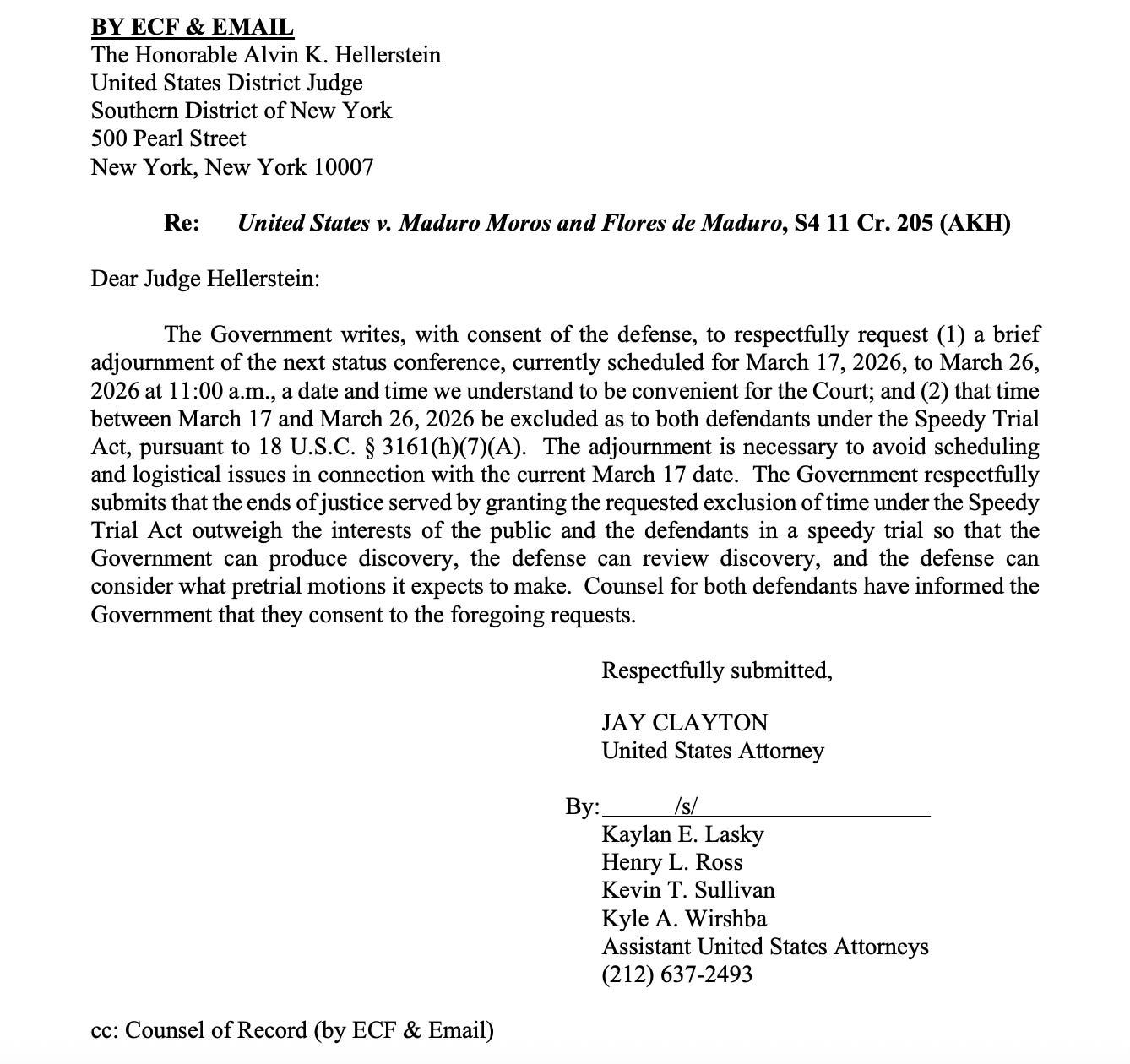
There was supposed to be a status conference on the case this Tuesday. But the government wrote the Judge, Alvin Hellerstein in the Southern District of New York, requesting a “brief continuance.” The stated reason was to permit discovery to proceed before the parties returned to court, a reasonable request given the likely amount of evidence the government will be turning over to the defense and the time it takes to review it with defendants who remain in custody.
But the government has been busy on the case already, opposing the defendants’ efforts to use Venezuelan government monies to fund their defense. Prosecutors say Maduro is not the legitimate leader of Venezuela and hasn’t been considered by the U.S. to be so for several years. Madura and Flores’ lawyers argue the laws and traditions of the country permit it to fund their defense. A Venezuelan official has said they are prepared to do so.
The defendants argue that their inability to access certain third-party funds to pay for their legal fees violates their Fifth and Sixth Amendment rights to due process and effective assistance of counsel. The parties have filed their briefs, and Judge Hellerstein is expected to consider the legal fees dispute during the March 26 hearing.
Tuesday: Illinois Primary
Illinois voters head to the polls Tuesday to choose their Democratic and Republican nominees for the open Senate seat being vacated by Dick Durbin, who is retiring after almost three decades. Two members of the House, Raja Krishnamoorthi and Robin Kelly, have thrown their hats into the ring, leaving their seats up for grabs. Three additional Illinois representatives are retiring: Danny Davis, Jan Schakowsky, and Jesus “Chuy” Garcia.
That means the Illinois delegation will look different, possibly younger, heading into 2027, and we will have new names to learn. Kamala Harris won the state with 54.8% of the vote in 2024, and it’s unlikely Democrats will lose any seats. In Kelly’s district, former representative Jesse Jackson Jr, who pled guilty to misusing campaign funds in 2013 and was sentenced to 30 months in prison (he served a little under two years), is trying to make a comeback, but he is one of 10 Democrats running for the seat. Jackson, who represented the district for over 20 years before going to prison, is up by double digits in two polls.
Everyone expects Governor JB Pritzker to handily win reelection. But as a potential 2028 presidential contender, there will be heavy scrutiny of how he handles himself during the campaign and how well he performs and leads the Democratic ticket. So there’s a lot to see here.
Under Illinois law, only poll workers and poll watchers can be at the polls on election day, and other people may not mill around outside as voters go about their business. Nonetheless, there have been concerns that ICE might show up to intimidate people. But DHS’s Assistant Secretary for Election Integrity, Heather Honey, issued a statement in late February, saying “Any suggestion that ICE is going to be present at polling places is simply disinformation.” She committed that there would “be no ICE presence at polling locations” during a call with voting officials from across the country.
That makes sense and I’m inclined to believe it. But only because doing it now would trigger legal challenges that would likely be decided against the administration. If they’re going to do this, we’ll likely see it for the first time when voters go to the polls in November.
Wednesday: Fulton County.
As you may recall from our earlier discussion, Judge J.P. Boulee sent the Justice Department and Fulton County to mediation in the case filed by the latter over the government’s seizure of voting records. Wednesday is the date by which the parties must let the Judge know whether they’ve been able to resolve the matter voluntarily. If mediation failed, it will be up to the Judge to decide whether the records are due to be returned, which they almost certainly are (the government gets to keep copies), but the administration could face some messy, revelatory testimony in court if the County goes into the unusual decision to have a U.S. Attorney from Missouri take over the matter, rather than the local U.S. Attorney.
The Rest of the Mess
Pam Bondi wants to deprive state bar associations of their ability to consider ethics challenges to federal prosecutors’ behavior.
DOJ has posted a proposed new regulation in the Federal Register that would prohibit state bars from proceeding while DOJ is conducting an internal review. Nothing in the rule would preclude DOJ from engaging in endless delay and short-circuiting state investigations.
In practice, state bar associations have routinely deferred to DOJ to conduct internal ethics proceedings before they act against a Justice Department lawyer. But that was under the old rules, where DOJ took ethics seriously. And as a practical matter, state bars, not Pam Bondi or Donald Trump, decide whether to give a specific lawyer a license to practice law in their state, so it’s difficult to see how the government has a legal leg to stand on here. It would be like Donald Trump deciding who can be a barber in Oklahoma or a cosmetologist in Arizona.
There is a 30-day comment period for the proposed regulations that will close on April 6. Comments will be public. Expect a wide variety of members of the legal profession to weigh in against the administration’s transparent effort to prevent state bar action against DOJ officials who are in ethical trouble. Congress made it clear in a law called the McDade Amendment that government attorneys “shall be subject to State laws and rules … governing attorneys in each State where such attorney engages in that attorney’s duties, to the same extent and in the same manner as other attorneys in that State.”The measure was passed in 1998 amid concerns about overzealous prosecutors. Pennsylvania Republican Representative Joseph McDade (R-PA) championed the measure after he was acquitted on bribery and racketeering charges.
The SAVE Act heads to the Senate for a vote this week.
We’ve been talking about it for months. This appears to be the week the Senate will vote on the SAVE Act. It has already passed in the House. In our conversation at Big Tent last week, Marc Elias opined it would not pass. The Senate would have to abandon the filibuster rule to get it across the finish line. That would be a last-ditch measure that Republican Senators have long argued against, but some seemed to waffle on the issue last week.
Trump tried to get Republican Senators to abandon the filibuster last November. He made that pitch with visiting Hungarian Prime Minister Viktor Orbán at his side. Orban heads what he has called an “illiberal democracy” in that country. It was quite an image.
The issue last year was the pending government shutdown. Trump called on Senate Republicans to scrap the filibuster rule and allow simple majority votes to prevail on that issue and for most other legislation. They declined, even though, or perhaps because, Trump promised his party that if they did, the GOP would “never lose the midterms and we will never lose a general election” for the foreseeable future. It will be interesting to see if that pitch reemerges this week as Trump tries to pass a measure designed to suppress Democratic votes in the upcoming election.
Senators on both sides of the aisle have long understood the power that honoring the filibuster gives both sides; it’s a form of mutually assured retention of power. But Texas Senator John Cornyn, long a proponent of the filibuster, put out an op ed in the New York Post arguing that the SAVE America Act is more important than it is.
“For many years, I believed that if the US Senate scrapped the filibuster, Texas and our nation would stand to lose more than we would gain … My fellow conservatives and I have proudly used the 60-vote threshold to protect the country from all sorts of bad ideas and dangerous policies. But when the reality on the ground changes, leaders must take stock and adapt…Today, Democrats are weaponizing the Senate’s rules to block the SAVE America Act, defund the Department of Homeland Security and hurt the American people — all to spite President Donald Trump.”
It was quite a reversal of long-held principles in service of Trump from the Texas Republican, who is facing an uphill battle to hold onto his Senate seat. He faced a primary challenge from Texas Attorney General Ken Paxton. Neither candidate reached the 50% threshold necessary for an outright win, so there will be a runoff, which is scheduled for May 26, although there have been whispers of a voluntary resolution. How we are about to find out if other Republican senators want to hold onto any of their institutional power or are willing to throw it away on Trump and a law that has strong arguments against its constitutionality.
Finally, Julie Le, the former government lawyer in Minneapolis who we met in this piece, when she begged a judge to hold her in contempt so she could get a good night’s sleep, has launched a Congressional campaign website. “This job sucks,” she told the judge. Now, it appears she might be looking for a new one, since she was ultimately removed after her outburst in court.
We read and write a great deal about the SAVE Act that may or may not pass. It is a federal law, and really it’s unconstitutional, because the states control their own elections. If it passes as a federal law, well, there are still a few things that can be done. In the meantime, state legislatures are busy. Depending upon your own state’s legislature, it’s at least likely there’s committee work happening on this. Or, possibly, your state has progressed (ha) as far as my state has.It’s a fine day to check in with your state’s business, so you aren’t caught unawares come your next election.
Kansas is not rewriting its election system with one sweeping law.
It is doing so in pieces.
A deadline adjustment here. A database requirement there. A repeal of mail-in ballot authority. A restriction on ballot return methods. A new reporting mandate. A rule centralizing constitutional challenges in one county. A provision that repeals advance voting if courts intervene.
Individually, each bill appears technical. Administrative. Procedural.
Collectively, they form a kind of architecture, and architecture is never accidental.
The justification offered repeatedly is election integrity, specifically, noncitizen voting. Yet documented cases of noncitizen voting in Kansas have been counted in the single digits through the decades.
National reviews of millions of ballots have found similarly rare occurrences. The problem, statistically, is exceedingly small.
The legislative response, however, is structurally expansive.
Consider what is being built.
One bill requires certain public assistance agencies to report identifying information about noncitizen recipients to the secretary of state. Another one mandates recurring comparisons between Kansas’s voter registration system and the federal SAVE database.
Others expand the removal triggers to include driver’s license status or database mismatches.
In practical terms, that creates a dubious data pipeline: Public benefits system data is sent to the Secretary of State, where it is cross-referenced against the federal immigration database, then checked against the statewide voter rolls and then returned to the secretary of state, who has removal authority.
Public benefits databases were designed to determine eligibility for food, health care, and housing assistance. The federal SAVE system was designed to verify immigration status for entitlement programs. Kansas’s voter registration system was designed to facilitate elections.
Now, these systems are being interconnected for enforcement.
Even small database error rates become significant when the right to vote is at stake. Federal oversight reports have documented reliability and oversight concerns within SAVE.
Legislative testimony in Kansas has acknowledged audit-tracking issues within the state’s voter system. When automated cross-checking expands and removal authority increases, the margin for error shrinks, and the constitutional risk grows.
At the same time, access pathways are narrowing.
Deadlines for advance mail ballots are shortened. Remote ballot return boxes are eliminated. The statutory authority for certain mail ballot elections is repealed. These changes do not eliminate voting, but they constrict time and space.
When time compresses, errors matter more.
If a voter is flagged incorrectly due to a database mismatch, an outdated record or a clerical error, there is less opportunity to correct the problem. Fewer alternatives. Less flexibility.
Then there is process.
Several of these election bills have moved rapidly through the House, advancing from committee to floor debate to final action within compressed timelines. Emergency procedural tools reduce the space between debate and final vote. Hearings are scheduled even when broad support is thin.
Procedure is not neutral.
When legislative time is compressed, public scrutiny thins. Stakeholder response shortens. Amendments shrink. The result may comply with formal rules, but deliberative depth diminishes.
Finally, litigation itself is being reshaped. House Bill 2569 centralizes constitutional challenges to election laws in Shawnee County. Another contains a provision that would repeal advance voting statutes if courts invalidate certain signature verification requirements. These measures alter the terrain of judicial review, raising the stakes of constitutional challenges.
States unquestionably possess the authority to regulate elections. That authority is granted by the Constitution. But it exists alongside equal protection guarantees, due process protections, and the Voting Rights Act.
The question is not whether Kansas can regulate elections.
The question is whether it should construct an expansive enforcement and restriction architecture in response to a statistically rare problem.
From a social work perspective, policy is not evaluated solely by its stated purpose but also by its impact.
Who is most likely to be flagged incorrectly in database cross-checks? Who relies most heavily on mail voting? Who has the least time and fewest resources to correct administrative errors?
Who bears the burden when access narrows, and timelines tighten? When election administration shifts from facilitation to filtration, those questions matter.
This is not about one bill. It is about the convergence of data centralization, verification expansion, access contraction, procedural acceleration and litigation hardening, all moving in the same direction, creating a cumulative burden on Kansas voters.
Kansas may not rewrite its election system in a single dramatic stroke.
But architecture does not require drama. It requires design. And Kansans deserve to understand the structure being built in their name.
Robin Monroe is a native Kansan living and working in Wichita. Through its opinion section, Kansas Reflector works to amplify the voices of people who are affected by public policies or excluded from public debate. Find information, including how to submit your own commentary, here.
Kansas Reflector is part of States Newsroom, a nonprofit news network supported by grants and a coalition of donors as a 501c(3) public charity. Kansas Reflector maintains editorial independence. Contact Editor Sherman Smith for questions: info@kansasreflector.com.
This caller is a well know immegration lawyer who calls in often. There has been a long running joke about the buttons on Sam’s shirts so ignore that part. The lawyer talks about what ICE is doing to help the detained people and he describes how horrific the conditions are. The goal is to make it so horrific these people will self-deport willingly. But the government is doing everything possible to hurt and harm the immigrants and detained people because of hate and bigotry of ICE and the white supremacists in the US government. Hugs
It surprises me how many religious evangelicals or fundies or whatever they are called are in Congress and government offices. They really are believers in the 7 mountains religious theocracy takeover of the US government. Between AIPAC and these religious people who believe Israel must be a beacon for all Jewish people to start the end times for their god to come home and hug them is horrific and costing the US every shred of our public safety net while providing Israel and religious organizations a free ride on our dime. Hugs
Her real crime was exercising her 1st amendment right to report negatively on ICE and the higher crime of doing it in spanish a language I would say most ICE couldn’t understand. She committed no crime and remember what DHS, Tom Lyons, Stephen Miller, and Bovino keep telling us they are only going after the worst of the worst criminals. Again look at my first sentence to see her worst of the worst crime. It is flat out racism and genocide of brown people in and name of creating a white ethnostate with an entrenched apartheid system. These people say they want people to come here legally but she is here legally. Hugs
A reporter for a Spanish-language news outlet in Tennessee who has been detained by U.S. Immigration and Customs Enforcement was not shown any warrant when she was arrested this week, according to court documents filed by her attorney.
Estefany Rodriguez Florez, a reporter for Nashville Noticias who has done stories critical of ICE, was arrested Wednesday during a traffic stop, according to documents filed in federal court in Nashville. Her lawyer called for her immediate release, but ICE has asked a judge to deny the request.
Rodriguez, a Colombian citizen, entered the U.S lawfully and has been living in the country for the past five years, court records filed by her lawyer show. She has a valid work permit, and she has applied for political asylum and legal status through her husband, who is a U.S. citizen.
Rodriguez has said she left Colombia after receiving death threats for her coverage of crime in the region, according to a statement from the National Association of Hispanic Journalists. The association said it “denounces immigration tactics that detain journalists and any efforts to interfere with news coverage of immigration enforcement.”
Rodriguez was with her husband in a marked Nashville Noticias vehicle when it was surrounded by several other vehicles and she was taken to a detention center, the news outlet said in a statement.
A court filing Friday by a lawyer for ICE said an arrest warrant had been issued for Rodriguez on Monday and her visa authorizing her to stay in the U.S. had expired. The filing said her arrest and detention “are not in violation of any laws or regulations.” ICE spokesperson Melissa Egan said Rodriguez was arrested during a “targeted enforcement operation” and she will remain in custody as her case proceeds through court.
Court documents filed by Rodriguez’s lawyer said that her attorney, Joel Coxander, spoke to an ICE agent who indicated that there was no arrest warrant for her at the time of her arrest. When she was arrested, Rodriguez was only shown an immigration document telling her to appear before ICE, according to the documents.
Rodriguez’s lawyer said in court documents that ICE had twice rescheduled a meeting with Rodriguez on her case, first because the office was closed during a winter storm and the second time because an agent couldn’t find her appointment in the system.
A new meeting was then set for March 17.
Rodriguez joined Nashville Noticias in 2022, covering social, family, health, police and immigration issues, the news outlet’s statement said.
“She needs to reunite with her young daughter and husband to continue her legal process within the framework permitted by law,” the statement said.
___
This story has been corrected to show the reporter’s second surname is Florez, not Flores as her attorneys initially said in a court filing.
President Donald Trump has long treated reality like something that can be bent to his will — declare that everything is under control, insist the operation is flawless and expect the people around him to project the same confidence whether the facts cooperate or not.
But as the war in the Middle East continues to spiral outward, the White House is once again finding that projecting strength and actually convincing people things are under control are two very different things.
President Donald Trump speaks during a roundtable discussion on college sports in the East Room of the White House on March 06, 2026 in Washington, DC. (Photo by Anna Moneymaker/Getty Images)
The latest flashpoint erupted after the White House posted a pair of bizarre, Hollywood-style propaganda videos celebrating U.S. missile strikes on Iran — a move critics say only reinforced the growing perception that the administration is treating a deadly war like a movie trailer or video game.
The posts immediately set off fierce backlash online. One video stitched together scenes from blockbuster action films with real footage of U.S. strikes on Tehran, while another blended clips from a video game.
The first video, posted to the White House’s X account on Wednesday, March 4, opens with a clip from Call of Duty before cutting to footage of military aircraft taking off and real U.S. airstrikes on Iran. Upbeat music plays beneath the one-minute-and-five-second montage captioned, “Courtesy of the Red, White & Blue.”
Critics say the second video, posted Thursday, March 5, is even more disturbing.
The 42-second montage opens with a scene from Iron Man in which AI assistant J.A.R.V.I.S. tells Tony Stark, played by Robert Downey Jr., “Wake up. Daddy’s home,” before cutting to action-heavy clips from films including “Gladiator”, “Braveheart”, “Top Gun” and “Superman” — all interspersed with real footage of the U.S. attack on Tehran.
Another moment features a line from the television series “Better Call Saul”, when the character Saul Goodman declares, “You can’t conceive what I’m capable of.”
The video is captioned “JUSTICE THE AMERICAN WAY” and ends with a deep, ominous voice declaring, “Flawless victory.”
Some of the footage of the U.S. airstrikes appears to have been pulled directly from posts on U.S. Central Command’s own X account.
But instead of projecting strength or confidence, the videos quickly ignited outrage online — reinforcing the criticism that Trump’s team appears more interested in staging a cinematic show of force than explaining a coherent strategy for a rapidly escalating conflict.
French TV host Alex Taylor in post on X called it, “Quite simply one of the most disgusting things I’ve ever seen on here.”
“Whatever you think of the awful Iranian régime, the White House treating bombing raids like a cheap video game is gut-wrenchingly shocking America, your country is going to hell,” he declared.
Yahoo readers were similarly “disgusted” by the first post on Wednesday likening war to a video game.
“Just imagine if Obama or Bush or for that matter any other president had spliced together a propaganda video like this?? The GOPed would impeach within minutes of its release,” one reader pointed out.
Trump’s White House is known for posting both vulgar and offensive videos. In October after millions took to the streets in cities across the country for the “No Kings” protests, Trump posted a gross video of himself flying a fighter jet and dumping feces on demonstrators.
Others argued the videos trivialized the human cost of war and only reinforced the growing accusation that there are no adults in the room running the administration.
“RIDICULOUS VIDEO! Real people are dying IRL. Don’t make it like you just reset and no one’s has died.”
“CHILDISHLY INAPPROPRIATE, THOUGHTLESS, JUVENILE, SADISTIC, MEAN, IMMORAL AND SAD! WAR IS NOT A GAME OR A MOVIE,” one user wrote. “There are men, women and children being killed, maimed and left homeless because of the cruel leadership in America and Israel.”
“It is all a game with these creeps,” another commenter wrote. “Fantasy is their truth — men who know nothing about war using sci-fi and movies to sell their real killing.”
Some observers also pointed out the bizarre irony in the White House’s choice of film clips with one X user providing a full breakdown.
“Dumb f***ers didn’t understand any one of these movie plot lines?! That tracks.”
The backlash is unfolding as the war launched by the United States and Israel continues to escalate across the region.
In less than a week, since Trump, along with Israel, launched airstrikes on Iran on Saturday, Feb. 28, six American service members have been killed in an Iranian drone attack on a port in Kuwait.
Iran’s Red Crescent says the death toll in Trump’s bombing campaign inside Iran has reached at least 1,000, according to PBS.
Meanwhile, Trump and his allies have offered shifting explanations for the purpose of the operation.
The president initially suggested the campaign was about regime change in Tehran before later saying it was about preventing Iran from developing a nuclear weapon.
Defense Secretary Pete Hegseth has framed the operation as an effort to “protect Americans” and destroy Iranian ballistic missile capabilities.
But critics say the administration’s messaging has been anything but clear — feeding the rumor spreading online that the White House may not have a coherent plan for how the conflict ends.
Meanwhile, Iran is signaling it has no intention of backing down.
In an interview with NBC News, Iranian Foreign Minister Abbas Araghchi struck a defiant tone when asked whether Tehran feared a potential U.S. ground invasion.
“No, we are waiting for them,” Araghchi said. “Because we are confident that we can confront them — and that would be a big disaster for them.”


 Scottie's Playtime