4th Amendment Workplaces

When ICE Shows Up, These Businesses Will Be Ready

Across the U.S., training, resources and hotlines have emerged to help workplaces exercise their rights in the case of an ICE raid.

By: Emily Nonko

Last April, at the James Beard Foundation’s Chef Action Summit, food industry leaders gathered to discuss the political and economic landscape with one concern hanging grimly in the air: undocumented and immigrant workers were increasingly afraid to come into work after ICE raids ramped up at the outset of Trump’s second term. 

But it just so happened the summit took place in Asheville, North Carolina, where activists had already asked, “What would it take to make this the safest state for immigrants in the south?” as Andrew Willis Garcés, senior strategist with the immigrant justice organization Siembra NC, puts it.

One answer: 4th Amendment Workplaces, a framework developed by Siembra NC and launched at the summit to help restaurants and other businesses train up on legally vetted protocols to defend employees against ICE. The idea quickly took hold — there are now over 1,000 4th Amendment Workplaces across North Carolina, with 4th Amendment Workplace resolutions passed in three cities and similar efforts underway across 12 states. 

It’s emerged as perhaps the most powerful workforce training to help businesses prepare for ICE raids, but it is not the only one. Across the country, training, resources and hotlines have been developed for workplaces, alongside an effort to harness the wider labor movement as a force against ICE. 

Though the ICE raids that make the news often take place on the street, workplaces are in fact a frequent target. “We’ve seen ICE this year go into workplaces more than a lot of other kinds of places where people are gathered,” Willis Garcés explains. “With workplaces, there’s usually an open door you can walk through.”

According to the American Immigration Council, ICE publicly reported at least 40 worksite enforcement actions resulting in over 1,100 arrests within the first seven months of the current Trump administration. Businesses employing noncitizen workers — restaurants, car washes, automotive shops, bakeries, nail salons — are typically targeted. ICE has also scaled up large raids at workplaces like meatpacking and manufacturing plants. 

These raids often represent legal violations, which 4th Amendment Workplaces raise awareness around. The Fourth Amendment to the U.S. Constitution guarantees “the right of the people to be secure in their persons, houses, papers and effects, against unreasonable searches and seizures” without a warrant based on probable cause — that is, reason to believe that a crime may have been committed.

In North Carolina, volunteers canvas businesses across the state to share what it means to be a 4th Amendment Workplace: identify invalid ICE warrants, secure private employee areas, document unconstitutional actions and defend all workers, no matter their immigration status. Resources include a workplace guide, organizing toolkit, posters signaling opposition to unconstitutional search and seizures, employee handouts and tips for designating private employee areas. 

Workplaces can request dedicated training, in which organizers help business owners and employees develop workplace-specific protocol, and lead them through roleplaying scenarios. “We help you think through … what would you do right after the fact? What would you do to preserve footage, how do you support families left behind, what’s the immediate triage that needs to happen [after a raid]?” explains Willis Garcés.

Scuppernong Books of Greensboro was an early adopter, participating in training, promoting itself as a 4th Amendment Workplace, hiring a lawyer, regularly keeping staff informed of ICE response protocol, even publishing a book on how to resist ICE. Co-owner Steve Mitchell says it is “absolutely essential” for business owners to step up on behalf of employees, especially if the owners are white and legally protected residents: “It’s important for people like us to say that this isn’t right, and we’re going to stand on this side of the issue.”

Even though there hasn’t been a heavy ICE presence in Greensboro, the bookstore’s work with Siembra NC “gives us some sense of confidence,” Mitchell says. “Whether that’s misplaced or not, it at least helps us know what our rights are in that situation.” He adds that using Siembra’s model has made the business feel connected to a broader network of activists.

Willis Garcés describes that model as “plug and play,” easily adaptable outside the state and across a variety of workplaces. Siembra NC recruited small businesses first, with the goal of expansion into higher-targer workplaces like factories and farms.

Today, some North Carolina farmers display giant vinyl banners about their constitutional rights, a riff on Siembra NC’s signage. In Oregon, organizers dubbed themselves “Baddies for the Fourth.” In Minneapolis, the 4th Amendment Workplace was a central demand in a public-pressure campaign around Target

There have been other efforts to develop localized training. In New York, Nonviolent Peaceforce trains mostly within the city’s Asian American community, which it has worked with since the pandemic. Last year, ICE raids erupted across the city’s Chinatown.

Nonviolent Peaceforce’s in-person training happens with trusted community partners and focuses on de-escalation and self-regulation tactics, alongside scenario and role-playing. “We came to develop scenarios really at the request of community members who felt that they really needed to know what it was like to be in the moment,” says Roz Lee, head of the organization’s U.S. efforts. She says simple tactics to slow things down — like introducing yourself, asking ICE agents their name, asking for a warrant and taking time to inspect it — can shift a potentially intense and traumatic interaction. 

Other groups have tied the urgency around ICE to larger labor organizing efforts. Emergency Workplace Organizing Committee (EWOC) emerged to help non-unionized labor organize in response to COVID-19. More recently, EWOC developed resources for resisting ICE, which are tied to broader workplace organizing tactics like facilitating conversation among employees, building a committee and planning collective action together. 

“These steps are very universal, whether you work in an office, in a kitchen, at a nonprofit,” says Wes Holing, an EWOC organizer. “If you’re talking about bread-and-butter issues, or you’re talking about a workplace that’s safe from ICE, you’re still ultimately fighting for a place that respects you as a person.” 

This January, EWOC partnered with Twin Cities Democratic Socialists of America to hold a No-Work Workshop to train workers on their rights and protections to participate in the Anti-ICE General Strike. It was part of a much larger mobilization among Minneapolis residents and businesses responding to Operation Metro Surge.

The city mobilized far beyond one-off trainings; instead, an entire ecosystem emerged. “The sheer volume, the sheer magnitude of mobilization … it felt like every single person I knew was extremely active,” says Mike Urbanski, who helps lead legal observer training with Monarca. Monarca is a project under the immigrant justice organization Unidos MN, which canvassed businesses in Twin Cities’ immigrant communities. They’d then direct people to Monarca’s ICE hotline as well as its two-hour, in-person training, which focuses on “upstander” legal observation tactics.

Monarca’s trainings were also shared through social media, word of mouth and within community spaces and houses of worship. “We could post a training with 1,000 people in Minneapolis and fill it within four or five days,” Urbanski says, “And most of those people would come, and another 100 people would just show up.” 

The Workers Solidarity Circle also canvassed and shared resources among Twin Cities businesses, channeling that energy into the Minneapolis Worker’s Assembly this February, which brought together over 300 unionized and non-unionized workers across sectors. “It was about building working class power and coordinated strike action, to really push people into action and not wait on managers, bosses or labor officials to save us,” says organizer Aminah Sheikh.

Now that Operation Metrosurge has wound down, organizers have turned their attention to this upcoming May Day: organizing strike committees, holding strike trainings, conducting labor education and committing unions and community organizations to strike on May 1st. Sheikh says there is a growing realization that workers must build political power far beyond their workplace. 

“Listen, in order for us to really stop — abolish — ICE, like people are saying, from the grassroots,” she says, “then we need to do economic disruption.” 

Most US Voters Support Trans Rights, Even Republicans

This video explains what everyone on the real left already knew instead of forgetting the trans  / woke culture wars and moving right, the center left keeps demanding which is simply code speak for leaning right.  While all the same democratic strategists since the Bill Clinton days demand candidates move to the right to “triangulate” to capture republican voters these polls show what we already knew.  The culture wars are losing for the republicans.  After republicans spent nearly 3 million dollars in ads against trans people the polls showed almost no one felt those adverts influenced their vote.  Even as red states rail against higher education, acceptance, and tolerance of people who are different it is losing them votes.  Some thing the Christian nationalists who are in the height of their influence now in political circles don’t understand is that people who grew up with LGBTQ+ classmates, friends, and even dated some do not find them the evil that these hate religions preach they are.  

*** Personal note.   I explained to Ali in an email that I am not functioning.  For what ever reason wheither it be anemia or something worse I am desperately tired from the time I manage to get up.  I often get up only to a few hours later go back to bed for four or more hours.  I have started taking vitamin B-12 and a woman’s one-a-day vitamin.  That with more red meat which was recommended to me in the past every time I go into anemia.   How ever I get up, I have coffee and stuff with Ron then I need to go back to bed for normally 4 hours, get up and do dishes while watching The Majority Report.  How ever some days like yesterday I did not even get that far, going to back to bed by 2 pm only to have Ron wake me and beg me to eat.

I have done better today only going back to bed for 3 hours later in the morning.  I wanted to go to bed two hours ago, but Ron was all upset he couldn’t sleep due to the neighbors having new skirting put around their home outside our bedroom.  So I got him in his recliner and moved his CPAP out to his chair.  Still he was not tracking.  Good news as I was falling asleep at my desk he woke up and is fixing supper.  At this point I am so tired I don’t really care whether I eat or not.  

I tried to reply to comments, but I couldn’t.  I even started to move old saved open tabs out by making a new cartoon / memes post but I simply couldn’t do it.  Right now the best I can do to function is make doctors appointments and watch videos that don’t take too much thought to understand.  That means most political videos are outside my ability.  I am sorry but right now I am functioning at the level of a confused grandpa.  Sorry.  I hope to get better soon.  Ron says if I don’t clear up by next week we will demand the primary care see me and deal with it. I’m not sure if I want that as my last visit he was insisting I think  about getting a colonoscopy.   Anyway.  This is a good video and one I watched several hours ago when I was much sharper than I feel now.   ***  Hugs


From MUTTS & Jane Goodall

FETCH THIS PRINT
“There is hope in the resilience of nature.”Jane Goodall

So, In Case You Can’t Get Outdoors Today For Earth Day,


And see an albatross do a very cool thing-

It Is Earth Day, 2026

https://peacebuttons.info/orderpp-the-ecology-corner.htm#geac

And Trae Says-

Josh Day, Next Day!

Whoa. So Very Close, In VA:

Virginia Redistricting Referendum Results

Virginia voters will decide whether to approve the adoption of a new, Democratic-drawn congressional map for the remainder of the decade — part of the partisan battle over redistricting happening in several states ahead of the 2026 midterm election. The proposed map would give Democrats a chance at winning 10 of Virginia’s 11 congressional districts, a dramatic shift from the current 6-5 split in the Virginia House delegation.

Amendment: Congressional Redistricting

Passed

Response

Votes

Percentage

Yes1,384,29650.7%
No1,344,42249.3%

85.9% expected votes in (Est. remaining 449,000)

(snip-a couple more simple charts, that don’t transmit well to here on WP, as seen above)

Virginia voters approve congressional redistricting amendment

See the latest results here.

And Now, From The Onion, About Its New Acquisition:

At Long Last, InfoWars Is Ours

By Bryce P. Tetraeder, CEO, Global Tetrahedron

Published: April 20, 2026
Let me tell you a story. When I was a child, I suffered from night terrors. It was always the same dream: I could hear my family and neighbors wailing in the street outside as they were pursued and then destroyed by a nameless malevolent force, something neither I nor anyone else could control, a great darkness that was, somehow, all my fault.

Today, that childhood dream is finally coming true. Today I can finally say the sweetest nine or 10 words in the English language: Global Tetrahedron has completed its plan to control InfoWars.com.

I’ve had a lot of time to think about InfoWars in the last year and a half. As the seasons have changed, my ambitions for the project have grown grander, crueler, better aligned with market data. Come, friends, and imagine with me…

Imagine a roaring arena packed to the rafters with pathological liars. High above you in the nosebleeds are podcasters, screaming that you’ll die if you don’t buy their skincare products. Below, on the floor, imagine demonic battalions of super-influencers physically forcing people into home fitness devices designed to dismantle their bodies bone by bone and reassemble them into a grotesque statue of yourself. Out of the throngs, an extremely sick looking man approaches you. He puts his hands on your shoulders. He explains that he is your life coach and that you owe him $800.

Such is the InfoWars I envision: An infinite virtual surface teeming with ads. Not just ads, but scams! Not just scams, but lies with no object, free radical misinformation, sentences and images so poorly thought out that they are unhealthy even to view for just a few seconds. The InfoWars of old was only the prototype for the hell I know we can build together: A digital platform where, every day, visitors sacrifice themselves at altars of delusion and misery, their minds fully disintegrating on contact.

With this new InfoWars, we will democratize psychological torture, welcoming brutal and sadistic ideas from everyone, even the very stupidest among us. It will be like the Manhattan Project, only instead of a bomb, we will be building a website. 

The InfoWars of tomorrow will converge into a swirling vortex of content about content, talent acquiring talent, rings of concentric media mergers processing all human artistry into one endlessly digestible slurry. This will be a dank, sunless place, one where panic and capital feed on each other like twins in the womb of a hulking, unknowable monster—a monster known by many names, but which I like to call modern-day America.

All of this is to say that I believe in us. I believe that with the new InfoWars, we can alchemize the pioneering spirit of amateur inquiry, the profit-maximizing drive of corporations, and the cold mental clarity that comes only with disciplined daily ingestion of mind- and body-altering chemicals. Ifwe can do that, what other great things can we do together? (snip-MORE)

All About That Shadow Docket

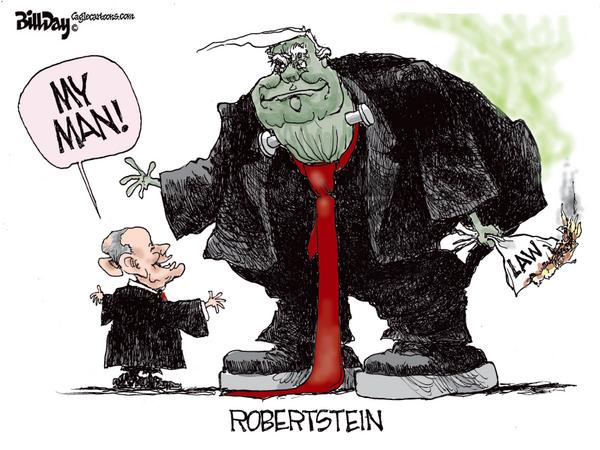
221. Chief Justice Roberts and the Clean Power Plan

Remarkable reporting from the New York Times provides a peek behind the curtain of the February 2016 rulings that ushered in the modern emergency docket. And what it reveals is pretty discouraging.

Steve Vladeck

Welcome back to “One First,” a newsletter that aims to make the U.S. Supreme Court more accessible to lawyers and non-lawyers alike. I’m grateful to all of you for your continued support, and I hope that you’ll consider sharing some of what we’re doing with your networks.

(snip)

Back in February, I wrote about the tenth anniversary of the Supreme Court’s unsigned, unexplained February 2016 rulings blocking President Obama’s “Clean Power Plan,” and how they ushered in what might be called “the modern emergency docket.” In my earlier post, I raised a series of questions about what had led the Court to do something that, in 2016, was completely unprecedented (blocking an executive branch program then under review in the lower courts), and whether the justices had any idea of the Pandora’s Box they were opening. As I wrote, “because the Court didn’t write then, and hasn’t explained itself since, we’ll never know (at least, until our grandkids can read the justices’ internal papers from that time period).”

It turns out, thanks to some truly remarkable reporting from Jodi Kantor and Adam Liptak for the New York Times, that we didn’t have to wait quite that long. On Saturday, Kantor and Liptak published 16 pages of (leaked) internal memoranda from six of the justices providing a window into how and why the Court did what it did on February 9, 2016. And the memos are, at least to me, a remarkable combination of eye-opening and sadly unsurprising. As I explain below, I think there are at least five significant takeaways from these materials—none of which paint the Court in an especially flattering light. And at the heart of most of them is Chief Justice Roberts.

Behind the scenes, Roberts led the charge for the Court to blaze a new trail—relying on statements outside the record; invoking the wrong standard for the kind of relief the applicants sought; failing to even acknowledge the irreparable harm the government (and the environment) would suffer from the Court intervening; and pushing back aggressively when Justices Breyer and Kagan both urged a compromise that should have accounted for his ostensible concerns. I’ve suggested before that the real acceleration of the Court’s modern emergency docket behavior can be traced to 2018, right around when Justice Kavanaugh succeeded Justice Kennedy. But in the first major case in which the Court granted emergency relief as a means of shaping nationwide policy, it turns out that the justice who led the charge was the one who was doing quite a bit more than calling balls and strikes. (snip-the rest is on the page)