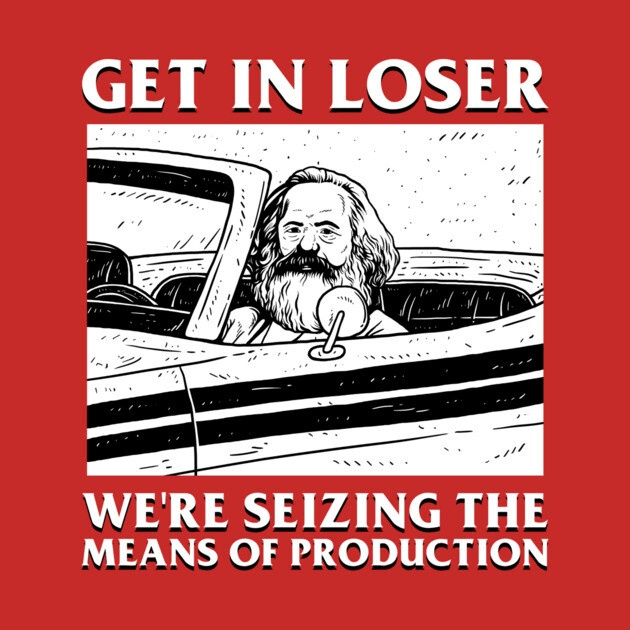
Lo, while billionaires gathered at the Met Gala to pretend they have class or culture, Amazon workers showed up outside to remind everyone what really funds their costume party.
Piss bottles.
1. The Workers Crashed The Party
Jeff Bezos paid $10 million to attend this year’s rich scumbag costume ball.
And lo, Amazon workers said: absolutely fucking not.
The Met Gala wanted to turn Bezos into a patron of the arts.
Amazon workers turned him back into the Lex Luther villain he is.
Behold, Chris Smalls and Amazon workers outside the Met Gala, reminding America who really built Bezos’ empire.
(There’s a little video embedded on the page that I can’t snag and bring back. Click above on the title, or here to see the videos, and to save yourself time, read the little bit of the rest there, too. Snip)
“I don’t see any path aside from the full removal of feminism. So long as we have democracy coupled with universal suffrage, you’ll constantly be going against the grain. You’ll constantly have half of the population voting for temperance, tolerance, suicidal empathy. I don’t think you’re going to get people to vote away democracy. It has to be taken. I think that men, virtuous, ambitious, masculine men have to climb the ladder of power and forcefully take away from the people that which is their detriment.” – Christian nationalist hate Pastor Joel Webbon, who appeared here last year when he called for Trump’s military to seize churches that fly Pride flags or have female clergy. In 2024, Webbon appeared here when he called for the death penalty for homosexuality.
Enjoy your rights while you have them, because Joel Webbon says the America First Christian nationalist movement is "going to take over the GOP" by 2032: "It's not if, it's simply when." https://t.co/nXHRp2C2yGpic.twitter.com/paQkcqMzYx
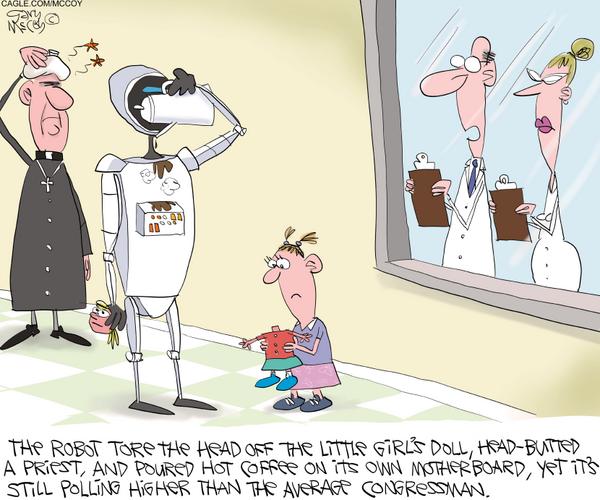
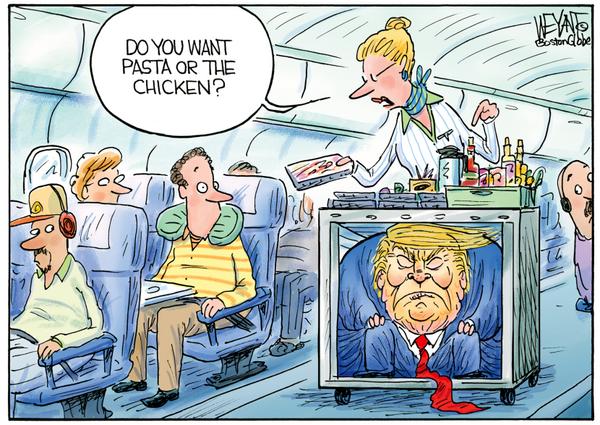
You got a new blog yesterday, but you didn’t get a new cartoon. Did you miss me?
From the Department of I-think-I’m-going-to-throw-up comes news that the State Department is going to issue passports featuring Donald Trump’s face. It’s not even his smiling face, either, as he’s grimacing in the photo, much like his mug shot.
Do the heads of all these agencies that’re putting Trump’s face, name, and signature on everything come up with this shit on their own, or is it ordered from the White House? Either way, everyone in the Trump administration is a sick sycophant. Why do they want us to look like North Korea? Why?
But yes, you heard correctly. They are going to put Trump’s face on American passports. If you’re like me, you worry that you won’t have a choice and that Trump’s face will be placed right next to your cheery mug, which would be sure to draw scorn as you go through customs and immigration while traveling internationally. Don’t we have enough to apologize for while traveling as Americans? (snip-MORE)
Mule Musings
by Jennifer Burville-Riley
Now I’ve heard The Man With No Name
tellin’ folks I don’t like people laughin’-
says I get the crazy notion
they’re laughin’
at me…
Well, that’s a load of hee-haw,
for sure:
I’m about as self-assured and confident a Mule
as you’re likely to find
either side of the Mexican borderline.
See, my Momma was a skittish chestnut mare,
and I get my fine set o’ teeth
and my elegant hooves from her
but my Pappy gave me
a donkey’s patience and an even temper…
shame about the ears.
So y’see I ain’t generally too fussed when folks are laughin’.
I confess, I do hate it when folks start shootin’.
Been shot at by Confederates,
been shot at by the Union,
been shot at by bandits, outlaws, inlaws,
mulateers, racketeers, pistoleers,
pursuin’ posses and ambushin’ enemies.
Been fired on by cannon, by pistol and by rifle…
By my rump, I sure could do without this rumpus nowadays.
Truth be told, I’d settle
for a quiet life,
a little paddock on the prairie.
Sometimes, I say to the cowboy:
look here, friend,
if we don’t take it easy soon,
I’m gonna tell all the folks in the next saloon
just what your Momma really christened
The Man With No Name.
Then we’ll see who gets the crazy idea
that people are laughin’.
I found a file full of photos of Amos and the Minions I hadn’t used.I went looking for a suitable poem and found this one.
And here we are! The poem is clever and funny! (Used for educational purposes only , btw) I’m glad I found it !
(I was hoping since I’d copied those grouped as on the page, they’d load that way, but no. No way I can find that WP will do side by side photos, even when picked up together. My apologies for those who scroll on their phones!)
There’s a story here – Penny got caught
Jenny thought it was hilarious –
Penny thought Jenny might be over doing it a bit.
And told her so-
They agreed to disagree and got over it in 10 minutes
That’s all I got room for – Thanks for dropping by!
Emma Tenayuca was a labor organizer in Texas who is best known for leading a strike of pecan shellers in 1938. Workers called her “La Pasionaria“ which means “Passionflower.” From a young age, she survived violence and imprisonment in her quest to help workers get better working conditions and higher wages.
Tenayuca was born on December 21, 1916, and I know all of you December birthday people will identify with her plight – born too close to Christmas, she never got ‘birthday’ presents. Her family was Mexican American, and had lived in Texas for many generations. She was raised by grandparents who were interested in politics, and was also influenced by the speakers in the San Antonio town square. She was brought up with pride in her family and their roots, and she was encouraged to be educated and politically active by her family.
Emma Tenayuca in 1939, photographed for a Personality of the Week article in The San Antonio Light
Tenayuca was arrested for the first time at 16, for protesting alongside striking workers from the Finck Cigar Company. She used her bilingual language skills to help people with their problems and worked with many organizations working towards better pay and better conditions for Mexican-Americans.
One of the most common positions for Mexican-American women in the area was in the pecan industry. Pecan shelling for 6-7 cents a pound was difficult work (the meat of the shell must remain intact) for little pay. Additionally, the process filled the factory rooms with a fine dust that contributed towards tuberculosis.
In 1938, the factories cut pay to 3 cents a pound and Tenayuca, who was 21 years old at the time, found herself leading a strike of approximately 12,000 workers. The strike faced violent opposition, as detailed in the article “Remembering Emma Tenayuca:”
When Pecan production ground to a halt, the owners fought back: Tenayuca and hundreds of strikers were gassed and arrested by San Antonio police. Some were beaten as well. With the NWA rallying community support, the strike turned into a city-wide uprising of the poorest and most oppressed people in San Antonio.
Thirty-seven days after the strike began the pecan producers agreed to arbitration. A few weeks later, the workers had won a wage increase to seven or eight cents per pound.
Tenayuca faced opposition as a woman, as a Mexican-American, as a labor organizer, and as a member of the Communist Party (she left the Party in 1946). From Americans Who Tell the Truth:
A quarter of immigration arrests since August were labeled by U.S. Immigration and Customs Enforcement as “collateral,” a type of arrest and detention that’s been challenged in court as an end run around civil rights.
Public outrage and lawsuits over the arrests may be tamping down the large-scale sweeps that foster them, but tens of thousands were arrested this way between August and early March.
Immigration arrests are usually based on warrants obtained ahead of time, showing either a removal order from immigration court or evidence of a crime or charge that makes the person subject to deportation.
But collateral arrests can result from street sweeps and raids in which a person is singled out for questioning based on appearance or proximity to someone wanted on a warrant. That person could be taken into custody if agents think they may be subject to deportation and also likely to flee if released.
Labeled for the first time ever, the collateral arrests are reported from August to early March in ICE arrest data obtained by the Deportation Data Project and analyzed by Stateline. In that time there were about 64,000 collateral arrests, a quarter of the 253,000 total arrests by ICE.
About 70% of the collateral arrests were for people with immigration-related crimes or violations alone, compared with 41% for arrests with warrants. Less than 2% of those with collateral arrests were convicted of a violent crime, one-third the rate of other arrests, and only 18% were convicted of any crime, compared with 33% for other arrests.
The collateral arrests contributed to an overall pattern of lower and lower shares of arrests for serious crimes, and more for immigration offenses alone.
Arrests climbed from about 12,000 in January 2025 to more than 40,000 in December, but fell back to 30,000 this February. The share of people with only immigration-related crimes and violations rose to more than half in December and January, the peak months for collateral arrests, and the share of violent criminals fell from 10% to 4% of arrests in that time.
(This chart is interactive. If you can’t see the arrest data here by mousing over states, you can on the page, linked in the title above, & also at the end of this post.)
New policy
ICE announced a new policy in January to issue warrants in real time if agents think an immigrant is deportable and “likely to escape,” though that policy faces a court challenge.
Total arrests and collateral arrests have been falling since December, whether because of the new policy or because of cutbacks in the large-scale street sweeps that tend to produce them.
One factor is public outrage over raids sweeping up noncriminals in places like Minneapolis and Chicago, said Colleen Putzel-Kavanaugh, an associate policy analyst for the nonpartisan Migration Policy Institute.
“The sort of large operations within big cities, as they were occurring, seems to have subsided somewhat,” Putzel-Kavanaugh said. “After the kind of public outcry following Minneapolis, it seems as though, at least for now, that tactic has kind of been paused.”
The Trump administration’s focus on mass deportation opened the way for more collateral street arrests with less investigation, she added.
“If it’s a more targeted arrest, they would take the time to sort of essentially have an investigation. It’s a pretty resource-intensive way that just would not yield the kind of numbers ICE was being told to produce,” she said.
The new policy was filed in court papers in February as a response to a lawsuit over ICE sweeps in the District of Columbia last year, alleging ICE agents “have flooded the streets of the nation’s capital, indiscriminately arresting without warrants and without probable cause District residents whom the agents perceive to be Latino.”
The case resulted in a preliminary injunction in December requiring a halt to warrantless arrests without establishing probable cause that the person is living here illegally and is a flight risk.
One plaintiff in the class-action case, José Escobar Molina, said in the lawsuit that agents in two cars pulled up to him as he approached his work truck on Aug. 21, grabbing him by the arms and legs and handcuffing him without asking any questions. Escobar, 47, said in the court papers that he’s lived in the district for 25 years and has had temporary protected status as a Salvadoran native the whole time. He was held overnight in Virginia before being released.
Other lawsuits are also challenging collateral arrests, such as an incident in Idaho in which agents with warrants for five people ended up arresting 105 immigrants at a Latino community event in October.
“I have a lot of fear that this will happen to me again. I was essentially kidnapped based only on the color of my skin. That really weighs on me,” said Yoshi Cuenca Villamar, one of the citizens and a North Carolina native, in a statement announcing the lawsuit. He said he was doing landscaping work Nov. 15 when agents pushed him to the ground and handcuffed him, then held him in a car before releasing him.
One Illinois case that started in the first Trump administration challenged warrantless arrests and traffic stops used as a pretext for immigration arrests. A 2022 settlement required ICE to document “reasonable suspicion” of illegal status before arresting somebody. The case continues since a judge found in February that the new ICE policy of issuing warrants in real time after a detention violates the consent decree.
Shares of collateral arrests
In the months since August where collateral arrests are now labeled, the District of Columbia and Illinois stand out with high shares of collateral arrests. More than half the arrests in the district were collateral, as were 41% of those in Illinois. There were eight states in which at least 30% of arrests were collateral: Alabama, Maryland, West Virginia, Arizona, Pennsylvania, New Hampshire, Maine and Minnesota.
West Virginia, where there was a “statewide surge” of immigration enforcement in January with state and local cooperation, stands out for its high rate of total arrests as well as a large share of collateral arrests.
For the eight months between August and early March, West Virginia had 1,831 arrests, or 1 in 10 of the state’s noncitizen population as of 2024, the latest data available. That’s by far the largest share in the country, followed by 7% in Wyoming (where truck drivers were targeted for immigration arrests in February) and 4% in Mississippi.
West Virginia Republican Gov. Patrick Morrisey, in a statement, cited the cooperation of state and local agencies with ICE through the 287(g) program that assists with immigration enforcement. He praised ICE, saying “they have removed dangerous illegal immigrants from our communities and made our state safer for families and law-abiding citizens.”
Few of those arrested in the surge were violent criminals, however. More than half of those arrested during the surge were collateral arrests, and only 1% — nine immigrants — had a violent crime conviction, according to the Stateline analysis. More than three-quarters, about 500 people, had only an immigration-related violation or crime.
Judges didn’t always agree that collateral arrests and detentions in the West Virginia surge were legal under the U.S. Constitution. U.S. District Judge Joseph Goodwin, a Clinton appointee, ordered two detainees released in January. He noted that “similar seizures and detentions are occurring frequently across the country” without any evidence they’re necessary as required by the Constitution.