Photo Illustration by Victoria Sunday/The Daily Beast/Getty Images
Homeland Security Secretary Kristi Noem and her alleged lover Corey Lewandowski ordered 10 Spirit Airlines jets before realizing the planes had no engines.
Officials warned the pair that purchasing the jets—which they said would be used to increase deportations and for their own travel—was impractical, and that simply hiring additional flight contractors would be far less costly, The Wall Street Journal reported
Corey Lewandowski and Kristi Noem, who are both married, deny reports that they are having an affair.Jabin Botsford/The Washington Post via Getty Images
But Noem and Lewandowski went ahead and blew through the funds allocated by Congress. Officials realized the pair’s blunder when they looked deeper into their spending spree and realized that Spirit—which has filed for bankruptcy twice—didn’t own the planes in the first place, and that the engines would have to be purchased separately, according to the Journal.
Noem and her shopping partner then purchased two Gulfstream jets for $200 million. However, shortly after, DHS notified the Democrats on the House Appropriations Committee that the project to increase deportation flights had been paused.
Noem looks pensive after a press conference held to discuss the “Midway Blitz” immigration enforcement operation in Chicago.Jamie Kelter Davis/Getty Images
Lewandowski—whose alleged relationship with Noem has been described as D.C.’s “worst-kept secret”—has been referred to as Noem’s “gatekeeper,” operating as a special government employee who travels with her, weighs in on personnel, and shapes enforcement.
He has also spearheaded efforts to replace ICE leaders across the country with Border Patrol veterans to impose a more heavy-handed, military-style approach to Trump’s immigration crackdown, such as the hostile situation dubbed “Midway Blitz,” unfolding in Chicago.
Gregory Bovino has a background in chasing migrants and drug smugglers through border terrain.Chicago Tribune/Brian Cassella/Chicago Tribune/Tribune News Service via Getty Images
Led by Border Patrol Chief Gregory Bovino, the operation’s militarized enforcement tactics and aggressive approaches have sparked public outcry. Footage and testimony have shown federal officers firing pepper-ball rounds and tear gas—even near children—while clashing with protesters. ICE agents have also been spotted roaming quiet neighborhoods, questioning landscapers and decorators.
Still, the militant approach hasn’t appeased the White House or met its steep daily deportation quotas.
ICE and Border Protection agents had made 3,000 arrests in Chicago over two months as of late October—the same number the White House has demanded they make in a single day, the Journal reported.
Noem’s methods—and the mounting pressure from the White House—have sparked infighting among DHS officials as they grapple with Lewandowski’s informal authority.
Kristi Noem and Greg Bovino visit the ICE facility in Chicago in October.DHS photo by Tia Dufour
Border czar Tom Homan and ICE Director Todd Lyons favor an old-school, less hostile approach, including using police research to develop target lists and focusing on those with criminal histories, sources told the Journal. But while Homan is influential in the White House, Noem has the final say.
Trump, however, is on the side of aggression, saying in a 60 Minutes interview last week that ICE officials “haven’t gone far enough” in Chicago.
The Daily Beast has reached out to DHS and ICE for comment. A spokesperson for DHS denied there were divisions in the department in a statement to the Journal, adding that Trump’s administration is on pace to “shatter records and deport 600,000 people by the end of Trump’s first year.”
Noem’s shake-up comes even as a federal judge on Thursday accused Bovino, 55, of lying to her in court as she imposed sweeping limits on a hardline anti-migrant crackdown in Illinois.
Bovino previously claimed he was hit in the head with a rock before he lobbed gas at anti-ICE protesters in Chicago—a claim he later admitted was false after DHS could not produce evidence to support it.
In an oral ruling, U.S. District Judge Sara Ellis said, “I find the government’s evidence to be simply not credible,” after weeks of tear-gassings, pepper-ball strikes, and hard takedowns against journalists, clergy, and residents during “Operation Midway Blitz,” with excessive violence that, she said, “shocks the conscience.”
People dressed in inflatable duck costumes at the Indianapolis No Kings protest on October 18, 2025 (Photo courtesy of J. Bortel)
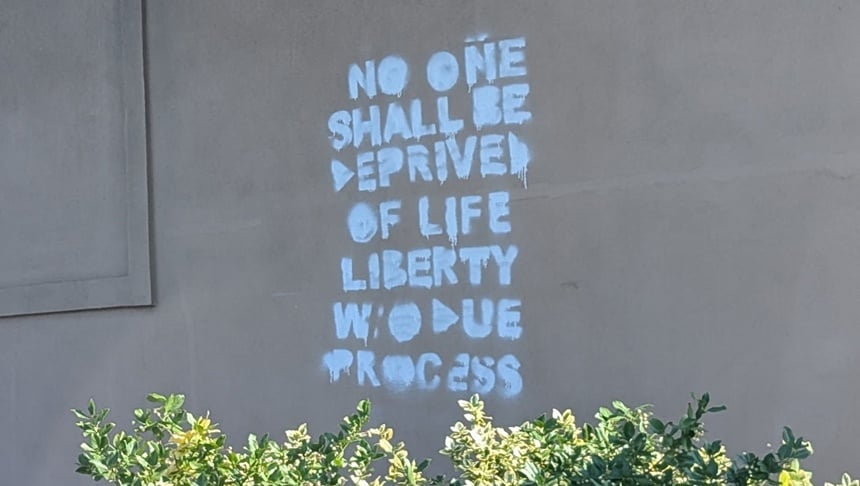
And public and street art has likewise become a consistent space for expressions of protest and resistance, as illustrated by this graffiti quotation from the 14th Amendment found on the wall of an abandoned Dunkin Donuts near my university in Fitchburg, Massachusetts.
Protest graffiti in Fitchburg, Massachusetts (Photo courtesy of Ben Railton)
Those examples comprise two distinct but interconnected categories: protest art — artworks present at or directly representing collective actions; and art as protest — artworks that themselves comprise an expression and form of resistance. Both types are part of a long, rich history, as art has been integral to the foundational American story of protest. Here I’ll highlight just a few examples of each category from across our history. (snip-MORE-click through on the title)
“I like to be rough. I like to be rowdy. I also like to be loving….I like to baby sit.”
—Mary Fields
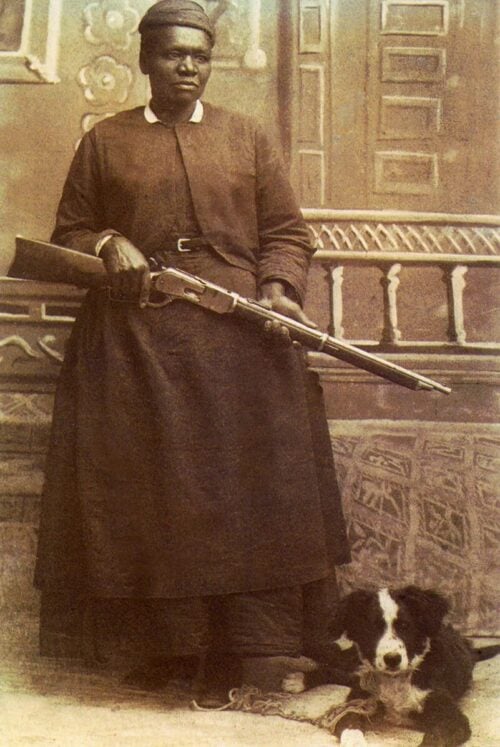
Mary Fields was as beloved as she was feared. Few people dared challenge the six-foot-tall, 200-pound former slave who carried a gun, drank, and had a hot temper. Despite her formidable image, Fields loved children, helped others, and carried the mail through the blizzards of northern Montana.
Born into slavery around 1832 in Hickman County, Tennessee and freed after the Civil War, Fields later found work as a chambermaid on the Mississippi steamboat Robert E. Lee. There she met Judge Edmund Dunne, who hired her as a servant in his household. After his wife’s death, Dunne sent Fields and his five children to live with his sister, Sara, or Mary Amadeus, Mother Superior of the Ursuline convent in Toledo, Ohio around 1874. There the former slave and the nun became fast friends. According to the Toledo Blade, legend has it that when Fields arrived in Toledo, Mother Amadeus asked if she needed anything, to which her friend replied, “Yes, a good cigar and a drink.”
The following year, Mother Amadeus was sent to Montana Territory to establish a school for indigenous girls at St. Peter’s Mission, west of the town of Cascade. When Fields learned that Mother Amadeus was stricken with pneumonia, she moved to Montana and nursed the nun back to health. After that, the 52-year-old Fields volunteered at the convent, hauling stones to build the school, fetching supplies from nearb y towns, washing the convent’s laundry, tending to its many chickens, managing the kitchen, and maintaining the mission’s garden and grounds. (While she lived at the convent, Fields refused to be paid for her work, preferring to come and go as she pleased.) (snip-MORE-click through on the title)
After the story of a cisgender man who was severely beaten over the summer while defending a trans woman went viral, strangers have helped him cover his reconstruction surgery.
33-year-old Jarod Adkison told Austin American-Statesman that he began chatting with three women while visiting Barton Springs Pool near Austin, Texas on July 26. While they were sitting by the pool, Adkison noticed three men who appeared drunk coming up and making fun of one of the women, who is trans.
“It all stemmed from the men seeing the trans lady and making a lewd gesture,” he said. (snip-MORE-click on the title to finish)
Cole Escola has been cast in the third season of Netflix’s live-action adaptation of One Piece as a fan favorite character.
The news of the actor’s casting was announced on Monday. They will be playing Bon Clay, who is described as “a master of performance and precision who is as dangerous as they are dazzling, a theatrical assassin who turns combat into art.” The character in the original manga is described as an okama, a Japanese umbrella term that can refer to gender nonconforming men, trans women, and crossdressers. So basically, Escola is perfect for the role. (snip-MORE-click through on the title)
Food pantries are not expected to be able to meet the needs of the increase in people requiring food in November and December. PLEASE – do whatever you can to help those most vulnerable as we enter the winter months and holiday season. Take a break this year. Scale back and donate instead.
Ali offered two comments to add additional information. I am going to repost this to get that information to more people. Thank you Ali for the volunteering work you have done. Hugs
If you’re giving to humans directly (like a little food pantry or a local drive where people don’t have to sign in to a bank,) as well as to a food bank, canned meats are good with the skillet helpers. It does help to check with your food bank before bringing fresh items in; some don’t have storage available to keep fresh food safe. Which could be a fundraising idea for those inclined to help in such a fashion! 🙂
Also, the top thing that will help a food bank is money. It doesn’t have to be a lot of money, either. The food bank in Wichita charges only .20 per pound to food banks, but a bag of food is going to cost, well, what a bag of food costs. We need our food banks, because it’s another example (like SNAP) that bigger entities can do more. But sometimes people who use or cannot use a food bank need a little in between food bank visits and the little food pantries help there. So many ways to help at little cost and trouble-thanks, Scottie!
That’s probably confusing, about money and the .20 per pound. Frequently, there is a large food bank that collects foods, etc., then distributes it to local food banks. The example above is our local food bank (yeah, I volunteered there for 4 years before going to work as a para). We received food donations, and money, but what really helped our bank (which keeps records on families served, allergies, etc.) was the money, because they could take the truck up to Wichita, and for 10.00, get 50.00 worth of food to bring back for our bank. It’s a simple thing, and I mucked it up with lots of words, as is my wont. 🙂
That said, I bring up other points for getting food to people because in some places, the food bank is only open one or two days per week, for a few hours. Depending upon volunteers, many of whom are retired, those hours are going to be during working hours, so people can’t always get to a food bank. So those little pantries make a big difference, too!

 Photo Illustration by Victoria Sunday/The Daily Beast/Getty Images